

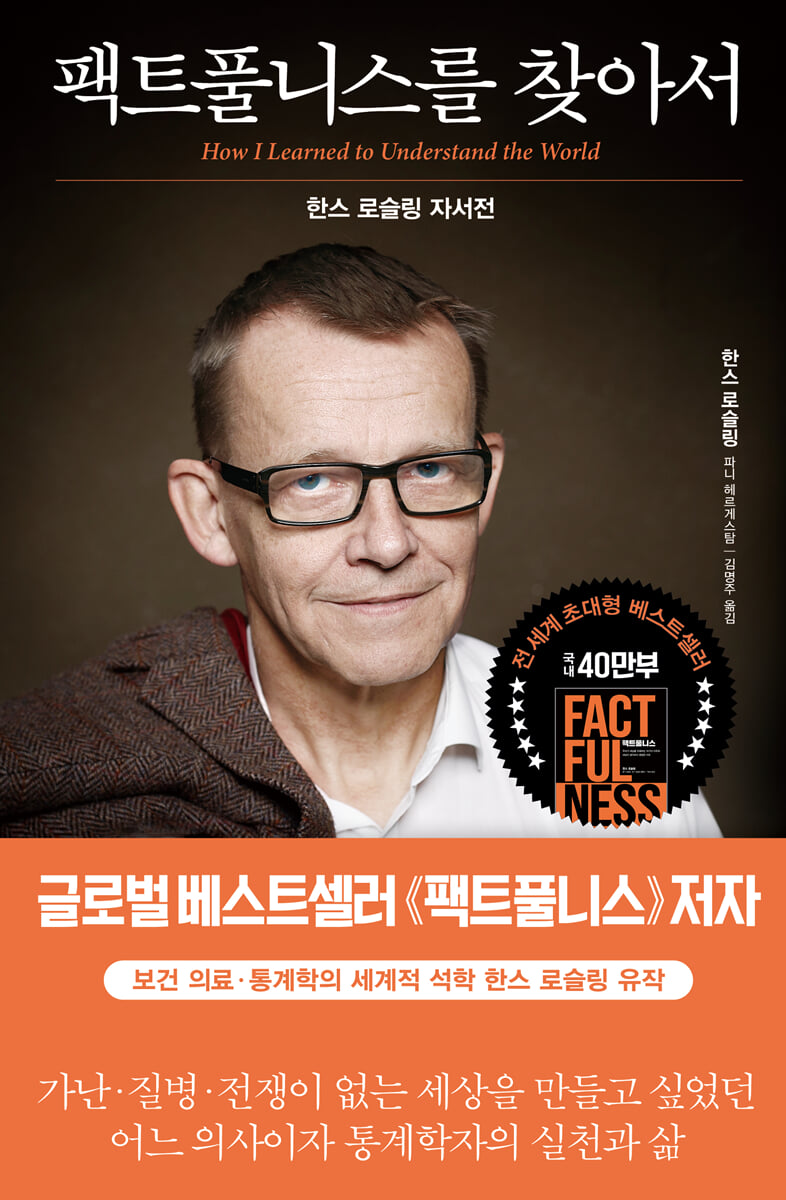
In search of factfulness
 |
Description
Book Introduction
The autobiography of Hans Rosling, author of the global bestseller "Factfulness," which sold 400,000 copies in Korea. The last and only autobiography of Hans Rosling, author of Factfulness. The life of Hans Rosling, a doctor, statistician, and thinker of action and practice who wanted to create a world without poverty, disease, and war, and the birth of the concept of 'factfulness' are woven into a single drama. We can witness the internal and external growth of Hans Rosling, who recognized and preached the need for a clear understanding of the world, as he followed him from an emergency clinic in Mozambique, Africa, through the Congo, Cuba, and Liberia in West Africa, all the way to Davos, Switzerland. Anecdotes that were only briefly mentioned in Factfulness, such as the African endemic disease Conzo incident, are presented in more detail and vividly. |
- You can preview some of the book's contents.
Preview
index
Introduction - Agneta Rosling
Entering
1 From illiteracy to scholarship
2 Discover the world
3 Nacalaro
4 From Medicine to Research
5 From research to lecture
From Classroom 6 to Davos
7 Ebola
Postscript - Fanny Hergestam
Appendix: About Cassava
Detailed image

Into the book
Factfulness is a book about why people have a hard time understanding developments on a global scale, and this book is about how I came to understand them.
In short, this book is a memoir.
Unlike Factfulness, there are hardly any numbers.
Instead, I'd like to tell you about the people I met who opened my eyes and forced me to take a step back and think again.
--- p.10
My family history over the past century has helped me understand the development of the wider world.
In the not-too-distant past when my grandmother lived, there was famine and extreme poverty, and those dire conditions were the main reason many of my ancestors emigrated to Illinois, Minnesota, and Oregon after 1846.
My grandmother Agnes and my mother Britta were able to move from a life of extreme poverty to a fairly satisfactory one thanks to a number of factors that strengthened each other as they got along.
--- p.30
To be honest, many patients were unable to enter any treatment facility, let alone a hospital.
That's understandable, as the treatment facility is quite small, with only about 50 beds, and even those are always full.
Even some of the hospitalized patients had to lie on the floor.
But it wasn't the number of beds that limited our care.
What was truly lacking was us, the medical staff.
--- p.122
The child mortality rate in Nacala turned out to be around 20 percent, not the 10 percent I initially estimated.
We expected that rural areas, where three-quarters of the region's population lives, would have higher child mortality rates.
I had to find a way to prevent more than 3,000 child deaths each year, of which only 52 died in hospitals.
It was deeply unethical to spend more resources on hospitals when the majority of the population did not have access to basic health care.
--- p.141
Over the past few years, I have been appalled by the way the blame for climate change has been systematically shifted to India and China.
The basis was the total emissions of those countries.
Despite the fact that both countries have significantly larger populations than other countries.
I knew early on that was a stupid claim.
It's like arguing that obesity is a bigger problem in China than in the United States because China has a larger total body mass.
Given the huge differences in population size, talking about 'total emissions per country' is meaningless.
According to that logic, Sweden, with a population of 10 million, is ignoring its enormous carbon dioxide emissions per capita because of its small population.
--- p.279
The question I posed in Davos was by no means trivial.
It was a question about the fundamental patterns of change in the world.
What's the most accurate way to describe the proportion of people living in extreme poverty? Is it a sharp increase, a near-constant decline, or a sharp decline? These three perspectives are so fundamentally different that they could be compared to traffic lights.
When is it right to drive on a green, yellow, or red traffic light?
--- p.334
Publisher's Review
Author of "Factfulness," a massive global bestseller that sold 400,000 copies domestically.
Hans Rosling's last and only autobiography published!
“In ‘Factfulness,’ we see clear ‘arguments,’ and in ‘In Search of Factfulness,’ we see clear ‘people.’”
Namgung In, emergency medicine specialist
“Those who dream of world peace will find a valuable step forward in In Search of Factfulness.”
Kim Young-mi, international conflict specialist PD
Before the publication of Factfulness, we didn't have a word for it: factfulness.
In an age of confirmation bias and post-truth, the autobiography of Hans Rosling, the author of this book that shattered our preconceptions and captivated intellectuals and the public around the world, has been published, titled "How I Learned to Understand the World."
A college student who traveled through Europe and India became an emergency room doctor in Mozambique, Africa, an infectious disease investigator in Congo and Cuba, and a speaker at the World Economic Forum in Davos, Switzerland.
This drama depicts the life of Hans Rosling, who overcame two bouts with cancer and the loss of his family, and grew up alongside the world while actively working in the medical field, research, education, and policy fields.
Hans Rosling's life was always dangerous.
It is telling that he, who struggled amidst local, national, and global crises, insisted throughout his life that “the world is slowly but surely getting better.”
Readers who dream different dreams will find optimism and hope for the world in this book, while readers who dream the same dreams will find inspiration.
Hans Rosling died in 2017 after battling cancer while working on this book.
The story he left unfinished was completed by Swedish journalist Fanny Hergestam.
The grim truth found in the world's darkest and most isolated places.
Only fact-based understanding can change the world!
In 1979, young doctor Hans Rosling headed to an emergency clinic in Mozambique, one of Africa's poorest countries, just emerging from long-time Portuguese colonial rule.
In a society where infrastructure and resources were lacking, the reality that Hans Rosling faced was a life-or-death crossroads that was decided in an utterly futile manner.
He introduces an anecdote about a mother who gave birth.
The rule I made was, 'The sun should never rise twice over a mother giving birth.'
It was clear that the baby had to be killed to save the mother.
I didn't have the proper tools, so I went in with scissors.
(Omitted) The mother received meticulous care and recovered safely.
It was a very difficult task, both technically and mentally, to have to kill a live, full-term fetus to save the mother.
Was my decision the right one? (From the text)
There was another anecdote that determined Hans Rosling's firm world view.
When a child came to the clinic with severe dehydration, Hans Rosling prescribed oral rehydration.
Normally, the injection would be done directly into the bloodstream, but this is a second-best option to save time and resources.
I had to argue with my fellow doctors all night because of this, but one thing remained certain.
He realized that with limited medical resources, there were things that had to be sacrificed to save more people.
I was responsible not only for the children I cared for, but also for the children I could not see die from illness.
Given our limited resources, I had to accept the low standard of care we provided in the hospital.
(From the text)
Hans Rosling believed that the way to save more lives was through a clear and quantitative understanding of the given situation, a 'fact-based understanding'.
While continuing his medical work in Mozambique, Hans Rosling envisioned a more radical approach.
By compiling statistics on the medical situation in the area, we discovered that the high mortality rate was due to the lack of treatment for basic diseases.
People would wait until their illness became severe before rushing to emergency rooms in critical condition.
Hans Rosling worked with the Mozambican government to improve the community's health system by providing vaccinations and basic medical care.
From medicine to research,
Clarifying the pandemic through accurate investigation and analysis.
The study of an African endemic disease called 'konzo' is a key point in Hans Rosling's journey.
Conzo is common in areas with severe malnutrition, and paralysis of the lower extremities is the main symptom.
Hans Rosling, who was summoned to respond to the Konjo pandemic that was raging in Nampula, Mozambique, began to systematically compile statistics.
It was a moment when the power of ‘fact-based understanding’ was demonstrated.
With the help of Mozambican health authorities and local residents, we investigated and analyzed all cases of conzo and paralysis.
Under the direction of Hans Rosling, 500,000 people were screened in just six weeks, and a total of 1,102 cases of paralysis were found.
There were two clear patterns here.
The Conjo was only active during the dry season when food was scarce.
Also, it occurred only in inland agricultural areas where the root vegetable cassava was the staple food.
At this time, Hans Rosling was convinced that Conzo was not an infectious disease.
This is because the area where it occurred coincided with a drought area.
Cassava contains an enzyme that produces cyanide in the body when consumed.
Because of this, cassava needs to be processed over a long period of time to be safe to consume, but in areas suffering from food shortages due to drought, cassava had no choice but to be processed over a short period of time or consumed unprocessed.
This was the true nature of Conzo's disease.
Because so many people suffered from it at the same time, it was naturally considered an epidemic.
This discovery marked the moment when Hans Rosling's stage shifted from medicine to research.
Towards progress in the world beyond ignorance and prejudice
Hans Rosling's endless challenge and dedication to 'facts'
“It was shocking to me that even the world’s most influential people didn’t know exactly how the world worked.”
- Hans Rosling
After completing his research on infectious diseases in Cuba and Central and South America, following his work on Conzo in Africa, Hans Rosling returned to Sweden to teach, where he lectured to trainee doctors and nurses about the health systems of developing countries.
It was a lecture for juniors who, like him, had to struggle with limited resources.
Hans Rosling provided his students with accurate figures and charts of the rest of the world, excluding the West.
It was at this time that he came up with the idea of the 'water drop diagram'.
It was a three-dimensional chart that drew water droplets representing each country on the graph, and expressed things like population, income, and life expectancy by the size and location of the water droplets.
With the help of his son Ola Rosling and his daughter-in-law Anna Rönnlund Rosling, he developed the droplet diagram into a computer program.
Gapminder, the non-profit foundation they co-founded, successfully demonstrated the water drop diagram, ultimately securing investment from Google.
The droplet diagram opened up new opportunities for Hans Rosling.
The video, which was released on YouTube and TED, attracted the attention of experts and leaders around the world.
In particular, the interest and support of the Bill Gates Foundation played a major role in making Hans Rosling more widely known around the world.
In 2015, Hans Rosling finally appeared on the stage of the World Economic Forum in Davos.
It was after a busy year of stabilizing the Ebola outbreak in West Africa in 2014.
Following Bill Gates and Melinda Gates, Hans Rosling took the podium to speak on the topics of 'sustainable development' and 'knowing the truth about the world.'
The lecture immediately captured the attention of the gathered politicians, journalists, businesspeople, and international organization activists.
It was then that Hans Rosling realized that even in Davos, where major leaders gathered, there was a lot of ignorance and prejudice about the world.
The public and experts of the 'old West' may have been paralyzed by the challenge of realistically understanding the 'rest of the world'.
The new thing we had to do was to capture people's attention and make them understand what makes ignorance so persistent.
After a while, Anna came up with the concept of 'factfulness'.
We decided on that as the title of the book and immediately began to develop our ideas. (From the text)
GOODS SPECIFICS
- Publication date: December 8, 2021
- Page count, weight, size: 360 pages | 530g | 141*215mm
- ISBN13: 9788934949107
- ISBN10: 8934949104
You may also like
카테고리
korean


korean


