

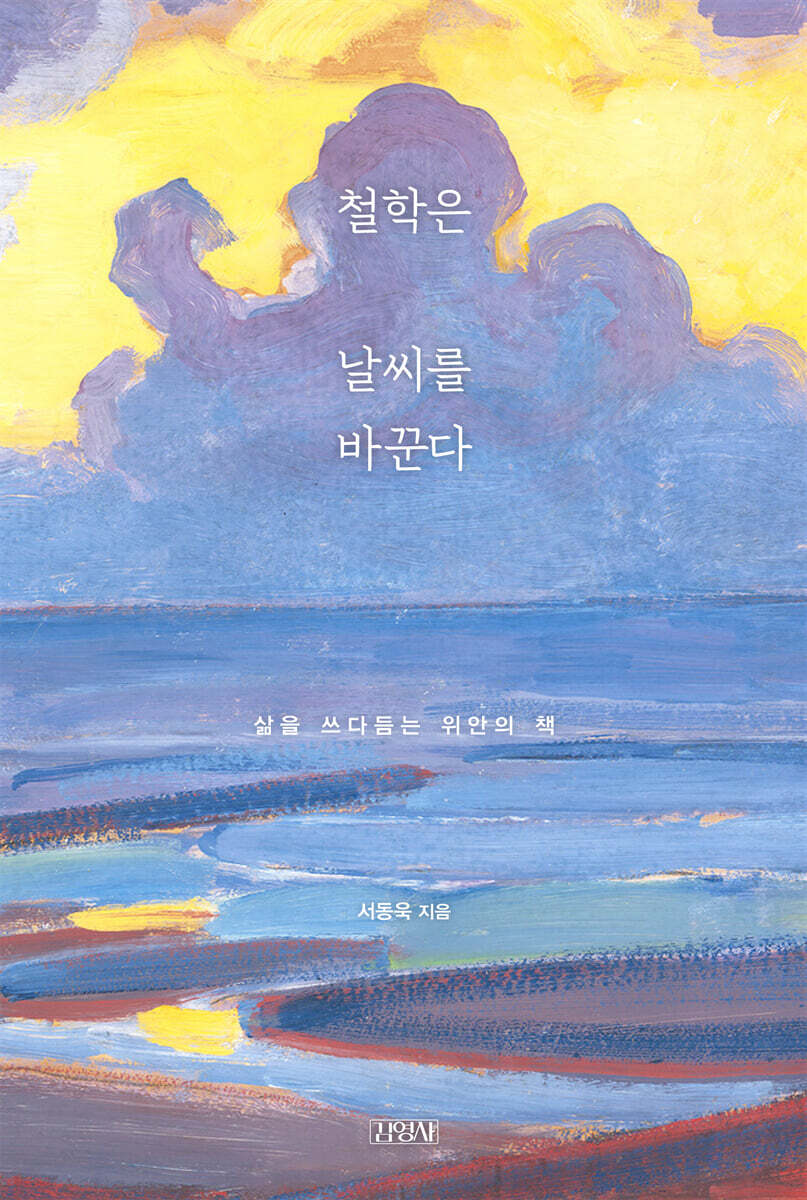
Philosophy changes the weather
 |
Description
Book Introduction
“Can you create a drought from a downpour?”
A story about the power to change today's mood and tomorrow's world.
Seven years after 『Thoughts on Life』, a new essay by philosopher Professor Seo Dong-wook!
The popularity of the cynical thinker Schopenhauer shows no sign of waning.
It may be because his candid gaze toward life gave him the 'strength to live by letting go of desires.'
But is it okay to leave the space where desire has disappeared empty?
Can we really stop thinking about a better life just because we don't have the time or the means?
An essay published after seven years by Professor Dong-wook Seo of the Department of Philosophy at Sogang University, who is Korea's leading researcher of Deleuze's thought and has been active as a poet and critic.
In a world that becomes more isolated the more we connect, and in a daily life that becomes more exhausting the more we endure, the consolation of philosophy helps us find “where in life the sunshine shines and where the welcome summer rain falls.”
We will experience the power of thought, which can soothe a person's heart and become the starting point of all change, the gift of weather.
A story about the power to change today's mood and tomorrow's world.
Seven years after 『Thoughts on Life』, a new essay by philosopher Professor Seo Dong-wook!
The popularity of the cynical thinker Schopenhauer shows no sign of waning.
It may be because his candid gaze toward life gave him the 'strength to live by letting go of desires.'
But is it okay to leave the space where desire has disappeared empty?
Can we really stop thinking about a better life just because we don't have the time or the means?
An essay published after seven years by Professor Dong-wook Seo of the Department of Philosophy at Sogang University, who is Korea's leading researcher of Deleuze's thought and has been active as a poet and critic.
In a world that becomes more isolated the more we connect, and in a daily life that becomes more exhausting the more we endure, the consolation of philosophy helps us find “where in life the sunshine shines and where the welcome summer rain falls.”
We will experience the power of thought, which can soothe a person's heart and become the starting point of all change, the gift of weather.
- You can preview some of the book's contents.
Preview
index
Prologue: The Weather Forecast That Gives You the Gift of Weather
Part 1: Can We Maturate?
The Answer to Life, the Universe, and Everything│The Art and Philosophy of Parasites│Repetition, the Secret of Life, History, and Art│Self-Deception, the Disease of the Soul│The Essence of the West, Melancholy, and Travel: Sea Story 1│The Philosophy of Water and the Sea: Sea Story 2│Aeneas, the Founding of Rome by Boat People: Sea Story 3│Relationships Between Men and Women Require Lifelong Learning│What Are Animals to Us│Toward a Society Without Sacrificial Lambs
Part 2: To Endure the World
The Land of Boys│Fools and Geniuses│Werewolves│Artificial Intelligence and Artificial Conscience│The Ability to Create Problems│Philosophy and Mass Media│Philosophers and Enlightened Monarchs│The Politics of Journey to the West and Escape from the Planet of the Apes│Modernity and the Birth of the Human Subject│After Modernity, Hybrid Life or AI
Part 3: Words of Comfort
A Walk│Centicism│Humor│Words of Love│Train Stories│Fidget Spinners and the Overtired Man│Eating Alone│The Philosophy of Wind and Lungs│The Poetry of Dream of the Red Chamber│Differences Protect Us
Part 4: Art, Time, and Its Shadows
The Right to Slow Down│A Story of Reincarnation│The Philosophy of Waste│Design, Ornament as Art│The Rigid World and the Freedom Art Taught Us│A Shining Moment in Life│A Philosophy for the Aging Human│Retromania or Collector│How to View Death│Festival
Epilogue: Caressing Hands
main
Part 1: Can We Maturate?
The Answer to Life, the Universe, and Everything│The Art and Philosophy of Parasites│Repetition, the Secret of Life, History, and Art│Self-Deception, the Disease of the Soul│The Essence of the West, Melancholy, and Travel: Sea Story 1│The Philosophy of Water and the Sea: Sea Story 2│Aeneas, the Founding of Rome by Boat People: Sea Story 3│Relationships Between Men and Women Require Lifelong Learning│What Are Animals to Us│Toward a Society Without Sacrificial Lambs
Part 2: To Endure the World
The Land of Boys│Fools and Geniuses│Werewolves│Artificial Intelligence and Artificial Conscience│The Ability to Create Problems│Philosophy and Mass Media│Philosophers and Enlightened Monarchs│The Politics of Journey to the West and Escape from the Planet of the Apes│Modernity and the Birth of the Human Subject│After Modernity, Hybrid Life or AI
Part 3: Words of Comfort
A Walk│Centicism│Humor│Words of Love│Train Stories│Fidget Spinners and the Overtired Man│Eating Alone│The Philosophy of Wind and Lungs│The Poetry of Dream of the Red Chamber│Differences Protect Us
Part 4: Art, Time, and Its Shadows
The Right to Slow Down│A Story of Reincarnation│The Philosophy of Waste│Design, Ornament as Art│The Rigid World and the Freedom Art Taught Us│A Shining Moment in Life│A Philosophy for the Aging Human│Retromania or Collector│How to View Death│Festival
Epilogue: Caressing Hands
main
Detailed image
.jpg)
Into the book
The important thing is to ask the question from the opposite direction.
Rather than weather creating ideas, isn't there an idea that creates weather? Does philosophy preserve the dream of the "rainmaker" that ancient peoples harbored long ago? Philosophy has long hovered around the edges of weather, yearning to touch it.
(…) Nietzsche also wants to change the weather in Thus Spoke Zarathustra.
From 'floating clouds' to 'clear skies', that is, freedom from the principles that oppress humans hidden behind the clouds.
I spread freedom and the clarity of the sky over everything like a blue bell, says Zarathustra.
The weather can be changed.
--- p.7
Do the answers others have found truly fit your own needs? They might be helpful for a while, but they will never be the answer for you.
Why? Because answers are inextricably linked to the questions that lead to them, and therefore, there's no way to simply pluck the answer from the ground up, like picking a fully bloomed flower.
The answer is a result that inevitably follows from the problem.
The problem to be solved determines the scope and nature of the solution.
And the problems that need to be solved arise only from each person's life, like each person's own illness.
--- p.22
AI creates works of literature and art.
This means that it can move, captivate and 'seduce' humans.
The key is not whether the work is of high quality or original, but whether it can seduce.
Will seduction remain confined to the realm of art? Once you master the art of seduction, its applications expand infinitely. The fact that AI is a problem of seduction is evident in the fact that AI can express its own opinions on even cocktails and cooking recipes.
It doesn't matter whether you can provide the best recipe or not.
We can never answer what the ultimate standard is.
The key is that AI will tempt humans by offering something, and eventually they will adapt.
--- p.168
There is an important truth about life in walking.
Walking combines monotony and novelty.
In other words, it is a combination of repetition and the newness gained through repetition.
We always take the same path, but it's always a new day.
My dog, my precious companion on walks, knows much better than I do that this is the very structure of daily life, that repetition is the condition of novelty.
Every walk feels like his first in the world, and Gureumi walks with such excitement.
If repetition, like walking, were not new, routine would be nothing more than punishment.
--- p.180
Growing older means having the opportunity to show greater interest in our friends, in the youth, in our students, in those who are simply testing their present as a possibility.
Now is the time to look after the potential of others, not just your own.
In a sense, isn't this the way to reclaim time? (...) Humans don't die alone, clutching their own time like the last coin, like a miser.
Time is infinite for humans because they care for the future of others as if it were their own.
From neighbor to neighbor, from generation to generation, the future advances, forming an immortal chain.
Rather than weather creating ideas, isn't there an idea that creates weather? Does philosophy preserve the dream of the "rainmaker" that ancient peoples harbored long ago? Philosophy has long hovered around the edges of weather, yearning to touch it.
(…) Nietzsche also wants to change the weather in Thus Spoke Zarathustra.
From 'floating clouds' to 'clear skies', that is, freedom from the principles that oppress humans hidden behind the clouds.
I spread freedom and the clarity of the sky over everything like a blue bell, says Zarathustra.
The weather can be changed.
--- p.7
Do the answers others have found truly fit your own needs? They might be helpful for a while, but they will never be the answer for you.
Why? Because answers are inextricably linked to the questions that lead to them, and therefore, there's no way to simply pluck the answer from the ground up, like picking a fully bloomed flower.
The answer is a result that inevitably follows from the problem.
The problem to be solved determines the scope and nature of the solution.
And the problems that need to be solved arise only from each person's life, like each person's own illness.
--- p.22
AI creates works of literature and art.
This means that it can move, captivate and 'seduce' humans.
The key is not whether the work is of high quality or original, but whether it can seduce.
Will seduction remain confined to the realm of art? Once you master the art of seduction, its applications expand infinitely. The fact that AI is a problem of seduction is evident in the fact that AI can express its own opinions on even cocktails and cooking recipes.
It doesn't matter whether you can provide the best recipe or not.
We can never answer what the ultimate standard is.
The key is that AI will tempt humans by offering something, and eventually they will adapt.
--- p.168
There is an important truth about life in walking.
Walking combines monotony and novelty.
In other words, it is a combination of repetition and the newness gained through repetition.
We always take the same path, but it's always a new day.
My dog, my precious companion on walks, knows much better than I do that this is the very structure of daily life, that repetition is the condition of novelty.
Every walk feels like his first in the world, and Gureumi walks with such excitement.
If repetition, like walking, were not new, routine would be nothing more than punishment.
--- p.180
Growing older means having the opportunity to show greater interest in our friends, in the youth, in our students, in those who are simply testing their present as a possibility.
Now is the time to look after the potential of others, not just your own.
In a sense, isn't this the way to reclaim time? (...) Humans don't die alone, clutching their own time like the last coin, like a miser.
Time is infinite for humans because they care for the future of others as if it were their own.
From neighbor to neighbor, from generation to generation, the future advances, forming an immortal chain.
--- p.298
Publisher's Review
For modern people who go back and forth between overload and lethargy
The comfort of philosophy that helps you find the weather of your heart
“Can you create drought from rain?” The idea of creating weather first appeared in the history of philosophy with this absurd question posed by the philosopher Heraclitus.
Philosopher Seo Dong-wook, who faces the helpless portrait of modern people who live each day as if they are exhausted, who are impatient to get the answer faster than others, and who let go of precious things one by one to reach growth measured in numbers, brings up this age-old question again.
Professor Seo Dong-wook of the Department of Philosophy at Sogang University, who is Korea's leading researcher on Gilles Deleuze's thought and also works as a poet and critic, has delved deeply into the issue of the 'other'. In this book, he writes about 'thoughts that find the weather.'
Forty essays, richly intersecting various fields from philosophy, literature, and art to film, comics, and games, illuminate the hidden sides of familiar words and awaken the hazy everyday life.
In his writing, familiar concepts become unfamiliar.
Finding heaviness in the familiar and lightness in the heavy, each essay offers insights into what it takes for humans to grow and mature, how to face mortality amidst repetition, the solace hidden like jewels in the ordinary, and why we find solace in art.
As you follow the reasoning that demonstrates the power of the saying, “All change begins with thoughts,” you will soon notice that the weather in your head has changed.
The power of 'difference' that turns life into art
The power of 'others' that leads to solid growth
Professor Seo Dong-wook has deeply explored the concept of the other, which supports human life and community, not only through philosophy but also through poetry and criticism.
One of the keywords that runs through this book is ‘difference.’
This word, also referred to as heterogeneity and otherness, cuts across several texts on different topics.
Differences have long influenced human survival.
It is also a breakthrough for the problems facing the entire planet today, such as pandemics, the climate crisis, and far-right politics that exclude others.
According to this book, 'difference' protects life.
Because through our differences, we can respect each other without any standards.
Moreover, differences are the source of creative thinking.
Just like the history of Baroque culture, which absorbed numerous artifacts from ancient Greece, Rome, and the East and differentiated them into various creations.
This is why this book, while discussing all the crises of modern society, persistently examines our attitudes toward difference, that is, the other and heterogeneity.
For example, we as hosts are uncomfortable with 'parasites', but this book notes that parasites shake up the host's identity and take it to a new level.
Three essays on the "sea," spanning from the founding myth of Rome to its colonial history, converge on a new path opened by the other, resonating with today's reality, where the sea has become a place of hostility rather than connection.
In the stories of philosophers who thought about 'animals', such as Pythagorean dogs, Nietzsche's horses, and Derrida's cats, the scope of these others is not limited to humans.
An era where other people's answers are useless
How to ask my question
This book also emphasizes the power of 'questions' as a way to change the weather of the mind and the world.
In The Hitchhiker's Guide to the Galaxy, a computer, after 7.5 million years of calculations, comes up with "the answer to life, the universe, and everything," but no one understands it.
I couldn't understand the answer because I didn't ask the right question.
“An answer is inextricably linked to the question that led to the answer, and there is no way to pluck the answer alone, like picking a flower in full bloom.” Good thoughts will also come from good questions.
Rather than focusing on either admiration or fear of artificial intelligence, I believe the core issue is whether artificial intelligence can become a being capable of making value judgments and how humans will adapt.
This might be an idea that comes up because the question focused on ‘intelligence’ rather than the word ‘artificial’ that everyone is paying attention to.
In this book, 'fool' and 'genius' are also grouped together as similar words.
From the perspective of 'how to create', both show a commonality of overturning the rules.
The enthusiasm for Schopenhauer may be due to the recognition of the futility of life in the harsh daily life, but this is literally only a preventative measure.
It doesn't tell us how to become better people or live better lives.
So, why not use this book as a compass to ask unfamiliar questions?
Until the thoughts we create change the weather in our hearts, and we can give the weather to each other.
The comfort of philosophy that helps you find the weather of your heart
“Can you create drought from rain?” The idea of creating weather first appeared in the history of philosophy with this absurd question posed by the philosopher Heraclitus.
Philosopher Seo Dong-wook, who faces the helpless portrait of modern people who live each day as if they are exhausted, who are impatient to get the answer faster than others, and who let go of precious things one by one to reach growth measured in numbers, brings up this age-old question again.
Professor Seo Dong-wook of the Department of Philosophy at Sogang University, who is Korea's leading researcher on Gilles Deleuze's thought and also works as a poet and critic, has delved deeply into the issue of the 'other'. In this book, he writes about 'thoughts that find the weather.'
Forty essays, richly intersecting various fields from philosophy, literature, and art to film, comics, and games, illuminate the hidden sides of familiar words and awaken the hazy everyday life.
In his writing, familiar concepts become unfamiliar.
Finding heaviness in the familiar and lightness in the heavy, each essay offers insights into what it takes for humans to grow and mature, how to face mortality amidst repetition, the solace hidden like jewels in the ordinary, and why we find solace in art.
As you follow the reasoning that demonstrates the power of the saying, “All change begins with thoughts,” you will soon notice that the weather in your head has changed.
The power of 'difference' that turns life into art
The power of 'others' that leads to solid growth
Professor Seo Dong-wook has deeply explored the concept of the other, which supports human life and community, not only through philosophy but also through poetry and criticism.
One of the keywords that runs through this book is ‘difference.’
This word, also referred to as heterogeneity and otherness, cuts across several texts on different topics.
Differences have long influenced human survival.
It is also a breakthrough for the problems facing the entire planet today, such as pandemics, the climate crisis, and far-right politics that exclude others.
According to this book, 'difference' protects life.
Because through our differences, we can respect each other without any standards.
Moreover, differences are the source of creative thinking.
Just like the history of Baroque culture, which absorbed numerous artifacts from ancient Greece, Rome, and the East and differentiated them into various creations.
This is why this book, while discussing all the crises of modern society, persistently examines our attitudes toward difference, that is, the other and heterogeneity.
For example, we as hosts are uncomfortable with 'parasites', but this book notes that parasites shake up the host's identity and take it to a new level.
Three essays on the "sea," spanning from the founding myth of Rome to its colonial history, converge on a new path opened by the other, resonating with today's reality, where the sea has become a place of hostility rather than connection.
In the stories of philosophers who thought about 'animals', such as Pythagorean dogs, Nietzsche's horses, and Derrida's cats, the scope of these others is not limited to humans.
An era where other people's answers are useless
How to ask my question
This book also emphasizes the power of 'questions' as a way to change the weather of the mind and the world.
In The Hitchhiker's Guide to the Galaxy, a computer, after 7.5 million years of calculations, comes up with "the answer to life, the universe, and everything," but no one understands it.
I couldn't understand the answer because I didn't ask the right question.
“An answer is inextricably linked to the question that led to the answer, and there is no way to pluck the answer alone, like picking a flower in full bloom.” Good thoughts will also come from good questions.
Rather than focusing on either admiration or fear of artificial intelligence, I believe the core issue is whether artificial intelligence can become a being capable of making value judgments and how humans will adapt.
This might be an idea that comes up because the question focused on ‘intelligence’ rather than the word ‘artificial’ that everyone is paying attention to.
In this book, 'fool' and 'genius' are also grouped together as similar words.
From the perspective of 'how to create', both show a commonality of overturning the rules.
The enthusiasm for Schopenhauer may be due to the recognition of the futility of life in the harsh daily life, but this is literally only a preventative measure.
It doesn't tell us how to become better people or live better lives.
So, why not use this book as a compass to ask unfamiliar questions?
Until the thoughts we create change the weather in our hearts, and we can give the weather to each other.
GOODS SPECIFICS
- Date of issue: January 12, 2024
- Page count, weight, size: 344 pages | 446g | 145*215*35mm
- ISBN13: 9788934971351
You may also like
카테고리
korean


korean

![ELLE 엘르 스페셜 에디션 A형 : 12월 [2025]](http://librairie.coreenne.fr/cdn/shop/files/b8e27a3de6c9538896439686c6b0e8fb.jpg?v=1766436872&width=3840)


