

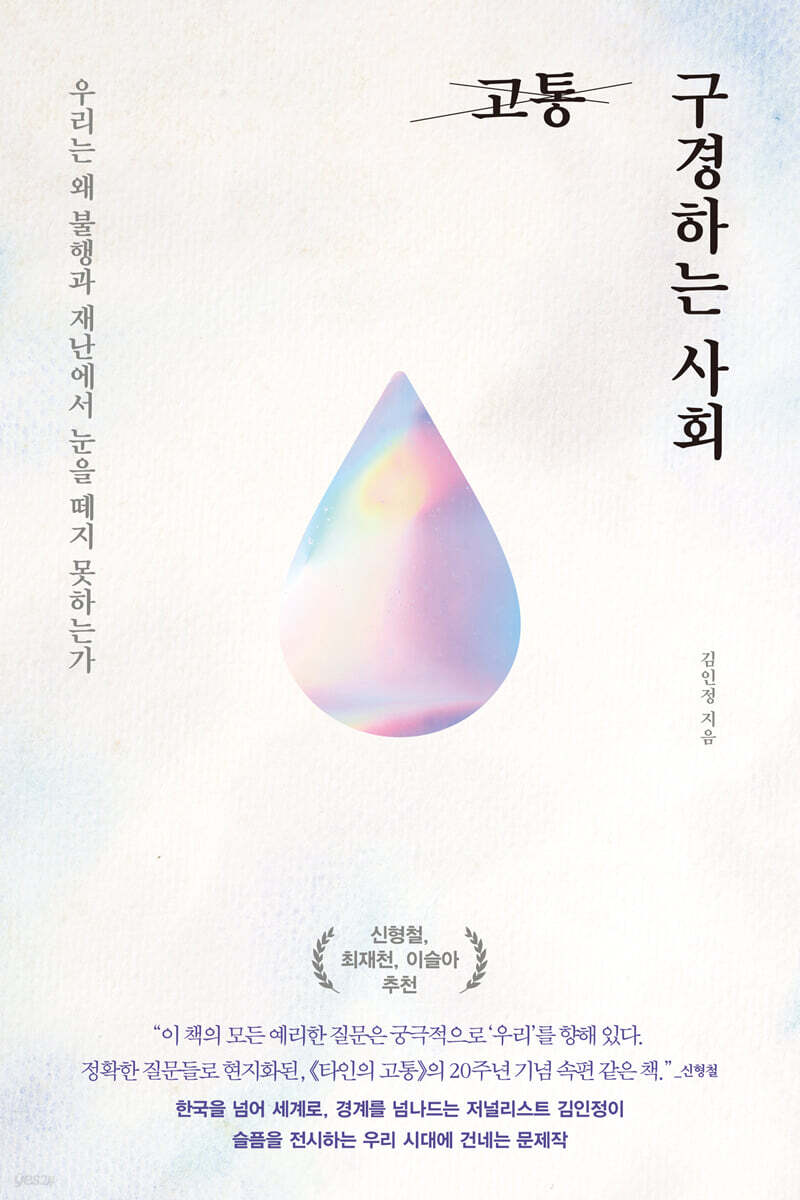
A society that watches suffering
 |
Description
Book Introduction
*** Iokto Recover Edition ***
*** Highly recommended by Shin Hyeong-cheol, Choi Jae-cheon, Lee Seul-ah, Kim Ji-soo, Song Gil-young, and Kim Shin-sik ***
“We must know ‘Kim In-jeong’, of course.
“You must read this book as earnestly as possible.”
Shin Hyeong-cheol (literary critic, professor at Seoul National University)
20 years after Susan Sontag,
A journalist who deals with the 'pain of this age',
Kim In-jeong's poignant question to the world
How Our Gaze Becomes a Force for Change
Journalist Kim In-jeong, who deals with the "pain of this era," has written a book titled "A Society that Witnesses Suffering," which chronicles the realities she faced in the midst of events for a long time. The book has been republished as a cover edition.
This Recover Edition, which includes the work of photographer Lee Ok-to, who “continuously questions people, relationships, and traces of existence through her photographic work,” asks again how we can gaze upon the “suffering of others” in a society that still exhibits sadness two years later.
In an age where news and social media combine to broadcast live what's happening around the world, journalist Kim In-jeong, who connects the world, brings back the topic of "others' suffering" as a contemporary topic 20 years after Susan Sontag.
Now, the suffering of others has gone beyond mere pity and objectification to become "high-stimulus content" competing for more subscriptions, likes, and notifications.
In a society that witnesses too many deaths and is a witness to suffering, guilt and helplessness are inevitable.
When a smartphone captures a victim receiving CPR, when CCTV footage shows a criminal wielding a weapon and threatening people, when a drone camera reveals a city bus locked in an underpass.
What is the purpose of these scenes? It seems that witnessing suffering only exacerbates social anxiety and fear, traumatizing the entire nation.
But this doesn't mean we should turn away from looking at suffering.
Rather than warning us against witnessing suffering, "The Society That Witnesses Suffering" offers a message of encouragement, reminding us that there is much we can do after witnessing it.
The author explores how suffering can become the starting point of change, traveling through domestic disaster sites, the heart of Hong Kong protests, Gwangju Peace Plaza, and California's drug-stricken streets.
And ultimately, it proposes a solution called 'public mourning' that creates change by writing the backstory together.
How does our 'gaze' become a driving force for change?
With this book, we can embrace the limitations of compassion, empathy, and objectification and gradually explore the path we must take.
*** Highly recommended by Shin Hyeong-cheol, Choi Jae-cheon, Lee Seul-ah, Kim Ji-soo, Song Gil-young, and Kim Shin-sik ***
“We must know ‘Kim In-jeong’, of course.
“You must read this book as earnestly as possible.”
Shin Hyeong-cheol (literary critic, professor at Seoul National University)
20 years after Susan Sontag,
A journalist who deals with the 'pain of this age',
Kim In-jeong's poignant question to the world
How Our Gaze Becomes a Force for Change
Journalist Kim In-jeong, who deals with the "pain of this era," has written a book titled "A Society that Witnesses Suffering," which chronicles the realities she faced in the midst of events for a long time. The book has been republished as a cover edition.
This Recover Edition, which includes the work of photographer Lee Ok-to, who “continuously questions people, relationships, and traces of existence through her photographic work,” asks again how we can gaze upon the “suffering of others” in a society that still exhibits sadness two years later.
In an age where news and social media combine to broadcast live what's happening around the world, journalist Kim In-jeong, who connects the world, brings back the topic of "others' suffering" as a contemporary topic 20 years after Susan Sontag.
Now, the suffering of others has gone beyond mere pity and objectification to become "high-stimulus content" competing for more subscriptions, likes, and notifications.
In a society that witnesses too many deaths and is a witness to suffering, guilt and helplessness are inevitable.
When a smartphone captures a victim receiving CPR, when CCTV footage shows a criminal wielding a weapon and threatening people, when a drone camera reveals a city bus locked in an underpass.
What is the purpose of these scenes? It seems that witnessing suffering only exacerbates social anxiety and fear, traumatizing the entire nation.
But this doesn't mean we should turn away from looking at suffering.
Rather than warning us against witnessing suffering, "The Society That Witnesses Suffering" offers a message of encouragement, reminding us that there is much we can do after witnessing it.
The author explores how suffering can become the starting point of change, traveling through domestic disaster sites, the heart of Hong Kong protests, Gwangju Peace Plaza, and California's drug-stricken streets.
And ultimately, it proposes a solution called 'public mourning' that creates change by writing the backstory together.
How does our 'gaze' become a driving force for change?
With this book, we can embrace the limitations of compassion, empathy, and objectification and gradually explore the path we must take.
- You can preview some of the book's contents.
Preview
index
Recommendation
Entering: Showing Pain
Chapter 1.
A new and special pain is here
Likes, Retweets, and More
Subscribe, like, and set notifications
What starts after the news ends
Chapter 2.
The illusion of empathy for others' suffering
The lie that the weather is fair to everyone
How Disaster Became Culture
When pain becomes hate
Beyond Poverty Porn: Society's Responsibility for Individual Suffering
Some stories don't have names
Chapter 3.
The pain of those who don't look like me
If we can get out of the algorithm
Trigger Warning: Something that catches or diverts attention
When localization of pain is needed
Why so many accidents occur in this area
Manufactured wars, gender conflicts
Chapter 4.
To write the back story of the world
Many things just end up as news.
Even if compassion doesn't change the world
A universal language that transcends language, class, and race
Public mourning for private mourning
Going Out: Text That Moves Forever
Books referenced
main
Entering: Showing Pain
Chapter 1.
A new and special pain is here
Likes, Retweets, and More
Subscribe, like, and set notifications
What starts after the news ends
Chapter 2.
The illusion of empathy for others' suffering
The lie that the weather is fair to everyone
How Disaster Became Culture
When pain becomes hate
Beyond Poverty Porn: Society's Responsibility for Individual Suffering
Some stories don't have names
Chapter 3.
The pain of those who don't look like me
If we can get out of the algorithm
Trigger Warning: Something that catches or diverts attention
When localization of pain is needed
Why so many accidents occur in this area
Manufactured wars, gender conflicts
Chapter 4.
To write the back story of the world
Many things just end up as news.
Even if compassion doesn't change the world
A universal language that transcends language, class, and race
Public mourning for private mourning
Going Out: Text That Moves Forever
Books referenced
main
Detailed image
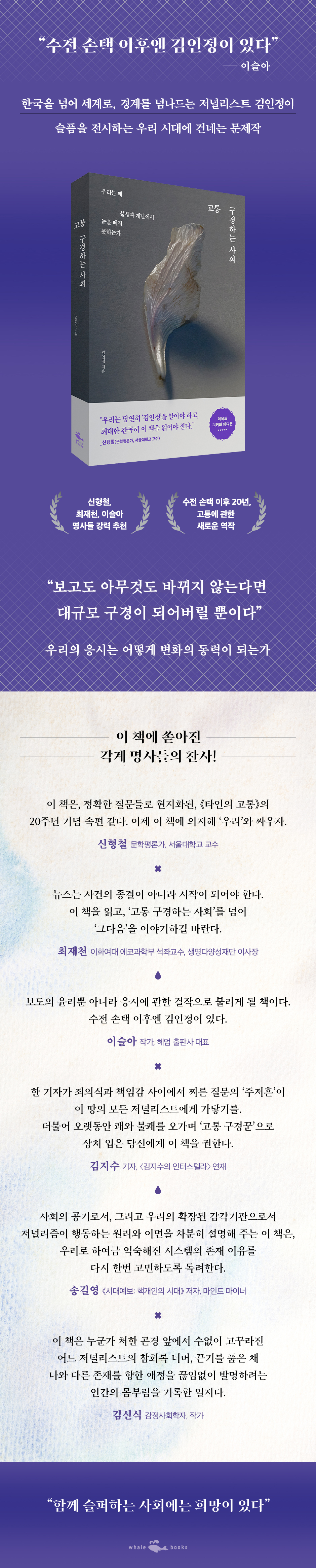
Into the book
There were those who, while offering breathless remembrances and a set period of mourning, raised their voices in a rather solemn manner, saying, "Do not use sorrow for politics."
But it is strange to force oneself to remain in sorrow after seeing the suffering of others.
There's a lot to do to avoid being a passive observer.
After seeing it, all that remains is for us to look into each other's eyes and think together about how and where we should go.
Perhaps such declarations have the grave side effect of blocking the very moment when politics can be mobilized to hold those responsible for the disaster accountable. There are many reasons why a single pain deserves to be made public, and grief is only one of many reasons, not the only one.
We see suffering not only to empathize with the pain of others, but also to temporarily activate a loose community through solidarity, thereby preventing similar pain.
--- p.34, from “Likes, Retweets, and More”
There is something at first glance refreshing about pointing fingers and swearing at someone who is believed to have committed an atrocious act.
In cases where there is a significant discrepancy between the actual sentencing and the public's perception of the law, tarnishing the criminal's reputation and honor may feel like the only realistic solution.
But of course, the finger pointing at the individual must change direction.
It should be pointed out not only to the social structure that facilitates crimes, but also to the judicial system that makes people think that it is not enough to not reveal their faces.
The bigger problem is not the public's distrust, but the judiciary, which often imposes light punishments that do not match the gravity of the crime.
--- p.69, from “What Begins After the News Ends”
The problem is the commonness of the suffering that is industrial accidents.
Common pain becomes a culture, not a problem, and naturally takes its place in society.
Statistics are cited in this article and that article, sometimes to show how many industrial accidents occur, but sometimes the real story is sucked into the neatly organized numbers and hidden.
The more common industrial accidents become, the more surprising it becomes to continue to produce articles with titles like “Industrial Accidents Never End.”
The more common an accident is, the more we see it everywhere, the more we become accustomed to seeing its pain, and the more we hear about it so regularly that we become almost incapable of feeling anything.
Ultimately, we fall into the paradox that social problems that need to be addressed urgently are not being discussed because they 'keep happening.'
--- p.94, from “How Disaster Became Culture”
Chun Doo-hwan died in 2021 at the age of 90.
I collapsed in the bathroom at home and couldn't get up.
There were no apples left.
Had he apologized and admitted it, would the outpouring of ridicule and hatred, lacking empathy for the victims' suffering, have diminished somewhat? At the very least, it might not have been spoken of so openly as it is now.
Although Chun Doo-hwan is dead, the wounds inflicted by his memoirs, which he left behind as a will, remain vivid.
In the middle of the May 18 Democracy Square in Geumnam-ro, where the victims died, a structure with the words “May 18 Truth Finding” written in huge letters was erected in 2016.
Mothers appear in the news crying, just as they did 40 years ago.
It's such a typical scene, but what's even more typical is the perpetrator's behavior, so I believe the media has a responsibility to at least tolerate the typicality of the victim, so I capture it without hesitation.
--- p.111, from “When Pain Becomes Hatred”
The most controversial part of the critique that followed the video's release to the students and professors taking the class was the point made by some students that it was unethical to re-show the already widely distributed video.
They said it was horrifying to see this footage repeatedly exposed in the media, and that it was unnecessary for us to use footage of the crime to talk about this topic.
In response to such criticism, the argument immediately followed that giving up on showing these videos would undermine efforts to shed light on issues that have been neglected.
In fact, moments of anti-Asian hate crimes were constantly being replayed not only in the news media, but also on Twitter, Instagram, and TikTok.
People who saw the video, which even caused pain as if they were the ones suffering, felt a moral obligation to do something, and they relieved some of their desire by retweeting the video to show it to more people or adding hashtags.
As a result, the video of a minority being horribly assaulted took on a life of its own and was shared explosively.
It felt pointless to have a trigger warning in the video, saying that some scenes or material included in the video may cause trauma to the viewer.
Warning signs sometimes read like little more than a promise of potentially stimulating content.
--- p.163-164, from “Trigger Warning: Catching or Diverting Attention”
When we look at the national news, the region is a place where many people die from terrible accidents, where violent criminals run rampant, where floods and fires occur, and where heavy rain and snow fall.
On the other hand, there are mountains and rivers that have not yet been developed, and it is a place where local festivals are held, making it a great place to visit.
During the Lunar New Year and Chuseok holidays, when Korean highways are congested with people returning home and returning to their hometowns, this is the 'hometown' that is a distant destination, kind but with fewer and fewer people.
The trajectory of the selection serves as a blueprint for conveying the appearance of the area to news viewers across the country.
If you don't see local news except for certain news, it means that some parts of the region are being covered.
For example, local public opinion on the avoidance of facilities is often dismissed as mere local egoism.
Local politics, economics, education, and culture disappear from central news as if they do not exist.
--- p.190, from “Why so many accidents and incidents occur in the region”
According to a 2022 survey by the Korea Press Foundation's Media Research Center, 89 percent of respondents said that "the distinction between 'Ewha Womans University men' and 'Ewha Womans University women' promotes gender and generational conflict and division," while only 19.2 percent of men in their 20s believed that the term 'Ewha Womans University men' accurately reflected their own tendencies.
More than half of both men and women expressed anger at the perceived exploitation of men in their 20s for political and commercial purposes.
So, whose voice is it that calls out the names of Lee Dae-nam and Lee Dae-nyeo?
Who do articles reporting on gender conflict serve?
--- p.207-208, from “Invented War, Gender Conflict”
Today, too, news is prepared and spread across the internet, screens, and newsstands.
Pain inevitably appears on screen and on the ground.
The display of suffering brings people together.
There's a problem here, there's a problem here that's rotting, rotting and decaying, this is a very serious problem, victims are dying here, he calls people together.
People gather.
The gathered people chatter and talk about the horror of their suffering.
--- p.225-226, from “Many Things That End Up Just as News”
When we look at the deaths a community has chosen to mourn, we can see the kind of society it desires.
It expands the subject's scope to consider what 'we' have lost.
The process of asking and answering questions like, "What kind of society mourns?" and "Is this death worth mourning?" allows us to at least get a sense of what is lacking in that society.
Death and loss are added as examples to the underlying social discontent.
Because of the case, which is fragmentary but sufficiently presents the overall picture, the vague problem becomes a story that people can easily empathize with and understand.
It lets you know what you've lost and what needs to be fixed.
--- p.259, from “Public Mourning for Private Mourning”
Sometimes I see people like that.
People who approach reporters after they have already endured the worst pain and terrible loss.
People who start making things public.
His world was already in ruins.
Perhaps he is having trouble telling his story without a single stitch.
He simply picks up a broken branch from the rubble and points out a path that can alleviate the pain.
But it is strange to force oneself to remain in sorrow after seeing the suffering of others.
There's a lot to do to avoid being a passive observer.
After seeing it, all that remains is for us to look into each other's eyes and think together about how and where we should go.
Perhaps such declarations have the grave side effect of blocking the very moment when politics can be mobilized to hold those responsible for the disaster accountable. There are many reasons why a single pain deserves to be made public, and grief is only one of many reasons, not the only one.
We see suffering not only to empathize with the pain of others, but also to temporarily activate a loose community through solidarity, thereby preventing similar pain.
--- p.34, from “Likes, Retweets, and More”
There is something at first glance refreshing about pointing fingers and swearing at someone who is believed to have committed an atrocious act.
In cases where there is a significant discrepancy between the actual sentencing and the public's perception of the law, tarnishing the criminal's reputation and honor may feel like the only realistic solution.
But of course, the finger pointing at the individual must change direction.
It should be pointed out not only to the social structure that facilitates crimes, but also to the judicial system that makes people think that it is not enough to not reveal their faces.
The bigger problem is not the public's distrust, but the judiciary, which often imposes light punishments that do not match the gravity of the crime.
--- p.69, from “What Begins After the News Ends”
The problem is the commonness of the suffering that is industrial accidents.
Common pain becomes a culture, not a problem, and naturally takes its place in society.
Statistics are cited in this article and that article, sometimes to show how many industrial accidents occur, but sometimes the real story is sucked into the neatly organized numbers and hidden.
The more common industrial accidents become, the more surprising it becomes to continue to produce articles with titles like “Industrial Accidents Never End.”
The more common an accident is, the more we see it everywhere, the more we become accustomed to seeing its pain, and the more we hear about it so regularly that we become almost incapable of feeling anything.
Ultimately, we fall into the paradox that social problems that need to be addressed urgently are not being discussed because they 'keep happening.'
--- p.94, from “How Disaster Became Culture”
Chun Doo-hwan died in 2021 at the age of 90.
I collapsed in the bathroom at home and couldn't get up.
There were no apples left.
Had he apologized and admitted it, would the outpouring of ridicule and hatred, lacking empathy for the victims' suffering, have diminished somewhat? At the very least, it might not have been spoken of so openly as it is now.
Although Chun Doo-hwan is dead, the wounds inflicted by his memoirs, which he left behind as a will, remain vivid.
In the middle of the May 18 Democracy Square in Geumnam-ro, where the victims died, a structure with the words “May 18 Truth Finding” written in huge letters was erected in 2016.
Mothers appear in the news crying, just as they did 40 years ago.
It's such a typical scene, but what's even more typical is the perpetrator's behavior, so I believe the media has a responsibility to at least tolerate the typicality of the victim, so I capture it without hesitation.
--- p.111, from “When Pain Becomes Hatred”
The most controversial part of the critique that followed the video's release to the students and professors taking the class was the point made by some students that it was unethical to re-show the already widely distributed video.
They said it was horrifying to see this footage repeatedly exposed in the media, and that it was unnecessary for us to use footage of the crime to talk about this topic.
In response to such criticism, the argument immediately followed that giving up on showing these videos would undermine efforts to shed light on issues that have been neglected.
In fact, moments of anti-Asian hate crimes were constantly being replayed not only in the news media, but also on Twitter, Instagram, and TikTok.
People who saw the video, which even caused pain as if they were the ones suffering, felt a moral obligation to do something, and they relieved some of their desire by retweeting the video to show it to more people or adding hashtags.
As a result, the video of a minority being horribly assaulted took on a life of its own and was shared explosively.
It felt pointless to have a trigger warning in the video, saying that some scenes or material included in the video may cause trauma to the viewer.
Warning signs sometimes read like little more than a promise of potentially stimulating content.
--- p.163-164, from “Trigger Warning: Catching or Diverting Attention”
When we look at the national news, the region is a place where many people die from terrible accidents, where violent criminals run rampant, where floods and fires occur, and where heavy rain and snow fall.
On the other hand, there are mountains and rivers that have not yet been developed, and it is a place where local festivals are held, making it a great place to visit.
During the Lunar New Year and Chuseok holidays, when Korean highways are congested with people returning home and returning to their hometowns, this is the 'hometown' that is a distant destination, kind but with fewer and fewer people.
The trajectory of the selection serves as a blueprint for conveying the appearance of the area to news viewers across the country.
If you don't see local news except for certain news, it means that some parts of the region are being covered.
For example, local public opinion on the avoidance of facilities is often dismissed as mere local egoism.
Local politics, economics, education, and culture disappear from central news as if they do not exist.
--- p.190, from “Why so many accidents and incidents occur in the region”
According to a 2022 survey by the Korea Press Foundation's Media Research Center, 89 percent of respondents said that "the distinction between 'Ewha Womans University men' and 'Ewha Womans University women' promotes gender and generational conflict and division," while only 19.2 percent of men in their 20s believed that the term 'Ewha Womans University men' accurately reflected their own tendencies.
More than half of both men and women expressed anger at the perceived exploitation of men in their 20s for political and commercial purposes.
So, whose voice is it that calls out the names of Lee Dae-nam and Lee Dae-nyeo?
Who do articles reporting on gender conflict serve?
--- p.207-208, from “Invented War, Gender Conflict”
Today, too, news is prepared and spread across the internet, screens, and newsstands.
Pain inevitably appears on screen and on the ground.
The display of suffering brings people together.
There's a problem here, there's a problem here that's rotting, rotting and decaying, this is a very serious problem, victims are dying here, he calls people together.
People gather.
The gathered people chatter and talk about the horror of their suffering.
--- p.225-226, from “Many Things That End Up Just as News”
When we look at the deaths a community has chosen to mourn, we can see the kind of society it desires.
It expands the subject's scope to consider what 'we' have lost.
The process of asking and answering questions like, "What kind of society mourns?" and "Is this death worth mourning?" allows us to at least get a sense of what is lacking in that society.
Death and loss are added as examples to the underlying social discontent.
Because of the case, which is fragmentary but sufficiently presents the overall picture, the vague problem becomes a story that people can easily empathize with and understand.
It lets you know what you've lost and what needs to be fixed.
--- p.259, from “Public Mourning for Private Mourning”
Sometimes I see people like that.
People who approach reporters after they have already endured the worst pain and terrible loss.
People who start making things public.
His world was already in ruins.
Perhaps he is having trouble telling his story without a single stitch.
He simply picks up a broken branch from the rubble and points out a path that can alleviate the pain.
--- p.261, from “Public Mourning for Private Mourning”
Publisher's Review
“All the sharp questions in this book are ultimately directed at ‘us.’
“A 20th-anniversary sequel to The Pain of Others, localized with precise questions.”
Shin Hyeong-cheol (literary critic, professor at Seoul National University)
★ Shin Hyeong-cheol, Choi Jae-cheon, Lee Seul-ah, Kim Ji-soo, Song Gil-young, Kim Shin-sik
Highly recommended by celebrities from all walks of life ★
* A localized, 20th-anniversary sequel to The Pain of Others, with precise questions.
_Shin Hyeong-cheol
* I hope we can move beyond a ‘society that watches suffering’ and talk about ‘what comes next.’
_Choi Jae-cheon
* This book will be called a masterpiece not only on the ethics of reporting but also on the gaze itself.
_Iseul
* I hope that the 'hesitation' of a question posed by a reporter between guilt and responsibility will reach all journalists in this land.
_Kim Ji-soo
* A book that calmly explains the principles and background of how journalism operates as a social atmosphere and an extended sensory organ.
_Song Gil-young
* A journal recording the struggles of humans to constantly invent affection for beings different from themselves.
_Kim Shin-sik
“We only react immediately to unusual deaths.”
Beyond 'Pain Porn': The Balance of Pain We Aim to Reach
What do the countless sufferings that exist in this world, the ones we see filtered through the news, have in common? They are so grand, dramatic, and unique that they captivate the viewer's attention.
The 2022 SPC Bakery worker entrapment accident was an unusually large industrial accident.
Many articles described in vivid detail how workers became trapped in machines mixing sauces, painting a vivid picture of their deaths.
While the provocative depiction has been met with criticism, it is also undeniable that the public reacted only after the shocking sight of a mutilated body.
The problem is that while only 'visible pain' receives attention, 'invisible pain' and 'pain that cannot be shown' are relatively neglected.
The author is concerned not only with the amputation of bodies due to entrapment accidents, but also with the successive cases of leukemia among electricians who handle high-voltage currents.
Because it's not necessarily the 'spectacular' pain that's worth showing.
In a paradox where common suffering becomes a cultural issue, and where urgent social problems are not talked about because they "keep happening," the author shines a spotlight on the pain that is rarely seen.
This is an attempt to balance the tilted scales of suffering by imposing a hierarchy.
“Kim died while repairing the screen door alone at Guui Station.
Kim Yong-gyun, a subcontracted worker who died after being caught in a coal conveyor belt while working alone at the Taean Thermal Power Plant.
There are only a few names we remember.
According to industrial accident statistics from the Korea Occupational Safety and Health Agency, more than six workers still lose their lives to industrial accidents every day.”_p.100
How Pain Becomes Drama
What the news can't do, Netflix can.
The 2023 Netflix original content, I Am God, generated a huge response.
The public outrage was so unusual that even the Prosecutor General stepped in, and the entire legal team of a large law firm resigned.
The 2011 film "Silenced," based on the novel of the same name, brought the sexual violence incident at Inhwa School, which was on the verge of being buried, to the surface.
What these two cases have in common is that they conveyed hard news through vivid storytelling, thereby triggering changes that news alone could not create.
This is also why many people turn their backs on the news.
In this day and age where diverse content captures our attention with dazzling screens, it's becoming increasingly difficult to focus on news that simply delivers facts.
Facing the crisis of news, the author acknowledges that “news is an imperfect medium that reveals the world’s mysteries, but does not have all the solutions.”
Therefore, we remind ourselves that news is not a medium that ends with viewing, and we urge reporters and viewers to work together to complete the news.
Reporter Kim Ji-soo, who read this book, said, “A society with journalists who do not condemn or judge has hope.”
In Chapter 1, the author diagnosed the state of society that consumes pain, and in Chapter 2, he restores the context of pain that society flatly objectifies.
Chapter 3 explores the alien suffering that has been alienated from my timeline, and the final chapter, Chapter 4, proposes a public mourning posture that will weave all stories into change.
This structure, which encourages the community to write the backstory of the news, becomes a clear map toward hope.
Irresponsible words like 'it could have been me',
How to break free from algorithmic and subscription-driven timelines and connect with the world.
“They are so much like us.”
In 2022, former British Conservative MP Daniel Hannon's remarks about Ukrainians immediately sparked international controversy.
Although it may have originated from good intentions, it quickly became commonplace that life was at risk outside of Europe.
But how proud are we in the face of these words?
During the Hong Kong protests, many media outlets added modifiers such as it was a tourist destination we often visited and a filming location for our favorite movies.
The phrase “it could have been me” appears like a cliché in news reports of disasters and calamities.
Having traveled the world and encountered various hardships, the author points out that in an era where news consumption is hyper-personalized, driven by social media, we may lose the ability to sense other groups, society, and the global community.
And he says that to break out of an extremely biased filter bubble, we need to believe that we can empathize with what's happening on the other side of the world.
This book acknowledges that even things unrelated to me are important to consider, and shows us how to break out of the confines of 'me' and think about the larger world of 'us.'
This is a way to restore the order of suffering disrupted by compassion limited to my field of vision, and to break free from the narrow timeline and connect with the wider world.
“Is this death worth mourning?”
We all owe a debt to the suffering of others.
“Don’t use sadness for politics.”
The familiar refrain that undermines efforts to uncover the truth and hold those responsible accountable always relegates grief to the private sphere.
But the author strongly argues that we need 'public mourning' now.
After experiencing the worst pain and terrible loss, some people make the incident public.
People who bring their pain out into the public eye become vulnerable.
It's easy to condemn them as "emotional" and "irrational" and to decry them for calling it a day.
But this is not respect for those who have overcome denial and anger, and have risen up to share their pain while replaying trauma over and over again.
They point the way to prevent other sufferings of the same name.
For those who seek to write new stories amidst the chaos of loss, grief, depression, and memory, we must grieve sincerely.
After listening to their stories, we must reflect on what they have lost and try to fix it.
For the lonely private mourning left in fragments, we must fill in the 'why', 'what', and 'how' in the story.
It is natural that condolences flow into politics at this time.
We all owe a debt to the suffering of others.
Because any death or loss is a visible sign of society's lack.
The deaths a community chooses to mourn reveal the kind of society they desire.
Therefore, the questions this book raises are directed not only at the suffering of others, but also at the future we choose.
What kind of society is this that mourns?
Is this death worth mourning?
“A 20th-anniversary sequel to The Pain of Others, localized with precise questions.”
Shin Hyeong-cheol (literary critic, professor at Seoul National University)
★ Shin Hyeong-cheol, Choi Jae-cheon, Lee Seul-ah, Kim Ji-soo, Song Gil-young, Kim Shin-sik
Highly recommended by celebrities from all walks of life ★
* A localized, 20th-anniversary sequel to The Pain of Others, with precise questions.
_Shin Hyeong-cheol
* I hope we can move beyond a ‘society that watches suffering’ and talk about ‘what comes next.’
_Choi Jae-cheon
* This book will be called a masterpiece not only on the ethics of reporting but also on the gaze itself.
_Iseul
* I hope that the 'hesitation' of a question posed by a reporter between guilt and responsibility will reach all journalists in this land.
_Kim Ji-soo
* A book that calmly explains the principles and background of how journalism operates as a social atmosphere and an extended sensory organ.
_Song Gil-young
* A journal recording the struggles of humans to constantly invent affection for beings different from themselves.
_Kim Shin-sik
“We only react immediately to unusual deaths.”
Beyond 'Pain Porn': The Balance of Pain We Aim to Reach
What do the countless sufferings that exist in this world, the ones we see filtered through the news, have in common? They are so grand, dramatic, and unique that they captivate the viewer's attention.
The 2022 SPC Bakery worker entrapment accident was an unusually large industrial accident.
Many articles described in vivid detail how workers became trapped in machines mixing sauces, painting a vivid picture of their deaths.
While the provocative depiction has been met with criticism, it is also undeniable that the public reacted only after the shocking sight of a mutilated body.
The problem is that while only 'visible pain' receives attention, 'invisible pain' and 'pain that cannot be shown' are relatively neglected.
The author is concerned not only with the amputation of bodies due to entrapment accidents, but also with the successive cases of leukemia among electricians who handle high-voltage currents.
Because it's not necessarily the 'spectacular' pain that's worth showing.
In a paradox where common suffering becomes a cultural issue, and where urgent social problems are not talked about because they "keep happening," the author shines a spotlight on the pain that is rarely seen.
This is an attempt to balance the tilted scales of suffering by imposing a hierarchy.
“Kim died while repairing the screen door alone at Guui Station.
Kim Yong-gyun, a subcontracted worker who died after being caught in a coal conveyor belt while working alone at the Taean Thermal Power Plant.
There are only a few names we remember.
According to industrial accident statistics from the Korea Occupational Safety and Health Agency, more than six workers still lose their lives to industrial accidents every day.”_p.100
How Pain Becomes Drama
What the news can't do, Netflix can.
The 2023 Netflix original content, I Am God, generated a huge response.
The public outrage was so unusual that even the Prosecutor General stepped in, and the entire legal team of a large law firm resigned.
The 2011 film "Silenced," based on the novel of the same name, brought the sexual violence incident at Inhwa School, which was on the verge of being buried, to the surface.
What these two cases have in common is that they conveyed hard news through vivid storytelling, thereby triggering changes that news alone could not create.
This is also why many people turn their backs on the news.
In this day and age where diverse content captures our attention with dazzling screens, it's becoming increasingly difficult to focus on news that simply delivers facts.
Facing the crisis of news, the author acknowledges that “news is an imperfect medium that reveals the world’s mysteries, but does not have all the solutions.”
Therefore, we remind ourselves that news is not a medium that ends with viewing, and we urge reporters and viewers to work together to complete the news.
Reporter Kim Ji-soo, who read this book, said, “A society with journalists who do not condemn or judge has hope.”
In Chapter 1, the author diagnosed the state of society that consumes pain, and in Chapter 2, he restores the context of pain that society flatly objectifies.
Chapter 3 explores the alien suffering that has been alienated from my timeline, and the final chapter, Chapter 4, proposes a public mourning posture that will weave all stories into change.
This structure, which encourages the community to write the backstory of the news, becomes a clear map toward hope.
Irresponsible words like 'it could have been me',
How to break free from algorithmic and subscription-driven timelines and connect with the world.
“They are so much like us.”
In 2022, former British Conservative MP Daniel Hannon's remarks about Ukrainians immediately sparked international controversy.
Although it may have originated from good intentions, it quickly became commonplace that life was at risk outside of Europe.
But how proud are we in the face of these words?
During the Hong Kong protests, many media outlets added modifiers such as it was a tourist destination we often visited and a filming location for our favorite movies.
The phrase “it could have been me” appears like a cliché in news reports of disasters and calamities.
Having traveled the world and encountered various hardships, the author points out that in an era where news consumption is hyper-personalized, driven by social media, we may lose the ability to sense other groups, society, and the global community.
And he says that to break out of an extremely biased filter bubble, we need to believe that we can empathize with what's happening on the other side of the world.
This book acknowledges that even things unrelated to me are important to consider, and shows us how to break out of the confines of 'me' and think about the larger world of 'us.'
This is a way to restore the order of suffering disrupted by compassion limited to my field of vision, and to break free from the narrow timeline and connect with the wider world.
“Is this death worth mourning?”
We all owe a debt to the suffering of others.
“Don’t use sadness for politics.”
The familiar refrain that undermines efforts to uncover the truth and hold those responsible accountable always relegates grief to the private sphere.
But the author strongly argues that we need 'public mourning' now.
After experiencing the worst pain and terrible loss, some people make the incident public.
People who bring their pain out into the public eye become vulnerable.
It's easy to condemn them as "emotional" and "irrational" and to decry them for calling it a day.
But this is not respect for those who have overcome denial and anger, and have risen up to share their pain while replaying trauma over and over again.
They point the way to prevent other sufferings of the same name.
For those who seek to write new stories amidst the chaos of loss, grief, depression, and memory, we must grieve sincerely.
After listening to their stories, we must reflect on what they have lost and try to fix it.
For the lonely private mourning left in fragments, we must fill in the 'why', 'what', and 'how' in the story.
It is natural that condolences flow into politics at this time.
We all owe a debt to the suffering of others.
Because any death or loss is a visible sign of society's lack.
The deaths a community chooses to mourn reveal the kind of society they desire.
Therefore, the questions this book raises are directed not only at the suffering of others, but also at the future we choose.
What kind of society is this that mourns?
Is this death worth mourning?
GOODS SPECIFICS
- Date of issue: October 15, 2023
- Page count, weight, size: 276 pages | 374g | 140*210*17mm
- ISBN13: 9791192097633
- ISBN10: 1192097637
You may also like
카테고리
korean


korean

![ELLE 엘르 스페셜 에디션 A형 : 12월 [2025]](http://librairie.coreenne.fr/cdn/shop/files/b8e27a3de6c9538896439686c6b0e8fb.jpg?v=1766436872&width=3840)


