

I decided to redesign myself
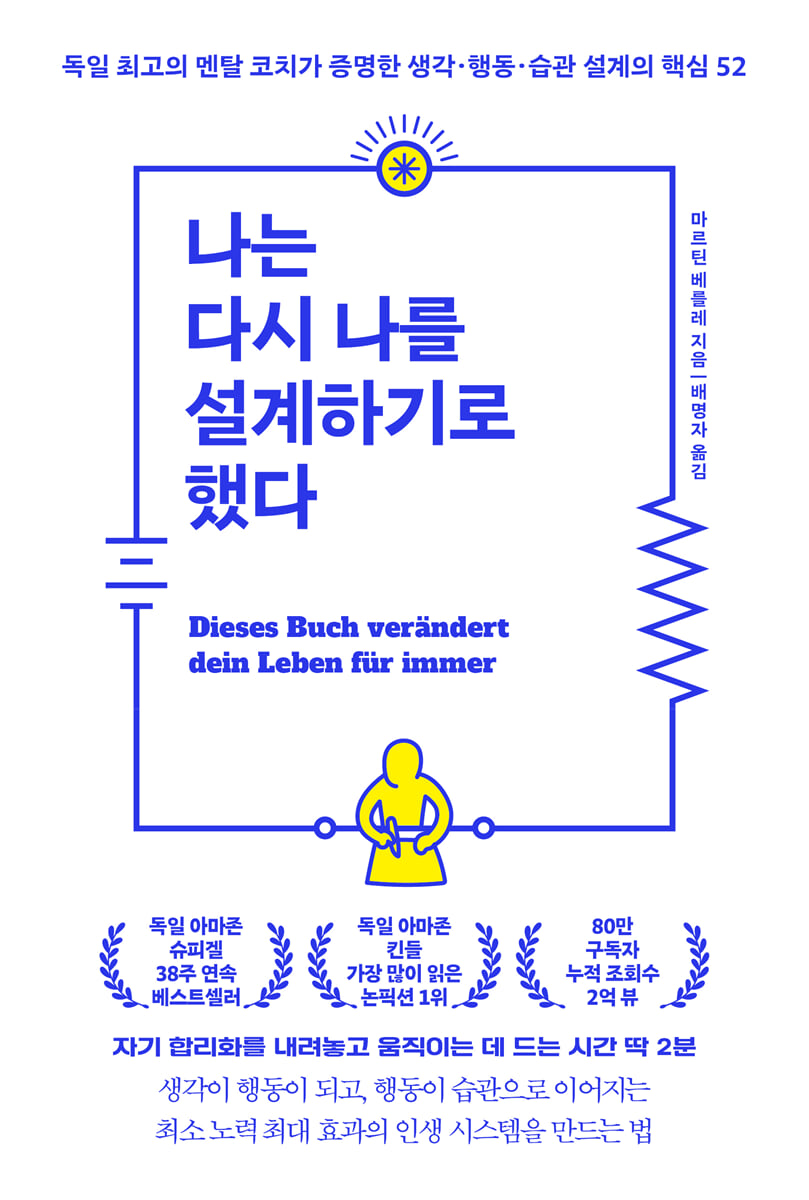 |
Description
Book Introduction
800,000 subscribers, 200 million cumulative views
The core of designing thoughts, actions, and habits, proven by Germany's top mental coach.
Martin Berle, Germany's top self-development mentor, introduced by Focus, one of Germany's three major weekly magazines, as "Germany's most famous career advisor" and with a record of "200 consecutive weeks on the Der Spiegel bestseller list."
This book is a compilation of 52 of the most effective methods he has found while counseling thousands of people for 23 years.
People believe that change requires great determination or overwhelming motivation.
But Martin Berle says that even without that, if you find a trigger for change and take action for just two minutes, a positive spiral of change will form on its own.
Regardless of what genes you were born with or how you lived, anyone can change if they know the three stages of change, and he explains the core of change by dividing it into thoughts, actions, and habit design.
If you change your thoughts just a little, actions become easier, and if small actions accumulate, habits will change before you know it.
Drawing on thousands of counseling cases, including brain science, psychology, and philosophical theories, this book outlines the key change triggers that lead to greater change. It has received rave reviews from various media outlets, including Express Cologne, which called it “the definitive answer to the question of how to change.”
Also, on major bookstore sites, readers are leaving comments such as, "I'm reading this 3 times a day for 20 minutes each," "I listened to it as an audiobook and then bought it as an e-book and a paperback," "It's easy to understand and, above all, easy to put into practice," and "I received personal consulting for the price of one book."
The core of designing thoughts, actions, and habits, proven by Germany's top mental coach.
Martin Berle, Germany's top self-development mentor, introduced by Focus, one of Germany's three major weekly magazines, as "Germany's most famous career advisor" and with a record of "200 consecutive weeks on the Der Spiegel bestseller list."
This book is a compilation of 52 of the most effective methods he has found while counseling thousands of people for 23 years.
People believe that change requires great determination or overwhelming motivation.
But Martin Berle says that even without that, if you find a trigger for change and take action for just two minutes, a positive spiral of change will form on its own.
Regardless of what genes you were born with or how you lived, anyone can change if they know the three stages of change, and he explains the core of change by dividing it into thoughts, actions, and habit design.
If you change your thoughts just a little, actions become easier, and if small actions accumulate, habits will change before you know it.
Drawing on thousands of counseling cases, including brain science, psychology, and philosophical theories, this book outlines the key change triggers that lead to greater change. It has received rave reviews from various media outlets, including Express Cologne, which called it “the definitive answer to the question of how to change.”
Also, on major bookstore sites, readers are leaving comments such as, "I'm reading this 3 times a day for 20 minutes each," "I listened to it as an audiobook and then bought it as an e-book and a paperback," "It's easy to understand and, above all, easy to put into practice," and "I received personal consulting for the price of one book."
- You can preview some of the book's contents.
Preview
index
PROLOGUE: The most effective methods proven through 23 years of counseling thousands of people.
CHAPTER 1.
The only way to change your life is to change yourself.
① If you are anxious about continuing to live like this
② All you need for anxiety is two minutes of action.
③ Why successful people risk their lives for small actions
④ It is not great trials that ruin a life, but petty excuses.
⑤ The most dangerous words in the world: 'Everyone else is like that too'
⑥ Stop procrastinating and blaming things you can't change.
⑦ Even in the worst situation, I can change myself.
⑧ A mindset that transforms anxiety and worry into a catalyst for growth
CHAPTER 2.
I decided to redesign myself
① I decided to design myself again.
② The moment you ask 'how', your brain already starts preparing.
③ If you change your identity, your behavior will change naturally.
④ Don't worry for more than 5 minutes.
⑤ Finishing is more important than doing well
⑥ Life is like an experiment; the more you try and modify, the better it gets.
⑦ The power to do exactly 10 percent more than the limit
⑧ Irreplaceability is hidden within weaknesses.
⑨ Start small and achieve consistent success.
CHAPTER 3.
Thought Design: The Beginning of All Change
① Psychologists unanimously say, just think that everything will go well no matter what.
② Post-traumatic stress disorder or resilience?
③ If you change your thinking by 1 percent, the results will change dramatically.
④ Break free from self-limiting beliefs
⑤ As soon as you say it out loud, the anxiety loses its effect.
⑥ Never say the same words as always, never, never.
⑦ Check your interpersonal filter periodically.
⑧ The answer to the question, 'Why is it so hard for me?'
⑨ How Mentally Strong People See the World
CHAPTER 4.
Action Design: Creating the Life You Want, Step by Step
① How did I escape from the prison of ‘comfort with reality’ where I had been trapped for 15 years?
② A painful truth is better than a pleasant lie.
③ People who dwell on regret vs. people who just act
④ Find something small you can do right now and start moving.
⑤ Imagining the worst-case scenario can lead to unexpected solutions.
⑥ Designing behaviors that attract luck
⑦ Smart speaking to get what you want without emotional exhaustion
⑧ The power to persevere to the end without being swayed by the world's doubts and comparisons
⑨ Don't hesitate when it's time to step on the accelerator.
CHAPTER 5.
Habit Design: Change that Lasts Without Effort
① No willpower required. Knowing the trigger is half the battle.
② How did I break my bad habit of biting my nails?
③ The most reliable and simple way to create good habits
④ The habit of comparing is what makes people the most miserable.
⑤ Five things that people who plan their lives wisely have in common
⑥ I just changed my tone of speech
⑦ The technique of changing a person who is disobedient to death
⑧ If you want to be well, rest well.
⑨ Why Strong People Keep Gratitude Journals
CHAPTER 6.
Final Tips for Keeping Moving
① [Wealth] The path to true wealth
② [Life] Excessive humility is poison.
③ [Success] Altruism is evolved self-interest.
④ [Human Relations] Don't get tired because of people, just think about what you can learn from them.
⑤ [Work] Don't be trapped by other people's opinions, and do what you want to do.
⑥ [Attitude] Even if you just raise the corners of your mouth, your brain thinks it's funny.
⑦ [The World] Why We Must Be Kind to People
⑧ [Life] How to live today without anxiety and regret
CHAPTER 1.
The only way to change your life is to change yourself.
① If you are anxious about continuing to live like this
② All you need for anxiety is two minutes of action.
③ Why successful people risk their lives for small actions
④ It is not great trials that ruin a life, but petty excuses.
⑤ The most dangerous words in the world: 'Everyone else is like that too'
⑥ Stop procrastinating and blaming things you can't change.
⑦ Even in the worst situation, I can change myself.
⑧ A mindset that transforms anxiety and worry into a catalyst for growth
CHAPTER 2.
I decided to redesign myself
① I decided to design myself again.
② The moment you ask 'how', your brain already starts preparing.
③ If you change your identity, your behavior will change naturally.
④ Don't worry for more than 5 minutes.
⑤ Finishing is more important than doing well
⑥ Life is like an experiment; the more you try and modify, the better it gets.
⑦ The power to do exactly 10 percent more than the limit
⑧ Irreplaceability is hidden within weaknesses.
⑨ Start small and achieve consistent success.
CHAPTER 3.
Thought Design: The Beginning of All Change
① Psychologists unanimously say, just think that everything will go well no matter what.
② Post-traumatic stress disorder or resilience?
③ If you change your thinking by 1 percent, the results will change dramatically.
④ Break free from self-limiting beliefs
⑤ As soon as you say it out loud, the anxiety loses its effect.
⑥ Never say the same words as always, never, never.
⑦ Check your interpersonal filter periodically.
⑧ The answer to the question, 'Why is it so hard for me?'
⑨ How Mentally Strong People See the World
CHAPTER 4.
Action Design: Creating the Life You Want, Step by Step
① How did I escape from the prison of ‘comfort with reality’ where I had been trapped for 15 years?
② A painful truth is better than a pleasant lie.
③ People who dwell on regret vs. people who just act
④ Find something small you can do right now and start moving.
⑤ Imagining the worst-case scenario can lead to unexpected solutions.
⑥ Designing behaviors that attract luck
⑦ Smart speaking to get what you want without emotional exhaustion
⑧ The power to persevere to the end without being swayed by the world's doubts and comparisons
⑨ Don't hesitate when it's time to step on the accelerator.
CHAPTER 5.
Habit Design: Change that Lasts Without Effort
① No willpower required. Knowing the trigger is half the battle.
② How did I break my bad habit of biting my nails?
③ The most reliable and simple way to create good habits
④ The habit of comparing is what makes people the most miserable.
⑤ Five things that people who plan their lives wisely have in common
⑥ I just changed my tone of speech
⑦ The technique of changing a person who is disobedient to death
⑧ If you want to be well, rest well.
⑨ Why Strong People Keep Gratitude Journals
CHAPTER 6.
Final Tips for Keeping Moving
① [Wealth] The path to true wealth
② [Life] Excessive humility is poison.
③ [Success] Altruism is evolved self-interest.
④ [Human Relations] Don't get tired because of people, just think about what you can learn from them.
⑤ [Work] Don't be trapped by other people's opinions, and do what you want to do.
⑥ [Attitude] Even if you just raise the corners of your mouth, your brain thinks it's funny.
⑦ [The World] Why We Must Be Kind to People
⑧ [Life] How to live today without anxiety and regret
Detailed image

Into the book
There are many things in life that you cannot influence.
You can't choose your parents when you're born, fate throws itself at you without your permission, and the genetic material that makes you up is chosen at random, like a lottery.
But even within these limited conditions, how you act is entirely up to you.
A bad childhood doesn't necessarily lead to a bad life.
Fate gives you gasoline.
You can burn your life with it, but you can also use it as precious fuel.
---From "If you're anxious about continuing to live like this"
One day, a close colleague said:
“I’m going to write a book about presentations.” “When are you starting?” I asked.
“I just installed a program.
“You can use it to collect data and organize references.” “So when do you plan on starting writing?” “I should start right after I finish researching the data.
I also want to read important books about presentations.
Both German and English books.
I plan to interview the top experts in that field.
“I’ll listen to their presentation and write about it in my book later.” There was a glass of water on the table where we were standing.
“I need to drink some water.
“I’m thirsty,” I said.
"Don't hold back and drink it quickly." "But before you drink it, I want to know what's in this water." "Right now? Really? It's just plain water, so you can drink it." "No.
I need to interview the manufacturer first.
Next, I plan to take a closer look at the supply chain.
“I’ll make it clear where this water actually comes from.” Only then did my colleague understand my intention and laugh.
"If you want to quench your thirst, you should drink water immediately, right? If you want to publish a book, you should write immediately, right?"
---From "All you need when you're anxious is two minutes of action"
One day, Wolfgang, a freelance illustrator working for the editorial department, showed up with bad news.
“I went to the hospital today, and the doctor said I was going to die soon.
“I only had two months left.” I was only twenty-two years old at the time.
I was at a loss as to how to deal with a seventy-two-year-old man who spoke like a machine, without any emotion.
I desperately searched for words to comfort Wolfgang, and a few sentences flashed through my mind.
"It could be a misdiagnosis. Maybe I could live much longer."
“Please get tested again at another hospital.
“It could be a wrong diagnosis.”
“Don’t give up, just live the rest of your days to the fullest.”
While I was thinking this, my mentor Richard, who was twenty years older than me, said this.
“Wolfgang, this is truly cruel to you! You love life so much.” At that moment, Wolfgang’s whole body shook and he burst into tears.
Richard hugged him tightly.
The two stood like that for a long time.
After the hug, Wolfgang asked.
“What kind of illustrations do you have for me?” “Are you sure you want to continue working on them?” Richard asked, puzzled.
“Of course.
I am happiest when I am drawing.
“I will draw until the very last moment,” said Wolfgang.
---From "A Mindset That Turns Anxiety and Worry into a Trigger for Growth"
Asking about possibilities is not constructive.
“Can I get promoted in six months?” This question implies a goal, but it lacks the motivation to execute.
On the other hand, asking, “What do I need to do to get promoted in six months?” focuses your attention on both the goal and the solution simultaneously.
You will already see yourself taking active action.
---From "The moment you ask 'how', your brain already begins to prepare"
An interesting study conducted at the University of California, Berkeley, supports this.
The researchers paired the participants in pairs and asked them to picture a penguin.
As a result, the probability that two people would think of the same penguin was only 12 percent.
When one person thought of an adult penguin, another thought of a baby penguin.
Some people thought of stuffed penguins, while others thought of stickers or characters from cartoons.
Up to 30 different penguins have appeared in people's minds.
If we can imagine penguins in such diverse ways, how much greater must the range be when it comes to abstract concepts like "recognition," "trust," "friendship," "love," and "contentment"? Therefore, don't assume anything about what others think, how a situation will unfold, or anything else.
Don't overinterpret your own perspective, but objectively examine the other person's thoughts and the circumstances surrounding them.
---From "Don't worry for more than 5 minutes"
Of course, skill and preparation are important.
Just as great athletes never neglect their basic physical training, developing your abilities and preparing for opportunities is fundamental.
But if you've prepared to some extent, fill in the rest through practice.
Perfect preparation is impossible in the first place, so you shouldn't pour all your energy into preparation.
Life is not a performance that must be played without mistakes.
On the contrary, it is closer to an experiment in which you make mistakes and gradually improve.
---From "Life is like an experiment, the more you try and modify, the better it gets"
What is expected actually happens because it is expected.
In psychology, this is called a "self-fulfilling prophecy."
How about using this positively? For example, some people believe they are good at English and have talent.
Then the challenge becomes easier.
Challenge yourself to read English books, watch CNN news, and speak English whenever you have the chance.
As a result, he becomes more and more fluent in English.
Even though I originally couldn't speak English and had no special talent.
---From "Psychologists unanimously say, 'Just think that everything will turn out well'"
What happens when heavy rain falls? The water level rises.
But the water level does not remain high.
It always returns to the previous level.
This is exactly how 'hedonic adaptation' works in the brain.
When success hits, you win the lottery, fall in love, or make a fortune in the stock market, your happiness level soars.
But it doesn't take long for the water level to return to its previous level.
So if you were unhappy before you won, you will be unhappy again after you win.
If you were happy before, you will be happy in the future.
---From "How Mentally Strong People See the World"
You've probably had this experience too.
I don't know how to solve a problem, but I know as well as any expert how to make it worse.
This very situation can be turned around.
In other words, we ask people who are worried about being shy to find ways to be more shy, and we ask people who are worried about being sensitive to find ways to act more sensitive.
In this case, clients feel resistance and either stop what they are doing or accept the change.
---From "Imagining the worst case scenario leads to unexpected solutions"
A woman complained to her therapist.
“I feel like I’m a completely useless person.
“My boss keeps stepping on me.” Then the therapist took a 50 euro note out of his wallet, threw it on the floor, and stomped on it, crumpling it and making it dirty.
Then he picked up the bill again and handed it to the woman.
“How much is this note?” “It’s still 50 euros,” the woman said.
That's when she realized that her worth couldn't be dictated by her boss.
---From "The Power to Persevere to the End Without Being Swayed by the World's Doubts and Comparisons"
We often overestimate the clairvoyant abilities of others.
I feel like the other person knows my thoughts, feelings, and desires even if I don't say anything.
But surprisingly, the opponent knows almost nothing.
Change your mind.
Being clear about what you want is actually a sign of respect for the other person.
You have to tell the other person what you mean so that they can decide whether or not to meet their expectations.
---From "I just changed my tone of speech"
Other people are constantly judging you.
But in nature it is different.
No one is gossiping about you.
The forest doesn't care if you were the CEO of a bank or were fired as an unskilled worker.
The river doesn't care if you're wearing designer clothes or an old t-shirt and socks with holes in them.
Whether you're newly in love or have been dumped again, the clouds in the sky don't care.
Whether he has a million dollars in assets or millions in debt, the woodpecker is not affected at all.
Nature accepts you as you are.
The more time you spend in nature, the more you will feel good about yourself just the way you are.
You can't choose your parents when you're born, fate throws itself at you without your permission, and the genetic material that makes you up is chosen at random, like a lottery.
But even within these limited conditions, how you act is entirely up to you.
A bad childhood doesn't necessarily lead to a bad life.
Fate gives you gasoline.
You can burn your life with it, but you can also use it as precious fuel.
---From "If you're anxious about continuing to live like this"
One day, a close colleague said:
“I’m going to write a book about presentations.” “When are you starting?” I asked.
“I just installed a program.
“You can use it to collect data and organize references.” “So when do you plan on starting writing?” “I should start right after I finish researching the data.
I also want to read important books about presentations.
Both German and English books.
I plan to interview the top experts in that field.
“I’ll listen to their presentation and write about it in my book later.” There was a glass of water on the table where we were standing.
“I need to drink some water.
“I’m thirsty,” I said.
"Don't hold back and drink it quickly." "But before you drink it, I want to know what's in this water." "Right now? Really? It's just plain water, so you can drink it." "No.
I need to interview the manufacturer first.
Next, I plan to take a closer look at the supply chain.
“I’ll make it clear where this water actually comes from.” Only then did my colleague understand my intention and laugh.
"If you want to quench your thirst, you should drink water immediately, right? If you want to publish a book, you should write immediately, right?"
---From "All you need when you're anxious is two minutes of action"
One day, Wolfgang, a freelance illustrator working for the editorial department, showed up with bad news.
“I went to the hospital today, and the doctor said I was going to die soon.
“I only had two months left.” I was only twenty-two years old at the time.
I was at a loss as to how to deal with a seventy-two-year-old man who spoke like a machine, without any emotion.
I desperately searched for words to comfort Wolfgang, and a few sentences flashed through my mind.
"It could be a misdiagnosis. Maybe I could live much longer."
“Please get tested again at another hospital.
“It could be a wrong diagnosis.”
“Don’t give up, just live the rest of your days to the fullest.”
While I was thinking this, my mentor Richard, who was twenty years older than me, said this.
“Wolfgang, this is truly cruel to you! You love life so much.” At that moment, Wolfgang’s whole body shook and he burst into tears.
Richard hugged him tightly.
The two stood like that for a long time.
After the hug, Wolfgang asked.
“What kind of illustrations do you have for me?” “Are you sure you want to continue working on them?” Richard asked, puzzled.
“Of course.
I am happiest when I am drawing.
“I will draw until the very last moment,” said Wolfgang.
---From "A Mindset That Turns Anxiety and Worry into a Trigger for Growth"
Asking about possibilities is not constructive.
“Can I get promoted in six months?” This question implies a goal, but it lacks the motivation to execute.
On the other hand, asking, “What do I need to do to get promoted in six months?” focuses your attention on both the goal and the solution simultaneously.
You will already see yourself taking active action.
---From "The moment you ask 'how', your brain already begins to prepare"
An interesting study conducted at the University of California, Berkeley, supports this.
The researchers paired the participants in pairs and asked them to picture a penguin.
As a result, the probability that two people would think of the same penguin was only 12 percent.
When one person thought of an adult penguin, another thought of a baby penguin.
Some people thought of stuffed penguins, while others thought of stickers or characters from cartoons.
Up to 30 different penguins have appeared in people's minds.
If we can imagine penguins in such diverse ways, how much greater must the range be when it comes to abstract concepts like "recognition," "trust," "friendship," "love," and "contentment"? Therefore, don't assume anything about what others think, how a situation will unfold, or anything else.
Don't overinterpret your own perspective, but objectively examine the other person's thoughts and the circumstances surrounding them.
---From "Don't worry for more than 5 minutes"
Of course, skill and preparation are important.
Just as great athletes never neglect their basic physical training, developing your abilities and preparing for opportunities is fundamental.
But if you've prepared to some extent, fill in the rest through practice.
Perfect preparation is impossible in the first place, so you shouldn't pour all your energy into preparation.
Life is not a performance that must be played without mistakes.
On the contrary, it is closer to an experiment in which you make mistakes and gradually improve.
---From "Life is like an experiment, the more you try and modify, the better it gets"
What is expected actually happens because it is expected.
In psychology, this is called a "self-fulfilling prophecy."
How about using this positively? For example, some people believe they are good at English and have talent.
Then the challenge becomes easier.
Challenge yourself to read English books, watch CNN news, and speak English whenever you have the chance.
As a result, he becomes more and more fluent in English.
Even though I originally couldn't speak English and had no special talent.
---From "Psychologists unanimously say, 'Just think that everything will turn out well'"
What happens when heavy rain falls? The water level rises.
But the water level does not remain high.
It always returns to the previous level.
This is exactly how 'hedonic adaptation' works in the brain.
When success hits, you win the lottery, fall in love, or make a fortune in the stock market, your happiness level soars.
But it doesn't take long for the water level to return to its previous level.
So if you were unhappy before you won, you will be unhappy again after you win.
If you were happy before, you will be happy in the future.
---From "How Mentally Strong People See the World"
You've probably had this experience too.
I don't know how to solve a problem, but I know as well as any expert how to make it worse.
This very situation can be turned around.
In other words, we ask people who are worried about being shy to find ways to be more shy, and we ask people who are worried about being sensitive to find ways to act more sensitive.
In this case, clients feel resistance and either stop what they are doing or accept the change.
---From "Imagining the worst case scenario leads to unexpected solutions"
A woman complained to her therapist.
“I feel like I’m a completely useless person.
“My boss keeps stepping on me.” Then the therapist took a 50 euro note out of his wallet, threw it on the floor, and stomped on it, crumpling it and making it dirty.
Then he picked up the bill again and handed it to the woman.
“How much is this note?” “It’s still 50 euros,” the woman said.
That's when she realized that her worth couldn't be dictated by her boss.
---From "The Power to Persevere to the End Without Being Swayed by the World's Doubts and Comparisons"
We often overestimate the clairvoyant abilities of others.
I feel like the other person knows my thoughts, feelings, and desires even if I don't say anything.
But surprisingly, the opponent knows almost nothing.
Change your mind.
Being clear about what you want is actually a sign of respect for the other person.
You have to tell the other person what you mean so that they can decide whether or not to meet their expectations.
---From "I just changed my tone of speech"
Other people are constantly judging you.
But in nature it is different.
No one is gossiping about you.
The forest doesn't care if you were the CEO of a bank or were fired as an unskilled worker.
The river doesn't care if you're wearing designer clothes or an old t-shirt and socks with holes in them.
Whether you're newly in love or have been dumped again, the clouds in the sky don't care.
Whether he has a million dollars in assets or millions in debt, the woodpecker is not affected at all.
Nature accepts you as you are.
The more time you spend in nature, the more you will feel good about yourself just the way you are.
---From "If you want to be well, rest well"
Publisher's Review
★★★★★A German Amazon and Spiegel Bestseller for 38 Consecutive Weeks
★★★★★ #1 Most-Read Nonfiction Book on Amazon Kindle in Germany
★★★★★ 800,000 subscribers, 200 million cumulative views
“It doesn’t matter what genes you were born with or how you lived.
Anyone can change if they know the three stages of change.”
Martin Berle, Germany's leading self-development expert
52 of the most effective methods proven through 23 years of counseling thousands of people.
'Everything about it applies 100% to me.' 'I click on his videos 365 times a year.' 'I can say with certainty that it works.
“Very useful.”… These are the comments from subscribers on Martin Berle’s self-improvement YouTube channel, “Coaching and Career Tips.”
Focus, one of Germany's three major weekly magazines, introduced him as "Germany's most famous career advisor," and his books became bestsellers immediately after publication and are exported to many countries around the world.
His masterpiece set a record of being a bestseller for 200 consecutive weeks.
Why are people so crazy about his coaching?
In 2003, Martin Berle, a former executive at a major corporation, switched to becoming a full-time personal development coach with the hope of changing people's lives.
He used all his knowledge to analyze his clients' problems one by one.
Then, the clients nodded as if they had gained a great insight and left the counseling center.
But the next time it came back to the same thing.
What on earth could have been the problem?
He confessed that he had overlooked the fact that man is a 'creature of habit'.
Just because a person realizes something once, their habits don't change drastically.
Because habits, whether good or bad, are the most efficient way the brain has set up.
So, changing your life means changing your habits.
And habits only change when we rewire our brains through consistent repetition.
Martin Berle, who realized that a one-time epiphany that flared up briefly and then faded away did not change anything, changed his coaching style.
I will motivate myself as often as possible.
I'll write this down briefly so you can read it when you feel like going back to old habits.
I'll start with a memorable story so I won't forget it.
Theories and research results will be provided with methods for immediate application.
In short, I decided to become a coach who would encourage his clients with such persistence that they would be surprised.
This method has been applied to platforms beyond personal coaching, such as the YouTube channels 'Coaching and Career Tips' and 'Digital 365 Challenge.'
He has been posting lecture videos twice a week for 10 years and motivational articles every day for 5 years.
Subscribers have proven his choice by saying that the short motivational messages he receives each morning have helped him change more than anything else.
This book is a compilation of the content and writing he's created over the past 10 years that has received the best response from subscribers and the methods he's found most effective for his clients in personal coaching.
Readers praised this book, which is the culmination of 23 years of self-development know-how, saying things like, "I'm reading it three times a day for 20 minutes each," "I listened to it as an audiobook and then bought it as an e-book and paperback," "It's easy to understand and, above all, easy to put into practice," and "I received personal consulting for the price of one book."
“It only takes two minutes to let go of your rationalizations and get moving.”
Thoughts become actions, and actions become habits.
How to Create a Life System for Minimum Effort and Maximum Effect
Lethargy, laziness, negative thinking, excessive perfectionism… everyone has issues they want to solve.
So I seek advice and make plans, but they usually don't last more than three days and I'm back where I started.
Then you will suffer from greater frustration and self-deprecation.
How can I break out of this vicious cycle and truly change my life?
People believe that change requires great determination or overwhelming motivation.
But Martin Berle, who has counseled thousands of people, has shown that anyone can change, even without motivation and determination.
All you have to do is find the trigger for change and take action in just two minutes.
Two minutes of action creates motivation, and one action leads to another.
Change always starts small and happens in a chain reaction.
Let's take an example.
Struggling with obesity, York decided to cook healthy meals for himself every night.
He watched cooking videos on YouTube, bought cookbooks, and researched local farms where he could source seasonal ingredients.
But everything seemed too complicated, and in the end he ate as before.
What measures are needed for this York?
Instead of making plans, just repeat actions that can be completed in two minutes.
So, instead of searching for ingredients and recipes, just peel carrots for two minutes and dip them in natural yogurt to eat.
Two minutes of action may seem small, but it has a significant impact.
Because they are small, they are carried out without internal resistance, and such actions become the foundation of a positive spiral.
If you spend two minutes preparing fresh vegetables every evening, at some point you'll naturally want to spend more time cooking with fire, and you'll naturally fall in love with healthy cooking.
The same goes for those who repeatedly fail and are overcome with doubts like, 'Can I really change?'
No matter what genes you were born with or how you lived, anyone can change by knowing the three stages of change.
Martin Berle explains the specific method of rewiring the brain in three steps.
1.
Thought Design: The Beginning of All Change
2.
Action Design: Creating the Life You Want, Step by Step
3.
Habit Design: Change that Lasts Without Effort
‘Thoughts-actions-habits’ are closely connected.
If you change your thoughts just a little, actions become easier, and if small actions accumulate, habits will change before you know it.
Drawing on brain science, psychology, and philosophical theories, as well as thousands of counseling cases, Martin Berle has compiled in this book the key change triggers that lead to greater change.
By putting his advice into practice, you will be able to create a highly efficient life system that achieves maximum results with minimum effort.
"The Ultimate Answer to How Things Can Change"_〈Express Cologne〉
How to Win the Battle Against Apathy, Laziness, Negative Thinking, and Excessive Perfectionism
Another strength of this book is that it concisely addresses common problems that everyone experiences at least once, along with specific solutions to overcome them, all in a short text.
How to break free from negative self-perceptions like "I can't do it" or "It won't work out anyway"; how to find the motivation to change again when you become complacent; how to break bad habits the easiest and fastest; how to speak intelligently to get what you want without emotional exhaustion; how to start small and steadily build success - this book contains only the most frequently asked and most difficult topics among thousands of consultations and countless questions from subscribers.
Martin Berle says that it is not the great trials that ruin a life, but the small excuses.
So, if you feel like giving up, I recommend that you quickly open this book and avoid falling into the trap of self-rationalization.
Two minutes of reading will help you calm your mind and get started on the easiest action.
This is why he wrote concisely, extracting only the essential points.
This book, which contains only the most effective content in the most effective way, has received favorable reviews from various media outlets, including Express Cologne, which called it “the definitive answer to the question of how to make a difference.”
★★★★★ #1 Most-Read Nonfiction Book on Amazon Kindle in Germany
★★★★★ 800,000 subscribers, 200 million cumulative views
“It doesn’t matter what genes you were born with or how you lived.
Anyone can change if they know the three stages of change.”
Martin Berle, Germany's leading self-development expert
52 of the most effective methods proven through 23 years of counseling thousands of people.
'Everything about it applies 100% to me.' 'I click on his videos 365 times a year.' 'I can say with certainty that it works.
“Very useful.”… These are the comments from subscribers on Martin Berle’s self-improvement YouTube channel, “Coaching and Career Tips.”
Focus, one of Germany's three major weekly magazines, introduced him as "Germany's most famous career advisor," and his books became bestsellers immediately after publication and are exported to many countries around the world.
His masterpiece set a record of being a bestseller for 200 consecutive weeks.
Why are people so crazy about his coaching?
In 2003, Martin Berle, a former executive at a major corporation, switched to becoming a full-time personal development coach with the hope of changing people's lives.
He used all his knowledge to analyze his clients' problems one by one.
Then, the clients nodded as if they had gained a great insight and left the counseling center.
But the next time it came back to the same thing.
What on earth could have been the problem?
He confessed that he had overlooked the fact that man is a 'creature of habit'.
Just because a person realizes something once, their habits don't change drastically.
Because habits, whether good or bad, are the most efficient way the brain has set up.
So, changing your life means changing your habits.
And habits only change when we rewire our brains through consistent repetition.
Martin Berle, who realized that a one-time epiphany that flared up briefly and then faded away did not change anything, changed his coaching style.
I will motivate myself as often as possible.
I'll write this down briefly so you can read it when you feel like going back to old habits.
I'll start with a memorable story so I won't forget it.
Theories and research results will be provided with methods for immediate application.
In short, I decided to become a coach who would encourage his clients with such persistence that they would be surprised.
This method has been applied to platforms beyond personal coaching, such as the YouTube channels 'Coaching and Career Tips' and 'Digital 365 Challenge.'
He has been posting lecture videos twice a week for 10 years and motivational articles every day for 5 years.
Subscribers have proven his choice by saying that the short motivational messages he receives each morning have helped him change more than anything else.
This book is a compilation of the content and writing he's created over the past 10 years that has received the best response from subscribers and the methods he's found most effective for his clients in personal coaching.
Readers praised this book, which is the culmination of 23 years of self-development know-how, saying things like, "I'm reading it three times a day for 20 minutes each," "I listened to it as an audiobook and then bought it as an e-book and paperback," "It's easy to understand and, above all, easy to put into practice," and "I received personal consulting for the price of one book."
“It only takes two minutes to let go of your rationalizations and get moving.”
Thoughts become actions, and actions become habits.
How to Create a Life System for Minimum Effort and Maximum Effect
Lethargy, laziness, negative thinking, excessive perfectionism… everyone has issues they want to solve.
So I seek advice and make plans, but they usually don't last more than three days and I'm back where I started.
Then you will suffer from greater frustration and self-deprecation.
How can I break out of this vicious cycle and truly change my life?
People believe that change requires great determination or overwhelming motivation.
But Martin Berle, who has counseled thousands of people, has shown that anyone can change, even without motivation and determination.
All you have to do is find the trigger for change and take action in just two minutes.
Two minutes of action creates motivation, and one action leads to another.
Change always starts small and happens in a chain reaction.
Let's take an example.
Struggling with obesity, York decided to cook healthy meals for himself every night.
He watched cooking videos on YouTube, bought cookbooks, and researched local farms where he could source seasonal ingredients.
But everything seemed too complicated, and in the end he ate as before.
What measures are needed for this York?
Instead of making plans, just repeat actions that can be completed in two minutes.
So, instead of searching for ingredients and recipes, just peel carrots for two minutes and dip them in natural yogurt to eat.
Two minutes of action may seem small, but it has a significant impact.
Because they are small, they are carried out without internal resistance, and such actions become the foundation of a positive spiral.
If you spend two minutes preparing fresh vegetables every evening, at some point you'll naturally want to spend more time cooking with fire, and you'll naturally fall in love with healthy cooking.
The same goes for those who repeatedly fail and are overcome with doubts like, 'Can I really change?'
No matter what genes you were born with or how you lived, anyone can change by knowing the three stages of change.
Martin Berle explains the specific method of rewiring the brain in three steps.
1.
Thought Design: The Beginning of All Change
2.
Action Design: Creating the Life You Want, Step by Step
3.
Habit Design: Change that Lasts Without Effort
‘Thoughts-actions-habits’ are closely connected.
If you change your thoughts just a little, actions become easier, and if small actions accumulate, habits will change before you know it.
Drawing on brain science, psychology, and philosophical theories, as well as thousands of counseling cases, Martin Berle has compiled in this book the key change triggers that lead to greater change.
By putting his advice into practice, you will be able to create a highly efficient life system that achieves maximum results with minimum effort.
"The Ultimate Answer to How Things Can Change"_〈Express Cologne〉
How to Win the Battle Against Apathy, Laziness, Negative Thinking, and Excessive Perfectionism
Another strength of this book is that it concisely addresses common problems that everyone experiences at least once, along with specific solutions to overcome them, all in a short text.
How to break free from negative self-perceptions like "I can't do it" or "It won't work out anyway"; how to find the motivation to change again when you become complacent; how to break bad habits the easiest and fastest; how to speak intelligently to get what you want without emotional exhaustion; how to start small and steadily build success - this book contains only the most frequently asked and most difficult topics among thousands of consultations and countless questions from subscribers.
Martin Berle says that it is not the great trials that ruin a life, but the small excuses.
So, if you feel like giving up, I recommend that you quickly open this book and avoid falling into the trap of self-rationalization.
Two minutes of reading will help you calm your mind and get started on the easiest action.
This is why he wrote concisely, extracting only the essential points.
This book, which contains only the most effective content in the most effective way, has received favorable reviews from various media outlets, including Express Cologne, which called it “the definitive answer to the question of how to make a difference.”
GOODS SPECIFICS
- Date of issue: August 22, 2025
- Page count, weight, size: 360 pages | 500g | 145*215*22mm
- ISBN13: 9791199092907
- ISBN10: 1199092908
You may also like
카테고리
korean


korean

![GQ KOREA Mark (Monthly): December [2025]](http://librairie.coreenne.fr/cdn/shop/files/8ef265dbbfbf186523ed75ba7319009d.jpg?v=1765340328&width=3840)


