

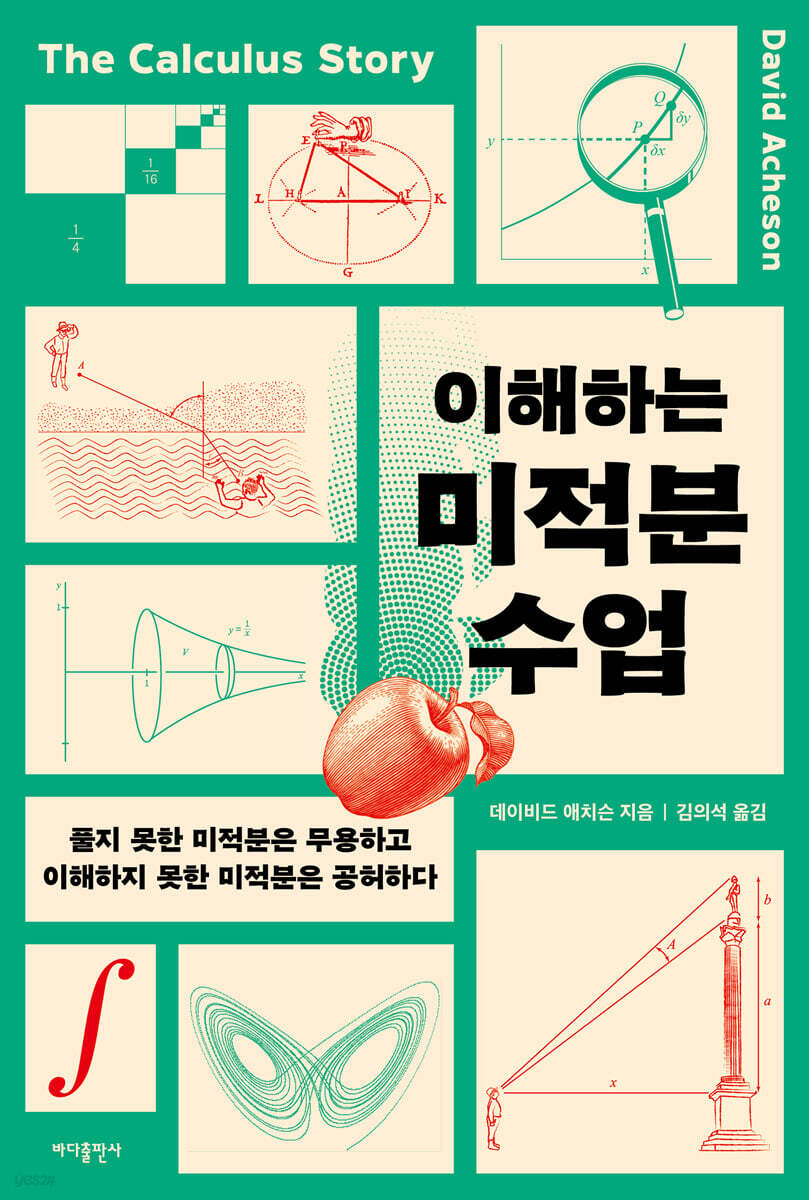
Understanding Calculus Class
 |
Description
Book Introduction
Beyond simply memorizing calculus
Let's understand the core
A commentary on calculus by David Acheson, a British applied mathematician and professor emeritus of mathematics at Jesus College, Oxford University.
For those who don't understand why they should learn calculus, we explain how it was created and why it is at the heart of modern science.
By placing the concepts and formulas of calculus, which we have simply memorized, in the context of history and science, we explain their meaning.
It provides readers with a three-dimensional perspective on calculus through various stories that are not told in mathematics textbooks, such as why limits are important in calculus, how Newton and Leibniz created calculus, and how differential equations reveal the secrets of the physical world.
Let's understand the core
A commentary on calculus by David Acheson, a British applied mathematician and professor emeritus of mathematics at Jesus College, Oxford University.
For those who don't understand why they should learn calculus, we explain how it was created and why it is at the heart of modern science.
By placing the concepts and formulas of calculus, which we have simply memorized, in the context of history and science, we explain their meaning.
It provides readers with a three-dimensional perspective on calculus through various stories that are not told in mathematics textbooks, such as why limits are important in calculus, how Newton and Leibniz created calculus, and how differential equations reveal the secrets of the physical world.
- You can preview some of the book's contents.
Preview
index
Lesson 1: Understanding Calculus Lesson Plan
Lecture 2: The Spirit of Mathematics
The emergence of the concept of infinity in the third phase
Calculus deals with change
Lesson 5: Basic Ideas of Differentiation
How to maximize the area of the 6-story field
Enjoying the Infinite in Lesson 7
From Differentiation to Integration in Chapter 8
Lesson 9: Stacking Boxes with Infinite Series
Lesson 10: Integrating with Infinite Series
Lecture 11: The Relationship Between Calculus and Mechanics
Lecture 12: Newton and the Principia
Lesson 13: Leibniz Beats the Player
Lesson 14: The Importance of Symbols
Lesson 15: Who Invented Calculus?
16 Vibrating Sines and Cosines
Lecture 17: Leibniz's Infinite Series
Calculus, under attack in Lecture 18
Lecture 19: Euler's Differential Equations
Lecture 20: Differential Equations and the World of Physics
Lesson 21: Finding the Shortest Descent Curve
The mysterious number e in the 22nd round
Lesson 23: How to Create Infinite Series
Lecture 24: Imaginary Numbers and Fluid Mechanics
Lesson 25: Beware of Infinity
Lesson 26: What exactly is a limit?
Lesson 27: Nature's Equations
Lesson 28: From Calculus to Chaos Theory
Lecture 2: The Spirit of Mathematics
The emergence of the concept of infinity in the third phase
Calculus deals with change
Lesson 5: Basic Ideas of Differentiation
How to maximize the area of the 6-story field
Enjoying the Infinite in Lesson 7
From Differentiation to Integration in Chapter 8
Lesson 9: Stacking Boxes with Infinite Series
Lesson 10: Integrating with Infinite Series
Lecture 11: The Relationship Between Calculus and Mechanics
Lecture 12: Newton and the Principia
Lesson 13: Leibniz Beats the Player
Lesson 14: The Importance of Symbols
Lesson 15: Who Invented Calculus?
16 Vibrating Sines and Cosines
Lecture 17: Leibniz's Infinite Series
Calculus, under attack in Lecture 18
Lecture 19: Euler's Differential Equations
Lecture 20: Differential Equations and the World of Physics
Lesson 21: Finding the Shortest Descent Curve
The mysterious number e in the 22nd round
Lesson 23: How to Create Infinite Series
Lecture 24: Imaginary Numbers and Fluid Mechanics
Lesson 25: Beware of Infinity
Lesson 26: What exactly is a limit?
Lesson 27: Nature's Equations
Lesson 28: From Calculus to Chaos Theory
Detailed image

Publisher's Review
“A concise guide to the essentials of calculus.
A concise, engaging, and interesting explanation of where calculus came from, what it is used for, and how it developed.
It is an ideal introductory book for beginners.
“I recommend it to anyone interested in calculus.” ― Ian Stewart, author of 17 Equations That Changed the World
Everyone learns calculus at least once, but few understand its core ideas and why it is learned.
Perhaps this is the main reason why people give up on studying calculus. The development of calculus was an intellectual adventure of great mathematicians.
Because the troubling concept of infinity creeps in almost everywhere.
In this book, applied mathematician David Acheson traces the intellectual adventure of calculus from its origins in ancient Greece to the present day.
Based on the original works of Archimedes, Newton, Leibniz, Euler, and others, it traces why calculus was needed and how it developed, providing a comprehensive picture of the emergence, development, and applications of calculus.
In addition, it introduces the relationship between calculus and the laws of planetary motion, fluid mechanics, quantum mechanics, and chaos theory.
This book will enable readers to go beyond a microscopic approach to mathematical techniques to gain a holistic view of calculus and understand why calculus is necessary and why it should be learned.
Understanding Calculus Through History
Calculus didn't just fall from the sky one day.
The research of mathematicians such as Archimedes, who first utilized the concept of infinity around 220 BC, Descartes and Fermat, who created coordinate geometry, and Wallace, who first introduced and actively utilized the infinity symbol, became the foundation of calculus research.
Newton and Leibniz were the ones who organized these numerous seemingly unrelated research results into the concepts and laws of calculus.
Most mathematicians who study the history of mathematics today believe that Newton and Leibniz developed calculus independently and in different ways.
The author traces this historical process, depicting how the concepts that form the foundation of calculus emerged and were integrated to form calculus.
Through this process, readers will be able to understand how concepts such as limits, infinite series, and infinitesimals relate to calculus.
Calculus is a key tool for understanding nature.
In 1666, Isaac Newton is said to have discovered the theory of gravity after observing an apple fall from a tree in his summer garden.
Although the actual process may be overly simplified, this story is a perfect introduction to calculus.
An apple moves at an increasing speed as it falls, and the acceleration due to gravity can be easily calculated using calculus.
Because the natural world is surrounded by change, the advent of calculus was a major breakthrough in mathematics and science.
At the time, the inverse square law of gravity, which states that gravity is proportional to 1/r2, was a regular topic of tea debate among London mathematicians and scientists.
This debate was later settled after Newton proved the relationship between the planets and the Sun in elliptical orbits.
Looking at Newton's manuscripts, it seems as though he used geometric methods for his proofs, but in reality he did not.
Newton used the core idea of calculus, which assumes limits, to great effect in proving the inverse square law of gravity.
As such, calculus did not emerge out of simple mathematical necessity.
Calculus, which can handle change, was a key means of understanding the natural world surrounded by change.
This motivation led to the development of calculus.
This is also clearly demonstrated through Leibniz's example.
At the end of Leibniz's first paper on calculus, published in the Journal of the Academics in 1684, he explains how the calculus he invented can be applied in the real world.
The most representative of these is the minimum time problem of finding which path is the fastest when light passes through two different media.
Leibniz showed that using calculus, one could easily find the fastest path for light to travel.
These two historical examples show that calculus was born from the process of solving problems in the physical world.
Moreover, as Euler expressed physical problems in the form of differential equations, our understanding of the natural world deepened, leading to chaos theory and quantum mechanics.
This book provides a wealth of examples of calculus applications, enabling readers to understand calculus within the context of science.
A concise, engaging, and interesting explanation of where calculus came from, what it is used for, and how it developed.
It is an ideal introductory book for beginners.
“I recommend it to anyone interested in calculus.” ― Ian Stewart, author of 17 Equations That Changed the World
Everyone learns calculus at least once, but few understand its core ideas and why it is learned.
Perhaps this is the main reason why people give up on studying calculus. The development of calculus was an intellectual adventure of great mathematicians.
Because the troubling concept of infinity creeps in almost everywhere.
In this book, applied mathematician David Acheson traces the intellectual adventure of calculus from its origins in ancient Greece to the present day.
Based on the original works of Archimedes, Newton, Leibniz, Euler, and others, it traces why calculus was needed and how it developed, providing a comprehensive picture of the emergence, development, and applications of calculus.
In addition, it introduces the relationship between calculus and the laws of planetary motion, fluid mechanics, quantum mechanics, and chaos theory.
This book will enable readers to go beyond a microscopic approach to mathematical techniques to gain a holistic view of calculus and understand why calculus is necessary and why it should be learned.
Understanding Calculus Through History
Calculus didn't just fall from the sky one day.
The research of mathematicians such as Archimedes, who first utilized the concept of infinity around 220 BC, Descartes and Fermat, who created coordinate geometry, and Wallace, who first introduced and actively utilized the infinity symbol, became the foundation of calculus research.
Newton and Leibniz were the ones who organized these numerous seemingly unrelated research results into the concepts and laws of calculus.
Most mathematicians who study the history of mathematics today believe that Newton and Leibniz developed calculus independently and in different ways.
The author traces this historical process, depicting how the concepts that form the foundation of calculus emerged and were integrated to form calculus.
Through this process, readers will be able to understand how concepts such as limits, infinite series, and infinitesimals relate to calculus.
Calculus is a key tool for understanding nature.
In 1666, Isaac Newton is said to have discovered the theory of gravity after observing an apple fall from a tree in his summer garden.
Although the actual process may be overly simplified, this story is a perfect introduction to calculus.
An apple moves at an increasing speed as it falls, and the acceleration due to gravity can be easily calculated using calculus.
Because the natural world is surrounded by change, the advent of calculus was a major breakthrough in mathematics and science.
At the time, the inverse square law of gravity, which states that gravity is proportional to 1/r2, was a regular topic of tea debate among London mathematicians and scientists.
This debate was later settled after Newton proved the relationship between the planets and the Sun in elliptical orbits.
Looking at Newton's manuscripts, it seems as though he used geometric methods for his proofs, but in reality he did not.
Newton used the core idea of calculus, which assumes limits, to great effect in proving the inverse square law of gravity.
As such, calculus did not emerge out of simple mathematical necessity.
Calculus, which can handle change, was a key means of understanding the natural world surrounded by change.
This motivation led to the development of calculus.
This is also clearly demonstrated through Leibniz's example.
At the end of Leibniz's first paper on calculus, published in the Journal of the Academics in 1684, he explains how the calculus he invented can be applied in the real world.
The most representative of these is the minimum time problem of finding which path is the fastest when light passes through two different media.
Leibniz showed that using calculus, one could easily find the fastest path for light to travel.
These two historical examples show that calculus was born from the process of solving problems in the physical world.
Moreover, as Euler expressed physical problems in the form of differential equations, our understanding of the natural world deepened, leading to chaos theory and quantum mechanics.
This book provides a wealth of examples of calculus applications, enabling readers to understand calculus within the context of science.
GOODS SPECIFICS
- Date of issue: September 5, 2025
- Page count, weight, size: 236 pages | 145*215*20mm
- ISBN13: 9791166893735
- ISBN10: 1166893731
You may also like
카테고리
korean


korean

![GQ KOREA Mark (Monthly): December [2025]](http://librairie.coreenne.fr/cdn/shop/files/8ef265dbbfbf186523ed75ba7319009d.jpg?v=1765340328&width=3840)


