

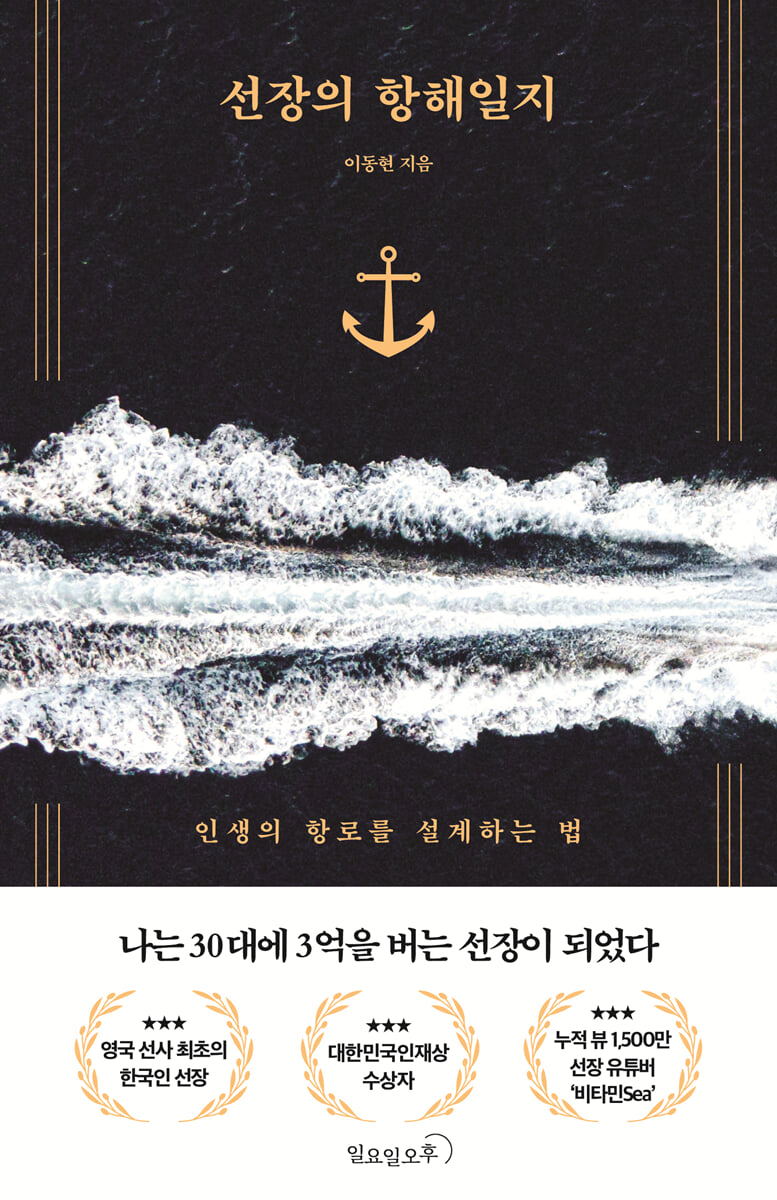
Captain's Log
 |
Description
Book Introduction
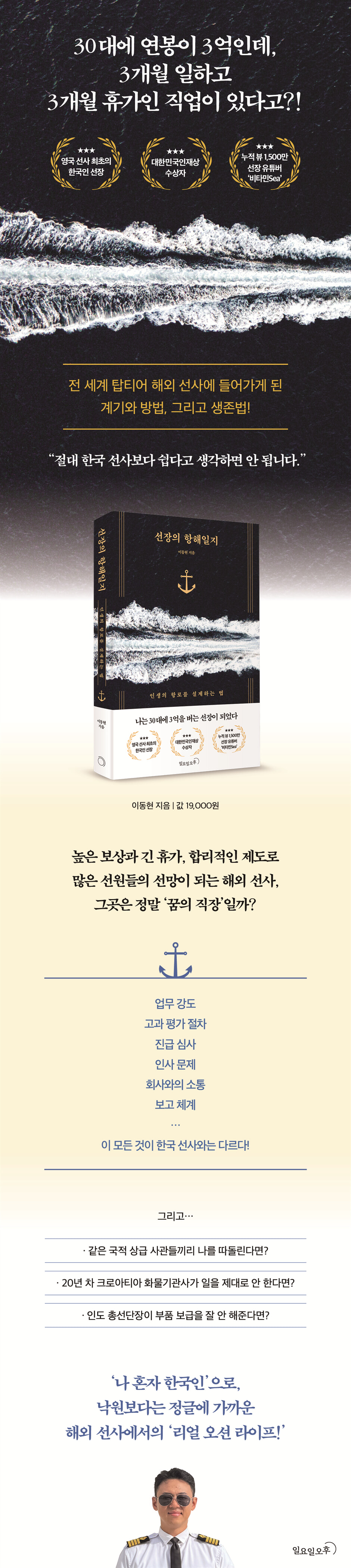
You only get 6 months of vacation a year, but your annual salary is 300 million won?!
All the stories about sailors told by the captain
While professions like judge, doctor, and firefighter are known in various ways, stories about shipboard professions are rare.
This book provides fascinating anecdotes and inspiration about little-known shipboard professions, as well as information on how to become a captain with a salary in the hundreds of millions.
It covers, without reservation, the reasons for choosing the sea as a career, the preparations and difficulties to become a navigator, life and roles in Korean merchant ships, the advantages and limitations, and the trial and error and leap forward experienced while challenging overseas shipping companies.
The author's journey from being a trainee navigator to first mate and then captain is the very essence of 'ocean life', filled with all the joys and sorrows.
The film realistically portrays the pressure of becoming a captain in his mid-thirties, commanding a ship weighing tens of thousands of tons, and being responsible for all the crew, as well as the leadership and determination required to overcome a crisis.
In addition, we provide a balanced comparison of wages, working conditions, and cultural differences between domestic and international shipping companies, thereby dispelling widespread misunderstandings and illusions.
It honestly illuminates the truth and lies of overseas shipping companies compared to Korean shipping companies, broadening the horizons of those who dream of becoming global maritime engineers.
This is the author's first book, having already shared the charm of the sea through his YouTube channel. For the general reader, it will be an interesting essay on the charm of life on the sea, and for those preparing to become a maritime engineer, it will be a most helpful guidebook.
All the stories about sailors told by the captain
While professions like judge, doctor, and firefighter are known in various ways, stories about shipboard professions are rare.
This book provides fascinating anecdotes and inspiration about little-known shipboard professions, as well as information on how to become a captain with a salary in the hundreds of millions.
It covers, without reservation, the reasons for choosing the sea as a career, the preparations and difficulties to become a navigator, life and roles in Korean merchant ships, the advantages and limitations, and the trial and error and leap forward experienced while challenging overseas shipping companies.
The author's journey from being a trainee navigator to first mate and then captain is the very essence of 'ocean life', filled with all the joys and sorrows.
The film realistically portrays the pressure of becoming a captain in his mid-thirties, commanding a ship weighing tens of thousands of tons, and being responsible for all the crew, as well as the leadership and determination required to overcome a crisis.
In addition, we provide a balanced comparison of wages, working conditions, and cultural differences between domestic and international shipping companies, thereby dispelling widespread misunderstandings and illusions.
It honestly illuminates the truth and lies of overseas shipping companies compared to Korean shipping companies, broadening the horizons of those who dream of becoming global maritime engineers.
This is the author's first book, having already shared the charm of the sea through his YouTube channel. For the general reader, it will be an interesting essay on the charm of life on the sea, and for those preparing to become a maritime engineer, it will be a most helpful guidebook.
- You can preview some of the book's contents.
Preview
index
· Prologue.
To you who dreams of a wider sea
Ⅰ The reason I wanted to become a sailor
- I want to make money by sailing.
- When I was thinking about becoming a monk
- The hidden meaning of the word 'it's okay'
- From student to sailor, preparing for the real sea
Ⅱ To the Real Sea, the Joys and Sorrows of a New Navigator
- My first experience of a voyage through the underworld
- Adapting to life in a small room on the sea, a cabin
- A relationship that smoothed out rough and tumble times
Does the position make the man? Becoming a First Mate
Ⅲ Towards a wider and deeper sea, personal transmission
- The goose's dream, or rather, the dream of personal transmission
- The first Korean sailor on a British ship
- Everyone has a first time.
- You should study English.
- Just wait and see, I'll get it done.
- I grew up like that too.
- The saying that a crisis is an opportunity
Ⅳ Becoming a First-Class Navigator of an Overseas Shipping Company
- A pod of dolphins encountered in the Mediterranean Sea
- I never thought I'd be acting captain
- Captain Matthew, my boss and friend
- A fire incident at sea
- Captain, I think you're mistaken.
- Final promotion recommendation letter
- Ground work in the UK
Ⅴ The seascape seen by the captain
- The first ship I boarded as captain
- Working with sailors from 36 countries
- How to weather a typhoon
- Captain's leadership
- The ship is under 24-hour alert
- It's impossible to get close to it
supplement.
Help for those who dream of the sea
- How to become a sailor
- The present and future of sailors
- Labor intensity and wages in the domestic seafarer market
Is overseas shipping truly paradise? Expectations and reality.
· Epilogue.
In fact, it is not as easy as you think.
To you who dreams of a wider sea
Ⅰ The reason I wanted to become a sailor
- I want to make money by sailing.
- When I was thinking about becoming a monk
- The hidden meaning of the word 'it's okay'
- From student to sailor, preparing for the real sea
Ⅱ To the Real Sea, the Joys and Sorrows of a New Navigator
- My first experience of a voyage through the underworld
- Adapting to life in a small room on the sea, a cabin
- A relationship that smoothed out rough and tumble times
Does the position make the man? Becoming a First Mate
Ⅲ Towards a wider and deeper sea, personal transmission
- The goose's dream, or rather, the dream of personal transmission
- The first Korean sailor on a British ship
- Everyone has a first time.
- You should study English.
- Just wait and see, I'll get it done.
- I grew up like that too.
- The saying that a crisis is an opportunity
Ⅳ Becoming a First-Class Navigator of an Overseas Shipping Company
- A pod of dolphins encountered in the Mediterranean Sea
- I never thought I'd be acting captain
- Captain Matthew, my boss and friend
- A fire incident at sea
- Captain, I think you're mistaken.
- Final promotion recommendation letter
- Ground work in the UK
Ⅴ The seascape seen by the captain
- The first ship I boarded as captain
- Working with sailors from 36 countries
- How to weather a typhoon
- Captain's leadership
- The ship is under 24-hour alert
- It's impossible to get close to it
supplement.
Help for those who dream of the sea
- How to become a sailor
- The present and future of sailors
- Labor intensity and wages in the domestic seafarer market
Is overseas shipping truly paradise? Expectations and reality.
· Epilogue.
In fact, it is not as easy as you think.
Detailed image
Into the book
The ship I was on was a 183-meter oil product tanker.
When I first boarded the ship, I greeted the officers, including the captain and first mate, and was assigned to my quarters.
But actually, I was a bit embarrassed.
Because my first accommodation was a hospital.
They said there were too many changing crews and there were no rooms available.
So my first bed at sea became a hospital cot.
Without even unpacking my large suitcase, I turned on the bedside light and started writing in my diary.
July 5, 2012.
First boarding.
Don't give up!'
--- p.26, from “The hidden meaning of the word ‘okay’”
Typhoons can rock a ship for a few days or even a week.
It was then that I realized.
Why do all the bathroom showers and washrooms on a ship have handrails like those in a disabled bathroom? Why do all the corridors on a ship have handrails? Why are the food bowls in the dining room attached to the table? Why are the computer monitors screwed to the desk?
A wave that could swallow up a building splashed from the bow and flew 300 meters and crashed into the bridge window.
--- p.45, from “The Yellow Sea I Experienced for the First Time in My Life”
You might think that going up a level from second mate to first mate isn't that much of a burden, but there's a difference between second mate and first mate that can't be captured in the numbers 2 and 1.
Third, second, first.
In Korean, only the numbers change, but even if you translate only the job titles into English, the difference is clearly visible.
3rd Officer, 2nd Officer, and 1st Officer.
--- p.63, from "Does a Place Make a Man? Becoming a First-Class Navigator"
I spent the night agonizing over whether I should seize this barely available opportunity, even if it was only half-baked, or wait for another, unspecified reply. Finally, I made up my mind.
“Son, have you decided what to do with the British prehistoric people?” “Yeah.
“I’m going to go.” Let’s go out into the wider world, let’s go and do it somehow.
This was the mindset that extinguished all other uncertainties.
And I didn't know it then, but this one mindset opened a new path in my life.
--- p.75, from “The Goose’s Dream, or rather, the Dream of Personal Transmission”
“Yes, Lee, nice to meet you.
"You came here after working as a first mate in Korea? Then let's take a few tests and answer to the best of your knowledge." As we were drinking coffee together on the bridge, the captain suddenly spoke.
"What is the definition of Dew Point? How is it calculated?" "Tell me the procedures after an LNG ship docks." The questions continued for about an hour.
In English, of course.
--- p.99p, from "You, I guess you should study English"
There was no doubt that it was social phobia.
I was afraid and terrified of the pressure and contempt from the captain and first mate, the anxiety about whether I could survive in this company, and the resulting uncertainty about my future.
Knowing that I had social phobia didn't solve anything.
If things continued this way, it was clear that my personal transmission would end in failure.
--- p.115, from "Just wait and see, I'll do it"
As soon as the interview was over, all the strength left my body.
The time and effort I poured into the past year and a half flashed before my eyes. Looking back, I have no regrets.
I did my best, and if I failed to get promoted, it meant my skills were lacking.
At the same time, I had a gut feeling that I was passing.
For some reason, the interviewer's final question, "What are your final words?" sounded like it was asking for my last words as a second mate.
--- p.135p, from the saying, “A crisis is an opportunity”
I had no way of knowing that day, when I fought with Marco in the cargo control room, he would be the one to give me my last letter of recommendation.
Had I known this in advance, would I have been able to avoid arguing with him and just get along? Of course, there are no "ifs" in life, so I wondered if any imagination would be meaningless.
But it was clear that the flow of life and relationships was as unpredictable as the waves of the sea.
--- p.185, from “Last Promotion Recommendation Letter”
In sailing, you must constantly ask yourself the question, 'what if?'
This is especially true for the captain, who is the highest ranking official.
When the captain decides, the crew follows.
This is especially true when a captain's misjudgment can put the entire crew at risk.
I kept thinking about how much to slow down when decelerating and when to accelerate after slowing down.
In the worst case scenario, if the typhoon's forward speed was slower than forecast, our ship would have to slow down even further, and there was a possibility that we would not be able to make the next port arrival schedule.
--- p.231, from “How to Weather a Typhoon”
"What do you think it'll be like to go out to sea for the first time as a captain? Don't you get nervous just thinking about it?" "No, I'm not nervous." Chris shook his head with a kind smile.
“Captain Dong-Hyeon, you are wrong.
You have to be nervous.
You have to be nervous.
“That’s the captain’s position,” he continued in a subdued tone.
“It doesn’t matter how prepared you are or how much experience you have.
You have to be nervous.
“Captain Dong-Hyeon’s decision determines the lives of 30 crew members and their families.”
When I first boarded the ship, I greeted the officers, including the captain and first mate, and was assigned to my quarters.
But actually, I was a bit embarrassed.
Because my first accommodation was a hospital.
They said there were too many changing crews and there were no rooms available.
So my first bed at sea became a hospital cot.
Without even unpacking my large suitcase, I turned on the bedside light and started writing in my diary.
July 5, 2012.
First boarding.
Don't give up!'
--- p.26, from “The hidden meaning of the word ‘okay’”
Typhoons can rock a ship for a few days or even a week.
It was then that I realized.
Why do all the bathroom showers and washrooms on a ship have handrails like those in a disabled bathroom? Why do all the corridors on a ship have handrails? Why are the food bowls in the dining room attached to the table? Why are the computer monitors screwed to the desk?
A wave that could swallow up a building splashed from the bow and flew 300 meters and crashed into the bridge window.
--- p.45, from “The Yellow Sea I Experienced for the First Time in My Life”
You might think that going up a level from second mate to first mate isn't that much of a burden, but there's a difference between second mate and first mate that can't be captured in the numbers 2 and 1.
Third, second, first.
In Korean, only the numbers change, but even if you translate only the job titles into English, the difference is clearly visible.
3rd Officer, 2nd Officer, and 1st Officer.
--- p.63, from "Does a Place Make a Man? Becoming a First-Class Navigator"
I spent the night agonizing over whether I should seize this barely available opportunity, even if it was only half-baked, or wait for another, unspecified reply. Finally, I made up my mind.
“Son, have you decided what to do with the British prehistoric people?” “Yeah.
“I’m going to go.” Let’s go out into the wider world, let’s go and do it somehow.
This was the mindset that extinguished all other uncertainties.
And I didn't know it then, but this one mindset opened a new path in my life.
--- p.75, from “The Goose’s Dream, or rather, the Dream of Personal Transmission”
“Yes, Lee, nice to meet you.
"You came here after working as a first mate in Korea? Then let's take a few tests and answer to the best of your knowledge." As we were drinking coffee together on the bridge, the captain suddenly spoke.
"What is the definition of Dew Point? How is it calculated?" "Tell me the procedures after an LNG ship docks." The questions continued for about an hour.
In English, of course.
--- p.99p, from "You, I guess you should study English"
There was no doubt that it was social phobia.
I was afraid and terrified of the pressure and contempt from the captain and first mate, the anxiety about whether I could survive in this company, and the resulting uncertainty about my future.
Knowing that I had social phobia didn't solve anything.
If things continued this way, it was clear that my personal transmission would end in failure.
--- p.115, from "Just wait and see, I'll do it"
As soon as the interview was over, all the strength left my body.
The time and effort I poured into the past year and a half flashed before my eyes. Looking back, I have no regrets.
I did my best, and if I failed to get promoted, it meant my skills were lacking.
At the same time, I had a gut feeling that I was passing.
For some reason, the interviewer's final question, "What are your final words?" sounded like it was asking for my last words as a second mate.
--- p.135p, from the saying, “A crisis is an opportunity”
I had no way of knowing that day, when I fought with Marco in the cargo control room, he would be the one to give me my last letter of recommendation.
Had I known this in advance, would I have been able to avoid arguing with him and just get along? Of course, there are no "ifs" in life, so I wondered if any imagination would be meaningless.
But it was clear that the flow of life and relationships was as unpredictable as the waves of the sea.
--- p.185, from “Last Promotion Recommendation Letter”
In sailing, you must constantly ask yourself the question, 'what if?'
This is especially true for the captain, who is the highest ranking official.
When the captain decides, the crew follows.
This is especially true when a captain's misjudgment can put the entire crew at risk.
I kept thinking about how much to slow down when decelerating and when to accelerate after slowing down.
In the worst case scenario, if the typhoon's forward speed was slower than forecast, our ship would have to slow down even further, and there was a possibility that we would not be able to make the next port arrival schedule.
--- p.231, from “How to Weather a Typhoon”
"What do you think it'll be like to go out to sea for the first time as a captain? Don't you get nervous just thinking about it?" "No, I'm not nervous." Chris shook his head with a kind smile.
“Captain Dong-Hyeon, you are wrong.
You have to be nervous.
You have to be nervous.
“That’s the captain’s position,” he continued in a subdued tone.
“It doesn’t matter how prepared you are or how much experience you have.
You have to be nervous.
“Captain Dong-Hyeon’s decision determines the lives of 30 crew members and their families.”
--- p.245, from “Captain’s Leadership”
Publisher's Review
A profession that has been gaining attention again since the 80s!
Sailors, who travel the ocean and connect the world
The once-slumping Maritime University is experiencing a resurgence of activity and its admission competition rate is being updated every year.
As the world becomes smaller due to technological advancements, the role of sailors, who connect the world by sea, is becoming more important.
Furthermore, as the job market narrows in the wake of the AI shock, the guaranteed compensation and unique lifestyle of maritime jobs are gaining attention, and interest among the younger generation is growing.
Navigating, once a high-paying profession in the 70s and 80s, has become increasingly seen as a "bad and lonely job" in the 90s. It is now re-establishing itself as an attractive profession that offers "hundreds of millions in annual salary, long vacations, and a global career."
Furthermore, as the lives of mariners who have advanced into overseas shipping companies and are active in the center of the global shipping industry become known through YouTube and other platforms, navigating is emerging as a 'dream job' for young people who dream of a life on the sea.
In particular, the 'captain', as a professional and leadership position that steers ships weighing tens of thousands of tons and commands dozens of crew members, has an appeal that sets it apart from other occupations in that it guarantees freedom to explore the ocean, a stable high income, and long breaks.
This book is a vivid record of the journey from the moment one sets foot in the world of navigation to the highest position, that of captain.
A balanced display of the light and dark sides of a navigator, life and charm.
The Tadpole Era as Told by a Korean Captain of an Overseas Ship
While the glamorous image and various advantages of shipboard jobs are being highlighted through social media and YouTube, behind the scenes, there are clearly intense concerns about practical work, the weight of relationships based on hierarchy and rank, and the psychological pressure of isolated spaces.
The same goes for authors who just seem cool now.
He started out as a trainee navigator at a domestic shipping company, was promoted to second mate and then first mate, and then moved to an overseas shipping company and returned to the starting line as a second mate.
From then on, he had to overcome the difficulties of language barriers, relational hardships, and physical isolation before he could be promoted to first mate and then captain.
The three-month vacation system after three months of work, which is difficult to find in domestic shipping companies, the benefits and compensation that meet global standards, and the freedom and long breaks that are hard to find in land-based jobs are the rewards given only after overcoming all these difficulties.
This reward is not given to everyone for free, which makes the life of a navigator all the more special.
This book shows both the light and dark sides of the seafaring profession, and presents a balanced picture of the life, charm, and reality of a navigator.
Beyond simple professional curiosity, readers will be able to join the journey of challenge and growth unfolding on the sea.
From how to become a seafarer to being sent abroad
The most accurate manual that shows you the path you have walked yourself!
This book is a fascinating essay in which the author, now a captain, candidly recounts his past, and is also a most helpful guidebook for those dreaming of a career at sea.
From choosing a major to become a navigator, the process of obtaining certification, the differences between Korean and foreign shipping companies, wage structures and the promotion process, to the actual work and life on board, this book contains detailed information necessary for those aspiring to and considering a career on board a ship.
In particular, the experience of trial and error and a leap forward while challenging overseas shipping companies will be of practical and realistic help to readers who dream of being dispatched and are preparing to join overseas shipping companies.
In addition, by comparing the working environments, compensation systems, and cultural differences between Korean and foreign shipping companies, it also clears up the misunderstandings and illusions that are floating around.
The author's first book, "I Became a Captain Earning 300 Million Won in My 30s," which has already been conveying the charm of the ocean through her YouTube channel, is an interesting essay depicting life on the sea for readers who want to get a glimpse into "ocean life," and for those preparing to pursue a career on board a ship, it will be a more helpful manual than any other material.
Sailors, who travel the ocean and connect the world
The once-slumping Maritime University is experiencing a resurgence of activity and its admission competition rate is being updated every year.
As the world becomes smaller due to technological advancements, the role of sailors, who connect the world by sea, is becoming more important.
Furthermore, as the job market narrows in the wake of the AI shock, the guaranteed compensation and unique lifestyle of maritime jobs are gaining attention, and interest among the younger generation is growing.
Navigating, once a high-paying profession in the 70s and 80s, has become increasingly seen as a "bad and lonely job" in the 90s. It is now re-establishing itself as an attractive profession that offers "hundreds of millions in annual salary, long vacations, and a global career."
Furthermore, as the lives of mariners who have advanced into overseas shipping companies and are active in the center of the global shipping industry become known through YouTube and other platforms, navigating is emerging as a 'dream job' for young people who dream of a life on the sea.
In particular, the 'captain', as a professional and leadership position that steers ships weighing tens of thousands of tons and commands dozens of crew members, has an appeal that sets it apart from other occupations in that it guarantees freedom to explore the ocean, a stable high income, and long breaks.
This book is a vivid record of the journey from the moment one sets foot in the world of navigation to the highest position, that of captain.
A balanced display of the light and dark sides of a navigator, life and charm.
The Tadpole Era as Told by a Korean Captain of an Overseas Ship
While the glamorous image and various advantages of shipboard jobs are being highlighted through social media and YouTube, behind the scenes, there are clearly intense concerns about practical work, the weight of relationships based on hierarchy and rank, and the psychological pressure of isolated spaces.
The same goes for authors who just seem cool now.
He started out as a trainee navigator at a domestic shipping company, was promoted to second mate and then first mate, and then moved to an overseas shipping company and returned to the starting line as a second mate.
From then on, he had to overcome the difficulties of language barriers, relational hardships, and physical isolation before he could be promoted to first mate and then captain.
The three-month vacation system after three months of work, which is difficult to find in domestic shipping companies, the benefits and compensation that meet global standards, and the freedom and long breaks that are hard to find in land-based jobs are the rewards given only after overcoming all these difficulties.
This reward is not given to everyone for free, which makes the life of a navigator all the more special.
This book shows both the light and dark sides of the seafaring profession, and presents a balanced picture of the life, charm, and reality of a navigator.
Beyond simple professional curiosity, readers will be able to join the journey of challenge and growth unfolding on the sea.
From how to become a seafarer to being sent abroad
The most accurate manual that shows you the path you have walked yourself!
This book is a fascinating essay in which the author, now a captain, candidly recounts his past, and is also a most helpful guidebook for those dreaming of a career at sea.
From choosing a major to become a navigator, the process of obtaining certification, the differences between Korean and foreign shipping companies, wage structures and the promotion process, to the actual work and life on board, this book contains detailed information necessary for those aspiring to and considering a career on board a ship.
In particular, the experience of trial and error and a leap forward while challenging overseas shipping companies will be of practical and realistic help to readers who dream of being dispatched and are preparing to join overseas shipping companies.
In addition, by comparing the working environments, compensation systems, and cultural differences between Korean and foreign shipping companies, it also clears up the misunderstandings and illusions that are floating around.
The author's first book, "I Became a Captain Earning 300 Million Won in My 30s," which has already been conveying the charm of the ocean through her YouTube channel, is an interesting essay depicting life on the sea for readers who want to get a glimpse into "ocean life," and for those preparing to pursue a career on board a ship, it will be a more helpful manual than any other material.
GOODS SPECIFICS
- Date of issue: November 5, 2025
- Page count, weight, size: 304 pages | 460g | 136*210*21mm
- ISBN13: 9791197531439
- ISBN10: 1197531432
You may also like
카테고리
korean


korean

![GQ KOREA Mark (Monthly): December [2025]](http://librairie.coreenne.fr/cdn/shop/files/8ef265dbbfbf186523ed75ba7319009d.jpg?v=1765340328&width=3840)


