

The forefront of 21st century thought
 |
Description
Book Introduction
The posthuman era awakens new ways of life and relationships beyond humans.
The thoughts and actions of 25 representative thinkers of the 21st century!
* [Culture Daily] Hot topic series project
“Ideology updated to suit the times……
“The politics and ethics of coexistence: the foundation for planning a new world.”
* [Planning Meeting] Selection of '30 Publishing Keywords for 2019'
“Overcoming the limitations of existing humanities discourse by exposing the latest ideas…
“The basis for thinking of humans as objects coexisting with things, machines, animals, and nature.”
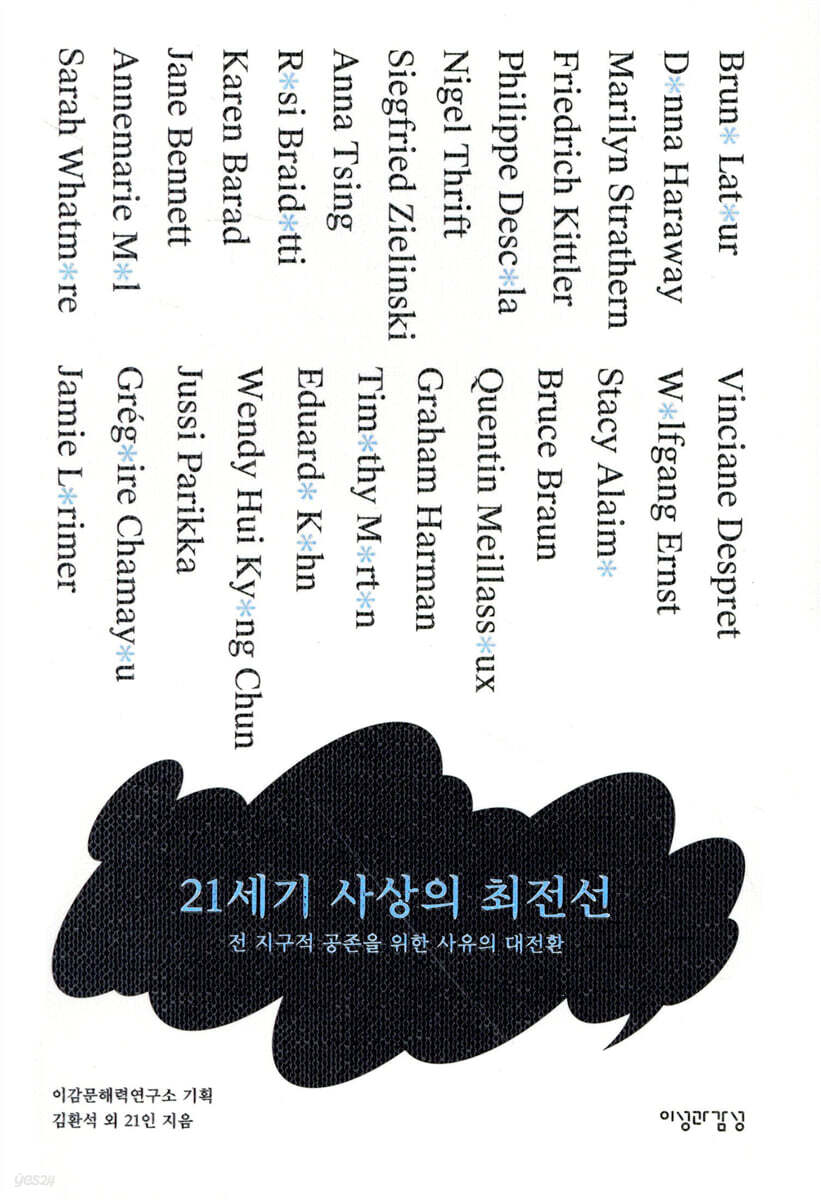
"The Frontiers of 21st Century Thought" is a book that clearly explains the discussions of twenty-five of today's leading thinkers, from Bruno Latour and Donna Haraway to Jussi Parica and Grégoire Chamayou.
Over the past 20 to 30 years, unprecedented new challenges have emerged on Earth, including zoonotic infectious diseases, the climate crisis, and big data surveillance, radically altering human life and the planetary environment.
Yet, much of the ideological discourse in the country still relies on outdated cognitive frameworks that are more than 30 years old.
Can we fully understand the 21st century without considering its material realities? In other words, can we fully anticipate the "post-COVID-19 era" through 20th-century thinking? Facing the unsustainable crisis caused not only by COVID-19 but also by global warming, fine dust, and plastic waste, we need updated diagnoses and solutions tailored to the conditions of 21st-century life.
The beginnings of a solution for a new future of coexistence are contained in 21st century thought, in 『The Front Line of 21st Century Thought』.
The thoughts and actions of 25 representative thinkers of the 21st century!
* [Culture Daily] Hot topic series project
“Ideology updated to suit the times……
“The politics and ethics of coexistence: the foundation for planning a new world.”
* [Planning Meeting] Selection of '30 Publishing Keywords for 2019'
“Overcoming the limitations of existing humanities discourse by exposing the latest ideas…
“The basis for thinking of humans as objects coexisting with things, machines, animals, and nature.”
"The Frontiers of 21st Century Thought" is a book that clearly explains the discussions of twenty-five of today's leading thinkers, from Bruno Latour and Donna Haraway to Jussi Parica and Grégoire Chamayou.
Over the past 20 to 30 years, unprecedented new challenges have emerged on Earth, including zoonotic infectious diseases, the climate crisis, and big data surveillance, radically altering human life and the planetary environment.
Yet, much of the ideological discourse in the country still relies on outdated cognitive frameworks that are more than 30 years old.
Can we fully understand the 21st century without considering its material realities? In other words, can we fully anticipate the "post-COVID-19 era" through 20th-century thinking? Facing the unsustainable crisis caused not only by COVID-19 but also by global warming, fine dust, and plastic waste, we need updated diagnoses and solutions tailored to the conditions of 21st-century life.
The beginnings of a solution for a new future of coexistence are contained in 21st century thought, in 『The Front Line of 21st Century Thought』.
- You can preview some of the book's contents.
Preview
index
- Introduction: What's Happening at the Forefront of 21st-Century Thought? (Kim Hwan-seok)
Bruno Latour: Do Only Humans Constitute Society? (Kim Hwan-seok)
Donna Haraway: How Can We Sustain Life on Earth? (Hwang Hee-sun)
Marilyn Strathearn: Why Can't We Understand the World Holistically? (Cha Eun-jung)
- Friedrich Kittler: How Does Media Change Human Perception? (Yoo Hyun-joo)
Philippe Descola: What world exists beyond the conflict between nature and culture? (Park Se-jin)
Nigel Thrift: Are Cities Made of Physical Relationships Alone? (Song Won-seop)
Siegfried Ciliński: How Do Old Media Connect with New Media? (Jussi Parica, Jeong Chan-cheol)
Anna Ching: Can nonhuman creatures become protagonists of history? (Noh Go-un)
Rosi Braidotti: How Does the Posthuman Become the Foundation of a Global Community? (Eunju Kim)
Karen Burrard: How Do Feminist Scientists Address Abortion? (Im So-yeon)
Jane Bennett: Should Lakes and Trees Be Given Legal and Political Rights? (Kim Jong-mi)
- Annemarie Mol: How Does Disease Become Real? (Seo Bo-kyung)
Sarah Watmore: How do soybeans intervene in human crop cultivation and consumption? (Choi Myung-ae)
- Banksian Despres: How Do Humans and Animals Think Together? (Joo Yoon-jung)
Wolfgang Ernst: How are digital media changing human temporality and memory? (Jeong Chan-cheol)
- Stacy Aloismo: Do the actions of substances have accidental effects on the body? (Kim Jong-gap)
Bruce Brown: Are Cities Just Human Spaces Without Animals? (Kim Sook-jin)
- Quentin Meillassoux: Can humans contemplate a pre-human world? (Taeyeon Eom)
Graham Harman: Can Humans and Nonhumans Be Unified as Objects? (Lee Jun-seok)
Timothy Morton: Is Global Warming a Natural Problem? (Lee Dong-shin)
Eduardo Cohn: How Does Life Think? (Cha Eun-jung)
- Wendy Hee-kyung Jeon: How do control and freedom coexist in computer networks? (Kim Ji-hoon)
- Yushi Parika: How Digital Devices Are Devastating the Planet (Sim Hyo-won)
- Grégoire Chamayou: How Drones Disrupt the Traditions of War (Kim Ji-hoon)
Jamie Lorimer: How can we preserve nature in an age of uncertainty about the Earth's future? (Choi Myung-ae)
Bruno Latour: Do Only Humans Constitute Society? (Kim Hwan-seok)
Donna Haraway: How Can We Sustain Life on Earth? (Hwang Hee-sun)
Marilyn Strathearn: Why Can't We Understand the World Holistically? (Cha Eun-jung)
- Friedrich Kittler: How Does Media Change Human Perception? (Yoo Hyun-joo)
Philippe Descola: What world exists beyond the conflict between nature and culture? (Park Se-jin)
Nigel Thrift: Are Cities Made of Physical Relationships Alone? (Song Won-seop)
Siegfried Ciliński: How Do Old Media Connect with New Media? (Jussi Parica, Jeong Chan-cheol)
Anna Ching: Can nonhuman creatures become protagonists of history? (Noh Go-un)
Rosi Braidotti: How Does the Posthuman Become the Foundation of a Global Community? (Eunju Kim)
Karen Burrard: How Do Feminist Scientists Address Abortion? (Im So-yeon)
Jane Bennett: Should Lakes and Trees Be Given Legal and Political Rights? (Kim Jong-mi)
- Annemarie Mol: How Does Disease Become Real? (Seo Bo-kyung)
Sarah Watmore: How do soybeans intervene in human crop cultivation and consumption? (Choi Myung-ae)
- Banksian Despres: How Do Humans and Animals Think Together? (Joo Yoon-jung)
Wolfgang Ernst: How are digital media changing human temporality and memory? (Jeong Chan-cheol)
- Stacy Aloismo: Do the actions of substances have accidental effects on the body? (Kim Jong-gap)
Bruce Brown: Are Cities Just Human Spaces Without Animals? (Kim Sook-jin)
- Quentin Meillassoux: Can humans contemplate a pre-human world? (Taeyeon Eom)
Graham Harman: Can Humans and Nonhumans Be Unified as Objects? (Lee Jun-seok)
Timothy Morton: Is Global Warming a Natural Problem? (Lee Dong-shin)
Eduardo Cohn: How Does Life Think? (Cha Eun-jung)
- Wendy Hee-kyung Jeon: How do control and freedom coexist in computer networks? (Kim Ji-hoon)
- Yushi Parika: How Digital Devices Are Devastating the Planet (Sim Hyo-won)
- Grégoire Chamayou: How Drones Disrupt the Traditions of War (Kim Ji-hoon)
Jamie Lorimer: How can we preserve nature in an age of uncertainty about the Earth's future? (Choi Myung-ae)
Detailed image

Into the book
- 21st century thought sees the world we live in as a combination of diverse human and non-human actors.
In the 21st century, hybrid phenomena such as climate change, ecological crises, and epochal technological transformations are expanding and deepening. 20th-century thinking, based on anthropocentric dualism, is no longer adequate for properly understanding and resolving these issues.
The post-anthropocentric monism of 21st-century thought, which views humans and non-humans as equal agents and seeks to understand their diverse and dynamic combinations, is far more necessary and appropriate for addressing the problems of our time.
The purpose of "The Front Lines of 21st Century Thought" is to introduce new theories that demonstrate precisely this kind of adventurous attempt.
- In 20th century thought, we would think that 'objects' like cars and cell phones move passively as directed by active 'subjects' like humans, but we know from experience that the reality is not that simple.
Cars and cell phones often don't readily comply with instructions from human agents.
Humans must adjust their behavior to the demands of the car and cell phone to successfully drive a car and use a cell phone.
---From "Introduction: What's Happening at the Forefront of 21st Century Thought? (Kim Hwan-seok)"
- In Latour's view, scientific facts are not objects that scientists discover by observing nature or that are simply constructed through mutual subjective agreement.
This is because non-human objects, no less than human scientists, play an important role as agents in creating scientific knowledge.
- To solve the ecological crisis, we need a new principle of recognition and practice that visualizes the role of hybrids, a principle that grants hybrids their rightful ontological status while simultaneously pursuing a desirable union of humans and non-humans.
To do so, we must move beyond the false dichotomy that takes for granted that science deals only with the non-human world, and that politics deals only with the human world.
---From "Bruno Latour: Do Only Humans Constitute Society? (Kim Hwan-seok)"
- Companionship is different from a ‘soft and cozy’ relationship.
‘I’ do not exist separately from the relationship and cannot exist without the other.
'I' am already someone else before the relationship, or I am just becoming someone else when different beings encounter each other.
This is the meaning of companionship.
- In Haraway's view, the ethical attitude needed today is not to reduce situations to either positive or negative, but to be faithful to both, and to cultivate the ability (responsibility) to respond responsibly to the problems inherent in each moment and each relationship.
---From "Donna Haraway: How to Pursue Sustainable Life on Earth (Hwang Hee-sun)"
- Anthropologists acknowledged that their descriptions of non-Western peoples were objective and not absolute truths, but argued that they had scholarly significance as 'partial truths'.
But as the Japanese government's example shows, partial truths often end up being the story of the West itself, not the non-West.
Pluralism attempts to discuss the innumerable and diverse worlds, but why does it ultimately end up talking about itself? Anthropologist Marilyn Strathairn points out that it's because pluralism still assumes a "whole."
… … No matter how decentralized, heterogeneous, and fragmented the parts included in the whole are, they cannot escape the whole.
There is no choice but to return to the center of the whole.
---From "Marilyn Strathairn: Why Can't We Understand the World Holistically? (Cha Eun-jung)"
- In Kittler's view, the superstructure, such as political institutions and ideologies, does not constitute a unit of history.
The same goes for the infrastructure that Marxism emphasizes, such as labor and productivity.
The element that serves as the standard for dividing eras is none other than information processing technology.
- With the invention of the phonograph, it became possible to record all kinds of noises and sounds in their raw form.
As noises that had previously been inaudible poured out all at once, human perception was also awakened in a new way.
Only after listening to recorded noises did humans realize that they had been selectively hearing only the sounds they considered meaningful.
---From "Friedrich Kittler: How Does Media Change Human Perception?" (Hyunju Yoo)
- The opposing positions of utilizing and protecting nature actually coexist antagonistically on the same horizon.
Both positions objectify nature.
In both cases, nature submits to anthropocentrism.
Nature, which is used and sacrificed for human pleasure, is protected for the greater pleasure of humans, or to relieve human suffering (for example, the heartache when seeing a cut-down tree).
- For the Achuans of the Amazon, the forests and rivers that Westernized humans objectify as nature are their world.
They make the forest and river their own world by physically and spiritually interacting with all the beings in it.
By believing that plant and animal species possess souls and lead autonomous lives, the Achua extend the patterns of interaction common among themselves to their relationships with non-humans.
---From "Philippe Descola: What World Exists Outside the Conflict Between Nature and Culture? (Park Se-jin)"
- In today's world, where people of more diverse races, classes, and genders live together in cities, it is especially important to look at these multiple entities, each with their own unique voice, as they are, and examine how they emotionally relate to and organically connect with the physical fabric of the city.
- A complete understanding of space cannot be achieved through scientific and empirical methods alone.
… … The meaning of urban space arises from the multifaceted and multi-layered relationship between space and humans, and its meaning must be understood relationally.
Therefore, the city must be understood through a microscopic approach to the emotions between space and humans, moving away from the conservative perspective of social science that discusses the completeness of space in a positivist way.
---From "Nigel Thrift: Are Cities Made of Physical Relationships Only? (Song Won-seop)"
- When people define media, they tend to focus only on the content conveyed through the media.
However, Chilinski defined media as all devices and tools that record, store, maintain, preserve, separate, and classify knowledge and information.
… … Thanks to this, people can acquire a sense of liberation about media.
We are no longer bound by the mainstream view of media as merely entertainment that provides satisfaction to audiences and consumers.
- People think of the everyday household appliance called a videotape recorder only as a device that records time and space.
But the videotape recorder is also a kind of time machine, allowing for the manipulation of space and time in someone's living room.
---From "Siegfried Ciliński: How Do Old Media Connect to New Media? (Jusi Parica, Jeong Chan-cheol)"
- Ching introduces an anecdote that the first poisonous creature to appear in these areas after the Hiroshima atomic bombing in 1945 and the Chernobyl nuclear accident in 1986 was the matsutake mushroom.
The fact that pine mushrooms, which cannot be produced by scientific farming techniques, have grown naturally in this devastated land… …shows that coexistence between humans and other creatures is possible in a devastated land.
- The global and the local do not exist in a clearly dichotomous state.
Just as the feet of living things constantly rub against the ground to create a hiking trail in the forest, global capitalism constantly rubs against the living things and cultures of the region in a specific way as it incorporates local things as resources and labor for industry.
---From "Anna Ching: Can Nonhumans Become the Protagonists of History?" (Noh Go-un)
- The body mediated by technology has already become established as a commodity in the capitalist market economy and is becoming widespread.
The commodified body is accepted by society in a wide range of forms, from relatively simple physical enhancements such as bodybuilding, colored contact lenses, and liposuction, to the direct implantation of artificial organs such as plastic surgery, artificial joints, and artificial teeth.
As technology and the body become more interconnected and commodified, the scope and scope of the “natural body” become more ambiguous.
- The ‘positive posthuman’ proposed by Braidotti actively accepts the insights of feminism.
It exposes that humanism is in fact nothing more than 'Logos-phallic-Western-anthropocentrism' and draws attention to the existence of 'others' who were not included in the category of modern humans due to gender, race, disability, etc.
This kind of reflective perspective leads to reflection on living beings and machines that have been considered inferior until now.
---From "Rosi Braidotti: How Does the Posthuman Become the Foundation of a Global Community?" (Eunju Kim)
- Ultrasound technology is not simply a tool to observe an existing fetus and confirm its existence, but rather a practice that makes the fetus an independent living being within the mother's body.
Until now, the practice has functioned as a very specific device that allows us to see the fetus in the womb and to perceive the fetus as a separate entity from society and women.
Therefore, agency lies in the technical practice itself that makes the fetus exist as an individual being, and not in the fetus as the effect of that practice.
- Women cannot be the only ones responsible for abortion.
The responsibility for abortion lies not only with the technical practice of visualizing the fetus as an independent life form, but also with health policies and medical systems, and even with the social structures that reproduce poverty.
Which of these we talk about and practice is in itself an ethical choice and an act of creating new knowledge and being.
Abortion is a phenomenon that is constantly created by this repetitive internal workings.
---From "Karen Burrard: How Do Feminist Scientists Deal with Abortion? (Im So-yeon)"
- Lake Erie, one of the Great Lakes in North America, is currently severely polluted.
… … In 2018, when the water supply reached a point where it could no longer provide drinking water, the Toledo, Ohio, City Council passed a bill declaring Lake Erie a being with the same right as humans to “live, thrive, and naturally evolve.”
It was a huge political event that shattered the traditional view that only humans have legal rights.
- The subject of classical politics was a group of people with purpose and intention, that is, the masses.
But if things, including nature, have such agency, they can also become political masses depending on how they combine with humans.
The so-called public life is created and produces effects differently at each moment depending on the various combinations of people and things.
---From "Jane Bennett: Should Lakes and Trees Be Given Legal and Political Rights?" (Kim Jong-mi)
- Disease is not simply something that doctors diagnose, but something that patients suffer from.
A hospital is more like an act that doctors and patients do together within the medical field.
In other words, illness cannot be objectively identified through medicine, but is realized through the process of finding out about it and suffering from it.
- Patients now have to research various treatments online, check doctors' records, and decide for themselves which of the major hospitals is best.
And the responsibility for all these choices lies entirely with the patient.
… …the logic of choice that combines consumerism and the concept of citizenship ultimately fails to understand the interdependence between doctors and patients, and at the same time makes care-based medicine impossible.
---From "Annemarie Mol: How Does Disease Become Real? (Seo Bo-kyung)"
- As the boycott of GM soybeans spread across Europe, new systems such as traceability and labeling of GM foods were created, and the market for organic soybeans that do not use GM seeds grew.
One result is the Chinese soybeans we commonly mix into our rice. As concerns about GM foods spread widely in our society, most of the soybeans we consume come from China, which doesn't cultivate GM soybeans.
In this way, soybeans are combined with various objects, actions, and relationships such as soil, farmers, scientists, legal systems, cultivation techniques, and markets in various times and spaces.
- The food crisis surrounding GM soybeans reveals that social phenomena are physical and sensory practices.
Scientists and policymakers provide scientific knowledge and policy judgments on the safety of GM soybeans.
However, the decisive driving force behind the social phenomenon of food safety controversy is the physical act of 'eating' and emotions such as anxiety and fear.
---From "Sarah Watmore: How Do Soybeans Intervene in Human Crop Cultivation and Consumption?" (Choi Myeong-ae)
- Is bird dance solely a reproductive act, or is it play? The question of whether birds also play invites us to consider that birds are not beings that survive and reproduce solely by the laws of evolution, but rather organisms possessing their own aesthetics, playfulness, and amusement.
- Science is not based on neutral, objective observation and analysis, but on implicit narratives, and animals, along with humans, are involved in shaping those narratives.
So, when constructing a story about the relationship between animals and humans, Despre recommends and practices thinking from the animals' perspective.
To do so, researchers must ask themselves whether the questions they are asking are ones that are of interest only to humans or whether they are topics that animals might also be interested in.
---From "Banksian Despre: How Do Humans and Animals Think Together? (Joo Yoon-jung)"
- The new humanity is a being that primarily converses with digital media itself.
The act of tapping the keyboard and touch screen with one's fingers and clicking the save and send buttons is in itself a conversation with digital media, and the recipient who receives the message through subsequent coding, transmission, and decoding is closer to the audience of the conversation between humans and digital media.
- Digital data does not always exist in the same form, as it follows methods such as streaming, encoding, and decoding.
… … Unlike paper documents, digital storage devices are constantly moving, updating, linking, and reconfiguring.
This means that the foundation of the archive that records and preserves human life, that is, the culture of memory, has moved from a fixed physical space to a fluid virtual space.
---From "Wolfgang Ernst: How Digital Media Changes Human Temporality and Memory (Jeong Chan-cheol)"
- Alamo believed that past feminist theories had overemphasized the social construction of sex, resulting in the neglect of the natural and material nature of sex.
… … He argued that if feminism were to break free from the shackles of biological determinism, it would have to redefine what matter is and examine the interaction between matter and humans.
- While efforts and practices at the level of science policy, such as reducing the use of fossil fuels and developing green energy, are of course important, a fundamental shift in perspective on nature is equally important.
Without the realization that the human body is the flesh of nature and that the body of nature is the flesh of human beings, these efforts will only end up as temporary measures.
---From "Stacey Alaimo: Do the actions of matter have accidental effects on the body? (Kim Jong-gap)"
- Common infectious diseases such as SARS, avian influenza, and MERS strike fear into people by appearing in the form of mutant viruses that even scientists and medical doctors cannot explain.
Because it is so deadly that it threatens life, because it spreads so quickly that it can spread across continents, and because there is not even a vaccine for treatment.
- The common infectious disease of humans draws attention to the agents that constitute important elements of urban life but are not recognized by humans: animals, microorganisms, aircraft, sewer systems, and respirators (masks).
- The common epidemic of the virus also challenges the perception that cities have strict boundaries.
… … The SARS crisis demonstrates that the spread and infection of viruses can occur regardless of the physical distance from the epicenter.
In other words, proximity is the effect of connection, not distance.
SARS posed a significant threat to people living far from its epicenter, such as in Singapore and Toronto, and was closely linked to their social and political lives.
---From "Bruce Brown: Is the City a Space for Humans Only, Without Animals? (Kim Sook-jin)"
If all thought is merely a bias about the world, and if, despite this (or perhaps because of it), every thought has its own meaning, can we criticize a particular thought as being wrong? Meiyasoux diagnoses that modern philosophy has become a refuge for relativistic beliefs that, through correlationism, endorse all sorts of irrationality.
- To escape the mystification of absolute reality, we must face the fact that the question of the reason for existence cannot but yield disappointing answers.
The absolute reality presented by Meiyasu does not mean any absolute principle, basis, or reason for existence, but rather the fundamental contingency of existence, that is, the absence of reason.
---From "Quentin Meillassoux: Can Humans Think of the Pre-Human World? (Tae-yeon Eom)"
- Understanding the world by using humans as the standard for all things can lead to contradictory perspectives that can lead to ethical debates, such as speciesism.
… … Therefore, Harman believes that by unifying everything as objects without distinguishing between humans and the rest of the world, he can solve or eliminate a significant portion of the problems occurring in the world.
- The rapid advancement of technology and science that we are experiencing at the turn of the century calls for new thinking about the relationship between subject and object.
Harman provides a new framework for thinking about the issues that have emerged surrounding nature-society polymers.
---From "Graham Harman: Can Humans and Non-Humans Be Unified as Objects? (Lee Jun-seok)"
- It is undeniable that the world of the 21st century is overflowing with gigantic objects created by humans.
Besides global warming, the Internet and nuclear testing illustrate this point well.
… … People use the Internet every day, yet they don’t realize the scale, speed, and change of the Internet as a whole.
- The question of whether environmental issues are more important than human issues may seem at first glance to require a value judgment, but in reality it only reproduces the dichotomous structure between humans and nature.
For this reason, Morton argues that to achieve a true ecological transformation, the very concept of nature must be abandoned.
---From "Timothy Morton: Is Global Warming a Natural Problem? (Lee Dong-shin)"
- Insects, ticks, and woolly monkeys are all interpreters of signs, and their life activities cannot be reduced to simple physiological functions.
This is because their ecosystem is a chain process of signs itself, and life cannot continue without participating in this process.
In other words, symbols are not limited to human language, but extend to the life activities of all living things.
Life is composed of symbols.
- In the Amazon rainforest, the subject of thought does not exist first, nor does the thought of the subject follow it.
In the forest, thoughts exist in themselves, and within this flow of thoughts, someone or something just happens to be there at the time.
In this way, Cone seeks to reach the teachings and enlightenment of the forest by asking how the forest thinks, rather than how humans think of the forest.
---From "Eduardo Cohn: How Does Life Think? (Cha Eun-jung)"
- The freedom of navigation and search enjoyed by users of cyberspace comes at the price of secretly submitting to a series of controls operating behind the computer monitor.
Therefore, the freedom enjoyed through the Internet brings with it new types of vulnerabilities, including a weakening of privacy, and causes paranoid anxiety.
- Habitual connection to social media fosters updates, supporting the logic of instability and change that drives neoliberalism.
It also promotes the collection of quantifiable data, including big data, and breaks down the traditional distinction between private and public space.
---From "Wendy Hee-kyung Jeon: How Do Control and Freedom Coexist in Computer Networks? (Kim Ji-hoon)"
Many digital devices tout themselves as innovative and are marketed as cutting-edge products, but in reality, they are based on things that are so old that it is difficult to imagine from a human perspective, let alone new.
Planned obsolescence is problematic not only because it distances us from the fundamental understanding that media is based on the earth's material, but also because it fuels global depletion and consumption, further accelerating the shortening of its life cycle.
- The development and use of media devices, a combination of cutting-edge technology and capitalism, leads to the compulsive release of new products that quickly become waste, accelerating environmental destruction.
---From "Yushi Parika: How Digital Devices Are Devastating the Earth (Sim Hyo-won)"
- The weapon called drone lacks a human body.
While kamikazes are beings for whom death is a given, drone pilots are beings for whom death is impossible.
In this way, drones paradoxically change the relationship between life and death, and between the body and technology.
- Today, the ethics of war are replaced by faceless, one-sided violence carried out by drones.
In this sense, Shamayu calls drones “weapons of cowards.”
---From "Grégoire Chamayou: How Drones Disrupt the Traditions of War (Kim Ji-hoon)"
- Discussions and practices on nature conservation in the 20th century were mainly conducted from the perspective of ‘wildlife’ conservation.
However, in the process of protecting large wild animals such as elephants and tigers, there have been cases where indigenous people who have lived there for generations have been forcibly relocated or their safety and livelihood have been sacrificed.
- Rewilding is a conservation practice that aims to restore ecological processes.
It is believed that nature can be restored by activating ecological processes, just as the current natural landscape was created over the past 10,000 years since the last ice age.
In the 21st century, hybrid phenomena such as climate change, ecological crises, and epochal technological transformations are expanding and deepening. 20th-century thinking, based on anthropocentric dualism, is no longer adequate for properly understanding and resolving these issues.
The post-anthropocentric monism of 21st-century thought, which views humans and non-humans as equal agents and seeks to understand their diverse and dynamic combinations, is far more necessary and appropriate for addressing the problems of our time.
The purpose of "The Front Lines of 21st Century Thought" is to introduce new theories that demonstrate precisely this kind of adventurous attempt.
- In 20th century thought, we would think that 'objects' like cars and cell phones move passively as directed by active 'subjects' like humans, but we know from experience that the reality is not that simple.
Cars and cell phones often don't readily comply with instructions from human agents.
Humans must adjust their behavior to the demands of the car and cell phone to successfully drive a car and use a cell phone.
---From "Introduction: What's Happening at the Forefront of 21st Century Thought? (Kim Hwan-seok)"
- In Latour's view, scientific facts are not objects that scientists discover by observing nature or that are simply constructed through mutual subjective agreement.
This is because non-human objects, no less than human scientists, play an important role as agents in creating scientific knowledge.
- To solve the ecological crisis, we need a new principle of recognition and practice that visualizes the role of hybrids, a principle that grants hybrids their rightful ontological status while simultaneously pursuing a desirable union of humans and non-humans.
To do so, we must move beyond the false dichotomy that takes for granted that science deals only with the non-human world, and that politics deals only with the human world.
---From "Bruno Latour: Do Only Humans Constitute Society? (Kim Hwan-seok)"
- Companionship is different from a ‘soft and cozy’ relationship.
‘I’ do not exist separately from the relationship and cannot exist without the other.
'I' am already someone else before the relationship, or I am just becoming someone else when different beings encounter each other.
This is the meaning of companionship.
- In Haraway's view, the ethical attitude needed today is not to reduce situations to either positive or negative, but to be faithful to both, and to cultivate the ability (responsibility) to respond responsibly to the problems inherent in each moment and each relationship.
---From "Donna Haraway: How to Pursue Sustainable Life on Earth (Hwang Hee-sun)"
- Anthropologists acknowledged that their descriptions of non-Western peoples were objective and not absolute truths, but argued that they had scholarly significance as 'partial truths'.
But as the Japanese government's example shows, partial truths often end up being the story of the West itself, not the non-West.
Pluralism attempts to discuss the innumerable and diverse worlds, but why does it ultimately end up talking about itself? Anthropologist Marilyn Strathairn points out that it's because pluralism still assumes a "whole."
… … No matter how decentralized, heterogeneous, and fragmented the parts included in the whole are, they cannot escape the whole.
There is no choice but to return to the center of the whole.
---From "Marilyn Strathairn: Why Can't We Understand the World Holistically? (Cha Eun-jung)"
- In Kittler's view, the superstructure, such as political institutions and ideologies, does not constitute a unit of history.
The same goes for the infrastructure that Marxism emphasizes, such as labor and productivity.
The element that serves as the standard for dividing eras is none other than information processing technology.
- With the invention of the phonograph, it became possible to record all kinds of noises and sounds in their raw form.
As noises that had previously been inaudible poured out all at once, human perception was also awakened in a new way.
Only after listening to recorded noises did humans realize that they had been selectively hearing only the sounds they considered meaningful.
---From "Friedrich Kittler: How Does Media Change Human Perception?" (Hyunju Yoo)
- The opposing positions of utilizing and protecting nature actually coexist antagonistically on the same horizon.
Both positions objectify nature.
In both cases, nature submits to anthropocentrism.
Nature, which is used and sacrificed for human pleasure, is protected for the greater pleasure of humans, or to relieve human suffering (for example, the heartache when seeing a cut-down tree).
- For the Achuans of the Amazon, the forests and rivers that Westernized humans objectify as nature are their world.
They make the forest and river their own world by physically and spiritually interacting with all the beings in it.
By believing that plant and animal species possess souls and lead autonomous lives, the Achua extend the patterns of interaction common among themselves to their relationships with non-humans.
---From "Philippe Descola: What World Exists Outside the Conflict Between Nature and Culture? (Park Se-jin)"
- In today's world, where people of more diverse races, classes, and genders live together in cities, it is especially important to look at these multiple entities, each with their own unique voice, as they are, and examine how they emotionally relate to and organically connect with the physical fabric of the city.
- A complete understanding of space cannot be achieved through scientific and empirical methods alone.
… … The meaning of urban space arises from the multifaceted and multi-layered relationship between space and humans, and its meaning must be understood relationally.
Therefore, the city must be understood through a microscopic approach to the emotions between space and humans, moving away from the conservative perspective of social science that discusses the completeness of space in a positivist way.
---From "Nigel Thrift: Are Cities Made of Physical Relationships Only? (Song Won-seop)"
- When people define media, they tend to focus only on the content conveyed through the media.
However, Chilinski defined media as all devices and tools that record, store, maintain, preserve, separate, and classify knowledge and information.
… … Thanks to this, people can acquire a sense of liberation about media.
We are no longer bound by the mainstream view of media as merely entertainment that provides satisfaction to audiences and consumers.
- People think of the everyday household appliance called a videotape recorder only as a device that records time and space.
But the videotape recorder is also a kind of time machine, allowing for the manipulation of space and time in someone's living room.
---From "Siegfried Ciliński: How Do Old Media Connect to New Media? (Jusi Parica, Jeong Chan-cheol)"
- Ching introduces an anecdote that the first poisonous creature to appear in these areas after the Hiroshima atomic bombing in 1945 and the Chernobyl nuclear accident in 1986 was the matsutake mushroom.
The fact that pine mushrooms, which cannot be produced by scientific farming techniques, have grown naturally in this devastated land… …shows that coexistence between humans and other creatures is possible in a devastated land.
- The global and the local do not exist in a clearly dichotomous state.
Just as the feet of living things constantly rub against the ground to create a hiking trail in the forest, global capitalism constantly rubs against the living things and cultures of the region in a specific way as it incorporates local things as resources and labor for industry.
---From "Anna Ching: Can Nonhumans Become the Protagonists of History?" (Noh Go-un)
- The body mediated by technology has already become established as a commodity in the capitalist market economy and is becoming widespread.
The commodified body is accepted by society in a wide range of forms, from relatively simple physical enhancements such as bodybuilding, colored contact lenses, and liposuction, to the direct implantation of artificial organs such as plastic surgery, artificial joints, and artificial teeth.
As technology and the body become more interconnected and commodified, the scope and scope of the “natural body” become more ambiguous.
- The ‘positive posthuman’ proposed by Braidotti actively accepts the insights of feminism.
It exposes that humanism is in fact nothing more than 'Logos-phallic-Western-anthropocentrism' and draws attention to the existence of 'others' who were not included in the category of modern humans due to gender, race, disability, etc.
This kind of reflective perspective leads to reflection on living beings and machines that have been considered inferior until now.
---From "Rosi Braidotti: How Does the Posthuman Become the Foundation of a Global Community?" (Eunju Kim)
- Ultrasound technology is not simply a tool to observe an existing fetus and confirm its existence, but rather a practice that makes the fetus an independent living being within the mother's body.
Until now, the practice has functioned as a very specific device that allows us to see the fetus in the womb and to perceive the fetus as a separate entity from society and women.
Therefore, agency lies in the technical practice itself that makes the fetus exist as an individual being, and not in the fetus as the effect of that practice.
- Women cannot be the only ones responsible for abortion.
The responsibility for abortion lies not only with the technical practice of visualizing the fetus as an independent life form, but also with health policies and medical systems, and even with the social structures that reproduce poverty.
Which of these we talk about and practice is in itself an ethical choice and an act of creating new knowledge and being.
Abortion is a phenomenon that is constantly created by this repetitive internal workings.
---From "Karen Burrard: How Do Feminist Scientists Deal with Abortion? (Im So-yeon)"
- Lake Erie, one of the Great Lakes in North America, is currently severely polluted.
… … In 2018, when the water supply reached a point where it could no longer provide drinking water, the Toledo, Ohio, City Council passed a bill declaring Lake Erie a being with the same right as humans to “live, thrive, and naturally evolve.”
It was a huge political event that shattered the traditional view that only humans have legal rights.
- The subject of classical politics was a group of people with purpose and intention, that is, the masses.
But if things, including nature, have such agency, they can also become political masses depending on how they combine with humans.
The so-called public life is created and produces effects differently at each moment depending on the various combinations of people and things.
---From "Jane Bennett: Should Lakes and Trees Be Given Legal and Political Rights?" (Kim Jong-mi)
- Disease is not simply something that doctors diagnose, but something that patients suffer from.
A hospital is more like an act that doctors and patients do together within the medical field.
In other words, illness cannot be objectively identified through medicine, but is realized through the process of finding out about it and suffering from it.
- Patients now have to research various treatments online, check doctors' records, and decide for themselves which of the major hospitals is best.
And the responsibility for all these choices lies entirely with the patient.
… …the logic of choice that combines consumerism and the concept of citizenship ultimately fails to understand the interdependence between doctors and patients, and at the same time makes care-based medicine impossible.
---From "Annemarie Mol: How Does Disease Become Real? (Seo Bo-kyung)"
- As the boycott of GM soybeans spread across Europe, new systems such as traceability and labeling of GM foods were created, and the market for organic soybeans that do not use GM seeds grew.
One result is the Chinese soybeans we commonly mix into our rice. As concerns about GM foods spread widely in our society, most of the soybeans we consume come from China, which doesn't cultivate GM soybeans.
In this way, soybeans are combined with various objects, actions, and relationships such as soil, farmers, scientists, legal systems, cultivation techniques, and markets in various times and spaces.
- The food crisis surrounding GM soybeans reveals that social phenomena are physical and sensory practices.
Scientists and policymakers provide scientific knowledge and policy judgments on the safety of GM soybeans.
However, the decisive driving force behind the social phenomenon of food safety controversy is the physical act of 'eating' and emotions such as anxiety and fear.
---From "Sarah Watmore: How Do Soybeans Intervene in Human Crop Cultivation and Consumption?" (Choi Myeong-ae)
- Is bird dance solely a reproductive act, or is it play? The question of whether birds also play invites us to consider that birds are not beings that survive and reproduce solely by the laws of evolution, but rather organisms possessing their own aesthetics, playfulness, and amusement.
- Science is not based on neutral, objective observation and analysis, but on implicit narratives, and animals, along with humans, are involved in shaping those narratives.
So, when constructing a story about the relationship between animals and humans, Despre recommends and practices thinking from the animals' perspective.
To do so, researchers must ask themselves whether the questions they are asking are ones that are of interest only to humans or whether they are topics that animals might also be interested in.
---From "Banksian Despre: How Do Humans and Animals Think Together? (Joo Yoon-jung)"
- The new humanity is a being that primarily converses with digital media itself.
The act of tapping the keyboard and touch screen with one's fingers and clicking the save and send buttons is in itself a conversation with digital media, and the recipient who receives the message through subsequent coding, transmission, and decoding is closer to the audience of the conversation between humans and digital media.
- Digital data does not always exist in the same form, as it follows methods such as streaming, encoding, and decoding.
… … Unlike paper documents, digital storage devices are constantly moving, updating, linking, and reconfiguring.
This means that the foundation of the archive that records and preserves human life, that is, the culture of memory, has moved from a fixed physical space to a fluid virtual space.
---From "Wolfgang Ernst: How Digital Media Changes Human Temporality and Memory (Jeong Chan-cheol)"
- Alamo believed that past feminist theories had overemphasized the social construction of sex, resulting in the neglect of the natural and material nature of sex.
… … He argued that if feminism were to break free from the shackles of biological determinism, it would have to redefine what matter is and examine the interaction between matter and humans.
- While efforts and practices at the level of science policy, such as reducing the use of fossil fuels and developing green energy, are of course important, a fundamental shift in perspective on nature is equally important.
Without the realization that the human body is the flesh of nature and that the body of nature is the flesh of human beings, these efforts will only end up as temporary measures.
---From "Stacey Alaimo: Do the actions of matter have accidental effects on the body? (Kim Jong-gap)"
- Common infectious diseases such as SARS, avian influenza, and MERS strike fear into people by appearing in the form of mutant viruses that even scientists and medical doctors cannot explain.
Because it is so deadly that it threatens life, because it spreads so quickly that it can spread across continents, and because there is not even a vaccine for treatment.
- The common infectious disease of humans draws attention to the agents that constitute important elements of urban life but are not recognized by humans: animals, microorganisms, aircraft, sewer systems, and respirators (masks).
- The common epidemic of the virus also challenges the perception that cities have strict boundaries.
… … The SARS crisis demonstrates that the spread and infection of viruses can occur regardless of the physical distance from the epicenter.
In other words, proximity is the effect of connection, not distance.
SARS posed a significant threat to people living far from its epicenter, such as in Singapore and Toronto, and was closely linked to their social and political lives.
---From "Bruce Brown: Is the City a Space for Humans Only, Without Animals? (Kim Sook-jin)"
If all thought is merely a bias about the world, and if, despite this (or perhaps because of it), every thought has its own meaning, can we criticize a particular thought as being wrong? Meiyasoux diagnoses that modern philosophy has become a refuge for relativistic beliefs that, through correlationism, endorse all sorts of irrationality.
- To escape the mystification of absolute reality, we must face the fact that the question of the reason for existence cannot but yield disappointing answers.
The absolute reality presented by Meiyasu does not mean any absolute principle, basis, or reason for existence, but rather the fundamental contingency of existence, that is, the absence of reason.
---From "Quentin Meillassoux: Can Humans Think of the Pre-Human World? (Tae-yeon Eom)"
- Understanding the world by using humans as the standard for all things can lead to contradictory perspectives that can lead to ethical debates, such as speciesism.
… … Therefore, Harman believes that by unifying everything as objects without distinguishing between humans and the rest of the world, he can solve or eliminate a significant portion of the problems occurring in the world.
- The rapid advancement of technology and science that we are experiencing at the turn of the century calls for new thinking about the relationship between subject and object.
Harman provides a new framework for thinking about the issues that have emerged surrounding nature-society polymers.
---From "Graham Harman: Can Humans and Non-Humans Be Unified as Objects? (Lee Jun-seok)"
- It is undeniable that the world of the 21st century is overflowing with gigantic objects created by humans.
Besides global warming, the Internet and nuclear testing illustrate this point well.
… … People use the Internet every day, yet they don’t realize the scale, speed, and change of the Internet as a whole.
- The question of whether environmental issues are more important than human issues may seem at first glance to require a value judgment, but in reality it only reproduces the dichotomous structure between humans and nature.
For this reason, Morton argues that to achieve a true ecological transformation, the very concept of nature must be abandoned.
---From "Timothy Morton: Is Global Warming a Natural Problem? (Lee Dong-shin)"
- Insects, ticks, and woolly monkeys are all interpreters of signs, and their life activities cannot be reduced to simple physiological functions.
This is because their ecosystem is a chain process of signs itself, and life cannot continue without participating in this process.
In other words, symbols are not limited to human language, but extend to the life activities of all living things.
Life is composed of symbols.
- In the Amazon rainforest, the subject of thought does not exist first, nor does the thought of the subject follow it.
In the forest, thoughts exist in themselves, and within this flow of thoughts, someone or something just happens to be there at the time.
In this way, Cone seeks to reach the teachings and enlightenment of the forest by asking how the forest thinks, rather than how humans think of the forest.
---From "Eduardo Cohn: How Does Life Think? (Cha Eun-jung)"
- The freedom of navigation and search enjoyed by users of cyberspace comes at the price of secretly submitting to a series of controls operating behind the computer monitor.
Therefore, the freedom enjoyed through the Internet brings with it new types of vulnerabilities, including a weakening of privacy, and causes paranoid anxiety.
- Habitual connection to social media fosters updates, supporting the logic of instability and change that drives neoliberalism.
It also promotes the collection of quantifiable data, including big data, and breaks down the traditional distinction between private and public space.
---From "Wendy Hee-kyung Jeon: How Do Control and Freedom Coexist in Computer Networks? (Kim Ji-hoon)"
Many digital devices tout themselves as innovative and are marketed as cutting-edge products, but in reality, they are based on things that are so old that it is difficult to imagine from a human perspective, let alone new.
Planned obsolescence is problematic not only because it distances us from the fundamental understanding that media is based on the earth's material, but also because it fuels global depletion and consumption, further accelerating the shortening of its life cycle.
- The development and use of media devices, a combination of cutting-edge technology and capitalism, leads to the compulsive release of new products that quickly become waste, accelerating environmental destruction.
---From "Yushi Parika: How Digital Devices Are Devastating the Earth (Sim Hyo-won)"
- The weapon called drone lacks a human body.
While kamikazes are beings for whom death is a given, drone pilots are beings for whom death is impossible.
In this way, drones paradoxically change the relationship between life and death, and between the body and technology.
- Today, the ethics of war are replaced by faceless, one-sided violence carried out by drones.
In this sense, Shamayu calls drones “weapons of cowards.”
---From "Grégoire Chamayou: How Drones Disrupt the Traditions of War (Kim Ji-hoon)"
- Discussions and practices on nature conservation in the 20th century were mainly conducted from the perspective of ‘wildlife’ conservation.
However, in the process of protecting large wild animals such as elephants and tigers, there have been cases where indigenous people who have lived there for generations have been forcibly relocated or their safety and livelihood have been sacrificed.
- Rewilding is a conservation practice that aims to restore ecological processes.
It is believed that nature can be restored by activating ecological processes, just as the current natural landscape was created over the past 10,000 years since the last ice age.
---From "Jamie Lorimer: How to Preserve Nature in an Age of Uncertainty about the Future of the Earth (Choi Myeong-ae)"
Publisher's Review
The posthuman era awakens new ways of life and relationships beyond humans.
The thoughts and actions of 25 representative thinkers of the 21st century!
* [Culture Daily] Hot topic series project
“Ideology updated to suit the times……
“The politics and ethics of coexistence: the foundation for planning a new world.”
* [Planning Meeting] Selection of '30 Publishing Keywords for 2019'
“Overcoming the limitations of existing humanities discourse by exposing the latest ideas…
“The basis for thinking of humans as objects coexisting with things, machines, animals, and nature.”
"The Frontiers of 21st Century Thought" is a book that clearly explains the discussions of twenty-five of today's leading thinkers, from Bruno Latour and Donna Haraway to Jussi Parica and Grégoire Chamayou.
Over the past 20 to 30 years, unprecedented new challenges have emerged on Earth, including zoonotic infectious diseases, the climate crisis, and big data surveillance, radically altering human life and the planetary environment.
Yet, much of the ideological discourse in the country still relies on outdated cognitive frameworks that are more than 30 years old.
Can we fully understand the 21st century without considering its material realities? In other words, can we fully anticipate the "post-COVID-19 era" through 20th-century thinking? Facing the unsustainable crisis caused not only by COVID-19 but also by global warming, fine dust, and plastic waste, we need updated diagnoses and solutions tailored to the conditions of 21st-century life.
The beginnings of a solution for a new future of coexistence are contained in 21st century thought, in 『The Front Line of 21st Century Thought』.
Korea's first public project to introduce the latest ideas of the present age.
The discussions introduced in "The Front Lines of 21st Century Thought" are a new intellectual current that began to sprout in the 1990s after the fad of "post-theory" in the late 20th century passed and blossomed in the 2010s.
Projects introducing multiple thinkers on the same page have often existed in Korea over the past several years, but most of them have either focused on 20th-century thought or have been retrospectives.
"The Front Line of Thought in the 21st Century" focuses on thoughts that reflect the very times we live in.
From new materialism (new materialist feminism), ontological turn, object-oriented ontology, speculative realism, critical posthumanism, media archaeology, critical digital media studies, to geography beyond the human... The thinkers and theories covered in 『Frontiers of Thought in the 21st Century』 are clearly theoretically and generationally distinct from the intellectual giants of the past era, such as Michel Foucault and Gilles Deleuze, or at least they differ from existing projects in that they read them in a very critical, reflective, and original way.
Accordingly, the book 『The Front Lines of Thought in the 21st Century』 has a large number of new Korean researchers in their 30s and 40s who have been rarely seen in established popular publications as authors.
As with the thinkers introduced in the book, scholars today freely interact and exchange ideological influences through social media and other platforms.
Thanks to these international connections, Yussi Parrikar, who has been introduced as one of the leading thinkers of the 21st century, also participated in this project as an author.
Parika also announced his participation in this project through his blog, and this collaborative landscape clearly demonstrates that 21st-century thought is still vibrant and evolving.
Post-anthropocentrism permeates 21st-century thought
Signs of a cataclysmic event that darkens the future of humanity were already appearing all over the globe.
As greenhouse gases in the atmosphere increase, lethal heat waves occur every year and ecosystem disruption worsens.
While humans have developed various new technologies such as artificial intelligence, artificial bodies, artificial radiation, advanced medicine, big data, electronic devices, and drones to further advance technological civilization, they have also faced the challenge of having to deal with the side effects that have arisen along with these technologies.
The COVID-19 pandemic has only brought these problematic situations to the forefront of our eyes.
Big data and drone surveillance have infiltrated the daily lives of ordinary people, and as humans vacate the streets, robots have taken their place, and animals have begun to find their own way back to their normal lives.
This unexpected development shatters the huge illusion that only humans can control the Earth.
The discussions of the thinkers featured in "The Front Lines of Thought in the 21st Century" share the view that even human society is not run by humans alone.
These thinkers emphasize that we must move beyond anthropocentric thinking, pointing out that the world we live in is made up of a combination of diverse human and non-human actors.
Yet, each thinker seeks to transform the chaotic present into a future of coexistence through their own unique insights and alternative practices.
For example, Bruno Latour cites the example of speed bumps that control human behavior, reminding us of objects as agents that intervene in society, and challenges the current political system that recognizes only humans as subjects.
Donna Haraway questions the term "Anthropocene," which refers to the period in which humans have had a major impact on the Earth's environment.
This is because behind the excessive sense of responsibility of humans, there may be an arrogance that only humans can do something.
He recognizes the dangers of this anthropocentric thinking and instead proposes a "capitalocene" to specifically understand the impact of capitalist production on the planet.
Rosi Braidotti also calls attention to the diverse genders, races, and disabilities that modern humanism has excluded, and argues that we must coexist and coevolve in new ways by solidarizing with diverse posthuman subjects, such as environmental others and technological devices.
A better future created by humans and non-humans together
21st-century thought presents a new perspective on human ontology by critically exploring the concrete material problems that arise in everyday reality.
For example, Bruce Brown revisits the ontology of the human body and the city through the specific case of the SARS crisis.
As the COVID-19 pandemic has clearly demonstrated, the spread of viruses occurs regardless of physical distance from the epicenter.
SARS originated in China's Guangdong province, but the first person infected was an American businessman.
However, the first place where symptoms appeared was Hanoi, Vietnam, and the first infected person died was Hong Kong.
During this process, medical staff, airplane passengers, and hotel guests who came into contact with him were infected, and SARS spread to 37 countries around the world in just a few weeks.
In the midst of the crisis brought about by the zoonotic pandemic, humans are finally realizing the existence of nonhuman agents such as animals, microbes, airplanes, and masks, as well as the borderlessness of the city.
Meanwhile, Grégoire Samayou focuses on drones, the modern embodiment of remote surveillance and attack technology, revealing a reality in which the relationship between the body and technology is subverted and human dignity is radically denied.
Drones, which can transform the entire world into a potential battlefield without deploying soldiers, are undermining traditional laws and ethics of war and jeopardizing the legal framework for interpreting war.
Drones are unstable entities with unprecedented ramifications, both as disembodied weapons and as ambiguous entities that merge objects and people.
In addition, Stacey Alaimo exposes the environmental damage linked to global economic activity by examining the effects of toxic substances on the body, while Yussi Parika focuses on the problem of digital devices and electronic waste mass-produced through planned obsolescence.
Timothy Morton captures the phenomenon of "giant things" as being too large in scale for an individual to perceive, and suggests a way to more deeply consider global phenomena that have emerged very recently in human history, such as global warming, fine dust, and the Internet.
The optimal guide to understanding the vast terrain of contemporary thought.
The vast terrain of 21st-century thought is difficult to grasp, as it freely crosses the boundaries of knowledge.
However, 『The Frontiers of Thought in the 21st Century』 serves as an optimal guide for readers new to contemporary thought, as it focuses on the core questions of each thinker and provides a three-dimensional explanation of the context and network of relationships in which new ideas emerged.
The titles of each essay are structured around specific questions, showing the angle from which each thinker approaches the problem and illustrating how ideas that once seemed distant can be connected to everyday material.
This allows readers who are encountering contemporary thinkers for the first time to easily share their critical awareness.
In addition to clearly explaining the core arguments and implications of each thinker in the main text, supplementary materials are included at the end of each chapter to provide a concise understanding of the thinker's history and the contents of his or her major works.
This resource presents a table of contents detailing the thinker's academic discipline, ideological stance, influential figures, critics, and colleagues, major activities, and events, along with a list of major translations.
This allows readers to grasp basic information about each thinker at a glance and find and read original texts more easily.
Illustrations that sensually capture the essence of each thinker's discussion, featuring artists Lee Jeong-ho, Byeon Yeong-geun, and Lee Bu-rok.
Each chapter of 『The Front Lines of 21st Century Thought』 includes full-color illustrations.
Artists Lee Jeong-ho, Byun Yeong-geun, and Lee Bu-rok, who have showcased their unique styles through various media such as individual collections, collaborative books, and exhibitions, have sensually interpreted and captured the core arguments of thinkers, giving each text a colorful visual image and identity.
These twenty-six illustrations are exquisite visual translations of 21st-century thought, and they are sure to be a valuable addition to any reader's collection.
The thoughts and actions of 25 representative thinkers of the 21st century!
* [Culture Daily] Hot topic series project
“Ideology updated to suit the times……
“The politics and ethics of coexistence: the foundation for planning a new world.”
* [Planning Meeting] Selection of '30 Publishing Keywords for 2019'
“Overcoming the limitations of existing humanities discourse by exposing the latest ideas…
“The basis for thinking of humans as objects coexisting with things, machines, animals, and nature.”
"The Frontiers of 21st Century Thought" is a book that clearly explains the discussions of twenty-five of today's leading thinkers, from Bruno Latour and Donna Haraway to Jussi Parica and Grégoire Chamayou.
Over the past 20 to 30 years, unprecedented new challenges have emerged on Earth, including zoonotic infectious diseases, the climate crisis, and big data surveillance, radically altering human life and the planetary environment.
Yet, much of the ideological discourse in the country still relies on outdated cognitive frameworks that are more than 30 years old.
Can we fully understand the 21st century without considering its material realities? In other words, can we fully anticipate the "post-COVID-19 era" through 20th-century thinking? Facing the unsustainable crisis caused not only by COVID-19 but also by global warming, fine dust, and plastic waste, we need updated diagnoses and solutions tailored to the conditions of 21st-century life.
The beginnings of a solution for a new future of coexistence are contained in 21st century thought, in 『The Front Line of 21st Century Thought』.
Korea's first public project to introduce the latest ideas of the present age.
The discussions introduced in "The Front Lines of 21st Century Thought" are a new intellectual current that began to sprout in the 1990s after the fad of "post-theory" in the late 20th century passed and blossomed in the 2010s.
Projects introducing multiple thinkers on the same page have often existed in Korea over the past several years, but most of them have either focused on 20th-century thought or have been retrospectives.
"The Front Line of Thought in the 21st Century" focuses on thoughts that reflect the very times we live in.
From new materialism (new materialist feminism), ontological turn, object-oriented ontology, speculative realism, critical posthumanism, media archaeology, critical digital media studies, to geography beyond the human... The thinkers and theories covered in 『Frontiers of Thought in the 21st Century』 are clearly theoretically and generationally distinct from the intellectual giants of the past era, such as Michel Foucault and Gilles Deleuze, or at least they differ from existing projects in that they read them in a very critical, reflective, and original way.
Accordingly, the book 『The Front Lines of Thought in the 21st Century』 has a large number of new Korean researchers in their 30s and 40s who have been rarely seen in established popular publications as authors.
As with the thinkers introduced in the book, scholars today freely interact and exchange ideological influences through social media and other platforms.
Thanks to these international connections, Yussi Parrikar, who has been introduced as one of the leading thinkers of the 21st century, also participated in this project as an author.
Parika also announced his participation in this project through his blog, and this collaborative landscape clearly demonstrates that 21st-century thought is still vibrant and evolving.
Post-anthropocentrism permeates 21st-century thought
Signs of a cataclysmic event that darkens the future of humanity were already appearing all over the globe.
As greenhouse gases in the atmosphere increase, lethal heat waves occur every year and ecosystem disruption worsens.
While humans have developed various new technologies such as artificial intelligence, artificial bodies, artificial radiation, advanced medicine, big data, electronic devices, and drones to further advance technological civilization, they have also faced the challenge of having to deal with the side effects that have arisen along with these technologies.
The COVID-19 pandemic has only brought these problematic situations to the forefront of our eyes.
Big data and drone surveillance have infiltrated the daily lives of ordinary people, and as humans vacate the streets, robots have taken their place, and animals have begun to find their own way back to their normal lives.
This unexpected development shatters the huge illusion that only humans can control the Earth.
The discussions of the thinkers featured in "The Front Lines of Thought in the 21st Century" share the view that even human society is not run by humans alone.
These thinkers emphasize that we must move beyond anthropocentric thinking, pointing out that the world we live in is made up of a combination of diverse human and non-human actors.
Yet, each thinker seeks to transform the chaotic present into a future of coexistence through their own unique insights and alternative practices.
For example, Bruno Latour cites the example of speed bumps that control human behavior, reminding us of objects as agents that intervene in society, and challenges the current political system that recognizes only humans as subjects.
Donna Haraway questions the term "Anthropocene," which refers to the period in which humans have had a major impact on the Earth's environment.
This is because behind the excessive sense of responsibility of humans, there may be an arrogance that only humans can do something.
He recognizes the dangers of this anthropocentric thinking and instead proposes a "capitalocene" to specifically understand the impact of capitalist production on the planet.
Rosi Braidotti also calls attention to the diverse genders, races, and disabilities that modern humanism has excluded, and argues that we must coexist and coevolve in new ways by solidarizing with diverse posthuman subjects, such as environmental others and technological devices.
A better future created by humans and non-humans together
21st-century thought presents a new perspective on human ontology by critically exploring the concrete material problems that arise in everyday reality.
For example, Bruce Brown revisits the ontology of the human body and the city through the specific case of the SARS crisis.
As the COVID-19 pandemic has clearly demonstrated, the spread of viruses occurs regardless of physical distance from the epicenter.
SARS originated in China's Guangdong province, but the first person infected was an American businessman.
However, the first place where symptoms appeared was Hanoi, Vietnam, and the first infected person died was Hong Kong.
During this process, medical staff, airplane passengers, and hotel guests who came into contact with him were infected, and SARS spread to 37 countries around the world in just a few weeks.
In the midst of the crisis brought about by the zoonotic pandemic, humans are finally realizing the existence of nonhuman agents such as animals, microbes, airplanes, and masks, as well as the borderlessness of the city.
Meanwhile, Grégoire Samayou focuses on drones, the modern embodiment of remote surveillance and attack technology, revealing a reality in which the relationship between the body and technology is subverted and human dignity is radically denied.
Drones, which can transform the entire world into a potential battlefield without deploying soldiers, are undermining traditional laws and ethics of war and jeopardizing the legal framework for interpreting war.
Drones are unstable entities with unprecedented ramifications, both as disembodied weapons and as ambiguous entities that merge objects and people.
In addition, Stacey Alaimo exposes the environmental damage linked to global economic activity by examining the effects of toxic substances on the body, while Yussi Parika focuses on the problem of digital devices and electronic waste mass-produced through planned obsolescence.
Timothy Morton captures the phenomenon of "giant things" as being too large in scale for an individual to perceive, and suggests a way to more deeply consider global phenomena that have emerged very recently in human history, such as global warming, fine dust, and the Internet.
The optimal guide to understanding the vast terrain of contemporary thought.
The vast terrain of 21st-century thought is difficult to grasp, as it freely crosses the boundaries of knowledge.
However, 『The Frontiers of Thought in the 21st Century』 serves as an optimal guide for readers new to contemporary thought, as it focuses on the core questions of each thinker and provides a three-dimensional explanation of the context and network of relationships in which new ideas emerged.
The titles of each essay are structured around specific questions, showing the angle from which each thinker approaches the problem and illustrating how ideas that once seemed distant can be connected to everyday material.
This allows readers who are encountering contemporary thinkers for the first time to easily share their critical awareness.
In addition to clearly explaining the core arguments and implications of each thinker in the main text, supplementary materials are included at the end of each chapter to provide a concise understanding of the thinker's history and the contents of his or her major works.
This resource presents a table of contents detailing the thinker's academic discipline, ideological stance, influential figures, critics, and colleagues, major activities, and events, along with a list of major translations.
This allows readers to grasp basic information about each thinker at a glance and find and read original texts more easily.
Illustrations that sensually capture the essence of each thinker's discussion, featuring artists Lee Jeong-ho, Byeon Yeong-geun, and Lee Bu-rok.
Each chapter of 『The Front Lines of 21st Century Thought』 includes full-color illustrations.
Artists Lee Jeong-ho, Byun Yeong-geun, and Lee Bu-rok, who have showcased their unique styles through various media such as individual collections, collaborative books, and exhibitions, have sensually interpreted and captured the core arguments of thinkers, giving each text a colorful visual image and identity.
These twenty-six illustrations are exquisite visual translations of 21st-century thought, and they are sure to be a valuable addition to any reader's collection.
GOODS SPECIFICS
- Date of issue: May 15, 2020
- Format: Paperback book binding method guide
- Page count, weight, size: 328 pages | 380g | 128*188*30mm
- ISBN13: 9791158695378
- ISBN10: 1158695373
You may also like
카테고리
korean


korean

![ELLE 엘르 스페셜 에디션 A형 : 12월 [2025]](http://librairie.coreenne.fr/cdn/shop/files/b8e27a3de6c9538896439686c6b0e8fb.jpg?v=1766436872&width=3840)


