

I am not a narrow path
 |
Description
Book Introduction
- A word from MD
- The current Hong Kong democracy movement began with the Umbrella Movement in 2014.
Joshua Wong is a key figure in the Umbrella Movement, which called for direct elections for the Chief Executive, the head of Hong Kong's administration.
This book is a record written by Joshua Wong from the summer of 2013 to the summer of 2015, and provides a glimpse into the current position and direction of the Hong Kong democracy movement.
- Son Min-gyu, Social and Political MD
"We are not afraid of the Chinese Communist Party."
Hong Kong democracy activist Joshua Wong's hesitation
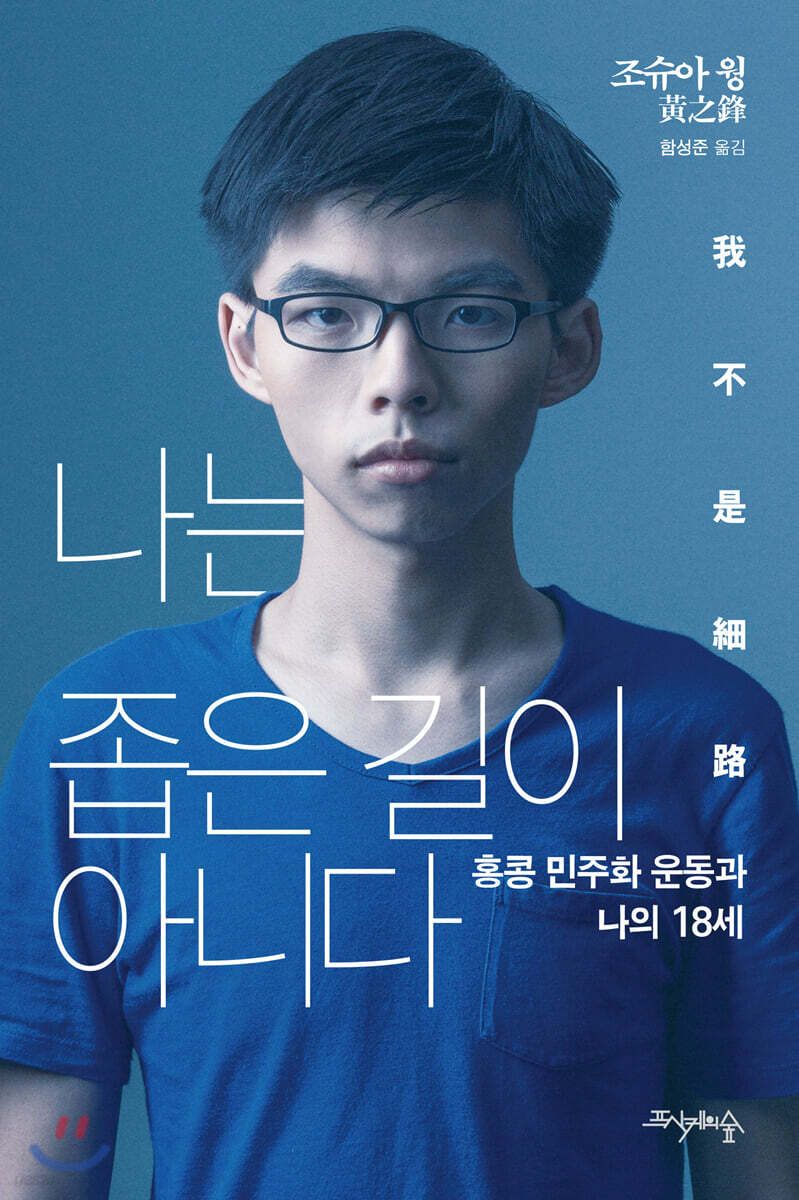
Joshua Wong's book, "I Am Not a Narrow Road," which documents the Hong Kong "Umbrella Movement," has been published.
Joshua Wong spearheaded the pro-democracy movement in 2014, leading the "Hakmin Sajo" group of middle and high school students.
He fought persistently, occupying areas such as Central, the center of Hong Kong, demanding direct elections for the Chief Executive, who was the highest official in Hong Kong at the time.
This made him a symbolic figure of the Hong Kong democracy movement.
This book is Joshua Wong's main work written in the midst of the Hong Kong democracy movement, and contains a record of his most heated period.
Through diaries from the summer of 2013 to the summer of 2015, he candidly conveys the hopes and aspirations of Hong Kong today, as well as its anxieties and fears.
It is deeply moving to see an 18-year-old youth reflect on social issues without turning a blind eye to the demands of the times.
Through this book, readers will be able to gain a detailed understanding of the present and future of Hong Kong society.
- You can preview some of the book's contents.
Preview
index
To our Korean readers
Introduction
Part 1: The Eve of the Citizens' Vote
Let's take back the government
'Citizen Place Names' Are Being Marginalized
A mass movement must trust the masses.
Priscilla Leung's Depoliticization
Hong Kong's Future: Students' Share
The determination to take direct action
What did they drag along that day?
Don't exchange glances with the intermediary.
The more you fight, the stronger you become
Asking what causes the conflict
Break the frame in the center
Are you saying you're doing social activism to get a job?
The minority filters out the wishes of the majority
To overcome the gap period
Conscience dictates, protect the press.
The capable take their place
The future belongs to the younger generation.
Don't bow your head to reality
Overcoming the unequal playing field
I have no intention of compromising.
Why are we extremists?
Moderates should face political reality.
Being a decisive minority
The White Paper Pours Cold Water on Hong Kong
But you are more afraid of winning
Part 2: Preparing for the Alliance's Leave of Absence
If your grades are low, are you not qualified?
It's just an illusion
A model of a top university student interested in society
Let's break the regime's arm
What I believe and what I don't believe
What you can't do today, you can't do in your lifetime.
That's right, this is an appeal to charge now.
Part 3: The Beginning of the Umbrella Movement
We are proud of Joshua
After Release: What Had to Be Said
The masses lead the leaders.
The unbearable violence of the dark world
Hawk and Dove Repertoire
A new referendum is needed.
Plans for the Aftermath of the Rejection of the Political Reform Bill
About the conflict surrounding the stage
Divided or awkward situation
Embracing youth and casting away fear
Mom's birthday postponed due to fasting
If you are the head of this beautiful city
Are the lawmakers just watching the fire across the river?
For the faith of my son and friends
After the fourth occupation came to an end
My Person of the Year: The Disobedient
Setting an agenda that transcends government
Asking the 'Angry Parents'
Democracy and non-democracy are just one letter apart
Just give me three broken oranges
Carrie Lam, blindfolded and ignorant
The best reward that gives me strength
To young people who are planning to run for district council elections
The stress of becoming famous at a young age
Two explanations
Something far more important than the title I earned
Breaking free from the shackles of school and society
Legendary Doctor, Don't Give Up on Treatment
The only exit
Rather, the moderates are just being used
I'd rather give the dog a piece of meat than eat it
You don't know the pressure of student loans.
Once again, as a convener of the Student Council
denied entry into Malaysia
Why University Students Burned the Basic Law
2047: The Year That Will Determine Hong Kong's Future
Words that come out
Appendix 1 Map of Hong Kong
Appendix 2: Hong Kong Chief Executive Election Method
Appendix 3: List of Major Events
Appendix 4: List of names
Into the book
A mass movement is a movement that allows miracles to happen.
The leaders of the democratic movement must not assume a position of moral superiority and assume that the proletarian masses will not understand them.
We must believe.
We must believe that Hong Kong people will eventually want change.
Because a mass movement must trust the masses.
--- p.27
Since the essence of social movements is to move the masses forward, when presenting an argument, it is essential to start from the perspective of others.
You should never write a story that the general public does not know.
Otherwise, it will only increase the distance between the public and activists.
--- p.35
The reason I'm appealing to you to vote for student equality is very simple.
I want to inform the so-called 'conscience of Hong Kong'.
Just because the central government doesn't accept it doesn't mean Hong Kong people should give up.
In fact, we have the freedom not to accept our fate.
--- p.91
If Hong Kongers want to face political reality, they must immediately abandon the illusion that the powerful will sympathize with the powerless.
--- p.98
For those involved in the democratic movement, the rewards are not always proportional.
And if you don't do it now because you're too young, you probably won't ever be able to do it.
--- p.102
As an adult who knows the world well, you will be afraid of rejection and fear failure.
But you are more afraid of winning.
--- p.108
I experienced the false world of adults while conducting interviews about my grades and college admissions.
This was due to the excessive focus on grades and attitudes toward third-rate universities.
Even democratic media outlets that advocate equality and justice tend to look up to highly educated people and first-class universities.
What disgusting people they are.
--- p.112
Don't underestimate the abilities of middle and high school students.
I'm just waiting for this historic moment to unfold.
The moment when the unprecedented voluntary strike by high school students in Hong Kong broke the arm of the Chinese Communist regime.
--- p.126
It is not really accurate to say that a leader leads the masses.
Rather, at turning points, the public often leads the leader.
--- p.149
I think it's better to show why your own path is better than wasting time criticizing your comrades who argue for a different path.
Only then can the movement avoid being mired in endless internal conflict.
--- p.182
We are often reluctant to take the next step forward.
Or, once a pattern of behavior is established, it is difficult to change it.
That's because we're worried that we might lose the influence we already have, that we might lose the public support we originally had.
It's okay to fail at something, but if you live in the past, become afraid of success, and become accustomed to failure, you will eventually be eliminated by the times.
--- p.191
Those who have never experienced youth are afraid and only know how to hide in the shadow of power.
And rather, he criticizes others for “wasting their youth.”
It's really funny.
--- p.194
There is no guarantee that you will win if you fight, but if you don't fight, you will definitely lose.
--- p.197
For the powerless to overcome the barriers set up by the powerful is like standing at a crossroads every time.
Many people, after being discouraged and discouraged, choose to submit to fate.
But on the contrary, there are a few people who constantly shout in a room made of iron.
They take on the role of the disobedient and refuse to submit to the predetermined fate of 'obedience'.
--- p.217
We said that the Umbrella Movement brought about a paradigm shift.
Simply put, we Hong Kongers cannot go back to the way things were.
--- p.301
Publisher's Review
Who is Joshua Wong?
Here lies Hong Kong's future.
Protests continue in Hong Kong.
One of the important reasons is the ‘direct election of the administrative minister.’
Hong Kong began electing its Chief Executive, the head of Hong Kong's administration, on July 1, 1997, when it was returned to China from Britain.
However, because the method was an indirect election, there was widespread dissatisfaction among citizens.
The Umbrella Movement of 2014 was the one that explicitly erupted and demanded direct election of the Chief Executive.
The Umbrella Movement deserves a detailed review, as it captures the essence of the ongoing Hong Kong situation.
Joshua Wong was a key figure in the Umbrella Movement at the time, and turned eighteen at the time of the pro-democracy movement.
In 2012, he led an organization called 'Hakmin Sajo' and began a movement against national education, which led to the democratization movement.
This book is written in a diary format from the summer of 2013 to the summer of 2015, and covers in detail the background, development, and results of the 2014 Umbrella Movement.
Additionally, each journal entry includes the author's afterword, helping readers understand current issues in Hong Kong in a more three-dimensional way.
The sight of an 18-year-old youth not turning a blind eye to the demands of the times and forging his thoughts and actions is deeply moving.
In this book, Joshua Wong says that politics, as he sees it, is not “the art of compromise,” but “the art of turning the impossible into the possible.”
This is where his ideals and strong beliefs are revealed.
In a situation where he was ridiculed by not only conservative politicians but also democratic politicians for being “idealistic” and “going to a third-rate university,” what he relied on was his belief in and desire for democracy.
With the idea that “we don’t keep going because we see hope, but because we keep going, we see hope,” we gather a small group of middle and high school students and take social action.
It is impressive how he keeps a journal in a calm manner without falling into petty heroism or rigid self-assertion.
One characteristic of the Umbrella Movement was that students led the protests.
The university student group 'Hakryun' and the high school student group 'Hakmin Sajo' represented by Joshua Wong were the main force behind the protests.
They take unprecedented action when the Chinese government's promise of direct elections for the Chief Executive is cleverly thwarted.
At the time, the Chinese government stipulated that a direct election system with one person, one vote would be implemented, but that candidates must pass a pro-China nomination committee.
Students, enraged by their inability to nominate a democratic candidate, take to the streets of Central, the heart of Hong Kong.
Citizens who were inspired by this joined in a large-scale protest that lasted 79 days, which is the so-called Umbrella Movement.
At the time, using umbrellas as shields against the police's tear gas suppression became a symbol of the protests.
Joshua Wong emerged as the face of Hong Kong's democracy movement by leading the Umbrella Movement.
That year, he was selected as Time's Person of the Year and as one of the 100 Global Thinkers by Foreign Policy.
He was also nominated for the Nobel Peace Prize along with the citizens of Hong Kong.
Joshua Wong's political standing is indirectly confirmed by the Hong Kong government's decision to block him from running for district council elections when mass protests erupted again in 2019.
He is only 24 years old this year.
Hong Kong today and
The Key to Understanding East Asia
The Umbrella Movement is a representative event in which the demand for democratization emerged in earnest.
Unless the Chinese government accepts the people's demand for direct elections for the Chief Executive, the Umbrella Movement will continue to be remembered as an "eternal present."
The events in Hong Kong in 2019 illustrate this clearly.
It started with opposition to the extradition bill, but even though the current government has officially withdrawn the extradition bill, citizens continue to protest, demanding direct election of the Chief Executive as one of their conditions.
Perhaps, in a few years, another incident will trigger another protest, culminating in a demand for direct election of the Chief Executive.
Joshua Wong and the Hakmin Sajo also left an indelible mark on the younger generation of Hong Kong through the Umbrella Movement.
As they grow up, they will constantly question the future of Hong Kong.
This generation will not be able to accept the expiration of the "one country, two systems" principle in 2047, and the resulting conflict is likely to intensify even more severely after 2030 than it is now.
Joshua Wong also clearly recognizes this point, and in this book, he proposes that we go beyond the demand for direct elections and consider an agenda that takes into account the post-“one country, two systems” era.
In fact, many Koreans tend to view the situation in Hong Kong with fond memories of the democracy movement of the 1980s.
Korea also used to have 'indirect elections at gymnasiums', and in opposition to this, 'young students' led the democratization of direct elections.
Perhaps conscious of this, Joshua Wong also appeals as follows in the preface to the Korean edition:
“Hong Kong people are fighting courageously for democracy.
Just like the Korean people did in the last century.
This year marks the 40th anniversary of the May 18 Gwangju Democratization Movement.
I hope that this book will convey to you the ideals and thoughts that the students held in their hearts before the protests became a massive wave in Hong Kong.
And I hope that ‘Today is Gwangju, tomorrow is Hong Kong,’ and that someday the people of Hong Kong will be able to enjoy freedom and democracy like those in Korea.”
But the reason we should pay attention to Hong Kong is not just because Korea is a 'senior' in democracy.
If we remain confined to the level of nostalgia or pride, we will miss the significance of the Hong Kong situation today.
South Korea needs to view the Hong Kong situation from a perspective that clearly understands and recognizes China's foreign policy.
This book clearly shows, from the perspective of Hong Kong, how the "one country, two systems" principle, which has been applied since Deng Xiaoping, is gradually shifting from "two systems" to "one country."
Through this, Korea can gauge what kind of influence the so-called China Dream can have on our diplomatic relations.
Because China is a reality to Hong Kong, and China is a reality to Korea.
GOODS SPECIFICS
- Date of issue: April 24, 2020
- Page count, weight, size: 348 pages | 442g | 140*210*30mm
- ISBN13: 9791189336240
- ISBN10: 1189336243
You may also like
카테고리
korean


korean


