

Feeling good
 |
Description
Book Introduction
It is the best treatment for depression and helps you become a true 'master of life'.
An excellent guide to life!
The self-help book "Feeling Good," which is considered the best book on treating and preventing depression, has been republished in a revised edition edited to make it easier and more convenient for readers.
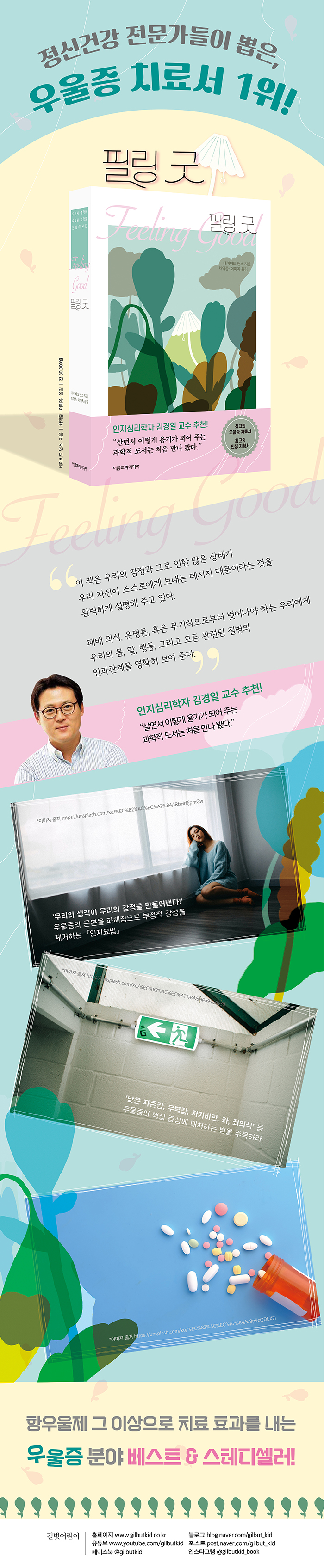
In a survey of 500 mental health professionals across the United States, which included 1,000 self-help books, this book ranked second overall and first by a landslide among books on depression.
This is evidence that even mental health experts recognize that it has excellent academic evidence and actual therapeutic effects.
In addition, it has proven its power as a bestseller and steady seller in the field of depression for over 10 years since its publication in Korea.
The cognitive therapy introduced in this book is an excellent treatment method that has been proven through rigorous clinical trials, research, and abundant treatment cases to be as effective as or better than the most widely used antidepressants.
In this book, author Dr. Burns clearly, persuasively, and systematically explains the principles and various techniques of cognitive therapy.
It also teaches you how to deal with core symptoms of depression, such as 'low self-esteem, doing nothing, criticism (self-criticism), anger, and guilt', using easy and various practical techniques.
Furthermore, it doesn't stop there. By uncovering the root causes of depression, it not only eliminates the buds of negative emotions and prevents depression in advance, but also provides a path to personal growth by bringing about profound and lasting changes in our mood, outlook on life, and capabilities.
In this book, Feeling Good, Dr. Burns presents a groundbreaking, scientifically proven psychotherapy method that will free us from the prison of depression, based on the simple and clear cognitive therapy principle that "our thoughts create our emotions."
The treatment techniques described in this book are at least as effective as the best antidepressants, work very quickly, have no side effects, and have a significantly lower chance of relapse.
Furthermore, it improves our personality by changing unreasonable and distorted values and worldviews, allowing us to live healthy and happy lives.
An excellent guide to life!
The self-help book "Feeling Good," which is considered the best book on treating and preventing depression, has been republished in a revised edition edited to make it easier and more convenient for readers.
In a survey of 500 mental health professionals across the United States, which included 1,000 self-help books, this book ranked second overall and first by a landslide among books on depression.
This is evidence that even mental health experts recognize that it has excellent academic evidence and actual therapeutic effects.
In addition, it has proven its power as a bestseller and steady seller in the field of depression for over 10 years since its publication in Korea.
The cognitive therapy introduced in this book is an excellent treatment method that has been proven through rigorous clinical trials, research, and abundant treatment cases to be as effective as or better than the most widely used antidepressants.
In this book, author Dr. Burns clearly, persuasively, and systematically explains the principles and various techniques of cognitive therapy.
It also teaches you how to deal with core symptoms of depression, such as 'low self-esteem, doing nothing, criticism (self-criticism), anger, and guilt', using easy and various practical techniques.
Furthermore, it doesn't stop there. By uncovering the root causes of depression, it not only eliminates the buds of negative emotions and prevents depression in advance, but also provides a path to personal growth by bringing about profound and lasting changes in our mood, outlook on life, and capabilities.
In this book, Feeling Good, Dr. Burns presents a groundbreaking, scientifically proven psychotherapy method that will free us from the prison of depression, based on the simple and clear cognitive therapy principle that "our thoughts create our emotions."
The treatment techniques described in this book are at least as effective as the best antidepressants, work very quickly, have no side effects, and have a significantly lower chance of relapse.
Furthermore, it improves our personality by changing unreasonable and distorted values and worldviews, allowing us to live healthy and happy lives.
- You can preview some of the book's contents.
Preview
index
Acknowledgements
Recommendation
preface
Part 1: What is Cognitive Therapy?
1.
A groundbreaking breakthrough in the treatment of mood disorders opens / 2.
Diagnosing Your Mood: The First Step to Healing
3.
Understanding My Moods: Emotions Come From Thoughts
Part 2: Practical Techniques for Managing Moods
4.
Building Self-Esteem / 5.
Doing Nothing: How to Win?
6.
Fighting with Words: Talking Back to Criticism / 7.
You're angry? What's your IQ?
8.
Some Ways to Overcome Guilt
Part 3: Is Depression Based on 'Reality'?
9.
Sadness is not depression
Part 4: Depression Prevention and Personal Growth
10.
The Root Causes of Depression / 11.
Admission addiction
12.
Love Addiction / 13.
Achievement is not worth it.
14.
Overcoming Perfectionism: Dare to Be Ordinary
Part 5: Overcoming Despair and Suicidal Impulses
15.
The Most Valuable Victory: Choose Life
Part 6: Overcoming Everyday Stress and Tension
16.
How do I put my words into practice in real life?
Part 7: Depression and Brain Chemistry
17.
Secrets of the Brain / 18.
Problems of body and mind / 19.
What You Need to Know About Antidepressants
Huzhou
Recommendation
preface
Part 1: What is Cognitive Therapy?
1.
A groundbreaking breakthrough in the treatment of mood disorders opens / 2.
Diagnosing Your Mood: The First Step to Healing
3.
Understanding My Moods: Emotions Come From Thoughts
Part 2: Practical Techniques for Managing Moods
4.
Building Self-Esteem / 5.
Doing Nothing: How to Win?
6.
Fighting with Words: Talking Back to Criticism / 7.
You're angry? What's your IQ?
8.
Some Ways to Overcome Guilt
Part 3: Is Depression Based on 'Reality'?
9.
Sadness is not depression
Part 4: Depression Prevention and Personal Growth
10.
The Root Causes of Depression / 11.
Admission addiction
12.
Love Addiction / 13.
Achievement is not worth it.
14.
Overcoming Perfectionism: Dare to Be Ordinary
Part 5: Overcoming Despair and Suicidal Impulses
15.
The Most Valuable Victory: Choose Life
Part 6: Overcoming Everyday Stress and Tension
16.
How do I put my words into practice in real life?
Part 7: Depression and Brain Chemistry
17.
Secrets of the Brain / 18.
Problems of body and mind / 19.
What You Need to Know About Antidepressants
Huzhou
Detailed image
Into the book
Cognitive therapy is a quick and effective technique for improving mood, and anyone can learn and apply it on their own.
Cognitive therapy also minimizes the worsening of symptoms by eliminating them and promoting personality growth, and even if a relapse occurs, it allows for much more effective coping.
--- p.36~37
Since this book was first published in 1980, many people have successfully overcome depression through cognitive therapy.
There were also people who came to me as a last resort, clutching at straws, just before committing suicide after falling into despair over the inability to cure.
Many people, struggling with the small tensions of everyday life, came here to experience greater happiness.
This book is the result of careful consideration and application of our achievements for such people.
This book was created just for you.
--- p.45
First, we must recognize that life goes on.
Therefore, we should not allow one small disappointment to permanently damage our happiness.
It is our thoughts that hurt our feelings when we are rejected or not accepted.
So if you fight against these thoughts and stubbornly refuse to give in to distorted self-abuse, your emotional turmoil will disappear.
--- p.397
This chapter provides general and practical information about taking antidepressants.
Learn who benefits most and least from antidepressants, whether antidepressants actually work, how much mood improvement they can bring, and what to do if the medication isn't working.
We'll also teach you how to identify and minimize side effects and how to avoid dangerous interactions between antidepressants and other medications.
Cognitive therapy also minimizes the worsening of symptoms by eliminating them and promoting personality growth, and even if a relapse occurs, it allows for much more effective coping.
--- p.36~37
Since this book was first published in 1980, many people have successfully overcome depression through cognitive therapy.
There were also people who came to me as a last resort, clutching at straws, just before committing suicide after falling into despair over the inability to cure.
Many people, struggling with the small tensions of everyday life, came here to experience greater happiness.
This book is the result of careful consideration and application of our achievements for such people.
This book was created just for you.
--- p.45
First, we must recognize that life goes on.
Therefore, we should not allow one small disappointment to permanently damage our happiness.
It is our thoughts that hurt our feelings when we are rejected or not accepted.
So if you fight against these thoughts and stubbornly refuse to give in to distorted self-abuse, your emotional turmoil will disappear.
--- p.397
This chapter provides general and practical information about taking antidepressants.
Learn who benefits most and least from antidepressants, whether antidepressants actually work, how much mood improvement they can bring, and what to do if the medication isn't working.
We'll also teach you how to identify and minimize side effects and how to avoid dangerous interactions between antidepressants and other medications.
--- p.603
Publisher's Review
The Best Books to Overcome Depression, Highly Recommended by Psychologists and Psychiatrists
『Feeling Good』 Revised Edition!
Dr. Burns, an author, has written many books on mood and relationships.
Among them, the best-selling book, "Feeling Good," has sold over 4 million copies in the United States alone and is published in over 20 countries around the world.
"Feeling Good" is the most frequently recommended self-help book for people with depression by psychologists and psychiatrists in the United States and Canada.
Additionally, in a survey of 500 mental health professionals in the United States, it was selected as the best self-help book among 1,000 self-help books for people with depression.
In this way, 『Feeling Good』 is a self-help book that is evaluated as the best book on treating and preventing depression. In particular, the cognitive therapy introduced in this book is an excellent treatment method that has been proven through rigorous clinical trials, research results, and abundant treatment cases to be as effective as or more effective than the most widely used antidepressants.
Because cognitive therapy does not use medication, there is no need to worry about side effects, the risk of relapse is much lower, the treatment period is shorter, and since self-treatment is possible, it is also much less burdensome in terms of cost.
Additionally, following the treatment methods in this book will help you manage negative emotions such as low self-esteem, anxiety, anger, guilt, helplessness, and self-deprecation, helping you live a healthy and positive life.
In that respect, this book is also a valuable guide to life, helping you control your mind and achieve happiness and peace in life.
Depression is so common that it is often dismissed as a mild cold.
However, depression and a cold are clearly different.
This is because, unlike the common cold, it is a fatal disease that can lead to death (suicide) if severe.
Although various psychotherapeutic methods, including psychoanalysis, have been developed, they have not achieved significant results.
Antidepressants have been developed and are still widely used, but they have also revealed several problems, such as the possibility of relapse and side effects.
In that respect, cognitive therapy, which was systematized by Dr. Aaron Beck and others in the 1960s, is considered to have provided a groundbreaking breakthrough in the treatment of depression.
In this book, author Dr. Burns clearly, persuasively, and systematically explains the principles and various techniques of cognitive therapy.
So, it presents a way for anyone to successfully overcome depression by learning it easily and applying it in their daily lives.
“Our thoughts create our emotions!”
When we are depressed, we brand ourselves as losers, inferior people, and useless beings. We look at ourselves and the world with bleak eyes, convinced that we were failures from the start, and we even make others believe the same.
They also believe that negative emotions like depression are caused by bad things, hardships, other people, personal shortcomings, unfortunate fate, childhood trauma, or imbalances in chemicals or hormones in their body.
If you make yourself a victim by blaming things beyond your control, it is nearly impossible to escape the trap of depression.
Cognitive therapy, with its simple yet powerful theory that “our thoughts create our feelings,” has provided a breakthrough in the treatment of depression.
The principles of cognitive therapy are as follows:
First, all the feelings (emotions) we feel are not caused by events that occur in reality, but by the way we interpret reality, that is, our thoughts (thoughts, cognitions).
Second, our thoughts are deeply dominated by negativity, especially when we feel negative emotions such as depression.
Third, these negative thoughts that cause us suffering always contain serious distortions.
Negative thoughts may seem correct at first glance, but they are irrational and wrong, and these distorted thoughts are the real cause of our suffering.
In other words, depression is most likely not based on an accurate perception of reality, but rather is the result of a malfunction in our mind.
When you're depressed, you not only become convinced that these distorted thoughts are true, you even convince other people that they are true.
By seeing through these cognitive distortions (delusions) that deceive ourselves and others, accurately understanding the facts, and learning and practicing the specific and effective cognitive therapy techniques presented in this book to manage negative thoughts and emotions, you can overcome depression as successfully as, or even more successfully than, the most effective antidepressants.
“Performance is not value!”
In this way, this book teaches you how to deal with the core symptoms of depression, such as “low self-esteem, inaction, criticism (self-criticism), anger, and guilt,” using easy and various practical techniques.
Furthermore, it doesn't stop there. By uncovering the root causes of depression, it not only eliminates the buds of negative emotions and prevents depression in advance, but also brings about profound and lasting changes in our mood, outlook on life, and capabilities, leading to personal growth.
The author says that there are several differences between feeling better and actually feeling better.
Even if we recover from depression, there is a high probability that the 'unspoken assumptions' that are the root cause of depression will remain hidden in our minds.
Implicit assumptions are like equations that define our own worth, and they refer to how we judge our own worth based on things like the approval or love of others, achievement, and perfection.
If you are addicted to these addictions of recognition, love addiction, work addiction, perfectionism addiction, etc., it is impossible to completely escape the prison of the mind.
For example, we can easily fall into the implicit assumption that “my worth as a human being is proportional to the results I achieve in life.”
The author counters this as follows:
“Like any other addiction, workaholism requires more and more stimulants to feel the high.
Wealth, fame, and success also create this kind of resistance.
…the answer is obvious.
Because success does not guarantee happiness.
…we must understand that human ‘value’ is originally an abstract concept.
…when evaluating people, we must realize that words like ‘valuable’ or ‘worthless’ are empty concepts.
…what are the challenges we face in life? How do we deal with them? That's the key, not some elusive mirage like 'value.'" The same goes for addictions to recognition, love, and perfectionism.
The author says:
“Success is neither a necessary nor a sufficient condition for maximum happiness.
There is no need to live like a hamster on a wheel, trying to win the love or approval of others.
“You don’t have to be number one to live a fulfilling life and enjoy inner peace and self-esteem.”
In this way, "Feeling Good" allows us to see clearly why our negative emotions are nothing more than distortions and delusions.
And it makes us realize how unreasonable and inadequate the values we base our lives on are.
Thus, no matter how painful or hopeless it may feel, it shows us how to maintain unshakable self-esteem and human dignity so that we can live a healthy and fulfilling life.
Effective and direct through various real-life cases and specific implementation methods
Self-help book for depression!
"Feeling Good" presents a wealth of real-life examples of patients the author personally experienced, and provides specific implementation methods for each situation.
Therefore, readers who are experiencing similar emotions and feelings can easily think of the cases in the book as their own situations, and through this process of objectifying their current state and emotions, they can clearly reflect on themselves.
It also covers general and practical information about taking antidepressants to provide specific help to people struggling with depression.
It provides clear and easy-to-understand explanations of who benefits most from antidepressants and who benefits least from them, whether antidepressants actually work, how much mood improvement occurs when taking them, and what to do if the medication doesn't work well, so readers can decide whether to use them based on their own situation.
It also provides meticulous guidance on identifying and minimizing side effects, as well as on how to prevent dangerous interactions between antidepressants and other medications, to comfort anxious readers.
『Feeling Good』 Revised Edition!
Dr. Burns, an author, has written many books on mood and relationships.
Among them, the best-selling book, "Feeling Good," has sold over 4 million copies in the United States alone and is published in over 20 countries around the world.
"Feeling Good" is the most frequently recommended self-help book for people with depression by psychologists and psychiatrists in the United States and Canada.
Additionally, in a survey of 500 mental health professionals in the United States, it was selected as the best self-help book among 1,000 self-help books for people with depression.
In this way, 『Feeling Good』 is a self-help book that is evaluated as the best book on treating and preventing depression. In particular, the cognitive therapy introduced in this book is an excellent treatment method that has been proven through rigorous clinical trials, research results, and abundant treatment cases to be as effective as or more effective than the most widely used antidepressants.
Because cognitive therapy does not use medication, there is no need to worry about side effects, the risk of relapse is much lower, the treatment period is shorter, and since self-treatment is possible, it is also much less burdensome in terms of cost.
Additionally, following the treatment methods in this book will help you manage negative emotions such as low self-esteem, anxiety, anger, guilt, helplessness, and self-deprecation, helping you live a healthy and positive life.
In that respect, this book is also a valuable guide to life, helping you control your mind and achieve happiness and peace in life.
Depression is so common that it is often dismissed as a mild cold.
However, depression and a cold are clearly different.
This is because, unlike the common cold, it is a fatal disease that can lead to death (suicide) if severe.
Although various psychotherapeutic methods, including psychoanalysis, have been developed, they have not achieved significant results.
Antidepressants have been developed and are still widely used, but they have also revealed several problems, such as the possibility of relapse and side effects.
In that respect, cognitive therapy, which was systematized by Dr. Aaron Beck and others in the 1960s, is considered to have provided a groundbreaking breakthrough in the treatment of depression.
In this book, author Dr. Burns clearly, persuasively, and systematically explains the principles and various techniques of cognitive therapy.
So, it presents a way for anyone to successfully overcome depression by learning it easily and applying it in their daily lives.
“Our thoughts create our emotions!”
When we are depressed, we brand ourselves as losers, inferior people, and useless beings. We look at ourselves and the world with bleak eyes, convinced that we were failures from the start, and we even make others believe the same.
They also believe that negative emotions like depression are caused by bad things, hardships, other people, personal shortcomings, unfortunate fate, childhood trauma, or imbalances in chemicals or hormones in their body.
If you make yourself a victim by blaming things beyond your control, it is nearly impossible to escape the trap of depression.
Cognitive therapy, with its simple yet powerful theory that “our thoughts create our feelings,” has provided a breakthrough in the treatment of depression.
The principles of cognitive therapy are as follows:
First, all the feelings (emotions) we feel are not caused by events that occur in reality, but by the way we interpret reality, that is, our thoughts (thoughts, cognitions).
Second, our thoughts are deeply dominated by negativity, especially when we feel negative emotions such as depression.
Third, these negative thoughts that cause us suffering always contain serious distortions.
Negative thoughts may seem correct at first glance, but they are irrational and wrong, and these distorted thoughts are the real cause of our suffering.
In other words, depression is most likely not based on an accurate perception of reality, but rather is the result of a malfunction in our mind.
When you're depressed, you not only become convinced that these distorted thoughts are true, you even convince other people that they are true.
By seeing through these cognitive distortions (delusions) that deceive ourselves and others, accurately understanding the facts, and learning and practicing the specific and effective cognitive therapy techniques presented in this book to manage negative thoughts and emotions, you can overcome depression as successfully as, or even more successfully than, the most effective antidepressants.
“Performance is not value!”
In this way, this book teaches you how to deal with the core symptoms of depression, such as “low self-esteem, inaction, criticism (self-criticism), anger, and guilt,” using easy and various practical techniques.
Furthermore, it doesn't stop there. By uncovering the root causes of depression, it not only eliminates the buds of negative emotions and prevents depression in advance, but also brings about profound and lasting changes in our mood, outlook on life, and capabilities, leading to personal growth.
The author says that there are several differences between feeling better and actually feeling better.
Even if we recover from depression, there is a high probability that the 'unspoken assumptions' that are the root cause of depression will remain hidden in our minds.
Implicit assumptions are like equations that define our own worth, and they refer to how we judge our own worth based on things like the approval or love of others, achievement, and perfection.
If you are addicted to these addictions of recognition, love addiction, work addiction, perfectionism addiction, etc., it is impossible to completely escape the prison of the mind.
For example, we can easily fall into the implicit assumption that “my worth as a human being is proportional to the results I achieve in life.”
The author counters this as follows:
“Like any other addiction, workaholism requires more and more stimulants to feel the high.
Wealth, fame, and success also create this kind of resistance.
…the answer is obvious.
Because success does not guarantee happiness.
…we must understand that human ‘value’ is originally an abstract concept.
…when evaluating people, we must realize that words like ‘valuable’ or ‘worthless’ are empty concepts.
…what are the challenges we face in life? How do we deal with them? That's the key, not some elusive mirage like 'value.'" The same goes for addictions to recognition, love, and perfectionism.
The author says:
“Success is neither a necessary nor a sufficient condition for maximum happiness.
There is no need to live like a hamster on a wheel, trying to win the love or approval of others.
“You don’t have to be number one to live a fulfilling life and enjoy inner peace and self-esteem.”
In this way, "Feeling Good" allows us to see clearly why our negative emotions are nothing more than distortions and delusions.
And it makes us realize how unreasonable and inadequate the values we base our lives on are.
Thus, no matter how painful or hopeless it may feel, it shows us how to maintain unshakable self-esteem and human dignity so that we can live a healthy and fulfilling life.
Effective and direct through various real-life cases and specific implementation methods
Self-help book for depression!
"Feeling Good" presents a wealth of real-life examples of patients the author personally experienced, and provides specific implementation methods for each situation.
Therefore, readers who are experiencing similar emotions and feelings can easily think of the cases in the book as their own situations, and through this process of objectifying their current state and emotions, they can clearly reflect on themselves.
It also covers general and practical information about taking antidepressants to provide specific help to people struggling with depression.
It provides clear and easy-to-understand explanations of who benefits most from antidepressants and who benefits least from them, whether antidepressants actually work, how much mood improvement occurs when taking them, and what to do if the medication doesn't work well, so readers can decide whether to use them based on their own situation.
It also provides meticulous guidance on identifying and minimizing side effects, as well as on how to prevent dangerous interactions between antidepressants and other medications, to comfort anxious readers.
GOODS SPECIFICS
- Date of issue: June 25, 2023
- Page count, weight, size: 656 pages | 938g | 153*223*32mm
- ISBN13: 9788955826968
You may also like
카테고리
korean


korean

![GQ KOREA Mark (Monthly): December [2025]](http://librairie.coreenne.fr/cdn/shop/files/8ef265dbbfbf186523ed75ba7319009d.jpg?v=1765340328&width=3840)


