

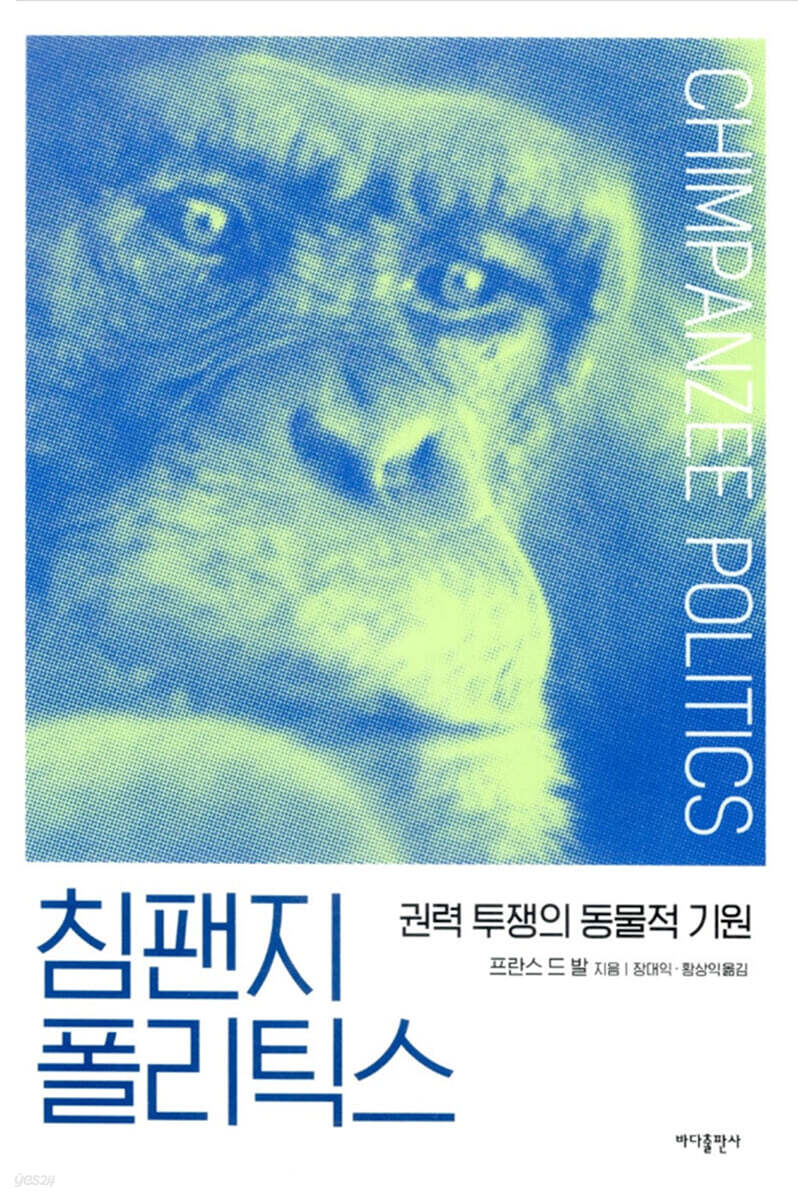
Chimpanzee Politics
 |
Description
Book Introduction
The origins of politics are older than the history of mankind.
A 25th anniversary edition of Chimpanzee Politics, a world-renowned bestseller for decades since its first publication and now a classic in science writing.
World-renowned primatologist Frans de Waal's book "Chimpanzee Politics" became a bestseller immediately after its publication, praising its scientific achievements among primatologists. It also received praise from politicians, business executives, and social psychologists for its surprising insights into the most fundamental aspects of human nature.
Who said politics is the exclusive domain of humans? Can we truly say that animals are driven solely by the instincts of the law of the jungle and survival of the fittest? By observing the chimpanzee group in Arnhem, which weaves their own web of relationships and hierarchies using sophisticated political techniques, the author reminds us once again that the origins of politics predate those of humans.
A 25th anniversary edition of Chimpanzee Politics, a world-renowned bestseller for decades since its first publication and now a classic in science writing.
World-renowned primatologist Frans de Waal's book "Chimpanzee Politics" became a bestseller immediately after its publication, praising its scientific achievements among primatologists. It also received praise from politicians, business executives, and social psychologists for its surprising insights into the most fundamental aspects of human nature.
Who said politics is the exclusive domain of humans? Can we truly say that animals are driven solely by the instincts of the law of the jungle and survival of the fittest? By observing the chimpanzee group in Arnhem, which weaves their own web of relationships and hierarchies using sophisticated political techniques, the author reminds us once again that the origins of politics predate those of humans.
- You can preview some of the book's contents.
Preview
index
Translator's Note 8
25th Anniversary Preface 13
First Encounters with Chimpanzees 25 First Impressions | The Herd on the Way to Freedom | An Unforgettable Escape | Ethology | Perceptual Abilities | Communication Signals | Biased Behavior | Reconciliation | Alliance | Safe Interpretation | Bold Interpretation | Flexible Behavior
77 Women Warriors of Gaeseong Mama | Ierun and Rawit | Faust | Horilla | Niki and Dandy | Female Subgroup | Dr. Sugiyama | Power Shift | Formal and Actual Superiority | The First Struggle | Ierun's Isolation | Indirect Alliance between Rawit and Niki | Tantrums and Fights | The Price of Peace | The Formation of a Love Triangle | Rawit's New Policy | Direct Alliance between Ierun and Niki | Niki's Absence
Unstable Stability 209 Divide and conquer | Collective leadership | Sexual privilege | Courtship and copulation | Ambition and fatherhood | Bargaining over sex
Principles of Social Life 263: Dependency Hierarchy | The Hierarchy Structure of Females | 'Panting Show' and 'Pretty Show' | Do Males and Females Have Different Goals in Life? | Sharing | Chimpanzees Reciprocate Convenience
The Origins of Politics 305
Epilogue 315
Acknowledgements 324
Week 326
Reference 336
25th Anniversary Preface 13
First Encounters with Chimpanzees 25 First Impressions | The Herd on the Way to Freedom | An Unforgettable Escape | Ethology | Perceptual Abilities | Communication Signals | Biased Behavior | Reconciliation | Alliance | Safe Interpretation | Bold Interpretation | Flexible Behavior
77 Women Warriors of Gaeseong Mama | Ierun and Rawit | Faust | Horilla | Niki and Dandy | Female Subgroup | Dr. Sugiyama | Power Shift | Formal and Actual Superiority | The First Struggle | Ierun's Isolation | Indirect Alliance between Rawit and Niki | Tantrums and Fights | The Price of Peace | The Formation of a Love Triangle | Rawit's New Policy | Direct Alliance between Ierun and Niki | Niki's Absence
Unstable Stability 209 Divide and conquer | Collective leadership | Sexual privilege | Courtship and copulation | Ambition and fatherhood | Bargaining over sex
Principles of Social Life 263: Dependency Hierarchy | The Hierarchy Structure of Females | 'Panting Show' and 'Pretty Show' | Do Males and Females Have Different Goals in Life? | Sharing | Chimpanzees Reciprocate Convenience
The Origins of Politics 305
Epilogue 315
Acknowledgements 324
Week 326
Reference 336
Detailed image

Publisher's Review
The Chimpanzees of Arnhem Reunite in a 25th Anniversary Edition
Frans de Waal, a world-renowned animal behaviorist from the Netherlands.
In 1976, he, a young scientist in his early 30s, entered the outdoor enclosure of the Bürchers Zoo in Arnhem, Netherlands, to observe in detail the social relationships and political movements of primates (chimpanzees).
And there, he witnessed chimpanzees forming frighteningly 'human' political relationships and social hierarchies, and as a result of his amazing observations and records, he completed a book called 'Chimpanzee Politics'.
In 1982, when the first edition of this book was published, general readers, who had previously associated primates with the caricatured monkey, were shocked to discover that chimpanzees also possessed sophisticated political behavior.
This book, which received significant attention at the time for both its public interest and academic value, is now available to Korean readers once again in a 25th anniversary edition.
This edition is a new preface to the first expanded edition published in 1998 (2004, domestic translation), containing the book's social repercussions and the author's insights into them.
We've added color photos not found in the first edition and also revised some of the major ape features.
Additionally, a preface by Seoul National University professors Jang Dae-ik and Hwang Sang-ik, who translated the Korean edition, is included, examining the significance of the book and introducing the influence of de Waal's research on primate studies.
The origins of politics are older than the origins of mankind.
Yeroen, a veteran who had long reigned as the leader of the chimpanzee group, was later forced to lose his power to a younger male with rising strength and spirit.
When internal tensions reach their peak, all the chimpanzees flock to Mama, the matriarch who seeks advice.
Luit, who has a sociable and cheerful personality and successfully transitioned to a new generation through trustworthy behavior among other individuals.
Puist, who is actually a female but is more intimate with males and shows her lesbian identity by touching the bodies of other females.
The chimpanzee group in Arnhem has four adult males.
When the author first visited this place, the leader of this group was Ierun.
He has been the leader of the group for a long time, and he has a considerable ability to recognize and deal with threats to his position.
However, when we look at the chapter on 'power change', we finally see a second person in power who dares to stage a coup d'état with youth and passion in front of this veteran and succeeds.
A generational shift towards younger generations has occurred.
Of course, it doesn't end with these two meeting face to face.
Behind this, Niki, armed with fighting power and greed, was preparing for his own era to come.
The two guys joined forces to overthrow the current ruler, and succeeded in changing the power structure, but as if nothing had happened, the two guys ended their alliance for practical gain and became enemies overnight.
The guy who was betrayed by the alliance goes back to the former leader who has already fallen, reaches out to him, and shows his intimacy.
Then again, the new ruler is jealous of these two's friendship and interferes with everything...
At first glance, a history book featuring characters vying for the throne comes to mind, or even if you just open today's newspaper and read the articles crammed into the political section, don't you see something that matches up so well that you'll slap your knee?
But clearly this is not a human story.
It is the life story of chimpanzees, not humans, that clearly takes place in reality.
An ordinary person would admire chimpanzees' behavior and say, "How similar to humans!" However, the author, an animal behaviorist, discovered that there are consistent and fixed patterns in their behavior.
The important point is that the act is becoming an element of the political action they carry out, and through the pattern of the act, we can understand the meaning of subduing the opponent, reconciling with the opponent, or superficial gestures, etc.
Let's look at some of those cases.
federation
When two chimpanzees start hitting or threatening each other, a third chimpanzee steps in and takes one side.
As a result, two of them form an alliance and fight against one of them.
In many cases, the fight escalates and larger coalitions are formed.
Because everything happens so quickly, it might seem like the chimpanzees are just blindly joining in the fight, as if they were being attacked by others, but chimpanzees never act without calculation.
The author reports that he has witnessed approximately 1,000 to 1,500 such acts per year.
reconciliation
The author discovered a peculiarity in that when chimpanzees fight, they are strangely drawn to each other like magnets.
This is because after a fight, rather than avoiding each other, contact behavior occurs here and there.
Sometimes the strategy of reconciliation was quite clear.
Less than a minute after the fight ends, the two opponents embrace, engage in a long kiss, and even groom each other.
Of course, it is impossible to know whether this act of reconciliation is genuine or fake, but one important fact is that chimpanzees are always aware of the need to resolve conflicts with others.
Instigation
This is when communication occurs in two directions simultaneously.
Most of the time, it's when a female tries to attract a third male to attack another female.
The threatened female will scream in anger and fight back against her enemy, while at the same time kissing or flirting with the male she is trying to attract.
And then she points her finger at her opponent.
The peculiarity of this instigation is that once the male takes some action, the female who instigated him no longer gets involved and delegates the entire matter to the male.
Is politics exclusively a human domain?
Until recently, the image of apes was fixed for us as giant, ferocious monsters like those seen in the movie King Kong, and after that, it seems like they were nothing more than monkeys performing acrobatics in zoo cages to please the general public.
However, since the 1980s, animal behaviorists like the author have begun to study apes not in metal cages, but in spacious outdoor enclosures, where they are with them on the ground, sometimes even on high observation platforms in the corners of the enclosures, observing their every move.
Unlike studying animal ecology or simple characteristics, studying the social relationships, sociality, and laws of group management that occur in a group of a species is absolutely impossible without being part of that group.
The young male Rawit does not immediately attack the old general Ierun due to his animalistic nature in order to achieve a power shift.
Little by little, he starts to act in a way that is annoying to Ierun, or he starts to show affection towards other females in front of Ierun, which makes him angry.
She even forms an indirect union with another male, Niki.
Little by little, troubles arise and fights break out, but in the end, they end up making up by plucking each other's hair.
However, if these situations repeat themselves, the old man Ierun will slowly feel himself losing his spirit, and the small entities who witnessed the series of events will begin to lean towards the next candidate for power rather than the current one.
(Slaps to the cheek, etc.) Rawit gradually increases the intensity of his attacks, and after a while, Ierun acknowledges the end of his dominance by 'greeting' Rawit.
Some may be skeptical about the fact that chimpanzees compete for leadership positions and have social hierarchies, but they may be somewhat intelligent animals, so it is questionable whether they can be said to engage in political behavior on a par with humans.
'Humans are just like monkeys'...
Moreover, even if you look through the book thoroughly, there is not a single place where people and monkeys are directly compared, or where it is written that they are 'so similar'.
There is not a single mention of humans.
However, any reader who finishes the book will realize that 'politics is not the exclusive domain of humans.'
Sexuality driven by power
Sexual intercourse between chimpanzees is a very important event.
Although it may be no different from other animals in terms of instinctual desires, the statistics showing that the frequency of sexual activity increases with the shift in power make us realize that power and sex are inextricably linked as one body.
If we look at the case where the males who held power at that time monopolized more than half of all sexual activities, it seems like we are seeing a typical example of human sociology in which sex is established as a form of power.
Politics doesn't just happen in the National Assembly.
Politics is constantly ongoing, whether at home, in groups, or at work.
If you look into the world of politics, there are supporters and competitors, and they develop friendships every day for each other's benefit.
Of course, the object of that friendship will change rapidly.
If my studies in Arnhem have taught me anything, it is that the origins of politics are older than human history.
Some might criticize me for projecting human behavioral patterns onto chimpanzees, whether consciously or unconsciously.
But this criticism is not correct.
Rather, the opposite is closer to the truth.
Because knowledge and experience of chimpanzee behavior has allowed us to see humans through different eyes.
- From the text
At the end of the book, Frans de Waal says that the only difference between humans and chimpanzees is 'not revealing' and 'revealing'.
Even though humans have a burning desire for power, they have a remarkable ability to conceal it.
Politicians are vocal about their promises and ideals, but they never express their desire to seize power.
But chimpanzees are very 'shameless' about their desires.
If you want to have sex, you should boldly seduce your partner even in a place where others can see you.
This is not because chimpanzees' desire for power or sex is stronger than that of humans.
Just because it's a little more 'blatant'.
That's the only difference.
Power grabs, class structures, power struggles, alliances, divide-and-rule strategies, coalitions, coordination, privilege, bargaining—there are few phenomena that occur around power in the human world that could not have originated in the social life of chimpanzee groups.
Can we any longer define animals as living according to the principles of survival of the fittest and the law of the jungle? The author's repeated assertion at the beginning and end of the manuscript—that "the origins of politics predate human history"—is not a naturalistic campaign questioning whether humans are truly entitled to a sense of superiority over animals.
Whether someone is better or worse than someone else is up to the reader's own opinion.
Frans de Waal, a world-renowned animal behaviorist from the Netherlands.
In 1976, he, a young scientist in his early 30s, entered the outdoor enclosure of the Bürchers Zoo in Arnhem, Netherlands, to observe in detail the social relationships and political movements of primates (chimpanzees).
And there, he witnessed chimpanzees forming frighteningly 'human' political relationships and social hierarchies, and as a result of his amazing observations and records, he completed a book called 'Chimpanzee Politics'.
In 1982, when the first edition of this book was published, general readers, who had previously associated primates with the caricatured monkey, were shocked to discover that chimpanzees also possessed sophisticated political behavior.
This book, which received significant attention at the time for both its public interest and academic value, is now available to Korean readers once again in a 25th anniversary edition.
This edition is a new preface to the first expanded edition published in 1998 (2004, domestic translation), containing the book's social repercussions and the author's insights into them.
We've added color photos not found in the first edition and also revised some of the major ape features.
Additionally, a preface by Seoul National University professors Jang Dae-ik and Hwang Sang-ik, who translated the Korean edition, is included, examining the significance of the book and introducing the influence of de Waal's research on primate studies.
The origins of politics are older than the origins of mankind.
Yeroen, a veteran who had long reigned as the leader of the chimpanzee group, was later forced to lose his power to a younger male with rising strength and spirit.
When internal tensions reach their peak, all the chimpanzees flock to Mama, the matriarch who seeks advice.
Luit, who has a sociable and cheerful personality and successfully transitioned to a new generation through trustworthy behavior among other individuals.
Puist, who is actually a female but is more intimate with males and shows her lesbian identity by touching the bodies of other females.
The chimpanzee group in Arnhem has four adult males.
When the author first visited this place, the leader of this group was Ierun.
He has been the leader of the group for a long time, and he has a considerable ability to recognize and deal with threats to his position.
However, when we look at the chapter on 'power change', we finally see a second person in power who dares to stage a coup d'état with youth and passion in front of this veteran and succeeds.
A generational shift towards younger generations has occurred.
Of course, it doesn't end with these two meeting face to face.
Behind this, Niki, armed with fighting power and greed, was preparing for his own era to come.
The two guys joined forces to overthrow the current ruler, and succeeded in changing the power structure, but as if nothing had happened, the two guys ended their alliance for practical gain and became enemies overnight.
The guy who was betrayed by the alliance goes back to the former leader who has already fallen, reaches out to him, and shows his intimacy.
Then again, the new ruler is jealous of these two's friendship and interferes with everything...
At first glance, a history book featuring characters vying for the throne comes to mind, or even if you just open today's newspaper and read the articles crammed into the political section, don't you see something that matches up so well that you'll slap your knee?
But clearly this is not a human story.
It is the life story of chimpanzees, not humans, that clearly takes place in reality.
An ordinary person would admire chimpanzees' behavior and say, "How similar to humans!" However, the author, an animal behaviorist, discovered that there are consistent and fixed patterns in their behavior.
The important point is that the act is becoming an element of the political action they carry out, and through the pattern of the act, we can understand the meaning of subduing the opponent, reconciling with the opponent, or superficial gestures, etc.
Let's look at some of those cases.
federation
When two chimpanzees start hitting or threatening each other, a third chimpanzee steps in and takes one side.
As a result, two of them form an alliance and fight against one of them.
In many cases, the fight escalates and larger coalitions are formed.
Because everything happens so quickly, it might seem like the chimpanzees are just blindly joining in the fight, as if they were being attacked by others, but chimpanzees never act without calculation.
The author reports that he has witnessed approximately 1,000 to 1,500 such acts per year.
reconciliation
The author discovered a peculiarity in that when chimpanzees fight, they are strangely drawn to each other like magnets.
This is because after a fight, rather than avoiding each other, contact behavior occurs here and there.
Sometimes the strategy of reconciliation was quite clear.
Less than a minute after the fight ends, the two opponents embrace, engage in a long kiss, and even groom each other.
Of course, it is impossible to know whether this act of reconciliation is genuine or fake, but one important fact is that chimpanzees are always aware of the need to resolve conflicts with others.
Instigation
This is when communication occurs in two directions simultaneously.
Most of the time, it's when a female tries to attract a third male to attack another female.
The threatened female will scream in anger and fight back against her enemy, while at the same time kissing or flirting with the male she is trying to attract.
And then she points her finger at her opponent.
The peculiarity of this instigation is that once the male takes some action, the female who instigated him no longer gets involved and delegates the entire matter to the male.
Is politics exclusively a human domain?
Until recently, the image of apes was fixed for us as giant, ferocious monsters like those seen in the movie King Kong, and after that, it seems like they were nothing more than monkeys performing acrobatics in zoo cages to please the general public.
However, since the 1980s, animal behaviorists like the author have begun to study apes not in metal cages, but in spacious outdoor enclosures, where they are with them on the ground, sometimes even on high observation platforms in the corners of the enclosures, observing their every move.
Unlike studying animal ecology or simple characteristics, studying the social relationships, sociality, and laws of group management that occur in a group of a species is absolutely impossible without being part of that group.
The young male Rawit does not immediately attack the old general Ierun due to his animalistic nature in order to achieve a power shift.
Little by little, he starts to act in a way that is annoying to Ierun, or he starts to show affection towards other females in front of Ierun, which makes him angry.
She even forms an indirect union with another male, Niki.
Little by little, troubles arise and fights break out, but in the end, they end up making up by plucking each other's hair.
However, if these situations repeat themselves, the old man Ierun will slowly feel himself losing his spirit, and the small entities who witnessed the series of events will begin to lean towards the next candidate for power rather than the current one.
(Slaps to the cheek, etc.) Rawit gradually increases the intensity of his attacks, and after a while, Ierun acknowledges the end of his dominance by 'greeting' Rawit.
Some may be skeptical about the fact that chimpanzees compete for leadership positions and have social hierarchies, but they may be somewhat intelligent animals, so it is questionable whether they can be said to engage in political behavior on a par with humans.
'Humans are just like monkeys'...
Moreover, even if you look through the book thoroughly, there is not a single place where people and monkeys are directly compared, or where it is written that they are 'so similar'.
There is not a single mention of humans.
However, any reader who finishes the book will realize that 'politics is not the exclusive domain of humans.'
Sexuality driven by power
Sexual intercourse between chimpanzees is a very important event.
Although it may be no different from other animals in terms of instinctual desires, the statistics showing that the frequency of sexual activity increases with the shift in power make us realize that power and sex are inextricably linked as one body.
If we look at the case where the males who held power at that time monopolized more than half of all sexual activities, it seems like we are seeing a typical example of human sociology in which sex is established as a form of power.
Politics doesn't just happen in the National Assembly.
Politics is constantly ongoing, whether at home, in groups, or at work.
If you look into the world of politics, there are supporters and competitors, and they develop friendships every day for each other's benefit.
Of course, the object of that friendship will change rapidly.
If my studies in Arnhem have taught me anything, it is that the origins of politics are older than human history.
Some might criticize me for projecting human behavioral patterns onto chimpanzees, whether consciously or unconsciously.
But this criticism is not correct.
Rather, the opposite is closer to the truth.
Because knowledge and experience of chimpanzee behavior has allowed us to see humans through different eyes.
- From the text
At the end of the book, Frans de Waal says that the only difference between humans and chimpanzees is 'not revealing' and 'revealing'.
Even though humans have a burning desire for power, they have a remarkable ability to conceal it.
Politicians are vocal about their promises and ideals, but they never express their desire to seize power.
But chimpanzees are very 'shameless' about their desires.
If you want to have sex, you should boldly seduce your partner even in a place where others can see you.
This is not because chimpanzees' desire for power or sex is stronger than that of humans.
Just because it's a little more 'blatant'.
That's the only difference.
Power grabs, class structures, power struggles, alliances, divide-and-rule strategies, coalitions, coordination, privilege, bargaining—there are few phenomena that occur around power in the human world that could not have originated in the social life of chimpanzee groups.
Can we any longer define animals as living according to the principles of survival of the fittest and the law of the jungle? The author's repeated assertion at the beginning and end of the manuscript—that "the origins of politics predate human history"—is not a naturalistic campaign questioning whether humans are truly entitled to a sense of superiority over animals.
Whether someone is better or worse than someone else is up to the reader's own opinion.
GOODS SPECIFICS
- Date of issue: March 9, 2018
- Page count, weight, size: 344 pages | 662g | 152*224*30mm
- ISBN13: 9788955617085
- ISBN10: 8955617089
You may also like
카테고리
korean


korean

![GQ KOREA Mark (Monthly): December [2025]](http://librairie.coreenne.fr/cdn/shop/files/8ef265dbbfbf186523ed75ba7319009d.jpg?v=1765340328&width=3840)


