

Mindset (Recovery Edition)
 |
Description
Book Introduction
The result of 40 years of research exploring the secrets of success!
Stanford University's Success Psychology Lecture Captivates 6 Million People!
What is the difference between successful and unsuccessful people? Is there truly only an innate difference called "talent" between them? If so, does that mean those without natural talent can never succeed? After decades of research to uncover the secrets of success, Stanford University psychology professor Carol Dweck has discovered a simple yet astonishing truth.
The point is that 'mindset determines everything.'
This book shows how much our lives are influenced by how we think about our talents and abilities.
People with a "fixed mindset," who believe that abilities are unchangeable, are significantly less likely to succeed than those with a "growth mindset," who believe that abilities can be developed.
How can this simple, obvious mindset completely transform a life? In this book, the author presents compelling examples from diverse fields, including education, work, sports, and child-rearing, demonstrating its effectiveness.
Furthermore, it explains how to transform a person with a 'fixed mindset' into one with a 'growth mindset'.
This book will give you powerful insights into how a simple mindset—that you can grow—can propel you to the top.
Stanford University's Success Psychology Lecture Captivates 6 Million People!
What is the difference between successful and unsuccessful people? Is there truly only an innate difference called "talent" between them? If so, does that mean those without natural talent can never succeed? After decades of research to uncover the secrets of success, Stanford University psychology professor Carol Dweck has discovered a simple yet astonishing truth.
The point is that 'mindset determines everything.'
This book shows how much our lives are influenced by how we think about our talents and abilities.
People with a "fixed mindset," who believe that abilities are unchangeable, are significantly less likely to succeed than those with a "growth mindset," who believe that abilities can be developed.
How can this simple, obvious mindset completely transform a life? In this book, the author presents compelling examples from diverse fields, including education, work, sports, and child-rearing, demonstrating its effectiveness.
Furthermore, it explains how to transform a person with a 'fixed mindset' into one with a 'growth mindset'.
This book will give you powerful insights into how a simple mindset—that you can grow—can propel you to the top.
- You can preview some of the book's contents.
Preview
index
To our Korean readers,
Introduction: The belief that you can still grow changes your life!
Chapter 1: The Power to Achieve What You Want: Mindset
Why are people different? | The meaning of two mindsets | Mindset as a science, not a secret | People with outstanding insight | This is what makes outstanding talent different.
Chapter 2: Differences in Life According to Mindset
The New Psychology of Success | Mindset Changes the Meaning of Failure | Mindset Changes the Meaning of Effort | Misconceptions and Truths about Mindset
Chapter 3: Achievement is not innate.
The Link Between Mindset and Achievement | Is Artistic Talent Innate? | The Dangers of Misplaced Praise | The Harmful Effects of Negative Labels | The Mindset That Accelerates Progress
Chapter 4: The Mindset of Those Who Reached the Top
Stereotypes about innate talent | The role of mindset and grit | A new definition of success | A new definition of failure | Success can be managed | The true meaning of being a superstar
Chapter 5: The Mindset of Respected People
Characteristics of Great Organizations | Fixed Mindsets Destroy Companies | Leaders with Fixed Mindsets | Leaders with Growth Mindsets | Attack of the Generation Raised on Praise | How the Best Negotiators Are Born | How to Develop Great Managers | Companies Have Mindsets Too
Chapter 6: The Mindset of People Who Lead Relationships
A Look Inside Human Relationships | How Mindset Affects Relationships | Partners or Enemies | The Secret to Developing and Leading Relationships | Bullies, Scapegoats, and Revenge | Change Your Mindset About Teaching
Chapter 7: How to Teach Mindset
A Message About Success | A Message About Failure | From a Child's Perspective | The Secrets of Great Teaching | The Emergence of the 'Fake' Growth Mindset
Chapter 8: How to Change Your Mindset
Examining the Nature of Change | How to Practice a Growth Mindset | The Problem with People Who Don't Want to Change | How to Change Your Child's Mindset | Mindset and Willpower | 4 Steps to a Growth Mindset | Always Focus on Learning | The Road Ahead
Introduction: The belief that you can still grow changes your life!
Chapter 1: The Power to Achieve What You Want: Mindset
Why are people different? | The meaning of two mindsets | Mindset as a science, not a secret | People with outstanding insight | This is what makes outstanding talent different.
Chapter 2: Differences in Life According to Mindset
The New Psychology of Success | Mindset Changes the Meaning of Failure | Mindset Changes the Meaning of Effort | Misconceptions and Truths about Mindset
Chapter 3: Achievement is not innate.
The Link Between Mindset and Achievement | Is Artistic Talent Innate? | The Dangers of Misplaced Praise | The Harmful Effects of Negative Labels | The Mindset That Accelerates Progress
Chapter 4: The Mindset of Those Who Reached the Top
Stereotypes about innate talent | The role of mindset and grit | A new definition of success | A new definition of failure | Success can be managed | The true meaning of being a superstar
Chapter 5: The Mindset of Respected People
Characteristics of Great Organizations | Fixed Mindsets Destroy Companies | Leaders with Fixed Mindsets | Leaders with Growth Mindsets | Attack of the Generation Raised on Praise | How the Best Negotiators Are Born | How to Develop Great Managers | Companies Have Mindsets Too
Chapter 6: The Mindset of People Who Lead Relationships
A Look Inside Human Relationships | How Mindset Affects Relationships | Partners or Enemies | The Secret to Developing and Leading Relationships | Bullies, Scapegoats, and Revenge | Change Your Mindset About Teaching
Chapter 7: How to Teach Mindset
A Message About Success | A Message About Failure | From a Child's Perspective | The Secrets of Great Teaching | The Emergence of the 'Fake' Growth Mindset
Chapter 8: How to Change Your Mindset
Examining the Nature of Change | How to Practice a Growth Mindset | The Problem with People Who Don't Want to Change | How to Change Your Child's Mindset | Mindset and Willpower | 4 Steps to a Growth Mindset | Always Focus on Learning | The Road Ahead
Detailed image

Into the book
No book to date has adequately explained this mindset and shown how to apply it in our own lives.
Now, through this book, you will finally understand the difference between those who achieved greatness in science, art, sports, and business, and those who did not.
You will also learn to understand the feelings of your partner, boss, friends, and children, and learn how to fully realize your and your children's potential through this book.
--- p.9
Not only did they not become discouraged when they experienced failure, they didn't even think that they were failing.
Rather, they were aware that they were learning through that failure.
--- p.18
This "growth mindset" is based on the belief that the qualities you currently possess are merely a starting point for growth, and that you can develop them through effort, strategy, and the help of others.
--- p.22
Children with a fixed mindset wanted to feel confident that they were successful.
'Smart people should always succeed.' But for kids with a growth mindset, success simply means doing your best.
'If you do your best, you will become smart.'
--- p.38
“I think intelligence is something you have to work hard to acquire.
It's not just given to you.
Most kids don't raise their hands if they're not sure about the answer.
But I'm always the one raising my hand.
Even if my answer is wrong, the teacher will correct it.
Or you can raise your hand and say, 'How do I solve this?' or 'I don't understand.
'Can you help me?' he asks.
“Because that way my intelligence will increase.”
--- p.38
People with a growth mindset don't just seek challenges; they grow through them.
The more challenging and difficult the challenge, the more we grow.
--- p.43
I still remember the first time in my life when I said to myself, “This is so hard, but it’s fun.”
That was the moment when my mindset changed.
--- p.47
An evaluation can only be made at one point in time.
How can we know how far a person can develop if we put in the effort, time, and proper guidance?
--- p.53
Among the many mythical beliefs about ability and achievement, one that stands out is the idea that a lonely, exceptional person suddenly produces remarkable results one day.
But even Darwin's masterpiece, The Origin of Species, required years of collaboration among his research team, hundreds of discussions with colleagues and mentors, numerous drafts, and a lifetime of dedication to produce the final result.
--- p.94
Bruce Jenner, who won gold in the decathlon at the 1976 Olympics, said:
“If I didn’t have dyslexia, I probably wouldn’t have won the Olympics.
“If I had been a better reader, life and exercise would have been easier, and I wouldn’t have realized how much effort it takes to get ahead in life.”
--- p.138
If parents truly want to give their children a gift, the best way to do so is to teach them to find excitement through mistakes, discover new strategies, and love continuous learning.
Then, children will no longer have to be slaves to praise, and will have their own path to building and restoring their self-confidence throughout their lives.
--- p.255
Did shifting to a growth mindset solve all my problems? No.
But I know that thanks to it, I can live a very different, more fulfilling life than before.
And I felt more alive, more courageous, and more open.
Now, through this book, you will finally understand the difference between those who achieved greatness in science, art, sports, and business, and those who did not.
You will also learn to understand the feelings of your partner, boss, friends, and children, and learn how to fully realize your and your children's potential through this book.
--- p.9
Not only did they not become discouraged when they experienced failure, they didn't even think that they were failing.
Rather, they were aware that they were learning through that failure.
--- p.18
This "growth mindset" is based on the belief that the qualities you currently possess are merely a starting point for growth, and that you can develop them through effort, strategy, and the help of others.
--- p.22
Children with a fixed mindset wanted to feel confident that they were successful.
'Smart people should always succeed.' But for kids with a growth mindset, success simply means doing your best.
'If you do your best, you will become smart.'
--- p.38
“I think intelligence is something you have to work hard to acquire.
It's not just given to you.
Most kids don't raise their hands if they're not sure about the answer.
But I'm always the one raising my hand.
Even if my answer is wrong, the teacher will correct it.
Or you can raise your hand and say, 'How do I solve this?' or 'I don't understand.
'Can you help me?' he asks.
“Because that way my intelligence will increase.”
--- p.38
People with a growth mindset don't just seek challenges; they grow through them.
The more challenging and difficult the challenge, the more we grow.
--- p.43
I still remember the first time in my life when I said to myself, “This is so hard, but it’s fun.”
That was the moment when my mindset changed.
--- p.47
An evaluation can only be made at one point in time.
How can we know how far a person can develop if we put in the effort, time, and proper guidance?
--- p.53
Among the many mythical beliefs about ability and achievement, one that stands out is the idea that a lonely, exceptional person suddenly produces remarkable results one day.
But even Darwin's masterpiece, The Origin of Species, required years of collaboration among his research team, hundreds of discussions with colleagues and mentors, numerous drafts, and a lifetime of dedication to produce the final result.
--- p.94
Bruce Jenner, who won gold in the decathlon at the 1976 Olympics, said:
“If I didn’t have dyslexia, I probably wouldn’t have won the Olympics.
“If I had been a better reader, life and exercise would have been easier, and I wouldn’t have realized how much effort it takes to get ahead in life.”
--- p.138
If parents truly want to give their children a gift, the best way to do so is to teach them to find excitement through mistakes, discover new strategies, and love continuous learning.
Then, children will no longer have to be slaves to praise, and will have their own path to building and restoring their self-confidence throughout their lives.
--- p.255
Did shifting to a growth mindset solve all my problems? No.
But I know that thanks to it, I can live a very different, more fulfilling life than before.
And I felt more alive, more courageous, and more open.
--- p.345
Publisher's Review
2 million copies sold worldwide!
Amazon Bestseller for 10 Years in a Row!
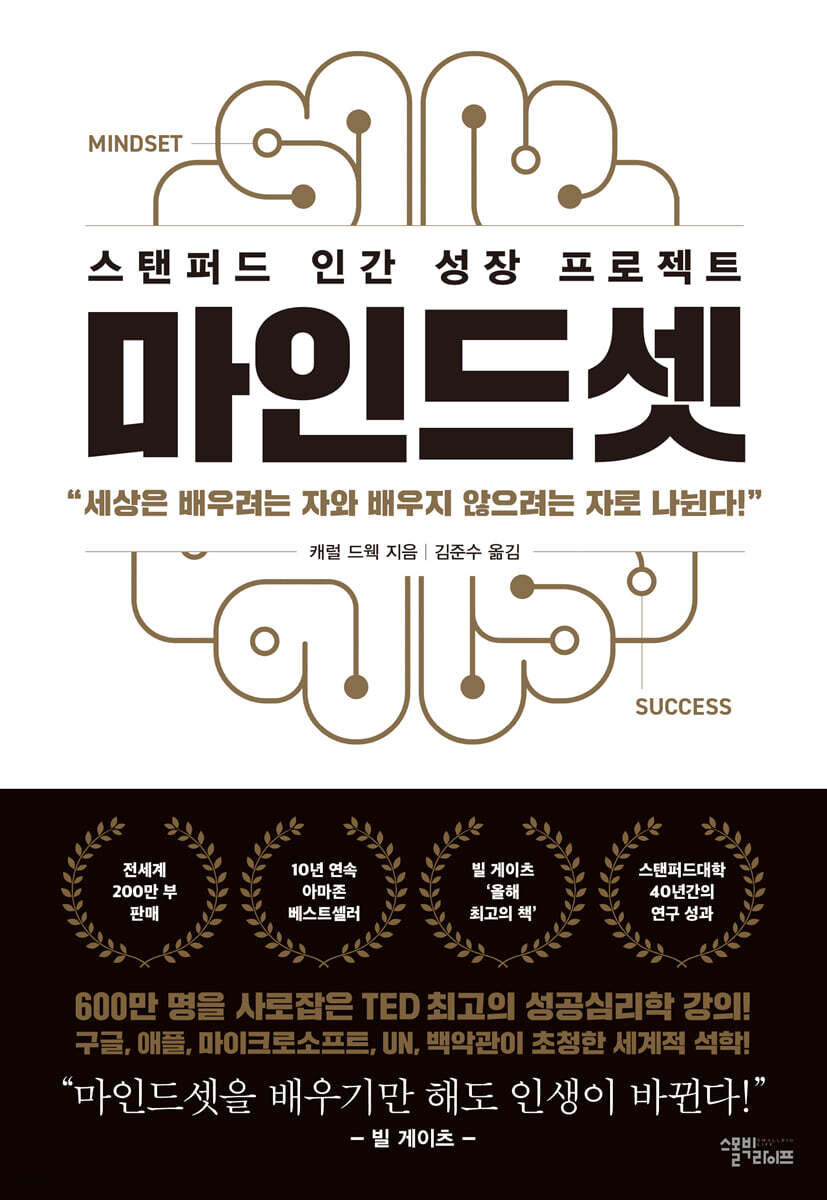
Bill Gates' 'Best Book of the Year'!
No one is born the best!
Carol Dweck, a professor at Stanford University, is a world-renowned psychology expert who has gained international fame for her theory of 'mindset.'
『Mindset』, the culmination of her 40 years of research, has sold over 2 million copies worldwide and has been translated into over 20 languages. Even now, 15 years after its initial publication, it remains a bestseller and steady seller, maintaining its position in the top 100 on Amazon, selling 5,000 copies a week.
Most people easily say, 'Success is for those who are born with it.'
Especially in the world of art and sports, this saying is a kind of unwritten rule.
But Jackson Pollock, a well-known star in the art world, and Michael Jordan, a sports giant, were both considered to have no talent.
Experts agree that Jackson Pollock had little artistic talent, and Michael Jordan was cut from his high school varsity basketball team and never even made the North Carolina State University basketball team he wanted to play for.
People forget all the failures and growth that went into it, and only look at the results they achieved and say that they had natural talent.
But they are not born the best, they are people who believe in themselves and constantly practice to become the best.
This book explains how 'mindset' influences human growth and how 'mindset' brings about such results through abundant examples of famous people who overcame failure to achieve success.
The only self-help book recommended by Bill Gates!
Every year, Bill Gates recommends or reviews books he has read on his blog, "Gates Notes."
In 2015, Bill Gates recommended Mindset as the "best book I've read this year," explaining his reasons for recommending it as follows:
“Mindset,” a book by Stanford University psychologist Dr. Carol Dweck, is a book that deserves special attention.
People with the "growth mindset" discussed in this book believe that basic qualities, including intelligence, can be developed like muscles.
That doesn't mean they believe anyone can become like Einstein or Michael Jordan by working hard on their physics homework and practicing their jump shots.
However, in Dweck's words, they believe that 'no one can know the true potential of a human being.'
As a result, people with a growth mindset don't shy away from difficult challenges and constantly seek opportunities to improve themselves.”
Bill Gates isn't the only person at Microsoft who's obsessed with "mindset."
Microsoft's current CEO, Satya Nadella, revealed in a 2016 interview with [Forbes] that he was a "big fan" of Professor Dweck, and in an interview with [Bloomberg], he cited "Mindset" as "the book that captures the essence of the change I want to create at Microsoft."
Behind success and perseverance lies a 'growth mindset'!
Besides Bill Gates, numerous scholars and business leaders have praised the strengths of Mindset and mindset theory.
For example, Jeffrey Pfeffer, a distinguished professor at Stanford University's Graduate School of Business who visited Korea to attend the 2015 Global Talent Forum, said this in an interview with a domestic media outlet.
“We need to change our mindset about ‘evaluation.’
Read Mindset by Stanford University professor Carol Dweck.
“The focus should be on ‘growth,’ not ‘evaluation.’”
Angela Duckworth, author of the best-selling book Grit, also suggested a growth mindset as a way to cultivate grit.
In his TED Talks and his book Grit, he emphasized the importance of a "growth mindset," which involves not responding pessimistically to failure and adversity, but constantly striving to learn.
Carol Dweck and Angela Duckworth conducted a survey of high school seniors and found that students with a growth mindset had significantly higher grit than those with a fixed mindset.
Later, they measured growth mindset and grit in children and adults and found a positive correlation between the two.
Dr. Carol Dweck's reputation has grown further as she has been invited to speak at IBM, Microsoft, Google, Apple, the U.S. Olympic team, the UN, the White House, and more. Her TED talk, "The Power of Believing You Can Still Grow," which summarizes the core concepts of mindset theory, has been viewed over 6 million times and continues to be loved by readers.
Amazon Bestseller for 10 Years in a Row!
Bill Gates' 'Best Book of the Year'!
No one is born the best!
Carol Dweck, a professor at Stanford University, is a world-renowned psychology expert who has gained international fame for her theory of 'mindset.'
『Mindset』, the culmination of her 40 years of research, has sold over 2 million copies worldwide and has been translated into over 20 languages. Even now, 15 years after its initial publication, it remains a bestseller and steady seller, maintaining its position in the top 100 on Amazon, selling 5,000 copies a week.
Most people easily say, 'Success is for those who are born with it.'
Especially in the world of art and sports, this saying is a kind of unwritten rule.
But Jackson Pollock, a well-known star in the art world, and Michael Jordan, a sports giant, were both considered to have no talent.
Experts agree that Jackson Pollock had little artistic talent, and Michael Jordan was cut from his high school varsity basketball team and never even made the North Carolina State University basketball team he wanted to play for.
People forget all the failures and growth that went into it, and only look at the results they achieved and say that they had natural talent.
But they are not born the best, they are people who believe in themselves and constantly practice to become the best.
This book explains how 'mindset' influences human growth and how 'mindset' brings about such results through abundant examples of famous people who overcame failure to achieve success.
The only self-help book recommended by Bill Gates!
Every year, Bill Gates recommends or reviews books he has read on his blog, "Gates Notes."
In 2015, Bill Gates recommended Mindset as the "best book I've read this year," explaining his reasons for recommending it as follows:
“Mindset,” a book by Stanford University psychologist Dr. Carol Dweck, is a book that deserves special attention.
People with the "growth mindset" discussed in this book believe that basic qualities, including intelligence, can be developed like muscles.
That doesn't mean they believe anyone can become like Einstein or Michael Jordan by working hard on their physics homework and practicing their jump shots.
However, in Dweck's words, they believe that 'no one can know the true potential of a human being.'
As a result, people with a growth mindset don't shy away from difficult challenges and constantly seek opportunities to improve themselves.”
Bill Gates isn't the only person at Microsoft who's obsessed with "mindset."
Microsoft's current CEO, Satya Nadella, revealed in a 2016 interview with [Forbes] that he was a "big fan" of Professor Dweck, and in an interview with [Bloomberg], he cited "Mindset" as "the book that captures the essence of the change I want to create at Microsoft."
Behind success and perseverance lies a 'growth mindset'!
Besides Bill Gates, numerous scholars and business leaders have praised the strengths of Mindset and mindset theory.
For example, Jeffrey Pfeffer, a distinguished professor at Stanford University's Graduate School of Business who visited Korea to attend the 2015 Global Talent Forum, said this in an interview with a domestic media outlet.
“We need to change our mindset about ‘evaluation.’
Read Mindset by Stanford University professor Carol Dweck.
“The focus should be on ‘growth,’ not ‘evaluation.’”
Angela Duckworth, author of the best-selling book Grit, also suggested a growth mindset as a way to cultivate grit.
In his TED Talks and his book Grit, he emphasized the importance of a "growth mindset," which involves not responding pessimistically to failure and adversity, but constantly striving to learn.
Carol Dweck and Angela Duckworth conducted a survey of high school seniors and found that students with a growth mindset had significantly higher grit than those with a fixed mindset.
Later, they measured growth mindset and grit in children and adults and found a positive correlation between the two.
Dr. Carol Dweck's reputation has grown further as she has been invited to speak at IBM, Microsoft, Google, Apple, the U.S. Olympic team, the UN, the White House, and more. Her TED talk, "The Power of Believing You Can Still Grow," which summarizes the core concepts of mindset theory, has been viewed over 6 million times and continues to be loved by readers.
GOODS SPECIFICS
- Date of issue: January 1, 2023
- Page count, weight, size: 348 pages | 508g | 148*215*22mm
- ISBN13: 9791191731415
- ISBN10: 1191731413
You may also like
카테고리
korean


korean

![GQ KOREA Mark (Monthly): December [2025]](http://librairie.coreenne.fr/cdn/shop/files/8ef265dbbfbf186523ed75ba7319009d.jpg?v=1765340328&width=3840)


