

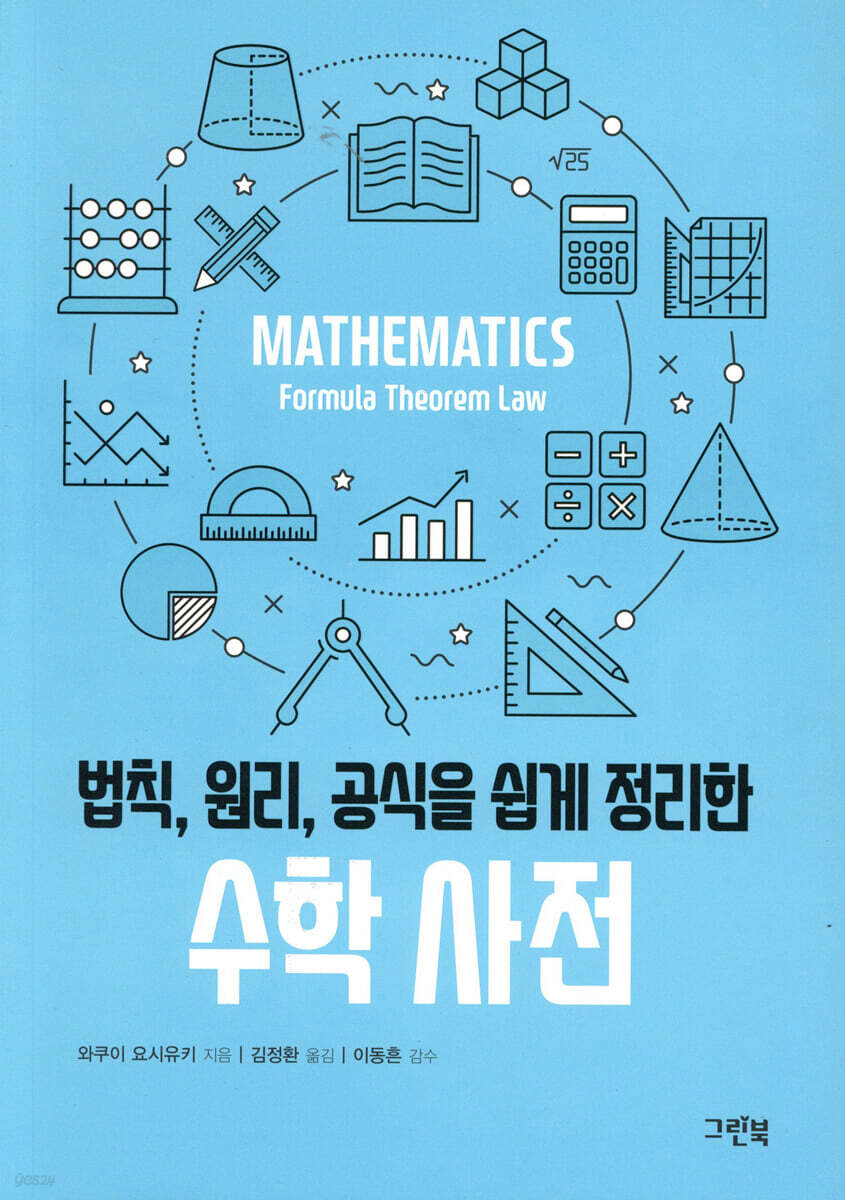
A math dictionary that easily organizes laws, principles, and formulas.
 |
Description
Book Introduction
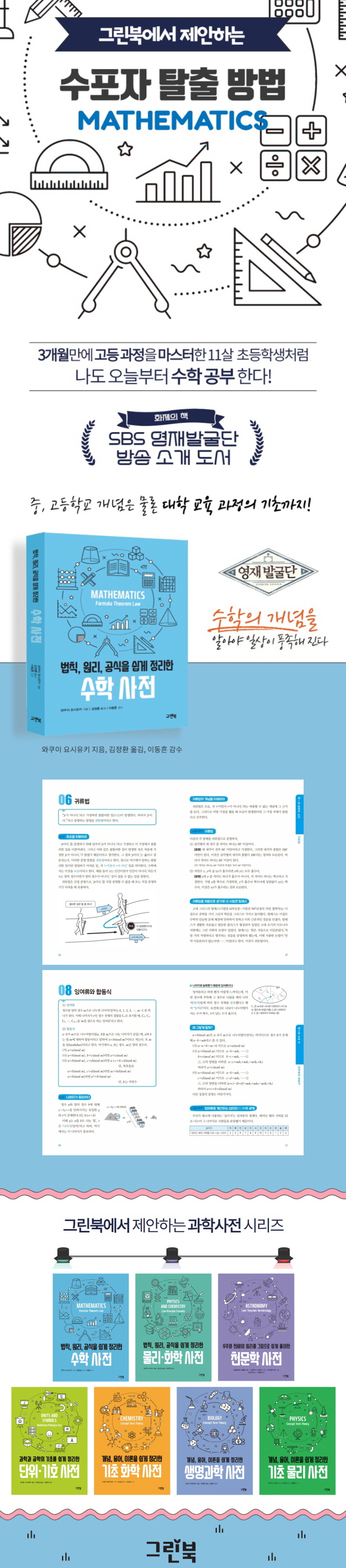
An 11-year-old boy who appeared on SBS's "Discovering Genius" is becoming a hot topic.
According to his family, fourth grader Lee Seo-jin liked math, but he did not do any advanced study or attend academies.
That child is now learning middle and high school subjects on his own and easily solving college math problems.
The book that Seojin always kept by her side was Green Book's "Mathematics Dictionary: An Easy-to-Use Guide to Laws, Principles, and Formulas."
In particular, unlike other gifted students who read multiple math books, Seo Jin is said to have read only this one book over and over again.
The study secret of math prodigy Lee Seo-jin, who firmly understood the concepts and solved problems on his own, has great implications for many students who are exhausted from the burden of prior study and arduous study.
This book is a dictionary of mathematical concepts that contains the fundamental concepts of mathematics, from concepts devised 2,000 years ago to current middle and high school mathematics and basic mathematics in university curricula.
Mathematical concepts are organized step by step, examples are provided to help readers understand the concepts, and background knowledge on how these mathematical concepts were created is included to make it more fun.
Let's cultivate the ability to view various phenomena and events through mathematical eyes, using mathematical concepts that have endured a long history of validation and remain active to this day.
According to his family, fourth grader Lee Seo-jin liked math, but he did not do any advanced study or attend academies.
That child is now learning middle and high school subjects on his own and easily solving college math problems.
The book that Seojin always kept by her side was Green Book's "Mathematics Dictionary: An Easy-to-Use Guide to Laws, Principles, and Formulas."
In particular, unlike other gifted students who read multiple math books, Seo Jin is said to have read only this one book over and over again.
The study secret of math prodigy Lee Seo-jin, who firmly understood the concepts and solved problems on his own, has great implications for many students who are exhausted from the burden of prior study and arduous study.
This book is a dictionary of mathematical concepts that contains the fundamental concepts of mathematics, from concepts devised 2,000 years ago to current middle and high school mathematics and basic mathematics in university curricula.
Mathematical concepts are organized step by step, examples are provided to help readers understand the concepts, and background knowledge on how these mathematical concepts were created is included to make it more fun.
Let's cultivate the ability to view various phenomena and events through mathematical eyes, using mathematical concepts that have endured a long history of validation and remain active to this day.
- You can preview some of the book's contents.
Preview
index
Preface 6
Chapter 1 Proof and Logic 16
01 Propositions and Sets
02 De Morgan's Law
03 Universal propositions, particular propositions, and their negation
04 Necessary and sufficient conditions
05 Station, Lee, Daewoo
06 Law of Absurdity
Chapter 2 Numbers and Formulas 28
7 Simple Multiple Determination Methods
8 Surplus and joint meal
9 Euclidean Algorithm
10 Binomial theorem
11 Conversion formulas between base 11 and decimal
12 Real roots and graph of the equation f(x)=0
13 Remainder theorem and factor theorem
14 Assembly method
15 Relationship between the sun and the coefficients
16 Formula for the roots of a quadratic equation
17 Formula for the roots of a cubic equation
Chapter 3: Shapes and Equations 58
18 Pythagorean theorem
19 The 5th center of the triangle
20 Area Formula of a Triangle
21 Menelaus' theorem
22 Cheba's Theorem
23 Law of Signs
24 Cosine Law
25 Equation of a parallel-translated figure
26 Equation of a rotated figure
27 Equation of a straight line
28 Equations of ellipses, hyperbolas, and parabolas
29 Tangents of ellipses, hyperbolas, and parabolas
30 Lissajous curves
31 cycloid
Chapter 4 Complex Numbers, Vectors, and Matrices96
32 Arithmetic operations on complex numbers
33. The polar form and de Moivre's theorem
34 Euler's formula
35 Definition of vector
Linear independence of 36 vectors
37 Dot product of vectors
38th minute formula
39 Vector equations of plane figures
40 Vector equations of spatial figures
41 A vector perpendicular to two vectors
42 Matrix calculation rules
43 Inverse Matrix Formula
44 Matrices and Simultaneous Equations
45 Matrices and Linear Transformations
46 Eigenvalues and Eigenvectors
Formula for the nth power of a matrix of 47
48 Cayley-Hamilton theorem
Chapter 5 Functions 140
49 Parallel shift formula for function graph
50 Graph of a linear function
51 Graph of a quadratic function
52 Trigonometric Functions and Basic Formulas
53 Addition theorem of trigonometric functions
54 Composition formulas for trigonometric functions
Expansion of the 55th index
56 Exponential functions and their properties
57 Inverse functions and properties
58 Logarithmic functions and their properties
59 Common Logarithms and Their Properties
Chapter 6 Sequences 176
60 Formula for the sum of an arithmetic sequence
61 Formula for the sum of geometric sequences
62 Formula for the sum of a sequence {}
63 Solution to the recurrence formula an+1=pan+q
64 Solution to the recurrence formula an+2+pan+1+qan=0
65 Mathematical Induction
Chapter 7 Differentiation 194
66 Differentiability and Differentiable Coefficients
67 Derivatives and derivatives of elementary functions
68 Formula for calculating derivatives
69 Differentiation of composite functions
70 Differentiation of inverse functions
71 Differentiation of implicit functions
Differentiation of 72 parameter representations
73 Tangent and normal formulas
74 Theorems on the increase and decrease of functions and their concavity and convexity
75 approximations
76 Maclaurin's theorem
77 Newton-Raphson method
78 Velocity and acceleration on a vertical line
79 Velocity and acceleration on a plane
80 Partial Differentiation
Chapter 8 Integration 240
81. Quadrature method
82 Integration
83 Fundamental Theorem of Calculus
84 Indefinite integrals and their formulas
85 Partial Integration (Indefinite Integration)
86 Substitution Integration (Indefinite Integration)
87 Calculating definite integrals using indefinite integrals
88 Partial Integration (Definite Integration)
89 Substitution Integration (Definite Integration)
90 Definite Integral and Area Formula
91 Formulas for definite integrals and volume
92 Definite integral and curve length formula
93 Papus-Gul'dan Theorem
94 Baumkuchen integral
95 Cavalieri's Principle
96 Trapezoidal Formula (Approximation)
97 Simpson's formula (approximation)
Chapter 9: Permutations and Combinations 292
98 Law of Set Agreement
The law of the product of 99 sets
100 Inclusion-Exclusion Principle
101 Permutation Formulas
102 Combination Formula
Chapter 10: Probability Average 306
103 Definition of probability
104 Addition Theorem of Probability
Summary of the 105th case
106 Probability Multiplication Theorem
107 Summary of Independent Implementation
Summary of 108 repeated trials
109 Law of Large Numbers
110 Mean and Variance
111 Central Limit Theorem
112 Estimation of the population mean
Estimated ratio of 113
114 Bayes' theorem
Search 352
Chapter 1 Proof and Logic 16
01 Propositions and Sets
02 De Morgan's Law
03 Universal propositions, particular propositions, and their negation
04 Necessary and sufficient conditions
05 Station, Lee, Daewoo
06 Law of Absurdity
Chapter 2 Numbers and Formulas 28
7 Simple Multiple Determination Methods
8 Surplus and joint meal
9 Euclidean Algorithm
10 Binomial theorem
11 Conversion formulas between base 11 and decimal
12 Real roots and graph of the equation f(x)=0
13 Remainder theorem and factor theorem
14 Assembly method
15 Relationship between the sun and the coefficients
16 Formula for the roots of a quadratic equation
17 Formula for the roots of a cubic equation
Chapter 3: Shapes and Equations 58
18 Pythagorean theorem
19 The 5th center of the triangle
20 Area Formula of a Triangle
21 Menelaus' theorem
22 Cheba's Theorem
23 Law of Signs
24 Cosine Law
25 Equation of a parallel-translated figure
26 Equation of a rotated figure
27 Equation of a straight line
28 Equations of ellipses, hyperbolas, and parabolas
29 Tangents of ellipses, hyperbolas, and parabolas
30 Lissajous curves
31 cycloid
Chapter 4 Complex Numbers, Vectors, and Matrices96
32 Arithmetic operations on complex numbers
33. The polar form and de Moivre's theorem
34 Euler's formula
35 Definition of vector
Linear independence of 36 vectors
37 Dot product of vectors
38th minute formula
39 Vector equations of plane figures
40 Vector equations of spatial figures
41 A vector perpendicular to two vectors
42 Matrix calculation rules
43 Inverse Matrix Formula
44 Matrices and Simultaneous Equations
45 Matrices and Linear Transformations
46 Eigenvalues and Eigenvectors
Formula for the nth power of a matrix of 47
48 Cayley-Hamilton theorem
Chapter 5 Functions 140
49 Parallel shift formula for function graph
50 Graph of a linear function
51 Graph of a quadratic function
52 Trigonometric Functions and Basic Formulas
53 Addition theorem of trigonometric functions
54 Composition formulas for trigonometric functions
Expansion of the 55th index
56 Exponential functions and their properties
57 Inverse functions and properties
58 Logarithmic functions and their properties
59 Common Logarithms and Their Properties
Chapter 6 Sequences 176
60 Formula for the sum of an arithmetic sequence
61 Formula for the sum of geometric sequences
62 Formula for the sum of a sequence {}
63 Solution to the recurrence formula an+1=pan+q
64 Solution to the recurrence formula an+2+pan+1+qan=0
65 Mathematical Induction
Chapter 7 Differentiation 194
66 Differentiability and Differentiable Coefficients
67 Derivatives and derivatives of elementary functions
68 Formula for calculating derivatives
69 Differentiation of composite functions
70 Differentiation of inverse functions
71 Differentiation of implicit functions
Differentiation of 72 parameter representations
73 Tangent and normal formulas
74 Theorems on the increase and decrease of functions and their concavity and convexity
75 approximations
76 Maclaurin's theorem
77 Newton-Raphson method
78 Velocity and acceleration on a vertical line
79 Velocity and acceleration on a plane
80 Partial Differentiation
Chapter 8 Integration 240
81. Quadrature method
82 Integration
83 Fundamental Theorem of Calculus
84 Indefinite integrals and their formulas
85 Partial Integration (Indefinite Integration)
86 Substitution Integration (Indefinite Integration)
87 Calculating definite integrals using indefinite integrals
88 Partial Integration (Definite Integration)
89 Substitution Integration (Definite Integration)
90 Definite Integral and Area Formula
91 Formulas for definite integrals and volume
92 Definite integral and curve length formula
93 Papus-Gul'dan Theorem
94 Baumkuchen integral
95 Cavalieri's Principle
96 Trapezoidal Formula (Approximation)
97 Simpson's formula (approximation)
Chapter 9: Permutations and Combinations 292
98 Law of Set Agreement
The law of the product of 99 sets
100 Inclusion-Exclusion Principle
101 Permutation Formulas
102 Combination Formula
Chapter 10: Probability Average 306
103 Definition of probability
104 Addition Theorem of Probability
Summary of the 105th case
106 Probability Multiplication Theorem
107 Summary of Independent Implementation
Summary of 108 repeated trials
109 Law of Large Numbers
110 Mean and Variance
111 Central Limit Theorem
112 Estimation of the population mean
Estimated ratio of 113
114 Bayes' theorem
Search 352
Detailed image
Publisher's Review
Understanding mathematical concepts enriches your daily life.
Unless you are in a science or engineering field, you are likely to avoid math.
It may be because it is difficult and I think it has little practical use in daily life.
However, mathematics, which we think has little application in our daily lives, is the fundamental and foundational discipline of all phenomena, and only when the theoretical foundation of mathematics is perfect can our daily lives be safe and comfortable.
Let's take an example.
The buildings we use are intricately structured.
The basic theory used when designing the structure of these buildings is the Pythagorean theorem, which is learned starting in middle school.
Among the Pythagorean theorem, the 3:4:5 ratio is particularly useful.
If there were no Pythagorean theorem, the harm caused by shoddy construction would be rampant, and we would have to sleep anxiously at home.
Meanwhile, mathematics can also be easily seen in the field of art.
A representative example is the golden ratio, which can be seen in Leonardo da Vinci's The Last Supper.
The screen is composed of a mathematical structure of approximately 1.618:1, creating a complete work that pleases our eyes.
Also, the ratio of A4 paper or credit cards that we commonly use in our daily lives also shows mathematically stable ratios.
In order to develop the ability to understand the principles of mathematics that are everywhere around us, it is important to understand the concepts above all else.
Let's take a closer look at these basic concepts one by one and organize them through "A Mathematical Dictionary that Easily Organizes Laws, Principles, and Formulas" to build a solid academic foundation.
Features of this book
A math dictionary that will help you lay the right foundation for math!
Developing a mathematical thinking process cannot be anything but crucial when starting to study mathematics.
It is of utmost importance to understand the structure of mathematical concepts by covering the most fundamental parts of theory creation.
This book aims to establish these most fundamental concepts correctly.
In particular, most of the concepts covered here are classics among the classics in mathematical theory.
There are quite a few formulas and theorems that were devised about 2,000 years ago.
As such, the discipline of mathematics has maintained a long and solid history and has served as the foundation for all academic disciplines.
This book will help you get off to a good start in this fundamental discipline.
A math dictionary that you can keep for a long time and refer to whenever you need it!
From concepts devised 2,000 years ago to current middle and high school mathematics and the basic mathematics of university curricula, the fundamental concepts of mathematics are comprehensively organized and organized in one volume.
The important concepts of mathematics, such as various laws, principles, and formulas, are organized by field and explained in order. If you use this like a dictionary and read through the necessary parts, you will find it easier to understand.
This "Mathematics Dictionary: Easily Organized Rules, Principles, and Formulas" will serve as a mathematics guidebook that can be taken out whenever needed, from teenagers who are laying the foundations of mathematics to adults who want to review what they have learned.
A comprehensive math dictionary packed with examples, case studies, and background knowledge surrounding the theory!
If you start studying mathematics without understanding the underlying principles, it becomes difficult to understand the theories built on top of it.
Therefore, each unit is structured so that the concepts can be learned and understood once again through examples, and the examples that supplement the explanation of the concepts are composed of content that anyone can understand, rather than difficult and rigid content.
We also added an in-depth course to broaden the concepts, and briefly covered the history and episodes that gave rise to these theories to help students learn more deeply.
A math dictionary that will help even math novice enjoy the fun of math!
Many students give up on math, and many say that the math they learned as a student is of no use in real life.
But if you find math fun, it's a different story.
As you find it fun, you will develop an eye for how mathematics can be applied to certain phenomena, and you will not easily give up on mathematics.
That's why you have to sew the first button well.
By taking the first step with the "Mathematics Dictionary: Easily Organized Rules, Principles, and Formulas," and thoroughly studying and mastering a wide range of mathematical concepts both inside and outside of textbooks, even those who were previously unsure about mathematics will discover new aspects of it and become immersed in the fun of mathematics.
Unless you are in a science or engineering field, you are likely to avoid math.
It may be because it is difficult and I think it has little practical use in daily life.
However, mathematics, which we think has little application in our daily lives, is the fundamental and foundational discipline of all phenomena, and only when the theoretical foundation of mathematics is perfect can our daily lives be safe and comfortable.
Let's take an example.
The buildings we use are intricately structured.
The basic theory used when designing the structure of these buildings is the Pythagorean theorem, which is learned starting in middle school.
Among the Pythagorean theorem, the 3:4:5 ratio is particularly useful.
If there were no Pythagorean theorem, the harm caused by shoddy construction would be rampant, and we would have to sleep anxiously at home.
Meanwhile, mathematics can also be easily seen in the field of art.
A representative example is the golden ratio, which can be seen in Leonardo da Vinci's The Last Supper.
The screen is composed of a mathematical structure of approximately 1.618:1, creating a complete work that pleases our eyes.
Also, the ratio of A4 paper or credit cards that we commonly use in our daily lives also shows mathematically stable ratios.
In order to develop the ability to understand the principles of mathematics that are everywhere around us, it is important to understand the concepts above all else.
Let's take a closer look at these basic concepts one by one and organize them through "A Mathematical Dictionary that Easily Organizes Laws, Principles, and Formulas" to build a solid academic foundation.
Features of this book
A math dictionary that will help you lay the right foundation for math!
Developing a mathematical thinking process cannot be anything but crucial when starting to study mathematics.
It is of utmost importance to understand the structure of mathematical concepts by covering the most fundamental parts of theory creation.
This book aims to establish these most fundamental concepts correctly.
In particular, most of the concepts covered here are classics among the classics in mathematical theory.
There are quite a few formulas and theorems that were devised about 2,000 years ago.
As such, the discipline of mathematics has maintained a long and solid history and has served as the foundation for all academic disciplines.
This book will help you get off to a good start in this fundamental discipline.
A math dictionary that you can keep for a long time and refer to whenever you need it!
From concepts devised 2,000 years ago to current middle and high school mathematics and the basic mathematics of university curricula, the fundamental concepts of mathematics are comprehensively organized and organized in one volume.
The important concepts of mathematics, such as various laws, principles, and formulas, are organized by field and explained in order. If you use this like a dictionary and read through the necessary parts, you will find it easier to understand.
This "Mathematics Dictionary: Easily Organized Rules, Principles, and Formulas" will serve as a mathematics guidebook that can be taken out whenever needed, from teenagers who are laying the foundations of mathematics to adults who want to review what they have learned.
A comprehensive math dictionary packed with examples, case studies, and background knowledge surrounding the theory!
If you start studying mathematics without understanding the underlying principles, it becomes difficult to understand the theories built on top of it.
Therefore, each unit is structured so that the concepts can be learned and understood once again through examples, and the examples that supplement the explanation of the concepts are composed of content that anyone can understand, rather than difficult and rigid content.
We also added an in-depth course to broaden the concepts, and briefly covered the history and episodes that gave rise to these theories to help students learn more deeply.
A math dictionary that will help even math novice enjoy the fun of math!
Many students give up on math, and many say that the math they learned as a student is of no use in real life.
But if you find math fun, it's a different story.
As you find it fun, you will develop an eye for how mathematics can be applied to certain phenomena, and you will not easily give up on mathematics.
That's why you have to sew the first button well.
By taking the first step with the "Mathematics Dictionary: Easily Organized Rules, Principles, and Formulas," and thoroughly studying and mastering a wide range of mathematical concepts both inside and outside of textbooks, even those who were previously unsure about mathematics will discover new aspects of it and become immersed in the fun of mathematics.
GOODS SPECIFICS
- Date of issue: September 5, 2017
- Page count, weight, size: 360 pages | 581g | 148*210*30mm
- ISBN13: 9788955883404
- ISBN10: 8955883404
You may also like
카테고리
korean


korean

![GQ KOREA Mark (Monthly): December [2025]](http://librairie.coreenne.fr/cdn/shop/files/8ef265dbbfbf186523ed75ba7319009d.jpg?v=1765340328&width=3840)


