

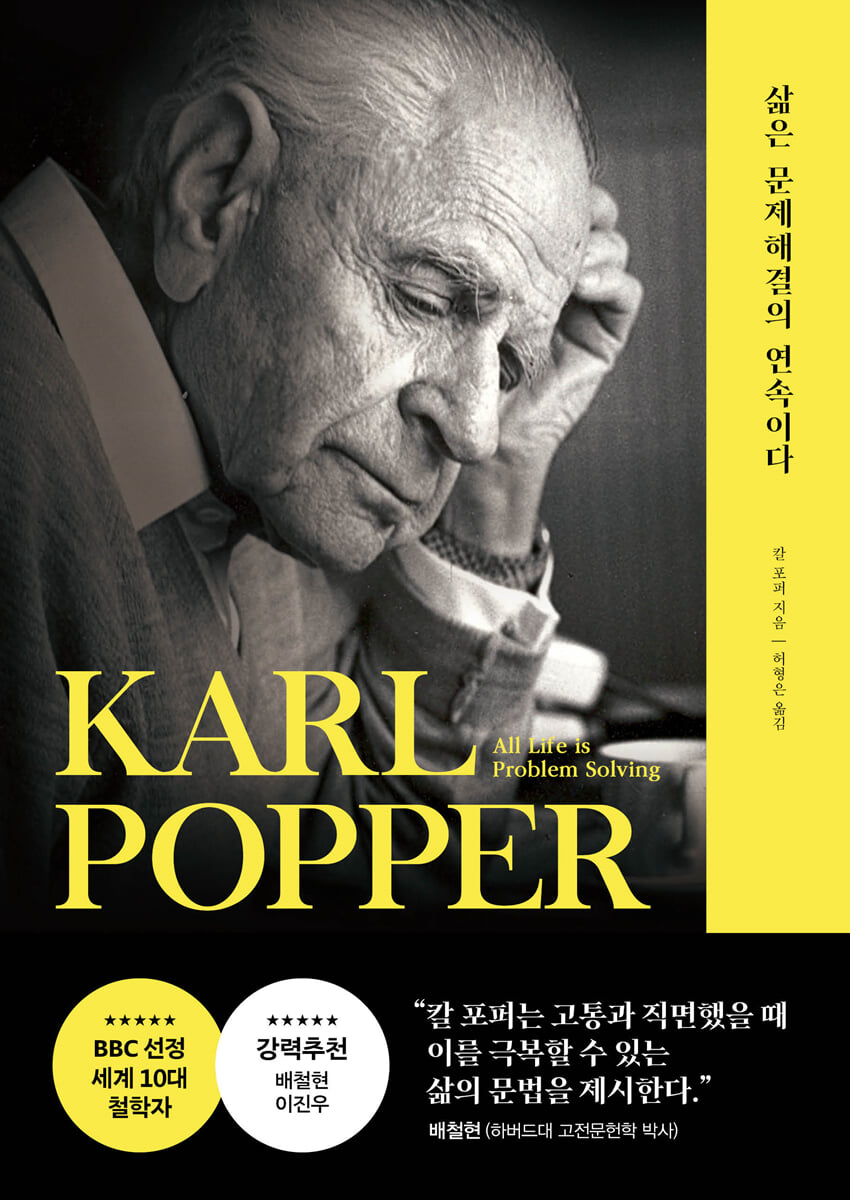
Life is a series of problem solving.
 |
Description
Book Introduction
The Last Lesson from Karl Popper, the "Intellectual of Our Time" “I have a mind to take responsibility for today “It becomes the hope of tomorrow” The greatest philosopher of the 20th century Hope and comfort for humanity in the 21st century "Life is a Continuum of Problem Solving" is a book that compiles the thoughts on natural science, history, and politics that Karl Popper, the greatest philosopher of the 20th century, explored throughout his life. He experienced two world wars and many other events, including the loss of friends and relatives to Nazi tyranny. Nevertheless, he expressed his trust in human reason until the end, saying, “Humans can only learn through criticism of their own mistakes and errors.” Karl Popper, who spent his entire life fighting cynicism and pessimism, included in this book the thoughts essential for humanity to continue moving forward without stopping. Despite the changing times, wars continue unabated, economic instability and social polarization become more severe with the passage of time, and extreme hatred prevails in all areas of society, including politics, race, and gender. To humanity living today, a 20th-century philosopher offers a hopeful suggestion. “The right direction for us to move forward is to view the past as something completely separate from the future. The future is open. Anything can happen, and we can decide the future.” Karl Popper says that in order for a society to be one that allows self-criticism and opposition, individuals must think independently and have an attitude of taking responsibility for themselves. Karl Popper’s suggestion that emphasizes the importance of an “attitude of taking responsibility” for humanity, which repeats wars with the idea that there are values more important than human life, is shining even brighter at this moment. |
- You can preview some of the book's contents.
Preview
index
Recommendation
Hyean, the Wisdom that Represents Life_Bae Cheol-hyeon
How to Love Your Life, Even When It Seems Like It's Filled with Problems_Lee Jin-woo
My favorite book_Hong Jin-chae
Humility and courage from a strong heart_Yoon Soo-young
Introduction
Part 1.
Problems related to natural science
Chapter 1.
The logic and evolution of scientific theories
Chapter 2.
A Realist's Consideration of the Problem of Body and Mind
Chapter 3.
Epistemology and the Problem of Peace
Chapter 4.
Epistemological Views on Evolutionary Epistemology
Chapter 5.
On evolutionary knowledge theory
Chapter 6.
Kepler's metaphysics of the solar system and empirical criticism
Part 2.
Reflections on History and Politics
Chapter 7.
About freedom
Chapter 8.
About democracy
Chapter 9.
Life is a series of problem solving.
Chapter 10.
Against the cynical view of history
Chapter 11.
War for Peace
Chapter 12.
The Fall of Communism: Understanding the Past Can Change the Future
Chapter 13.
Knowledge must be used for peace.
Chapter 14.
Masaryk and the Power of an Open Society
Chapter 15.
I fell in love with problems, and one day I became a philosopher.
Translator's Note
Hyean, the Wisdom that Represents Life_Bae Cheol-hyeon
How to Love Your Life, Even When It Seems Like It's Filled with Problems_Lee Jin-woo
My favorite book_Hong Jin-chae
Humility and courage from a strong heart_Yoon Soo-young
Introduction
Part 1.
Problems related to natural science
Chapter 1.
The logic and evolution of scientific theories
Chapter 2.
A Realist's Consideration of the Problem of Body and Mind
Chapter 3.
Epistemology and the Problem of Peace
Chapter 4.
Epistemological Views on Evolutionary Epistemology
Chapter 5.
On evolutionary knowledge theory
Chapter 6.
Kepler's metaphysics of the solar system and empirical criticism
Part 2.
Reflections on History and Politics
Chapter 7.
About freedom
Chapter 8.
About democracy
Chapter 9.
Life is a series of problem solving.
Chapter 10.
Against the cynical view of history
Chapter 11.
War for Peace
Chapter 12.
The Fall of Communism: Understanding the Past Can Change the Future
Chapter 13.
Knowledge must be used for peace.
Chapter 14.
Masaryk and the Power of an Open Society
Chapter 15.
I fell in love with problems, and one day I became a philosopher.
Translator's Note
Detailed image

Into the book
Whenever I look into European and American history, I always quote the historian H.
AL
Fisher comes to this conclusion:
“Progress is clearly recorded throughout history.
But progress is not a law of nature.
“The progress made by one generation can easily be lost by the next generation.”
I think I agree with each of these three sentences, and I can't help but agree.
But what exactly is this "progress" that, as Fisher suggests, history teaches us, yet is also unstable and can be lost at any time? The answer to this question is both clear and crucial.
The progress that Fisher speaks of, the progress we usually think of, is ethical or moral progress.
It refers to the peace on earth that the New Testament has already promised, the peace that will come when all civil wars and conflicts between nations end.
It signifies progress toward a civilized human society, progress toward the rule of law aimed at maintaining peace, and progress toward establishing a federation of all nations based on the rule of law.
---From "Introductory Remarks"
We always learn something entirely new through counter-examples.
You learn not only that a hypothesis is wrong, but also why it is wrong.
Most importantly, you get a new, more sharply targeted problem.
And as we all know, new problems are the true starting point of new scientific developments.
---「Chapter 1.
From “Logic and Evolution of Scientific Theory”
It seems that there is only one very difficult road to peace.
It's a long and arduous road.
Perhaps a nuclear war will break out long before we set foot on this path.
Intellectuals, most of whom have the best intentions, need to become more humble and change their attitudes so that they do not take on leading roles.
There is no need for a new ideology or a new religion.
What's needed instead is 'a little more intellectual humility.'
Our intellectuals know nothing.
I just keep moving forward, groping around from time to time.
Among us who call ourselves scientists, we need to be a little more humble going forward, and more importantly, we need to abandon our dogmatic attitude.
Otherwise, science will ultimately fail.
That science, which is mankind's greatest and most reliable creation.
Intellectuals are beings who know nothing.
Their arrogance and presumption may be the greatest obstacle to peace.
The one ray of hope is that, although they are arrogant, they are not so stupid as to not realize it.”
---「Chapter 3.
From “Epistemology and the Problem of Peace”
As far as I know, there is no scientist who has never made a mistake.
This is true even for the great scientists who are emerging today.
Galileo Galilei, Kepler, Newton, Einstein, Darwin, Mendel, Pasteur, Koch, Crick, and even Hilbert and Gödel are no exception.
All humans, as well as all animals, are imperfect beings who make mistakes.
Therefore, there may be experts, but there can be no absolute authority.
However, this is a fact that is not yet widely accepted.
Of course, we all know that we must not make mistakes, and we try our best not to (Gödel tried harder than most scientists).
Yet, we are still finite beings who make mistakes and are capable of making mistakes.
The Greek philosophers also said:
“Only God knows, and we humans can only guess and have opinions.”
---「Chapter 5.
From “On the Evolutionary Theory of Knowledge”
Kepler, like other scientists, reached his conclusions through intuition, trial (hypotheses) and error (empirical refutation).
And like other scientists who seek and discover new truths, Kepler was a metaphysician who knew how to learn from his mistakes.
It was very clear to him that you learn from your mistakes.
This is in stark contrast to the fact that many scientists today overlook it.
Without intuition, there is no progress.
Even if most of our intuitions turn out to be wrong.
We need intuition and ideas, preferably conflicting ideas.
We also need ideas about how those ideas can be critiqued, improved, and rigorously tested.
Until those ideas are refuted (and even after that), we have no choice but to continue to explore ideas whose truth is questionable.
Even the best ideas are bound to have their doubts.
---「Chapter 6.
From "Kepler's Metaphysics of the Solar System and Empirical Criticism"
The yearning for freedom is certainly a primitive one, and is found to varying degrees in animals (even domestic animals) and even in children.
But when it comes to the realm of politics, freedom becomes a problem.
Because unlimited freedom of every individual is impossible for humanity to coexist.
The solution Kant proposed was to limit individual freedom only to the extent necessary for human coexistence, and to apply those restrictions as equally as possible to all citizens.
This principle shows that the problem of political freedom is solvable, at least in theory.
But it does not tell us the standards of political freedom.
Given that it is difficult to readily determine in most individual cases whether a particular restriction on liberty is truly necessary and whether it is applied fairly to all citizens, other, more easily applicable criteria are needed.
The criteria I propose are these:
“A country is politically free if it has a political system that allows for a change of government without bloodshed when the majority of the people so desire.” To put it more simply, if we can remove a ruler without bloodshed, we are free.
---「Chapter 7.
From “On Freedom”
“We often discover that many of our ideas are flawed before we can seriously consider them, and in some cases, criticism eliminates ideas before they are even put out into the world.
Humans may seem somewhat superior to nature in that they are capable of conscious self-criticism and of receiving both friendly and hostile criticism from colleagues and others.
But when it comes to selection through trial and error and critical experimentation, nature has so far been far superior to us.
We have tried to imitate many of nature's inventions, but have not succeeded.
Still, there is hope that success can be achieved in the near future.
All life solves problems.
All living beings, whether skilled or inexperienced, successful or unsuccessful, are inventors and experts at solving technological problems.
The life of all animals is like this.
While human technology solves problems like sewage treatment and water and food storage, bees have long had to solve those problems.
---「Chapter 9.
From “Life is a series of problem solving”
“I am not an optimistic person about the future.
Because the future is open.
There is no law of progress in history.
We don't know what tomorrow will look like.
There are billions of good and bad possibilities that no one can predict.
It is a wrong attitude to try to extrapolate anything from history.
For example, by looking at today's trends, we can guess what tomorrow will be like.
The right direction for us to move forward is to view the past as something completely separate from the future.
We must judge the facts of the past historically and morally to learn what is feasible and what is morally right.
We should avoid inferring trends or customs from the past in an attempt to predict the future.
Because the future is open.
Anything can happen.
---「Chapter 10.
From “Against the Cynical View of History”
“Our attitude toward the future should be as follows:
We are responsible now for what happens in the future.
The past is something that has already happened.
There's nothing we can do about it.
Although, in a slightly different sense, I am responsible for the past.
So even if we take responsibility for what we've already done.
But we have a moral responsibility for the future, from the present moment on.
We have a duty to do our best without applying any ideological lens.
Even if the outlook isn't that bright.”
---「Chapter 11.
From “War for Peace”
“Combine a constant awareness of human fallibility and unceasing self-criticism with an unwavering commitment to solving the central thesis, its sub-problems, and the problems it raises along the way.” This is the research method I confidently and wholeheartedly recommend to you.
No matter how satisfying the answer you arrive at, never assume it is the final answer.
There are many good answers, but there is no such thing as a final answer.
Because all the answers we give are likely to be wrong.
This principle is often mistaken for relativism, but it is actually the exact opposite of relativism.
We seek truth, which is absolute and objective, and so is falsehood.
But every answer to a question opens the door to a deeper one.
AL
Fisher comes to this conclusion:
“Progress is clearly recorded throughout history.
But progress is not a law of nature.
“The progress made by one generation can easily be lost by the next generation.”
I think I agree with each of these three sentences, and I can't help but agree.
But what exactly is this "progress" that, as Fisher suggests, history teaches us, yet is also unstable and can be lost at any time? The answer to this question is both clear and crucial.
The progress that Fisher speaks of, the progress we usually think of, is ethical or moral progress.
It refers to the peace on earth that the New Testament has already promised, the peace that will come when all civil wars and conflicts between nations end.
It signifies progress toward a civilized human society, progress toward the rule of law aimed at maintaining peace, and progress toward establishing a federation of all nations based on the rule of law.
---From "Introductory Remarks"
We always learn something entirely new through counter-examples.
You learn not only that a hypothesis is wrong, but also why it is wrong.
Most importantly, you get a new, more sharply targeted problem.
And as we all know, new problems are the true starting point of new scientific developments.
---「Chapter 1.
From “Logic and Evolution of Scientific Theory”
It seems that there is only one very difficult road to peace.
It's a long and arduous road.
Perhaps a nuclear war will break out long before we set foot on this path.
Intellectuals, most of whom have the best intentions, need to become more humble and change their attitudes so that they do not take on leading roles.
There is no need for a new ideology or a new religion.
What's needed instead is 'a little more intellectual humility.'
Our intellectuals know nothing.
I just keep moving forward, groping around from time to time.
Among us who call ourselves scientists, we need to be a little more humble going forward, and more importantly, we need to abandon our dogmatic attitude.
Otherwise, science will ultimately fail.
That science, which is mankind's greatest and most reliable creation.
Intellectuals are beings who know nothing.
Their arrogance and presumption may be the greatest obstacle to peace.
The one ray of hope is that, although they are arrogant, they are not so stupid as to not realize it.”
---「Chapter 3.
From “Epistemology and the Problem of Peace”
As far as I know, there is no scientist who has never made a mistake.
This is true even for the great scientists who are emerging today.
Galileo Galilei, Kepler, Newton, Einstein, Darwin, Mendel, Pasteur, Koch, Crick, and even Hilbert and Gödel are no exception.
All humans, as well as all animals, are imperfect beings who make mistakes.
Therefore, there may be experts, but there can be no absolute authority.
However, this is a fact that is not yet widely accepted.
Of course, we all know that we must not make mistakes, and we try our best not to (Gödel tried harder than most scientists).
Yet, we are still finite beings who make mistakes and are capable of making mistakes.
The Greek philosophers also said:
“Only God knows, and we humans can only guess and have opinions.”
---「Chapter 5.
From “On the Evolutionary Theory of Knowledge”
Kepler, like other scientists, reached his conclusions through intuition, trial (hypotheses) and error (empirical refutation).
And like other scientists who seek and discover new truths, Kepler was a metaphysician who knew how to learn from his mistakes.
It was very clear to him that you learn from your mistakes.
This is in stark contrast to the fact that many scientists today overlook it.
Without intuition, there is no progress.
Even if most of our intuitions turn out to be wrong.
We need intuition and ideas, preferably conflicting ideas.
We also need ideas about how those ideas can be critiqued, improved, and rigorously tested.
Until those ideas are refuted (and even after that), we have no choice but to continue to explore ideas whose truth is questionable.
Even the best ideas are bound to have their doubts.
---「Chapter 6.
From "Kepler's Metaphysics of the Solar System and Empirical Criticism"
The yearning for freedom is certainly a primitive one, and is found to varying degrees in animals (even domestic animals) and even in children.
But when it comes to the realm of politics, freedom becomes a problem.
Because unlimited freedom of every individual is impossible for humanity to coexist.
The solution Kant proposed was to limit individual freedom only to the extent necessary for human coexistence, and to apply those restrictions as equally as possible to all citizens.
This principle shows that the problem of political freedom is solvable, at least in theory.
But it does not tell us the standards of political freedom.
Given that it is difficult to readily determine in most individual cases whether a particular restriction on liberty is truly necessary and whether it is applied fairly to all citizens, other, more easily applicable criteria are needed.
The criteria I propose are these:
“A country is politically free if it has a political system that allows for a change of government without bloodshed when the majority of the people so desire.” To put it more simply, if we can remove a ruler without bloodshed, we are free.
---「Chapter 7.
From “On Freedom”
“We often discover that many of our ideas are flawed before we can seriously consider them, and in some cases, criticism eliminates ideas before they are even put out into the world.
Humans may seem somewhat superior to nature in that they are capable of conscious self-criticism and of receiving both friendly and hostile criticism from colleagues and others.
But when it comes to selection through trial and error and critical experimentation, nature has so far been far superior to us.
We have tried to imitate many of nature's inventions, but have not succeeded.
Still, there is hope that success can be achieved in the near future.
All life solves problems.
All living beings, whether skilled or inexperienced, successful or unsuccessful, are inventors and experts at solving technological problems.
The life of all animals is like this.
While human technology solves problems like sewage treatment and water and food storage, bees have long had to solve those problems.
---「Chapter 9.
From “Life is a series of problem solving”
“I am not an optimistic person about the future.
Because the future is open.
There is no law of progress in history.
We don't know what tomorrow will look like.
There are billions of good and bad possibilities that no one can predict.
It is a wrong attitude to try to extrapolate anything from history.
For example, by looking at today's trends, we can guess what tomorrow will be like.
The right direction for us to move forward is to view the past as something completely separate from the future.
We must judge the facts of the past historically and morally to learn what is feasible and what is morally right.
We should avoid inferring trends or customs from the past in an attempt to predict the future.
Because the future is open.
Anything can happen.
---「Chapter 10.
From “Against the Cynical View of History”
“Our attitude toward the future should be as follows:
We are responsible now for what happens in the future.
The past is something that has already happened.
There's nothing we can do about it.
Although, in a slightly different sense, I am responsible for the past.
So even if we take responsibility for what we've already done.
But we have a moral responsibility for the future, from the present moment on.
We have a duty to do our best without applying any ideological lens.
Even if the outlook isn't that bright.”
---「Chapter 11.
From “War for Peace”
“Combine a constant awareness of human fallibility and unceasing self-criticism with an unwavering commitment to solving the central thesis, its sub-problems, and the problems it raises along the way.” This is the research method I confidently and wholeheartedly recommend to you.
No matter how satisfying the answer you arrive at, never assume it is the final answer.
There are many good answers, but there is no such thing as a final answer.
Because all the answers we give are likely to be wrong.
This principle is often mistaken for relativism, but it is actually the exact opposite of relativism.
We seek truth, which is absolute and objective, and so is falsehood.
But every answer to a question opens the door to a deeper one.
---「Chapter 15.
“I fell in love with problems, and one day I became a philosopher.”
“I fell in love with problems, and one day I became a philosopher.”
Publisher's Review
“The answers we came up with
“It is possible that all of this is an error.”
The noble philosopher 'Karl Popper',
The problems he wanted to solve until the end
"Life is a Continuum of Problem Solving" is the last book written by philosopher Karl Popper, who devoted his life to examining and verifying scientific and historical theories and to approaching the truth.
In this book, he unfolds the thoughts he continued to explore until the end of his life, one by one, on two topics: 'Problems of Natural Science' and 'Considerations on History and Politics.'
In Part 1, 'Problems of Natural Science', he explains 'falsifiability', which can be said to be the foundation of his philosophy of science, using Einstein's example.
Einstein was diligent in finding cases that would verify the contradictions of Newton's theory of mechanics and refute his theory of gravity, and Popper deeply sympathized with Einstein's rigorous and critical attitude in defining his theory as a "tentative attempt at a solution" like all other natural science theories, and defined science as "a process of approximating the truth, not the 100 percent truth."
Part 2, 'Reflections on History and Politics', provides a detailed explanation of the concept of the 'open society', advocated by Karl Popper and still mentioned by many politicians at home and abroad.
Although he was an ardent Marxist in his youth, he discovered the totalitarian nature of this ideology, which failed to critically examine its ideological basis, and has since criticized Marxism and totalitarian ideologies.
Karl Popper defined a society in which people claimed that the future of society was predetermined and that only unchanging ideologies were the truth as a "closed society," and he insisted until the day he died that an "open society" in which change was possible through thorough verification and criticism was the most ideal society that humans should pursue.
“No matter how satisfying the answer you arrive at, never assume it is the final answer.
There are many good answers, but there is no such thing as a final answer.
“Because all the answers we give could be wrong.” From ancient Greek philosophy to modern physics and social science theories, he has explored knowledge, and if there is one thing he emphasizes in this book, it is an attitude of humility toward knowledge.
His philosophy of life, which states that all we can do is to move towards the truth little by little, is an attitude we need to revisit in this age where we only pursue certain answers.
“We only learn through trial and error
You can learn”
Wisdom for Life from the 20th Century's Greatest Philosopher
When Karl Popper passed away in 1994, the world mourned, saying, “The last philosopher has died.”
Global investor George Soros named his foundation 'Open Society' after his mentor Karl Popper's 'Open Society', and Nobel Prize winner for literature Mario Vargas Llosa praised Karl Popper, saying, "I consider Karl Popper the most important philosopher of our time."
In the final chapter of this book, he looks back on his life and says:
“I never tried to be a philosopher.
The problems I considered as my own to solve led me to study various fields, including philosophy.
I truly fell in love with the first scientific problem I explored.
After finding a solution to that, I immediately fell in love with the problems of the history of philosophy, and before I knew it, I had evolved into a philosopher who teaches philosophy.” Karl Popper, who lived his entire life solving problems, as the title of his book, ‘Life is a Continuum of Problem-Solving’ suggests.
“Don’t be afraid of mistakes.
His advice, “We can only learn through trial and error,” will serve as a guide to a creative and happy life for those of us who must live a life full of problems.
“It is possible that all of this is an error.”
The noble philosopher 'Karl Popper',
The problems he wanted to solve until the end
"Life is a Continuum of Problem Solving" is the last book written by philosopher Karl Popper, who devoted his life to examining and verifying scientific and historical theories and to approaching the truth.
In this book, he unfolds the thoughts he continued to explore until the end of his life, one by one, on two topics: 'Problems of Natural Science' and 'Considerations on History and Politics.'
In Part 1, 'Problems of Natural Science', he explains 'falsifiability', which can be said to be the foundation of his philosophy of science, using Einstein's example.
Einstein was diligent in finding cases that would verify the contradictions of Newton's theory of mechanics and refute his theory of gravity, and Popper deeply sympathized with Einstein's rigorous and critical attitude in defining his theory as a "tentative attempt at a solution" like all other natural science theories, and defined science as "a process of approximating the truth, not the 100 percent truth."
Part 2, 'Reflections on History and Politics', provides a detailed explanation of the concept of the 'open society', advocated by Karl Popper and still mentioned by many politicians at home and abroad.
Although he was an ardent Marxist in his youth, he discovered the totalitarian nature of this ideology, which failed to critically examine its ideological basis, and has since criticized Marxism and totalitarian ideologies.
Karl Popper defined a society in which people claimed that the future of society was predetermined and that only unchanging ideologies were the truth as a "closed society," and he insisted until the day he died that an "open society" in which change was possible through thorough verification and criticism was the most ideal society that humans should pursue.
“No matter how satisfying the answer you arrive at, never assume it is the final answer.
There are many good answers, but there is no such thing as a final answer.
“Because all the answers we give could be wrong.” From ancient Greek philosophy to modern physics and social science theories, he has explored knowledge, and if there is one thing he emphasizes in this book, it is an attitude of humility toward knowledge.
His philosophy of life, which states that all we can do is to move towards the truth little by little, is an attitude we need to revisit in this age where we only pursue certain answers.
“We only learn through trial and error
You can learn”
Wisdom for Life from the 20th Century's Greatest Philosopher
When Karl Popper passed away in 1994, the world mourned, saying, “The last philosopher has died.”
Global investor George Soros named his foundation 'Open Society' after his mentor Karl Popper's 'Open Society', and Nobel Prize winner for literature Mario Vargas Llosa praised Karl Popper, saying, "I consider Karl Popper the most important philosopher of our time."
In the final chapter of this book, he looks back on his life and says:
“I never tried to be a philosopher.
The problems I considered as my own to solve led me to study various fields, including philosophy.
I truly fell in love with the first scientific problem I explored.
After finding a solution to that, I immediately fell in love with the problems of the history of philosophy, and before I knew it, I had evolved into a philosopher who teaches philosophy.” Karl Popper, who lived his entire life solving problems, as the title of his book, ‘Life is a Continuum of Problem-Solving’ suggests.
“Don’t be afraid of mistakes.
His advice, “We can only learn through trial and error,” will serve as a guide to a creative and happy life for those of us who must live a life full of problems.
GOODS SPECIFICS
- Date of issue: March 3, 2023
- Format: Hardcover book binding method guide
- Page count, weight, size: 356 pages | 628g | 148*210*30mm
- ISBN13: 9791192625263
- ISBN10: 1192625269
You may also like
카테고리
korean


korean

![GQ KOREA Mark (Monthly): December [2025]](http://librairie.coreenne.fr/cdn/shop/files/8ef265dbbfbf186523ed75ba7319009d.jpg?v=1765340328&width=3840)


