

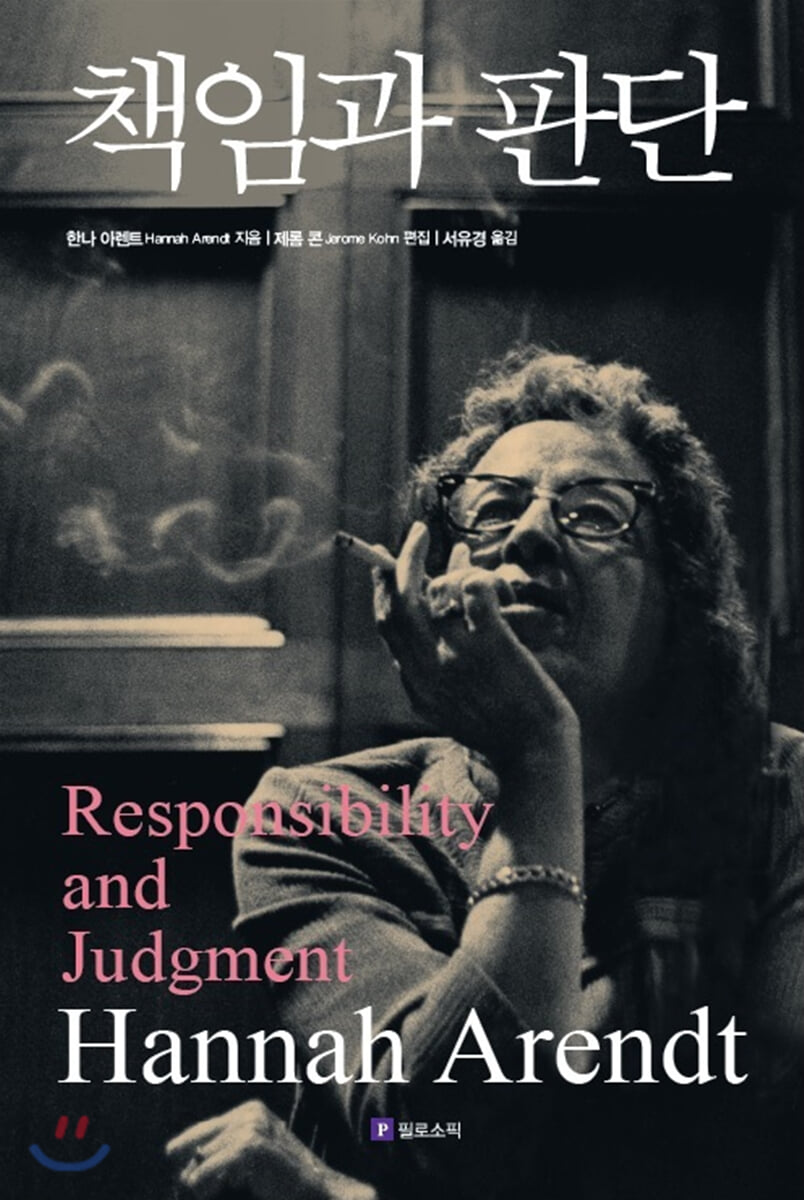
Responsibility and judgment
 |
Description
Book Introduction
Why responsibility and judgment?
A book that delves into the most crucial political and philosophical issues of our time.
This is a collection of unpublished essays written by Arendt, one of the greatest intellectuals of the 20th century, during the last ten years of her life.
From her masterpiece, Eichmann in Jerusalem, to her last work, The Life of the Spirit, Arendt has consistently raised the question of good and evil, and has constantly grappled with the question of what we can do in the midst of the moral crisis of the 20th century.
In this regard, Arendt brought to the forefront of discussion the issue of independent and free judgment that is not influenced by existing general standards, rules, doctrines, or doctrines and claims, the actions based on such judgments, and the moral responsibility of the actor for the consequences of those actions.
Arendt says that we are responsible to the highest human majority, from the smallest unit, the family, to the city and the nation, and finally to humanity as a part of the planet Earth.
Because we participate in this supreme human majority simultaneously and overlappingly, either willingly or involuntarily.
Arendt demands that we simultaneously fulfill two civic duties: the political judgments related to our individual choices and the moral responsibility we have for the world we belong to, that is, the political community.
For modern people who find themselves in a situation where they are overwhelmed by information and cannot decide what choices to make, Arendt provides a method of thinking that allows them to reflect and judge more wisely.
A book that delves into the most crucial political and philosophical issues of our time.
This is a collection of unpublished essays written by Arendt, one of the greatest intellectuals of the 20th century, during the last ten years of her life.
From her masterpiece, Eichmann in Jerusalem, to her last work, The Life of the Spirit, Arendt has consistently raised the question of good and evil, and has constantly grappled with the question of what we can do in the midst of the moral crisis of the 20th century.
In this regard, Arendt brought to the forefront of discussion the issue of independent and free judgment that is not influenced by existing general standards, rules, doctrines, or doctrines and claims, the actions based on such judgments, and the moral responsibility of the actor for the consequences of those actions.
Arendt says that we are responsible to the highest human majority, from the smallest unit, the family, to the city and the nation, and finally to humanity as a part of the planet Earth.
Because we participate in this supreme human majority simultaneously and overlappingly, either willingly or involuntarily.
Arendt demands that we simultaneously fulfill two civic duties: the political judgments related to our individual choices and the moral responsibility we have for the world we belong to, that is, the political community.
For modern people who find themselves in a situation where they are overwhelmed by information and cannot decide what choices to make, Arendt provides a method of thinking that allows them to reflect and judge more wisely.
index
Translator's Note
Foreword by editor Jerome Cohn
Supplementary Notes on Documents Contained in This Book
Acknowledgements
|Preface|
Part 1 Responsibility
Chapter 1: Personal Responsibility under Dictatorship
Chapter 2: Some Questions on Moral Philosophy
Chapter 3 Collective Responsibility
Chapter 4: Reasoning and Moral Considerations
Part 2 Judgment
Chapter 5: Reflections on the Little Rock Incident
Chapter 6 [Agent]: The Sin of Silence?
Chapter 7 Auschwitz on Judgment
Chapter 8: Reaping What You Sow
Search
Foreword by editor Jerome Cohn
Supplementary Notes on Documents Contained in This Book
Acknowledgements
|Preface|
Part 1 Responsibility
Chapter 1: Personal Responsibility under Dictatorship
Chapter 2: Some Questions on Moral Philosophy
Chapter 3 Collective Responsibility
Chapter 4: Reasoning and Moral Considerations
Part 2 Judgment
Chapter 5: Reflections on the Little Rock Incident
Chapter 6 [Agent]: The Sin of Silence?
Chapter 7 Auschwitz on Judgment
Chapter 8: Reaping What You Sow
Search
Into the book
How do you make judgments without clinging to preconceived notions, norms, or general rules that can subordinate special cases to them? Or, to use another expression, how do you make judgments without clinging to preconceived notions, norms, or general rules that can subordinate special cases to them?
For example, what would happen to the human faculty of judgment if we were confronted with events that demonstrate the breakdown of all conventional standards, events unprecedented in the sense that their consequences cannot be foreseen by general rules, even unprecedented among the exceptions to those general rules? A valid answer to these questions would require an analysis of the nature of human judgment, a still deeply mysterious realm, and of what it can and cannot accomplish.
Only if we assume that there exists some human faculty which, without being swayed by emotion or self-interest, judges rationally, and at the same time functions spontaneously, that is, which, by the very act of judgment, creates its own principles, while performing its function unbound by standards or rules to which particular cases are simply subordinated, are we prepared to risk setting foot on this very slippery moral ground with any hope of gaining a firm footing.
--- p.97
The reason I have expounded on Plato's teachings at such length is to show you what would happen—or should I say, what would happen—if you did not trust your conscience.
Even leaving aside the etymology of the word conscience—that is, its original identity as "consciousness"—conscience acquired its specific moral character only when it was understood as an organ through which humans listen to the word of God rather than to their own words.
Therefore, if we want to talk about these matters in secular terms, we have little to turn to other than ancient pre-Christian philosophy.
By the way, isn't it quite striking that you find there, in the midst of philosophical thought that is not bound by any religious dogma in any way, a theory of hell, purgatory, and paradise, with its supporting theories of the Last Judgment, rewards and punishments, the distinction between forgivable and unforgivable sins, and all the other elements of that Last Judgment? All you will find in vain is the [Christian] idea that sins can be forgiven.
--- p.186
We are the first generation since the rise of Christianity in the West, the first not only among the elite but also among the masses, who no longer believe in the "majesty of the future," as our founding fathers still put it.
So our generation tends to think of conscience as an organ that responds without expectation of reward or fear of punishment—perhaps it seems so.
It is frankly questionable whether people still believe that this conscience receives its messages from some divine voice.
The fact that our judicial systems still rely on the conscience, an organ that tells everyone right from wrong, even if they are not well-versed in the law, at least in matters of criminal conduct, can by no means be an argument in favor of the existence of conscience.
Institutions often outlive the fundamental principles on which they are based.
--- p.187
You yourself have reached the truth of what has become clear in the process of discourse between you and yourself in order to live with yourself.
For example, if you are in conflict with your own ego, it is like forcing yourself to live with your enemy and have daily interactions with him.
Nobody wants that.
For example, if you commit an injustice, you are cohabiting with the person who committed the injustice.
While many people would rather commit injustice for their own gain than suffer it, no one would prefer to live with a thief, a murderer, or a fraudster.
This is something that those who praise tyrants who came to power through murder and corruption forget.
--- p.189
We are certain that the most serious evils we know of are not committed because the evildoer is forced to confront himself again [in the process of reflection] or because he has been cursed by an unforgettable curse.
The worst of the wicked have never thought about it, and so have no memory, and nothing can restrain them.
For humans, reflecting on the past means moving into a deeper dimension, essentially putting down roots and stabilizing oneself so that whatever happens—whether it be the zeitgeist, history, or mere temptation—will not be swept away.
The greatest evil is not essential [by its nature], and therefore has no root, and since it has no root, it has no limit.
Therefore, it can reach unimaginable extremes and completely sweep away the entire world.
--- p.196
The Socratic-Platonic account of the process of reasoning seems to me very significant, for although it is mentioned in passing, it points to the fact that man is not singular but plural; in short, that there is not just one Man but many men inhabiting the earth.
Even though we exist only alone, when we articulate or realize this 'being alone' in words, we know that we are present, that is, present with ourselves.
Loneliness, as we all know, that nightmare that overtakes us even in a crowd, is precisely this 'being alone', a state of being abandoned by oneself, a state in which one is temporarily unable to become 'two in one', with no one to be one's friend.
From this perspective, it is clear that my conduct towards others will be influenced by my conduct towards myself.
It's a fact.
Only when no specific details, no special duties or responsibilities are involved is the pure capacity for reason and recollection, or its loss, actually in question.
--- p.197~198
There is more to the distinction between thinking and acting than a simple distinction.
And there is a kind of inherent tension between these two types of activity.
Plato's contempt for busy people who run around and never stop creates a certain atmosphere that will appear in one form or another in every true philosopher thereafter.
But this tension has been glossed over by an idea dear to all philosophers: that thinking is also a kind of acting.
To elaborate, thinking is sometimes referred to as a kind of “inner action.”
There are several reasons for this confusion, some of which are inadequate, some of which philosophers offer as a form of self-defense against the criticisms they receive from people of action and citizens, while others are valid, stemming from the very nature of thought itself.
--- p.211
Politically speaking, the main distinction between reason and action can be found in the following fact:
While I am thinking, I am only with my own self or with another self, whereas the moment I begin to act, I am in the presence of many people.
The power of non-omnipotent humans lies only in one of the many forms of human plurality.
On the other hand, all aspects of human singularity are by definition powerless.
But since I, though one, can think only by dividing into two, multiplicity is at any rate fundamentally present even in [my] singularity or in [my] duality which appears in the process of thinking.
But this 'two in one', viewed from the perspective of human plurality, is like discovering the last trace of companionship—that even when I am one with myself, I am or can be two.
This fact is significant simply because we find [human] multiplicity in places where we least expect it.
But as far as being with others is concerned, the discovery must still be considered a peripheral phenomenon.
--- p.212
As citizens, we must prevent injustice from happening because it is a matter of shared world shared by all of us—the perpetrators of injustice, the victims of injustice, and the spectators.
What has really been wronged here is the city [world] we share together.
For example, what would happen to the human faculty of judgment if we were confronted with events that demonstrate the breakdown of all conventional standards, events unprecedented in the sense that their consequences cannot be foreseen by general rules, even unprecedented among the exceptions to those general rules? A valid answer to these questions would require an analysis of the nature of human judgment, a still deeply mysterious realm, and of what it can and cannot accomplish.
Only if we assume that there exists some human faculty which, without being swayed by emotion or self-interest, judges rationally, and at the same time functions spontaneously, that is, which, by the very act of judgment, creates its own principles, while performing its function unbound by standards or rules to which particular cases are simply subordinated, are we prepared to risk setting foot on this very slippery moral ground with any hope of gaining a firm footing.
--- p.97
The reason I have expounded on Plato's teachings at such length is to show you what would happen—or should I say, what would happen—if you did not trust your conscience.
Even leaving aside the etymology of the word conscience—that is, its original identity as "consciousness"—conscience acquired its specific moral character only when it was understood as an organ through which humans listen to the word of God rather than to their own words.
Therefore, if we want to talk about these matters in secular terms, we have little to turn to other than ancient pre-Christian philosophy.
By the way, isn't it quite striking that you find there, in the midst of philosophical thought that is not bound by any religious dogma in any way, a theory of hell, purgatory, and paradise, with its supporting theories of the Last Judgment, rewards and punishments, the distinction between forgivable and unforgivable sins, and all the other elements of that Last Judgment? All you will find in vain is the [Christian] idea that sins can be forgiven.
--- p.186
We are the first generation since the rise of Christianity in the West, the first not only among the elite but also among the masses, who no longer believe in the "majesty of the future," as our founding fathers still put it.
So our generation tends to think of conscience as an organ that responds without expectation of reward or fear of punishment—perhaps it seems so.
It is frankly questionable whether people still believe that this conscience receives its messages from some divine voice.
The fact that our judicial systems still rely on the conscience, an organ that tells everyone right from wrong, even if they are not well-versed in the law, at least in matters of criminal conduct, can by no means be an argument in favor of the existence of conscience.
Institutions often outlive the fundamental principles on which they are based.
--- p.187
You yourself have reached the truth of what has become clear in the process of discourse between you and yourself in order to live with yourself.
For example, if you are in conflict with your own ego, it is like forcing yourself to live with your enemy and have daily interactions with him.
Nobody wants that.
For example, if you commit an injustice, you are cohabiting with the person who committed the injustice.
While many people would rather commit injustice for their own gain than suffer it, no one would prefer to live with a thief, a murderer, or a fraudster.
This is something that those who praise tyrants who came to power through murder and corruption forget.
--- p.189
We are certain that the most serious evils we know of are not committed because the evildoer is forced to confront himself again [in the process of reflection] or because he has been cursed by an unforgettable curse.
The worst of the wicked have never thought about it, and so have no memory, and nothing can restrain them.
For humans, reflecting on the past means moving into a deeper dimension, essentially putting down roots and stabilizing oneself so that whatever happens—whether it be the zeitgeist, history, or mere temptation—will not be swept away.
The greatest evil is not essential [by its nature], and therefore has no root, and since it has no root, it has no limit.
Therefore, it can reach unimaginable extremes and completely sweep away the entire world.
--- p.196
The Socratic-Platonic account of the process of reasoning seems to me very significant, for although it is mentioned in passing, it points to the fact that man is not singular but plural; in short, that there is not just one Man but many men inhabiting the earth.
Even though we exist only alone, when we articulate or realize this 'being alone' in words, we know that we are present, that is, present with ourselves.
Loneliness, as we all know, that nightmare that overtakes us even in a crowd, is precisely this 'being alone', a state of being abandoned by oneself, a state in which one is temporarily unable to become 'two in one', with no one to be one's friend.
From this perspective, it is clear that my conduct towards others will be influenced by my conduct towards myself.
It's a fact.
Only when no specific details, no special duties or responsibilities are involved is the pure capacity for reason and recollection, or its loss, actually in question.
--- p.197~198
There is more to the distinction between thinking and acting than a simple distinction.
And there is a kind of inherent tension between these two types of activity.
Plato's contempt for busy people who run around and never stop creates a certain atmosphere that will appear in one form or another in every true philosopher thereafter.
But this tension has been glossed over by an idea dear to all philosophers: that thinking is also a kind of acting.
To elaborate, thinking is sometimes referred to as a kind of “inner action.”
There are several reasons for this confusion, some of which are inadequate, some of which philosophers offer as a form of self-defense against the criticisms they receive from people of action and citizens, while others are valid, stemming from the very nature of thought itself.
--- p.211
Politically speaking, the main distinction between reason and action can be found in the following fact:
While I am thinking, I am only with my own self or with another self, whereas the moment I begin to act, I am in the presence of many people.
The power of non-omnipotent humans lies only in one of the many forms of human plurality.
On the other hand, all aspects of human singularity are by definition powerless.
But since I, though one, can think only by dividing into two, multiplicity is at any rate fundamentally present even in [my] singularity or in [my] duality which appears in the process of thinking.
But this 'two in one', viewed from the perspective of human plurality, is like discovering the last trace of companionship—that even when I am one with myself, I am or can be two.
This fact is significant simply because we find [human] multiplicity in places where we least expect it.
But as far as being with others is concerned, the discovery must still be considered a peripheral phenomenon.
--- p.212
As citizens, we must prevent injustice from happening because it is a matter of shared world shared by all of us—the perpetrators of injustice, the victims of injustice, and the spectators.
What has really been wronged here is the city [world] we share together.
--- p.331
GOODS SPECIFICS
- Date of issue: December 31, 2019
- Page count, weight, size: 468 pages | 142*210*30mm
- ISBN13: 9791157831678
- ISBN10: 1157831672
You may also like
카테고리
korean


korean

![GQ KOREA Mark (Monthly): December [2025]](http://librairie.coreenne.fr/cdn/shop/files/8ef265dbbfbf186523ed75ba7319009d.jpg?v=1765340328&width=3840)


