

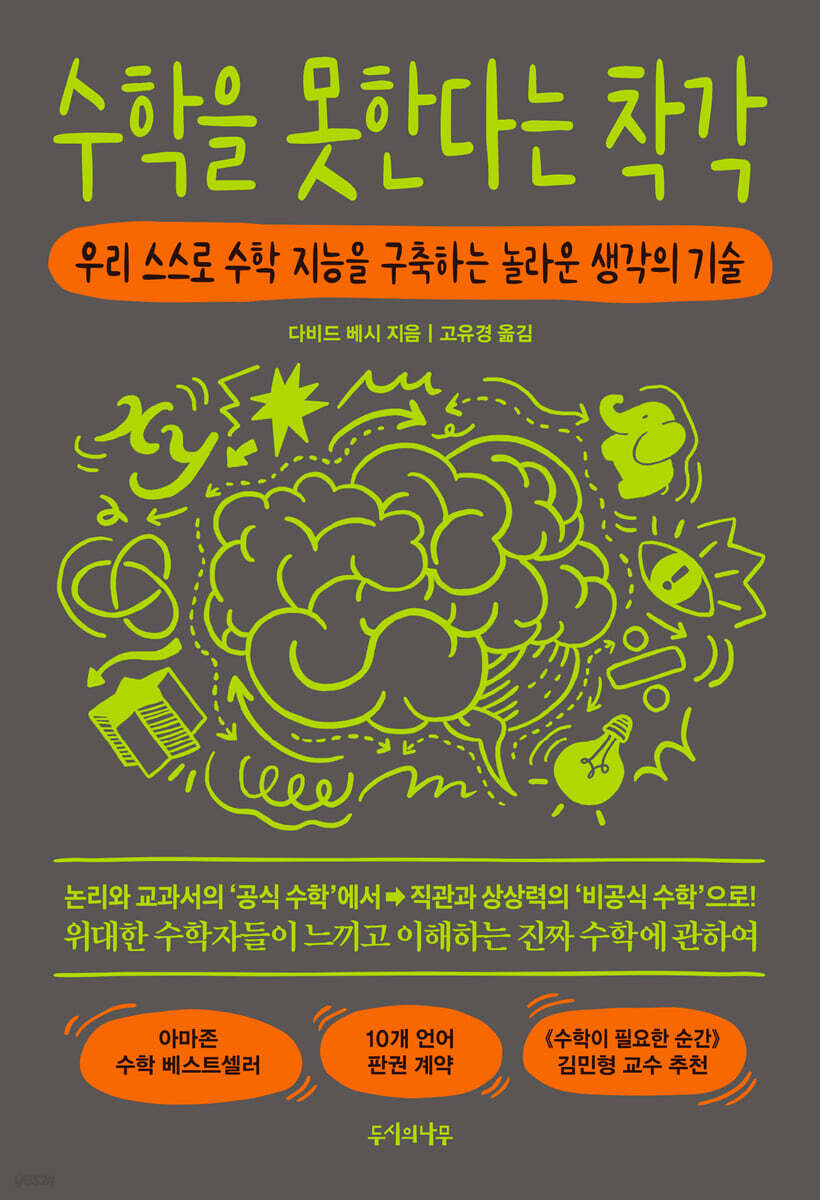
The illusion of being bad at math
 |
Description
Book Introduction
The joy of building our own mathematical intelligence
The secret world of mathematics created by intuition and imagination
Is the joy of mathematics reserved for a select few geniuses like mathematicians? Is the joy of transformation brought about by mathematics only experienced by those born with a natural talent for mathematics? This book firmly denies this, instantly dispelling the prejudice that mathematics is difficult and the myth of mathematical genius.
The author, who received a doctorate in pure mathematics from a prestigious French university and has been researching and teaching mathematics, tells his own stories of mathematics from his childhood and compares two types of mathematics that exist in this world.
One is the official math that appears in textbooks, and the other is the secret math that uses intuition and imagination.
In the former case, you will come to dislike math, and in the latter case, your cognitive abilities will expand, the author emphasizes.
“Real mathematics is the informal mathematics that broadens our intuition about the world around us.”
This book features prominent mathematicians, from René Descartes to Alexander Grothendieck, William Thurston, and Einstein.
When we look at how they feel and understand mathematics, we can see that their mathematics is different from ours.
The true secret of the mathematician is the art of thinking, which allows one to see the invisible, to feel the insensible, and to perceive the absurdly abstract to the point of becoming completely self-evident.
But how? These skills aren't taught in school.
This is the story this book wants to tell.
Just like mathematicians who seem to be born with mathematical talent, we too can build our own mathematical intelligence.
In one interview, the author introduced this book as a self-help book on mathematics.
I wanted to provide practical methods and directions for people who think they are bad at math to enjoy math to their heart's content.
It guides us into a new world of mathematics that was previously hidden in plain language, without any difficult formulas or difficult descriptions.
This book will provide you with a wonderful opportunity to immerse yourself in the real mathematics you've forgotten and easily overcome the psychological barriers to traditional mathematics.
The secret world of mathematics created by intuition and imagination
Is the joy of mathematics reserved for a select few geniuses like mathematicians? Is the joy of transformation brought about by mathematics only experienced by those born with a natural talent for mathematics? This book firmly denies this, instantly dispelling the prejudice that mathematics is difficult and the myth of mathematical genius.
The author, who received a doctorate in pure mathematics from a prestigious French university and has been researching and teaching mathematics, tells his own stories of mathematics from his childhood and compares two types of mathematics that exist in this world.
One is the official math that appears in textbooks, and the other is the secret math that uses intuition and imagination.
In the former case, you will come to dislike math, and in the latter case, your cognitive abilities will expand, the author emphasizes.
“Real mathematics is the informal mathematics that broadens our intuition about the world around us.”
This book features prominent mathematicians, from René Descartes to Alexander Grothendieck, William Thurston, and Einstein.
When we look at how they feel and understand mathematics, we can see that their mathematics is different from ours.
The true secret of the mathematician is the art of thinking, which allows one to see the invisible, to feel the insensible, and to perceive the absurdly abstract to the point of becoming completely self-evident.
But how? These skills aren't taught in school.
This is the story this book wants to tell.
Just like mathematicians who seem to be born with mathematical talent, we too can build our own mathematical intelligence.
In one interview, the author introduced this book as a self-help book on mathematics.
I wanted to provide practical methods and directions for people who think they are bad at math to enjoy math to their heart's content.
It guides us into a new world of mathematics that was previously hidden in plain language, without any difficult formulas or difficult descriptions.
This book will provide you with a wonderful opportunity to immerse yourself in the real mathematics you've forgotten and easily overcome the psychological barriers to traditional mathematics.
- You can preview some of the book's contents.
Preview
index
01 Three Secrets
02 Right side of the spoon
03 The Power of Thought
04 Real Magic
05 Invisible Action
06 Math books are not meant to be read
07 Like a child
08 Tactile Theory
09 Something is happening here
10 Seeing Skills
11 Ball and Bat
12 There is no trick
13 Look like a fool
14 Martial Arts
15 Awe and Magic
16 Extreme clarity
17 Controlling the Universe
The Elephant in the Room 18
19 Abstract and Ambiguous World
20 Mathematical Enlightenment
Epilogue
References and Readings
Acknowledgements
02 Right side of the spoon
03 The Power of Thought
04 Real Magic
05 Invisible Action
06 Math books are not meant to be read
07 Like a child
08 Tactile Theory
09 Something is happening here
10 Seeing Skills
11 Ball and Bat
12 There is no trick
13 Look like a fool
14 Martial Arts
15 Awe and Magic
16 Extreme clarity
17 Controlling the Universe
The Elephant in the Room 18
19 Abstract and Ambiguous World
20 Mathematical Enlightenment
Epilogue
References and Readings
Acknowledgements
Detailed image

Into the book
Mathematicians recognize that there are two different kinds of mathematics.
Official math can be found in textbooks.
Textbooks explain mathematics in a complex language of cryptic symbols and in a logical and structured way.
However, secret math, which is called mathematical intuition, can be found in the minds of mathematicians.
Mathematicians derive great and profound pleasure from informal mathematics, which consists of mental representations, abstract sensations, and usually visual sensations.
But whenever they share this feeling with the world, they often feel embarrassed.
Because what seemed so obvious to mathematicians suddenly seems less obvious.
--- From "01 Three Secrets"
The reason people are bad at math is because no one took the time to give them clear instructions.
Because no one told you that math was a physical activity, that there was something to do in math, not something to learn.
No one ever told you there was a right side to the spoon, so you're just holding the wrong side and struggling.
--- From "02 The Right Side of the Spoon"
When schools teach us to be wary of intuition, two major mistakes follow that hinder intellectual growth.
The first mistake is to exaggerate the situation.
It makes me angry for nothing.
Of course, sometimes intuition is wrong, but not always.
Rather, it is often correct.
And you can make your intuition more correct.
With consistent practice, you can develop clearer and more distinct intuition.
Mathematicians start from the same place we do and build strong, reliable intuitions.
They reach intuition using simple methods like those taught in this book.
--- From "03 The Power of Thought"
Learning mathematics means learning how to use the 'empty shell' words defined by logical formalism as if they were ordinary words.
It is about learning how to give those words an intuitive and concrete meaning, and learning to see the objects they refer to as if they were right before your eyes.
--- From "06 Math Books Are Not for Reading"
That little voice that shyly whispers, “I don’t know,” is mathematical intuition.
Don't confuse this with the loud voice that says, "You're stupid."
--- From "09 Something's Happening Here"
Thurston had no access to three-dimensional perception.
So I tried to build a three-dimensional perception in my own way through the power of thought.
If Thurston had a talent, it was perseverance and determination.
Or maybe it's a love and confidence in geometry.
Doing math isn't a series of lightning-quick insights and brilliant ideas.
It is a re-educational task that constantly repeats the same imagination.
--- From "10 Seeing Skills"
The goal is to understand where things are going wrong.
Do my intuition and logic speak the same language? Are they talking about the same thing? My intuition is never perfect.
It's often appropriate, but sometimes it's just plain wrong.
Fortunately, however, intuition can be modified.
On the other hand, the logic is not wrong.
At least officially.
However, logic does not tell me exactly what I think.
In the end, my intuition is almost always the one who wins.
When forced to listen to logic, intuition silently accepts and adjusts its position.
Logic doesn't move like a pebble.
But my intuition is organic, living, breathing, and growing.
--- From "11 Balls and a Bat"
This kind of inner exploration is at the heart of mathematics.
Inner inquiry is about deconstructing the mental representations we use without thinking and figuring out where we can improve them.
If you practice this process properly, your intuition will become stronger every day.
--- From "There Are No Tricks"
If you want to practice changing your perspective, the following method may be effective.
① Select an arbitrary reference point in the surrounding area.
For example, if you are in a room, it could be the corner across from you, or if you are walking down the street, it could be the window of a house.
② Imagine what you would see if you looked in my direction from that reference point.
(…) The goal of this exercise is to make that image increasingly clear and vivid, while keeping it in your mind for as long as possible.
--- From "16 Extreme Clarity"
If I hadn't become a mathematician, I might have believed that mathematicians were special beings who could speak the language of the universe with ease.
But now I know that's not true.
Because I experienced firsthand where I started and how my skills improved.
The reason I've been able to grow step by step is because I've always stumbled upon a new technique that helped me overcome my inner barriers or learned how to use my imagination more effectively.
Official math can be found in textbooks.
Textbooks explain mathematics in a complex language of cryptic symbols and in a logical and structured way.
However, secret math, which is called mathematical intuition, can be found in the minds of mathematicians.
Mathematicians derive great and profound pleasure from informal mathematics, which consists of mental representations, abstract sensations, and usually visual sensations.
But whenever they share this feeling with the world, they often feel embarrassed.
Because what seemed so obvious to mathematicians suddenly seems less obvious.
--- From "01 Three Secrets"
The reason people are bad at math is because no one took the time to give them clear instructions.
Because no one told you that math was a physical activity, that there was something to do in math, not something to learn.
No one ever told you there was a right side to the spoon, so you're just holding the wrong side and struggling.
--- From "02 The Right Side of the Spoon"
When schools teach us to be wary of intuition, two major mistakes follow that hinder intellectual growth.
The first mistake is to exaggerate the situation.
It makes me angry for nothing.
Of course, sometimes intuition is wrong, but not always.
Rather, it is often correct.
And you can make your intuition more correct.
With consistent practice, you can develop clearer and more distinct intuition.
Mathematicians start from the same place we do and build strong, reliable intuitions.
They reach intuition using simple methods like those taught in this book.
--- From "03 The Power of Thought"
Learning mathematics means learning how to use the 'empty shell' words defined by logical formalism as if they were ordinary words.
It is about learning how to give those words an intuitive and concrete meaning, and learning to see the objects they refer to as if they were right before your eyes.
--- From "06 Math Books Are Not for Reading"
That little voice that shyly whispers, “I don’t know,” is mathematical intuition.
Don't confuse this with the loud voice that says, "You're stupid."
--- From "09 Something's Happening Here"
Thurston had no access to three-dimensional perception.
So I tried to build a three-dimensional perception in my own way through the power of thought.
If Thurston had a talent, it was perseverance and determination.
Or maybe it's a love and confidence in geometry.
Doing math isn't a series of lightning-quick insights and brilliant ideas.
It is a re-educational task that constantly repeats the same imagination.
--- From "10 Seeing Skills"
The goal is to understand where things are going wrong.
Do my intuition and logic speak the same language? Are they talking about the same thing? My intuition is never perfect.
It's often appropriate, but sometimes it's just plain wrong.
Fortunately, however, intuition can be modified.
On the other hand, the logic is not wrong.
At least officially.
However, logic does not tell me exactly what I think.
In the end, my intuition is almost always the one who wins.
When forced to listen to logic, intuition silently accepts and adjusts its position.
Logic doesn't move like a pebble.
But my intuition is organic, living, breathing, and growing.
--- From "11 Balls and a Bat"
This kind of inner exploration is at the heart of mathematics.
Inner inquiry is about deconstructing the mental representations we use without thinking and figuring out where we can improve them.
If you practice this process properly, your intuition will become stronger every day.
--- From "There Are No Tricks"
If you want to practice changing your perspective, the following method may be effective.
① Select an arbitrary reference point in the surrounding area.
For example, if you are in a room, it could be the corner across from you, or if you are walking down the street, it could be the window of a house.
② Imagine what you would see if you looked in my direction from that reference point.
(…) The goal of this exercise is to make that image increasingly clear and vivid, while keeping it in your mind for as long as possible.
--- From "16 Extreme Clarity"
If I hadn't become a mathematician, I might have believed that mathematicians were special beings who could speak the language of the universe with ease.
But now I know that's not true.
Because I experienced firsthand where I started and how my skills improved.
The reason I've been able to grow step by step is because I've always stumbled upon a new technique that helped me overcome my inner barriers or learned how to use my imagination more effectively.
--- From "20 Mathematical Enlightenments"
Publisher's Review
Amazon Math Bestseller
Worldwide copyright agreement in 10 languages
Recommended by many famous mathematicians
“I hope that many readers will find healing in mathematics through reading this book.”
Professor Kim Min-hyung, author of "When Math is Needed"
“Mathematics is the exclusive domain of geniuses?”
A book that helps you overcome prejudice and psychological barriers and gain a new understanding of the essence of mathematics.
Einstein is said to have said this to a high school student who asked for advice:
“Don’t worry about math being difficult.
“I bet math is much harder for me.”
400 years ago, René Descartes, the greatest mathematician of his time, is said to have written a summary like this in his autobiographical work, Discourse on the Method.
“I’m not smarter than other people.
“I just had the opportunity to discover a magical way to become a better person than others.”
Can you believe it? Could it be that these two people, once considered the smartest, are just playing a trick on us?
French mathematician David Bessy, author of the book "The Illusion of Being Bad at Math," says that to understand what they are saying, we must first get rid of three false beliefs about mathematics.
First, the belief that logical thinking is necessary to do mathematics.
Second, the belief that only some of us are naturally good at numbers or have a good geometric intuition.
Third, the belief that great mathematicians are born with brains that are completely different from ours.
And the author counters this:
In fact, mathematicians do not think logically, and their ability is not logic but intuition, which is a natural ability that everyone is endowed with.
In these days when the term 'math dropout' is used casually and mathematical intelligence is judged solely on entrance exam preparation, this book says that mathematical talent is not something that is born only with geniuses and that real mathematics lies elsewhere.
And he advises that if we just increase our thinking power just a little, we can easily enjoy mathematics.
The author asks us to think back to the mathematics we experienced before entering school.
He uses the example of the shape-matching game we first played with our parents to explain how mathematical thinking was formed and how we developed our thinking skills in the process.
In particular, it shows that intuition, imagination, and curiosity play a greater role than logic and memorization in mathematics.
This book describes the charm of mathematics, often obscured by the prejudices created by our education system, in a fun and friendly way, blending the author's own experiences with stories of great mathematicians.
One Amazon reader even lamented that he wished he had read this book in high school.
I hope that through this book, which breaks down the psychological barriers we have built for ourselves, you will gain a new understanding of the essence of mathematics and enjoy a time of immersion in true mathematics.
In logic and 'formal mathematics' in textbooks
With the 'unofficial mathematics' of intuition and imagination!
About real mathematics as felt and understood by great mathematicians
“Real mathematics is the informal mathematics that broadens our intuition about the world around us.” (p. 342)
According to the author, there are two types of mathematics in this world.
Formal mathematics as found in textbooks and informal mathematics referred to as mathematical intuition.
Any mathematician would recognize that there are two different kinds of mathematics.
And they take great pleasure in informal mathematics, which is made up of mental representations, abstract sensations, and visual sensations.
Einstein often talked about the importance of intuition in his discoveries.
When we think of mathematics, we usually think of logical thinking and memorizing formulas, but this book emphasizes that real mathematics is primarily made up of intuition, imagination, and curiosity.
So the author says that mathematics is, above all, an inner tool.
William Thurston, who said that he focuses on 'thinking between the lines' when reading research papers; Alexander Grothendieck, who said that a researcher's creativity and imagination come from 'attention to the voice of things'; René Descartes, who liked to reconstruct everything in his head.
Mathematicians know that formal mathematics alone cannot tell the whole story.
For mathematicians, intuition is far more important than any public results.
So what they do every day is to cultivate their intuition to be richer, clearer, and more powerful.
As you read this book, you will learn how mathematicians approached mathematics and realize that their thinking techniques are not unrelated to us.
This book's key advice for anyone who wants to understand mathematics
“Imagine the object as if it were really before your eyes.”
“The true joy of mathematics is to wake up one morning and suddenly realize that you can see stars in your mind that you couldn’t see before.” (p. 121)
For a long time, the author says, he didn't quite understand the connection between the "invisible workings" of his head and his ability to excel at math.
Because the movement was simply a habit he had learned, a way to use his imagination.
For example, it was a game where you closed your eyes, walked around the room, and memorized the arrangement of the furniture.
So the author unfolds a story about the 'way of seeing' necessary for mathematics.
The author argues that we have already developed a solid mathematical intuition and have fully absorbed mathematical ideas that were once considered the exclusive domain of geniuses.
He mentions several powers of thought: a remarkable capacity for abstraction, a tremendous capacity for reasoning, a remarkable intuition, the ability to imagine things, etc., and argues that everyone possesses all the intellectual abilities necessary to be good at mathematics.
In particular, it is said that if we use our imagination correctly, we can develop the ability to intuitively understand and accept mathematical concepts in a familiar way, and the concepts that are naturally absorbed into us can be utilized as if they were part of our body.
And I believe that everyone has the freedom to constantly refine their way of looking at and thinking about the world, and to build their own intelligence every day.
It also tells us that great discoverers keep searching for the right mental image, the right way to visualize, until they clearly understand something.
To see something clearly, you must first build a possible mental representation of it so that you can understand it immediately without much effort.
It's a very simple example, but it's as if we've built a sufficient mental representation of something called a 'circle'.
However, building that representation can take longer than you might think, and requires overcoming uncertainty, trial and error, and having to start over from scratch.
But true mathematical understanding is precisely this process.
Rather than simply memorizing the formal definition, you create a correct mental representation of the definition yourself, transforming it into something intuitive and directly 'experiencing' what the definition actually says.
That's why Grothendieck said that you can't read even the simplest math book if you can't get the right picture in your head.
In short, learning mathematics means learning how to see.
If you've been cowering in the belief that you're bad at math, now's the time to focus on building the mental strength needed for math.
The author encourages us to rest assured that we can use the power of thought effectively.
Because it means that you have the genetic potential and intellectual ability to be very good at math.
And from a biological standpoint, this is all that's needed, the rest is not genetic, it's just a matter of mindset.
Sincerity, patience, passion, courage, etc.
“Mathematics isn’t something you learn, it’s something you experience.”
The wondrous and fantastical inner journey that takes place when doing math.
“I realized that there are two fundamentally different approaches to education, and that these two approaches are incompatible.” (p. 134)
Let's look at the differences between "good" and "bad" math teachers as discussed in this book.
The author says that people who are bad at math are so convinced of their inherent inferiority that they hesitate to even ask really simple questions.
He also says that teachers who create the illusion that you can only do well in math if you know formal formulas are also responsible for this.
Let's take the problem of assembling a toaster as an example.
The 'bad' teacher recites the 198 steps to assembling a toaster and thinks that's it.
A 'good' teacher tries his best to explain what a toaster is.
And constantly look into the students' eyes.
Because you can tell whether or not your students understand the toaster by looking at their eyes.
The author points out that forcing someone who doesn't even know what bread is to learn the 198 steps of assembling a toaster is downright cruel.
Treating mathematics as knowledge and accepting it as a sensory experience require diametrically opposed mindsets.
The author says that if we treat mathematics as knowledge, we are giving up the joy of understanding it.
If we fail to experience the wondrous and fantastical inner journey that intuition, imagination, curiosity, and perseverance bring to our understanding of mathematics, mathematics will remain forever distant from us.
The author also adds advice for mathematical creativity: think "like a child," look "like an idiot," face your fears, and be willing to be wrong.
In this way, this book emphasizes that mathematics is not something to be learned, but rather something to be experienced.
This is probably why mathematicians of this era, who fell in love with the charm of mathematics before we did, sympathized with this book and readily recommended it.
Worldwide copyright agreement in 10 languages
Recommended by many famous mathematicians
“I hope that many readers will find healing in mathematics through reading this book.”
Professor Kim Min-hyung, author of "When Math is Needed"
“Mathematics is the exclusive domain of geniuses?”
A book that helps you overcome prejudice and psychological barriers and gain a new understanding of the essence of mathematics.
Einstein is said to have said this to a high school student who asked for advice:
“Don’t worry about math being difficult.
“I bet math is much harder for me.”
400 years ago, René Descartes, the greatest mathematician of his time, is said to have written a summary like this in his autobiographical work, Discourse on the Method.
“I’m not smarter than other people.
“I just had the opportunity to discover a magical way to become a better person than others.”
Can you believe it? Could it be that these two people, once considered the smartest, are just playing a trick on us?
French mathematician David Bessy, author of the book "The Illusion of Being Bad at Math," says that to understand what they are saying, we must first get rid of three false beliefs about mathematics.
First, the belief that logical thinking is necessary to do mathematics.
Second, the belief that only some of us are naturally good at numbers or have a good geometric intuition.
Third, the belief that great mathematicians are born with brains that are completely different from ours.
And the author counters this:
In fact, mathematicians do not think logically, and their ability is not logic but intuition, which is a natural ability that everyone is endowed with.
In these days when the term 'math dropout' is used casually and mathematical intelligence is judged solely on entrance exam preparation, this book says that mathematical talent is not something that is born only with geniuses and that real mathematics lies elsewhere.
And he advises that if we just increase our thinking power just a little, we can easily enjoy mathematics.
The author asks us to think back to the mathematics we experienced before entering school.
He uses the example of the shape-matching game we first played with our parents to explain how mathematical thinking was formed and how we developed our thinking skills in the process.
In particular, it shows that intuition, imagination, and curiosity play a greater role than logic and memorization in mathematics.
This book describes the charm of mathematics, often obscured by the prejudices created by our education system, in a fun and friendly way, blending the author's own experiences with stories of great mathematicians.
One Amazon reader even lamented that he wished he had read this book in high school.
I hope that through this book, which breaks down the psychological barriers we have built for ourselves, you will gain a new understanding of the essence of mathematics and enjoy a time of immersion in true mathematics.
In logic and 'formal mathematics' in textbooks
With the 'unofficial mathematics' of intuition and imagination!
About real mathematics as felt and understood by great mathematicians
“Real mathematics is the informal mathematics that broadens our intuition about the world around us.” (p. 342)
According to the author, there are two types of mathematics in this world.
Formal mathematics as found in textbooks and informal mathematics referred to as mathematical intuition.
Any mathematician would recognize that there are two different kinds of mathematics.
And they take great pleasure in informal mathematics, which is made up of mental representations, abstract sensations, and visual sensations.
Einstein often talked about the importance of intuition in his discoveries.
When we think of mathematics, we usually think of logical thinking and memorizing formulas, but this book emphasizes that real mathematics is primarily made up of intuition, imagination, and curiosity.
So the author says that mathematics is, above all, an inner tool.
William Thurston, who said that he focuses on 'thinking between the lines' when reading research papers; Alexander Grothendieck, who said that a researcher's creativity and imagination come from 'attention to the voice of things'; René Descartes, who liked to reconstruct everything in his head.
Mathematicians know that formal mathematics alone cannot tell the whole story.
For mathematicians, intuition is far more important than any public results.
So what they do every day is to cultivate their intuition to be richer, clearer, and more powerful.
As you read this book, you will learn how mathematicians approached mathematics and realize that their thinking techniques are not unrelated to us.
This book's key advice for anyone who wants to understand mathematics
“Imagine the object as if it were really before your eyes.”
“The true joy of mathematics is to wake up one morning and suddenly realize that you can see stars in your mind that you couldn’t see before.” (p. 121)
For a long time, the author says, he didn't quite understand the connection between the "invisible workings" of his head and his ability to excel at math.
Because the movement was simply a habit he had learned, a way to use his imagination.
For example, it was a game where you closed your eyes, walked around the room, and memorized the arrangement of the furniture.
So the author unfolds a story about the 'way of seeing' necessary for mathematics.
The author argues that we have already developed a solid mathematical intuition and have fully absorbed mathematical ideas that were once considered the exclusive domain of geniuses.
He mentions several powers of thought: a remarkable capacity for abstraction, a tremendous capacity for reasoning, a remarkable intuition, the ability to imagine things, etc., and argues that everyone possesses all the intellectual abilities necessary to be good at mathematics.
In particular, it is said that if we use our imagination correctly, we can develop the ability to intuitively understand and accept mathematical concepts in a familiar way, and the concepts that are naturally absorbed into us can be utilized as if they were part of our body.
And I believe that everyone has the freedom to constantly refine their way of looking at and thinking about the world, and to build their own intelligence every day.
It also tells us that great discoverers keep searching for the right mental image, the right way to visualize, until they clearly understand something.
To see something clearly, you must first build a possible mental representation of it so that you can understand it immediately without much effort.
It's a very simple example, but it's as if we've built a sufficient mental representation of something called a 'circle'.
However, building that representation can take longer than you might think, and requires overcoming uncertainty, trial and error, and having to start over from scratch.
But true mathematical understanding is precisely this process.
Rather than simply memorizing the formal definition, you create a correct mental representation of the definition yourself, transforming it into something intuitive and directly 'experiencing' what the definition actually says.
That's why Grothendieck said that you can't read even the simplest math book if you can't get the right picture in your head.
In short, learning mathematics means learning how to see.
If you've been cowering in the belief that you're bad at math, now's the time to focus on building the mental strength needed for math.
The author encourages us to rest assured that we can use the power of thought effectively.
Because it means that you have the genetic potential and intellectual ability to be very good at math.
And from a biological standpoint, this is all that's needed, the rest is not genetic, it's just a matter of mindset.
Sincerity, patience, passion, courage, etc.
“Mathematics isn’t something you learn, it’s something you experience.”
The wondrous and fantastical inner journey that takes place when doing math.
“I realized that there are two fundamentally different approaches to education, and that these two approaches are incompatible.” (p. 134)
Let's look at the differences between "good" and "bad" math teachers as discussed in this book.
The author says that people who are bad at math are so convinced of their inherent inferiority that they hesitate to even ask really simple questions.
He also says that teachers who create the illusion that you can only do well in math if you know formal formulas are also responsible for this.
Let's take the problem of assembling a toaster as an example.
The 'bad' teacher recites the 198 steps to assembling a toaster and thinks that's it.
A 'good' teacher tries his best to explain what a toaster is.
And constantly look into the students' eyes.
Because you can tell whether or not your students understand the toaster by looking at their eyes.
The author points out that forcing someone who doesn't even know what bread is to learn the 198 steps of assembling a toaster is downright cruel.
Treating mathematics as knowledge and accepting it as a sensory experience require diametrically opposed mindsets.
The author says that if we treat mathematics as knowledge, we are giving up the joy of understanding it.
If we fail to experience the wondrous and fantastical inner journey that intuition, imagination, curiosity, and perseverance bring to our understanding of mathematics, mathematics will remain forever distant from us.
The author also adds advice for mathematical creativity: think "like a child," look "like an idiot," face your fears, and be willing to be wrong.
In this way, this book emphasizes that mathematics is not something to be learned, but rather something to be experienced.
This is probably why mathematicians of this era, who fell in love with the charm of mathematics before we did, sympathized with this book and readily recommended it.
GOODS SPECIFICS
- Date of issue: September 22, 2025
- Page count, weight, size: 400 pages | 528g | 145*212*20mm
- ISBN13: 9791198876232
- ISBN10: 1198876239
You may also like
카테고리
korean


korean

![GQ KOREA Mark (Monthly): December [2025]](http://librairie.coreenne.fr/cdn/shop/files/8ef265dbbfbf186523ed75ba7319009d.jpg?v=1765340328&width=3840)


