

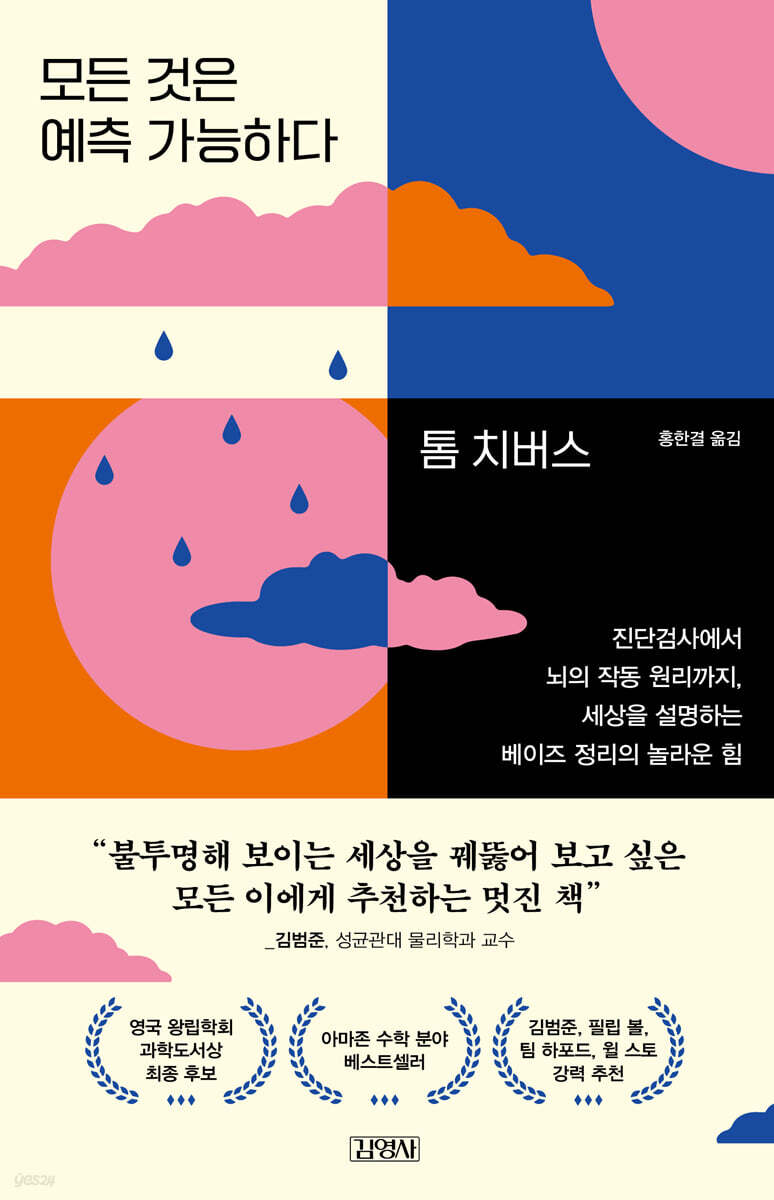
Everything is predictable
 |
Description
Book Introduction
- A word from MD
- Bayes' theorem, a theory discovered by the 18th-century British amateur mathematician Thomas Bayes, is widely used in social statistics and stock market analysis.
This book explains Bayes' theorem through various examples from everyday life.
A science textbook that can be easily understood even without advanced mathematical knowledge.
- Min-gyu Son, PD of Natural Sciences
The one and only solution to the uncertainty of the future
The Science of Prediction: Understanding Bayes' Theorem
Essential knowledge for the big data era, even without mathematical knowledge
Our lives are a series of predictions, big and small.
Every time we breathe, we make a basic, implicit prediction: the air will remain breathable.
We also make more complex predictions, like whether a friend we're meeting will be on time or whether the convenience store will still have our favorite orange juice.
All predictions have one thing in common: uncertainty.
In our lives, where we must make the best decisions with limited information, Bayes' theorem is a powerful tool that helps us deal with uncertainty and make better decisions.
Bayes' theorem is a theory discovered by the 18th-century British amateur mathematician Thomas Bayes, and is a powerful principle that allows us to more accurately predict the probability of an event based on the information we have.
Although it seems simple, this theorem is a key tool in many fields today, from spam filters to legal systems, medical diagnosis, neuroscience, and artificial intelligence.
Bayes' theorem also explains how our mind and consciousness work.
This book briskly explains the concepts, controversies, and philosophical implications of Bayes' theorem, using familiar, everyday examples, guiding readers to view the world more rationally.
The Science of Prediction: Understanding Bayes' Theorem
Essential knowledge for the big data era, even without mathematical knowledge
Our lives are a series of predictions, big and small.
Every time we breathe, we make a basic, implicit prediction: the air will remain breathable.
We also make more complex predictions, like whether a friend we're meeting will be on time or whether the convenience store will still have our favorite orange juice.
All predictions have one thing in common: uncertainty.
In our lives, where we must make the best decisions with limited information, Bayes' theorem is a powerful tool that helps us deal with uncertainty and make better decisions.
Bayes' theorem is a theory discovered by the 18th-century British amateur mathematician Thomas Bayes, and is a powerful principle that allows us to more accurately predict the probability of an event based on the information we have.
Although it seems simple, this theorem is a key tool in many fields today, from spam filters to legal systems, medical diagnosis, neuroscience, and artificial intelligence.
Bayes' theorem also explains how our mind and consciousness work.
This book briskly explains the concepts, controversies, and philosophical implications of Bayes' theorem, using familiar, everyday examples, guiding readers to view the world more rationally.
- You can preview some of the book's contents.
Preview
index
Introduction: A theory that explains quite a bit.
Chapter 1: From the Book of Common Prayer to Nude Performances
The Life of Thomas Bayes | Pascal and Fermat | The Law of Large Numbers | De Moivre and the Normal Distribution | Simpson and Bayes | Bayes's Billiard Table | The First Bayesian Defends God Against Hume | From Bayes to Galton | Galton, Pearson, Fisher, and the Rise of Frequentism | Are Frequentists Racists? | The Fall of Bayesianism | Statistical Significance | Bayes in Crisis | Glory, Glory, Probability
Chapter 2: Bayes in Science
The Reproducibility Crisis in Science and Solutions | Superpowers, a Moon Made of Cheese, and Faster-than-Light Particles | Popper's Swan | Bayes and the Reproducibility Crisis | Dennis Lindley's Paradox | Finding Prior Probabilities | The Unfinished Debate
Chapter 3: Bayesian Decision Theory
Aristotle and George Boole | Bayes's Law: The Core of Decision Making | Cromwell's Law | The Law of Conservation of Expected Evidence | Utility, Dutch Book, and Game Theory | Occam's Prior | Super-Prior Probability | Multiple Hypotheses | AI and Bayes
Chapter 4: Bayes in the World
Are Humans Irrational? | Monty's Difficult Bargain | The Superforecaster (Part 1) | The Superforecaster (Part 2) | Bayesian Epistemology
Chapter 5: Bayesian Brain Model
From Plato to Gregory | Optical Illusions | Reality is a Controlled Hallucination | Dopamine and Advanced Computer Robots | Waddle, Tennis, and Rapid Eye Movement | Why People with Schizophrenia Can Tickle Themselves | Have You Ever Taken a Good Look at Your Hands? | God, Please
Conclusion: Bayes in Life
Acknowledgements
main
Search
Recommendation
Chapter 1: From the Book of Common Prayer to Nude Performances
The Life of Thomas Bayes | Pascal and Fermat | The Law of Large Numbers | De Moivre and the Normal Distribution | Simpson and Bayes | Bayes's Billiard Table | The First Bayesian Defends God Against Hume | From Bayes to Galton | Galton, Pearson, Fisher, and the Rise of Frequentism | Are Frequentists Racists? | The Fall of Bayesianism | Statistical Significance | Bayes in Crisis | Glory, Glory, Probability
Chapter 2: Bayes in Science
The Reproducibility Crisis in Science and Solutions | Superpowers, a Moon Made of Cheese, and Faster-than-Light Particles | Popper's Swan | Bayes and the Reproducibility Crisis | Dennis Lindley's Paradox | Finding Prior Probabilities | The Unfinished Debate
Chapter 3: Bayesian Decision Theory
Aristotle and George Boole | Bayes's Law: The Core of Decision Making | Cromwell's Law | The Law of Conservation of Expected Evidence | Utility, Dutch Book, and Game Theory | Occam's Prior | Super-Prior Probability | Multiple Hypotheses | AI and Bayes
Chapter 4: Bayes in the World
Are Humans Irrational? | Monty's Difficult Bargain | The Superforecaster (Part 1) | The Superforecaster (Part 2) | Bayesian Epistemology
Chapter 5: Bayesian Brain Model
From Plato to Gregory | Optical Illusions | Reality is a Controlled Hallucination | Dopamine and Advanced Computer Robots | Waddle, Tennis, and Rapid Eye Movement | Why People with Schizophrenia Can Tickle Themselves | Have You Ever Taken a Good Look at Your Hands? | God, Please
Conclusion: Bayes in Life
Acknowledgements
main
Search
Recommendation
Detailed image

Into the book
If I were to compare life to a game, it would be poker, not chess.
In chess, you have perfect information and in principle there is a 'solution', but in poker, you have limited information and you just try to make the best decision possible.
The formula that makes that possible is the subject of this book.
--- p.10
Bayes' theorem is really strange.
It is a short formula and consists only of multiplication and division, which even first graders can do.
Bayes, who first proposed this formula, was a nonconformist minister in a small town outside London in the 18th century who studied mathematics as a hobby, but this formula has truly profound implications.
Even if a cancer test is 99 percent accurate, this formula explains why 99 percent of those who test positive may not actually have cancer. Even if DNA testing is highly accurate, with a one-in-20 million chance of matching an innocent person, it's still easy to catch a living person.
This formula also explains why the results of scientific research, even if they are "statistically significant," may still be wrong.
--- p.13
It cannot be said that there is a theory that explains everything.
But it can be said that it explains 'almost' everything.
Once you start looking at the world through a Bayesian lens, you will see Bayes' theorem everywhere.
The purpose of this book is to open the reader's eyes in that way.
--- p.15
Humans can be called Bayesian machines.
Well, from a fairly high level, yes.
We are not very good at calculating the exact formula of Bayes' theorem, but when we look at the way we make decisions in our daily lives, we see that they are not much different from decisions made according to ideal Bayesian inference.
That doesn't mean everyone agrees.
If two people have very different preconceived beliefs, they may reach completely different conclusions even when exposed to the same evidence.
That's why, even on issues like climate change and vaccines, where there seems to be ample evidence, people can have completely different opinions.
--- p.32~33
One of Bayes's great contributions to probability theory should be discussed from a philosophical rather than a mathematical perspective.
Until now, when discussing probability, we have talked about it as if it were something that actually exists in the world.
'The probability of getting heads when flipping a coin is 0.5.' 'The probability of getting heads more than 60 times when flipping a coin 100 times is approximately 2.8 percent.' We talk about probability like this as if it were an objective fact of the world.
Bayes completely turned that thinking on its head.
--- p.84
That's what it means to say that Bayesianism is subjective.
Probability and statistics should be viewed as the results of evaluating and measuring uncertainty.
We don't know whether event X or event Y will happen, but we can try to judge how likely it is that such an event will happen, given what we know about the world.
And the knowledge that person A knows about the world may be very different from the knowledge that person B knows.
Therefore, the possibilities that two people see can be very different.
--- p.201
In an uncertain situation, the closer a decision is to Bayes' theorem, the better the decision. The closer it is to Bayes' theorem, the worse the decision.
--- p.232
Nothing should be given a probability of 0 or 1.
That doesn't mean that anything can be considered impossible.
It is not impossible for all the atoms that make up a statue's arm to move back and forth simultaneously, so that the statue could wave at me.
It is not impossible for a normal coin to land heads 100,000 times in a row.
But such an event is so unlikely that it will not occur during the lifetime of the universe, or even during the trillions of universes that have been created and destroyed.
The extremely slim probability is literally extremely slim.
There is no need to blink and say, “So, that means there is a possibility?!” when someone says, “There is a one in a trillion chance.”
But Cromwell is right when he says, “I beg you, in the mercy of Christ, to consider the possibility that you are wrong.”
Even if the possibility is not high.
--- p.240
But in reality, especially when it comes to political issues, many people don't reason this way because they are prone to confirmation bias and groupthink.
If you don't reason this way, you're not making good use of the evidence you have.
The best way is to not renew your faith.
For example, if you strongly expect to find evidence of evil deeds and then, when you don't, shrug your shoulders and think, "Well, he's probably a bad person anyway," you've missed an opportunity to adjust your beliefs in a more correct direction.
--- p.243
I once thought that the lesson to be learned from all these cases was that 'humans are truly irrational.'
But now I've changed my mind a bit.
It is true that the ideal decision should be Bayesian.
But it is also true that humans generally make good decisions.
In most cases, we are looking for food to eat, shelter from the rain, and getting around without being hit by a car.
If so, we must be doing something right.
Also, I think the meaning behind the discourse of 'humans are too biased!' is often 'other humans are too biased, except for me.'
--- p.281~282
But there is one thing that is more important than anything else.
Forecasters keep records.
You record your predictions publicly and see how many of them come true, whether a prediction you made with a 60 percent chance actually comes true 60 percent of the time, etc.
Otherwise, it is easy to forget the wrong predictions and only remember the right ones.
According to the story, “People say they want to be right.” But there are two meanings to this.
It could mean that they don't want to hear that their beliefs are wrong, or that they want to get rid of any beliefs they have that are wrong.
“The desire to be right can lead to two conflicting actions.
“You can force your opinions on others, or you can reject wrong ideas,” the story continues.
“If I make my predictions public, I have an incentive to make sure my information is correct.
There is no way to force everyone to agree with my predictions.
I made specific predictions, wrote them down, and recorded them to the extent of my confidence.
Now that it's been made public, there's nothing we can do about it.
“(If that prediction turns out to be wrong) the only way I can be right is to change my opinion.”
--- p.318
In the end, everything is a prediction, and what's interesting is the prediction error.
When a strongly held and precise prior probability contradicts precise information obtained from the world, the posterior probability should change significantly.
Bayes' theorem tells us to what extent we should change our beliefs at that time.
In chess, you have perfect information and in principle there is a 'solution', but in poker, you have limited information and you just try to make the best decision possible.
The formula that makes that possible is the subject of this book.
--- p.10
Bayes' theorem is really strange.
It is a short formula and consists only of multiplication and division, which even first graders can do.
Bayes, who first proposed this formula, was a nonconformist minister in a small town outside London in the 18th century who studied mathematics as a hobby, but this formula has truly profound implications.
Even if a cancer test is 99 percent accurate, this formula explains why 99 percent of those who test positive may not actually have cancer. Even if DNA testing is highly accurate, with a one-in-20 million chance of matching an innocent person, it's still easy to catch a living person.
This formula also explains why the results of scientific research, even if they are "statistically significant," may still be wrong.
--- p.13
It cannot be said that there is a theory that explains everything.
But it can be said that it explains 'almost' everything.
Once you start looking at the world through a Bayesian lens, you will see Bayes' theorem everywhere.
The purpose of this book is to open the reader's eyes in that way.
--- p.15
Humans can be called Bayesian machines.
Well, from a fairly high level, yes.
We are not very good at calculating the exact formula of Bayes' theorem, but when we look at the way we make decisions in our daily lives, we see that they are not much different from decisions made according to ideal Bayesian inference.
That doesn't mean everyone agrees.
If two people have very different preconceived beliefs, they may reach completely different conclusions even when exposed to the same evidence.
That's why, even on issues like climate change and vaccines, where there seems to be ample evidence, people can have completely different opinions.
--- p.32~33
One of Bayes's great contributions to probability theory should be discussed from a philosophical rather than a mathematical perspective.
Until now, when discussing probability, we have talked about it as if it were something that actually exists in the world.
'The probability of getting heads when flipping a coin is 0.5.' 'The probability of getting heads more than 60 times when flipping a coin 100 times is approximately 2.8 percent.' We talk about probability like this as if it were an objective fact of the world.
Bayes completely turned that thinking on its head.
--- p.84
That's what it means to say that Bayesianism is subjective.
Probability and statistics should be viewed as the results of evaluating and measuring uncertainty.
We don't know whether event X or event Y will happen, but we can try to judge how likely it is that such an event will happen, given what we know about the world.
And the knowledge that person A knows about the world may be very different from the knowledge that person B knows.
Therefore, the possibilities that two people see can be very different.
--- p.201
In an uncertain situation, the closer a decision is to Bayes' theorem, the better the decision. The closer it is to Bayes' theorem, the worse the decision.
--- p.232
Nothing should be given a probability of 0 or 1.
That doesn't mean that anything can be considered impossible.
It is not impossible for all the atoms that make up a statue's arm to move back and forth simultaneously, so that the statue could wave at me.
It is not impossible for a normal coin to land heads 100,000 times in a row.
But such an event is so unlikely that it will not occur during the lifetime of the universe, or even during the trillions of universes that have been created and destroyed.
The extremely slim probability is literally extremely slim.
There is no need to blink and say, “So, that means there is a possibility?!” when someone says, “There is a one in a trillion chance.”
But Cromwell is right when he says, “I beg you, in the mercy of Christ, to consider the possibility that you are wrong.”
Even if the possibility is not high.
--- p.240
But in reality, especially when it comes to political issues, many people don't reason this way because they are prone to confirmation bias and groupthink.
If you don't reason this way, you're not making good use of the evidence you have.
The best way is to not renew your faith.
For example, if you strongly expect to find evidence of evil deeds and then, when you don't, shrug your shoulders and think, "Well, he's probably a bad person anyway," you've missed an opportunity to adjust your beliefs in a more correct direction.
--- p.243
I once thought that the lesson to be learned from all these cases was that 'humans are truly irrational.'
But now I've changed my mind a bit.
It is true that the ideal decision should be Bayesian.
But it is also true that humans generally make good decisions.
In most cases, we are looking for food to eat, shelter from the rain, and getting around without being hit by a car.
If so, we must be doing something right.
Also, I think the meaning behind the discourse of 'humans are too biased!' is often 'other humans are too biased, except for me.'
--- p.281~282
But there is one thing that is more important than anything else.
Forecasters keep records.
You record your predictions publicly and see how many of them come true, whether a prediction you made with a 60 percent chance actually comes true 60 percent of the time, etc.
Otherwise, it is easy to forget the wrong predictions and only remember the right ones.
According to the story, “People say they want to be right.” But there are two meanings to this.
It could mean that they don't want to hear that their beliefs are wrong, or that they want to get rid of any beliefs they have that are wrong.
“The desire to be right can lead to two conflicting actions.
“You can force your opinions on others, or you can reject wrong ideas,” the story continues.
“If I make my predictions public, I have an incentive to make sure my information is correct.
There is no way to force everyone to agree with my predictions.
I made specific predictions, wrote them down, and recorded them to the extent of my confidence.
Now that it's been made public, there's nothing we can do about it.
“(If that prediction turns out to be wrong) the only way I can be right is to change my opinion.”
--- p.318
In the end, everything is a prediction, and what's interesting is the prediction error.
When a strongly held and precise prior probability contradicts precise information obtained from the world, the posterior probability should change significantly.
Bayes' theorem tells us to what extent we should change our beliefs at that time.
--- p.396
Publisher's Review
The only book on Bayes' theorem written by a master of statistics for the masses.
Royal Statistical Society Award for Excellence in Statistics in Journalism
A new book from Tom Chivers, winner of this year's Science Writer of the Year award.
★★★Finalist for the Royal Society Scientific Book Award★★★
★★★Amazon Math Bestseller★★★
★★★Recommended by Kim Beom-jun, Philip Ball, Tim Harford, and Will Stowe★★★
“A wonderful book for anyone who wants to see through a world that seems opaque.”
Kim Beom-jun (Professor of Physics, Sungkyunkwan University)
"Can you predict the future? Of course you can!"
The one and only solution to the uncertainty of the future
The Science of Prediction: Understanding Bayes' Theorem
As the new year approaches, many people begin to envision an uncertain future for themselves.
In fact, our lives are a series of big and small predictions from beginning to end.
We make basic, implicit predictions, such as that the sun will rise tomorrow morning or that we will soon inhale and exhale.
We also make more complex predictions, like whether a friend we're meeting will be on time or whether the convenience store will still have our favorite orange juice.
Furthermore, predictions are made based on a myriad of factors, such as weather, climate, and the economic situation decades into the future.
All predictions share a common characteristic: uncertainty. However, our ability to roughly predict the world and navigate it is not due to some mystical power of foresight, but rather to the information we have gathered in the past.
A powerful tool to help us make the best decisions with such limited information is Bayes' theorem.
Bayes' theorem is a theory discovered by the 18th-century British amateur mathematician Thomas Bayes, and is a powerful principle that allows us to more accurately predict the probability of an event based on the information we have.
Although it seems simple, this theorem is a key tool in many fields today, from spam filters to legal systems, medical diagnosis, neuroscience, and artificial intelligence.
Especially in today's data-saturated world, this discipline is essential for reducing uncertainty and making reliable decisions.
Bayes' theorem is not just a useful tool, it's also the way our minds and consciousness work.
This book briskly explains the concepts, controversies, and philosophical implications of Bayes' theorem, using familiar, everyday examples, guiding readers to view the world more rationally.
“If geometry has the Pythagorean theorem, probability theory has Bayes’ theorem.”
The most important formula in history that everyone should understand
Essential knowledge for the big data era, even without mathematical knowledge
A positive result was obtained in a cancer diagnostic test that has a sensitivity of 80 percent, meaning that it correctly predicts that a person with the disease has the disease.
What's the probability of having cancer? 80 percent? No.
The reason is Bayes' theorem.
Bayes' theorem is expressed as P(A|B)=P(B|A)×P(A)/P(B), which calculates the probability that event A occurs given that event B has occurred.
In the case of diagnostic testing, what we want to know is, 'If the test result is positive, what is the probability that I have cancer?'
However, what 'sensitivity' tells us is the exact opposite information: 'the probability that the test result will be positive when you have cancer.'
Although they sound similar, they have completely different meanings.
It's like saying, "The probability of any human being being the Pope is 1 in 8 billion" and "The probability of the Pope being human is 1 in 8 billion" are completely different statements.
To properly understand this difference, we need additional information about the prevalence, or what Bayes' theorem calls the "prior probability."
If the prevalence of that cancer is, say, 1 percent, then the probability that I actually have cancer may only be 7 percent.
In this way, Bayes' theorem serves as the most rational standard for decision-making in uncertain situations, such as not only medical diagnosis but also the scientific activity of establishing and verifying hypotheses, and forensic activities such as determining the likelihood of a suspect being the criminal based on DNA test results.
Bayes' theorem also raises philosophically interesting questions.
What is probability? Is the statement, "The probability of getting heads when flipping a coin is 1/2," an objective fact about the world? Bayes' theorem interprets probability not as a fixed property of the objective world, but rather as a subjective belief that varies depending on the observer.
But being subjective doesn't mean it's baseless or random.
Rather, Bayes' theorem suggests a way to make the most of the information and data we have to reach rational conclusions.
“Everything is a prediction, and what’s interesting is the prediction error.”
From diagnostic tests to how the brain works,
A single textbook on Bayes' theorem
The book unfolds in five themes how Bayes' theorem, a one-line mathematical formula, can be a powerful tool for explaining the world and understanding ourselves.
Chapter 1 introduces the life of Thomas Bayes, an 18th-century amateur mathematician and clergyman, and the birth of Bayes' theorem.
It illuminates the conflict between frequentism and Bayesianism that arose during the development of statistics, and also provides an interesting explanation of how the history of probability and statistics, which began with gambling such as dice and cards, is intertwined with racism such as eugenics.
Chapter 2 explores the role of probability and statistics in scientific research, focusing on the "reproducibility crisis" that shook the scientific community.
In 2011, American social psychologist Daryl Behm published a paper arguing that "precognition exists."
Although it was contrary to common sense, it was a 'scientifically significant' result derived using the correct methodology and tools.
Similarly, a "reproducibility crisis" has emerged in psychology, particularly as a number of high-profile research findings have failed to replicate in repeated experiments.
This crisis has clearly demonstrated how frequentist statistics can undermine the reliability of research results.
The author shows how Bayesianism can solve or complement these problems and highlights the advantages of Bayesian methodology.
Chapter 3 explains specifically why Bayes' theorem is essential in decision theory.
In particular, it covers how Bayes' theorem operates as a core principle of decision-making in artificial intelligence and game theory.
Reading explanations of Cromwell's law, which states that nothing should be given a 100% or 0% probability other than a proposition that is logically either true or false, or the multiple hypothesis problem, which shows that even claims that are unwavering in the face of clear evidence, like vaccine conspiracy theories, can be the product of rational reasoning, reveals the crucial role Bayes' theorem plays in decision theory.
Chapter 4 covers Bayesian inference in everyday life.
It seems that humans are prone to making irrational judgments due to various errors and biases, but it emphasizes that in reality, they make rational decisions that are closer to Bayesian thinking.
In a prediction study involving a large number of experts, including journalists, military commanders, politicians, and academics, as well as famous quizzes like the 'Monty Hall Problem,' the average forecaster's performance was no better than that of a 'dart-throwing chimpanzee,' while the secrets of 'superforecasters' who showed outstanding prediction skills are also covered.
Chapter 5 explains how our brain works, and that perception and consciousness itself are Bayesian.
Through various examples of optical illusions, such as the bizarre 'concave mask' illusion and the 'dress illusion' that took the internet by storm for a while, as well as perceptual processes and mental illness, the Bayesian process by which the brain makes predictions and corrects them is explored.
In particular, it suggests that mental illnesses such as schizophrenia and depression can be explained by errors in the prediction process, providing new insights into human consciousness.
“I beg you to consider the possibility that you are wrong.”
Why it's important to renew your beliefs based on new evidence
From spam filtering to evolution, everything related to decision-making, science—the highest level of human thought—and even how the brain itself works, Bayes' theorem is a powerful and useful tool for explaining the world.
The author suggests important lessons we can learn from this summary.
First, I say that there is no need to be bound by dichotomous thinking such as right/wrong, true/false.
Because in the real world, such clear boundaries often do not exist.
The same goes for debates surrounding vague and ambiguous categorical definitions like, "Is Party A a fascist organization?", "Is Group B a cult?", or "Is Person C a racist?"
Instead of this approach, we can adjust the strength of our beliefs through probabilistic thinking.
Updating our knowledge in light of new evidence is central to Bayesian thinking, and this attitude leads to rational judgment.
This helps us avoid falling into superficial postmodern relativism even when faced with uncertainty, reduces prediction errors, and builds the most robust beliefs.
This book is not simply a book that covers one field of mathematics.
Bayes' theorem embodies the ability to renew beliefs and deal with uncertainty through probabilistic thinking.
As we seek to view the world more rationally and learn how to live wisely in the midst of a deluge of information, Bayes' theorem will be an essential compass and map.
Royal Statistical Society Award for Excellence in Statistics in Journalism
A new book from Tom Chivers, winner of this year's Science Writer of the Year award.
★★★Finalist for the Royal Society Scientific Book Award★★★
★★★Amazon Math Bestseller★★★
★★★Recommended by Kim Beom-jun, Philip Ball, Tim Harford, and Will Stowe★★★
“A wonderful book for anyone who wants to see through a world that seems opaque.”
Kim Beom-jun (Professor of Physics, Sungkyunkwan University)
"Can you predict the future? Of course you can!"
The one and only solution to the uncertainty of the future
The Science of Prediction: Understanding Bayes' Theorem
As the new year approaches, many people begin to envision an uncertain future for themselves.
In fact, our lives are a series of big and small predictions from beginning to end.
We make basic, implicit predictions, such as that the sun will rise tomorrow morning or that we will soon inhale and exhale.
We also make more complex predictions, like whether a friend we're meeting will be on time or whether the convenience store will still have our favorite orange juice.
Furthermore, predictions are made based on a myriad of factors, such as weather, climate, and the economic situation decades into the future.
All predictions share a common characteristic: uncertainty. However, our ability to roughly predict the world and navigate it is not due to some mystical power of foresight, but rather to the information we have gathered in the past.
A powerful tool to help us make the best decisions with such limited information is Bayes' theorem.
Bayes' theorem is a theory discovered by the 18th-century British amateur mathematician Thomas Bayes, and is a powerful principle that allows us to more accurately predict the probability of an event based on the information we have.
Although it seems simple, this theorem is a key tool in many fields today, from spam filters to legal systems, medical diagnosis, neuroscience, and artificial intelligence.
Especially in today's data-saturated world, this discipline is essential for reducing uncertainty and making reliable decisions.
Bayes' theorem is not just a useful tool, it's also the way our minds and consciousness work.
This book briskly explains the concepts, controversies, and philosophical implications of Bayes' theorem, using familiar, everyday examples, guiding readers to view the world more rationally.
“If geometry has the Pythagorean theorem, probability theory has Bayes’ theorem.”
The most important formula in history that everyone should understand
Essential knowledge for the big data era, even without mathematical knowledge
A positive result was obtained in a cancer diagnostic test that has a sensitivity of 80 percent, meaning that it correctly predicts that a person with the disease has the disease.
What's the probability of having cancer? 80 percent? No.
The reason is Bayes' theorem.
Bayes' theorem is expressed as P(A|B)=P(B|A)×P(A)/P(B), which calculates the probability that event A occurs given that event B has occurred.
In the case of diagnostic testing, what we want to know is, 'If the test result is positive, what is the probability that I have cancer?'
However, what 'sensitivity' tells us is the exact opposite information: 'the probability that the test result will be positive when you have cancer.'
Although they sound similar, they have completely different meanings.
It's like saying, "The probability of any human being being the Pope is 1 in 8 billion" and "The probability of the Pope being human is 1 in 8 billion" are completely different statements.
To properly understand this difference, we need additional information about the prevalence, or what Bayes' theorem calls the "prior probability."
If the prevalence of that cancer is, say, 1 percent, then the probability that I actually have cancer may only be 7 percent.
In this way, Bayes' theorem serves as the most rational standard for decision-making in uncertain situations, such as not only medical diagnosis but also the scientific activity of establishing and verifying hypotheses, and forensic activities such as determining the likelihood of a suspect being the criminal based on DNA test results.
Bayes' theorem also raises philosophically interesting questions.
What is probability? Is the statement, "The probability of getting heads when flipping a coin is 1/2," an objective fact about the world? Bayes' theorem interprets probability not as a fixed property of the objective world, but rather as a subjective belief that varies depending on the observer.
But being subjective doesn't mean it's baseless or random.
Rather, Bayes' theorem suggests a way to make the most of the information and data we have to reach rational conclusions.
“Everything is a prediction, and what’s interesting is the prediction error.”
From diagnostic tests to how the brain works,
A single textbook on Bayes' theorem
The book unfolds in five themes how Bayes' theorem, a one-line mathematical formula, can be a powerful tool for explaining the world and understanding ourselves.
Chapter 1 introduces the life of Thomas Bayes, an 18th-century amateur mathematician and clergyman, and the birth of Bayes' theorem.
It illuminates the conflict between frequentism and Bayesianism that arose during the development of statistics, and also provides an interesting explanation of how the history of probability and statistics, which began with gambling such as dice and cards, is intertwined with racism such as eugenics.
Chapter 2 explores the role of probability and statistics in scientific research, focusing on the "reproducibility crisis" that shook the scientific community.
In 2011, American social psychologist Daryl Behm published a paper arguing that "precognition exists."
Although it was contrary to common sense, it was a 'scientifically significant' result derived using the correct methodology and tools.
Similarly, a "reproducibility crisis" has emerged in psychology, particularly as a number of high-profile research findings have failed to replicate in repeated experiments.
This crisis has clearly demonstrated how frequentist statistics can undermine the reliability of research results.
The author shows how Bayesianism can solve or complement these problems and highlights the advantages of Bayesian methodology.
Chapter 3 explains specifically why Bayes' theorem is essential in decision theory.
In particular, it covers how Bayes' theorem operates as a core principle of decision-making in artificial intelligence and game theory.
Reading explanations of Cromwell's law, which states that nothing should be given a 100% or 0% probability other than a proposition that is logically either true or false, or the multiple hypothesis problem, which shows that even claims that are unwavering in the face of clear evidence, like vaccine conspiracy theories, can be the product of rational reasoning, reveals the crucial role Bayes' theorem plays in decision theory.
Chapter 4 covers Bayesian inference in everyday life.
It seems that humans are prone to making irrational judgments due to various errors and biases, but it emphasizes that in reality, they make rational decisions that are closer to Bayesian thinking.
In a prediction study involving a large number of experts, including journalists, military commanders, politicians, and academics, as well as famous quizzes like the 'Monty Hall Problem,' the average forecaster's performance was no better than that of a 'dart-throwing chimpanzee,' while the secrets of 'superforecasters' who showed outstanding prediction skills are also covered.
Chapter 5 explains how our brain works, and that perception and consciousness itself are Bayesian.
Through various examples of optical illusions, such as the bizarre 'concave mask' illusion and the 'dress illusion' that took the internet by storm for a while, as well as perceptual processes and mental illness, the Bayesian process by which the brain makes predictions and corrects them is explored.
In particular, it suggests that mental illnesses such as schizophrenia and depression can be explained by errors in the prediction process, providing new insights into human consciousness.
“I beg you to consider the possibility that you are wrong.”
Why it's important to renew your beliefs based on new evidence
From spam filtering to evolution, everything related to decision-making, science—the highest level of human thought—and even how the brain itself works, Bayes' theorem is a powerful and useful tool for explaining the world.
The author suggests important lessons we can learn from this summary.
First, I say that there is no need to be bound by dichotomous thinking such as right/wrong, true/false.
Because in the real world, such clear boundaries often do not exist.
The same goes for debates surrounding vague and ambiguous categorical definitions like, "Is Party A a fascist organization?", "Is Group B a cult?", or "Is Person C a racist?"
Instead of this approach, we can adjust the strength of our beliefs through probabilistic thinking.
Updating our knowledge in light of new evidence is central to Bayesian thinking, and this attitude leads to rational judgment.
This helps us avoid falling into superficial postmodern relativism even when faced with uncertainty, reduces prediction errors, and builds the most robust beliefs.
This book is not simply a book that covers one field of mathematics.
Bayes' theorem embodies the ability to renew beliefs and deal with uncertainty through probabilistic thinking.
As we seek to view the world more rationally and learn how to live wisely in the midst of a deluge of information, Bayes' theorem will be an essential compass and map.
GOODS SPECIFICS
- Date of issue: January 3, 2025
- Page count, weight, size: 444 pages | 530g | 135*209*25mm
- ISBN13: 9791173320149
You may also like
카테고리
korean


korean

![GQ KOREA Mark (Monthly): December [2025]](http://librairie.coreenne.fr/cdn/shop/files/8ef265dbbfbf186523ed75ba7319009d.jpg?v=1765340328&width=3840)


