

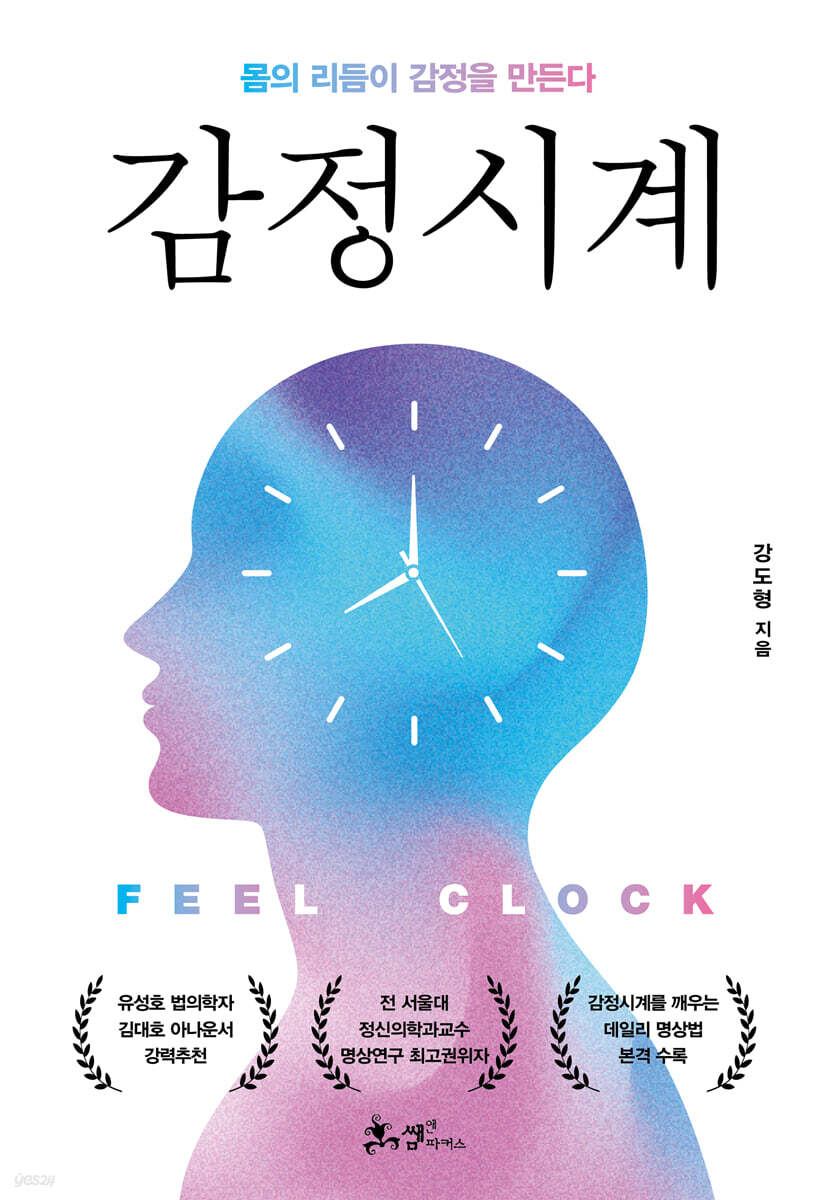
Emotion Clock
 |
Description
Book Introduction
“What are emotions? Can they be managed?”
Dr. Kang Do-hyung, former professor of psychiatry at Seoul National University
The culmination of 20 years of body-brain-mind research!
Emotions are a flow that moves through time and the body.
《Emotion Clock》 is a psychological humanities book that explores the relationship between emotions and the body through these facts.
We stop wandering in the abstract space of the mind and look into our emotions through the concrete medium of the body, and try to recover our emotions by regulating our misaligned biological rhythms.
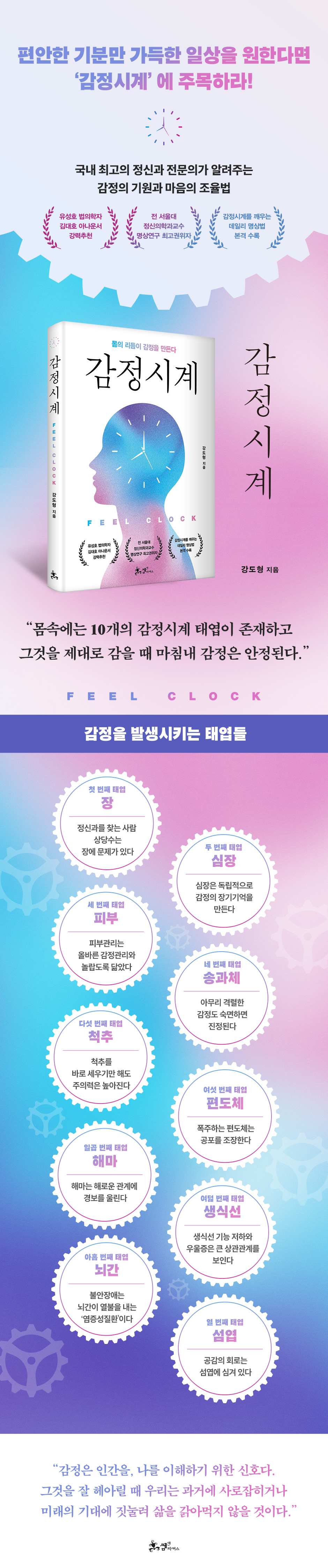
This book unfolds the story by following the ten body clocks that make up human emotions, focusing on the concept of the emotional clock.
Organs like the gut, heart, skin, spine, and hippocampus are conduits for emotions and starting points of rhythm.
Through daily routines and sensory meditations that explore the intersections of body and emotion, readers are guided to regulate their own emotional clocks.
This book argues that the illusion that we can perfectly understand and control our emotions, which is prevalent in countless books on emotions, is false.
And rather than rushing to offer advice to those who are emotionally swayed, or sending achievement-oriented messages about how to overcome emotions, we argue that emotions are the very way we live, and that they can be properly managed when we accept them as a fundamental part of our physical being.
This book will be helpful to those who want to recover their emotional sensitivity, those who want to understand the mechanisms of emotional development, and those who want to feel alive and emotional again as if they were children.
Dr. Kang Do-hyung, former professor of psychiatry at Seoul National University
The culmination of 20 years of body-brain-mind research!
Emotions are a flow that moves through time and the body.
《Emotion Clock》 is a psychological humanities book that explores the relationship between emotions and the body through these facts.
We stop wandering in the abstract space of the mind and look into our emotions through the concrete medium of the body, and try to recover our emotions by regulating our misaligned biological rhythms.
This book unfolds the story by following the ten body clocks that make up human emotions, focusing on the concept of the emotional clock.
Organs like the gut, heart, skin, spine, and hippocampus are conduits for emotions and starting points of rhythm.
Through daily routines and sensory meditations that explore the intersections of body and emotion, readers are guided to regulate their own emotional clocks.
This book argues that the illusion that we can perfectly understand and control our emotions, which is prevalent in countless books on emotions, is false.
And rather than rushing to offer advice to those who are emotionally swayed, or sending achievement-oriented messages about how to overcome emotions, we argue that emotions are the very way we live, and that they can be properly managed when we accept them as a fundamental part of our physical being.
This book will be helpful to those who want to recover their emotional sensitivity, those who want to understand the mechanisms of emotional development, and those who want to feel alive and emotional again as if they were children.
- You can preview some of the book's contents.
Preview
index
Prologue: The Illusion of Understanding Emotions
Chapter 1: Depression Begins in the Gut
Collapsed intestines and brain work together/Martial arts masters are close to the intestines/Intestine management that restores emotional balance
Emotion Clock ON: Jang Meditation
Chapter 2 When the heart rhythm makes you anxious
The First Listener of Your Emotions/The Seat of God/How to Tune Your Body's Metronome
Emotion Clock ON: Heart Meditation
Chapter 3: The Relationship Between Skin Care and Emotional Management
Skin can induce emotions? / Emotions change with just a handshake / A chef who can discern the freshness of ingredients
Emotion Clock ON: Skin Meditation
Chapter 4: The Pineal Gland: The Organ That Organizes Your Mind Overnight
Insomnia is like a cough/The coordinator at the back of the brain/If your condition doesn't improve no matter how much you sleep
Emotion Clock ON: Pineal Gland Meditation
Chapter 5: The Philosophy of Straightening the Spine
Attention is choice/We don't feel emotions/The spine collapses like the mind
Emotion Clock ON: Spinal Meditation
Chapter 6: The Amygdala, the Wild Within
Prepare for real pain with pain savings. If you don't want to be gripped by the everyday fear of death, pain savings financial strategy.
Emotion Clock ON: Amygdala Meditation
Chapter 7: How the Hippocampus Remembers Loneliness
Embrace Loneliness / Hacking the Hippocampus / How to Walk with Loneliness in Your Pet
Emotion Clock ON: Hippocampus Meditation
Chapter 8: The Impact of Emotional Labor on Reproduction
The Gonadal Rhythm That Calls to Death/Amplifier of Desire/A Man Who Can Live Without Law/Re-sow the Roots of Emotion
Emotion Clock ON: Gonad Meditation
Chapter 9: The Brainstem Erases Time Between Pleasure and Depression
The essence of dopamine is deficiency/The emotional ring of fire/When emotions race through the body with broken brakes/The skills the brainstem demands of us
Emotion Clock ON: Brainstem Meditation
Chapter 10: If you question the existence of a country, look at the island leaves.
How to Turn on Your Emotional Clock/Isolated Desert Island/The Origin of Happiness
Emotion Clock ON: Insula Meditation
Epilogue: How to Live with Emotions
Appendix: Emotion Clock 1-Month Practice Sheet
References
Chapter 1: Depression Begins in the Gut
Collapsed intestines and brain work together/Martial arts masters are close to the intestines/Intestine management that restores emotional balance
Emotion Clock ON: Jang Meditation
Chapter 2 When the heart rhythm makes you anxious
The First Listener of Your Emotions/The Seat of God/How to Tune Your Body's Metronome
Emotion Clock ON: Heart Meditation
Chapter 3: The Relationship Between Skin Care and Emotional Management
Skin can induce emotions? / Emotions change with just a handshake / A chef who can discern the freshness of ingredients
Emotion Clock ON: Skin Meditation
Chapter 4: The Pineal Gland: The Organ That Organizes Your Mind Overnight
Insomnia is like a cough/The coordinator at the back of the brain/If your condition doesn't improve no matter how much you sleep
Emotion Clock ON: Pineal Gland Meditation
Chapter 5: The Philosophy of Straightening the Spine
Attention is choice/We don't feel emotions/The spine collapses like the mind
Emotion Clock ON: Spinal Meditation
Chapter 6: The Amygdala, the Wild Within
Prepare for real pain with pain savings. If you don't want to be gripped by the everyday fear of death, pain savings financial strategy.
Emotion Clock ON: Amygdala Meditation
Chapter 7: How the Hippocampus Remembers Loneliness
Embrace Loneliness / Hacking the Hippocampus / How to Walk with Loneliness in Your Pet
Emotion Clock ON: Hippocampus Meditation
Chapter 8: The Impact of Emotional Labor on Reproduction
The Gonadal Rhythm That Calls to Death/Amplifier of Desire/A Man Who Can Live Without Law/Re-sow the Roots of Emotion
Emotion Clock ON: Gonad Meditation
Chapter 9: The Brainstem Erases Time Between Pleasure and Depression
The essence of dopamine is deficiency/The emotional ring of fire/When emotions race through the body with broken brakes/The skills the brainstem demands of us
Emotion Clock ON: Brainstem Meditation
Chapter 10: If you question the existence of a country, look at the island leaves.
How to Turn on Your Emotional Clock/Isolated Desert Island/The Origin of Happiness
Emotion Clock ON: Insula Meditation
Epilogue: How to Live with Emotions
Appendix: Emotion Clock 1-Month Practice Sheet
References
Detailed image
Into the book
What I felt most strongly while conducting clinical research on the integrated body-brain-mind was the temporality of emotions.
The clients' depression was usually concentrated at certain times of the day.
Right after waking up in the morning, around 3pm, around 11pm.
The pattern was different, but the rhythm was clear.
Patients with panic disorder often reported worsening symptoms in the early afternoon, while those with depression reported the mornings as the most distressing.
The obsessive-compulsive symptoms were most severe around bedtime, and the anxiety often occurred in the empty hours right after work.
I started keeping a daily log of those times, noting what they ate, when they went to bed, how their digestion was, and how much sunlight they got.
Then I discovered something surprising.
The point is that emotions are not the result of stress or events, but rather the product of waves of bodily rhythms.
One client said that her anxiety always peaked around 10 a.m.
What was revealed through repeated counseling sessions was that this client skipped breakfast, drank only strong coffee, and then sat in front of the computer, working without moving.
She wondered why she always felt anxious around 10 o'clock.
I explained that during that time, the combination of low blood sugar, residual caffeine, and natural fluctuations in cortisol all contribute to anxiety.
It wasn't a mental issue.
It was a tangle of emotions created by the rhythm of the body.
I started treating the 'body' of patients who came to the 'psychiatry' department.
Your stomach, intestines, heart rate, body temperature, breathing, muscle tension, sleep hormones, and even the condition of your spine.
At some point, we began to believe that we could confine our minds to the brain and that emotions could be explained solely through the workings of the brain.
But I rather think that the clock of emotions operates as the mainspring of the body turns.
If this clock operates according to patterns that everyone has, it could provide a basis for measuring, managing, and regulating emotions.
--- From "Prologue: The Illusion of Understanding Emotions"
However, in my clinical experience, a significant number of people who come to the hospital for mental health problems have problems with their bowel function.
To be more precise, there are many cases where we live without recognizing the signals our intestines send and ignoring them.
I ask them again cautiously.
"The five reasons you just mentioned, weren't they something that's been around for a long time? So why is it so difficult to endure now?" The trauma happened years ago, his personality remained the same for decades, and his economic problems hadn't suddenly worsened.
But I held out well during that time.
If so, there may be a separate trigger that caused the pain to explode now.
Interpreting the mind is important, but from a therapeutic perspective, what we need to find first is a system that can intervene right now.
That's the chapter.
Trauma, personality, relationships, and financial problems are all things that are difficult or take a long time to control.
Even if it can be solved, it must be supported by extraordinary efforts and continuous environmental changes.
On the other hand, the intestines are an area that we can control from this moment on.
Changes are rapid and responses are relatively clear.
If the body is the ingredient, the brain is the cook, and the heart is the dish the cook creates.
If a dish goes bad, the cause could be the cook or the ingredients.
There is also a possibility that the systems between these two are out of sync.
Ultimately, what we need to do is redesign the entire cuisine—reorganize the body-brain-mind system.
--- From "Depression Begins in the Gut"
The heart is the metronome of emotions.
So how can we tune this metronome? Let's start our day with the rhythm of our heart.
As soon as you open your eyes in the morning, place your hand on your chest instead of your smartphone, and feel your heartbeat while taking deep breaths.
This routine is even more effective on days when you're anxious or busy.
The heart, the second spring of the emotional clock, is the standard tone that sets the daily rhythm.
If this standard is shaken, the entire day's emotions can be distorted.
Cardio routines focus on sensation and rhythm.
The simplest way is to start your day with five deep breathing exercises after waking up.
Inhale for 4 seconds, exhale for 6 seconds, and place your hands lightly on your chest and lower abdomen.
You should not try to measure your heart rate at this time.
We need an attitude of listening to the rhythm of the heart without judging or trying to correct it.
When the rhythm is transmitted to the fingertips and synchronized with the breathing, the emotional pattern also stabilizes.
From here, you can expand the training to visualizing the heart.
Close your eyes and imagine the weight inside your chest.
Imagine what color your heart is, what shape it is, and how fast it moves.
There is no right answer.
The important thing is to accept that this rhythm reflects your current emotions.
--- From "When the Heart's Rhythm Makes You Uneasy"
The spine is the invisible pillar that supports our emotions, sustains our attention, and enables us to make choices.
When the spine collapses, emotions become crushed and attention becomes scattered.
When you feel like you can't focus, you may actually be losing your focus.
So you need to train your body as much as you train your brain.
In particular, proprioception, the ability to recognize where the body is in space, especially around the spine, must be alive for emotions to find their place.
Only when we add a sense of posture and the central sensory integration that allows the brain to readjust the balance of the entire body is functioning properly can we reach a state of feeling emotions.
In other words, emotions must settle in the body before they can be interpreted by the brain.
This means that emotions can only become clear when the spine is aligned.
The same goes for attention.
Attention is not the ability to select information, but the ability to cut out unnecessary stimuli.
In other words, it is not a skill of selection, but a skill of cutting.
The ability to cut, ignore, and suppress.
When the center is shaken, this cutting sense disappears and we are endlessly swayed by emotional noise.
So straightening your spine is also a way to realign your emotional filters.
To feel emotions, you must first feel your center.
--- From "The Philosophy of Straightening Your Spine"
Researchers at Oxford University have discovered that the insula and prefrontal cortex are the brain regions that evolved most recently in humans, and are also the first to be affected by aging.
As chimpanzees age, the striatum, which is responsible for reward behaviors and habits, atrophies more quickly, while in humans, the insula degenerates first.
Evolutionarily, the abilities acquired last are the first to disappear.
The price is a decline in empathy.
The insula is responsible for higher-order functions such as empathy, morality, consciousness, happiness, and emotional regulation.
I think this is the mechanical basis of the emotional clock.
The insula is the intersection in the brain where the external world of time and the internal world of emotions meet.
When the insula isn't functioning properly, we can't recognize our emotions and connect them to the passage of time.
It means that you cannot regulate your emotions within the rhythm of time.
The problem is that most people live their lives forgetting how to use this island leaf.
In an age where emotions are hidden and suppressed, islands are increasingly becoming isolated, uninhabited.
Expressions like 'my stomach is churning', 'my chest is tight', 'my shoulders are heavy', and 'my head is dizzy' are all bodily sensations, and the insular cortex captures these sensations and gives them names as emotions.
However, when we are in a state of trauma or emotional numbness, the insula stops functioning.
Your body is still reacting, but you can't feel it.
For example, the insula of a person who is overcome with anger but does not recognize it as anger is not functioning.
The insula allows us to perceive emotional waveforms as part of ourselves, but when the insula is not functioning, those waveforms are just passing noise.
You become a person who appears normal on the outside, but cannot feel, connect, or explain.
--- From "If you ask about the existence of a country, look at the island leaves"
Let's say you're learning to dance.
Even if we struggle to keep the rhythm and move stiffly when we first learn to dance, we won't think of ourselves as "failures" or "slaves to dance."
Unless you have a great talent, most people have to move their joints little by little to get used to the rhythm and movements.
Rather than trying to control or suppress your emotions, you must first learn to listen to the rhythm of your emotions.
It may be awkward, confusing, and difficult to handle at first, but if you get into the rhythm and repeat it, you will get used to it.
This is not something that can be done all at once.
Just like learning a foreign language or learning to dance, a process of repetition and failure is necessary.
What this book aims to do is to speak to the inner workings of our bodies that we have neglected.
Through the practice of questioning, feeling, imagining, and communicating, the rhythm of emotions is restored.
You will be able to dance together without being in conflict with your emotions or giving in to them.
Emotions are not something that anyone seeks to control.
It only encroaches on those who are ignorant of the rhythm of emotions.
The clients' depression was usually concentrated at certain times of the day.
Right after waking up in the morning, around 3pm, around 11pm.
The pattern was different, but the rhythm was clear.
Patients with panic disorder often reported worsening symptoms in the early afternoon, while those with depression reported the mornings as the most distressing.
The obsessive-compulsive symptoms were most severe around bedtime, and the anxiety often occurred in the empty hours right after work.
I started keeping a daily log of those times, noting what they ate, when they went to bed, how their digestion was, and how much sunlight they got.
Then I discovered something surprising.
The point is that emotions are not the result of stress or events, but rather the product of waves of bodily rhythms.
One client said that her anxiety always peaked around 10 a.m.
What was revealed through repeated counseling sessions was that this client skipped breakfast, drank only strong coffee, and then sat in front of the computer, working without moving.
She wondered why she always felt anxious around 10 o'clock.
I explained that during that time, the combination of low blood sugar, residual caffeine, and natural fluctuations in cortisol all contribute to anxiety.
It wasn't a mental issue.
It was a tangle of emotions created by the rhythm of the body.
I started treating the 'body' of patients who came to the 'psychiatry' department.
Your stomach, intestines, heart rate, body temperature, breathing, muscle tension, sleep hormones, and even the condition of your spine.
At some point, we began to believe that we could confine our minds to the brain and that emotions could be explained solely through the workings of the brain.
But I rather think that the clock of emotions operates as the mainspring of the body turns.
If this clock operates according to patterns that everyone has, it could provide a basis for measuring, managing, and regulating emotions.
--- From "Prologue: The Illusion of Understanding Emotions"
However, in my clinical experience, a significant number of people who come to the hospital for mental health problems have problems with their bowel function.
To be more precise, there are many cases where we live without recognizing the signals our intestines send and ignoring them.
I ask them again cautiously.
"The five reasons you just mentioned, weren't they something that's been around for a long time? So why is it so difficult to endure now?" The trauma happened years ago, his personality remained the same for decades, and his economic problems hadn't suddenly worsened.
But I held out well during that time.
If so, there may be a separate trigger that caused the pain to explode now.
Interpreting the mind is important, but from a therapeutic perspective, what we need to find first is a system that can intervene right now.
That's the chapter.
Trauma, personality, relationships, and financial problems are all things that are difficult or take a long time to control.
Even if it can be solved, it must be supported by extraordinary efforts and continuous environmental changes.
On the other hand, the intestines are an area that we can control from this moment on.
Changes are rapid and responses are relatively clear.
If the body is the ingredient, the brain is the cook, and the heart is the dish the cook creates.
If a dish goes bad, the cause could be the cook or the ingredients.
There is also a possibility that the systems between these two are out of sync.
Ultimately, what we need to do is redesign the entire cuisine—reorganize the body-brain-mind system.
--- From "Depression Begins in the Gut"
The heart is the metronome of emotions.
So how can we tune this metronome? Let's start our day with the rhythm of our heart.
As soon as you open your eyes in the morning, place your hand on your chest instead of your smartphone, and feel your heartbeat while taking deep breaths.
This routine is even more effective on days when you're anxious or busy.
The heart, the second spring of the emotional clock, is the standard tone that sets the daily rhythm.
If this standard is shaken, the entire day's emotions can be distorted.
Cardio routines focus on sensation and rhythm.
The simplest way is to start your day with five deep breathing exercises after waking up.
Inhale for 4 seconds, exhale for 6 seconds, and place your hands lightly on your chest and lower abdomen.
You should not try to measure your heart rate at this time.
We need an attitude of listening to the rhythm of the heart without judging or trying to correct it.
When the rhythm is transmitted to the fingertips and synchronized with the breathing, the emotional pattern also stabilizes.
From here, you can expand the training to visualizing the heart.
Close your eyes and imagine the weight inside your chest.
Imagine what color your heart is, what shape it is, and how fast it moves.
There is no right answer.
The important thing is to accept that this rhythm reflects your current emotions.
--- From "When the Heart's Rhythm Makes You Uneasy"
The spine is the invisible pillar that supports our emotions, sustains our attention, and enables us to make choices.
When the spine collapses, emotions become crushed and attention becomes scattered.
When you feel like you can't focus, you may actually be losing your focus.
So you need to train your body as much as you train your brain.
In particular, proprioception, the ability to recognize where the body is in space, especially around the spine, must be alive for emotions to find their place.
Only when we add a sense of posture and the central sensory integration that allows the brain to readjust the balance of the entire body is functioning properly can we reach a state of feeling emotions.
In other words, emotions must settle in the body before they can be interpreted by the brain.
This means that emotions can only become clear when the spine is aligned.
The same goes for attention.
Attention is not the ability to select information, but the ability to cut out unnecessary stimuli.
In other words, it is not a skill of selection, but a skill of cutting.
The ability to cut, ignore, and suppress.
When the center is shaken, this cutting sense disappears and we are endlessly swayed by emotional noise.
So straightening your spine is also a way to realign your emotional filters.
To feel emotions, you must first feel your center.
--- From "The Philosophy of Straightening Your Spine"
Researchers at Oxford University have discovered that the insula and prefrontal cortex are the brain regions that evolved most recently in humans, and are also the first to be affected by aging.
As chimpanzees age, the striatum, which is responsible for reward behaviors and habits, atrophies more quickly, while in humans, the insula degenerates first.
Evolutionarily, the abilities acquired last are the first to disappear.
The price is a decline in empathy.
The insula is responsible for higher-order functions such as empathy, morality, consciousness, happiness, and emotional regulation.
I think this is the mechanical basis of the emotional clock.
The insula is the intersection in the brain where the external world of time and the internal world of emotions meet.
When the insula isn't functioning properly, we can't recognize our emotions and connect them to the passage of time.
It means that you cannot regulate your emotions within the rhythm of time.
The problem is that most people live their lives forgetting how to use this island leaf.
In an age where emotions are hidden and suppressed, islands are increasingly becoming isolated, uninhabited.
Expressions like 'my stomach is churning', 'my chest is tight', 'my shoulders are heavy', and 'my head is dizzy' are all bodily sensations, and the insular cortex captures these sensations and gives them names as emotions.
However, when we are in a state of trauma or emotional numbness, the insula stops functioning.
Your body is still reacting, but you can't feel it.
For example, the insula of a person who is overcome with anger but does not recognize it as anger is not functioning.
The insula allows us to perceive emotional waveforms as part of ourselves, but when the insula is not functioning, those waveforms are just passing noise.
You become a person who appears normal on the outside, but cannot feel, connect, or explain.
--- From "If you ask about the existence of a country, look at the island leaves"
Let's say you're learning to dance.
Even if we struggle to keep the rhythm and move stiffly when we first learn to dance, we won't think of ourselves as "failures" or "slaves to dance."
Unless you have a great talent, most people have to move their joints little by little to get used to the rhythm and movements.
Rather than trying to control or suppress your emotions, you must first learn to listen to the rhythm of your emotions.
It may be awkward, confusing, and difficult to handle at first, but if you get into the rhythm and repeat it, you will get used to it.
This is not something that can be done all at once.
Just like learning a foreign language or learning to dance, a process of repetition and failure is necessary.
What this book aims to do is to speak to the inner workings of our bodies that we have neglected.
Through the practice of questioning, feeling, imagining, and communicating, the rhythm of emotions is restored.
You will be able to dance together without being in conflict with your emotions or giving in to them.
Emotions are not something that anyone seeks to control.
It only encroaches on those who are ignorant of the rhythm of emotions.
--- From "Epilogue: How to Live with Emotions"
Publisher's Review
Insomnia, depression, binge eating, lethargy, burnout…
A new perspective on preventing and regulating emotional outbursts!
“Emotions start in the body, not the brain.”
Dr. Kang Do-hyung has been working as a professor of psychiatry at Seoul National University Hospital and as the director of a private psychiatric hospital for over 20 years, consistently researching the relationship between emotions, biorhythms, meditation, and neurophysiology.
He has been particularly interested in how various types of pain disrupt the body's rhythms and what emotional distortions result from them, using clinical cases and scientific data.
《Emotion Clock》 is the result of such research, presenting a unique map of emotional interpretation that combines physiology, neuroscience, psychology, and the humanities.
We have been misunderstanding emotions.
If you feel bad, I think your mindset is wrong.
I thought that I could be happy if I had a positive outlook.
I believed that controlling my emotions meant controlling my mind.
But when I felt inexplicably depressed in the morning, anxious all day long for no reason, or lethargic for days on end without any particular reason, I had no choice but to suppress these feelings because I didn't know where they came from.
But according to this book, emotions are not the result of willpower or thought.
Dr. Kang Do-hyung, a specialist in psychiatry, asserts that emotions are a phenomenon of rhythm created by the body.
This rhythm operates in time and is surprisingly unaffected by thoughts or the mind.
This book calls the bodily organs that are the origin of emotions the emotional clockwork.
Emotions arise from rhythms created by ten organs and the complex systems built around them: the gut, heart, skin, spine, pineal gland, amygdala, hippocampus, gonads, brainstem, and insula.
Each chapter is centered around a specific organ, which is the mainspring of the emotional clock.
Without taking care of my body
The time of emotion can never be recovered
The gut is the emotional center that produces serotonin and regulates inflammatory responses, and the heart is both a blood pump and a transmitter of electrical emotional signals.
The skin is the sensory gateway that connects emotions to the world, and the amygdala and hippocampus are the memory centers that store and regulate emotions.
The spine transmits emotional vibrations throughout the body via nerve signals, and the pineal gland governs the beginning and end of rhythms, day and night, wakefulness and sleep.
The gonads regulate the vitality and energy of daily life, while the insula regulates the 'self' through an integrated sense of time and emotion.
Through all these organs we 'feel' emotions.
The body creates emotions, the brain simply translates them.
For example, inflammation of the gut can affect the brain through the gut-brain axis, translating into feelings of fatigue or lethargy, while electrical signals from irregular heartbeat patterns can travel through the brainstem to trigger immediate responses in emotional circuits.
On the surface, it may seem like simple irritation, anxiety, and depression, but underneath, a disrupted biological rhythm is creating dissonance.
Anger occurs when the emotional rhythm becomes rapid, depression occurs when the rhythm slows down and becomes subdued, and anxiety occurs when excessively rapid signals become uncontrollable.
Emptiness occurs when the rhythm stops, and lethargy occurs when the amplitude of the rhythm disappears to a small vibration.
The author's insight is that all of these results are a symphony of emotions produced by the body.
This book also provides specific solutions for emotional regulation.
Of course, it does not require exceptional will or persistent training.
I suggest just a few small habits: opening your body to the sunlight pouring down on your face every morning, imagining the warmth gathering around your belly button before you fall asleep, slowly shaking your head to create vibrations in your brainstem, and stimulating your skin with your hands to awaken your senses.
It is about opening the gaps in the senses and winding the emotional clock.
What's surprising is that the author, a meditation researcher, defines some of these seemingly unspectacular practices as meditation.
This book contains unique meditation instructions never before offered.
Through this process, readers will discover new ways to examine and restore their emotional rhythms.
Break free from the compulsion to regulate emotions
Tiny Habits That Create Peace of Mind
The author says that the reason modern people view emotions not as something to be managed but as something to be controlled and suppressed is because they do not know how to read the time of emotions.
Through this book, readers will experience the temporality of emotions for the first time and will be able to shift their perception to the idea that emotions are objects of coordination rather than control.
This book makes us realize that emotions are a living, breathing time with our bodies.
Anyone can become a rhythm conductor.
You can fill your day with the beautiful melody of feeling.
If you want to experience peace of mind, think of your body, not your brain.
If you want to change your mood, move your body instead of thinking.
If the emotional clock is properly wound, let's feel 'me' with our whole body.
What time is your emotional clock right now?
A new perspective on preventing and regulating emotional outbursts!
“Emotions start in the body, not the brain.”
Dr. Kang Do-hyung has been working as a professor of psychiatry at Seoul National University Hospital and as the director of a private psychiatric hospital for over 20 years, consistently researching the relationship between emotions, biorhythms, meditation, and neurophysiology.
He has been particularly interested in how various types of pain disrupt the body's rhythms and what emotional distortions result from them, using clinical cases and scientific data.
《Emotion Clock》 is the result of such research, presenting a unique map of emotional interpretation that combines physiology, neuroscience, psychology, and the humanities.
We have been misunderstanding emotions.
If you feel bad, I think your mindset is wrong.
I thought that I could be happy if I had a positive outlook.
I believed that controlling my emotions meant controlling my mind.
But when I felt inexplicably depressed in the morning, anxious all day long for no reason, or lethargic for days on end without any particular reason, I had no choice but to suppress these feelings because I didn't know where they came from.
But according to this book, emotions are not the result of willpower or thought.
Dr. Kang Do-hyung, a specialist in psychiatry, asserts that emotions are a phenomenon of rhythm created by the body.
This rhythm operates in time and is surprisingly unaffected by thoughts or the mind.
This book calls the bodily organs that are the origin of emotions the emotional clockwork.
Emotions arise from rhythms created by ten organs and the complex systems built around them: the gut, heart, skin, spine, pineal gland, amygdala, hippocampus, gonads, brainstem, and insula.
Each chapter is centered around a specific organ, which is the mainspring of the emotional clock.
Without taking care of my body
The time of emotion can never be recovered
The gut is the emotional center that produces serotonin and regulates inflammatory responses, and the heart is both a blood pump and a transmitter of electrical emotional signals.
The skin is the sensory gateway that connects emotions to the world, and the amygdala and hippocampus are the memory centers that store and regulate emotions.
The spine transmits emotional vibrations throughout the body via nerve signals, and the pineal gland governs the beginning and end of rhythms, day and night, wakefulness and sleep.
The gonads regulate the vitality and energy of daily life, while the insula regulates the 'self' through an integrated sense of time and emotion.
Through all these organs we 'feel' emotions.
The body creates emotions, the brain simply translates them.
For example, inflammation of the gut can affect the brain through the gut-brain axis, translating into feelings of fatigue or lethargy, while electrical signals from irregular heartbeat patterns can travel through the brainstem to trigger immediate responses in emotional circuits.
On the surface, it may seem like simple irritation, anxiety, and depression, but underneath, a disrupted biological rhythm is creating dissonance.
Anger occurs when the emotional rhythm becomes rapid, depression occurs when the rhythm slows down and becomes subdued, and anxiety occurs when excessively rapid signals become uncontrollable.
Emptiness occurs when the rhythm stops, and lethargy occurs when the amplitude of the rhythm disappears to a small vibration.
The author's insight is that all of these results are a symphony of emotions produced by the body.
This book also provides specific solutions for emotional regulation.
Of course, it does not require exceptional will or persistent training.
I suggest just a few small habits: opening your body to the sunlight pouring down on your face every morning, imagining the warmth gathering around your belly button before you fall asleep, slowly shaking your head to create vibrations in your brainstem, and stimulating your skin with your hands to awaken your senses.
It is about opening the gaps in the senses and winding the emotional clock.
What's surprising is that the author, a meditation researcher, defines some of these seemingly unspectacular practices as meditation.
This book contains unique meditation instructions never before offered.
Through this process, readers will discover new ways to examine and restore their emotional rhythms.
Break free from the compulsion to regulate emotions
Tiny Habits That Create Peace of Mind
The author says that the reason modern people view emotions not as something to be managed but as something to be controlled and suppressed is because they do not know how to read the time of emotions.
Through this book, readers will experience the temporality of emotions for the first time and will be able to shift their perception to the idea that emotions are objects of coordination rather than control.
This book makes us realize that emotions are a living, breathing time with our bodies.
Anyone can become a rhythm conductor.
You can fill your day with the beautiful melody of feeling.
If you want to experience peace of mind, think of your body, not your brain.
If you want to change your mood, move your body instead of thinking.
If the emotional clock is properly wound, let's feel 'me' with our whole body.
What time is your emotional clock right now?
GOODS SPECIFICS
- Date of issue: October 29, 2025
- Page count, weight, size: 256 pages | 396g | 145*210*15mm
- ISBN13: 9791194755722
- ISBN10: 1194755720
You may also like
카테고리
korean


korean

![ELLE 엘르 스페셜 에디션 A형 : 12월 [2025]](http://librairie.coreenne.fr/cdn/shop/files/b8e27a3de6c9538896439686c6b0e8fb.jpg?v=1766436872&width=3840)


