

Utopia
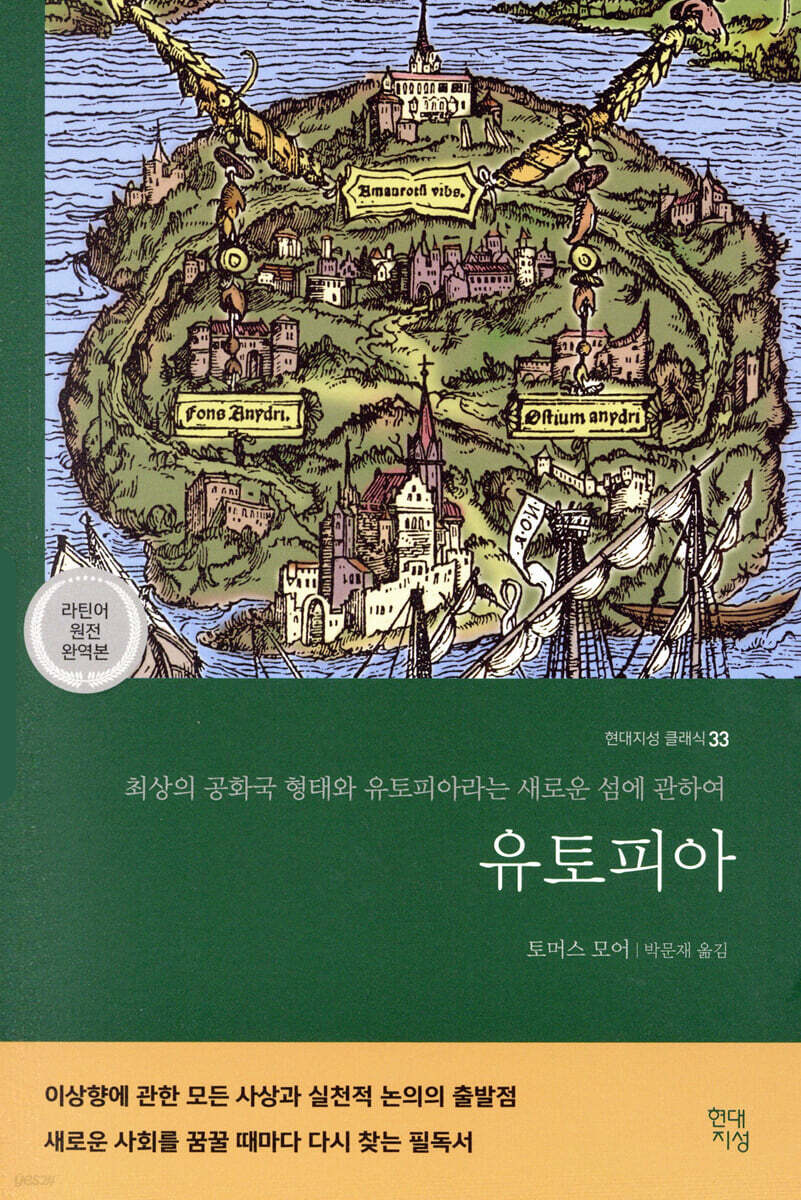 |
Description
Book Introduction
Basic income, public housing, a six-hour workday, economic equality, a sharing society…
The basic framework of the ideal state currently being discussed was already presented 500 years ago.
"Utopia," a masterpiece that embodies the beliefs and thoughts of Thomas More, a devout Catholic, while also fully displaying his unconventional side as a Renaissance humanist, has been published as the 33rd Modern Intellectual Classic.
The author, living in an era of absolute monarchy, proposed a "republic" as an ideal state. He brought together all the ideas and philosophical discussions about utopias up to that time, and depicted in detail, as if drawing a picture, the food, clothing, shelter, economic activities, and political and social life of the citizens of the ideal state.
During the time Thomas More lived, England had become a lawless country after the Hundred Years' War and the Wars of the Roses.
The forest was infested with bandits, and merchants had to hire warriors.
The enclosure movement led to the ruin of the peasantry and the explosion of London's population, which resulted in all sorts of social problems.
Moore believed that rather than simply punishing criminals, a system should be created to prevent such criminals from ever emerging.
The author's radical ideas, such as basic income, public housing, the six-hour workday, and economic equality, mentioned in the 16th century, later led to works such as Marx's "Das Kapital," and are so groundbreaking and innovative that they are still actively discussed in the 21st century.
It is evaluated that the best republic presented by Plato in 『The Republic』 was vividly depicted as a real model rather than a philosophical discourse.
This book, which explores the topic of "What kind of being is a human being, and how should one live to be happy?" from a humanist perspective, presents an engaging novel that will deepen the thoughts of readers who dream of a utopia in this age.
The basic framework of the ideal state currently being discussed was already presented 500 years ago.
"Utopia," a masterpiece that embodies the beliefs and thoughts of Thomas More, a devout Catholic, while also fully displaying his unconventional side as a Renaissance humanist, has been published as the 33rd Modern Intellectual Classic.
The author, living in an era of absolute monarchy, proposed a "republic" as an ideal state. He brought together all the ideas and philosophical discussions about utopias up to that time, and depicted in detail, as if drawing a picture, the food, clothing, shelter, economic activities, and political and social life of the citizens of the ideal state.
During the time Thomas More lived, England had become a lawless country after the Hundred Years' War and the Wars of the Roses.
The forest was infested with bandits, and merchants had to hire warriors.
The enclosure movement led to the ruin of the peasantry and the explosion of London's population, which resulted in all sorts of social problems.
Moore believed that rather than simply punishing criminals, a system should be created to prevent such criminals from ever emerging.
The author's radical ideas, such as basic income, public housing, the six-hour workday, and economic equality, mentioned in the 16th century, later led to works such as Marx's "Das Kapital," and are so groundbreaking and innovative that they are still actively discussed in the 21st century.
It is evaluated that the best republic presented by Plato in 『The Republic』 was vividly depicted as a real model rather than a philosophical discourse.
This book, which explores the topic of "What kind of being is a human being, and how should one live to be happy?" from a humanist perspective, presents an engaging novel that will deepen the thoughts of readers who dream of a utopia in this age.
- You can preview some of the book's contents.
Preview
index
Preface | Letter from Thomas More to Peter Hilles
Volume 1
Volume 2
1.
Utopia Island
2.
The cities of Utopia, especially Amaurus
3.
managers
4.
job
5.
social organization
6.
travel
7.
fair distribution of products
8.
Parenting and learning
9.
slave
10.
war
11.
religion
12.
Praise the Utopian Republic
Letters and Poetry
Thomas More to Peter Hilles
Erasmus to Johann Froben
Guillaume Budé to Thomas Lubset
A short poem by Anemolios
Peter Hilles to Jerome Busridius
Hieronymus Busridius to Thomas More
Gerard Holdenhauber's poetry
Beatus Renaus to Pirckheimer
Demarais to Peter Hilles
Demaret's poem
Utopian alphabet
Cornelius de Schreiber to the reader
Glossary of Terms
clear
Chronology
Volume 1
Volume 2
1.
Utopia Island
2.
The cities of Utopia, especially Amaurus
3.
managers
4.
job
5.
social organization
6.
travel
7.
fair distribution of products
8.
Parenting and learning
9.
slave
10.
war
11.
religion
12.
Praise the Utopian Republic
Letters and Poetry
Thomas More to Peter Hilles
Erasmus to Johann Froben
Guillaume Budé to Thomas Lubset
A short poem by Anemolios
Peter Hilles to Jerome Busridius
Hieronymus Busridius to Thomas More
Gerard Holdenhauber's poetry
Beatus Renaus to Pirckheimer
Demarais to Peter Hilles
Demaret's poem
Utopian alphabet
Cornelius de Schreiber to the reader
Glossary of Terms
clear
Chronology
Detailed image

Into the book
I said earlier that they only work six hours a day.
So, you might think that with such short working hours, there must be a shortage of basic necessities in that country.
But in fact, that is not the case at all.
With just six hours a day, we can produce all the necessities of life, as well as all the things that make life convenient and comfortable. And even after producing these things, we still have time to spare.
If you consider that in other countries, a significant number of people do nothing but just sit around and eat, you can quickly understand why.
First, almost all women, who make up half of the population, do not work.
In most homes where women work, you can almost always hear the sound of a man snoring while lounging around with nothing to do.
Next, there are a large number of clergy, so-called religious people, who live idle lives doing nothing.
Also, there are all the rich, especially the great landowners called gentlemen and nobles, and their servants and vassals, those scoundrels who are the dens of all evil.
Finally, there are those who are actually very healthy and strong, but pretend to be sick and go around begging to survive without working.
If you add up the number of people who live without working like this, you will realize that everything, including the necessities of life, can be produced with far less labor than you might have imagined.
Now consider how few of the people who actually work actually make the necessities of life.
In a world where everything is measured in money, many useless and vain occupations are created that serve only to satisfy people's luxurious and indulgent lives, and many people have no choice but to engage in them.
--- p.116~117
On the other hand, since all the houses that the Utopians inhabit have already been built and supplied by the state under meticulous planning, building new houses on new land is extremely rare.
Not only will home repairs and maintenance be completed quickly, but home repair technicians will also anticipate potential problems in their assigned areas and take preventative measures to minimize future repairs.
As a result, even though minimal labor is invested in home repairs, the lifespan is very long.
And since the workers in charge of this work have little else to do, they prepare wood and stone at home in advance so that they can use them immediately when the need arises.
--- p.119~120
I said earlier that each city sends three representatives each year to the National Congress held in Amaurus.
The first thing to do at this meeting is to determine which of the goods produced by each city are in excess and which are in short supply, and then immediately send the surplus production from each city to the city that is in short supply.
This is done free of charge, so you don't get anything in return for sending your surplus goods to other cities.
Each city gives its surplus produce to the other cities without asking anything in return, but it also receives other goods it needs from the other cities without asking anything in return, so that in the end all cities benefit from each other, and there is no shortage of goods for everyone.
In this way, the entire island of Utopia is like one family.
--- p.132
But the most important issue that everyone living in Utopia is deeply interested in and discusses is human happiness.
We discuss where happiness lies, and whether happiness consists of one thing or many things.
On this issue, they seem to lean heavily towards hedonism.
That is, human happiness is either entirely composed of pleasure, or the most important part of it is pleasure.
--- p.144
In Utopia, there are only a very few laws.
Because under the system that the country operates, only a very small number of laws are sufficient.
One of the most serious flaws that Utopians see in other countries is that, although there are countless laws and countless books interpreting those laws, even this innumerable number of laws and legal books is still not enough to solve many social problems.
They believe it is extremely unjust to bind people by enacting laws that are so numerous that they cannot be read or whose meaning is so ambiguous that they cannot be understood.
Moreover, there are no lawyers in this country who abuse their knowledge of the law to cleverly distort the truth of a case.
Because I think it's better for the litigants to take charge of their own defense and state the truth in front of the judge rather than through a lawyer.
So, you might think that with such short working hours, there must be a shortage of basic necessities in that country.
But in fact, that is not the case at all.
With just six hours a day, we can produce all the necessities of life, as well as all the things that make life convenient and comfortable. And even after producing these things, we still have time to spare.
If you consider that in other countries, a significant number of people do nothing but just sit around and eat, you can quickly understand why.
First, almost all women, who make up half of the population, do not work.
In most homes where women work, you can almost always hear the sound of a man snoring while lounging around with nothing to do.
Next, there are a large number of clergy, so-called religious people, who live idle lives doing nothing.
Also, there are all the rich, especially the great landowners called gentlemen and nobles, and their servants and vassals, those scoundrels who are the dens of all evil.
Finally, there are those who are actually very healthy and strong, but pretend to be sick and go around begging to survive without working.
If you add up the number of people who live without working like this, you will realize that everything, including the necessities of life, can be produced with far less labor than you might have imagined.
Now consider how few of the people who actually work actually make the necessities of life.
In a world where everything is measured in money, many useless and vain occupations are created that serve only to satisfy people's luxurious and indulgent lives, and many people have no choice but to engage in them.
--- p.116~117
On the other hand, since all the houses that the Utopians inhabit have already been built and supplied by the state under meticulous planning, building new houses on new land is extremely rare.
Not only will home repairs and maintenance be completed quickly, but home repair technicians will also anticipate potential problems in their assigned areas and take preventative measures to minimize future repairs.
As a result, even though minimal labor is invested in home repairs, the lifespan is very long.
And since the workers in charge of this work have little else to do, they prepare wood and stone at home in advance so that they can use them immediately when the need arises.
--- p.119~120
I said earlier that each city sends three representatives each year to the National Congress held in Amaurus.
The first thing to do at this meeting is to determine which of the goods produced by each city are in excess and which are in short supply, and then immediately send the surplus production from each city to the city that is in short supply.
This is done free of charge, so you don't get anything in return for sending your surplus goods to other cities.
Each city gives its surplus produce to the other cities without asking anything in return, but it also receives other goods it needs from the other cities without asking anything in return, so that in the end all cities benefit from each other, and there is no shortage of goods for everyone.
In this way, the entire island of Utopia is like one family.
--- p.132
But the most important issue that everyone living in Utopia is deeply interested in and discusses is human happiness.
We discuss where happiness lies, and whether happiness consists of one thing or many things.
On this issue, they seem to lean heavily towards hedonism.
That is, human happiness is either entirely composed of pleasure, or the most important part of it is pleasure.
--- p.144
In Utopia, there are only a very few laws.
Because under the system that the country operates, only a very small number of laws are sufficient.
One of the most serious flaws that Utopians see in other countries is that, although there are countless laws and countless books interpreting those laws, even this innumerable number of laws and legal books is still not enough to solve many social problems.
They believe it is extremely unjust to bind people by enacting laws that are so numerous that they cannot be read or whose meaning is so ambiguous that they cannot be understood.
Moreover, there are no lawyers in this country who abuse their knowledge of the law to cleverly distort the truth of a case.
Because I think it's better for the litigants to take charge of their own defense and state the truth in front of the judge rather than through a lawyer.
--- p.176
Publisher's Review
The starting point of all ideological and practical discussions on utopia
The person who first proposed an ideal country in this world, rather than a happy country to dream of after death, that is, a utopia in the afterlife, was Plato.
In 『The Republic』, he introduces a republic ruled by philosophers as an ideal state, and argues that 'sharing of property' is the foundation of a fair and just society.
Thomas More, the greatest intellectual of his time, a country's Supreme Court justice, and a Renaissance humanist, vividly described the republic proposed by Plato in his book, Utopia, not just as a philosophical discourse, but as a model that actually came to fruition in reality.
By borrowing the form of a novel, he depicted a society in which all the social problems that Britain and Europe were suffering from at the time had been resolved, and he established the basic framework of an ideal state necessary for advancing toward such a society.
Life for the common people in 16th-century England was a series of hardships following the Hundred Years' War and the Wars of the Roses, and as a result, the streets were overflowing with beggars and thieves.
Additionally, under the absolute monarchy that emerged during the transition period from feudal society to civil society, harsh laws were enacted and strictly enforced.
Wool prices soared, forcing landlords to rapidly expand their pastures, forcing large numbers of peasants into the cities (“enclosures”).
As the whirlwind of the Reformation and Renaissance swept through the times, people began to dream of a 'new world'.
This book not only brought together the ideas and philosophical discussions on utopia up to that time, but has also been recognized as a must-read and thought-provoking book for those who dream of a new society.
Especially for those who contemplate a post-capitalist society amidst the limitations and extreme contradictions of the capitalist system, it is full of surprising content that can be vividly applied even now.
Many of the radical ideas the author mentioned in the 16th century, such as basic income, public housing, the six-hour workday, and economic equality, are so groundbreaking and innovative that their introduction is actively being discussed in the 21st century.
The framework for the welfare state discussed today was presented 500 years ago.
Utopia Volume 1 serves as an introduction to the island nation of Utopia, the ultimate republic, which will be fully explained in Volume 2.
That is, the motivation or purpose of introducing the ideal country called Utopia is revealed here, and the direct motivation was the injustice that was rampant in England at the time. That is, while the majority of the common people who served the public interest had difficulty making ends meet and were executed for stealing, the nobles and landowners who did not serve the public interest at all lived in luxury.
Thomas More asserts that all these social evils are ultimately rooted in the system of private property, and in Book 2, he presents a description of a utopia to illustrate what a country where private property is abolished would look like.
Book 2 consists of Raphael explaining the institutions and customs of the country called Utopia in various fields.
Utopia was not originally an island, but a general named Utopus, who conquered it and founded a country, dug a 15-mile-wide channel on both corners, making it an island.
Citizens here work only six hours a day and use their leisure time as they please.
He was the first to introduce the concept of basic income, which allows people to live like humans by working only 3 hours in the morning and 3 hours in the afternoon in the job of their choice.
There are several public lectures held before dawn, where you can learn as much as you want.
Utopia is a state-run institution that provides free housing with gardens to all citizens (public housing).
When all public needs are met, the State will do its best to ensure that as much time as possible is devoted to the pursuit and development of mental freedom.
We built a very large and spacious hospital to fully equip the public health care system, and prepared for natural disasters such as drought by preparing two years' worth of supplies.
The government office near my house provides free meals with hearty food.
This country does not understand the concept of 'economic inequality' and encourages each other to pursue 'true pleasure'.
In Utopia, there are very few laws, and therefore no need for lawyers.
Living in a dystopia, dreaming of utopia
"Utopia," introduced as the 33rd volume of the Modern Intellectual Classics, is translated from the original Latin text. Through marginal notes added by Erasmus and the translator's 184 detailed footnotes and helpful commentaries, the book provides readers with a three-dimensional understanding of the work's background and details.
Thomas More wrote this book to emphasize that the root cause of all social evils of his time was private property, and that in order to create a just and equal society, the private property system should be abolished and people should live by maximizing spiritual values through communal production and communal ownership.
In other words, it depicts what kind of life humanity would enjoy in a place where the private property system disappeared.
The ideal state described by Plato in 『The Republic』 continued through 『Utopia』, Italian philosopher Campanella's 『The City of the Sun』 (1602), and British thinker Francis Bacon's 『New Atlantis』 (1627), and finally in the modern era, it gained a theoretical foundation and was further concretized by Marx's 『Capital』 (1867).
In fact, 'Utopia' is a Greek word meaning "a place that does not exist anywhere."
Thomas More dreamed of utopia, but the world he actually had to live in was a dystopian world.
And even if the utopia depicted in this book were to be reproduced in this day and age, I wonder if people would still consider it a utopia.
But isn't the virtue of this book in its ability to inspire dreams of utopia even while living in such a dystopian world? While each reader's vision of utopia will ultimately differ, this fascinating novel explores the question, "What kind of being is a human being, and how should one live to be happy?" from the perspective of a leading humanist of the time. This book will deepen the thinking of readers who dream of a utopia and welfare state in the future.
The person who first proposed an ideal country in this world, rather than a happy country to dream of after death, that is, a utopia in the afterlife, was Plato.
In 『The Republic』, he introduces a republic ruled by philosophers as an ideal state, and argues that 'sharing of property' is the foundation of a fair and just society.
Thomas More, the greatest intellectual of his time, a country's Supreme Court justice, and a Renaissance humanist, vividly described the republic proposed by Plato in his book, Utopia, not just as a philosophical discourse, but as a model that actually came to fruition in reality.
By borrowing the form of a novel, he depicted a society in which all the social problems that Britain and Europe were suffering from at the time had been resolved, and he established the basic framework of an ideal state necessary for advancing toward such a society.
Life for the common people in 16th-century England was a series of hardships following the Hundred Years' War and the Wars of the Roses, and as a result, the streets were overflowing with beggars and thieves.
Additionally, under the absolute monarchy that emerged during the transition period from feudal society to civil society, harsh laws were enacted and strictly enforced.
Wool prices soared, forcing landlords to rapidly expand their pastures, forcing large numbers of peasants into the cities (“enclosures”).
As the whirlwind of the Reformation and Renaissance swept through the times, people began to dream of a 'new world'.
This book not only brought together the ideas and philosophical discussions on utopia up to that time, but has also been recognized as a must-read and thought-provoking book for those who dream of a new society.
Especially for those who contemplate a post-capitalist society amidst the limitations and extreme contradictions of the capitalist system, it is full of surprising content that can be vividly applied even now.
Many of the radical ideas the author mentioned in the 16th century, such as basic income, public housing, the six-hour workday, and economic equality, are so groundbreaking and innovative that their introduction is actively being discussed in the 21st century.
The framework for the welfare state discussed today was presented 500 years ago.
Utopia Volume 1 serves as an introduction to the island nation of Utopia, the ultimate republic, which will be fully explained in Volume 2.
That is, the motivation or purpose of introducing the ideal country called Utopia is revealed here, and the direct motivation was the injustice that was rampant in England at the time. That is, while the majority of the common people who served the public interest had difficulty making ends meet and were executed for stealing, the nobles and landowners who did not serve the public interest at all lived in luxury.
Thomas More asserts that all these social evils are ultimately rooted in the system of private property, and in Book 2, he presents a description of a utopia to illustrate what a country where private property is abolished would look like.
Book 2 consists of Raphael explaining the institutions and customs of the country called Utopia in various fields.
Utopia was not originally an island, but a general named Utopus, who conquered it and founded a country, dug a 15-mile-wide channel on both corners, making it an island.
Citizens here work only six hours a day and use their leisure time as they please.
He was the first to introduce the concept of basic income, which allows people to live like humans by working only 3 hours in the morning and 3 hours in the afternoon in the job of their choice.
There are several public lectures held before dawn, where you can learn as much as you want.
Utopia is a state-run institution that provides free housing with gardens to all citizens (public housing).
When all public needs are met, the State will do its best to ensure that as much time as possible is devoted to the pursuit and development of mental freedom.
We built a very large and spacious hospital to fully equip the public health care system, and prepared for natural disasters such as drought by preparing two years' worth of supplies.
The government office near my house provides free meals with hearty food.
This country does not understand the concept of 'economic inequality' and encourages each other to pursue 'true pleasure'.
In Utopia, there are very few laws, and therefore no need for lawyers.
Living in a dystopia, dreaming of utopia
"Utopia," introduced as the 33rd volume of the Modern Intellectual Classics, is translated from the original Latin text. Through marginal notes added by Erasmus and the translator's 184 detailed footnotes and helpful commentaries, the book provides readers with a three-dimensional understanding of the work's background and details.
Thomas More wrote this book to emphasize that the root cause of all social evils of his time was private property, and that in order to create a just and equal society, the private property system should be abolished and people should live by maximizing spiritual values through communal production and communal ownership.
In other words, it depicts what kind of life humanity would enjoy in a place where the private property system disappeared.
The ideal state described by Plato in 『The Republic』 continued through 『Utopia』, Italian philosopher Campanella's 『The City of the Sun』 (1602), and British thinker Francis Bacon's 『New Atlantis』 (1627), and finally in the modern era, it gained a theoretical foundation and was further concretized by Marx's 『Capital』 (1867).
In fact, 'Utopia' is a Greek word meaning "a place that does not exist anywhere."
Thomas More dreamed of utopia, but the world he actually had to live in was a dystopian world.
And even if the utopia depicted in this book were to be reproduced in this day and age, I wonder if people would still consider it a utopia.
But isn't the virtue of this book in its ability to inspire dreams of utopia even while living in such a dystopian world? While each reader's vision of utopia will ultimately differ, this fascinating novel explores the question, "What kind of being is a human being, and how should one live to be happy?" from the perspective of a leading humanist of the time. This book will deepen the thinking of readers who dream of a utopia and welfare state in the future.
GOODS SPECIFICS
- Publication date: November 2, 2020
- Page count, weight, size: 296 pages | 388g | 150*225*20mm
- ISBN13: 9791191174595
- ISBN10: 119117459X
You may also like
카테고리
korean


korean

![GQ KOREA Mark (Monthly): December [2025]](http://librairie.coreenne.fr/cdn/shop/files/8ef265dbbfbf186523ed75ba7319009d.jpg?v=1765340328&width=3840)


