

Vincent van Gogh
 |
Description
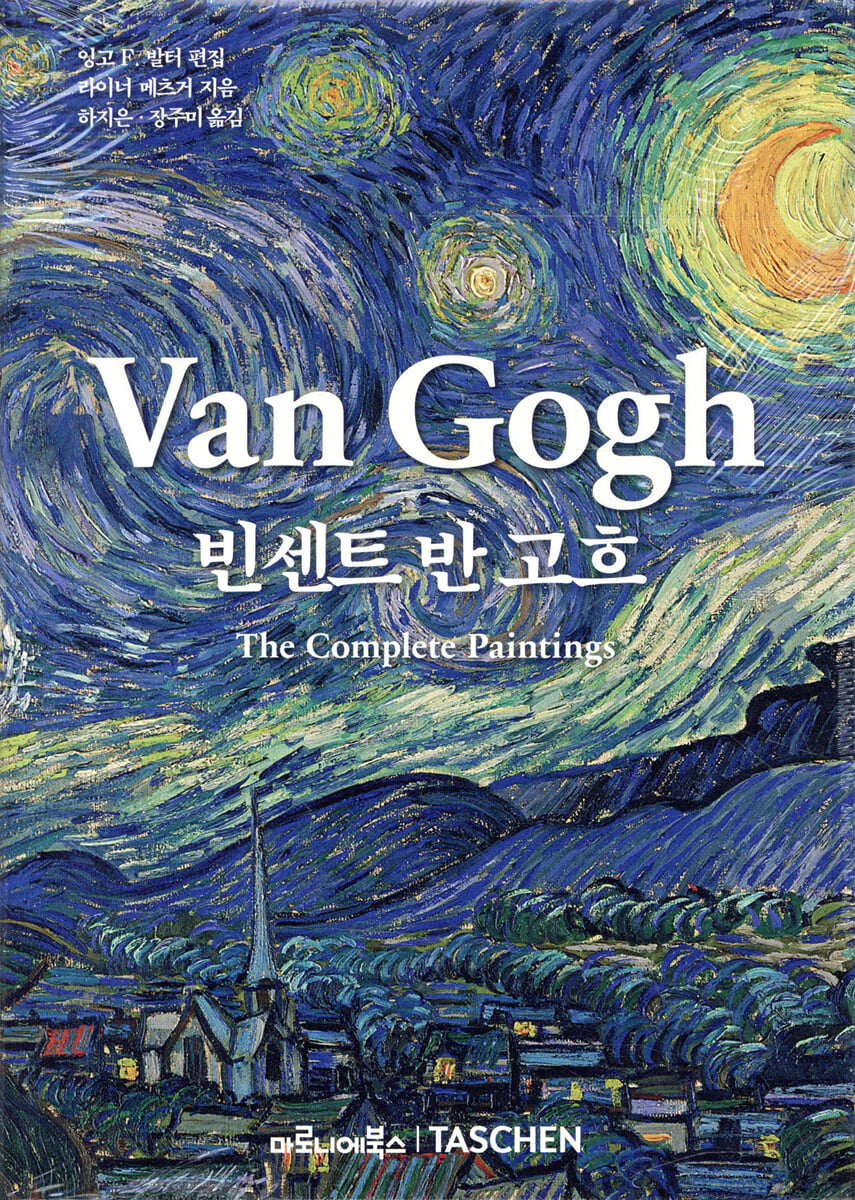
Book Introduction
A modern portrait realized in Vincent van Gogh's paintings,
Was Van Gogh an eternal stranger to his time?
Vincent van Gogh.
His paintings reflect the modern spirit of the 19th century, including the art, intellectual, scientific, and social atmosphere.
As a modern culture that has inherited and developed the modern era, Van Gogh's work, which contains the very foundation of the modern era, inevitably draws sympathy and support from us living in the modern era.
Van Gogh, who enjoyed both painting and books, frequently referred to and quoted in his letters the works and opinions of Thomas à Kempis, Jules Michelet, the Goncourt brothers, Émile Zola, and Eugène Delacroix.
These letters allow us to trace his ideological foundation and the values he pursued, and by adding the opinions of his contemporaries, including Nietzsche, the author provides a glimpse into the currents and thinking of his time.
Van Gogh was a Romantic who did not hide his awe for nature, a Realist who tried to portray subjects as they were, revealing the lives of farmers and weavers, an Impressionist who broke away from the conventions of the Academy to capture the subjective world and pursued total art, and a Symbolist who painted pictures whose meaning can only be guessed through personal clues as a person named Van Gogh.
The author persuasively explains the process of change in Van Gogh's thinking by looking at the 19th century in which he lived.
index
Entering
Abandoned person
Chapter 1: The Birth of a Painter 1853 to 1883
Family/Another art of Van Gogh/A man obsessed with religion/“Everything begins with God”/First steps as a painter/Van Gogh’s early models/Family life/Art and responsibility/No soul, no ego
Chapter 2: The Nuenen Period 1883 to 1885
A simple and pure painter/Growth/“With all my might”/Painting as a declaration/Understanding and doubt/Color and the finished work
Chapter 3: City Life 1885–1888
Antwerp Interlude/A Dutchman in Paris/Through the Window/Trends, Trends, Trends/The Far East Before Our Eyes/The Integration of Life and Art
Chapter 4: Paintings and Utopia, Arles, February 1888 to May 1889
Arles: The Heart of Japan / Personal Impressionism / Under the Southern Sun / Working Without Color / Pain and Ecstasy / Dreams of a Painters' Community / Aesthetic Delicacy / Genius and Error: Gauguin in Arles / Art and Madness / The Sustaining Power of Painting
Chapter 5 “The Cry of Fear” Saint-Rémy, May 1889–May 1890
Monastic Life/Olives, Cypress Trees, and Hills/Portraits/Space and Color/Exhibitions and Criticism/Self and Other/Methods of Escape/Respect and Awe
Chapter 6: The Last Auvers-sur-Oise, May 1890 to July 1890
In the Land of Dr. Gachet/Frieze Art/“I Wish It All Would Be Over Now”/Revolution in Art: Modernism
supplement
Vincent van Gogh Chronology 1853–1890/Bibliography/Plate Index/Biography/List of Classification Numbers
Detailed image

Into the book
“Just as a painting has color, life has passion.
In other words, it is a great thing to control it,” he said in Letter 443, speaking of his new interest in color.
Violent clashes of color, colorful stripes, and smears of paint straight from the tube all took over the role of motifs of the past.
In other words, it is to harmoniously combine the world as seen subjectively by the artist and the objective state of the phenomenon.
In the past, Van Gogh suggested a better life living in harmony with nature.
Now he took a step back from the diversity of nature and tried to show his own unique comprehensive interpretation on canvas.
--- p.213
Van Gogh experimented with new subjects.
The sunflower, a symbol of his most outstanding artistic self, was painted for the first time.
He placed a luminous yellow against a familiar blue background (compare the painting on the right), and expressed the seeds with short brushstrokes and marks of paint.
This borrowing of various trends does not leave us with the unpleasant aftertaste of imitation.
Van Gogh's vision through his stained-glass windows was dedicated and considerate.
The jagged petals, the severed stems, and the confident close-up depictions hint at a metaphor of threat, as well as a sense of solidarity with a life form that will soon wither and die.
--- p.280
He sent a letter to his brother.
“When I’m alone, I need intense work rather than companionship.
So I always order canvas and paints.
The only time I feel alive is when I'm working like crazy.
In society, this need would not have been fully recognized, or things would have been more complicated.
But if I can do it my way, I sometimes work to my heart's content, overcoming all limits, relying on the passion that overwhelms me.” (Letter 504) --- p.339
The relationship between the building and the colors of the Yellow House is exactly the same as the relationship between the motifs and colors in Van Gogh's paintings.
In his work, colors are applied to the real world, and subtle colors are applied to this building.
Van Gogh's world itself may be natural and simple, but his use of color gives his paintings a special, mysterious atmosphere and a utopian, sparkling light.
The Yellow House is a painting transformed into architecture.
The difference between the two is utility, and at this point the yellow house comes closer to the better life that van Gogh pursued in art.
Yellow is being applied systematically.
In other words, it is both a home paint and a message, an actual paint job applied to an actual building and an aesthetic statement.
--- p.392
The gloomy and gloomy environment of the monastery was perfect for heightening Van Gogh's emotions and making them more violent than before.
Saint-Rémy was a place cut off from the outside world.
Cut off from the excitement and excitement of life, he could concentrate entirely on himself and the psychological power he held in his hands.
Van Gogh tried to accept the situation through his paintings.
Without alcohol, cigarettes, contact with other people, or distractions, I was able to delve deeper into my life and art.
--- p.499
Publisher's Review
A modern portrait realized in Vincent van Gogh's paintings,
Was Van Gogh an eternal stranger to his time?
An artist whose name is more widely known than any other celebrity of any era.
How is it that a painter who has been dead for over a hundred years is so beloved by the public?
The reason why Van Gogh's paintings are popular is because of the 'modern' feel that emanates from his works themselves.
His paintings reflect the modern spirit of the 19th century, including the art, intellectual, scientific, and social atmosphere.
As a modern culture that has inherited and developed the modern era, Van Gogh's work, which contains the very foundation of modernity, inevitably elicits sympathy and support from us living in the modern era.
Van Gogh, who enjoyed both paintings and books, frequently referred to and quoted in his letters the works and opinions of Thomas à Kempis, Jules Michelet, the Goncourt brothers, Émile Zola, and Eugène Delacroix.
These letters allow us to trace his ideological foundation and the values he pursued, and by adding the opinions of his contemporaries, including Nietzsche, the author provides a glimpse into the currents and thinking of his time.
Van Gogh was a Romantic who did not hide his awe for nature, a Realist who tried to portray subjects as they were, revealing the lives of farmers and weavers, an Impressionist who broke away from the conventions of the Academy to capture the subjective world and pursued total art, and a Symbolist who painted pictures whose meaning can only be guessed through personal clues as a person named Van Gogh.
The author persuasively explains the process of change in Van Gogh's thinking by looking at the 19th century in which he lived.
In reality, Van Gogh was not an eccentric figure who appeared out of nowhere, but rather a person who embodied the changing times and expressed them in his paintings.
He highly regarded the French Revolution, sought to revive it in everyday life, and was swept up in the atmosphere of the 19th century, which was full of the exploration of nature.
At the same time, he was a paradoxical figure: born into a bourgeois family, he cherished the lives of peasants and workers, he was deeply religious, yet he did not become a religious painter, and he hoped that his existence would one day be recognized, yet he was reluctant to come forward.
He borrowed solidarity with the peasants from Millet, color contrast from Delacroix, native colors from Monticelli, and abstraction from Gauguin.
It is difficult to fully understand his work with the simple logic that he used bright colors because he went to the South.
He discovered far more native colors in the North, and with a clear understanding of native colors, not due to the Southern sun, he was able to show his own colors even in the bright South, where everything seemed the same.
Was it only recognition that he wanted from Gauguin, or was it because he was secretly in love with Gauguin's style that he wanted to be close to him?
Van Gogh was aware of the reality faced by contemporary artists, and because of that, he wanted to find a way to overcome that reality.
The yellow house was just that.
His somewhat exaggerated ideals glorified the Yellow House as a place of overly splendid futures, but his dream of a painters' community nonetheless led Gauguin to Arles and further sought solidarity with painters.
In addition to solidarity with artists, Japan cannot be left out.
For Van Gogh, Japan was not simply a decorative object, but the epitome of the utopia he dreamed of and pursued.
He wanted to live like Japanese painters, paint like them, interact like them, and share their values.
In fact, Japan has introduced various elements that characterize Van Gogh's paintings.
Meanwhile, Van Gogh humbly paid homage to the world of the great masters by imitating them, like Millet and Delacroix, just as a conductor recreates the scores of Wagner or Berlioz according to his own feeling.
To understand the artist Van Gogh
We need to understand Van Gogh as a person.
Vincent van Gogh lived a short life of thirty-seven, but he was called by many different names.
The maniac who cut off his own ear, the impressionist painter who admired Millet and Gauguin, the loner who exchanged over 600 letters with his brother, the artist who left behind numerous self-portraits and sunflower paintings, and the depressed patient who ultimately committed suicide - the artist's versatility is truly the epitome of an artist.
However, his life had too many ups and downs to be considered merely an artist who traveled.
If you truly want to understand the artist Vincent van Gogh, you need to understand the man who walked a lonely path.
Although this book does not include the view that van Gogh's suicide was actually murder, as has been recently introduced, it contains insightful analyses of van Gogh's birth, the moments of choice he faced, and the values he held dear.
Despite his deep faith, why did he abandon his path as a pastor? Why did he feel empathy and compassion for farmers and weavers? Why, among all the trends, was he captivated by Japanese woodblock prints? Why did he abandon his life in Paris, where he was just beginning to make a name for himself, and travel so far south? Why did he capture subjective colors in his paintings, rather than the natural tones of objects? Why did he make the extreme choice of cutting off his ear for a fight with Gauguin? Why did he voluntarily commit himself to a mental hospital? Why were so many self-portraits and copies of masters painted in a mental hospital? Why, of all the doctors, did he turn to Dr. Gachet? Why, as the contemporary art world focused on his work and predicted his success, did he struggle to distance himself from the spotlight? Are the crows in his posthumous work, "Wheatfield with Crows," truly a somber symbol for suicide? Why is Vincent, Van Gogh's nephew and Theo's son, mentioned as the circumstances that led to his suicide? The author explores Van Gogh's life and art, leaving readers room to ponder these questions and make their own judgments.
It also introduces critiques that were actually discussed in academic circles, carefully guiding even those who are not part of the art world to examine the controversies surrounding Van Gogh and the conclusions reached.
From 871 plates and photographs of the Van Gogh family
Vincent van Gogh's chronology, including a list of classification numbers by de Rapaille and Jan Hülsker.
Author Rainer Metzger and editor Ingo F.
Walter has included 871 paintings close to Van Gogh's entire oeuvre in color plates rather than black and white, thereby providing visual enjoyment and completeness to the book.
The credibility of the critique is enhanced by introducing letters sent to his brother Theo, his mother, his sister Wilhelmina, and his friends Raffart and Bernard in a contextually appropriate manner. In the appendix, portraits of the Van Gogh family and photographs of Van Gogh's last traces are included, and a more concise chronological table format is provided to enable readers to grasp his life at a glance.
The references, plate index, and biographical index introduced in the text allow readers to review the text at any time. Furthermore, the book includes a list of classification numbers by de Rapaille, who first classified van Gogh's works, and Jan Hülsker, who again classified the works in his own way, thereby striving to provide a valuable resource for van Gogh research.
Filled with a vast array of Van Gogh's works and a comprehensive review of his life and art, this compact hardcover volume offers a glimpse into the world of Vincent van Gogh, allowing you to dive into his life at any time.
GOODS SPECIFICS
- Date of issue: August 15, 2018
- Format: Hardcover book binding method guide
- Page count, weight, size: 744 pages | 1,290g | 140*195*40mm
- ISBN13: 9788960535541
- ISBN10: 8960535540
You may also like
카테고리
korean


korean


