

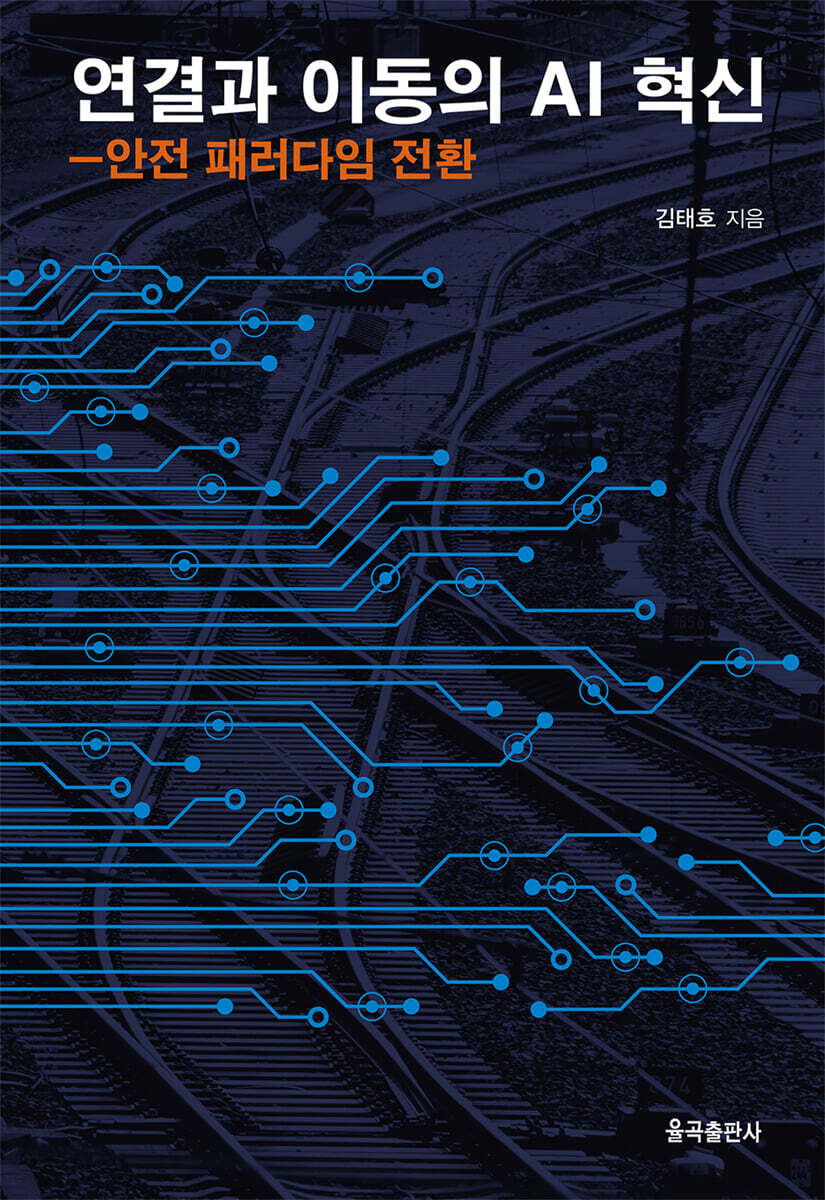
AI Innovation in Connectivity and Mobility
 |
Description
Book Introduction
The various AICT application cases in urban railways explored in this book are not limited to railways. AICT can be used to build digital firewalls in the same way in any industry, including construction, manufacturing, logistics, and energy.
Analyzing actual industrial accident cases reveals that the logic of multi-layer safety nets, proven in railways, can be applied to other industrial sites.
If we view safety not as a cost but as an investment in protecting lives, AI and ICT will become powerful tools for elevating the safety level of all industries.
But technology alone cannot bring about complete change.
No matter how sophisticated a system is, if people do not accept it, it is nothing more than a decoration.
That's why change management is important.
A new culture can only take root when leaders learn first, the field participates together, and small successes are repeated.
Ultimately, operational innovation is a process that people and organizations create together.
This book, based on firsthand experience in the communications and railway sectors, documents the journey of digitizing multi-layered firewalls with safety as the top priority and establishing it as an operational culture.
Through this book, readers will discover that “AI and ICT are not simply technologies, but new firewalls that make our lives safer and more convenient.”
“I hope this book will serve as a small guide for students and researchers who are thinking about railway operation, officials who are thinking about policy, and everyone who dreams of a better city.” - From the author’s words
Analyzing actual industrial accident cases reveals that the logic of multi-layer safety nets, proven in railways, can be applied to other industrial sites.
If we view safety not as a cost but as an investment in protecting lives, AI and ICT will become powerful tools for elevating the safety level of all industries.
But technology alone cannot bring about complete change.
No matter how sophisticated a system is, if people do not accept it, it is nothing more than a decoration.
That's why change management is important.
A new culture can only take root when leaders learn first, the field participates together, and small successes are repeated.
Ultimately, operational innovation is a process that people and organizations create together.
This book, based on firsthand experience in the communications and railway sectors, documents the journey of digitizing multi-layered firewalls with safety as the top priority and establishing it as an operational culture.
Through this book, readers will discover that “AI and ICT are not simply technologies, but new firewalls that make our lives safer and more convenient.”
“I hope this book will serve as a small guide for students and researchers who are thinking about railway operation, officials who are thinking about policy, and everyone who dreams of a better city.” - From the author’s words
index
CHAPTER 01 Smart Safety Paradigm
1.
The foundation of an organization built on trust
2.
A five-layer safety barrier born from crisis
3.
A Challenge to a World Without Human Error
4.
A life-saving firewall: A task that must be expanded across all industries.
5. AICT's Digital Firewall
CHAPTER 02 AICT's Smart Urban Railway
1.
How far has AICT progressed in Korea's urban railways?
2.
Platforms and tracks, protected by AI
3.
Railroads predict failures, intelligence manages assets
4.
Algorithms that read demand and manage congestion
5.
A breathing urban railway, optimizing energy and the environment.
6.
AI Watchdog: Tickets in Numbers, Fare Order
7.
Transforming the Passenger Experience: New Services Created by AI
8.
The secret of car manufacturers: artificial intelligence installed in electric vehicles.
9.
The Era of Fully Autonomous Driving: The Convergence of Control and AI
10. AI-powered rail tracks: innovations in inspection and maintenance.
11.
Health checkup of running electric trains
12.
The Heart of the Railway: The Birth of a Digital Depot
CHAPTER 03 AICT Change Management and Talent Innovation
1.
People and organizations are more important than technology
2.
Leaders learn, and the field practices.
3.
The global competition to cultivate digital railway talent
4.
From small successes to organizational routines
1.
The foundation of an organization built on trust
2.
A five-layer safety barrier born from crisis
3.
A Challenge to a World Without Human Error
4.
A life-saving firewall: A task that must be expanded across all industries.
5. AICT's Digital Firewall
CHAPTER 02 AICT's Smart Urban Railway
1.
How far has AICT progressed in Korea's urban railways?
2.
Platforms and tracks, protected by AI
3.
Railroads predict failures, intelligence manages assets
4.
Algorithms that read demand and manage congestion
5.
A breathing urban railway, optimizing energy and the environment.
6.
AI Watchdog: Tickets in Numbers, Fare Order
7.
Transforming the Passenger Experience: New Services Created by AI
8.
The secret of car manufacturers: artificial intelligence installed in electric vehicles.
9.
The Era of Fully Autonomous Driving: The Convergence of Control and AI
10. AI-powered rail tracks: innovations in inspection and maintenance.
11.
Health checkup of running electric trains
12.
The Heart of the Railway: The Birth of a Digital Depot
CHAPTER 03 AICT Change Management and Talent Innovation
1.
People and organizations are more important than technology
2.
Leaders learn, and the field practices.
3.
The global competition to cultivate digital railway talent
4.
From small successes to organizational routines
Publisher's Review
Having worked in the telecommunications and urban rail sectors for a long time, I have seen firsthand how technology can transform people's safety and convenience.
What we realized in the process was the simple but essential truth that safety is the starting point of all operations.
No matter how many new technologies are introduced, if the foundation of safety collapses, everything becomes meaningless in an instant.
So, the first thing I want to emphasize while writing this book is safety.
Our society still carries the ignominious label of being the 'world's worst industrial accident kingdom.'
Small mistakes lead to major accidents, and countermeasures are only taken after a crisis occurs.
It is now clear that waiting for an accident and then responding has its limitations.
Only by anticipating risks and preparing for them in layers can we avoid repeating the same tragedy.
This idea of multi-layered preparedness actually originates from the High Reliability Organization (HRO).
In fields like aviation and nuclear power, where even a single failure can be fatal, HROs have built a multi-layered safety barrier that systematically absorbs even small mistakes.
Seoul Metro creatively developed this concept and created a system called the 'Safety Five-Layer Protective Wall.'
We have built a five-layer safety net, including facilities and equipment, procedures and regulations, human training and culture, organization and systems, and cooperation with external parties.
This system has significantly reduced human error in real-world settings, demonstrating a way to complement the harsh reality that "people can make mistakes at any time" with technology and organizational culture.
However, today's railway operating environment is incomparably more complex than in the past.
Simply observing human precautions and procedures cannot prevent all risks.
So what we need is a digital five-layer firewall.
Detect risks through sensors, cameras, and wearable devices, and collect data in real time through ultra-low latency networks.
Artificial intelligence analyzes the data to detect abnormalities, and control systems and devices automatically respond.
Finally, all processes are recorded and verified to help organizations learn and make better decisions.
This safety net, created by layering digital technologies, is the digital five-layer firewall.
I am convinced that AICT (Artificial Intelligence & Communication Technology) will soon play the role of this digital firewall in urban railway operation.
On the platform, artificial intelligence monitors passengers' movements to prevent safety accidents, and on the tracks, drones and robots perform inspections.
The train diagnoses its own health while running, and the control system automatically analyzes the information to make the safest decision.
During peak hours, it disperses crowds and optimizes energy use to create a comfortable environment.
The various AICT application cases in urban railways explored in this book are not limited to railways. AICT can be used to build digital firewalls in the same way in any industry, including construction, manufacturing, logistics, and energy.
Analyzing actual industrial accident cases reveals that the logic of multi-layer safety nets, proven in railways, can be applied to other industrial sites.
If we view safety not as a cost but as an investment in protecting lives, AI and ICT will become powerful tools for elevating the safety level of all industries.
But technology alone cannot bring about complete change.
No matter how sophisticated a system is, if people do not accept it, it is nothing more than a decoration.
That's why change management is important.
A new culture can only take root when leaders learn first, the field participates together, and small successes are repeated.
Ultimately, operational innovation is a process that people and organizations create together.
This book, based on firsthand experience in the communications and railway sectors, documents the journey of digitizing multi-layered firewalls with safety as the top priority and establishing it as an operational culture.
Through this book, readers will discover that “AI and ICT are not simply technologies, but new firewalls that make our lives safer and more convenient.”
I hope this book will serve as a small guide for students and researchers contemplating railway operation, officials considering policy, and everyone dreaming of a better city.
Finally, I would like to express my deepest gratitude to all my colleagues who have worked hard and shared their wisdom with me on the path to creating a safe and smart Seoul Metro.
In particular, Kwon Ji-won, Kim Seok-tae, Kim Seong-wan, Noh Gap-jin, Oh Jae-gang, Shim Jae-chang, Jeong Il-bong, and Han Jae-hyeon, who led the innovation that implemented the Smart Connected Metro together, are still actively working in their respective fields of expertise, but their dedication and passion from the time we spent together still resonate deeply in my heart.
I would like to take this opportunity to express my deepest gratitude to Mr. Jong-Seok Kim, who shared his thoughts on safety and HRO with me and helped me implement it; to Mr. Gwan-Oh Kim, who spared no effort in providing meticulous advice on the content and format of the book; and to the countless employees of Seoul Metro who provided invaluable assistance in various fields.
I also express my gratitude and love to my family for their continuous support and encouragement until my thesis was published as a book.
October 2025
Kim Tae-ho
What we realized in the process was the simple but essential truth that safety is the starting point of all operations.
No matter how many new technologies are introduced, if the foundation of safety collapses, everything becomes meaningless in an instant.
So, the first thing I want to emphasize while writing this book is safety.
Our society still carries the ignominious label of being the 'world's worst industrial accident kingdom.'
Small mistakes lead to major accidents, and countermeasures are only taken after a crisis occurs.
It is now clear that waiting for an accident and then responding has its limitations.
Only by anticipating risks and preparing for them in layers can we avoid repeating the same tragedy.
This idea of multi-layered preparedness actually originates from the High Reliability Organization (HRO).
In fields like aviation and nuclear power, where even a single failure can be fatal, HROs have built a multi-layered safety barrier that systematically absorbs even small mistakes.
Seoul Metro creatively developed this concept and created a system called the 'Safety Five-Layer Protective Wall.'
We have built a five-layer safety net, including facilities and equipment, procedures and regulations, human training and culture, organization and systems, and cooperation with external parties.
This system has significantly reduced human error in real-world settings, demonstrating a way to complement the harsh reality that "people can make mistakes at any time" with technology and organizational culture.
However, today's railway operating environment is incomparably more complex than in the past.
Simply observing human precautions and procedures cannot prevent all risks.
So what we need is a digital five-layer firewall.
Detect risks through sensors, cameras, and wearable devices, and collect data in real time through ultra-low latency networks.
Artificial intelligence analyzes the data to detect abnormalities, and control systems and devices automatically respond.
Finally, all processes are recorded and verified to help organizations learn and make better decisions.
This safety net, created by layering digital technologies, is the digital five-layer firewall.
I am convinced that AICT (Artificial Intelligence & Communication Technology) will soon play the role of this digital firewall in urban railway operation.
On the platform, artificial intelligence monitors passengers' movements to prevent safety accidents, and on the tracks, drones and robots perform inspections.
The train diagnoses its own health while running, and the control system automatically analyzes the information to make the safest decision.
During peak hours, it disperses crowds and optimizes energy use to create a comfortable environment.
The various AICT application cases in urban railways explored in this book are not limited to railways. AICT can be used to build digital firewalls in the same way in any industry, including construction, manufacturing, logistics, and energy.
Analyzing actual industrial accident cases reveals that the logic of multi-layer safety nets, proven in railways, can be applied to other industrial sites.
If we view safety not as a cost but as an investment in protecting lives, AI and ICT will become powerful tools for elevating the safety level of all industries.
But technology alone cannot bring about complete change.
No matter how sophisticated a system is, if people do not accept it, it is nothing more than a decoration.
That's why change management is important.
A new culture can only take root when leaders learn first, the field participates together, and small successes are repeated.
Ultimately, operational innovation is a process that people and organizations create together.
This book, based on firsthand experience in the communications and railway sectors, documents the journey of digitizing multi-layered firewalls with safety as the top priority and establishing it as an operational culture.
Through this book, readers will discover that “AI and ICT are not simply technologies, but new firewalls that make our lives safer and more convenient.”
I hope this book will serve as a small guide for students and researchers contemplating railway operation, officials considering policy, and everyone dreaming of a better city.
Finally, I would like to express my deepest gratitude to all my colleagues who have worked hard and shared their wisdom with me on the path to creating a safe and smart Seoul Metro.
In particular, Kwon Ji-won, Kim Seok-tae, Kim Seong-wan, Noh Gap-jin, Oh Jae-gang, Shim Jae-chang, Jeong Il-bong, and Han Jae-hyeon, who led the innovation that implemented the Smart Connected Metro together, are still actively working in their respective fields of expertise, but their dedication and passion from the time we spent together still resonate deeply in my heart.
I would like to take this opportunity to express my deepest gratitude to Mr. Jong-Seok Kim, who shared his thoughts on safety and HRO with me and helped me implement it; to Mr. Gwan-Oh Kim, who spared no effort in providing meticulous advice on the content and format of the book; and to the countless employees of Seoul Metro who provided invaluable assistance in various fields.
I also express my gratitude and love to my family for their continuous support and encouragement until my thesis was published as a book.
October 2025
Kim Tae-ho
GOODS SPECIFICS
- Date of issue: October 25, 2025
- Format: Hardcover book binding method guide
- Page count, weight, size: 224 pages | 152*225*15mm
- ISBN13: 9791194359340
You may also like
카테고리
korean


korean

![ELLE 엘르 스페셜 에디션 A형 : 12월 [2025]](http://librairie.coreenne.fr/cdn/shop/files/b8e27a3de6c9538896439686c6b0e8fb.jpg?v=1766436872&width=3840)


