

The Prince
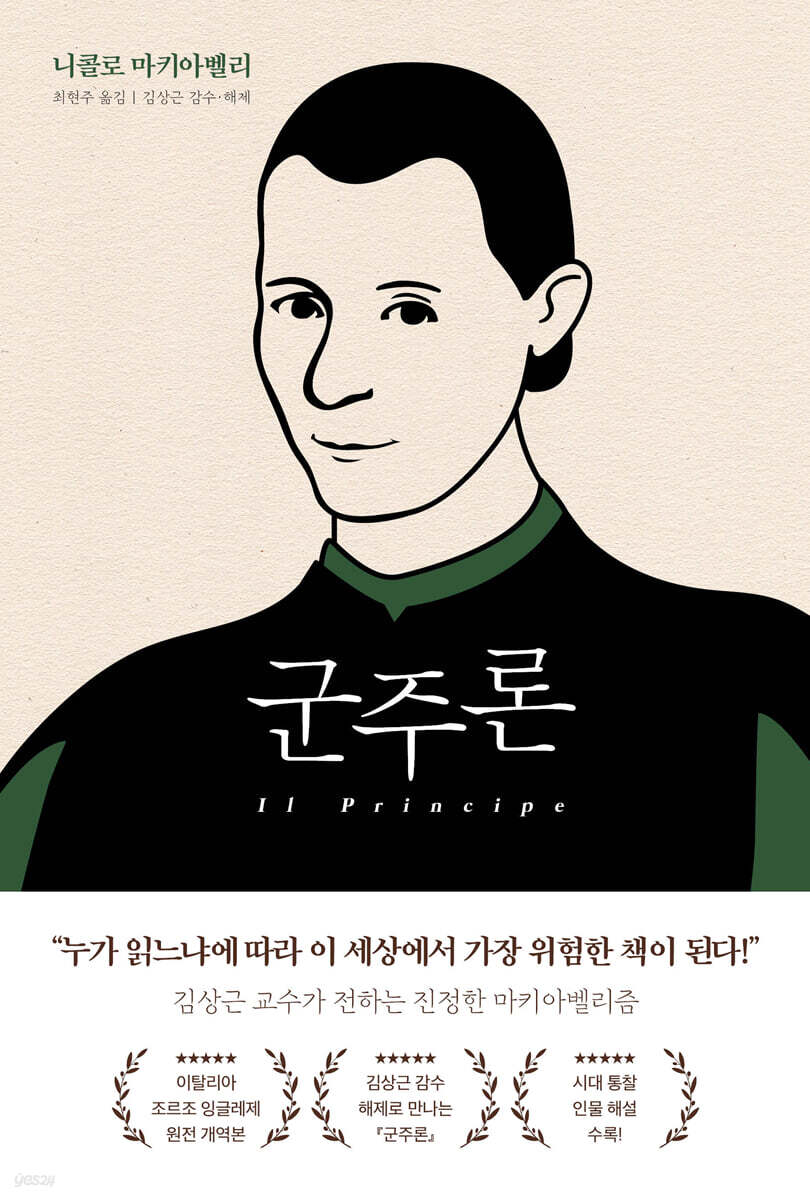 |
Description
Book Introduction
“A political science textbook written 500 years ago
Speaking of the qualities of a true leader in the 21st century
Why has the Vatican's forbidden book become today's political science textbook?
Explore the most complete classic that established the 'principles of leadership'!
The Prince, known as the "Devil's Book" banned by the Vatican and the "Dictator's Manual" loved by Hitler and Mussolini.
However, Rousseau praised it as a 'textbook for republicans', and Francis Bacon was generous in his praise, saying, 'I am greatly indebted to Machiavelli for revealing without concealment what men are doing.'
Why is this book, written 500 years ago, so controversial, and why should we, living in the 21st century, read it?
Professor Kim Sang-geun, who supervised and commented on this book, recommends that anyone living in a time of turmoil in modern times read The Prince.
16th-century Italy, a time of chaos and mayhem, was a time when the Pope had wives and children and concubines, monarchs fought not against their enemies but against the syphilis bacillus, and abbots stopped praying and took to the front lines of politics.
This is because, in an era when the distinction between orthodoxy and falsehood was impossible, when five great powers clashed and winners and losers changed overnight, The Prince is a book that presents realistic conduct and methods for a leader who must take responsibility for the fate of the community.
Although 『The Prince』 has already been published in various translations, we have put great care into the composition and editing of this book to properly convey its essence to readers.
In order to properly unravel the gaps between the lines of Machiavelli, who was an excellent writer, we provide annotations (Chapters 1-26, 150 pages) for each chapter by Professor Sang-geun Kim of Yonsei University's College of Theology, who wrote a biography of Machiavelli. In order to increase the reliability of the translation, we used The Prince (2013 expanded edition) edited by Giorgio Inglese, a professor of medieval and Renaissance Italian literature at the University of La Sapienza in Rome, as the basis, and compared and contrasted it with the English version by Professor Harvey Mansfield of Harvard University and the translation by Professor Cha-seop Kwak of Pusan National University to ensure that the context and meaning of the original book were not damaged.
In particular, it includes a character commentary to increase understanding of Machiavelli, the author of 『The Prince』 (38 pages) and a work commentary that looks back on the background and meaning of the writing of this book (9 pages) to increase reading interest and readability.
Speaking of the qualities of a true leader in the 21st century
Why has the Vatican's forbidden book become today's political science textbook?
Explore the most complete classic that established the 'principles of leadership'!
The Prince, known as the "Devil's Book" banned by the Vatican and the "Dictator's Manual" loved by Hitler and Mussolini.
However, Rousseau praised it as a 'textbook for republicans', and Francis Bacon was generous in his praise, saying, 'I am greatly indebted to Machiavelli for revealing without concealment what men are doing.'
Why is this book, written 500 years ago, so controversial, and why should we, living in the 21st century, read it?
Professor Kim Sang-geun, who supervised and commented on this book, recommends that anyone living in a time of turmoil in modern times read The Prince.
16th-century Italy, a time of chaos and mayhem, was a time when the Pope had wives and children and concubines, monarchs fought not against their enemies but against the syphilis bacillus, and abbots stopped praying and took to the front lines of politics.
This is because, in an era when the distinction between orthodoxy and falsehood was impossible, when five great powers clashed and winners and losers changed overnight, The Prince is a book that presents realistic conduct and methods for a leader who must take responsibility for the fate of the community.
Although 『The Prince』 has already been published in various translations, we have put great care into the composition and editing of this book to properly convey its essence to readers.
In order to properly unravel the gaps between the lines of Machiavelli, who was an excellent writer, we provide annotations (Chapters 1-26, 150 pages) for each chapter by Professor Sang-geun Kim of Yonsei University's College of Theology, who wrote a biography of Machiavelli. In order to increase the reliability of the translation, we used The Prince (2013 expanded edition) edited by Giorgio Inglese, a professor of medieval and Renaissance Italian literature at the University of La Sapienza in Rome, as the basis, and compared and contrasted it with the English version by Professor Harvey Mansfield of Harvard University and the translation by Professor Cha-seop Kwak of Pusan National University to ensure that the context and meaning of the original book were not damaged.
In particular, it includes a character commentary to increase understanding of Machiavelli, the author of 『The Prince』 (38 pages) and a work commentary that looks back on the background and meaning of the writing of this book (9 pages) to increase reading interest and readability.
- You can preview some of the book's contents.
Preview
index
- To the reader holding this book in his hands
- On the edition and translation of The Prince
- A dedication by Niccolo Machiavelli to the "Great" Lorenzo de' Medici
Chapter 1. Of the Kinds of Principalities, and the Methods of Obtaining Them
Chapter 2: On Hereditary Monarchy
Chapter 3: On Mixed Monarchies
Chapter 4: Why Darius's Successors Did Not Revolt After the Death of Alexander the Great
Chapter 5: On the method of governing cities or principalities which lived under their own laws before being conquered.
Chapter 6: On the Rule of a New Principality Acquired by One's Own Force and Ability
Chapter 7. Of the government of new principalities acquired by the power of others or by good fortune.
Chapter 8: Concerning those who ascended to the throne through wicked deeds
Chapter 9: On Civil Principalities
Chapter 10: On the Method of Assessing the Strength of Each Principality
Chapter 11: On Ecclesiastical Monarchy
Chapter 12: On the Different Types of Armies and Mercenary Units
Chapter 13: On Support Forces, Mixed Forces, and Domestic Forces
Chapter 14: How Should a Prince View the Art of War?
Chapter 15: On the things that make a prince praised or blamed
Chapter 16: On Generosity and Stinginess
Chapter 17: On Cruelty and Kindness: Should a Prince Be Feared or Beloved?
Chapter 18: On the Meaning of a Prince Keeping His Promises
Chapter 19: How to Avoid Contempt and Hatred
Chapter 20: Is it useful or harmful for a prince to do various things, such as build castles?
Chapter 21: How a Prince Should Act to Be Respected
Chapter 22: On the Monarch's Subjects
Chapter 23: How to Avoid Flatterers
Chapter 24: Why the Italian Monarchs Lost Their Kingdoms
Chapter 25: On the Role of the Lady of Fortune in Human Affairs and How to Deal with It
Chapter 26: A Word of Exhortation to Drive Out the Barbarians from Italy and Restore Liberty
Appendix
1.
clear
2.
What kind of book is The Prince?
3.
Who is Machiavelli?
- On the edition and translation of The Prince
- A dedication by Niccolo Machiavelli to the "Great" Lorenzo de' Medici
Chapter 1. Of the Kinds of Principalities, and the Methods of Obtaining Them
Chapter 2: On Hereditary Monarchy
Chapter 3: On Mixed Monarchies
Chapter 4: Why Darius's Successors Did Not Revolt After the Death of Alexander the Great
Chapter 5: On the method of governing cities or principalities which lived under their own laws before being conquered.
Chapter 6: On the Rule of a New Principality Acquired by One's Own Force and Ability
Chapter 7. Of the government of new principalities acquired by the power of others or by good fortune.
Chapter 8: Concerning those who ascended to the throne through wicked deeds
Chapter 9: On Civil Principalities
Chapter 10: On the Method of Assessing the Strength of Each Principality
Chapter 11: On Ecclesiastical Monarchy
Chapter 12: On the Different Types of Armies and Mercenary Units
Chapter 13: On Support Forces, Mixed Forces, and Domestic Forces
Chapter 14: How Should a Prince View the Art of War?
Chapter 15: On the things that make a prince praised or blamed
Chapter 16: On Generosity and Stinginess
Chapter 17: On Cruelty and Kindness: Should a Prince Be Feared or Beloved?
Chapter 18: On the Meaning of a Prince Keeping His Promises
Chapter 19: How to Avoid Contempt and Hatred
Chapter 20: Is it useful or harmful for a prince to do various things, such as build castles?
Chapter 21: How a Prince Should Act to Be Respected
Chapter 22: On the Monarch's Subjects
Chapter 23: How to Avoid Flatterers
Chapter 24: Why the Italian Monarchs Lost Their Kingdoms
Chapter 25: On the Role of the Lady of Fortune in Human Affairs and How to Deal with It
Chapter 26: A Word of Exhortation to Drive Out the Barbarians from Italy and Restore Liberty
Appendix
1.
clear
2.
What kind of book is The Prince?
3.
Who is Machiavelli?
Detailed image
.jpg)
Into the book
This is not a book, it's a bomb.
No one can predict when it will explode, where the debris will fly, or how much damage it will cause.
Machiavelli was a mysterious figure.
Those who read Machiavelli's political reports were impressed by his keen insight and praised him as a "prophet" of the Old Testament, while others, not fully understanding the hidden intentions between the lines, called him a "bizzaro."
He was a truly elusive character.
He was a man of immeasurable imagination, a bureaucrat who freely moved between truth and reality, and a historian who, across time and space, discerned the errors of his time.
That is why 『The Prince』, which he wrote with determination, is a dangerous book.
There are traps hidden everywhere, and there are many sentences that lead you into clever traps.
The Prince is a time bomb that could explode at any time, in any way, or on any scale.
--- From "To the Readers Who Hold This Book"
Doctors say that although it is difficult to diagnose lung disease in the early stages, it is easy to treat once it is discovered. Conversely, when lung disease reaches its final stages, it is easy to detect but difficult to treat.
The same goes for state affairs.
If the evils that arise in a country are recognized early, they can be easily corrected, but this is something that can only be done by a prudent person.
Initially, no one notices the problem, but by the time it becomes obvious to everyone, there is no solution.
--- 「Chapter 3.
From “On Mixed Monarchies”
Humans always tend to follow the paths of others and imitate the paths they have lived.
However, it is impossible to follow exactly the same path as another person or to possess the excellence of the person you are trying to imitate.
Therefore, a wise man should follow the example of great men and imitate the best.
This is because, even if you cannot reach the same level of excellence as them, you can still give off a similar fragrance.
We must act as thoughtful archers do, knowing well the reach of their bows and recognizing that their targets are farther away.
They aim their arrows much higher than their target, not to hit that high spot, but to aim high and achieve what they intended.
--- Chapter 6.
From “On the Rule of a New Monarchy Acquired by One’s Own Force and Ability”
He who seizes a state must remember that he must examine all the unlawful acts which he must inevitably commit when he takes control of the state, and then execute them all at once.
You have to stabilize people and bring them to your side by giving them benefits so that you don't have to do this every day.
Anyone who does not do this out of fear or bad advice will never be able to put down the sword.
Moreover, if new damages continue to arise and the subjects are not safe from the monarch, the monarch cannot make the subjects his [political] base.
Therefore, all damage should be inflicted at once so that it is less bitter and less infuriating.
On the contrary, the benefits should be given little by little to make them more enjoyable.
And above all, a monarch must live with his subjects and remain constant, no matter what happens, whether good or bad.
Because in times of adversity there is no time to commit necessary evil, and doing good then is of no use.
And because you know you had to do it, no one will thank you.
--- Chapter 8.
From “On those who ascended to the throne through evil deeds”
In times of crisis, there is no time for a monarch to seize absolute power.
Because citizens and subjects, accustomed to taking orders from high officials, are not prepared to take orders from their monarch in times of crisis.
And in uncertain times, there will always be a shortage of people you can trust.
A monarch should not be satisfied with the phenomenon that occurs in times of peace, that is, when the citizens are satisfied with the state.
In times of peace, citizens come running voluntarily, and everyone promises [loyalty].
It is said that when death is far away, everyone is ready to die for their monarch.
But when real trouble comes, when the nation needs its citizens, almost all such people disappear.
Trying this is a very risky thing to do, as you can only do it once.
Therefore, a wise ruler must devise a way to make the citizens need the state and the ruler in any situation.
Then they will always be loyal
--- Chapter 9.
From “On Civil Monarchy”
As for the training of the mind, a ruler should read history and ponder the deeds of outstanding figures.
We must examine how they conducted themselves during the war, analyze the causes of their victories and defeats, and avoid the latter while emulating the former.
And above all, among the outstanding figures, we must find those who lived before us and who were praised and glorified, and take them as our examples to imitate.
As people say that Alexander the Great imitated Achilles, Caesar imitated Alexander, and Scipio imitated Cyrus, they always kept the achievements and deeds of past figures close at hand.
A wise ruler should never spend a time of peace in idleness by following this method.
We must cultivate our abilities with passion, make them our own, and be able to benefit from them in times of adversity.
Then, when your luck changes, you will know that you are ready to face it.
--- Chapter 14.
From “How Should a Monarch View the Art of War?”
A prince should be feared, but if he cannot be loved, he must avoid being hated.
Because being feared and not being hated go together very well.
If you only watch out for the property of citizens and subjects, and their women, you will never be hated.
And if there is something that requires action, even at the cost of seeing another person's blood, it should be done only when there is proper justification and clear reason.
But above all, we must refrain from taking away other people's property.
Because people forget the death of their father more quickly than the loss of their inheritance.
There is never a shortage of reasons to rob property.
Therefore, a person who begins to live by plunder will always find a reason to take other people's property.
But on the contrary, there are fewer reasons to bleed and they disappear more quickly.
--- Chapter 17.
From “On Cruelty and Kindness”
There are three types of judgment (cervelli):
One type is the self-awakening type.
The other type is the one who recognizes what others have realized.
The third category are those who do not realize [anything], either by themselves or through others.
The first one is the best, the second one is good, and the third one is useless.
Therefore, if Pandolfo was not of the first category, he must have belonged [at least] to the second category.
For if, even if he has not realized anything himself, he can discern good and bad in every action and word of anyone, he will notice the good and bad deeds of his subjects, and will exalt the former and correct the latter.
And the subject will not think of deceiving him and will act well.
--- 「Chapter 22.
From “On the King’s Subjects”
There is a tendency in our time for monarchs to blame luck for losing their principalities after ruling them for many years.
[But this] was due to their laziness.
It is a common human failing to fear the storm when the wind is calm, and they never consider that change can come in calm times.
Then, when adversity struck, they did not think of defending themselves, but only thought of running away.
And then later, he hoped that the common people would become dissatisfied with the winner's arrogance and call him back.
This may be a good option when there are no other options, but in reality, holding off on other solutions for this is a very bad choice.
Because you should never fall down believing that someone else will catch you.
Whether someone catches you or not, you are not safe.
Because such a contrast would lead to disastrous results, and you are not relying on your own strength.
A good defense, a solid defense, a sustainable defense is achieved only when you rely solely on yourself and your excellence.
--- Chapter 24.
From "Why the Italian Monarchs Lost Their Kingdoms"
Machiavelli briefly mentions the republic in the first sentence of Chapter 1, but does not develop a detailed discussion of it.
Because the subject of The Prince is monarchy, not republic.
In the first sentence of the next two chapters, Machiavelli states, “I will omit the discussion of the Republic, as it has already been discussed in detail on another occasion,” once again clarifying that the theme of The Prince is not a republic.
Machiavelli breaks with Western tradition by focusing on the 'methods of acquiring' monarchy.
What kind of person ascends to the throne and leads a "new monarchy"? How did he achieve this position? Did his power and ability make him a monarch? Or did he gain the support of others, or was it simply luck? This short chapter, while seemingly simple, conceals a profound provocation.
--- 「Appendix 1.
From "Chapter 1 of the Release"
The purpose and circumstances that led Machiavelli to write The Prince can be confirmed through 19 letters exchanged with his friend Francesco Vettori, who was in Rome at the time.
Correspondence between the two men remained quiet between August and November 1513, but in a letter dated December 10, important information that can help us understand the motives and process of writing The Prince is mentioned.
In this letter, Machiavelli first recorded that he had written a small book titled “On Princes.”
Therefore, it is presumed that the content of 『The Prince』 that Machiavelli intended was not to teach the virtues of a monarch who would lead a troubled era like today, but rather to discuss the identity of a monarchy.
Afterwards, Machiavelli changed the name of his book to Il principe, and when the book was published posthumously as a single volume, it was given a new title.
--- 「Appendix 2.
From "What Kind of Book is The Prince?"
The Prince should be read while pounding the table with your fist.
The reason is that Machiavelli wrote it while hitting the desk.
If you understand Machiavelli's motivations for writing, you will understand why he wrote it with such anger, sighs, and pounding his fists on the table.
Every writer writes within the context of the times in which he or she lives, and Machiavelli's The Prince is one of them.
This is especially true because it is closely related to life itself.
In his dedication, he wrote that he would offer insights gained through “my experience with recent events.”
Therefore, to understand The Prince, we must understand Machiavelli's life, especially his public service experience from 1498 to 1512.
No one can predict when it will explode, where the debris will fly, or how much damage it will cause.
Machiavelli was a mysterious figure.
Those who read Machiavelli's political reports were impressed by his keen insight and praised him as a "prophet" of the Old Testament, while others, not fully understanding the hidden intentions between the lines, called him a "bizzaro."
He was a truly elusive character.
He was a man of immeasurable imagination, a bureaucrat who freely moved between truth and reality, and a historian who, across time and space, discerned the errors of his time.
That is why 『The Prince』, which he wrote with determination, is a dangerous book.
There are traps hidden everywhere, and there are many sentences that lead you into clever traps.
The Prince is a time bomb that could explode at any time, in any way, or on any scale.
--- From "To the Readers Who Hold This Book"
Doctors say that although it is difficult to diagnose lung disease in the early stages, it is easy to treat once it is discovered. Conversely, when lung disease reaches its final stages, it is easy to detect but difficult to treat.
The same goes for state affairs.
If the evils that arise in a country are recognized early, they can be easily corrected, but this is something that can only be done by a prudent person.
Initially, no one notices the problem, but by the time it becomes obvious to everyone, there is no solution.
--- 「Chapter 3.
From “On Mixed Monarchies”
Humans always tend to follow the paths of others and imitate the paths they have lived.
However, it is impossible to follow exactly the same path as another person or to possess the excellence of the person you are trying to imitate.
Therefore, a wise man should follow the example of great men and imitate the best.
This is because, even if you cannot reach the same level of excellence as them, you can still give off a similar fragrance.
We must act as thoughtful archers do, knowing well the reach of their bows and recognizing that their targets are farther away.
They aim their arrows much higher than their target, not to hit that high spot, but to aim high and achieve what they intended.
--- Chapter 6.
From “On the Rule of a New Monarchy Acquired by One’s Own Force and Ability”
He who seizes a state must remember that he must examine all the unlawful acts which he must inevitably commit when he takes control of the state, and then execute them all at once.
You have to stabilize people and bring them to your side by giving them benefits so that you don't have to do this every day.
Anyone who does not do this out of fear or bad advice will never be able to put down the sword.
Moreover, if new damages continue to arise and the subjects are not safe from the monarch, the monarch cannot make the subjects his [political] base.
Therefore, all damage should be inflicted at once so that it is less bitter and less infuriating.
On the contrary, the benefits should be given little by little to make them more enjoyable.
And above all, a monarch must live with his subjects and remain constant, no matter what happens, whether good or bad.
Because in times of adversity there is no time to commit necessary evil, and doing good then is of no use.
And because you know you had to do it, no one will thank you.
--- Chapter 8.
From “On those who ascended to the throne through evil deeds”
In times of crisis, there is no time for a monarch to seize absolute power.
Because citizens and subjects, accustomed to taking orders from high officials, are not prepared to take orders from their monarch in times of crisis.
And in uncertain times, there will always be a shortage of people you can trust.
A monarch should not be satisfied with the phenomenon that occurs in times of peace, that is, when the citizens are satisfied with the state.
In times of peace, citizens come running voluntarily, and everyone promises [loyalty].
It is said that when death is far away, everyone is ready to die for their monarch.
But when real trouble comes, when the nation needs its citizens, almost all such people disappear.
Trying this is a very risky thing to do, as you can only do it once.
Therefore, a wise ruler must devise a way to make the citizens need the state and the ruler in any situation.
Then they will always be loyal
--- Chapter 9.
From “On Civil Monarchy”
As for the training of the mind, a ruler should read history and ponder the deeds of outstanding figures.
We must examine how they conducted themselves during the war, analyze the causes of their victories and defeats, and avoid the latter while emulating the former.
And above all, among the outstanding figures, we must find those who lived before us and who were praised and glorified, and take them as our examples to imitate.
As people say that Alexander the Great imitated Achilles, Caesar imitated Alexander, and Scipio imitated Cyrus, they always kept the achievements and deeds of past figures close at hand.
A wise ruler should never spend a time of peace in idleness by following this method.
We must cultivate our abilities with passion, make them our own, and be able to benefit from them in times of adversity.
Then, when your luck changes, you will know that you are ready to face it.
--- Chapter 14.
From “How Should a Monarch View the Art of War?”
A prince should be feared, but if he cannot be loved, he must avoid being hated.
Because being feared and not being hated go together very well.
If you only watch out for the property of citizens and subjects, and their women, you will never be hated.
And if there is something that requires action, even at the cost of seeing another person's blood, it should be done only when there is proper justification and clear reason.
But above all, we must refrain from taking away other people's property.
Because people forget the death of their father more quickly than the loss of their inheritance.
There is never a shortage of reasons to rob property.
Therefore, a person who begins to live by plunder will always find a reason to take other people's property.
But on the contrary, there are fewer reasons to bleed and they disappear more quickly.
--- Chapter 17.
From “On Cruelty and Kindness”
There are three types of judgment (cervelli):
One type is the self-awakening type.
The other type is the one who recognizes what others have realized.
The third category are those who do not realize [anything], either by themselves or through others.
The first one is the best, the second one is good, and the third one is useless.
Therefore, if Pandolfo was not of the first category, he must have belonged [at least] to the second category.
For if, even if he has not realized anything himself, he can discern good and bad in every action and word of anyone, he will notice the good and bad deeds of his subjects, and will exalt the former and correct the latter.
And the subject will not think of deceiving him and will act well.
--- 「Chapter 22.
From “On the King’s Subjects”
There is a tendency in our time for monarchs to blame luck for losing their principalities after ruling them for many years.
[But this] was due to their laziness.
It is a common human failing to fear the storm when the wind is calm, and they never consider that change can come in calm times.
Then, when adversity struck, they did not think of defending themselves, but only thought of running away.
And then later, he hoped that the common people would become dissatisfied with the winner's arrogance and call him back.
This may be a good option when there are no other options, but in reality, holding off on other solutions for this is a very bad choice.
Because you should never fall down believing that someone else will catch you.
Whether someone catches you or not, you are not safe.
Because such a contrast would lead to disastrous results, and you are not relying on your own strength.
A good defense, a solid defense, a sustainable defense is achieved only when you rely solely on yourself and your excellence.
--- Chapter 24.
From "Why the Italian Monarchs Lost Their Kingdoms"
Machiavelli briefly mentions the republic in the first sentence of Chapter 1, but does not develop a detailed discussion of it.
Because the subject of The Prince is monarchy, not republic.
In the first sentence of the next two chapters, Machiavelli states, “I will omit the discussion of the Republic, as it has already been discussed in detail on another occasion,” once again clarifying that the theme of The Prince is not a republic.
Machiavelli breaks with Western tradition by focusing on the 'methods of acquiring' monarchy.
What kind of person ascends to the throne and leads a "new monarchy"? How did he achieve this position? Did his power and ability make him a monarch? Or did he gain the support of others, or was it simply luck? This short chapter, while seemingly simple, conceals a profound provocation.
--- 「Appendix 1.
From "Chapter 1 of the Release"
The purpose and circumstances that led Machiavelli to write The Prince can be confirmed through 19 letters exchanged with his friend Francesco Vettori, who was in Rome at the time.
Correspondence between the two men remained quiet between August and November 1513, but in a letter dated December 10, important information that can help us understand the motives and process of writing The Prince is mentioned.
In this letter, Machiavelli first recorded that he had written a small book titled “On Princes.”
Therefore, it is presumed that the content of 『The Prince』 that Machiavelli intended was not to teach the virtues of a monarch who would lead a troubled era like today, but rather to discuss the identity of a monarchy.
Afterwards, Machiavelli changed the name of his book to Il principe, and when the book was published posthumously as a single volume, it was given a new title.
--- 「Appendix 2.
From "What Kind of Book is The Prince?"
The Prince should be read while pounding the table with your fist.
The reason is that Machiavelli wrote it while hitting the desk.
If you understand Machiavelli's motivations for writing, you will understand why he wrote it with such anger, sighs, and pounding his fists on the table.
Every writer writes within the context of the times in which he or she lives, and Machiavelli's The Prince is one of them.
This is especially true because it is closely related to life itself.
In his dedication, he wrote that he would offer insights gained through “my experience with recent events.”
Therefore, to understand The Prince, we must understand Machiavelli's life, especially his public service experience from 1498 to 1512.
--- 「Appendix 3.
From "Who is Machiavelli?"
From "Who is Machiavelli?"
Publisher's Review
“A technique of governance like no other before or since.”
The first political philosophy book that deals with how the world works and how leaders govern!
In the Middle Ages, when morality was understood as justice, there was someone who said that a monarch should maintain power by any means necessary.
It is none other than Niccolo Machiavelli.
He struggled to survive in an era where 'survival was the key', and he hoped that his homeland, Florence, would survive the cracks between the surrounding great powers and become strong again.
The book that contains his wishes is 『The Prince』.
"The Prince" is the first work of political philosophy to separate politics from morality and religion, and can be seen as a self-help book that deals with how individuals can overcome their limitations by strengthening their own abilities without being swayed by fate.
It is also a textbook on leadership and organizational management that covers how emerging organizations can thrive in a highly competitive environment.
"The Prince" covers the virtues and conduct of a monarch over a total of 26 chapters.
Chapters 1-11 explain the various types of monarchies according to their governing forms.
It also explains that the way we govern within the same culture and within different cultures must be different, and in particular, it explains practical methods for governing within different cultures.
Chapters 12-14 describe the types of armies and military training methods.
The army can be divided into mercenaries, reinforcements, and domestic troops, and it explains that a ruler without a domestic army can always be anxious, and that hunting can be a useful method of military training.
Chapters 15-23 deal with the virtues a monarch should possess and those he should avoid.
A prince, they say, must be feared rather than loved, must be able to break promises, and must possess both the courage of a lion and the cunning of a fox.
This part is a favorite of many politicians and businesspeople as a model of leadership.
Chapters 24-26 discuss Fortuna and Virtu again, which were discussed earlier.
By telling stories about capable and uncapable monarchs, and about capable but unlucky monarchs, he emphasizes that what a monarch must possess is ultimately the ability of a leader, and that he must navigate the waves of fate based on that ability.
“Depending on who reads it, it becomes the most dangerous book in the world!”
A life-changing perspective: the one virtue a leader must possess.
In 1513, Machiavelli was imprisoned on charges of involvement in a conspiracy against the Medici family, but was released by a papal legate and took refuge in the country farm of Sant'Andrea.
As the dusky sunset painted the Tuscan hills red, I returned home and changed into my official attire.
This is the clothing worn when meeting the emperor and the pope.
Instead of emperors and popes, he met with the great men of ancient Greece and Rome and began imaginary conversations.
I asked them about the course of history and the nature of power.
And then I picked up the pen.
I wrote this article, recalling the breathtaking political and diplomatic scenes that unfolded over the years, and comparing the insights I gained then with the teachings of the classics.
This is how The Prince was born.
We can often see similar scenes from Machiavelli's life journey in the politicians and leaders we see in the news today.
Moreover, our social climate, which encourages constant competition, growth, capital accumulation, and expansion, and our situation, where we must wage trade and diplomatic wars in the gap between the great powers, overlaps significantly with that of 16th-century Italy, where "survival was the key."
This is why we must read this book, written 500 years ago, in the 21st century.
Machiavelli says that we must overcome fate by strengthening our personal abilities.
He hoped that an outstanding leader would emerge to overcome the turbulent times and put the country on a firm foundation, and that each individual would become the master of his or her own destiny, forging his or her own path without being swept away by the times or succumbing to circumstances.
From the perspective that those who can properly govern themselves can also lead others, The Prince could be viewed as a self-help book.
This book conveys the message that only individuals and nations that lead proactive lives can overcome the limitations of reality and advance toward an ideal life.
The first political philosophy book that deals with how the world works and how leaders govern!
In the Middle Ages, when morality was understood as justice, there was someone who said that a monarch should maintain power by any means necessary.
It is none other than Niccolo Machiavelli.
He struggled to survive in an era where 'survival was the key', and he hoped that his homeland, Florence, would survive the cracks between the surrounding great powers and become strong again.
The book that contains his wishes is 『The Prince』.
"The Prince" is the first work of political philosophy to separate politics from morality and religion, and can be seen as a self-help book that deals with how individuals can overcome their limitations by strengthening their own abilities without being swayed by fate.
It is also a textbook on leadership and organizational management that covers how emerging organizations can thrive in a highly competitive environment.
"The Prince" covers the virtues and conduct of a monarch over a total of 26 chapters.
Chapters 1-11 explain the various types of monarchies according to their governing forms.
It also explains that the way we govern within the same culture and within different cultures must be different, and in particular, it explains practical methods for governing within different cultures.
Chapters 12-14 describe the types of armies and military training methods.
The army can be divided into mercenaries, reinforcements, and domestic troops, and it explains that a ruler without a domestic army can always be anxious, and that hunting can be a useful method of military training.
Chapters 15-23 deal with the virtues a monarch should possess and those he should avoid.
A prince, they say, must be feared rather than loved, must be able to break promises, and must possess both the courage of a lion and the cunning of a fox.
This part is a favorite of many politicians and businesspeople as a model of leadership.
Chapters 24-26 discuss Fortuna and Virtu again, which were discussed earlier.
By telling stories about capable and uncapable monarchs, and about capable but unlucky monarchs, he emphasizes that what a monarch must possess is ultimately the ability of a leader, and that he must navigate the waves of fate based on that ability.
“Depending on who reads it, it becomes the most dangerous book in the world!”
A life-changing perspective: the one virtue a leader must possess.
In 1513, Machiavelli was imprisoned on charges of involvement in a conspiracy against the Medici family, but was released by a papal legate and took refuge in the country farm of Sant'Andrea.
As the dusky sunset painted the Tuscan hills red, I returned home and changed into my official attire.
This is the clothing worn when meeting the emperor and the pope.
Instead of emperors and popes, he met with the great men of ancient Greece and Rome and began imaginary conversations.
I asked them about the course of history and the nature of power.
And then I picked up the pen.
I wrote this article, recalling the breathtaking political and diplomatic scenes that unfolded over the years, and comparing the insights I gained then with the teachings of the classics.
This is how The Prince was born.
We can often see similar scenes from Machiavelli's life journey in the politicians and leaders we see in the news today.
Moreover, our social climate, which encourages constant competition, growth, capital accumulation, and expansion, and our situation, where we must wage trade and diplomatic wars in the gap between the great powers, overlaps significantly with that of 16th-century Italy, where "survival was the key."
This is why we must read this book, written 500 years ago, in the 21st century.
Machiavelli says that we must overcome fate by strengthening our personal abilities.
He hoped that an outstanding leader would emerge to overcome the turbulent times and put the country on a firm foundation, and that each individual would become the master of his or her own destiny, forging his or her own path without being swept away by the times or succumbing to circumstances.
From the perspective that those who can properly govern themselves can also lead others, The Prince could be viewed as a self-help book.
This book conveys the message that only individuals and nations that lead proactive lives can overcome the limitations of reality and advance toward an ideal life.
GOODS SPECIFICS
- Date of issue: October 16, 2023
- Page count, weight, size: 420 pages | 152*225*30mm
- ISBN13: 9791169850476
- ISBN10: 1169850472
You may also like
카테고리
korean


korean

![ELLE 엘르 스페셜 에디션 A형 : 12월 [2025]](http://librairie.coreenne.fr/cdn/shop/files/b8e27a3de6c9538896439686c6b0e8fb.jpg?v=1766436872&width=3840)


