

Start with Why
 |
Description
Book Introduction
World record
Life Books Chosen by World Leaders
『Start With Why』 15th Anniversary Special Revised Edition Released!
“It’s not what you do, it’s why you do it.” This simple sentence has changed the course of countless people’s work and lives.
"Start with Why" conveys the power of WHY, the question that individuals and organizations must first grasp to avoid being shaken.
Author Simon Sinek has discovered a common pattern in the success stories of countless leaders and companies.
Purpose preceded strategy, and reason preceded performance. WHY goes beyond mere motivation; it's the starting point for establishing identity and driving action.
This special 15th-anniversary edition, newly revised and updated by the author, includes updated case studies and insights, a modernized format, and new translation standards for Korean readers, further clarifying the essence of WHY.
Now, it's time to get back to WHY.
Life Books Chosen by World Leaders
『Start With Why』 15th Anniversary Special Revised Edition Released!
“It’s not what you do, it’s why you do it.” This simple sentence has changed the course of countless people’s work and lives.
"Start with Why" conveys the power of WHY, the question that individuals and organizations must first grasp to avoid being shaken.
Author Simon Sinek has discovered a common pattern in the success stories of countless leaders and companies.
Purpose preceded strategy, and reason preceded performance. WHY goes beyond mere motivation; it's the starting point for establishing identity and driving action.
This special 15th-anniversary edition, newly revised and updated by the author, includes updated case studies and insights, a modernized format, and new translation standards for Korean readers, further clarifying the essence of WHY.
Now, it's time to get back to WHY.
- You can preview some of the book's contents.
Preview
index
Preface to the 15th Anniversary Special Revised Edition | The Beginning of a New Movement
Before we begin | Anyone can change the world
Part 1: A World That Doesn't Start with WHY
Chapter 1 If We Think We Know Everything
Chapter 2: Carrots and Sticks: What Drives Real Choices?
Part 2: The Hidden Power that Leads the World
Chapter 3: The Golden Circle: Everything Starts with Why
Chapter 4: The Reason for the Unspeakable Attraction
Chapter 5: Three Requirements for Authenticity: Clarity, Principles of Conduct, and Consistency
Part 3: What Makes a Leader Different?
Chapter 6: Sustainable Trust
Chapter 7: The Tipping Point: Creating a Trend
Part 4: How to Bring People Together Who Share Your Beliefs
Chapter 8: Start with WHY, Move to HOW
Chapter 9: Knowing the WHY, the HOW, and the WHAT Follow
Chapter 10 It's not what I said, but how you heard it that matters.
Part 5: The Crisis That Comes After Success
Chapter 11: When the WHY Becomes Blurry, the Real Crisis Begins
Chapter 12 Great Companies and Once Great Companies
Part 6: Discover My WHY
Chapter 13: We All Have a WHY
Chapter 14: Why We Do This
Before we begin | Anyone can change the world
Part 1: A World That Doesn't Start with WHY
Chapter 1 If We Think We Know Everything
Chapter 2: Carrots and Sticks: What Drives Real Choices?
Part 2: The Hidden Power that Leads the World
Chapter 3: The Golden Circle: Everything Starts with Why
Chapter 4: The Reason for the Unspeakable Attraction
Chapter 5: Three Requirements for Authenticity: Clarity, Principles of Conduct, and Consistency
Part 3: What Makes a Leader Different?
Chapter 6: Sustainable Trust
Chapter 7: The Tipping Point: Creating a Trend
Part 4: How to Bring People Together Who Share Your Beliefs
Chapter 8: Start with WHY, Move to HOW
Chapter 9: Knowing the WHY, the HOW, and the WHAT Follow
Chapter 10 It's not what I said, but how you heard it that matters.
Part 5: The Crisis That Comes After Success
Chapter 11: When the WHY Becomes Blurry, the Real Crisis Begins
Chapter 12 Great Companies and Once Great Companies
Part 6: Discover My WHY
Chapter 13: We All Have a WHY
Chapter 14: Why We Do This
Detailed image

Into the book
Now, 15 years after the publication of this book, I'd like to release a revised edition to commemorate the "movement" you and I are creating together.
Although we've updated several examples and refined the narrative flow, the core message and lessons this book conveys remain the same as before.
---From "Preface to the 15th Anniversary Special Revised Edition | The Beginning of a New Movement"
People who do what they love are more productive and creative.
After work, you will enjoy a more fulfilling life and have a positive impact on your family.
He naturally treats coworkers and customers warmly.
Employees who move people's hearts create stronger companies and a more robust economy.
So I wrote this book.
---From "Before We Begin | Anyone Can Change the World"
We make decisions based on what we 'think we know'.
Until just a few centuries ago, most people believed that the Earth was flat.
(…) But the world began to change when the one fact that the Earth was round was discovered.
---「… ) Just correcting one wrong assumption completely changed the course of almost every society on Earth.
---From "Chapter 1: If We Think We Know Everything"
There are only two ways to influence human behavior.
Control, or move the mind.
(…) Whether in business or politics, manipulation is deeply ingrained in sales and marketing.
Typical manipulation tactics include price cuts, promotions such as limited-time discounts, fear-mongering, aspirational messages, social pressure, and promises of innovation.
---From "Chapter 2 Carrots and Sticks: There is something else that leads to real choices"
All change begins at the center of the Golden Circle.
That's WHY.
(…) Most companies, organizations and individuals know what they do, that is, WHAT.
(…) Some companies or people know how to do something, that is, HOW.
---「… ) WHY is a question about the reason for existence, purpose, and beliefs.
(…) People make choices based on WHY rather than WHAT.
---From "Chapter 3 The Golden Circle: Everything Starts with 'Why'"
The outermost WHAT corresponds to the neocortex, the brain of Homo sapiens.
This area is responsible for language, reasoning, and analytical thinking.
On the other hand, HOW and WHY, which correspond to the middle area, belong to the limbic brain.
This area is responsible for almost all the emotions we feel, including trust and loyalty, while also playing a role in actually driving human behavior and decision-making.
However, this part cannot use language.
---From "Chapter 4: The Reason for the Unspeakable Attraction"
When you start with WHY, people take action.
When our WHY is clear, our WHY is supported by a clear HOW, and our actions are consistently reflected in our WHAT, only then will people understand who we are and what we believe.
And that's when we can move people's hearts and inspire action.
---From "Chapter 5: Three Requirements for Authenticity: Clarity, Principles of Action, and Consistency"
When people with the same beliefs come together, they dedicate themselves to something, not to someone else.
They work not for the company, but for themselves and their colleagues.
Great leaders have something in common.
The point is to identify the people who are the perfect fit for your organization and bring them together.
They are excellent at choosing people who share their beliefs.
---From "Chapter 6: Sustainable Trust"
According to the law of diffusion of innovation, mass market entry is only possible when an initial support base of approximately 15 to 18 percent of the total market is secured. (…) It is at this point that the tipping point becomes a reality.
(…) 15 to 18 percent of people are not simply consumers who open their wallets for products or services.
They empathize with the company's beliefs and incorporate the company's ideas, products, services, and brands into their lives, making them the WHAT that reflects their WHY.
---From "Chapter 7: The Tipping Point: Creating a Trend"
Organizations are inherently hierarchical and systematic in structure.
The very top of the cone, the layer corresponding to WHY, is the leader, the person who has the vision and sticks to it.
In the case of a company, the CEO usually stands in that position (at least he should).
The HOW layer below that is made up of people who deeply empathize with the vision and know how to make it happen.
This mainly includes senior executives.
The thing to remember is that WHY is the belief, HOW is the action to realize that belief, and WHAT is the result of that action.
---From "Chapter 8: Start with WHY, Move to HOW"
As a company grows, the CEO must become a living embodiment of the WHY. They must speak, act, and teach the WHY, and their very presence symbolizes the organization's beliefs. The WHY is the leader's intention, and the company's words and actions—the WHAT—are its voice.
---From "Chapter 9: If you know WHY, you will see HOW and WHAT will follow"
Starting with WHY will help you see clearly what advice works for you and what choices will shake your core.
Of course, you can also choose to break the center if necessary.
But if that happens repeatedly, one day no one will know what you believe.
Herein lies the essence of the celery test.
---From "Chapter 10: It's not what I said, but how you heard it that matters"
Achievement is what comes when you pursue and get what you want, and success is the feeling that comes when you clearly know why you want it, WHY.
Achievement is motivated by external factors.
Success, on the other hand, comes from deep within the brain, from an inner impulse that is difficult to express in words.
True success comes when you wake up every morning and live your life reminding yourself of your WHY.
---From "Chapter 11: The Moment WHY Becomes Blurry, the Real Crisis Begins"
When there is a person within an organization who embodies WHY, people find clear direction through him.
But when he leaves, his absence often leaves a huge void.
To continue the WHY without losing sight of it after the founder leaves, it must be made into an 'immortal principle.'
It must be recorded in writing.
---From "Chapter 12 Great Companies and Once Great Companies"
For an arrow to advance toward its target, it must first be pulled back 180 degrees. The same goes for WHY. WHY doesn't arise from defining a goal and developing a strategy to achieve it.
It is not obtained through market research, nor is it derived from customer or member interviews.
Rather, it's only when you look in the opposite direction from where you are now that it becomes apparent. WHY isn't something new to invent, but rather a process of discovering what already exists.
---From Chapter 13, “We All Have a WHY”
We constantly compare ourselves to others.
And the more we compare, the less likely anyone is to help us.
But what if we worked today to become better people, to achieve better results than last week, and to build a better organization than last month? There's only one reason.
Although we've updated several examples and refined the narrative flow, the core message and lessons this book conveys remain the same as before.
---From "Preface to the 15th Anniversary Special Revised Edition | The Beginning of a New Movement"
People who do what they love are more productive and creative.
After work, you will enjoy a more fulfilling life and have a positive impact on your family.
He naturally treats coworkers and customers warmly.
Employees who move people's hearts create stronger companies and a more robust economy.
So I wrote this book.
---From "Before We Begin | Anyone Can Change the World"
We make decisions based on what we 'think we know'.
Until just a few centuries ago, most people believed that the Earth was flat.
(…) But the world began to change when the one fact that the Earth was round was discovered.
---「… ) Just correcting one wrong assumption completely changed the course of almost every society on Earth.
---From "Chapter 1: If We Think We Know Everything"
There are only two ways to influence human behavior.
Control, or move the mind.
(…) Whether in business or politics, manipulation is deeply ingrained in sales and marketing.
Typical manipulation tactics include price cuts, promotions such as limited-time discounts, fear-mongering, aspirational messages, social pressure, and promises of innovation.
---From "Chapter 2 Carrots and Sticks: There is something else that leads to real choices"
All change begins at the center of the Golden Circle.
That's WHY.
(…) Most companies, organizations and individuals know what they do, that is, WHAT.
(…) Some companies or people know how to do something, that is, HOW.
---「… ) WHY is a question about the reason for existence, purpose, and beliefs.
(…) People make choices based on WHY rather than WHAT.
---From "Chapter 3 The Golden Circle: Everything Starts with 'Why'"
The outermost WHAT corresponds to the neocortex, the brain of Homo sapiens.
This area is responsible for language, reasoning, and analytical thinking.
On the other hand, HOW and WHY, which correspond to the middle area, belong to the limbic brain.
This area is responsible for almost all the emotions we feel, including trust and loyalty, while also playing a role in actually driving human behavior and decision-making.
However, this part cannot use language.
---From "Chapter 4: The Reason for the Unspeakable Attraction"
When you start with WHY, people take action.
When our WHY is clear, our WHY is supported by a clear HOW, and our actions are consistently reflected in our WHAT, only then will people understand who we are and what we believe.
And that's when we can move people's hearts and inspire action.
---From "Chapter 5: Three Requirements for Authenticity: Clarity, Principles of Action, and Consistency"
When people with the same beliefs come together, they dedicate themselves to something, not to someone else.
They work not for the company, but for themselves and their colleagues.
Great leaders have something in common.
The point is to identify the people who are the perfect fit for your organization and bring them together.
They are excellent at choosing people who share their beliefs.
---From "Chapter 6: Sustainable Trust"
According to the law of diffusion of innovation, mass market entry is only possible when an initial support base of approximately 15 to 18 percent of the total market is secured. (…) It is at this point that the tipping point becomes a reality.
(…) 15 to 18 percent of people are not simply consumers who open their wallets for products or services.
They empathize with the company's beliefs and incorporate the company's ideas, products, services, and brands into their lives, making them the WHAT that reflects their WHY.
---From "Chapter 7: The Tipping Point: Creating a Trend"
Organizations are inherently hierarchical and systematic in structure.
The very top of the cone, the layer corresponding to WHY, is the leader, the person who has the vision and sticks to it.
In the case of a company, the CEO usually stands in that position (at least he should).
The HOW layer below that is made up of people who deeply empathize with the vision and know how to make it happen.
This mainly includes senior executives.
The thing to remember is that WHY is the belief, HOW is the action to realize that belief, and WHAT is the result of that action.
---From "Chapter 8: Start with WHY, Move to HOW"
As a company grows, the CEO must become a living embodiment of the WHY. They must speak, act, and teach the WHY, and their very presence symbolizes the organization's beliefs. The WHY is the leader's intention, and the company's words and actions—the WHAT—are its voice.
---From "Chapter 9: If you know WHY, you will see HOW and WHAT will follow"
Starting with WHY will help you see clearly what advice works for you and what choices will shake your core.
Of course, you can also choose to break the center if necessary.
But if that happens repeatedly, one day no one will know what you believe.
Herein lies the essence of the celery test.
---From "Chapter 10: It's not what I said, but how you heard it that matters"
Achievement is what comes when you pursue and get what you want, and success is the feeling that comes when you clearly know why you want it, WHY.
Achievement is motivated by external factors.
Success, on the other hand, comes from deep within the brain, from an inner impulse that is difficult to express in words.
True success comes when you wake up every morning and live your life reminding yourself of your WHY.
---From "Chapter 11: The Moment WHY Becomes Blurry, the Real Crisis Begins"
When there is a person within an organization who embodies WHY, people find clear direction through him.
But when he leaves, his absence often leaves a huge void.
To continue the WHY without losing sight of it after the founder leaves, it must be made into an 'immortal principle.'
It must be recorded in writing.
---From "Chapter 12 Great Companies and Once Great Companies"
For an arrow to advance toward its target, it must first be pulled back 180 degrees. The same goes for WHY. WHY doesn't arise from defining a goal and developing a strategy to achieve it.
It is not obtained through market research, nor is it derived from customer or member interviews.
Rather, it's only when you look in the opposite direction from where you are now that it becomes apparent. WHY isn't something new to invent, but rather a process of discovering what already exists.
---From Chapter 13, “We All Have a WHY”
We constantly compare ourselves to others.
And the more we compare, the less likely anyone is to help us.
But what if we worked today to become better people, to achieve better results than last week, and to build a better organization than last month? There's only one reason.
---From Chapter 14, “Why Do We Do This?”
Publisher's Review
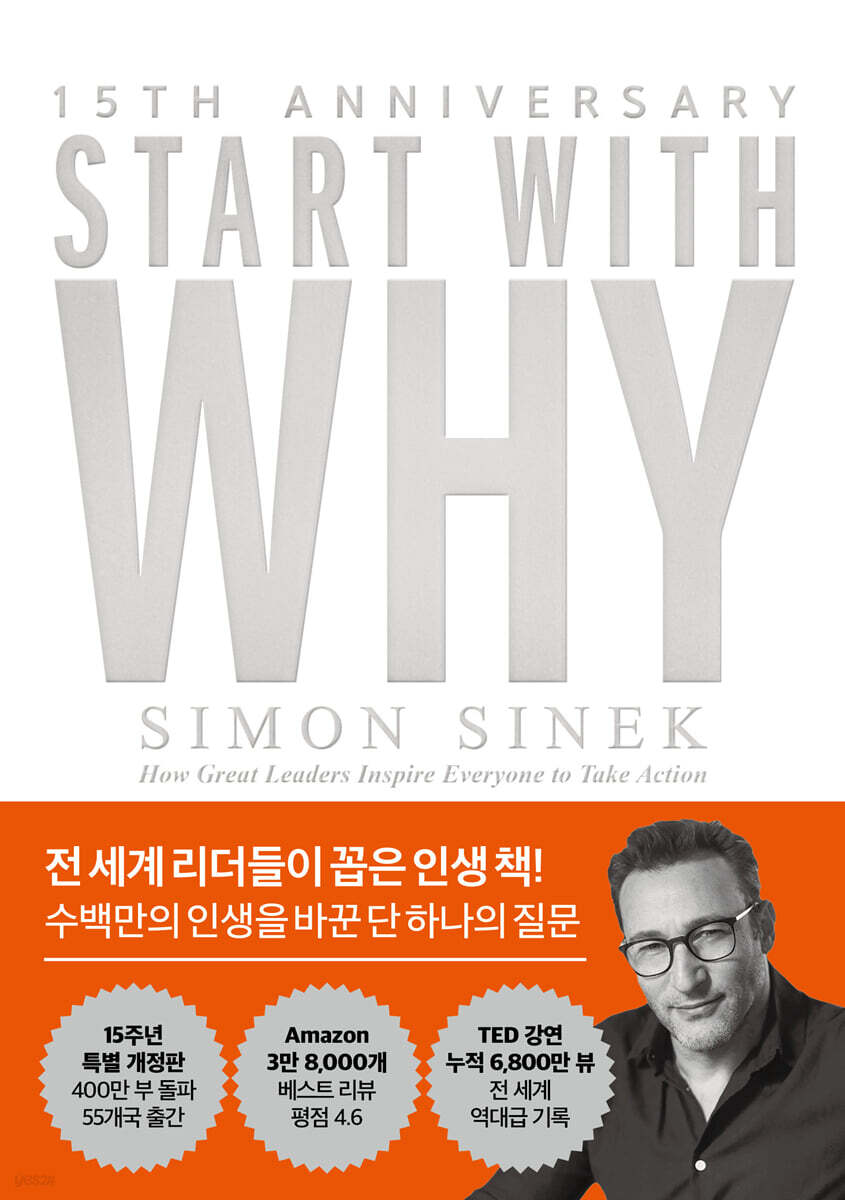
Published in 55 countries, selling over 4 million copies
Amazon 38,000 Best Reviews 4.6 rating
TED Talks have accumulated 68 million views.
The one sentence that changed the world
“It’s not what you do, it’s why you do it.” Fifteen years ago, this simple sentence posed a question to the work and lives of millions of people around the world.
And now, the question has become more urgent.
"Start with Why" is a book that presents a sense of the questions that people and organizations must first grasp to avoid losing direction, as well as a reference point for existence.
Author Simon Sinek distilled the common threads found in countless leaders and corporate success stories into a single question.
The purpose came before the strategy, and the 'WHY' came before the results.
When the question becomes a direction
WHY is not just motivation.
In an age where speed consumes everything, WHY is a language of recovery that helps us regain our center even in the midst of uncertainty, and a questioning power that establishes an explainable identity.
This book argues that asking "why" before "what" and "how" should be the first step toward sustainable leadership, branding, collaboration, and life.
This book became known worldwide through a TED talk immediately after its publication, and with over 70 million cumulative views, it became one of the “most-watched business talks in history.”
As of 2025, "Start With Why" has been translated into 55 languages and sold over 4 million copies. Numerous leaders, practitioners, entrepreneurs, and creators say they have used this book as a focal point and a reference point for their work and life.
15 Years of Sincerity, Why We Redesigned It
And now, in its 15th anniversary, the book has been reborn.
This special revised edition is not simply a recovery, but the result of a conviction that the question of WHY remains relevant in an age when it is needed again.
Author Simon Sinek himself added new examples and insights, and rearranged the narrative structure to keep pace with the times.
Translation standards for Korean readers were re-established and sentences were also organized.
We've removed the translation style of the first edition and redesigned the language to make the concept of WHY clearer and more persuasive. The translator has also retranslated the newly added chapters from scratch and fine-tuned the entire sentence to fit the flow of thought of Korean readers.
Time to go back to WHY
The 15th anniversary special revised edition of "Start With Why" still asks the same question.
"Why did you start this?" And can we answer that question more honestly now than we could 15 years ago? The results can vanish.
But the reason 'why' lingers for a long time.
And now, when we may be losing sight of that question, this book revives the direction we must reclaim.
A single question that changed millions of lives.
Now is the time to reset our standards.
Amazon 38,000 Best Reviews 4.6 rating
TED Talks have accumulated 68 million views.
The one sentence that changed the world
“It’s not what you do, it’s why you do it.” Fifteen years ago, this simple sentence posed a question to the work and lives of millions of people around the world.
And now, the question has become more urgent.
"Start with Why" is a book that presents a sense of the questions that people and organizations must first grasp to avoid losing direction, as well as a reference point for existence.
Author Simon Sinek distilled the common threads found in countless leaders and corporate success stories into a single question.
The purpose came before the strategy, and the 'WHY' came before the results.
When the question becomes a direction
WHY is not just motivation.
In an age where speed consumes everything, WHY is a language of recovery that helps us regain our center even in the midst of uncertainty, and a questioning power that establishes an explainable identity.
This book argues that asking "why" before "what" and "how" should be the first step toward sustainable leadership, branding, collaboration, and life.
This book became known worldwide through a TED talk immediately after its publication, and with over 70 million cumulative views, it became one of the “most-watched business talks in history.”
As of 2025, "Start With Why" has been translated into 55 languages and sold over 4 million copies. Numerous leaders, practitioners, entrepreneurs, and creators say they have used this book as a focal point and a reference point for their work and life.
15 Years of Sincerity, Why We Redesigned It
And now, in its 15th anniversary, the book has been reborn.
This special revised edition is not simply a recovery, but the result of a conviction that the question of WHY remains relevant in an age when it is needed again.
Author Simon Sinek himself added new examples and insights, and rearranged the narrative structure to keep pace with the times.
Translation standards for Korean readers were re-established and sentences were also organized.
We've removed the translation style of the first edition and redesigned the language to make the concept of WHY clearer and more persuasive. The translator has also retranslated the newly added chapters from scratch and fine-tuned the entire sentence to fit the flow of thought of Korean readers.
Time to go back to WHY
The 15th anniversary special revised edition of "Start With Why" still asks the same question.
"Why did you start this?" And can we answer that question more honestly now than we could 15 years ago? The results can vanish.
But the reason 'why' lingers for a long time.
And now, when we may be losing sight of that question, this book revives the direction we must reclaim.
A single question that changed millions of lives.
Now is the time to reset our standards.
GOODS SPECIFICS
- Date of issue: June 11, 2025
- Page count, weight, size: 332 pages | 148*210*30mm
- ISBN13: 9791198985637
- ISBN10: 1198985631
You may also like
카테고리
korean


korean

![GQ KOREA Mark (Monthly): December [2025]](http://librairie.coreenne.fr/cdn/shop/files/8ef265dbbfbf186523ed75ba7319009d.jpg?v=1765340328&width=3840)


