

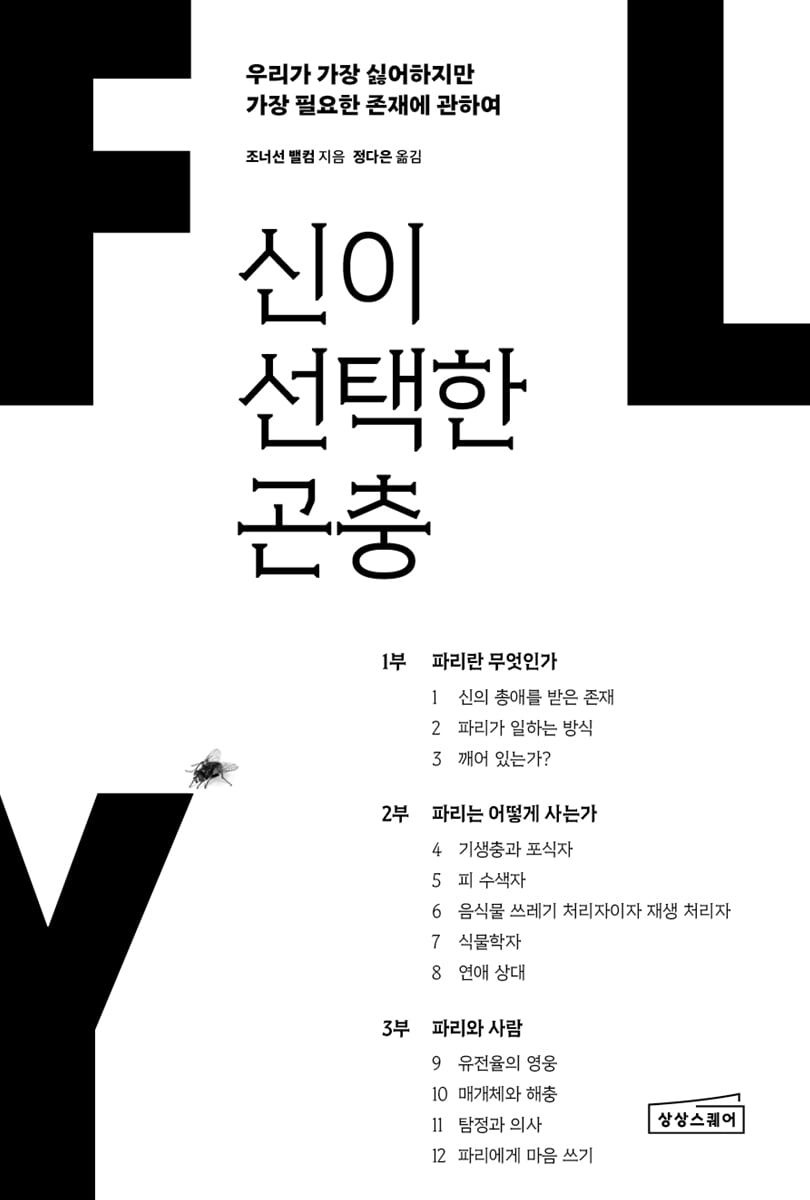
Insects chosen by God
 |
Description
Book Introduction
World-renowned zoologist Jane Goodall recommends Lulu Miller's book, "Fish Don't Exist."
A new book from Jonathan Balcombe, author of the best-selling book "Fish Knows"!
About the world's most misunderstood, yet vital, being that enriches the planet.
There is an insect that turns death into life.
Cleanse nature, heal wounds and save lives.
They spread pollen to make forests green, uncover the secrets of humanity's genes with their small bodies, and testify to the truth in place of silent corpses at crime scenes.
It is a fly, an insect that humans instinctively hate.
Flies are the driving force that keeps our lives running smoothly, and they have survived and supported the Earth for hundreds of millions of years.
Flies are the most successful insects on Earth.
There are currently over 160,000 known species, and they live in almost every environment.
The flies' two tiny wings, their sophisticated balance mechanism, and their visual acuity that even cameras can't match, are testament to their amazing abilities.
Insects, which we have considered insignificant, are actually at the pinnacle of evolution.
But how much do we know about Paris?
Our knowledge of Paris is shallow.
Often, we think of a few species buzzing around inside the house, and associate them with uncleanness.
But this book reveals the true face of Paris.
Flies are ecosystem cleaners, pollinators, masters of survival, and major contributors to scientific advancement.
Thanks to flies, humans were able to understand genes.
This book introduces in detail the life and colorful aspects of Paris.
"Insects Chosen by God" expands our thoughts and perspectives.
After reading this book, your view of Paris will change from one of disgust and displeasure to one of awe and gratitude.
The book's message of loving concern and consideration for flies, insects chosen by God that have endured hundreds of millions of years and still live alongside humanity, will also resonate deeply with you.
A new book from Jonathan Balcombe, author of the best-selling book "Fish Knows"!
About the world's most misunderstood, yet vital, being that enriches the planet.
There is an insect that turns death into life.
Cleanse nature, heal wounds and save lives.
They spread pollen to make forests green, uncover the secrets of humanity's genes with their small bodies, and testify to the truth in place of silent corpses at crime scenes.
It is a fly, an insect that humans instinctively hate.
Flies are the driving force that keeps our lives running smoothly, and they have survived and supported the Earth for hundreds of millions of years.
Flies are the most successful insects on Earth.
There are currently over 160,000 known species, and they live in almost every environment.
The flies' two tiny wings, their sophisticated balance mechanism, and their visual acuity that even cameras can't match, are testament to their amazing abilities.
Insects, which we have considered insignificant, are actually at the pinnacle of evolution.
But how much do we know about Paris?
Our knowledge of Paris is shallow.
Often, we think of a few species buzzing around inside the house, and associate them with uncleanness.
But this book reveals the true face of Paris.
Flies are ecosystem cleaners, pollinators, masters of survival, and major contributors to scientific advancement.
Thanks to flies, humans were able to understand genes.
This book introduces in detail the life and colorful aspects of Paris.
"Insects Chosen by God" expands our thoughts and perspectives.
After reading this book, your view of Paris will change from one of disgust and displeasure to one of awe and gratitude.
The book's message of loving concern and consideration for flies, insects chosen by God that have endured hundreds of millions of years and still live alongside humanity, will also resonate deeply with you.
- You can preview some of the book's contents.
Preview
index
Part 1: What is Paris?
1 A being favored by God
2 How Paris Works
3 Are you awake? (Evidence that insects think)
Part 2: How Paris Lives
4 Parasites and Predators
5 Blood Seekers
6 Food waste disposer and recycler
7 Botanists
8 Dating Partners
Part 3: Paris and People
9 Heroes of Hereditary Rate
10 Mediums and Pests
11 Detective and Doctor
12. Pay attention to Paris
Acknowledgements
Americas
References
1 A being favored by God
2 How Paris Works
3 Are you awake? (Evidence that insects think)
Part 2: How Paris Lives
4 Parasites and Predators
5 Blood Seekers
6 Food waste disposer and recycler
7 Botanists
8 Dating Partners
Part 3: Paris and People
9 Heroes of Hereditary Rate
10 Mediums and Pests
11 Detective and Doctor
12. Pay attention to Paris
Acknowledgements
Americas
References
Into the book
What did they mean by "flying well"? The adjective "flying well" doesn't quite fit the description of a housefly, which, while trapped, seems to be dazed and jumps on the windowpane.
In fact, the expression "doing well" is closer to the biological meaning.
It's about diversity and huge numbers.
In this respect, Paris is doing exceptionally well.
--- p.26 From “The Being Favored by God”
I hope you can put aside any prejudices you may have about Paris and any anxieties that might weigh you down when thinking about Paris.
I hope you don't cut Paris up arbitrarily.
I believe you can do it.
If you do, you will at least be amazed at the fantastic variety of ways that flies find to eat and survive.
There can be quite a bit of fascination and respect for Paris.
If I feel that way, then I've done my job right.
Hope is there.
Simply put, we cannot live without flies.
--- p.47 From “The Being Favored by God”
It will be sad to see the flies go, but it's worth noting how much faster they are evolving than we are.
Considering that we can cram 500 generations of flies into every human generation, it's no surprise that they thrive on Earth as a gift from nature.
It is precisely here that we can learn a lesson that strikes a chord with our ability to adapt to artificial change.
--- p.73 From “How Paris Works”
There is still much to be learned about whether insects feel pain.
Evidence so far suggests that insects have sentience, but where they feel pain and how they express it may differ from ours.
Whether or not we feel pain depends not only on physical events but also on the situation.
I feel terrible when I think about drowning, but for those who are doing well, water is a part of life.
This is because they spend their eggs and larvae in lakes or ponds.
So I hesitate to apply the pain of drowning felt by humans to mayflies.
Perhaps the experience of being submerged in water during the final moments of life, the reproductive stage, might actually be beneficial, or at least not terrible, for mayflies?
--- p.95 From “Are You Awake? (Evidence That Insects Think)”
“A kind of bond was forming between Paris and me.
At least it felt like I was raising a different life form than myself.
It was like an unspoken contract between the two.
I didn't try to get rid of the parasite, and the parasite did its job carefully, making sure the wound didn't get infected.
After telling Nancy this story, it felt like it was closer to a pregnancy experience I could have.
--- p.116 From “Parasites and Predators”
Isn't that fortunate?
It makes me shudder to think what the Earth would look and smell like without flies to clean up the messes other creatures inevitably leave behind when they poop or die.
--- p.190 From “Food Waste Disposal and Recycling Processor”
Let's broaden our horizons a bit.
Awe goes without saying.
Because creatures big and small prepare for mating in a variety of ways.
There is no need to judge the sexual norms of other species.
In fact, when we think about the bizarre fetishes that people are said to have, we can't say that we only maintain sexual purity.
Even those who would cringe at the thought of a rotten Parisian tryst might find themselves sizzling in a giant bowl of chocolate pudding.
--- p.243 From "Love Partner"
While we can't blame just one cause for such a massive reshuffling of life on Earth, the so-called "sixth mass extinction" is of our own making.
The overwhelming and ever-growing human presence puts nature at innumerable risk.
Examples include urban encroachment and habitat destruction, air and water pollution, and agriculture, especially livestock farming.
The same goes for commercial fishing, aquaculture, hunting and poaching.
This also includes the climate emergency, which has existed for a long time but has only recently become widely known.
In fact, the expression "doing well" is closer to the biological meaning.
It's about diversity and huge numbers.
In this respect, Paris is doing exceptionally well.
--- p.26 From “The Being Favored by God”
I hope you can put aside any prejudices you may have about Paris and any anxieties that might weigh you down when thinking about Paris.
I hope you don't cut Paris up arbitrarily.
I believe you can do it.
If you do, you will at least be amazed at the fantastic variety of ways that flies find to eat and survive.
There can be quite a bit of fascination and respect for Paris.
If I feel that way, then I've done my job right.
Hope is there.
Simply put, we cannot live without flies.
--- p.47 From “The Being Favored by God”
It will be sad to see the flies go, but it's worth noting how much faster they are evolving than we are.
Considering that we can cram 500 generations of flies into every human generation, it's no surprise that they thrive on Earth as a gift from nature.
It is precisely here that we can learn a lesson that strikes a chord with our ability to adapt to artificial change.
--- p.73 From “How Paris Works”
There is still much to be learned about whether insects feel pain.
Evidence so far suggests that insects have sentience, but where they feel pain and how they express it may differ from ours.
Whether or not we feel pain depends not only on physical events but also on the situation.
I feel terrible when I think about drowning, but for those who are doing well, water is a part of life.
This is because they spend their eggs and larvae in lakes or ponds.
So I hesitate to apply the pain of drowning felt by humans to mayflies.
Perhaps the experience of being submerged in water during the final moments of life, the reproductive stage, might actually be beneficial, or at least not terrible, for mayflies?
--- p.95 From “Are You Awake? (Evidence That Insects Think)”
“A kind of bond was forming between Paris and me.
At least it felt like I was raising a different life form than myself.
It was like an unspoken contract between the two.
I didn't try to get rid of the parasite, and the parasite did its job carefully, making sure the wound didn't get infected.
After telling Nancy this story, it felt like it was closer to a pregnancy experience I could have.
--- p.116 From “Parasites and Predators”
Isn't that fortunate?
It makes me shudder to think what the Earth would look and smell like without flies to clean up the messes other creatures inevitably leave behind when they poop or die.
--- p.190 From “Food Waste Disposal and Recycling Processor”
Let's broaden our horizons a bit.
Awe goes without saying.
Because creatures big and small prepare for mating in a variety of ways.
There is no need to judge the sexual norms of other species.
In fact, when we think about the bizarre fetishes that people are said to have, we can't say that we only maintain sexual purity.
Even those who would cringe at the thought of a rotten Parisian tryst might find themselves sizzling in a giant bowl of chocolate pudding.
--- p.243 From "Love Partner"
While we can't blame just one cause for such a massive reshuffling of life on Earth, the so-called "sixth mass extinction" is of our own making.
The overwhelming and ever-growing human presence puts nature at innumerable risk.
Examples include urban encroachment and habitat destruction, air and water pollution, and agriculture, especially livestock farming.
The same goes for commercial fishing, aquaculture, hunting and poaching.
This also includes the climate emergency, which has existed for a long time but has only recently become widely known.
--- p.342 From "Writing to Paris"
Publisher's Review
All About the Insects Chosen by the God We Have Turned Away!
"This book will shatter any hatred or resentment toward Paris and lead you to awe and gratitude."
Close your eyes and think of the insect you hate the most.
The first thing that comes to mind is the deadly killer mosquito that sucks our blood.
Then perhaps Paris comes to mind.
Flies are notorious for hovering around kitchens, contaminating food, causing discomfort with their buzzing wings, and carrying diseases.
However, insects that we think we can kill with a slap are actually indispensable for supporting the Earth's ecosystem and human civilization.
"The Insects Chosen by God" illuminates the true face of flies and their amazing abilities, surrounded by unpleasantness and disgust that we never knew existed.
Flies are the most successful insects on Earth.
There are approximately 160,000 species known to date, and they live in almost all environments, including glaciers, deserts, highlands, and jungles.
Two small wings, a balance organ for balance, and eyes that provide a much faster and wider field of vision than humans complete the fly's ability to fly.
Moreover, they flap their wings hundreds of times per second and can even make rapid changes in direction.
It can be said that he is a true master of aerial flight created by evolution.
Flies are not simply mechanical beings that move according to instinct.
Studies have shown that flies can remember and associate certain odors with electric shocks, and learn to modify their behavior by learning from rejected courtship experiences.
Even behaviors that are rewarded tend to be repeated more often.
Flies that are continuously exposed to threatening stimuli may show a state close to anxiety.
In other words, flies are beings that learn, remember, and show emotional responses.
We can see traces of human-like emotions and learning in the tiny insects we detest.
Flies play a variety of roles in supporting the ecosystem and humanity.
Maggots decompose decaying corpses and excrement, purifying nature and recycling nutrients.
Some flies carry pollen and make forests and fields green.
Even the cocoa beans, the raw material for chocolate, cannot bear fruit without certain flies.
Maggots are used medically to treat wounds, remove infected tissue and aid healing, and in forensic medicine, they provide crucial clues to estimating the time of death.
Fruit flies are a key model for modern genetic research and have made significant contributions to our understanding of human genes and disease.
In this way, Paris acts as an invisible mediator connecting life and death, nature and science.
Of course, flies are also a nuisance to humans.
Some species, such as mosquitoes, tsetse flies, and horse flies, suck blood and transmit diseases such as malaria, dengue fever, and sleeping sickness.
However, this is only a very small fraction of all flies, about 1%.
The remaining 99% of flies are working invisibly for humans and nature.
In fact, it is nothing more than a prejudice to regard flies as nothing more than a 'pest'.
Just as flies help cocoa beans to bear fruit, they make a powerful presence as connective tissue in complex ecosystems.
In this way, "The Insect Chosen by God" leads readers to a new understanding of flies.
It shows that flies, once a symbol of disgust and discomfort, are actually ecosystem circulators, responsible for important scientific achievements, and a driving force that enriches our lives.
The author proposes to the reader an attitude that goes beyond a human-centered perspective and recognizes the value of all living beings.
If there were no flies, the world would not survive even a single day.
Dead lives will pile up, forests will not bear fruit, and our tables will quickly become impoverished.
But because of flies, nature maintains order, humanity gains knowledge, and life continues to cycle.
The insect we hate the most is actually our voice hero.
It is a being that has survived for hundreds of millions of years and continues to thrive alongside humanity to this day.
"The Insect Chosen by God" reveals the great meaning hidden in the flapping wings of these tiny insects, and movingly testifies to why flies deserve to be called "the insect favored by God."
A vivid and clear exploration.
This one book contains everything you could ever want to know about Paris.
-Kirkus Review-
Biologist Jonathan Balcombe captivates us as he delves deep into the world of flies.
This humorous book vividly describes the maggot infestation he experienced while on a research trip to Africa, revealing the complex and secretive world of flies, usually dismissed as buzzing, biting pests.
Balcombe perfectly captures the complexities of the natural world with his vibrant prose.
Naturalists who only engage in armchair research will likely be surprised to discover that this book, along with other books like "The Bee's Forest Life" and "The Octopus and the Soul," vividly depict the natural world, is a perfect complement to the book.
-Publisher's Weekly-
"This book will shatter any hatred or resentment toward Paris and lead you to awe and gratitude."
Close your eyes and think of the insect you hate the most.
The first thing that comes to mind is the deadly killer mosquito that sucks our blood.
Then perhaps Paris comes to mind.
Flies are notorious for hovering around kitchens, contaminating food, causing discomfort with their buzzing wings, and carrying diseases.
However, insects that we think we can kill with a slap are actually indispensable for supporting the Earth's ecosystem and human civilization.
"The Insects Chosen by God" illuminates the true face of flies and their amazing abilities, surrounded by unpleasantness and disgust that we never knew existed.
Flies are the most successful insects on Earth.
There are approximately 160,000 species known to date, and they live in almost all environments, including glaciers, deserts, highlands, and jungles.
Two small wings, a balance organ for balance, and eyes that provide a much faster and wider field of vision than humans complete the fly's ability to fly.
Moreover, they flap their wings hundreds of times per second and can even make rapid changes in direction.
It can be said that he is a true master of aerial flight created by evolution.
Flies are not simply mechanical beings that move according to instinct.
Studies have shown that flies can remember and associate certain odors with electric shocks, and learn to modify their behavior by learning from rejected courtship experiences.
Even behaviors that are rewarded tend to be repeated more often.
Flies that are continuously exposed to threatening stimuli may show a state close to anxiety.
In other words, flies are beings that learn, remember, and show emotional responses.
We can see traces of human-like emotions and learning in the tiny insects we detest.
Flies play a variety of roles in supporting the ecosystem and humanity.
Maggots decompose decaying corpses and excrement, purifying nature and recycling nutrients.
Some flies carry pollen and make forests and fields green.
Even the cocoa beans, the raw material for chocolate, cannot bear fruit without certain flies.
Maggots are used medically to treat wounds, remove infected tissue and aid healing, and in forensic medicine, they provide crucial clues to estimating the time of death.
Fruit flies are a key model for modern genetic research and have made significant contributions to our understanding of human genes and disease.
In this way, Paris acts as an invisible mediator connecting life and death, nature and science.
Of course, flies are also a nuisance to humans.
Some species, such as mosquitoes, tsetse flies, and horse flies, suck blood and transmit diseases such as malaria, dengue fever, and sleeping sickness.
However, this is only a very small fraction of all flies, about 1%.
The remaining 99% of flies are working invisibly for humans and nature.
In fact, it is nothing more than a prejudice to regard flies as nothing more than a 'pest'.
Just as flies help cocoa beans to bear fruit, they make a powerful presence as connective tissue in complex ecosystems.
In this way, "The Insect Chosen by God" leads readers to a new understanding of flies.
It shows that flies, once a symbol of disgust and discomfort, are actually ecosystem circulators, responsible for important scientific achievements, and a driving force that enriches our lives.
The author proposes to the reader an attitude that goes beyond a human-centered perspective and recognizes the value of all living beings.
If there were no flies, the world would not survive even a single day.
Dead lives will pile up, forests will not bear fruit, and our tables will quickly become impoverished.
But because of flies, nature maintains order, humanity gains knowledge, and life continues to cycle.
The insect we hate the most is actually our voice hero.
It is a being that has survived for hundreds of millions of years and continues to thrive alongside humanity to this day.
"The Insect Chosen by God" reveals the great meaning hidden in the flapping wings of these tiny insects, and movingly testifies to why flies deserve to be called "the insect favored by God."
A vivid and clear exploration.
This one book contains everything you could ever want to know about Paris.
-Kirkus Review-
Biologist Jonathan Balcombe captivates us as he delves deep into the world of flies.
This humorous book vividly describes the maggot infestation he experienced while on a research trip to Africa, revealing the complex and secretive world of flies, usually dismissed as buzzing, biting pests.
Balcombe perfectly captures the complexities of the natural world with his vibrant prose.
Naturalists who only engage in armchair research will likely be surprised to discover that this book, along with other books like "The Bee's Forest Life" and "The Octopus and the Soul," vividly depict the natural world, is a perfect complement to the book.
-Publisher's Weekly-
GOODS SPECIFICS
- Date of issue: September 10, 2025
- Page count, weight, size: 452 pages | 656g | 152*225*23mm
- ISBN13: 9791194368564
- ISBN10: 1194368565
You may also like
카테고리
korean


korean

![ELLE 엘르 스페셜 에디션 A형 : 12월 [2025]](http://librairie.coreenne.fr/cdn/shop/files/b8e27a3de6c9538896439686c6b0e8fb.jpg?v=1766436872&width=3840)


