

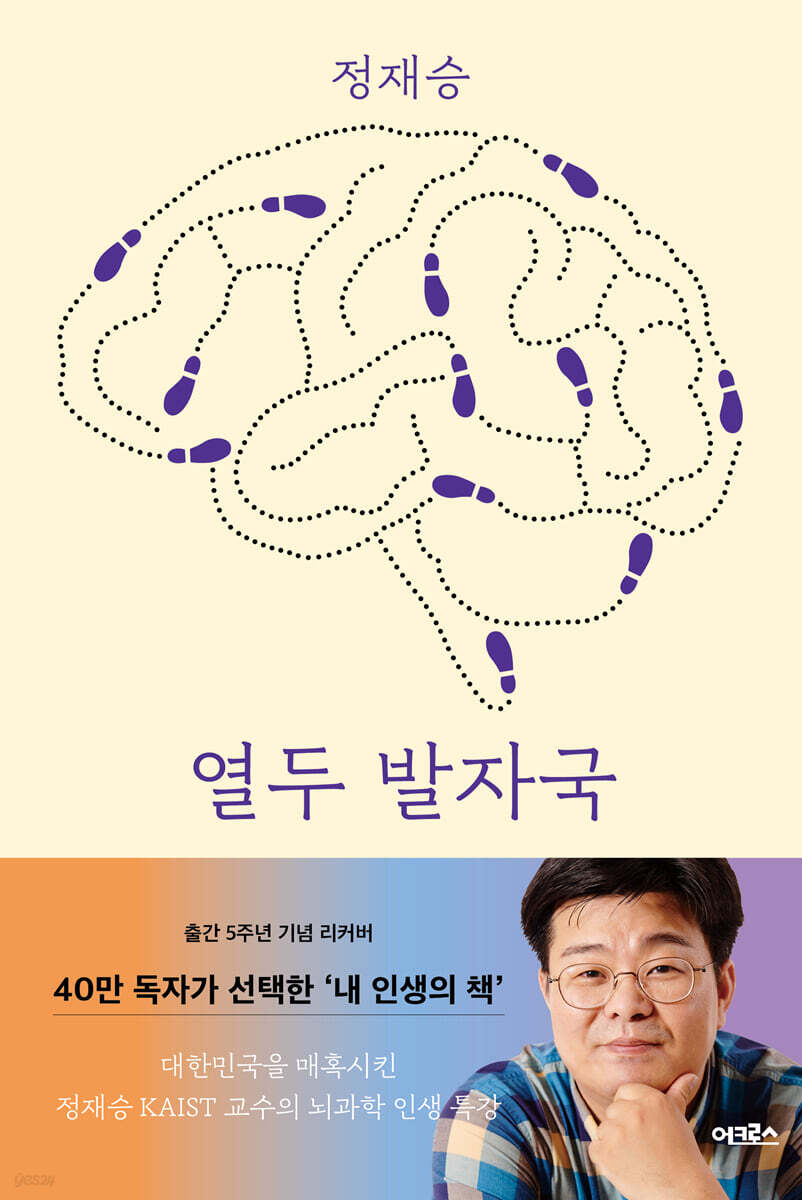
Twelve Footsteps (Recovery Edition)
 |
Description
Book Introduction
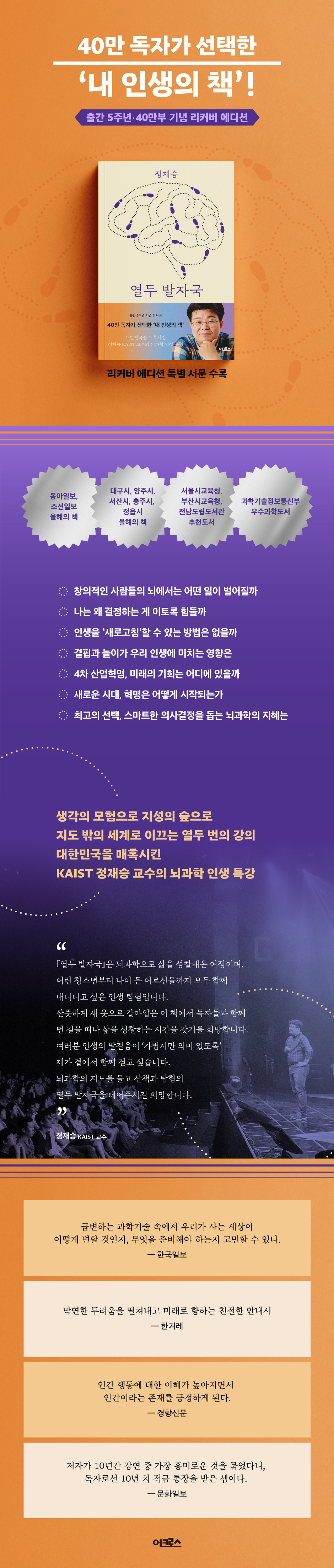
★★★ Book of the Year by Dong-A Ilbo and Chosun Ilbo
★★★ Book of the Year in Daegu, Yangju, Seosan, Chungju, and Jeongeup
★★★ Selected as an excellent science book by the Ministry of Science and ICT
★★★ Recommended books by the Seoul Metropolitan Office of Education, Busan Metropolitan Office of Education, and Jeonnam Provincial Library
KAIST Professor Jaeseung Jeong's Lifetime Lecture on Brain Science, Captivating South Korea
From the wisdom of brain science for smart choices
From scientific insights to discovering future opportunities in the era of the Fourth Industrial Revolution.
Twelve Amazing Experiences That Turn Knowledge into Wisdom
Jaeseung Jeong's lectures are footsteps that lead you to a new forest of ideas you have never been to before.
Following in his footsteps into the forest, the audience will experience 'the transformation of scientific knowledge into insight and wisdom about life and the world.'
That's why people of all generations and genders, from young people in Korea to leaders of organizations, are listening to his story.
This book is filled with the wisdom and insights of brain science that offer young people and leaders of this land who are struggling for better choices and a brighter future.
These are stories of thought-overturning that overturns conventional wisdom and hits the back of the head, of surprising adventures in thought that connect seemingly unrelated facts and knowledge, and of how seemingly cold scientific and intellectual reflections transform into heart-pounding insights into life.
What goes on in the brains of creative people? What wisdom from brain science can help us make better choices and decisions? How can we discover new opportunities in the era of the Fourth Industrial Revolution? What advice can we offer to clumsy Sapiens navigating the age of artificial intelligence?
Faced with life's challenges that always make us want to "refresh," in the midst of a rapidly changing era, the author poses questions and explores answers with readers.
And readers will be able to embark on a wonderful journey, following in the author's footsteps as he leads them on an adventure of thought, into the forest of intellect, into a world beyond the map, exploring the vast universe that is humanity, and the world yet to come.
A solo work after 17 years since "Science Concert," which was chosen by 700,000 readers.
The ultimate knowledge concert that takes you beyond boundaries into a universe of new ideas.
Jaeseung Jeong's "Twelve Footsteps" is a solo work published 17 years after "Jaeseung Jeong's Science Concert," which sold 700,000 copies and was the highest-selling science book by a Korean author in the past 20 years.
In his previous work, Jeong Jae-seung presented the "joy of connecting to the world through science" by introducing science hidden in complex social phenomena and familiar cultural content. In "Twelve Footsteps," he directly addresses the complex and intriguing "essence of human existence."
Jaeseung Jeong has dedicated himself to public lectures, conveying rigorous scientific knowledge in everyday language and helping more people access the heart-pounding insights that science brings to our lives.
I've also been passionate about sharing my knowledge by witnessing what's happening at the forefront of the technology industry and sharing it with the innovators in our society.
Widely known for his lectures, which offer practical, science-based advice to help solve life's problems and are filled with insights for leading organizations and businesses, he receives over 1,200 speaking requests each year.
This book, "Twelve Footsteps," is a compilation of twelve of Jeong Jae-seung's most enthusiastically received public lectures, with newly discovered information added.
"This book deals with the universal human from the perspective of a tiny 1.4-kilogram universe called the 'brain,' but I hope that the story will connect with the stories of your own intimate lives.
And I hope to share the experience of discovering myself and discovering ourselves in it." - From the prologue
A Neuroscientist's Life Lecture for a Better Life
Why do humans often make absurd decisions?
Can the Homo sapiens brain cope with this complex modern world?
In this book, the author introduces various scientific perspectives and stories related to decision-making, creativity, play, deficiency, habit, superstition, and choice.
We have the opportunity to rethink the complex forest that is humanity, something we have never encountered before, from a scientific perspective: why do we always make plans to improve our lives but fail to put them into practice? What happens in the brain at the moment of choice? How can we overcome Hamlet syndrome? What does play mean to humans? Why do we believe in superstitions?
Following in his footsteps as he guides us through “how Homo sapiens has responded to the world and lived for tens of thousands of years, how we survive in this complex modern society with our slowly evolving, fragile brains, and how we strive to live wise, happy, and ever-awake beings despite this,” will provide an opportunity to understand humanity and gain insight and wisdom for a better life.
From the secrets of creative innovation to the future shaped by the Fourth Industrial Revolution.
The joy of imagining a world that has never come
“In particular, I wanted to talk about what dreams and ideals humanity is preparing for this great transformation of civilization.
And I wanted to examine how our contemporaries, who need a revolutionary change in thinking, are accepting this revolutionary spirit.” - From the prologue
Predicting and preparing for the future is not easy.
Knowledge and skills that could be learned once and used for a lifetime are now not uncommon for their lifespan to not exceed 10 years.
Every day new technologies emerge and new scientific terms emerge.
New discourses and terms like the 'Fourth Industrial Revolution,' 'Artificial Intelligence,' and 'Blockchain' leave us breathless and anxious.
Part 2 of this book, at the forefront of rapidly changing science and technology, explores how the world we live in will change, what we must discover and prepare for in the process, and what we need to know to imagine and explore the world yet to come.
What will the new platform that will dominate the market after smartphones look like? What human tasks cannot be replaced by AI? How will cryptocurrency and blockchain technology evolve? As readers explore the questions posed by technological revolutions alongside the author, they will be prepared to embrace new opportunities rather than fear.
You will be able to experience the thrilling excitement of welcoming the future that those who have achieved unprecedented innovations have dreamed of.
A book that takes you on an adventure of thought, to the boundaries beyond the map.
This book is not a book that lists amazing scientific facts, but aims to provide that knowledge with wisdom for life and insight for navigating the world.
The author constantly asks questions that lead readers on an adventure of thought.
“Can you write your name with a red pen?”, “Is it really that hard to choose between jajangmyeon and jjambbong?”, “Do you know why you’re putting off making a decision now?”, “Is there a way to look at your job, which will compete with AI, differently?” As we tilt our heads to his questions that seem obvious or unfamiliar and follow in his footsteps, we embark on an unfamiliar adventure into a world we’ve never been to before.
As you follow his stories that challenge your thinking and lead you into worlds beyond the map, you will laugh, wonder, and experience "the transformation of knowledge into insight."
It introduces the science of what happens in our brains on a daily basis, from various perspectives and stories, including decision-making, creativity, deficiencies, habits, and superstitions.
It is not simply a list of scientific common sense.
Through Professor Jeong's stories, readers gain wisdom and insight to navigate life through knowledge.
In this rapidly changing world of science and technology, we can think about how the world we live in will change and what we need to prepare for.
-Korea Daily
Armed with a wealth of data, references, and a keen sense of humor, the author's guidance seems to ease some of the fears about this vague future. - Hankyoreh
I want to take a look at myself and see how I usually act and why I act that way.
According to the book, it is natural for humans to not keep all of their New Year's resolutions, have difficulty making choices, and be prone to superstitions.
As our understanding of human behavior grows, we come to appreciate the existence of humans.
- Kyunghyang Shinmun
The author hopes that while the story is about the universal human brain, it will touch the readers' intimate lives and share the experience of discovering themselves and ourselves within it.
The book is actually like that.
This is a book I would like to give as a gift to my college-aged daughter who is worried about life and her future.
I also want to throw this out to my hardened middle-aged coworkers.
-Culture Daily
★★★ Book of the Year in Daegu, Yangju, Seosan, Chungju, and Jeongeup
★★★ Selected as an excellent science book by the Ministry of Science and ICT
★★★ Recommended books by the Seoul Metropolitan Office of Education, Busan Metropolitan Office of Education, and Jeonnam Provincial Library
KAIST Professor Jaeseung Jeong's Lifetime Lecture on Brain Science, Captivating South Korea
From the wisdom of brain science for smart choices
From scientific insights to discovering future opportunities in the era of the Fourth Industrial Revolution.
Twelve Amazing Experiences That Turn Knowledge into Wisdom
Jaeseung Jeong's lectures are footsteps that lead you to a new forest of ideas you have never been to before.
Following in his footsteps into the forest, the audience will experience 'the transformation of scientific knowledge into insight and wisdom about life and the world.'
That's why people of all generations and genders, from young people in Korea to leaders of organizations, are listening to his story.
This book is filled with the wisdom and insights of brain science that offer young people and leaders of this land who are struggling for better choices and a brighter future.
These are stories of thought-overturning that overturns conventional wisdom and hits the back of the head, of surprising adventures in thought that connect seemingly unrelated facts and knowledge, and of how seemingly cold scientific and intellectual reflections transform into heart-pounding insights into life.
What goes on in the brains of creative people? What wisdom from brain science can help us make better choices and decisions? How can we discover new opportunities in the era of the Fourth Industrial Revolution? What advice can we offer to clumsy Sapiens navigating the age of artificial intelligence?
Faced with life's challenges that always make us want to "refresh," in the midst of a rapidly changing era, the author poses questions and explores answers with readers.
And readers will be able to embark on a wonderful journey, following in the author's footsteps as he leads them on an adventure of thought, into the forest of intellect, into a world beyond the map, exploring the vast universe that is humanity, and the world yet to come.
A solo work after 17 years since "Science Concert," which was chosen by 700,000 readers.
The ultimate knowledge concert that takes you beyond boundaries into a universe of new ideas.
Jaeseung Jeong's "Twelve Footsteps" is a solo work published 17 years after "Jaeseung Jeong's Science Concert," which sold 700,000 copies and was the highest-selling science book by a Korean author in the past 20 years.
In his previous work, Jeong Jae-seung presented the "joy of connecting to the world through science" by introducing science hidden in complex social phenomena and familiar cultural content. In "Twelve Footsteps," he directly addresses the complex and intriguing "essence of human existence."
Jaeseung Jeong has dedicated himself to public lectures, conveying rigorous scientific knowledge in everyday language and helping more people access the heart-pounding insights that science brings to our lives.
I've also been passionate about sharing my knowledge by witnessing what's happening at the forefront of the technology industry and sharing it with the innovators in our society.
Widely known for his lectures, which offer practical, science-based advice to help solve life's problems and are filled with insights for leading organizations and businesses, he receives over 1,200 speaking requests each year.
This book, "Twelve Footsteps," is a compilation of twelve of Jeong Jae-seung's most enthusiastically received public lectures, with newly discovered information added.
"This book deals with the universal human from the perspective of a tiny 1.4-kilogram universe called the 'brain,' but I hope that the story will connect with the stories of your own intimate lives.
And I hope to share the experience of discovering myself and discovering ourselves in it." - From the prologue
A Neuroscientist's Life Lecture for a Better Life
Why do humans often make absurd decisions?
Can the Homo sapiens brain cope with this complex modern world?
In this book, the author introduces various scientific perspectives and stories related to decision-making, creativity, play, deficiency, habit, superstition, and choice.
We have the opportunity to rethink the complex forest that is humanity, something we have never encountered before, from a scientific perspective: why do we always make plans to improve our lives but fail to put them into practice? What happens in the brain at the moment of choice? How can we overcome Hamlet syndrome? What does play mean to humans? Why do we believe in superstitions?
Following in his footsteps as he guides us through “how Homo sapiens has responded to the world and lived for tens of thousands of years, how we survive in this complex modern society with our slowly evolving, fragile brains, and how we strive to live wise, happy, and ever-awake beings despite this,” will provide an opportunity to understand humanity and gain insight and wisdom for a better life.
From the secrets of creative innovation to the future shaped by the Fourth Industrial Revolution.
The joy of imagining a world that has never come
“In particular, I wanted to talk about what dreams and ideals humanity is preparing for this great transformation of civilization.
And I wanted to examine how our contemporaries, who need a revolutionary change in thinking, are accepting this revolutionary spirit.” - From the prologue
Predicting and preparing for the future is not easy.
Knowledge and skills that could be learned once and used for a lifetime are now not uncommon for their lifespan to not exceed 10 years.
Every day new technologies emerge and new scientific terms emerge.
New discourses and terms like the 'Fourth Industrial Revolution,' 'Artificial Intelligence,' and 'Blockchain' leave us breathless and anxious.
Part 2 of this book, at the forefront of rapidly changing science and technology, explores how the world we live in will change, what we must discover and prepare for in the process, and what we need to know to imagine and explore the world yet to come.
What will the new platform that will dominate the market after smartphones look like? What human tasks cannot be replaced by AI? How will cryptocurrency and blockchain technology evolve? As readers explore the questions posed by technological revolutions alongside the author, they will be prepared to embrace new opportunities rather than fear.
You will be able to experience the thrilling excitement of welcoming the future that those who have achieved unprecedented innovations have dreamed of.
A book that takes you on an adventure of thought, to the boundaries beyond the map.
This book is not a book that lists amazing scientific facts, but aims to provide that knowledge with wisdom for life and insight for navigating the world.
The author constantly asks questions that lead readers on an adventure of thought.
“Can you write your name with a red pen?”, “Is it really that hard to choose between jajangmyeon and jjambbong?”, “Do you know why you’re putting off making a decision now?”, “Is there a way to look at your job, which will compete with AI, differently?” As we tilt our heads to his questions that seem obvious or unfamiliar and follow in his footsteps, we embark on an unfamiliar adventure into a world we’ve never been to before.
As you follow his stories that challenge your thinking and lead you into worlds beyond the map, you will laugh, wonder, and experience "the transformation of knowledge into insight."
It introduces the science of what happens in our brains on a daily basis, from various perspectives and stories, including decision-making, creativity, deficiencies, habits, and superstitions.
It is not simply a list of scientific common sense.
Through Professor Jeong's stories, readers gain wisdom and insight to navigate life through knowledge.
In this rapidly changing world of science and technology, we can think about how the world we live in will change and what we need to prepare for.
-Korea Daily
Armed with a wealth of data, references, and a keen sense of humor, the author's guidance seems to ease some of the fears about this vague future. - Hankyoreh
I want to take a look at myself and see how I usually act and why I act that way.
According to the book, it is natural for humans to not keep all of their New Year's resolutions, have difficulty making choices, and be prone to superstitions.
As our understanding of human behavior grows, we come to appreciate the existence of humans.
- Kyunghyang Shinmun
The author hopes that while the story is about the universal human brain, it will touch the readers' intimate lives and share the experience of discovering themselves and ourselves within it.
The book is actually like that.
This is a book I would like to give as a gift to my college-aged daughter who is worried about life and her future.
I also want to throw this out to my hardened middle-aged coworkers.
-Culture Daily
- You can preview some of the book's contents.
Preview
index
Recover Edition Preface - Taking Steps of Reflection Again
Prologue - Twelve Footsteps into the Forest of Humanity
Part 1: Exploring a Better Life
- Gaining insight into life from brain science
First Footsteps
What Happens in Your Brain While You Make Choices
Second Footsteps
How to overcome Hamlet syndrome
Third Footprint
Can one desire without wanting?
Fourth Footstep
What is play to humans?
Fifth Footstep
Can Our Brains 'Refresh'?
Sixth Footstep
Why We Fall Into Superstition
Part 2: Imagining a World Yet to Come
Discovering Future Opportunities in Brain Science
Seventh Footstep
What Happens in the Brains of Creative People
Eighth Footstep
In the age of artificial intelligence, what is the future of human intelligence?
Ninth Footstep
In the era of the Fourth Industrial Revolution, where do future opportunities lie?
Tenth Footstep
How a Revolution Begins
Eleventh Footstep
How Nonconformists Challenge the World
The twelfth footprint
Exploring the Universe of the Brain and Remembering Carl Sagan
supplement
Interview Special Lecture 1 - A Neuroscientist Discusses Leadership
Interview Special Lecture 2 - A Neuroscientist Discusses Creativity
For readers who want to know more detailed information
Prologue - Twelve Footsteps into the Forest of Humanity
Part 1: Exploring a Better Life
- Gaining insight into life from brain science
First Footsteps
What Happens in Your Brain While You Make Choices
Second Footsteps
How to overcome Hamlet syndrome
Third Footprint
Can one desire without wanting?
Fourth Footstep
What is play to humans?
Fifth Footstep
Can Our Brains 'Refresh'?
Sixth Footstep
Why We Fall Into Superstition
Part 2: Imagining a World Yet to Come
Discovering Future Opportunities in Brain Science
Seventh Footstep
What Happens in the Brains of Creative People
Eighth Footstep
In the age of artificial intelligence, what is the future of human intelligence?
Ninth Footstep
In the era of the Fourth Industrial Revolution, where do future opportunities lie?
Tenth Footstep
How a Revolution Begins
Eleventh Footstep
How Nonconformists Challenge the World
The twelfth footprint
Exploring the Universe of the Brain and Remembering Carl Sagan
supplement
Interview Special Lecture 1 - A Neuroscientist Discusses Leadership
Interview Special Lecture 2 - A Neuroscientist Discusses Creativity
For readers who want to know more detailed information
Detailed image
Into the book
We carefully share with you the facts discovered by scientists who embarked on an uncharted expedition to understand the forest called "humanity," an eternal object of inquiry.
Although this knowledge can be refuted by new discoveries in the future, it contains many fragmentary truths about 'humans as we understand them now.'
To enter the human forest and face the essence of humanity, we will need to explore tens of thousands of steps.
These twelve steps are just the first, but we hope you'll join our scientists on their exploration.
You will be able to enjoy the exhilarating experience of having the facts we took for granted overturned, and the freedom of breaking free from the inertia of conventional wisdom and familiar common sense.
---From "Prologue, Twelve Footsteps into the Forest of Humanity"
You can't plan something you do for the first time.
Innovation doesn't happen by planning.
Innovation is achieved through a process of trying different things and constantly revising plans.
The important thing is not to complete the plan, but to complete the goal.
We must learn to constantly revise our plans to achieve our goals.
---From "The First Step: What Happens in the Brain While Making a Choice"
The question, 'What do I get pleasure from?' tells me what kind of person I am.
To answer the question, "What should I do for a living?", we need to look into the source of our joy, our play time.
---From "The Fourth Footstep, What Does Play Mean to Humans"
Within the comfort of habit, we can lead peaceful and predictable lives.
Trying to break out of a habitual pattern is difficult.
That's why it's difficult to reset your life.
A neuroscientific interpretation of refreshing is that it's an attempt to break free from bad habits and the mundane routine.
If you don't make a conscious effort to meet people who are in different fields and have different interests than you, the chances of meeting them will decrease.
If you don't live your life tolerating discomfort and enjoying talking to new people, refreshing becomes increasingly difficult.
You must first move away from bad habits and routines and toward a place where there is fresh stimulation that can transform your life.
---From "The Fifth Step: Can Our Brains 'Refresh'?"
The reason I'm bringing up the topic of superstition today is, above all, because our precious lives are being influenced by irrational elements.
Why do we allow irrational beliefs that bind us to life to dominate us? Why do we so readily, so readily, abandon the noble belief that our lives are our own, governed by our own complete will?
---From "The Sixth Step, Why We Fall Into Superstition"
To see what actually happens in the brains of creative people when they come up with an original idea, researchers placed creative participants in an fMRI machine and scanned their brains.
(...) As a result, the moment a creative idea is created, brain regions that are very far apart and do not normally exchange neural signals begin to exchange signals with each other.
Creative ideas emerge when the frontal lobe, occipital lobe, temporal lobe, and parietal lobe exchange signals and process information together.
Creativity is not a function created in the most advanced areas like the prefrontal cortex, but rather an ability that requires the use of the entire brain.
Their brains are working to look at a problem from a different angle, connect unrelated concepts, and connect two abstract ideas.
---From "The Seventh Step: What Happens in the Brains of Creative People"
Humans need a balance between time spent doing smartphone-like thinking—editing, searching, and quickly switching modes—and time spent reading, thinking long and deep, and contemplating.
This balance has played a role in filling my life with variety and richness, but daily immersion technology may disrupt this balance.
Because now we have to turn on our ‘life navigation’ at every moment and live in this world.
As I shift my life into different modes, I may get the information I want more quickly and be less likely to make mistakes, but I will also be further removed from a life of deep reflection and long-term introspection.
Although this knowledge can be refuted by new discoveries in the future, it contains many fragmentary truths about 'humans as we understand them now.'
To enter the human forest and face the essence of humanity, we will need to explore tens of thousands of steps.
These twelve steps are just the first, but we hope you'll join our scientists on their exploration.
You will be able to enjoy the exhilarating experience of having the facts we took for granted overturned, and the freedom of breaking free from the inertia of conventional wisdom and familiar common sense.
---From "Prologue, Twelve Footsteps into the Forest of Humanity"
You can't plan something you do for the first time.
Innovation doesn't happen by planning.
Innovation is achieved through a process of trying different things and constantly revising plans.
The important thing is not to complete the plan, but to complete the goal.
We must learn to constantly revise our plans to achieve our goals.
---From "The First Step: What Happens in the Brain While Making a Choice"
The question, 'What do I get pleasure from?' tells me what kind of person I am.
To answer the question, "What should I do for a living?", we need to look into the source of our joy, our play time.
---From "The Fourth Footstep, What Does Play Mean to Humans"
Within the comfort of habit, we can lead peaceful and predictable lives.
Trying to break out of a habitual pattern is difficult.
That's why it's difficult to reset your life.
A neuroscientific interpretation of refreshing is that it's an attempt to break free from bad habits and the mundane routine.
If you don't make a conscious effort to meet people who are in different fields and have different interests than you, the chances of meeting them will decrease.
If you don't live your life tolerating discomfort and enjoying talking to new people, refreshing becomes increasingly difficult.
You must first move away from bad habits and routines and toward a place where there is fresh stimulation that can transform your life.
---From "The Fifth Step: Can Our Brains 'Refresh'?"
The reason I'm bringing up the topic of superstition today is, above all, because our precious lives are being influenced by irrational elements.
Why do we allow irrational beliefs that bind us to life to dominate us? Why do we so readily, so readily, abandon the noble belief that our lives are our own, governed by our own complete will?
---From "The Sixth Step, Why We Fall Into Superstition"
To see what actually happens in the brains of creative people when they come up with an original idea, researchers placed creative participants in an fMRI machine and scanned their brains.
(...) As a result, the moment a creative idea is created, brain regions that are very far apart and do not normally exchange neural signals begin to exchange signals with each other.
Creative ideas emerge when the frontal lobe, occipital lobe, temporal lobe, and parietal lobe exchange signals and process information together.
Creativity is not a function created in the most advanced areas like the prefrontal cortex, but rather an ability that requires the use of the entire brain.
Their brains are working to look at a problem from a different angle, connect unrelated concepts, and connect two abstract ideas.
---From "The Seventh Step: What Happens in the Brains of Creative People"
Humans need a balance between time spent doing smartphone-like thinking—editing, searching, and quickly switching modes—and time spent reading, thinking long and deep, and contemplating.
This balance has played a role in filling my life with variety and richness, but daily immersion technology may disrupt this balance.
Because now we have to turn on our ‘life navigation’ at every moment and live in this world.
As I shift my life into different modes, I may get the information I want more quickly and be less likely to make mistakes, but I will also be further removed from a life of deep reflection and long-term introspection.
---From "The Ninth Step, The Era of the Fourth Industrial Revolution, Where Are the Future Opportunities?"
GOODS SPECIFICS
- Date of issue: January 18, 2023
- Page count, weight, size: 408 pages | 564g | 145*217*23mm
- ISBN13: 9791167740861
- ISBN10: 1167740866
You may also like
카테고리
korean


korean

![ELLE 엘르 스페셜 에디션 A형 : 12월 [2025]](http://librairie.coreenne.fr/cdn/shop/files/b8e27a3de6c9538896439686c6b0e8fb.jpg?v=1766436872&width=3840)


