

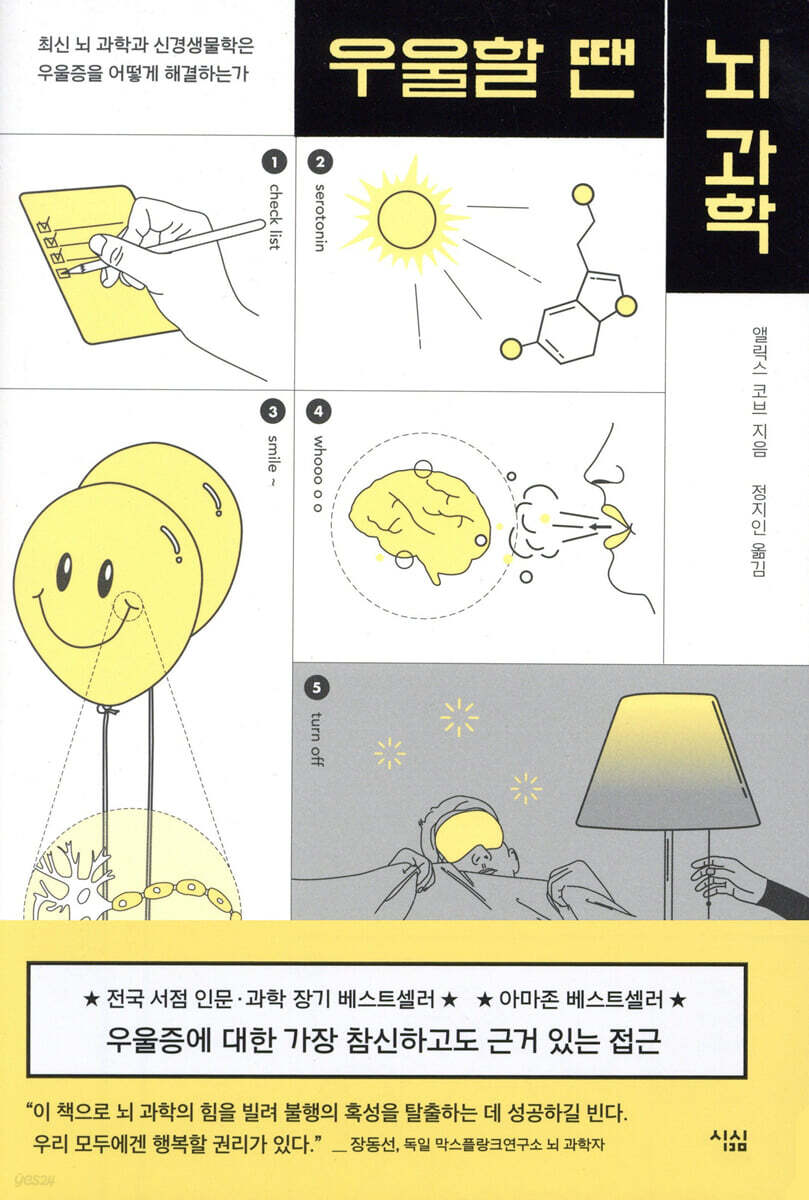
Brain Science When You're Depressed
 |
Description
Book Introduction
“The Most Scientific Book on Depression” How cutting-edge brain science and neurobiology can help address depression Once developed, depression is a dangerous and destructive mental illness whose final symptoms are likely to end in suicide. We often say this to people who suffer from depression: “Everything depends on your mindset.” “If you think more positively, if you think about your children and your family, you will be able to gain strength.” “There are people who are worse off than you, but they are doing well.” How much do we know about depression, which affects 5.35 million adults in Korea alone, or one in eight people, and is considered as common as a cold? Depression is often referred to as a 'fracture of the mind, a disease of the mind'. So what is the true nature and identity of that mind? Previous books on depression and melancholia have primarily focused on psychological perspectives, psychiatric backgrounds, and personal factors. Previous prescriptions such as “It depends on your mindset” or “Think positively” were enough to create the stereotype that depression is a disease whose causes can only be found in the individual and whose solutions depend solely on individual effort. Neuroscience (brain science) is the study of the brain, and the biological basis of human thoughts, emotions, and behavior. According to neuroscience, the human mind is shaped by the way the brain works. Therefore, from a neuroscientific perspective, depression is a disease caused by the way the 'brain' works rather than by an individual's will or effort. Dr. Alex Kob, a world-renowned neuroscientist and depression expert who received his Ph.D. in brain science from UCLA and has been studying depression using brain science for 15 years, wrote the book, "Brain Science When You're Depressed (published by Simsim, original title: The Upward Spiral)," which looks at depression from a neuroscience perspective. This book uses cutting-edge brain science to meticulously and thoroughly examine what depression is, how it begins, the specific causes of each symptom, the resulting harm, and ultimately, how to reverse the brain circuits that lead to depression. Backed by scientific evidence and logic, this book was hailed as “the least nonsensical book on depression I’ve ever read” (Amazon reader review) and has been a long-term bestseller in the psychology section of Amazon. |
- You can preview some of the book's contents.
Preview
index
Recommendation
Introduction - The Most Scientific Look at Depression
Part 1: The Brain Stuck in a Downward Spiral
Chapter 1: Brain Map of Depression
Good News and Bad News About Depression
Similarities Between Tornadoes and Depression
The Brain Science of Depression
The Chemicals of Depression
The underlying neural circuitry of depression
Everything is connected
What's wrong with my brain?
Five Factors That Determine How Brain Circuits Are Tuned
Depression is a problem with communication between brain circuits.
Chapter 2: The Hamster Wheel of Anxiety and Worry
Why does the brain worry?
The Neuroscientific Difference Between Worry and Anxiety
Why does the brain get anxious?
Worry and anxiety can also be beneficial.
The ABCs of Anxiety
How to Calm Your Anxious Limbic System
Chapter 3: Why Life Is Filled with Fucking Incidents
A brain that is more emotional than others
The brain reacts more intensely to negative events
Even when everything is going smoothly
Here are a few things you can do first:
Chapter 4: A Man Trapped in Bad Habits
The brain doesn't distinguish between bad and good habits.
Why it's so damn hard to get out of bed
What Triggers Habits
How to Engrave New Habits into Your Body
Software also changes hardware
Part 2: The Brain That Creates an Ascending Spiral
Chapter 5: How Exercise Affects the Brain
It's not me, it's my brain that's lazy
How Exercise Benefits Your Brain
It started out as just a walk
No matter what your brain says
Chapter 6: A Good Decision, Not the Best Decision
Indecision blocks happiness
Why Decision Making Helps Recover from Depression
When you make a decision, your cognitive pattern changes.
It's more fun when you decide
Setting goals increases dopamine.
When you decide, your habits become regulated.
Making decisions gives you a sense of control
Decisions reduce worry and anxiety
There's no need to make grand decisions right from the start.
Chapter 7: The Neuroscience of Sleep
Good sleep hygiene is like good dental hygiene.
Mechanisms by which sleep affects the brain
What sleep does for us
What sleep does for your brain
7 Tips to Put Your Brain to Sleep
Cognitive behavioral therapy for insomnia
Chapter 8: Making Habits Your Allies, Not Your Enemies
Each time you repeat it, it gets engraved deeper.
A Novel Way to Break Bad Habits
Stress reinforces habits
The brain is like a dog
Serotonin creates good habits
What to do to develop good habits
You can't control your emotions, but you can control your circumstances.
Productive procrastination
Chapter 9: The Power of Biofeedback
How does biofeedback work?
Biofeedback for depression
How to Use Biofeedback 1: Smile
How to Use Biofeedback 2: Straight and Upright Posture
How to Use Biofeedback 3: A Calm Face
Biofeedback Tip 4: Breathe Slowly and Deeply
Biofeedback Tip 5: Muscle Relaxation
Chapter 10: Gratitude Circuit Pushes Out Negative Emotions
3 Practical Benefits of Gratitude in Your Life
The effects of gratitude on the brain
The wolf we feed wins
Comparison is not a condition for gratitude.
Knowing how to be thankful and not forgetting
Chapter 11 Just Being Among People
The correlation between bullying and physical pain
Depression disrupts the neurochemistry of love.
What Others Do for Your Brain
How to Activate the Brain Circuits Responsible for Sociality
A few things to watch out for
Chapter 12: The Tool of Experts
Just as each person's brain is different, so too are the symptoms of depression.
How Psychotherapy Changes the Brain
How Antidepressants Change the Brain
brain stimulation technology
Epilogue - Get Out of Bed
Acknowledgements
Huzhou
Introduction - The Most Scientific Look at Depression
Part 1: The Brain Stuck in a Downward Spiral
Chapter 1: Brain Map of Depression
Good News and Bad News About Depression
Similarities Between Tornadoes and Depression
The Brain Science of Depression
The Chemicals of Depression
The underlying neural circuitry of depression
Everything is connected
What's wrong with my brain?
Five Factors That Determine How Brain Circuits Are Tuned
Depression is a problem with communication between brain circuits.
Chapter 2: The Hamster Wheel of Anxiety and Worry
Why does the brain worry?
The Neuroscientific Difference Between Worry and Anxiety
Why does the brain get anxious?
Worry and anxiety can also be beneficial.
The ABCs of Anxiety
How to Calm Your Anxious Limbic System
Chapter 3: Why Life Is Filled with Fucking Incidents
A brain that is more emotional than others
The brain reacts more intensely to negative events
Even when everything is going smoothly
Here are a few things you can do first:
Chapter 4: A Man Trapped in Bad Habits
The brain doesn't distinguish between bad and good habits.
Why it's so damn hard to get out of bed
What Triggers Habits
How to Engrave New Habits into Your Body
Software also changes hardware
Part 2: The Brain That Creates an Ascending Spiral
Chapter 5: How Exercise Affects the Brain
It's not me, it's my brain that's lazy
How Exercise Benefits Your Brain
It started out as just a walk
No matter what your brain says
Chapter 6: A Good Decision, Not the Best Decision
Indecision blocks happiness
Why Decision Making Helps Recover from Depression
When you make a decision, your cognitive pattern changes.
It's more fun when you decide
Setting goals increases dopamine.
When you decide, your habits become regulated.
Making decisions gives you a sense of control
Decisions reduce worry and anxiety
There's no need to make grand decisions right from the start.
Chapter 7: The Neuroscience of Sleep
Good sleep hygiene is like good dental hygiene.
Mechanisms by which sleep affects the brain
What sleep does for us
What sleep does for your brain
7 Tips to Put Your Brain to Sleep
Cognitive behavioral therapy for insomnia
Chapter 8: Making Habits Your Allies, Not Your Enemies
Each time you repeat it, it gets engraved deeper.
A Novel Way to Break Bad Habits
Stress reinforces habits
The brain is like a dog
Serotonin creates good habits
What to do to develop good habits
You can't control your emotions, but you can control your circumstances.
Productive procrastination
Chapter 9: The Power of Biofeedback
How does biofeedback work?
Biofeedback for depression
How to Use Biofeedback 1: Smile
How to Use Biofeedback 2: Straight and Upright Posture
How to Use Biofeedback 3: A Calm Face
Biofeedback Tip 4: Breathe Slowly and Deeply
Biofeedback Tip 5: Muscle Relaxation
Chapter 10: Gratitude Circuit Pushes Out Negative Emotions
3 Practical Benefits of Gratitude in Your Life
The effects of gratitude on the brain
The wolf we feed wins
Comparison is not a condition for gratitude.
Knowing how to be thankful and not forgetting
Chapter 11 Just Being Among People
The correlation between bullying and physical pain
Depression disrupts the neurochemistry of love.
What Others Do for Your Brain
How to Activate the Brain Circuits Responsible for Sociality
A few things to watch out for
Chapter 12: The Tool of Experts
Just as each person's brain is different, so too are the symptoms of depression.
How Psychotherapy Changes the Brain
How Antidepressants Change the Brain
brain stimulation technology
Epilogue - Get Out of Bed
Acknowledgements
Huzhou
Detailed image

Into the book
1.
Depression isn't just about being sad all the time.
When we think of depression, we often think of it as just being sad all the time.
But depression is much more widespread than that.
In fact, being depressed doesn't necessarily mean you feel sad.
Most of the time, I feel numb and empty where my emotions should be.
It's so hopeless and hopeless that there's nothing we can do.
Things that used to be fun are no longer fun.
Food, friends, hobbies.
Stamina also declines rapidly.
Everything feels difficult, and it's hard to explain why because there's absolutely no reason for it.
I feel like nothing is worth the effort.
Difficulty falling asleep, and even if you do fall asleep, difficulty staying asleep.
I feel pain and suffering much more intensely.
I can't concentrate, I feel anxious, I feel ashamed, and I feel lonely. --- p.12~13
2.
Even if you have depression, it doesn't mean your brain is damaged.
Why do tornadoes occur in Oklahoma but not in New York? Because Oklahoma has just the right conditions.
From flat terrain, temperature changes, humidity, wind direction and wind speed.
That doesn't mean there's anything wrong with Oklahoma.
The same is true for the brain.
Even when you are depressed, there is nothing fundamentally wrong with your brain itself.
It's simply that certain neural circuits are tuned to go into depressive patterns.
It has to do with the way the brain processes stress, planning, habits, decision-making, and other tasks, and the dynamic interactions between the circuits responsible for those tasks.
Once this pattern is established, dozens of small changes occur in a downward spiral throughout the brain. --- p.
31
3.
The Neuroscientific Difference Between Worry and Anxiety
Worry and anxiety are distinct but related concepts.
You can be anxious without being anxious, and you can be anxious without being worried.
While worry is primarily thought-based, anxiety is more closely tied to physical factors, such as bodily sensations (e.g., stomach pain), or related behaviors, such as avoiding situations.
Worry is governed by the prefrontal cortex.
Interactions between the prefrontal cortex and the limbic system, particularly the anterior cingulate cortex, are also involved in worry.
However, anxiety is solely the responsibility of the limbic system, and the interaction between the amygdala, hippocampus, and hypothalamus is mainly involved.
In short, worry is thinking about a potential problem, and anxiety is feeling a potential problem. --- p.67~68
4.
Why we repeat bad habits even though we know they are bad
If bad habits don't help, why do we continue to do them? The reason is that, unlike the prefrontal cortex, the striatum isn't rational.
It is not 'rational', at least not in the sense we normally define it.
The ancestral body does not distinguish between good and bad habits.
They happily indulge in one bad habit after another without any consideration of the long-term consequences.
It's important to realize that your brain doesn't recognize your bad habits until you become very frustrated with them.
Just as you can't blame a sleepwalker for something he did while sleeping, it's not easy to feel frustrated by habits you're not aware of. --- p.
110
5.
Exercise acts like an antidepressant
Exercise builds muscles, but it also strengthens your brain.
Exercise increases neurotrophic factors like BDNF (brain-derived neurotrophic factor), which act like steroids for the brain. BDNF strengthens the brain, empowering it to fight depression and other health problems.
(…) It's cool in itself that exercise increases BDNF, but it's even cooler to know that antidepressants increase BDNF, especially in the frontal lobe.
In other words, exercise has an effect on the brain similar to that of antidepressants.
As I shook myself off the couch and started walking, my brain was producing BDNF and getting stronger.
At that moment, I triggered a series of neural events without even realizing it.
But it's important to remember that BDNF is like fertilizer.
You can't just sprinkle fertilizer on freshly planted seeds and ask, "Where are my plants?"
It takes time.
Exercise helps create a favorable environment for growth, but it must be sustained over time to see results. --- p. 136, 138
6.
Making a decision that is not the best decision, but just okay.
When we try to make decisions, we focus on what drawbacks each choice might have.
This is why we often want to avoid making decisions.
Also, we usually don't have enough information to be confident in our decisions.
Because the world is too complicated.
But let's remember.
It is better to do something, even if it is partially right, than to do nothing.
If you try to do your best rather than just do okay, you end up engaging your overly emotional ventromedial prefrontal cortex in the decision-making process.
In contrast, perceiving that just okay is enough activates more of the ventrolateral prefrontal region, which helps you feel more in control of the situation. --- p.
154
7.
Naps don't help
Sleep, mood, and pain levels interact with each other.
Poor sleep can lead to negative moods and worsen pain, which in turn worsens sleep.
For people with chronic pain, poor sleep can make their pain worse, and this effect is amplified when they are depressed.
Poor sleep can worsen pain and make you feel depressed.
Depressed moods can make pain worse, and both of these can affect sleep.
It may seem like a huge problem, but it also means that changing just one term in this equation can affect all three.
The important thing to note is that pain increases most significantly when you are unable to sleep continuously throughout the night without waking up.
In short, what matters most is not the total amount of sleep, but the total amount of continuous sleep.
So, you need to create an environment where you can sleep without being disturbed.
This also means that taking regular naps to make up for lost sleep will likely do little to alleviate pain. --- p.189
8.
The brain is like a dog
Think of it as a dog that needs to be trained.
You can't leave a plate of cookies on the table and then get mad at your dog for eating them.
Dogs are like that.
What did you expect? Cookie would be safe if he just stood there and watched the dog the whole time, but that's not possible.
Because one day you'll have to answer the phone or go to work.
Our brain is just like this dog.
If we don't train our striatum not to eat cookies, what happens when our prefrontal cortex turns its attention elsewhere?
When we make mistakes while trying to form good habits, we often say it's a failure of willpower.
But maintaining good habits isn't just a matter of willpower.
We can only maintain willpower when our prefrontal cortex is paying attention and has enough serotonin to function properly.
Deciding to change is certainly a very important first step, but the ancestral body doesn't really care what we want.
The only thing the ancestors are interested in is repetition.--- p.
206~207
9.
Gratitude reduces the likelihood of suicide
The most serious problem with depression is not simply that you feel like life is not worth living, but that you can act on that thought.
However, gratitude has actually been shown to reduce the likelihood of suicidal thoughts.
The important point is that gratitude had the greatest effect on people who were most desperate.
Even if everything seems bleak and meaningless, if you can feel gratitude, even in small ways, you can make a huge difference. --- p.240~241
10.
Just as each person's brain is different, the symptoms and treatments for depression also vary.
There are many treatments that have been shown to be surprisingly effective for depression.
The problem is that these methods are not completely effective for everyone.
If 100 people with depression take medication for one or two months, only about 30 of them will fully recover.
Although the cure rate may not be that great, it still means that 30 people overcame depression just by taking pills.
The remaining 20 people have recovered significantly, but still remain depressed.
Unfortunately, the rest either get only a little better or don't get better at all.
But if those 50 people try a different drug, 15 of them get better.
If you try another drug, some of them will get better.
(…) One thing we can be sure of is that the drug is having a positive effect on your brain, even if you don't feel better yet.
Feeling better comes from making changes in our lives that shift our brains in the right direction.
Everyone's brain is different, and everyone's depression is different.
So the healing process sometimes becomes a journey of exploration.
Depression isn't just about being sad all the time.
When we think of depression, we often think of it as just being sad all the time.
But depression is much more widespread than that.
In fact, being depressed doesn't necessarily mean you feel sad.
Most of the time, I feel numb and empty where my emotions should be.
It's so hopeless and hopeless that there's nothing we can do.
Things that used to be fun are no longer fun.
Food, friends, hobbies.
Stamina also declines rapidly.
Everything feels difficult, and it's hard to explain why because there's absolutely no reason for it.
I feel like nothing is worth the effort.
Difficulty falling asleep, and even if you do fall asleep, difficulty staying asleep.
I feel pain and suffering much more intensely.
I can't concentrate, I feel anxious, I feel ashamed, and I feel lonely. --- p.12~13
2.
Even if you have depression, it doesn't mean your brain is damaged.
Why do tornadoes occur in Oklahoma but not in New York? Because Oklahoma has just the right conditions.
From flat terrain, temperature changes, humidity, wind direction and wind speed.
That doesn't mean there's anything wrong with Oklahoma.
The same is true for the brain.
Even when you are depressed, there is nothing fundamentally wrong with your brain itself.
It's simply that certain neural circuits are tuned to go into depressive patterns.
It has to do with the way the brain processes stress, planning, habits, decision-making, and other tasks, and the dynamic interactions between the circuits responsible for those tasks.
Once this pattern is established, dozens of small changes occur in a downward spiral throughout the brain. --- p.
31
3.
The Neuroscientific Difference Between Worry and Anxiety
Worry and anxiety are distinct but related concepts.
You can be anxious without being anxious, and you can be anxious without being worried.
While worry is primarily thought-based, anxiety is more closely tied to physical factors, such as bodily sensations (e.g., stomach pain), or related behaviors, such as avoiding situations.
Worry is governed by the prefrontal cortex.
Interactions between the prefrontal cortex and the limbic system, particularly the anterior cingulate cortex, are also involved in worry.
However, anxiety is solely the responsibility of the limbic system, and the interaction between the amygdala, hippocampus, and hypothalamus is mainly involved.
In short, worry is thinking about a potential problem, and anxiety is feeling a potential problem. --- p.67~68
4.
Why we repeat bad habits even though we know they are bad
If bad habits don't help, why do we continue to do them? The reason is that, unlike the prefrontal cortex, the striatum isn't rational.
It is not 'rational', at least not in the sense we normally define it.
The ancestral body does not distinguish between good and bad habits.
They happily indulge in one bad habit after another without any consideration of the long-term consequences.
It's important to realize that your brain doesn't recognize your bad habits until you become very frustrated with them.
Just as you can't blame a sleepwalker for something he did while sleeping, it's not easy to feel frustrated by habits you're not aware of. --- p.
110
5.
Exercise acts like an antidepressant
Exercise builds muscles, but it also strengthens your brain.
Exercise increases neurotrophic factors like BDNF (brain-derived neurotrophic factor), which act like steroids for the brain. BDNF strengthens the brain, empowering it to fight depression and other health problems.
(…) It's cool in itself that exercise increases BDNF, but it's even cooler to know that antidepressants increase BDNF, especially in the frontal lobe.
In other words, exercise has an effect on the brain similar to that of antidepressants.
As I shook myself off the couch and started walking, my brain was producing BDNF and getting stronger.
At that moment, I triggered a series of neural events without even realizing it.
But it's important to remember that BDNF is like fertilizer.
You can't just sprinkle fertilizer on freshly planted seeds and ask, "Where are my plants?"
It takes time.
Exercise helps create a favorable environment for growth, but it must be sustained over time to see results. --- p. 136, 138
6.
Making a decision that is not the best decision, but just okay.
When we try to make decisions, we focus on what drawbacks each choice might have.
This is why we often want to avoid making decisions.
Also, we usually don't have enough information to be confident in our decisions.
Because the world is too complicated.
But let's remember.
It is better to do something, even if it is partially right, than to do nothing.
If you try to do your best rather than just do okay, you end up engaging your overly emotional ventromedial prefrontal cortex in the decision-making process.
In contrast, perceiving that just okay is enough activates more of the ventrolateral prefrontal region, which helps you feel more in control of the situation. --- p.
154
7.
Naps don't help
Sleep, mood, and pain levels interact with each other.
Poor sleep can lead to negative moods and worsen pain, which in turn worsens sleep.
For people with chronic pain, poor sleep can make their pain worse, and this effect is amplified when they are depressed.
Poor sleep can worsen pain and make you feel depressed.
Depressed moods can make pain worse, and both of these can affect sleep.
It may seem like a huge problem, but it also means that changing just one term in this equation can affect all three.
The important thing to note is that pain increases most significantly when you are unable to sleep continuously throughout the night without waking up.
In short, what matters most is not the total amount of sleep, but the total amount of continuous sleep.
So, you need to create an environment where you can sleep without being disturbed.
This also means that taking regular naps to make up for lost sleep will likely do little to alleviate pain. --- p.189
8.
The brain is like a dog
Think of it as a dog that needs to be trained.
You can't leave a plate of cookies on the table and then get mad at your dog for eating them.
Dogs are like that.
What did you expect? Cookie would be safe if he just stood there and watched the dog the whole time, but that's not possible.
Because one day you'll have to answer the phone or go to work.
Our brain is just like this dog.
If we don't train our striatum not to eat cookies, what happens when our prefrontal cortex turns its attention elsewhere?
When we make mistakes while trying to form good habits, we often say it's a failure of willpower.
But maintaining good habits isn't just a matter of willpower.
We can only maintain willpower when our prefrontal cortex is paying attention and has enough serotonin to function properly.
Deciding to change is certainly a very important first step, but the ancestral body doesn't really care what we want.
The only thing the ancestors are interested in is repetition.--- p.
206~207
9.
Gratitude reduces the likelihood of suicide
The most serious problem with depression is not simply that you feel like life is not worth living, but that you can act on that thought.
However, gratitude has actually been shown to reduce the likelihood of suicidal thoughts.
The important point is that gratitude had the greatest effect on people who were most desperate.
Even if everything seems bleak and meaningless, if you can feel gratitude, even in small ways, you can make a huge difference. --- p.240~241
10.
Just as each person's brain is different, the symptoms and treatments for depression also vary.
There are many treatments that have been shown to be surprisingly effective for depression.
The problem is that these methods are not completely effective for everyone.
If 100 people with depression take medication for one or two months, only about 30 of them will fully recover.
Although the cure rate may not be that great, it still means that 30 people overcame depression just by taking pills.
The remaining 20 people have recovered significantly, but still remain depressed.
Unfortunately, the rest either get only a little better or don't get better at all.
But if those 50 people try a different drug, 15 of them get better.
If you try another drug, some of them will get better.
(…) One thing we can be sure of is that the drug is having a positive effect on your brain, even if you don't feel better yet.
Feeling better comes from making changes in our lives that shift our brains in the right direction.
Everyone's brain is different, and everyone's depression is different.
So the healing process sometimes becomes a journey of exploration.
--- p.282, 283
Publisher's Review
“The Most Scientific Book on Depression”
How cutting-edge brain science and neurobiology can help address depression
Once developed, depression is a dangerous and destructive mental illness whose final symptoms are likely to end in suicide.
We often say this to people who suffer from depression:
“Everything depends on your mindset.”
“If you think more positively, if you think about your children and your family, you will be able to gain strength.”
“There are people who are worse off than you, but they are doing well.”
How much do we know about depression, which affects 5.35 million adults in Korea alone, or one in eight people, and is considered as common as a cold?
Depression is often referred to as a 'fracture of the mind, a disease of the mind'.
So what is the true nature and identity of that mind? Previous books on depression and melancholia have primarily focused on psychological perspectives, psychiatric backgrounds, and personal factors.
Previous prescriptions such as “It depends on your mindset” or “Think positively” were enough to create the stereotype that depression is a disease whose causes can only be found in the individual and whose solutions depend solely on individual effort.
Neuroscience (brain science) is the study of the brain, and the biological basis of human thoughts, emotions, and behavior.
According to neuroscience, the human mind is shaped by the way the brain works.
Therefore, from a neuroscientific perspective, depression is a disease caused by the way the 'brain' works rather than by an individual's will or effort.
Dr. Alex Korb, a world-renowned neuroscientist and depression expert who received his Ph.D. in brain science from UCLA and has been studying depression using brain science for 15 years, wrote the book "Brain Science When You're Depressed (published by Simsim, original title: The Upward Spiral)", which looks at depression from a neuroscience perspective.
This book uses cutting-edge brain science to meticulously and thoroughly examine what depression is, how it begins, the specific causes of each symptom, the resulting harm, and ultimately, how to reverse the brain circuits that lead to depression.
Backed by scientific evidence and logic, this book was hailed as “the least nonsensical book on depression I’ve ever read” (Amazon reader review) and has been a long-term bestseller in the psychology section of Amazon.
This book has four special features:
1.
It is based on scientific evidence.
There is no empty encouragement or empty boasting about “think positively.”
Instead, it deals with depression in earnest based on clinical trials of the latest brain science and objective research on the brain.
2.
It is easy to read even without basic knowledge of brain science.
The problem with scientifically based writing is that it's often too dry and boring, or it's too abstract and makes the reader feel stupid while showing off the sheer volume of knowledge, or it's so abstract that it leaves the reader feeling frustrated because they have no idea what's going on.
This book explains the structure and function of the brain more clearly than any other book, and the story is truly "hands-on" through the use of metaphors for familiar objects and concepts.
3.
It tells you exactly what to do.
Another problem with books that claim to be science-based is that even if you understand exactly which synapses fire and when, it doesn't help you know what to do to actually make them fire.
This book tells you directly, without beating around the bush, what to do on almost every page.
4.
In the end, it gives me peace of mind.
The power of 'science' is amazing.
It's comforting to hear an explanation of a mental issue that seems so subjective and inexplicable through objective and logical research results.
The relief that comes from the well-founded realization that depression isn't my "fault," but rather the way my brain's circuitry is wired.
I was frustrated that my pain, anxiety, and worries were all 'intangible threats,' but I believed that they were not, but rather, physical entities, and therefore there was a way to deal with them.
The moment I close this book, these things fill my heart.
This change and awareness is the ultimate goal of this book.
The brain is not fixed, but changes throughout life.
Applying the principle of 'neuroplasticity' to depression
In the spring of 1870, William James, a young man, was going through a period of anxiety and depression.
Then one day, after reading a short essay on free will, I realized that if you change your habits, your mood will change too.
Three years later, he taught at Harvard University and later became the 'father of American psychology.'
In 1890 he wrote, “Therefore the greatest work in all education is to make the nervous system our friend rather than our enemy.
(…) as early as possible, you should make as many useful actions as possible automatic and habitual.”
It was already understood at that time that changes in lifestyle could induce changes in the brain.
The 'suggestion' of a great psychologist, made over 120 years ago, is now being 'proven' by neuroscience.
Neuroplasticity is the ability of the human brain to constantly change through experience.
In the past, scientists believed that the brain did not change after a critical early period, such as childhood.
However, with the advancement of science and technology, it has become possible to utilize techniques such as magnetic resonance imaging, that is, to observe the living brain without dissecting it. This has relatively recently confirmed that 'the brain is not fixed, but changes throughout life' is a fact rather than a hypothesis.
《Brain Science When You're Depressed》 focuses on neuroscience principles, particularly neuroplasticity.
That is, because the brain changes depending on how you use your mind, you can use that neurological knowledge to repair relationships, reduce worry and anxiety, and ultimately, lessen the weight of depressive thoughts and feelings.
In his 'Recommendation', world-renowned psychiatrist and professor of UCLA School of Medicine Daniel Siegel said, "Reading this fascinating book is like stepping into the very important world of applied brain science." He also said, "This book would be a great gift not only for those who ruminate excessively, constantly belittle themselves in their minds, or suffer from severe depression, but also for anyone who wants to use brain knowledge to better understand and enjoy life."
What Happens in the Brain When You're Depressed?
How does neuroplasticity relate to depression? The book describes it as the "descending spiral of depression."
When we're on the edge of the swamp of depression, a downward spiral kicks in, sweeping us down like a whirlpool and pulling us to the bottom of the swamp because what happened to us and what we decided to do changed our brain activity.
In other words, when brain activity changes in an unfavorable direction, negative thoughts snowball and the brain moves in a direction that worsens the negative changes.
Anyone who has ever felt even a little bit depressed in their life will know what it means to be “in a downward spiral of depression.”
One Friday night, you get invited to a party, but for a moment, the thought 'that party doesn't seem like it'll be much fun' creeps into your head, so you decide not to go.
Instead, I sit on the sofa and watch television until late at night.
So the next day I overslept and didn't have much energy.
With no one to call, the feeling of isolation deepens, and the possibility of socializing becomes even less.
There's nothing particularly interesting to do, so I'm just going to lie around all weekend.
Before I knew it, I was feeling unhappy and lonely.
I have no idea how to get out of this situation.
Because no matter what judgment I make, I feel like it's all wrong.
This state is the precarious edge of the swamp called depression.
-Pages 11-12
The author points out that the downward spiral of depression is a serious problem not because it "simply makes you feel low," but because "there is a tendency to maintain that low state."
Depression is a very stable condition.
The brain tends to think and act in a way that maintains a depressed state.
It just feels so hard to change your lifestyle to help relieve your depression.
I know exercise helps, but I don't feel like exercising.
Getting a good night's sleep would be helpful, but insomnia can get in the way.
I've heard that doing something fun with friends helps, but nothing seems fun and I don't want to bother people.
Our brains are stuck in that state and cannot escape, and depression pulls us down like gravity, without mercy.
Feelings are like marbles on the bottom of a bowl, no matter where you roll them, they always roll down.
- Page 13
Fortunately, research over the past few decades has allowed us to use neuroscience principles to understand what happens in the brain during depression and how to improve it.
First, what happens in the brain when you are depressed?
The book argues that depression is triggered by the coordination between various brain circuits and their interactions with each other and the world.
Specifically, the two parts of the brain, the prefrontal cortex (the thinking brain) and the limbic system (the feeling brain), are the main culprits in causing depression, and a state where there is a problem with the interaction between these two is called a 'depressive state'.
In other words, the prefrontal cortex, which thinks, is responsible for controlling the limbic system, which feels, and when the prefrontal cortex fails to perform its function properly, it is defined as 'depression'.
So, how can we get out of depression?
The book asserts that our brain circuits have the ability to not only create depression but also overcome it, and that "just a few positive emotions can be enough to jump-start the process."
In other words, the neuroplasticity of the brain that creates the downward spiral of depression is, paradoxically, the very same principle that creates the upward spiral of depression.
It has been found that when your life changes positively, your nerves also change positively.
Additionally, the brain's electrical activity, chemical composition, and even its ability to create new neurons change.
As the brain changes in this way, the brain circuits are re-tuned, leading to other positive life changes.
For example, when you exercise, your brain's electrical activity changes during sleep, which in turn reduces anxiety and improves your mood, creating more energy to exercise.
Similarly, expressing gratitude releases serotonin, which in turn improves your mood and helps you kick bad habits, making you more likely to have things to be grateful for.
Any small change can be just the boost your brain needs to kickstart its upward spiral.
-Page 15
Starting with understanding what you can do and acknowledging what you can't do.
Eight practical ways to change the course of your depression.
This book is largely divided into two parts.
Part 1 details the brain circuits and chemicals involved, including why the brain gets stuck in the downward spiral of depression and can't escape.
Although it sometimes uses quite technical terms, it is written in a way that can be easily understood by the general reader, not just a neurosurgeon or neuroscientist.
In Part 1, the author states, "We focused on knowing what we can change and acknowledging what we cannot."
Part 2 explains how to reverse the course of depression by changing the activity of various brain circuits through specific changes in your lifestyle.
If readers were able to gain 'understanding and acceptance' through Part 1, they can learn eight specific efforts and methods to help overcome depression through Part 2.
Each chapter is devoted to exercise (Chapter 5), decision-making (Chapter 6), sleep (Chapter 7), habits (Chapter 8), biofeedback (Chapter 9), gratitude (Chapter 10), social support (Chapter 11), and professional help (Chapter 12).
Also, helpful tips to help you get help, whether you have depression or not, are sprinkled throughout the book.
Depression is a disease that is "difficult to break free from."
Intimate and detailed advice that only those with experience can give
“Brain Science When You’re Depressed” was serialized in advance on the Naver Mobile Book Culture Edition for ten days from February 26 to March 2.
Pre-release is a service that allows readers to read a very small portion of the manuscript in advance.
The total number of people who read this pre-series, which was introduced in Korea for the first time by an author who used the somewhat 'difficult' tool of neuroscience to deal with the somewhat 'heavy' topic of depression, is approximately 130,000 (10 installments in total).
This means that on average, more than 10,000 people read it per synagogue.
It's not just about reading a lot.
The book received between 175 and 26 comments, most of which were positive, including comments like, “It’s interesting,” “It’s like my story,” “I thought it would be difficult because it’s about brain science, but it’s easy to read,” “I was worried it might be a patchwork of stories, but it’s definitely different from other books,” and “It’s more helpful than any comfort or advice I’ve ever received.”
The biggest reason why this book, which could have been difficult and heavy, is so easy to read and even fun to read, is because of the author's attitude and stance that he maintains until the moment he closes the book.
The book's greatest virtue lies in its nuanced descriptions and insights that only someone who has suffered from mild or severe depression can appreciate.
This was possible because the author himself has experienced in great detail and with keen insight the brain's ability to correct negative tendencies that lead to worry, anxiety, and depression.
The author shares his own experiences openly and honestly.
The day you decide to invite your new friend over, everything seems to be going perfectly, but just as you pull out your cutting board and start chopping vegetables, you notice the house is a complete mess.
The thought crosses my mind that I don't want to look like a slacker to my friends who haven't been to my house yet, and I decide to clean up.
But five seconds after you plan your cleaning, you realize you need to shower and get dressed.
Time passes without me being able to decide whether to start cooking, cleaning, or taking a shower.
I ended up wasting 20 minutes worrying about not being able to get everything ready on time, and ended up finishing everything 15 minutes late for the appointment.
Plus, I'm so distracted that I don't see my friends' text messages saying they'll be 30 minutes late.
The author's urgent account (Chapter 2, pp. 61-62)—"a pathetic example of how worry disrupts life"—reads as "my story" rather than as a neuroscientist's professional account.
Dr. Seo Cheon-seok, a psychiatrist who read this book first, praised the book's usefulness, saying, "This book will be a great friend to me as a psychiatrist and to those suffering from depression."
Another reason why this book doesn't read like a 'one-size-fits-all' book like other depression books is that it doesn't 'lie' that there are absolute principles that can help you overcome depression.
The author asserts that 'there is no single principle that will solve depression overnight.'
Instead, he advises that there are dozens of small solutions, and that even just one of them can be effective if used well.
Dr. Jang Dong-seon, a famous brain scientist, said, “When your heart hurts, it hurts more if you don’t know why it hurts,” and recommended, “I hope that you will succeed in escaping the planet of misfortune by borrowing the power of brain science.”
Regarding people's advice to think more positively, he criticizes, "You probably all know this, but there are hundreds of 300-page books that say exactly this," and "These books are no different from criticizing depressed people for bringing their own suffering on." (p. 90) In this "300-plus-page book," the author neuroscientifically proves that depression is not something you can "just cut off and get out of," and that there are dozens of ways to overcome depression, and that the right one for each person is different.
GOODS SPECIFICS
- Date of publication: March 12, 2018
- Page count, weight, size: 336 pages | 542g | 145*215*30mm
- ISBN13: 9791156757344
- ISBN10: 1156757347
You may also like
카테고리
korean


korean

![GQ KOREA Mark (Monthly): December [2025]](http://librairie.coreenne.fr/cdn/shop/files/8ef265dbbfbf186523ed75ba7319009d.jpg?v=1765340328&width=3840)


