

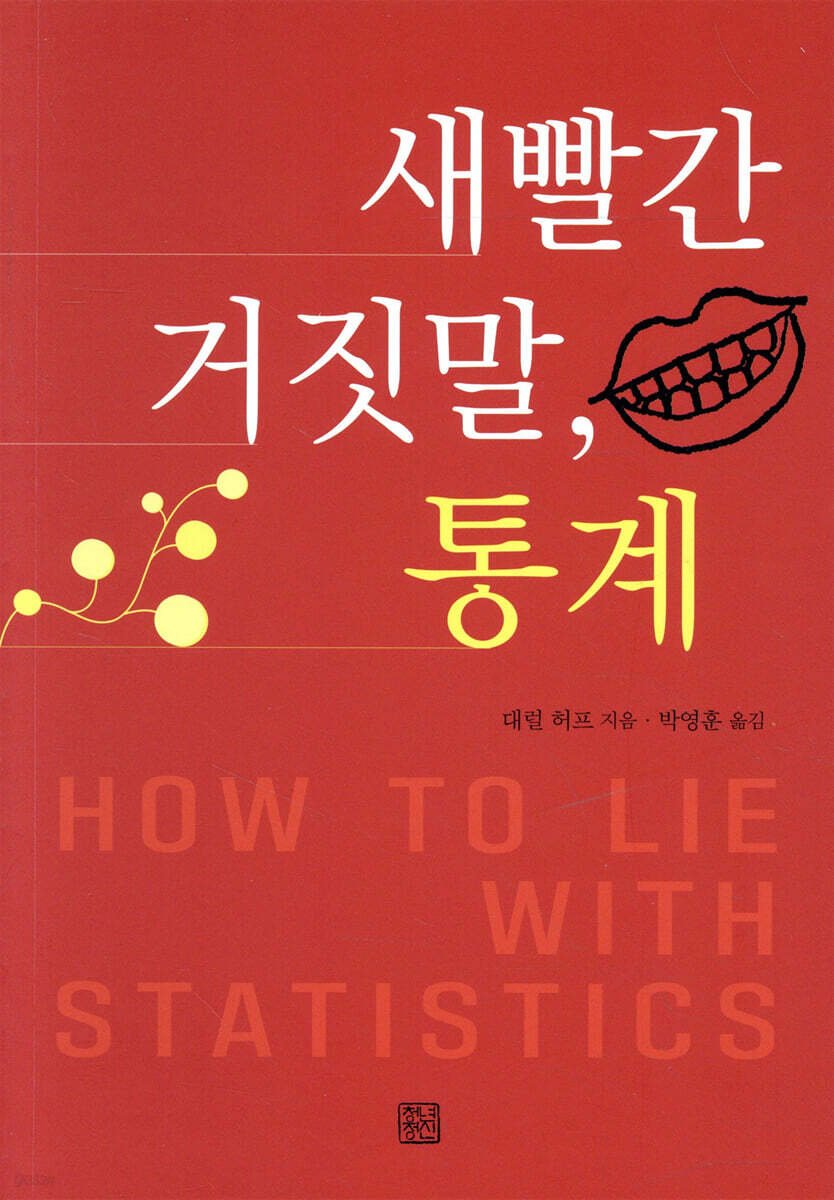
A blatant lie, statistics
 |
Description
Book Introduction
A book strongly recommended by Bill Gates twice.
This book is one of the best books published since 1950.
This book is filled with the best insights and humor.
_ From Bill Gates' TED talk
blatantly fraudulent opinion polls
He sharply points out, through humorous tone, the numerous pitfalls of statistics and opinion polls, the number games that deceive the public, and the use of various graphs and charts.
The author describes his book as "a kind of primer on how to cheat with statistics," and describes various tools necessary in a democratic society, including samples, averages, margins of error, graphs, and indices.
It also presents all the forms of statistics that statisticians like to use, analyzing sample studies, charting, interview techniques, and methods of extracting conclusions from numbers, and it shows vividly and clearly how statisticians use numbers and various statistical techniques to deceive the public and achieve their intentions, even though it has been quite a while since its first publication.
This book is one of the best books published since 1950.
This book is filled with the best insights and humor.
_ From Bill Gates' TED talk
blatantly fraudulent opinion polls
He sharply points out, through humorous tone, the numerous pitfalls of statistics and opinion polls, the number games that deceive the public, and the use of various graphs and charts.
The author describes his book as "a kind of primer on how to cheat with statistics," and describes various tools necessary in a democratic society, including samples, averages, margins of error, graphs, and indices.
It also presents all the forms of statistics that statisticians like to use, analyzing sample studies, charting, interview techniques, and methods of extracting conclusions from numbers, and it shows vividly and clearly how statisticians use numbers and various statistical techniques to deceive the public and achieve their intentions, even though it has been quite a while since its first publication.
- You can preview some of the book's contents.
Preview
index
Prologue
PART 1.
Always questionable opinion polls… … … … … … … … … 013
Average Annual Income of Yale University Graduates│Blind Spots in Sampling
Yale graduates with unknown addresses│Liars│Statistical manipulation
If the sample is skewed│Suspicion of possible skew│Random sampling method
Stratified Random Sampling│Kinsey Report
Distorted Conclusions According to the Questioner│Why Distorted Results Occur
PART 2.
The average is not one… … … … … … … … … … … … … … 043
How to cheat with averages│Appropriate averages│Average wages?
The average value that is relatively reliable
PART 3.
How to cheat by omitting small numbers… … … … … … 061
Why use a small sample size?
Values that vary with sample size│How to avoid being fooled
Gesell's Standard│Can you trust newspaper articles?
Parents are blind and pretending not to know│Don't be fooled by the graph.
PART 4.
A fuss over useless numbers… … … … … … 089
Is IQ Reliable?│Expected Error│No Matter How Small The Difference Is A Difference
PART 5 .
A graph that deceives the human eye… … … … … … … … … … … … 101
A Graph That Deceives the Eye│Small Things Make Big│Cutoff Bar Graphs
PART 6.
Seeing is believing? Absolutely not… … … … … … … … … 113
Bar graphs aren't enough | Visually stimulating graphic diagrams
exaggerated charts
PART 7.
Random statistics for the sake of the previous takeover… … … … … … … … 127
Forcing it on│Playing with numbers
Numbers are different from reality│Meaningless numbers
Numbers that appear every four years
PART 8 .
Statistics are also logic… … … … … … … … … … … … … … … … … … … 151
Smoking Hinders Studying? │Third Factor and Correlation
Negative Correlation│Female College Students Don't Get Married?
Milk Causes Cancer? │ New Hebrides Health Scale
PART 9.
How to manipulate statistics … … … … … … … … … … … … … … … 171
Manipulated Statistics│Colored Maps│Inappropriate Average Rules
How to make things look good with uselessly precise numbers
Cheating with Percentages│What is the Standard│Adding Percentages
Percentage, Percentage Point, Percentile│Causes of Inflation
Price index
PART 10.
Five Keys to Avoiding Statistical Deception… … 205
Spotting False Statistics│The First Key│The Second Key
Third Key Fourth Key│Fifth Key
PART 1.
Always questionable opinion polls… … … … … … … … … 013
Average Annual Income of Yale University Graduates│Blind Spots in Sampling
Yale graduates with unknown addresses│Liars│Statistical manipulation
If the sample is skewed│Suspicion of possible skew│Random sampling method
Stratified Random Sampling│Kinsey Report
Distorted Conclusions According to the Questioner│Why Distorted Results Occur
PART 2.
The average is not one… … … … … … … … … … … … … … 043
How to cheat with averages│Appropriate averages│Average wages?
The average value that is relatively reliable
PART 3.
How to cheat by omitting small numbers… … … … … … 061
Why use a small sample size?
Values that vary with sample size│How to avoid being fooled
Gesell's Standard│Can you trust newspaper articles?
Parents are blind and pretending not to know│Don't be fooled by the graph.
PART 4.
A fuss over useless numbers… … … … … … 089
Is IQ Reliable?│Expected Error│No Matter How Small The Difference Is A Difference
PART 5 .
A graph that deceives the human eye… … … … … … … … … … … … 101
A Graph That Deceives the Eye│Small Things Make Big│Cutoff Bar Graphs
PART 6.
Seeing is believing? Absolutely not… … … … … … … … … 113
Bar graphs aren't enough | Visually stimulating graphic diagrams
exaggerated charts
PART 7.
Random statistics for the sake of the previous takeover… … … … … … … … 127
Forcing it on│Playing with numbers
Numbers are different from reality│Meaningless numbers
Numbers that appear every four years
PART 8 .
Statistics are also logic… … … … … … … … … … … … … … … … … … … 151
Smoking Hinders Studying? │Third Factor and Correlation
Negative Correlation│Female College Students Don't Get Married?
Milk Causes Cancer? │ New Hebrides Health Scale
PART 9.
How to manipulate statistics … … … … … … … … … … … … … … … 171
Manipulated Statistics│Colored Maps│Inappropriate Average Rules
How to make things look good with uselessly precise numbers
Cheating with Percentages│What is the Standard│Adding Percentages
Percentage, Percentage Point, Percentile│Causes of Inflation
Price index
PART 10.
Five Keys to Avoiding Statistical Deception… … 205
Spotting False Statistics│The First Key│The Second Key
Third Key Fourth Key│Fifth Key
Into the book
Not only are the various average values obtained from data on a person's height, weight, chest circumference, and other body types almost identical, but their distribution is shown as a beautiful picture close to a curve called a normal distribution.
In other words, if these data are represented as a curve, it will be drawn in a bell shape, and the arithmetic mean, median, and mode will all be set to the same value.
--- p.50
Just because a statistical number is listed does not mean that the statistical number guarantees that fact.
Moreover, it is important to note that although these statistics were collected from Cornell University, the article's conclusion is not the same.
It can't be helped that you believe the article at face value because of your hasty personality.
--- p.163
His argument was that most statistical manipulations were due to incompetence, not the symbolism of fraudsters trying to fool people.
There is some truth to his protest.
I'm not sure if the following assumption will provide any comfort to statisticians, but I believe that statistical distortions and manipulations are not always the work of professional statisticians.
Because the naive numbers that come out of a statistician's desk are distorted, exaggerated, drastically omitted, and arbitrarily selected by salespeople, advertising professionals, journalists, and copywriters.
--- p.173
Don't just accept the statistics or numbers that appear in newspapers, magazines, brochures, or advertisements; you need to examine them more closely.
Because if you look carefully, you can easily spot fakes or tricks.
However, it is also problematic to blindly reject statistical methods.
This is like arguing that we should not read books or newspapers blindly because newspaper articles and books sometimes try to hide facts or relationships rather than reveal them.
--- p.203
The first thing to be careful of, above all else, is to detect distorted statistics.
For example, if a laboratory has tested something, it is necessary to find out whether it is done to show off the perfection of the theory they claim, for fame, or for money.
In the case of newspapers, it is also necessary to carefully examine whether their purpose is to publish desirable articles or whether there are other purposes, such as whether it is the union or management that are engaged in a tug-of-war over wage issues.
In other words, if these data are represented as a curve, it will be drawn in a bell shape, and the arithmetic mean, median, and mode will all be set to the same value.
--- p.50
Just because a statistical number is listed does not mean that the statistical number guarantees that fact.
Moreover, it is important to note that although these statistics were collected from Cornell University, the article's conclusion is not the same.
It can't be helped that you believe the article at face value because of your hasty personality.
--- p.163
His argument was that most statistical manipulations were due to incompetence, not the symbolism of fraudsters trying to fool people.
There is some truth to his protest.
I'm not sure if the following assumption will provide any comfort to statisticians, but I believe that statistical distortions and manipulations are not always the work of professional statisticians.
Because the naive numbers that come out of a statistician's desk are distorted, exaggerated, drastically omitted, and arbitrarily selected by salespeople, advertising professionals, journalists, and copywriters.
--- p.173
Don't just accept the statistics or numbers that appear in newspapers, magazines, brochures, or advertisements; you need to examine them more closely.
Because if you look carefully, you can easily spot fakes or tricks.
However, it is also problematic to blindly reject statistical methods.
This is like arguing that we should not read books or newspapers blindly because newspaper articles and books sometimes try to hide facts or relationships rather than reveal them.
--- p.203
The first thing to be careful of, above all else, is to detect distorted statistics.
For example, if a laboratory has tested something, it is necessary to find out whether it is done to show off the perfection of the theory they claim, for fame, or for money.
In the case of newspapers, it is also necessary to carefully examine whether their purpose is to publish desirable articles or whether there are other purposes, such as whether it is the union or management that are engaged in a tug-of-war over wage issues.
--- p.209
Publisher's Review
A kind of primer on how to cheat with statistics
"Statistics: A Bright Red Lie" is a must-read to avoid being deceived by the statistical figures presented by various organizations, including the government, the media, and public opinion research agencies.
Although this book was published quite a while ago and has been a steady seller, it doesn't feel outdated at all even when read now; rather, it feels perfectly relevant.
―Bill Gates
Darrell Huff describes his book as "a kind of primer on how to cheat with statistics," and he accurately describes many of the tools needed in a democratic society, including samples, averages, margins of error, graphs, and indices.
He also delves into every form of statistics that statisticians love to use, delving into sample studies, charting, interview techniques, and methods for extracting conclusions from numbers, exposing the countless tricks used to fool people rather than inform them.
The book has been hailed as a brilliant and brilliant blasphemy against a faith that, in our time, is full of outrageous lies.
Although it was published in 1954, it is still a classic and bestseller that is reprinted over and over again.
Even today, when statistics still leave us in a difficult situation, it serves as an excellent guide to avoid being fooled by numbers that make us believe without thinking.
statistical manipulation by corporations and governments
Unless you are an expert, the general public has no choice but to believe the statistics presented by broadcasts and the media.
In particular, statistical announcements made by the government have greater credibility.
However, it is said that economic growth rates, unemployment rates, and income inequality rates are highly likely to be manipulated according to the government's purposes and needs.
Think about it carefully.
Surely, everyone has tilted their head at least once after seeing statistics published in the newspaper.
Of course, I was puzzled and thought that I was a person who was far from the statistics.
Businessmen and politicians use a variety of data and statistics to manipulate public opinion, but ordinary people, unaware that such things are happening, believe the numbers they present when evaluating companies and government policies.
This kind of blind faith is what traps us.
Pollsters and statisticians deliberately use deception.
Opinion poll statistics related to political and social issues are delivered to us through the news at all times.
This is an election season, and we must never accept these figures without any filtering.
The figures presented by statisticians should be viewed with even greater skepticism.
They know statistics so well that they can fool us.
Numbers calculated by guesswork are always false, but accurate and scientific calculations done by well-trained statisticians using decimals and percentages are not.
Computers, like cameras, don't lie.
Unless someone does it intentionally.
The problem with this word "intentional" is that if experts intentionally force the public to believe scientific calculations using decimals and percentages, they will have no choice but to believe them, even if they are outright lies.
We are always exposed to statistics.
Whether you watch the news or read the newspaper, you see a vast amount of data organized into numbers and charts, and you believe it as is.
For those of us who only have basic common sense about statistics, we have no choice but to believe it and come to believe that it is true.
Separating the wheat from the chaff among election season statistics
As we enter the height of the election season, various statistics, along with approval ratings, are released daily through the media. Should we trust them all? Of course not.
Because these numbers could all be manipulated to your advantage.
So how do we distinguish between jade and stone?
Here are five tips from author Darrell Huff to help you spot a gem.
First, who announced it? We need to dig up the source.
Second, we must be careful about the research method and how we find out.
Third, you need to look for hidden data to see if there is any missing data.
Fourth, we must be careful not to change the issue to avoid changing the content.
Fifth, we need to examine whether the story makes sense.
Investigate any unclear parts.
Just knowing this much will help you maintain your own opinion in the midst of a deluge of statistics.
Can't we just take it any further from those who are already trying to control the people and manipulate them?
"Statistics: A Bright Red Lie" is a must-read to avoid being deceived by the statistical figures presented by various organizations, including the government, the media, and public opinion research agencies.
Although this book was published quite a while ago and has been a steady seller, it doesn't feel outdated at all even when read now; rather, it feels perfectly relevant.
―Bill Gates
Darrell Huff describes his book as "a kind of primer on how to cheat with statistics," and he accurately describes many of the tools needed in a democratic society, including samples, averages, margins of error, graphs, and indices.
He also delves into every form of statistics that statisticians love to use, delving into sample studies, charting, interview techniques, and methods for extracting conclusions from numbers, exposing the countless tricks used to fool people rather than inform them.
The book has been hailed as a brilliant and brilliant blasphemy against a faith that, in our time, is full of outrageous lies.
Although it was published in 1954, it is still a classic and bestseller that is reprinted over and over again.
Even today, when statistics still leave us in a difficult situation, it serves as an excellent guide to avoid being fooled by numbers that make us believe without thinking.
statistical manipulation by corporations and governments
Unless you are an expert, the general public has no choice but to believe the statistics presented by broadcasts and the media.
In particular, statistical announcements made by the government have greater credibility.
However, it is said that economic growth rates, unemployment rates, and income inequality rates are highly likely to be manipulated according to the government's purposes and needs.
Think about it carefully.
Surely, everyone has tilted their head at least once after seeing statistics published in the newspaper.
Of course, I was puzzled and thought that I was a person who was far from the statistics.
Businessmen and politicians use a variety of data and statistics to manipulate public opinion, but ordinary people, unaware that such things are happening, believe the numbers they present when evaluating companies and government policies.
This kind of blind faith is what traps us.
Pollsters and statisticians deliberately use deception.
Opinion poll statistics related to political and social issues are delivered to us through the news at all times.
This is an election season, and we must never accept these figures without any filtering.
The figures presented by statisticians should be viewed with even greater skepticism.
They know statistics so well that they can fool us.
Numbers calculated by guesswork are always false, but accurate and scientific calculations done by well-trained statisticians using decimals and percentages are not.
Computers, like cameras, don't lie.
Unless someone does it intentionally.
The problem with this word "intentional" is that if experts intentionally force the public to believe scientific calculations using decimals and percentages, they will have no choice but to believe them, even if they are outright lies.
We are always exposed to statistics.
Whether you watch the news or read the newspaper, you see a vast amount of data organized into numbers and charts, and you believe it as is.
For those of us who only have basic common sense about statistics, we have no choice but to believe it and come to believe that it is true.
Separating the wheat from the chaff among election season statistics
As we enter the height of the election season, various statistics, along with approval ratings, are released daily through the media. Should we trust them all? Of course not.
Because these numbers could all be manipulated to your advantage.
So how do we distinguish between jade and stone?
Here are five tips from author Darrell Huff to help you spot a gem.
First, who announced it? We need to dig up the source.
Second, we must be careful about the research method and how we find out.
Third, you need to look for hidden data to see if there is any missing data.
Fourth, we must be careful not to change the issue to avoid changing the content.
Fifth, we need to examine whether the story makes sense.
Investigate any unclear parts.
Just knowing this much will help you maintain your own opinion in the midst of a deluge of statistics.
Can't we just take it any further from those who are already trying to control the people and manipulate them?
GOODS SPECIFICS
- Date of issue: January 10, 2022
- Page count, weight, size: 238 pages | 350g | 140*200*20mm
- ISBN13: 9788958612131
- ISBN10: 8958612134
You may also like
카테고리
korean


korean

![ELLE 엘르 스페셜 에디션 A형 : 12월 [2025]](http://librairie.coreenne.fr/cdn/shop/files/b8e27a3de6c9538896439686c6b0e8fb.jpg?v=1766436872&width=3840)


