

Chemical Chronicles
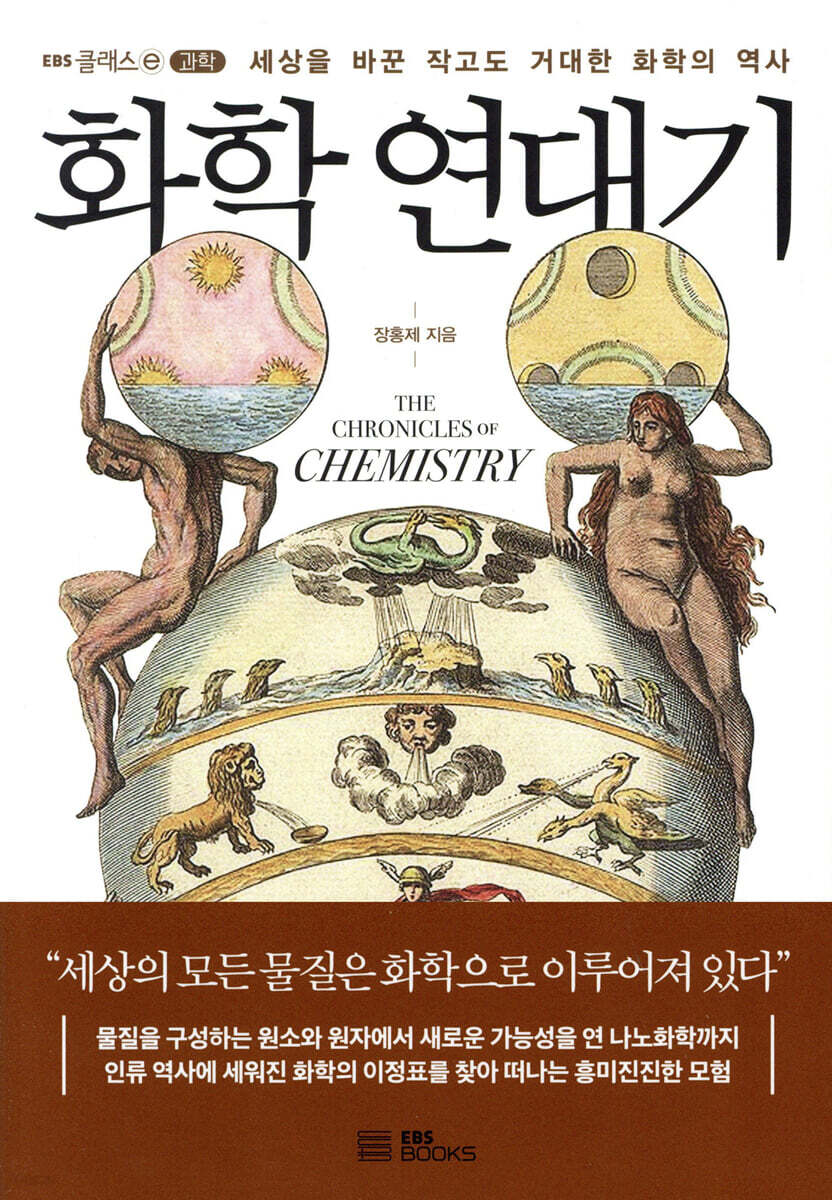 |
Description
Book Introduction
Moving human history from an invisible place
The small yet wonderful world of chemists and chemistry!
It started with the birth of the universe
A fascinating intellectual journey to discover milestones in the history of chemistry.
What is the material that surrounds us made of? From the discovery of the elements and atoms that make up all matter on earth, to the emergence of nanochemistry, which opened up new possibilities for humanity, history has witnessed martyrs of chemistry, those who achieved great feats with a relentless spirit of challenge, and the chemistry that emerged from them.
"Chronicles of Chemistry" is a monumental work that traces the birth, development, and rapid changes and exploration of chemistry, a discipline as vast as the universe and as wondrous as the origin of all life, based on experiments and facts.
This extensive and meticulous work provides a broad perspective on chemistry in history and the history of chemistry.
The small yet wonderful world of chemists and chemistry!
It started with the birth of the universe
A fascinating intellectual journey to discover milestones in the history of chemistry.
What is the material that surrounds us made of? From the discovery of the elements and atoms that make up all matter on earth, to the emergence of nanochemistry, which opened up new possibilities for humanity, history has witnessed martyrs of chemistry, those who achieved great feats with a relentless spirit of challenge, and the chemistry that emerged from them.
"Chronicles of Chemistry" is a monumental work that traces the birth, development, and rapid changes and exploration of chemistry, a discipline as vast as the universe and as wondrous as the origin of all life, based on experiments and facts.
This extensive and meticulous work provides a broad perspective on chemistry in history and the history of chemistry.
- You can preview some of the book's contents.
Preview
index
Introduction | What is Chemistry?
Chapter 1 | The Beginning of Everything: Origins
Chapter 2 | A Civilization in the Making: The Age of Material
Chapter 3 | The Birth of Philosophical Thought: Elemental Theory and Atomic Theory
Chapter 4 | Bridgehead to Modern Chemistry: Alchemy
Chapter 5 | Chemistry on the Waves of History: A Turbulent Age
Chapter 6 | Defense Against Authority: Scientific Revolutions
Chapter 7 | Exploding Detonators: The Chemical Revolution
Chapter 8 | The Age of Elemental Discovery: Analytical Chemistry
Chapter 9 | The Struggle Over the Invention of the Periodic Table: Inorganic Chemistry
Chapter 10 | In Search of the Secrets of Heat and Energy: Physical Chemistry
Chapter 11 | A Passionate Exploration of Bonding and Structure: Organic Chemistry
Chapter 12 | Opening a New Era: Industrial and Medicinal Chemistry
Chapter 13 | The Birth of the Singularity: Quantum Chemistry
Chapter 14 | From Single Molecules to Polymers: Fiber Chemistry and Biochemistry
Chapter 15 | A New Engine of Chemical Growth: Nanochemistry
main
Image source
Appendix | Nobel Prize in Chemistry Winners and Awards
Chapter 1 | The Beginning of Everything: Origins
Chapter 2 | A Civilization in the Making: The Age of Material
Chapter 3 | The Birth of Philosophical Thought: Elemental Theory and Atomic Theory
Chapter 4 | Bridgehead to Modern Chemistry: Alchemy
Chapter 5 | Chemistry on the Waves of History: A Turbulent Age
Chapter 6 | Defense Against Authority: Scientific Revolutions
Chapter 7 | Exploding Detonators: The Chemical Revolution
Chapter 8 | The Age of Elemental Discovery: Analytical Chemistry
Chapter 9 | The Struggle Over the Invention of the Periodic Table: Inorganic Chemistry
Chapter 10 | In Search of the Secrets of Heat and Energy: Physical Chemistry
Chapter 11 | A Passionate Exploration of Bonding and Structure: Organic Chemistry
Chapter 12 | Opening a New Era: Industrial and Medicinal Chemistry
Chapter 13 | The Birth of the Singularity: Quantum Chemistry
Chapter 14 | From Single Molecules to Polymers: Fiber Chemistry and Biochemistry
Chapter 15 | A New Engine of Chemical Growth: Nanochemistry
main
Image source
Appendix | Nobel Prize in Chemistry Winners and Awards
Detailed image

Into the book
Before the advent of mankind, the singularity and diversity of matter were created through a series of chemical reactions that mankind could never control.
Simple molecules endlessly reacted, clumping together, separating, and swapping places with each other, using water as a solvent that could dissolve various substances.
What drives this and what processes lead to its creation have long been unknown.
All of these processes led to the incredible result of the birth of life, and the field that elucidated and achieved this was chemistry.
--- pp.34-35
Alchemy, which is interpreted to mean 'practicing chemistry', has endlessly explored and pursued knowledge related to two aspects that have been considered important since the beginning of human civilization.
One was to synthesize gold, which had become the pinnacle of material value, and to create medicines for medical purposes, while the other was to renew the old and seek the soul from the body.
--- pp.103-104
Just as with the flow of all things in the world, the development of learning also repeats periods of rise, stagnation, and decline.
After the birth of empirical scientific philosophy and the development of methods for producing mineral acids and alcohol, which marked the peak of intellectual progress, the 14th and 15th centuries were a dark age of stagnation and decline in chemistry.
--- p.165
Lavoisier was the only person who realized that dephlogistonized air, or oxygen, was the key to overturning the phlogiston theory that dominated the academic world at the time.
It is no exaggeration to say that the development of chemistry can be divided into the period before and after Lavoisier, who established the system and created standards for expression and communication, and that is why we call it the chemical revolution.
--- p.237
The reflection on the essential meaning of combustion, a common and natural chemical reaction, and the interest in the ubiquitous air and gaseous substances served as the fuse for the chemical revolution.
Chemistry, which had not previously been fully established as a discipline, began to develop explosively, differentiating itself from alchemy, distancing itself from philosophy, and separating itself from medicine.
--- p.207
At present, the most attractive field encompassing cutting-edge science is nanoscience.
And all approaches to chemistry that work and take place in the nano-world are again categorized as nanochemistry.
Simple molecules endlessly reacted, clumping together, separating, and swapping places with each other, using water as a solvent that could dissolve various substances.
What drives this and what processes lead to its creation have long been unknown.
All of these processes led to the incredible result of the birth of life, and the field that elucidated and achieved this was chemistry.
--- pp.34-35
Alchemy, which is interpreted to mean 'practicing chemistry', has endlessly explored and pursued knowledge related to two aspects that have been considered important since the beginning of human civilization.
One was to synthesize gold, which had become the pinnacle of material value, and to create medicines for medical purposes, while the other was to renew the old and seek the soul from the body.
--- pp.103-104
Just as with the flow of all things in the world, the development of learning also repeats periods of rise, stagnation, and decline.
After the birth of empirical scientific philosophy and the development of methods for producing mineral acids and alcohol, which marked the peak of intellectual progress, the 14th and 15th centuries were a dark age of stagnation and decline in chemistry.
--- p.165
Lavoisier was the only person who realized that dephlogistonized air, or oxygen, was the key to overturning the phlogiston theory that dominated the academic world at the time.
It is no exaggeration to say that the development of chemistry can be divided into the period before and after Lavoisier, who established the system and created standards for expression and communication, and that is why we call it the chemical revolution.
--- p.237
The reflection on the essential meaning of combustion, a common and natural chemical reaction, and the interest in the ubiquitous air and gaseous substances served as the fuse for the chemical revolution.
Chemistry, which had not previously been fully established as a discipline, began to develop explosively, differentiating itself from alchemy, distancing itself from philosophy, and separating itself from medicine.
--- p.207
At present, the most attractive field encompassing cutting-edge science is nanoscience.
And all approaches to chemistry that work and take place in the nano-world are again categorized as nanochemistry.
--- p.491
Publisher's Review
There was chemistry in everything and everywhere.
What is chemistry?
When we think of chemistry, we often picture the rigid periodic table of elements and a laboratory filled with dangerous-looking reagents, and we tend to assume that it is a field unrelated to us.
But in fact, we have an inseparable relationship with chemistry.
From the moment we open our eyes in the morning to the moment we start our day until we go to bed again, everything we eat, drink, wear, and use is a product of chemistry.
In other words, the world we live in is all 'made of something'.
But what exactly are these substances made of and how are they made? This is the question that begins our journey with this book, "Chronicles of Chemistry."
In fact, chemistry is much more vast, diverse, and mysterious than we usually think.
The elements that make up the Earth we live on now and the elements that make up an unknown planet millions of light years away are completely identical in quality, even though their overall composition ratios may be different.
The hydrogen that makes up the water we drink today is the same as the metallic hydrogen that is known to fill the interior of Jupiter, and the iron in the spoons we use when we eat is the exact same element as the iron in the soil that covers the surface of Mars.
The wonders of chemistry don't stop there.
The elements and atoms that made up dinosaurs and other life forms that ruled the Earth before humans were created are being completely recycled and used to make up our living, breathing bodies.
Iron, which once covered the surface of the Earth, is now the most important component of hemoglobin in red blood cells, which carries oxygen in our bodies, and iridium, which came from the meteorite that wiped out the dinosaurs, has been used as a compass material to guide us through the ocean.
The elements that formed the Earth's ecosystem billions of years ago are still around us in various reactions, including combustion, distillation, compression, substitution, decomposition, crystallization, melting, and addition, even as we read this book.
Moving the world from an invisible place
Chemists and the Hidden History of Chemistry
In human history, chemistry can be said to be a tremendous journey that began with the origin of life.
After the Earth was born, DNA and RNA were created through chemical reactions, and life emerged and evolved to reach the present.
In this process, the discipline of chemistry was formed through various forms, including superstition, folk remedies, and alchemy, along with the interpretations of ancient philosophers on the theory of elements and atomic theory.
The challenges, successes, trials and errors, and failures that accompanied the persistent experiments of early scientists were inevitable.
French chemist Lavoisier devoted his life to proving that wood was not burning because of a hypothetical substance called phlogiston, and Italian chemist and physicist Avogadro distinguished between atoms and molecules and figured out their relationships, yet no one paid any attention to his work throughout his life.
Also, British chemist Newlands came close to inventing the periodic table, but was ridiculed by others and left the chemistry world.
Swedish chemist Scheele discovered numerous elements based on his innate ability to design experiments and analyze them, but he suffered serious physical problems due to his research on several toxic substances.
But thanks to their pure passion to uncover the secrets of matter, humanity has made progress.
Since the formation of chemistry, the challenge of understanding and defining elements has triggered the rapid development of analytical chemistry and inorganic chemistry, and organic chemistry, which sprouted from the isolation and purification of pharmaceuticals and practical compounds, has continued to develop into the modern era.
Furthermore, the process of elucidating atoms through physics theory and experimental results, leading to thermodynamics and quantum mechanics, became the basis for fundamentally understanding chemical reactions, which had previously been confined to alchemical techniques.
Physical chemistry subsequently established itself as a field that studies the chemical properties of substances, and interest in the elements and functions that make up life reactions formed biochemistry.
Throughout the major events of human history, including subsequent industrialization, two world wars, and the colonial era, chemistry has always held a central position, even without our noticing it.
Lavoisier's colleague Watt improved the steam engine, and the French engineer Nicolas-Joseph Cugnot created a steam car.
After the internal combustion engine was developed, Henry Ford designed the first form of automobile, and the importance of tires came to the forefront.
The war on tires triggered the production of chemical products such as synthetic rubber, polymers, dyes, and gunpowder.
Since then, numerous derivative fields, including industrial chemistry, polymer chemistry, and environmental chemistry, have emerged, and interest has now expanded to the world of nano-materials, which cannot be observed with the naked eye and are the most significant world in terms of chemistry, leading to the development of a new field called nanochemistry.
It is still unknown what lies behind these challenges.
However, as Professor Jang Hong-je, the author of this book, says, chemistry is a fascinating discipline that does not easily reveal answers, and therefore, it is clear that the journey of chemistry will continue along with the vast time of the universe.
『Chronicles of Chemistry』 is a monumental work that historically traces the birth and development of chemistry, its rapid changes and explorations, based on experiments and facts. It is also a tribute to chemists who, just as they silently searched for gold long ago, through experimentation and experience, logic and reasoning, understanding and analysis, have uncovered the secrets of all substances that surround the world.
What is chemistry?
When we think of chemistry, we often picture the rigid periodic table of elements and a laboratory filled with dangerous-looking reagents, and we tend to assume that it is a field unrelated to us.
But in fact, we have an inseparable relationship with chemistry.
From the moment we open our eyes in the morning to the moment we start our day until we go to bed again, everything we eat, drink, wear, and use is a product of chemistry.
In other words, the world we live in is all 'made of something'.
But what exactly are these substances made of and how are they made? This is the question that begins our journey with this book, "Chronicles of Chemistry."
In fact, chemistry is much more vast, diverse, and mysterious than we usually think.
The elements that make up the Earth we live on now and the elements that make up an unknown planet millions of light years away are completely identical in quality, even though their overall composition ratios may be different.
The hydrogen that makes up the water we drink today is the same as the metallic hydrogen that is known to fill the interior of Jupiter, and the iron in the spoons we use when we eat is the exact same element as the iron in the soil that covers the surface of Mars.
The wonders of chemistry don't stop there.
The elements and atoms that made up dinosaurs and other life forms that ruled the Earth before humans were created are being completely recycled and used to make up our living, breathing bodies.
Iron, which once covered the surface of the Earth, is now the most important component of hemoglobin in red blood cells, which carries oxygen in our bodies, and iridium, which came from the meteorite that wiped out the dinosaurs, has been used as a compass material to guide us through the ocean.
The elements that formed the Earth's ecosystem billions of years ago are still around us in various reactions, including combustion, distillation, compression, substitution, decomposition, crystallization, melting, and addition, even as we read this book.
Moving the world from an invisible place
Chemists and the Hidden History of Chemistry
In human history, chemistry can be said to be a tremendous journey that began with the origin of life.
After the Earth was born, DNA and RNA were created through chemical reactions, and life emerged and evolved to reach the present.
In this process, the discipline of chemistry was formed through various forms, including superstition, folk remedies, and alchemy, along with the interpretations of ancient philosophers on the theory of elements and atomic theory.
The challenges, successes, trials and errors, and failures that accompanied the persistent experiments of early scientists were inevitable.
French chemist Lavoisier devoted his life to proving that wood was not burning because of a hypothetical substance called phlogiston, and Italian chemist and physicist Avogadro distinguished between atoms and molecules and figured out their relationships, yet no one paid any attention to his work throughout his life.
Also, British chemist Newlands came close to inventing the periodic table, but was ridiculed by others and left the chemistry world.
Swedish chemist Scheele discovered numerous elements based on his innate ability to design experiments and analyze them, but he suffered serious physical problems due to his research on several toxic substances.
But thanks to their pure passion to uncover the secrets of matter, humanity has made progress.
Since the formation of chemistry, the challenge of understanding and defining elements has triggered the rapid development of analytical chemistry and inorganic chemistry, and organic chemistry, which sprouted from the isolation and purification of pharmaceuticals and practical compounds, has continued to develop into the modern era.
Furthermore, the process of elucidating atoms through physics theory and experimental results, leading to thermodynamics and quantum mechanics, became the basis for fundamentally understanding chemical reactions, which had previously been confined to alchemical techniques.
Physical chemistry subsequently established itself as a field that studies the chemical properties of substances, and interest in the elements and functions that make up life reactions formed biochemistry.
Throughout the major events of human history, including subsequent industrialization, two world wars, and the colonial era, chemistry has always held a central position, even without our noticing it.
Lavoisier's colleague Watt improved the steam engine, and the French engineer Nicolas-Joseph Cugnot created a steam car.
After the internal combustion engine was developed, Henry Ford designed the first form of automobile, and the importance of tires came to the forefront.
The war on tires triggered the production of chemical products such as synthetic rubber, polymers, dyes, and gunpowder.
Since then, numerous derivative fields, including industrial chemistry, polymer chemistry, and environmental chemistry, have emerged, and interest has now expanded to the world of nano-materials, which cannot be observed with the naked eye and are the most significant world in terms of chemistry, leading to the development of a new field called nanochemistry.
It is still unknown what lies behind these challenges.
However, as Professor Jang Hong-je, the author of this book, says, chemistry is a fascinating discipline that does not easily reveal answers, and therefore, it is clear that the journey of chemistry will continue along with the vast time of the universe.
『Chronicles of Chemistry』 is a monumental work that historically traces the birth and development of chemistry, its rapid changes and explorations, based on experiments and facts. It is also a tribute to chemists who, just as they silently searched for gold long ago, through experimentation and experience, logic and reasoning, understanding and analysis, have uncovered the secrets of all substances that surround the world.
GOODS SPECIFICS
- Publication date: May 26, 2021
- Page count, weight, size: 572 pages | 876g | 145*210*34mm
- ISBN13: 9788954758239
- ISBN10: 8954758231
You may also like
카테고리
korean


korean

![GQ KOREA Mark (Monthly): December [2025]](http://librairie.coreenne.fr/cdn/shop/files/8ef265dbbfbf186523ed75ba7319009d.jpg?v=1765340328&width=3840)


