

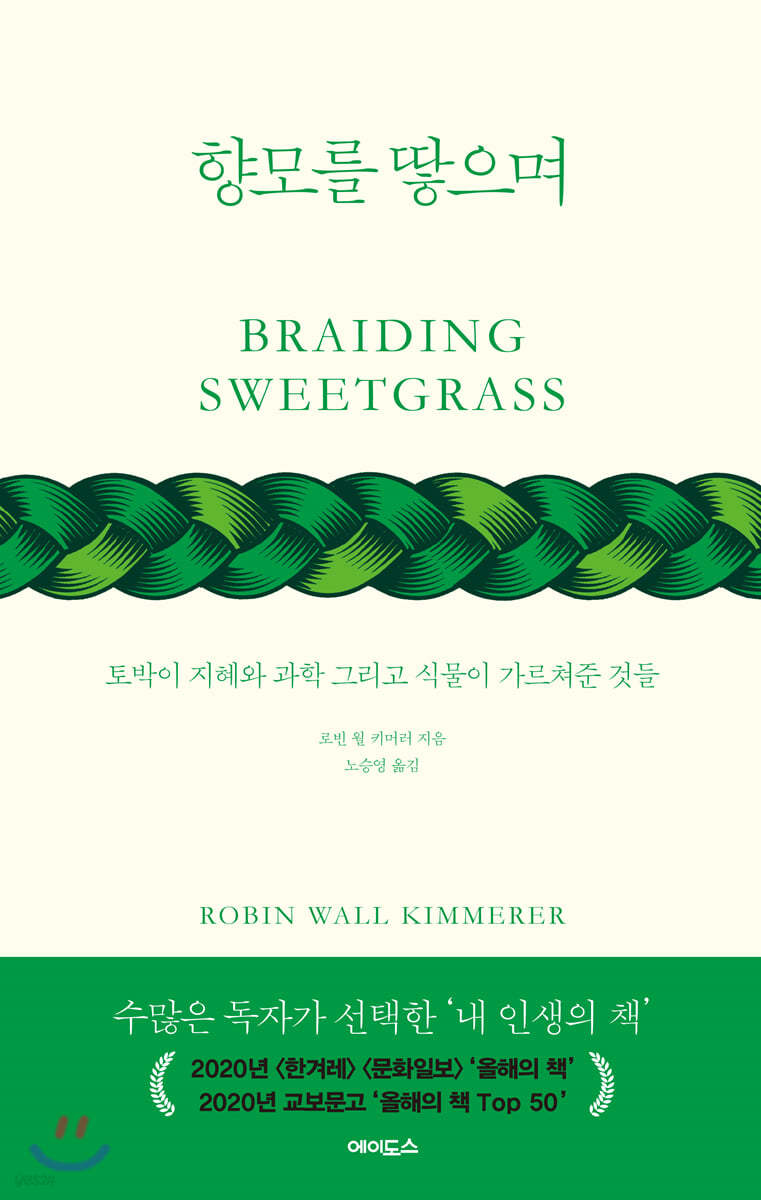
Braiding the Fragrant Hair (Popular Edition)
 |
Description
Book Introduction
This is a popular edition of 『Braiding Fragrance』, which was selected as the 'Book of the Year' in 2020 by [Hankyoreh], [Culture Daily], [Maeil Business Newspaper], [Sisa IN], etc. and has established itself as the 'Book of My Life' for numerous readers.
This book is about what a plant ecologist of Native American descent experienced, felt, and realized while pursuing the path of science and finding his roots.
In this book, which is imbued with botanical knowledge, indigenous mythology and culture, life wisdom and philosophy, and the language and attitude of a humble scientist toward nature, the author seeks to blend old and new stories, indigenous wisdom and science.
The fragmented relationship between humans and nature, and the capitalist commodity economy and culture that exploits nature, are seriously reflected upon through science that reveals the secrets of reciprocity between humans and nature, and through indigenous traditions and wisdom that revive the meaning of a culture of gratitude and a gift economy. These are rewritten as a new story that restores the broken relationship between humans and nature.
As a mother, a scientist, and a member of an Indian tribe that has been marginalized in American history, her life experiences and realizations are captured in beautiful sentences and stories.
This book is about what a plant ecologist of Native American descent experienced, felt, and realized while pursuing the path of science and finding his roots.
In this book, which is imbued with botanical knowledge, indigenous mythology and culture, life wisdom and philosophy, and the language and attitude of a humble scientist toward nature, the author seeks to blend old and new stories, indigenous wisdom and science.
The fragmented relationship between humans and nature, and the capitalist commodity economy and culture that exploits nature, are seriously reflected upon through science that reveals the secrets of reciprocity between humans and nature, and through indigenous traditions and wisdom that revive the meaning of a culture of gratitude and a gift economy. These are rewritten as a new story that restores the broken relationship between humans and nature.
As a mother, a scientist, and a member of an Indian tribe that has been marginalized in American history, her life experiences and realizations are captured in beautiful sentences and stories.
- You can preview some of the book's contents.
Preview
index
Preface 010
Planting fragrant flowers
Sky Lady Falls 015
Pecan Meeting 026
Strawberry Gift 043
Bachim 058
Chamchwi and Miyeokchwi 066
Grammar of the Eurythmian 079
Caring for the fragrant grass
Maple Leaf Moon 099
Location Hazel 111
Mom's Work 126
Comfort of Training 150
Vow of Gratitude 160
Picking out incense sticks
Realizing by Looking at Beans 181
Three Sisters 190
Whisgak Gok Phenagen: Black Ash Basket 209
Mishukos Kenomagwen: Teachings of the Grass 231
Maple Nation: Citizenship Guide 247
259 Receiving Harvest
Braiding the fragrant hair
In Nana Bozo's Footsteps: How to Become a Native American 301
Silver Bell Sound 317
Sitting around 328
Fire 355 at Cascade Head
Putting Down Roots 373
Umbilicaria: The Navel of the World 393
Old Child 406
Witness of the Rain 429
Burning incense
Windigo Footprint 443
The Sacred and Superfund 453
Corn Man, Light Man 497
Collateral Damage 507
Shukitagen: The Seventh Fire People 525
Win against Windigo 547
Review: Repaying the Gift 557
Reference 564
Acknowledgements 566
Search 569
Planting fragrant flowers
Sky Lady Falls 015
Pecan Meeting 026
Strawberry Gift 043
Bachim 058
Chamchwi and Miyeokchwi 066
Grammar of the Eurythmian 079
Caring for the fragrant grass
Maple Leaf Moon 099
Location Hazel 111
Mom's Work 126
Comfort of Training 150
Vow of Gratitude 160
Picking out incense sticks
Realizing by Looking at Beans 181
Three Sisters 190
Whisgak Gok Phenagen: Black Ash Basket 209
Mishukos Kenomagwen: Teachings of the Grass 231
Maple Nation: Citizenship Guide 247
259 Receiving Harvest
Braiding the fragrant hair
In Nana Bozo's Footsteps: How to Become a Native American 301
Silver Bell Sound 317
Sitting around 328
Fire 355 at Cascade Head
Putting Down Roots 373
Umbilicaria: The Navel of the World 393
Old Child 406
Witness of the Rain 429
Burning incense
Windigo Footprint 443
The Sacred and Superfund 453
Corn Man, Light Man 497
Collateral Damage 507
Shukitagen: The Seventh Fire People 525
Win against Windigo 547
Review: Repaying the Gift 557
Reference 564
Acknowledgements 566
Search 569
Detailed image
.jpg)
Into the book
“As I left the forest of my childhood and entered college, my worldview changed without me realizing it.
It is a natural history of experience that regards plants as teachers and companions connected with us through mutual responsibility, and has entered the realm of science.
The question scientists ask is not “Who are you?” but “What is that?”
No one ever asked the plants, “What can you tell us?”
The main question asked was, “What is the principle behind that?”
The botany I learned was reductionist, mechanistic, and strictly objective.
Plants were reduced to objects rather than subjects.
The way botany was conceived and taught didn't leave much room for people like me to think like that.
“The only way I could make sense of the situation was to conclude that what I had always believed about plants couldn’t possibly be true.”
--- p.70
“After going around and around, I arrived at the place where I started, the question of beauty.
That was a question that science did not ask.
It's not that it's unimportant, but that science as a way of knowing is too narrow to handle such questions.
If my advisor had been a better scholar, he would have praised my questions rather than dismissed them.
He argued that beauty is in the eye of the beholder and that science separates the observer from the observed, so beauty cannot by definition be a valid scientific question.
But the answer I should have heard was that my question was bigger than science.”
--- p.74~75
“You may walk the path of fear and despair.
We can chronicle the horrific scenes of ecological destruction.
…you can also see pelicans covered in oil.
What about a murder scene where a mountainside is cleared with a chainsaw, leaving the debris flowing into the river? The carcass of an extinct Amazonian primate.
A parking lot made by paving the prairie.
A polar bear unable to move on melting ice floes.
What could such a sight evoke but heartbreak and tears? Joanna Macy wrote that we cannot love the Earth until we grieve for it.
Grief is a sign of spiritual health.
But it is not enough to just mourn the lost landscape.
We must lay our hands on the earth and make ourselves whole again.
Even a wounded world feeds us.
Even a wounded world supports us and gives us moments of surprise and joy.
I choose joy over despair.
It's not that I'm turning a blind eye to reality, but because joy is what the earth gives me every day, and I have to return that gift.
We are bombarded with information showing us that the world is being destroyed, yet we are told nothing about how to nourish it.
It's no wonder that environmentalism has become synonymous with bleak prophecies and helplessness.
“When our innate drive to do the right thing, no matter what, is suppressed, it breeds despair rather than sparking action.”
It is a natural history of experience that regards plants as teachers and companions connected with us through mutual responsibility, and has entered the realm of science.
The question scientists ask is not “Who are you?” but “What is that?”
No one ever asked the plants, “What can you tell us?”
The main question asked was, “What is the principle behind that?”
The botany I learned was reductionist, mechanistic, and strictly objective.
Plants were reduced to objects rather than subjects.
The way botany was conceived and taught didn't leave much room for people like me to think like that.
“The only way I could make sense of the situation was to conclude that what I had always believed about plants couldn’t possibly be true.”
--- p.70
“After going around and around, I arrived at the place where I started, the question of beauty.
That was a question that science did not ask.
It's not that it's unimportant, but that science as a way of knowing is too narrow to handle such questions.
If my advisor had been a better scholar, he would have praised my questions rather than dismissed them.
He argued that beauty is in the eye of the beholder and that science separates the observer from the observed, so beauty cannot by definition be a valid scientific question.
But the answer I should have heard was that my question was bigger than science.”
--- p.74~75
“You may walk the path of fear and despair.
We can chronicle the horrific scenes of ecological destruction.
…you can also see pelicans covered in oil.
What about a murder scene where a mountainside is cleared with a chainsaw, leaving the debris flowing into the river? The carcass of an extinct Amazonian primate.
A parking lot made by paving the prairie.
A polar bear unable to move on melting ice floes.
What could such a sight evoke but heartbreak and tears? Joanna Macy wrote that we cannot love the Earth until we grieve for it.
Grief is a sign of spiritual health.
But it is not enough to just mourn the lost landscape.
We must lay our hands on the earth and make ourselves whole again.
Even a wounded world feeds us.
Even a wounded world supports us and gives us moments of surprise and joy.
I choose joy over despair.
It's not that I'm turning a blind eye to reality, but because joy is what the earth gives me every day, and I have to return that gift.
We are bombarded with information showing us that the world is being destroyed, yet we are told nothing about how to nourish it.
It's no wonder that environmentalism has become synonymous with bleak prophecies and helplessness.
“When our innate drive to do the right thing, no matter what, is suppressed, it breeds despair rather than sparking action.”
--- p.477~478
Publisher's Review
2020 [Hankyoreh] [Culture Daily] 《Sisa IN》 'Book of the Year'
Kyobo Book Centre's 2020 Top 50 Books of the Year
2020 Yes24's "Books of the Year" by 50 Authors, Publishers, Journalists, and MDs
Aladdin's 2020 Book of the Year Nominees
[Maeil Business Newspaper] · Kyobo Book Centre's "50 Books to Open 2021"
[Kookmin Ilbo] "20 Books You Can't Miss in 2020"
Finalist in the Translation Category of the 61st Korean Publishing Culture Awards
Literary Hub's "Top 10 Essays of the 2010s"
[New York Times] Bestseller
[Washington Post] Bestseller
The book of my life, chosen by countless readers!
This book is a story of memory, tradition, wisdom, restoration, healing, and new knowledge.
A girl who was born and raised in the countryside and was very curious about why the wild chives and seaweed were so beautiful and in harmony with each other, and wanted to know the secret.
So, an Indian female student entered the botany department at a university, but was told by her advisor that "that's not science" and that "I'll correct your thinking."
A botanist who entered the path of science and acquired the powerful extension of science, but by chance was drawn to the language, sounds, and wisdom of living things that science could not contain or hear, and who reflects on science and seeks new knowledge.
A member of a tribe that traces back the traditions, lives, language, wisdom, and stories of their ancestors, who were erased and forgotten in a history of persecution and oppression.
This book is a dazzlingly beautiful story of a mother of two daughters, a botanist, and a traveler who transcends indigenous knowledge and science.
The story of Sky Woman and Eve.
How we, the human species, who were originally 'immigrants', can become 'natives' of this land
The book begins with 'The Tale of the Sky Lady'.
Why did the author, a scientist, bring up the Sky Woman myth? In the Sky Woman story, the birth myth of the North American continent, also known as Turtle Island, Sky Woman is described as "the ancestor of farmers and co-creator of a good, green world."
And for the immigrants who came to the Americas after 1492, there was Eve, who was driven out of Eden.
Eve, who was 'expelled' from Eden, had to sweat to fill her stomach, and to fill her stomach, she had to conquer the wasteland.
In a way, Eve symbolizes the myth of modern man exploiting nature, while Sky Woman symbolizes the story of healing the broken earth.
The book says that the place where the Sky Woman from the indigenous people's tales and the Eve from the settlers' tales meet is the present-day North American continent and the land we stand on.
The important thing is that both Sky Woman and Eve are 'immigrants'.
The Sky Woman who fell from the sky and came to Turtle Island, and Eve who was banished from Eden.
But one became a native, and the other still acts like an immigrant.
The author tells us to look at the legacy of Eve who was driven out of Eden.
"The land is tainted by exploitative relationships." How did this come to be? A clue lies in the words of a tribal elder.
“Even though many ages have passed since Columbus, the wisest of our native elders still wonder who came to our shores.
They look at the damage the land has suffered and say:
'The problem with these new people is that they don't have both feet on the shore.
One foot is still in the boat.
“They don’t seem to know whether they are staying or not.” (pp. 304-305)
The starting point for restoring the broken relationship between humans and the land is for immigrants to abandon the colonialist ways and become 'natives.'
The reason Sky Woman, who was originally an immigrant, became a native was because she shared an act of reciprocity, an act of give and take, with the land.
“Becoming a native of a place means living as if our children’s future depended on it, caring for the land as if our material and spiritual lives depended on it.”
The author's journey begins and ends with this story in the folktale.
What kind of ‘knowledge’, ‘wisdom’, and ‘culture’ shall we talk about?
Blending Native Wisdom and Science
There are two intersecting stories in the book.
There is a story about a girl who played with nature in the countryside, entered the botany department of a university, and then entered a world-class ecology program, and went on to become a scientist.
Another is the story of a man who revives the culture and history of a persecuted indigenous minority tribe and finds his roots.
As the scientist walks the path of science, he learns the power of scientific reasoning, how to separate and distinguish perception from material reality, how to atomize complex objects into their smallest components, and how to look up to the chain of evidence and logic. On the other hand, he traces the history of his ancestors who suffered from forced migration and the eradication of their traditions, meets indigenous people who listen to the voice of plants with their hearts rather than as subjects of experiments, meets traditional basket makers, learns the language of his tribe, of which only nine people in the world can speak, seeks out sable hunters who know with their bodies and minds the reciprocal relationship between nature and humans, tribal elders who advise 'learn from those who stand (plants),' and indigenous people who continue the tradition of giving thanks speeches.
The intersection of stories leads to the fusion of two forms of knowing, two types of knowledge.
Perhaps, if the author had not followed the path of science, he would not have thought of the fusion of traditional knowledge and science.
Science, that is, 'the way we measure, record, and analyze, which may seem lifeless, is for us a passageway to understanding the enigmatic lives of non-human species,' 'a way of crossing species boundaries, a way of shedding our human skin and wearing fins, feathers, and leaves to know other beings as fully as we can.'
But science is not a complete language for understanding the world.
“Scientists are particularly good at learning about the lives of other species.
The stories they tell convey the inherent value of the lives of other beings, lives that are in every way as interesting, if not more interesting, than the lives of Homo sapiens.
But scientists, despite knowing that other beings have intelligence, seem to believe that their own intelligence is the only intelligence they can access.
Scientists are missing a basic ingredient.
“It is humility.”
Practicing science with awe and humility toward nature can be a powerful act of reciprocal engagement with the world beyond humanity.
The author's search for a blend of science and indigenous knowledge is related to reviving the lost reciprocal relationship between humans and nature.
What this means is that when we blend the two types of knowledge rather than simply combine them, we can restore the land and the earth that have been stained by exploitative relationships.
Lost reciprocity, a culture of gratitude, respect for other species, and the humility of science…
A new story that heals and restores the broken and fragmented relationship between humans and nature!
“Stories are one of the most effective extensions of our relationship with the land.
We must unearth the old stories that still exist in certain places and create new ones.
Because we are not just storytellers, we are storytellers.
“All stories are connected, and new stories are woven from the threads of old ones.” (p. 497)
The book features many Native American folktales and tales, including the Sky Woman story, the tale of the Three Sisters (corn, beans, and pumpkins), the tale of Nanabozho, the story of the Windigo, the Mayan creation story, and the story of the Seventh Fire People.
‘Storytelling’ is a reciprocal act that humans share with the living world, and language is our gift and responsibility.
“We cannot achieve restoration or meaningful healing without ‘re-story-ation.’” (p. 25) New stories are connected to listening to the voices of creatures that have lived and taken root on this land for a long time, reviving traditional wisdom, and ‘rituals’, which are ‘ways of remembering to remember.’
'Telling Again' and 'How to Remember Remembering' can be considered attempts at restoration and healing.
This is the most fundamental starting point for healing our era, which is filled with only negative words like destruction, exploitation, and pollution when it comes to the relationship between humans and nature.
Listening to the species that lived on this land long before us, retelling their stories, and renewing the "culture of gratitude" and the "reciprocal gift economy" is the starting point for restoring our broken and shattered relationship with the land.
As the author says, 'we cannot heal our relationship with the earth without listening to its story' and we cannot resolve the 'loneliness of species' that we humans currently face.
Kyobo Book Centre's 2020 Top 50 Books of the Year
2020 Yes24's "Books of the Year" by 50 Authors, Publishers, Journalists, and MDs
Aladdin's 2020 Book of the Year Nominees
[Maeil Business Newspaper] · Kyobo Book Centre's "50 Books to Open 2021"
[Kookmin Ilbo] "20 Books You Can't Miss in 2020"
Finalist in the Translation Category of the 61st Korean Publishing Culture Awards
Literary Hub's "Top 10 Essays of the 2010s"
[New York Times] Bestseller
[Washington Post] Bestseller
The book of my life, chosen by countless readers!
This book is a story of memory, tradition, wisdom, restoration, healing, and new knowledge.
A girl who was born and raised in the countryside and was very curious about why the wild chives and seaweed were so beautiful and in harmony with each other, and wanted to know the secret.
So, an Indian female student entered the botany department at a university, but was told by her advisor that "that's not science" and that "I'll correct your thinking."
A botanist who entered the path of science and acquired the powerful extension of science, but by chance was drawn to the language, sounds, and wisdom of living things that science could not contain or hear, and who reflects on science and seeks new knowledge.
A member of a tribe that traces back the traditions, lives, language, wisdom, and stories of their ancestors, who were erased and forgotten in a history of persecution and oppression.
This book is a dazzlingly beautiful story of a mother of two daughters, a botanist, and a traveler who transcends indigenous knowledge and science.
The story of Sky Woman and Eve.
How we, the human species, who were originally 'immigrants', can become 'natives' of this land
The book begins with 'The Tale of the Sky Lady'.
Why did the author, a scientist, bring up the Sky Woman myth? In the Sky Woman story, the birth myth of the North American continent, also known as Turtle Island, Sky Woman is described as "the ancestor of farmers and co-creator of a good, green world."
And for the immigrants who came to the Americas after 1492, there was Eve, who was driven out of Eden.
Eve, who was 'expelled' from Eden, had to sweat to fill her stomach, and to fill her stomach, she had to conquer the wasteland.
In a way, Eve symbolizes the myth of modern man exploiting nature, while Sky Woman symbolizes the story of healing the broken earth.
The book says that the place where the Sky Woman from the indigenous people's tales and the Eve from the settlers' tales meet is the present-day North American continent and the land we stand on.
The important thing is that both Sky Woman and Eve are 'immigrants'.
The Sky Woman who fell from the sky and came to Turtle Island, and Eve who was banished from Eden.
But one became a native, and the other still acts like an immigrant.
The author tells us to look at the legacy of Eve who was driven out of Eden.
"The land is tainted by exploitative relationships." How did this come to be? A clue lies in the words of a tribal elder.
“Even though many ages have passed since Columbus, the wisest of our native elders still wonder who came to our shores.
They look at the damage the land has suffered and say:
'The problem with these new people is that they don't have both feet on the shore.
One foot is still in the boat.
“They don’t seem to know whether they are staying or not.” (pp. 304-305)
The starting point for restoring the broken relationship between humans and the land is for immigrants to abandon the colonialist ways and become 'natives.'
The reason Sky Woman, who was originally an immigrant, became a native was because she shared an act of reciprocity, an act of give and take, with the land.
“Becoming a native of a place means living as if our children’s future depended on it, caring for the land as if our material and spiritual lives depended on it.”
The author's journey begins and ends with this story in the folktale.
What kind of ‘knowledge’, ‘wisdom’, and ‘culture’ shall we talk about?
Blending Native Wisdom and Science
There are two intersecting stories in the book.
There is a story about a girl who played with nature in the countryside, entered the botany department of a university, and then entered a world-class ecology program, and went on to become a scientist.
Another is the story of a man who revives the culture and history of a persecuted indigenous minority tribe and finds his roots.
As the scientist walks the path of science, he learns the power of scientific reasoning, how to separate and distinguish perception from material reality, how to atomize complex objects into their smallest components, and how to look up to the chain of evidence and logic. On the other hand, he traces the history of his ancestors who suffered from forced migration and the eradication of their traditions, meets indigenous people who listen to the voice of plants with their hearts rather than as subjects of experiments, meets traditional basket makers, learns the language of his tribe, of which only nine people in the world can speak, seeks out sable hunters who know with their bodies and minds the reciprocal relationship between nature and humans, tribal elders who advise 'learn from those who stand (plants),' and indigenous people who continue the tradition of giving thanks speeches.
The intersection of stories leads to the fusion of two forms of knowing, two types of knowledge.
Perhaps, if the author had not followed the path of science, he would not have thought of the fusion of traditional knowledge and science.
Science, that is, 'the way we measure, record, and analyze, which may seem lifeless, is for us a passageway to understanding the enigmatic lives of non-human species,' 'a way of crossing species boundaries, a way of shedding our human skin and wearing fins, feathers, and leaves to know other beings as fully as we can.'
But science is not a complete language for understanding the world.
“Scientists are particularly good at learning about the lives of other species.
The stories they tell convey the inherent value of the lives of other beings, lives that are in every way as interesting, if not more interesting, than the lives of Homo sapiens.
But scientists, despite knowing that other beings have intelligence, seem to believe that their own intelligence is the only intelligence they can access.
Scientists are missing a basic ingredient.
“It is humility.”
Practicing science with awe and humility toward nature can be a powerful act of reciprocal engagement with the world beyond humanity.
The author's search for a blend of science and indigenous knowledge is related to reviving the lost reciprocal relationship between humans and nature.
What this means is that when we blend the two types of knowledge rather than simply combine them, we can restore the land and the earth that have been stained by exploitative relationships.
Lost reciprocity, a culture of gratitude, respect for other species, and the humility of science…
A new story that heals and restores the broken and fragmented relationship between humans and nature!
“Stories are one of the most effective extensions of our relationship with the land.
We must unearth the old stories that still exist in certain places and create new ones.
Because we are not just storytellers, we are storytellers.
“All stories are connected, and new stories are woven from the threads of old ones.” (p. 497)
The book features many Native American folktales and tales, including the Sky Woman story, the tale of the Three Sisters (corn, beans, and pumpkins), the tale of Nanabozho, the story of the Windigo, the Mayan creation story, and the story of the Seventh Fire People.
‘Storytelling’ is a reciprocal act that humans share with the living world, and language is our gift and responsibility.
“We cannot achieve restoration or meaningful healing without ‘re-story-ation.’” (p. 25) New stories are connected to listening to the voices of creatures that have lived and taken root on this land for a long time, reviving traditional wisdom, and ‘rituals’, which are ‘ways of remembering to remember.’
'Telling Again' and 'How to Remember Remembering' can be considered attempts at restoration and healing.
This is the most fundamental starting point for healing our era, which is filled with only negative words like destruction, exploitation, and pollution when it comes to the relationship between humans and nature.
Listening to the species that lived on this land long before us, retelling their stories, and renewing the "culture of gratitude" and the "reciprocal gift economy" is the starting point for restoring our broken and shattered relationship with the land.
As the author says, 'we cannot heal our relationship with the earth without listening to its story' and we cannot resolve the 'loneliness of species' that we humans currently face.
GOODS SPECIFICS
- Date of issue: January 11, 2021
- Page count, weight, size: 572 pages | 716g | 137*217*35mm
- ISBN13: 9791185415413
- ISBN10: 1185415416
You may also like
카테고리
korean


korean

![ELLE 엘르 스페셜 에디션 A형 : 12월 [2025]](http://librairie.coreenne.fr/cdn/shop/files/b8e27a3de6c9538896439686c6b0e8fb.jpg?v=1766436872&width=3840)


