

C. Wright Mills
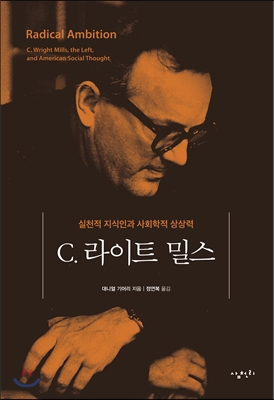 |
Description
Book Introduction
C.
Wright Mills' 100th birthday
August 28th marks the 100th anniversary of the birth of Charles Wright Mills (1916–1962) in Waco, Texas.
Compared to the likes of David Riesman, Paul Sweezy, and Daniel Bell, who rose to prominence after World War II and survived into the 21st century and played a significant role in American intellectual life, C.
Wright Mills died young.
He left a significant mark on the American social sciences by publishing books such as “White Collar,” “The Power Elite,” and “The Sociological Imagination” until he died of a heart attack at the age of 46 in 1962.
Also, "Listen, Yankees" and "Letter to the New Left" served as guides for Third World revolutionary movements and Western New Left theorists and activists.
Things are a little different now, but C.
Wright Mills was an idol to student activists and intellectuals in our country until the 1980s.
The inaugural issue of Creation and Criticism in 1966 featured writings by Jean-Paul Sartre alongside C.
Published by Wright Mills.
The article “Culture and Politics,” which was lectured at the London School of Economics and broadcast on BBC Radio in 1959 and garnered a passionate response from the British left, was translated by editor Baek Nak-cheong (then 28 years old).
The Sociological Imagination, first published in 1978, was translated by Lee Hae-chan (then 26 years old), who was in hiding due to the Mincheonghakryeon incident.
Lee Man-yeol, a veteran historian and former chairman of the National Institute of Korean History, chose “Listen, Yankees,” which he read during his college years (when he was 24 years old), as “the book of my life.”
In addition, C.
Wright Mills, a model of a practical intellectual, led countless young people to the forefront of the student movement during the military dictatorship and raised awareness among sociologists in the academy.
Wright Mills' 100th birthday
August 28th marks the 100th anniversary of the birth of Charles Wright Mills (1916–1962) in Waco, Texas.
Compared to the likes of David Riesman, Paul Sweezy, and Daniel Bell, who rose to prominence after World War II and survived into the 21st century and played a significant role in American intellectual life, C.
Wright Mills died young.
He left a significant mark on the American social sciences by publishing books such as “White Collar,” “The Power Elite,” and “The Sociological Imagination” until he died of a heart attack at the age of 46 in 1962.
Also, "Listen, Yankees" and "Letter to the New Left" served as guides for Third World revolutionary movements and Western New Left theorists and activists.
Things are a little different now, but C.
Wright Mills was an idol to student activists and intellectuals in our country until the 1980s.
The inaugural issue of Creation and Criticism in 1966 featured writings by Jean-Paul Sartre alongside C.
Published by Wright Mills.
The article “Culture and Politics,” which was lectured at the London School of Economics and broadcast on BBC Radio in 1959 and garnered a passionate response from the British left, was translated by editor Baek Nak-cheong (then 28 years old).
The Sociological Imagination, first published in 1978, was translated by Lee Hae-chan (then 26 years old), who was in hiding due to the Mincheonghakryeon incident.
Lee Man-yeol, a veteran historian and former chairman of the National Institute of Korean History, chose “Listen, Yankees,” which he read during his college years (when he was 24 years old), as “the book of my life.”
In addition, C.
Wright Mills, a model of a practical intellectual, led countless young people to the forefront of the student movement during the military dictatorship and raised awareness among sociologists in the academy.
- You can preview some of the book's contents.
Preview
index
Introduction: Heretic on a Motorcycle
American traitor
The Lonely Radical
The renegade sociologist
Chapter 1: The Ambitious Social Scientist: Pragmatist Philosophy and the Sociology of Knowledge
Pragmatism and Social Science
A theory for a discipline in confusion
American Ideology and Utopia
reflexive sociology
Chapter 2: What's Happening in the World Now: Radicalism Wakes Up from a Dream
Mills and Hans Guth, Social Structure and Power
A radical to Dewey's left
The Social Role of Intellectuals and the Apathetic
From Max Weber
Chapter 3: Solidarity between Power and Intellectuals: The Labor Movement and Social Science
Columbia University's Institute for Applied Social Studies
labor union officials and intellectuals
Decatur Study
New powers
Chapter 4: The New Middle Class That Doesn't Act: White-Collar
Social Psychology and Political Debate
Mills is isolated
White-collar workers and modern capitalism
Criticism of postwar American society
Chapter 5: The Politics of Truth: Power Elites and the Sociological Imagination
The responsibility of intellectuals
Power Elite
The End of Ideology?
sociological imagination
Chapter 6 For the Third World: A Letter from the New Left
The revival of the International
cultural devices
peace program
The Cuban Revolution and the Third World
Epilogue C.
What Wright Mills Left Behind
C.
Wright Mills Chronology
annotation
Search
American traitor
The Lonely Radical
The renegade sociologist
Chapter 1: The Ambitious Social Scientist: Pragmatist Philosophy and the Sociology of Knowledge
Pragmatism and Social Science
A theory for a discipline in confusion
American Ideology and Utopia
reflexive sociology
Chapter 2: What's Happening in the World Now: Radicalism Wakes Up from a Dream
Mills and Hans Guth, Social Structure and Power
A radical to Dewey's left
The Social Role of Intellectuals and the Apathetic
From Max Weber
Chapter 3: Solidarity between Power and Intellectuals: The Labor Movement and Social Science
Columbia University's Institute for Applied Social Studies
labor union officials and intellectuals
Decatur Study
New powers
Chapter 4: The New Middle Class That Doesn't Act: White-Collar
Social Psychology and Political Debate
Mills is isolated
White-collar workers and modern capitalism
Criticism of postwar American society
Chapter 5: The Politics of Truth: Power Elites and the Sociological Imagination
The responsibility of intellectuals
Power Elite
The End of Ideology?
sociological imagination
Chapter 6 For the Third World: A Letter from the New Left
The revival of the International
cultural devices
peace program
The Cuban Revolution and the Third World
Epilogue C.
What Wright Mills Left Behind
C.
Wright Mills Chronology
annotation
Search
Publisher's Review
History and Practical Intellectuals of American Sociology
One of the unique features of this book is that it is a study of intellectual history that focuses on the trajectory of Mills's scholarship and thought since his college days.
So, it shows the history of American social science and intellectual society that developed rapidly before and after World War II.
Mills was a promising sociologist who studied within the mainstream American academic tradition during his school years.
At the University of Texas, he was influenced by John Dewey's pragmatism, Chicago School sociology, and Veblen's institutional economics, and published papers in mainstream academic journals.
Afterwards, he met Hans Gus, a German sociologist, at the University of Wisconsin, where he accepted the ideas of Max Weber and Karl Mannheim and received his doctorate with a dissertation on 'pragmatism'.
He continued the tradition of Max Weber and John Dewey until the end of his life as a political leftist.
In 1945, he took up a position at the School of Applied Social Research (BASR) at Columbia University in New York, establishing Columbia as the center of American sociology along with Paul Lazarsfeld and Robert Merton.
The Decatur Study, a large-scale project on American society and the daily lives of individuals, provided Mills with an excellent opportunity to analyze mass society and the daily lives of individuals.
On the one hand, he interacted with the so-called "New York left-wing intellectuals" group and the Frankfurt School, including Horkheimer, Marcuse, and Fromm, and wrote for influential magazines such as The New Republic, The Descent, Partisan Review, and Monthly Review.
Gradually, Mills's sphere of activity moved beyond the ivory tower and toward the masses and the working class, and soon he directly challenged the liberal hypothesis that American society had a pluralistic and democratic political structure.
White Collar, Power Elite, The Sociological Imagination
“Just as department store salespeople identify themselves with their wealthy customers or office workers associate their identities with the names of their prestigious companies, white-collar workers borrow prestige from those who are socially superior to them.” (p. 221)
Published in 1951, White Collar was Mills's first successful work as a "public" intellectual who went beyond the intellectual specialist.
The book's analysis of American labor issues clearly demonstrates how the divide between work and leisure and how escapist popular culture dismantles working-class identity.
Furthermore, by analyzing the changes in the labor process due to automation and division of labor, it paved the way for masterpieces such as Harry Brayman's Labor and Monopoly Capital.
Mills's attention soon turned to the centers of American power.
"Power Elite" has established itself as a political radical in intellectual circles and the public alike by exposing the dark side of American society, where corporate, military, and political leaders control the masses through their own boards of directors, and where an oppressive, massive bureaucracy dominates the masses.
These days, sociology has been disseminated to the public by suggesting terms such as 'power elite', 'white collar', 'military-industrial complex', and 'paradigm', which are commonly used by social scientists and the media.
C. Wright Mills challenged the mainstream sociology, which was divided between Talcott Parsons' 'grand theory' and Lazarsfeld's 'abstract empiricism', and raised issues such as social psychology, sociology of knowledge, public sociology, historical context, culture and politics.
Meanwhile, despite his passionate activities, he was attacked by Talcott Parsons and Daniel Bell on the right and criticized by the "New York left" including Paul Sweezy on the left.
Although he achieved academic success faster than his academic rival Talcott Parsons, being promoted to full professor at the age of thirty in 1956, he also experienced severe frustration as he became isolated from academia and intellectual society and became disillusioned with modern capitalism.
Letter to the New Left, Listen Up, Yankees
Meanwhile, he opened a new breakthrough while teaching at the University of Copenhagen with support from the Fulbright Foundation in 1956-1957.
In March 1957, he lectured at the London School of Economics and Political Science, where E.
He associated with British left-wing intellectuals such as P. Thompson, Ralph Miliband, and Thomas Botomore.
By publishing “Letter to the New Left” in New Left Review in 1960, he created a fresh stir in the left-wing camp not only in Europe but also around the world.
Michael Foot, who later became leader of the British Labour Party, praised Mills's work as "the strongest breath of fresh air to come across the Atlantic for many years."
Tom Hayden, president of the American Democratic Student Union and author of the Port Huron Declaration, was called the "Mills of the student movement."
From this time on, Mills' interests expanded to include cultural apparatus, reflexive sociology, anti-war pacifism, and Third World revolutions, and he began publishing more popular books such as The Causes of World War III and Listen Up, Yankees.
Traveling extensively in Eastern Europe, Russia, Brazil, Mexico, and Cuba, Mills' interests expanded beyond the confines of the United States and Western Europe, focusing on world peace and democracy while offering long-term alternatives to the Cold War.
It led to calls for what were considered radical at the time: nuclear disarmament, the abolition of NATO, and the closure of all overseas US military bases.
Mexican writer Carlos Fuentes, in dedicating his novel to Mills, called him “the voice of truth in North America, a friend and comrade in the struggles of Latin America.”
Fidel Castro, who read "The Power Elite" while leading a guerrilla war in the Sierra Maestra mountains, sent a wreath as president of Cuba's Council of State at his funeral held at Columbia University in 1962.
Mills' sociological imagination, which expanded awareness of the possibilities of social science throughout his short life, sowed the seeds of the fervent anti-war movement and New Left movement that would unfold in the 1960s.
Furthermore, reflexive sociology and the concept of the ‘public’ inspired the sociology of Jurgen Habermas and Pierre Bourdieu.
Leading social scientists such as Alvin Gouldner and Barrington Moore parroted much of Mills' critique until the late 1950s.
Theda Scotchpole (1979) and Charles Tilly (1986), both current giants of American sociology, wrote 'C.
He achieved academic success by receiving the Wright Mills Award.
Author Daniel Geary, who had a copy of "Power Elite" under his arm during his college days when he was in love with his current wife, portrays Mills not as an "idol" but as a "contradictory human being" struggling in the midst of the Cold War.
C. Wright Mills was a university professor who criticized the university system while worrying about losing his job, and who opposed crass capitalism while conducting research projects funded by big business.
He was also a progressive intellectual who did not pay much attention to gender and race issues during his lifetime.
He concludes this biography by quoting Quentin Skinner's reflective words: "We must learn to think for ourselves."
Recommended articles
Finally C.
Wright Mills' biography has been published.
Avoiding the romantic image of a leftist idol, he portrayed the true face of a complex and ambitious character.
Daniel Geary is a breath of fresh air in American intellectual history.
-Mike Davis (Editorial Board Member, New Left Review)
This book is a solid C.
This is a novel biography that breaks away from the image of Wright Mills.
In particular, it is outstanding that he has been re-evaluated as a public sociologist who has left a distinct mark on American politics and academia.
-Michael Burawoy (UC Berkeley Professor)
Daniel Geary is one of the C. who influenced us as a practical intellectual of the past.
Wright Mills was portrayed brilliantly.
Mills' life and passion, always challenging mainstream power and thinking broadly, will resonate deeply with 21st-century readers.
-Nelson Lichtenstein (Professor, UC Santa Barbara)
One of the unique features of this book is that it is a study of intellectual history that focuses on the trajectory of Mills's scholarship and thought since his college days.
So, it shows the history of American social science and intellectual society that developed rapidly before and after World War II.
Mills was a promising sociologist who studied within the mainstream American academic tradition during his school years.
At the University of Texas, he was influenced by John Dewey's pragmatism, Chicago School sociology, and Veblen's institutional economics, and published papers in mainstream academic journals.
Afterwards, he met Hans Gus, a German sociologist, at the University of Wisconsin, where he accepted the ideas of Max Weber and Karl Mannheim and received his doctorate with a dissertation on 'pragmatism'.
He continued the tradition of Max Weber and John Dewey until the end of his life as a political leftist.
In 1945, he took up a position at the School of Applied Social Research (BASR) at Columbia University in New York, establishing Columbia as the center of American sociology along with Paul Lazarsfeld and Robert Merton.
The Decatur Study, a large-scale project on American society and the daily lives of individuals, provided Mills with an excellent opportunity to analyze mass society and the daily lives of individuals.
On the one hand, he interacted with the so-called "New York left-wing intellectuals" group and the Frankfurt School, including Horkheimer, Marcuse, and Fromm, and wrote for influential magazines such as The New Republic, The Descent, Partisan Review, and Monthly Review.
Gradually, Mills's sphere of activity moved beyond the ivory tower and toward the masses and the working class, and soon he directly challenged the liberal hypothesis that American society had a pluralistic and democratic political structure.
White Collar, Power Elite, The Sociological Imagination
“Just as department store salespeople identify themselves with their wealthy customers or office workers associate their identities with the names of their prestigious companies, white-collar workers borrow prestige from those who are socially superior to them.” (p. 221)
Published in 1951, White Collar was Mills's first successful work as a "public" intellectual who went beyond the intellectual specialist.
The book's analysis of American labor issues clearly demonstrates how the divide between work and leisure and how escapist popular culture dismantles working-class identity.
Furthermore, by analyzing the changes in the labor process due to automation and division of labor, it paved the way for masterpieces such as Harry Brayman's Labor and Monopoly Capital.
Mills's attention soon turned to the centers of American power.
"Power Elite" has established itself as a political radical in intellectual circles and the public alike by exposing the dark side of American society, where corporate, military, and political leaders control the masses through their own boards of directors, and where an oppressive, massive bureaucracy dominates the masses.
These days, sociology has been disseminated to the public by suggesting terms such as 'power elite', 'white collar', 'military-industrial complex', and 'paradigm', which are commonly used by social scientists and the media.
C. Wright Mills challenged the mainstream sociology, which was divided between Talcott Parsons' 'grand theory' and Lazarsfeld's 'abstract empiricism', and raised issues such as social psychology, sociology of knowledge, public sociology, historical context, culture and politics.
Meanwhile, despite his passionate activities, he was attacked by Talcott Parsons and Daniel Bell on the right and criticized by the "New York left" including Paul Sweezy on the left.
Although he achieved academic success faster than his academic rival Talcott Parsons, being promoted to full professor at the age of thirty in 1956, he also experienced severe frustration as he became isolated from academia and intellectual society and became disillusioned with modern capitalism.
Letter to the New Left, Listen Up, Yankees
Meanwhile, he opened a new breakthrough while teaching at the University of Copenhagen with support from the Fulbright Foundation in 1956-1957.
In March 1957, he lectured at the London School of Economics and Political Science, where E.
He associated with British left-wing intellectuals such as P. Thompson, Ralph Miliband, and Thomas Botomore.
By publishing “Letter to the New Left” in New Left Review in 1960, he created a fresh stir in the left-wing camp not only in Europe but also around the world.
Michael Foot, who later became leader of the British Labour Party, praised Mills's work as "the strongest breath of fresh air to come across the Atlantic for many years."
Tom Hayden, president of the American Democratic Student Union and author of the Port Huron Declaration, was called the "Mills of the student movement."
From this time on, Mills' interests expanded to include cultural apparatus, reflexive sociology, anti-war pacifism, and Third World revolutions, and he began publishing more popular books such as The Causes of World War III and Listen Up, Yankees.
Traveling extensively in Eastern Europe, Russia, Brazil, Mexico, and Cuba, Mills' interests expanded beyond the confines of the United States and Western Europe, focusing on world peace and democracy while offering long-term alternatives to the Cold War.
It led to calls for what were considered radical at the time: nuclear disarmament, the abolition of NATO, and the closure of all overseas US military bases.
Mexican writer Carlos Fuentes, in dedicating his novel to Mills, called him “the voice of truth in North America, a friend and comrade in the struggles of Latin America.”
Fidel Castro, who read "The Power Elite" while leading a guerrilla war in the Sierra Maestra mountains, sent a wreath as president of Cuba's Council of State at his funeral held at Columbia University in 1962.
Mills' sociological imagination, which expanded awareness of the possibilities of social science throughout his short life, sowed the seeds of the fervent anti-war movement and New Left movement that would unfold in the 1960s.
Furthermore, reflexive sociology and the concept of the ‘public’ inspired the sociology of Jurgen Habermas and Pierre Bourdieu.
Leading social scientists such as Alvin Gouldner and Barrington Moore parroted much of Mills' critique until the late 1950s.
Theda Scotchpole (1979) and Charles Tilly (1986), both current giants of American sociology, wrote 'C.
He achieved academic success by receiving the Wright Mills Award.
Author Daniel Geary, who had a copy of "Power Elite" under his arm during his college days when he was in love with his current wife, portrays Mills not as an "idol" but as a "contradictory human being" struggling in the midst of the Cold War.
C. Wright Mills was a university professor who criticized the university system while worrying about losing his job, and who opposed crass capitalism while conducting research projects funded by big business.
He was also a progressive intellectual who did not pay much attention to gender and race issues during his lifetime.
He concludes this biography by quoting Quentin Skinner's reflective words: "We must learn to think for ourselves."
Recommended articles
Finally C.
Wright Mills' biography has been published.
Avoiding the romantic image of a leftist idol, he portrayed the true face of a complex and ambitious character.
Daniel Geary is a breath of fresh air in American intellectual history.
-Mike Davis (Editorial Board Member, New Left Review)
This book is a solid C.
This is a novel biography that breaks away from the image of Wright Mills.
In particular, it is outstanding that he has been re-evaluated as a public sociologist who has left a distinct mark on American politics and academia.
-Michael Burawoy (UC Berkeley Professor)
Daniel Geary is one of the C. who influenced us as a practical intellectual of the past.
Wright Mills was portrayed brilliantly.
Mills' life and passion, always challenging mainstream power and thinking broadly, will resonate deeply with 21st-century readers.
-Nelson Lichtenstein (Professor, UC Santa Barbara)
GOODS SPECIFICS
- Date of issue: August 28, 2016
- Format: Hardcover book binding method guide
- Page count, weight, size: 416 pages | 710g | 153*224*30mm
- ISBN13: 9788994898414
- ISBN10: 8994898417
You may also like
카테고리
korean


korean

![ELLE 엘르 A형 (여성월간) : 1월 [2026]](http://librairie.coreenne.fr/cdn/shop/files/3b70e1cf77cf67d6da56e0eb041901e8.jpg?v=1767265322&width=3840)


