

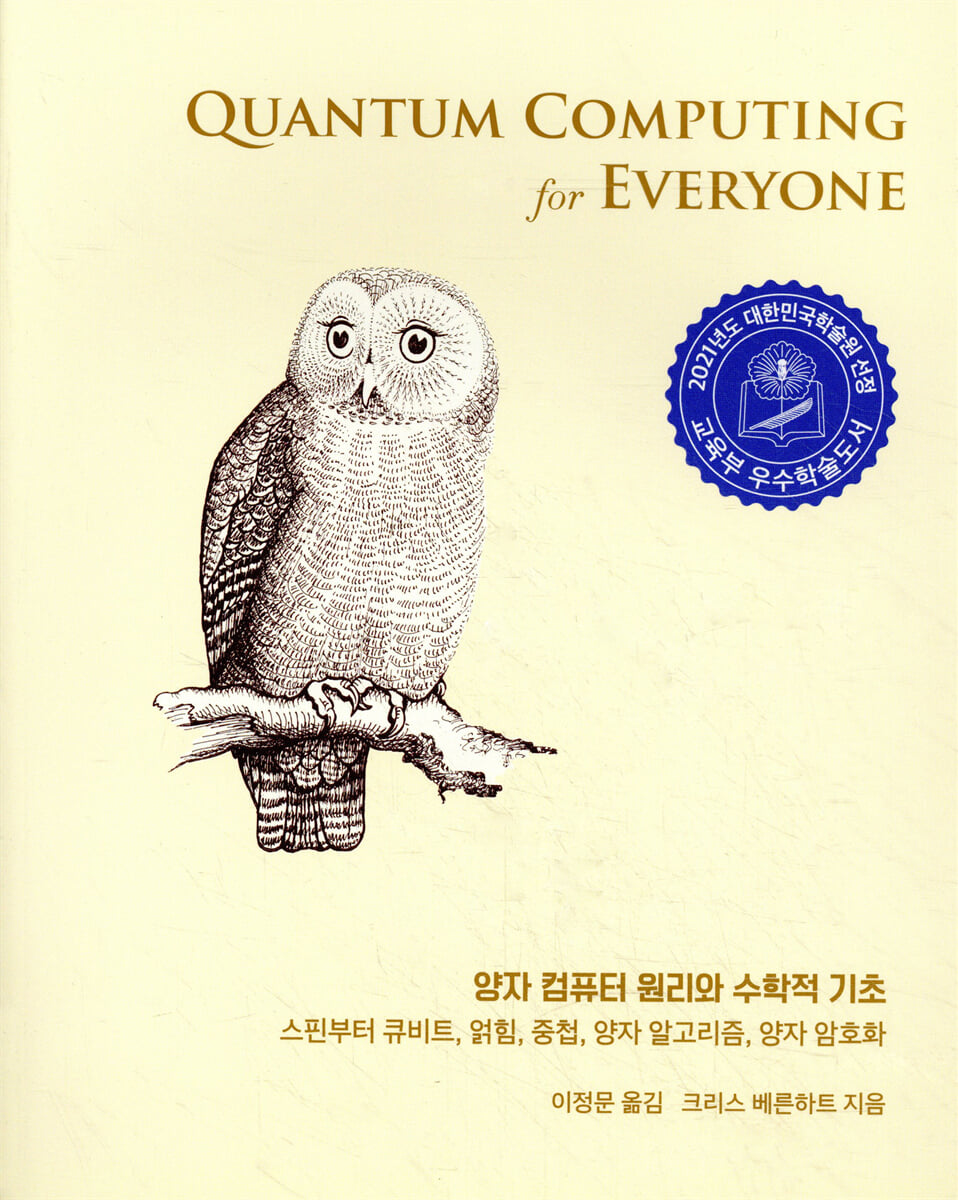
Quantum computer principles and mathematical foundations
 |
Description
Book Introduction
This is a theoretical book that explains the basic principles of quantum computers for readers with basic mathematical background.
The mathematical models of quantum mechanical concepts that form the basis of quantum computers, such as entanglement and superposition, are explained in a simplified manner as much as possible, so anyone with a high school level of mathematics knowledge can follow the content.
This is a good introductory or supplementary textbook for readers who want to build the mathematical foundations of quantum computers.
The mathematical models of quantum mechanical concepts that form the basis of quantum computers, such as entanglement and superposition, are explained in a simplified manner as much as possible, so anyone with a high school level of mathematics knowledge can follow the content.
This is a good introductory or supplementary textbook for readers who want to build the mathematical foundations of quantum computers.
- You can preview some of the book's contents.
Preview
index
Chapter 1.
Spin
__Quantum Clock
__Repeat measurements in the same direction
__Repeat measurements in different directions
__measurement
__randomness
__Photons and polarization
__conclusion
Chapter 2.
linear algebra
__Complex numbers vs. real numbers
__vector
__Vector Diagram
__length of vector
__real number multiplication (or scalar multiplication)
__Vector addition
__orthogonal vector
__bra times ket
__Bracket and length
__Bracket and orthogonal
__Orthogonal basis
__Vector as a linear combination of basis vectors
__order basis
__length of vector
__procession
__Matrix calculation
__Orthogonal matrix and unitary matrix
__Linear Algebra Toolbox
Chapter 3.
Spin and Qubits
__probability
__Mathematics for Quantum Spin
__equivalent state vector
__basis for a specific spin direction
Rotate the device by __608
__Mathematical model for photon polarization
__basis for a specific polarization direction
__Polarizing filter experiment
__qubit
__Alice, Bob, Eve
__Probability amplitude and interference
__Alice, Bob, Eve, and the BB84 Protocol
Chapter 4.
tangle
__If Alice and Bob's qubits are not entangled
__If the qubits are not entangled
__If the qubits are entangled
__Superluminal communication
__Standard basis for tensor product
__How to entangle qubits
Entangling qubits using __CNOT gates
__Entangled quantum clock
Chapter 5.
Bell's inequality
__Measuring entangled qubits in different bases
__Einstein and Local Realism
__Einstein and the Hidden Variable
__Classical physics explanation of entanglement
__Bell's inequality
__The answer of quantum mechanics
__Answer to the classical model
__measurement
__Eckert Protocol for Quantum Key Distribution
Chapter 6.
Classical logic, gates, circuits
__logic
__Boolean algebra
__Function completeness
__gate
__circuit
__NAND is a universal gate
__gates and computing
__memory
__Reversible computing
__Billiard Ball Computing
Chapter 7.
Quantum gates and quantum circuits
__qubit
__CNOT gate
__Quantum Gate
__Quantum gates that operate on one qubit
__Amardar Gate
__Do universal quantum gates exist?
__No-replication theorem
Quantum Computing vs. Classical Computing
__Bell circuit
__Ultra-high density coding
__Quantum teleportation
__Error correction
Chapter 8.
quantum algorithms
Complexity classes P and NP
__Are quantum algorithms faster than classical algorithms?
__Query Complexity
__Deutsch algorithm
__Kronecker product of Hadamard matrix
__Deutsch-Jossa Algorithm
Simon's Algorithm
__Complexity class
__Quantum Algorithm
Chapter 9.
The Impact of Quantum Computing
__Shor's algorithm and cryptography
Grover's Algorithm and Data Retrieval
__Chemistry and Simulation
__hardware
__Quantum Supremacy and Parallel Universes
__Computing
Spin
__Quantum Clock
__Repeat measurements in the same direction
__Repeat measurements in different directions
__measurement
__randomness
__Photons and polarization
__conclusion
Chapter 2.
linear algebra
__Complex numbers vs. real numbers
__vector
__Vector Diagram
__length of vector
__real number multiplication (or scalar multiplication)
__Vector addition
__orthogonal vector
__bra times ket
__Bracket and length
__Bracket and orthogonal
__Orthogonal basis
__Vector as a linear combination of basis vectors
__order basis
__length of vector
__procession
__Matrix calculation
__Orthogonal matrix and unitary matrix
__Linear Algebra Toolbox
Chapter 3.
Spin and Qubits
__probability
__Mathematics for Quantum Spin
__equivalent state vector
__basis for a specific spin direction
Rotate the device by __608
__Mathematical model for photon polarization
__basis for a specific polarization direction
__Polarizing filter experiment
__qubit
__Alice, Bob, Eve
__Probability amplitude and interference
__Alice, Bob, Eve, and the BB84 Protocol
Chapter 4.
tangle
__If Alice and Bob's qubits are not entangled
__If the qubits are not entangled
__If the qubits are entangled
__Superluminal communication
__Standard basis for tensor product
__How to entangle qubits
Entangling qubits using __CNOT gates
__Entangled quantum clock
Chapter 5.
Bell's inequality
__Measuring entangled qubits in different bases
__Einstein and Local Realism
__Einstein and the Hidden Variable
__Classical physics explanation of entanglement
__Bell's inequality
__The answer of quantum mechanics
__Answer to the classical model
__measurement
__Eckert Protocol for Quantum Key Distribution
Chapter 6.
Classical logic, gates, circuits
__logic
__Boolean algebra
__Function completeness
__gate
__circuit
__NAND is a universal gate
__gates and computing
__memory
__Reversible computing
__Billiard Ball Computing
Chapter 7.
Quantum gates and quantum circuits
__qubit
__CNOT gate
__Quantum Gate
__Quantum gates that operate on one qubit
__Amardar Gate
__Do universal quantum gates exist?
__No-replication theorem
Quantum Computing vs. Classical Computing
__Bell circuit
__Ultra-high density coding
__Quantum teleportation
__Error correction
Chapter 8.
quantum algorithms
Complexity classes P and NP
__Are quantum algorithms faster than classical algorithms?
__Query Complexity
__Deutsch algorithm
__Kronecker product of Hadamard matrix
__Deutsch-Jossa Algorithm
Simon's Algorithm
__Complexity class
__Quantum Algorithm
Chapter 9.
The Impact of Quantum Computing
__Shor's algorithm and cryptography
Grover's Algorithm and Data Retrieval
__Chemistry and Simulation
__hardware
__Quantum Supremacy and Parallel Universes
__Computing
Publisher's Review
★ Recommended Article ★
“The media has been churning out countless articles recently about the advent of the quantum computing revolution.
Author Chris Bernhardt has written a remarkably concise and accessible book that will provide a foundational introduction to the fascinating field of quantum computing for anyone interested.
Readers only need to know high school level mathematics.
Then you will be given a very friendly guide to many parts of quantum computers.”
- Noson S.
Yanofsky (Noson S.
Yanofsky) / Professor of Computer and Information Science at Brooklyn College, co-author of Quantum Computing for Computer Scientists and author of The Outer Limits of Reason
“Bernhard has written a clear and precise introduction to quantum computing.
Beginners can read this book to gain a solid understanding of quantum teleportation, Bell's inequality, Simon's algorithm, and more.
If a beginner were to ask me for a good quantum computing book, I would definitely recommend this one.”
- Scott Aaronson, David J. Brewton Centennial Professor of Computer Science and Director of the Quantum Information Center at the University of Texas, author of Quantum Computing since Democritus
Will bits be replaced by qubits? Quantum computers are looming on the technological horizon.
This book paves the way for IT leaders to move beyond simply observing quantum effects and reach the fundamentals of quantum computing.”
- Alexander Keewatin Dewdney, Professor of Computer Science, University of Western Ontario
★ Target audience for this book ★
The purpose of this book is to introduce quantum computing to readers familiar with high school-level mathematics.
In particular, we study qubits, entanglement, quantum teleportation, and key quantum algorithms, aiming to clearly understand each concept rather than just vaguely knowing it.
★ Structure of this book ★
Chapter 1.
Spin
The basic unit of classical computing is the bit.
A bit can be represented by anything that can have one of two states.
The most common example is an electrical switch that can be either on or off.
The basic unit of quantum computing is the 'qubit'.
A qubit can be represented by the spin of an electron or the polarization of a photon.
But the properties of spin and polarization are not as familiar to us as switches that can be on or off.
We will begin by exploring the fundamental properties of spin, beginning with the experiments of Otto Stern and Walther Gerlach, who studied the magnetic properties of atoms.
We'll explore what happens when we measure spin in different directions, and learn that the act of measurement can affect the state of a qubit.
We will also explain that measurements involve inherent randomness.
We conclude Chapter 1 by showing that experiments similar to electron spin experiments can be performed using polarizing filters and light.
Chapter 2.
linear algebra
Quantum computing is based on a mathematics called linear algebra.
Fortunately, you only need to know a few of these concepts.
This book introduces linear algebra to readers and shows how to use it through examples.
After introducing vectors and matrices, we will show you how to calculate the length of a vector and how to determine whether two vectors are perpendicular to each other.
Initially, we will only consider basic operations on vectors, but we will also show a simple way to compute multiple vector operations simultaneously by using matrices.
When you first learn the contents of Chapter 2, it may be difficult to feel how useful studying linear algebra will be.
But linear algebra is really useful.
Because it forms the foundation of quantum computing.
Chapter 3 and later use the mathematics introduced in Chapter 2, so you should read Chapter 2 carefully.
Chapter 3.
Spin and Qubits
Chapter 3 shows how the content of Chapters 1 and 2 is connected.
The mathematical model of spin or polarization will be given by linear algebra.
This allows us to define a qubit and explain what happens when we measure a qubit.
An example of measuring a qubit from different directions is presented.
We then conclude Chapter 3 with an introduction to quantum cryptography, the BB84 protocol.
Chapter 4.
tangle
Explains what it means for two qubits to be entangled.
Entanglement is difficult to explain in words, but it can be easily expressed mathematically.
It also introduces a new mathematical concept: tensor product.
Tensor product is the simplest way to combine mathematical models of individual qubits to provide a single model that describes a collection of qubits.
Entanglement is a phenomenon that can be expressed simply mathematically, but we cannot experience it in our daily lives.
When you measure one of the entangled qubits, the other qubits are affected.
This is a phenomenon that the scientist Einstein called “demon action at a distance.”
Let's look at some examples of this.
Chapter 4 concludes by showing that faster-than-light communication cannot be achieved using entanglement.
Chapter 5.
Bell's inequality
We explore Einstein's interest in entanglement and explore whether hidden variable theory can preserve local realism.
Bell's inequality is mathematically examined, and this equation can be used to experimentally determine the validity of Einstein's claims.
Later, Einstein's claim was proven wrong.
But even Bell thought Einstein would be proven right.
Artur Ekert discovered that experiments verifying Bell's inequality could be used to generate keys for encryption and to detect eavesdroppers.
We conclude Chapter 5 with a description of this encryption protocol.
Chapter 6.
Classical logic, gates, circuits
We'll start by explaining the basic topics of computing: bits, gates, and logic, and then briefly look at reversible computing and the ideas of Ed Fredkin.
Also, we prove that the Fredkin gate and the Toffoli gate are universal gates.
In other words, a complete computer can be built using only Fredkin gates (or Toffoli gates).
Finally, we introduce Fredkin's billiard ball computer.
Although the billiard ball computer is not directly related to the topic of this book, it is included because it is a very original concept.
A billiard ball computer consists of balls that hit walls and collide with each other.
Just think of an image of interacting particles.
It is also one of the concepts that got Richard Feynman interested in quantum computers.
Feynman wrote an early paper on the billiard ball computer.
Chapter 7.
Quantum gates and quantum circuits
We begin by exploring quantum computing using quantum circuits.
First, we define quantum gates.
And as we look at how quantum gates work on qubits, we realize that we've actually been using the concept of quantum gates for quite some time now.
It's just a difference of perspective.
The idea is that the orthogonal matrix acts on the qubits, not on the measuring device.
It demonstrates remarkable results in ultra-high-density coding, quantum teleportation, replication, and error correction.
Chapter 8.
quantum algorithms
This is probably the most difficult chapter.
We will look at several quantum algorithms and show how much faster they can be computed compared to classical algorithms.
To discuss the speed of algorithms, it is necessary to introduce the concept of complexity theory.
We first define query complexity, then introduce three quantum algorithms and show how much faster they are than classical algorithms in terms of query complexity.
Quantum algorithms delve into the fundamental structure of the problem they are trying to solve.
It's not simply about exploiting quantum parallelism, which means that inputs can be made into a superposition of all possible states.
As the final mathematical tool introduced in this book, we introduce the Kronecker product of matrices.
What makes Chapter 8 difficult is not the introduction of new mathematical tools, but the fact that we are calculating in a completely new way and have no experience solving problems using these new concepts.
Chapter 9.
The Impact of Quantum Computing
Chapter 9, the final chapter, explores the impact quantum computing will have on our lives.
First, we briefly describe two important algorithms devised by Peter Shor and Lov Grover.
After introducing each algorithm, we will explore how quantum computing can be used to simulate quantum processes.
The fundamental basis of chemistry is quantum mechanics.
Classical computational chemistry simulates the equations of quantum mechanics using classical computers, but the simulations are only approximate and often ignore details.
While approximations are often sufficient, in some cases details must be taken into account, and this is where quantum computers can provide solutions.
Chapter 9 also briefly introduces the construction of an actual quantum computer.
This field is developing very rapidly.
There are already machines available on the market.
Additionally, some are serviced in the cloud so that everyone can use them.
It is highly likely that we will soon enter an era of quantum supremacy.
Finally, the book concludes with the realization that quantum computing is not a new type of computing, but rather a discovery about the true nature of computing.
★ Author's Note ★
Quantum computing news has been frequently featured in recent media reports.
You've probably heard the news that China teleported qubits from Earth to a satellite, that Shor's algorithm is jeopardizing current encryption systems, that quantum key distribution could restore the security of encryption systems, and that Grover's algorithm will speed up data retrieval.
But what does this news actually mean? How does it all work? This book will explain it all.
But is it possible to explain quantum computing without using mathematics? No.
If you really want to understand the principle, you can't explain it properly without mathematics.
The basic concepts come from quantum mechanics and are often counterintuitive.
Explaining things with words alone is not effective.
Because it is something that cannot be experienced in everyday life.
Explaining things verbally often makes us think we understand something we don't actually understand.
Fortunately, it doesn't require a lot of math.
My role as a mathematician is to simplify mathematics as much as possible, focusing on the core concepts and providing basic examples that demonstrate their use and meaning.
Still, this book will contain mathematical concepts that you may not have encountered before.
And like all mathematical concepts, it's bound to feel unfamiliar at first.
Therefore, it is important to read the examples carefully, following the calculation steps one by one, rather than just skimming through them.
Quantum computing is a beautiful fusion of quantum mechanics and computer science, combining brilliant concepts from 20th-century physics with a completely new way of thinking about computing.
The basic unit of quantum computing is the qubit.
We will learn what a qubit is and what happens when we measure a qubit.
A classical bit is either 0 or 1.
If you measure a classical bit 0, you get 0, and if you measure a bit 1, you get 1.
In either case, the value of the bit does not change.
But for qubits, the situation is completely different.
A qubit can be in one of an infinite number of states (a superposition of 0 and 1).
But when you measure a qubit, you get a value of either 0 or 1.
The act of measurement changes the qubit.
All these phenomena can be described in detail with a simple mathematical model.
Qubits can also be entangled.
Measuring one of the qubits affects the state of the other qubits.
This phenomenon is also something we cannot experience in our daily lives.
But it can be perfectly described by a mathematical model.
These three phenomena – superposition, measurement, and entanglement – are the core concepts of quantum mechanics.
Once you learn what these concepts mean, you can understand how they can be used in quantum computing.
This is where human ingenuity shines.
Mathematicians say that proofs are beautiful and often contain unexpected insights.
I felt the same way when explaining many of the topics covered in this book.
Bell's theorem, quantum teleportation, and ultra-dense coding are all gems.
Error correction circuits and Grover's algorithm are truly amazing.
By reading this book, you will not only understand the fundamental concepts that underpin quantum computing, but also learn about several unique and beautiful structures.
You will see some ingenious and beautiful structures.
You will come to realize that quantum computing and classical computing are not separate principles, and that quantum computing is a more fundamental form of computing.
Anything that can be computed classically can also be computed on a quantum computer.
Qubits, not bits, are the basic unit of computation.
Computing essentially means quantum computing.
Finally, I would like to emphasize that this book deals with the theory of quantum computation.
In other words, this book is primarily about software, not hardware.
We briefly mention the hardware and explain how to physically entangle qubits, but this is only a secondary topic.
This book covers how to use a quantum computer, not how to build one.
★ Translator's Note ★
This is a theoretical book that explains the basic principles of quantum computers for readers with a basic background in mathematics.
Quantum mechanics, the basis of quantum computers, includes concepts such as entanglement and superposition.
It is a concept that is not easy to accept in common sense, and it is difficult to understand accurately when expressed in words.
So mathematical expressions are essential.
This book focuses on presenting mathematical models of these concepts in a simplified manner as possible.
To this end, the author puts in a lot of effort, including excluding complex number representations and explaining the basic concepts of linear algebra, but high school level mathematical knowledge is still essential.
Chapter 1 introduces the qubit, the basic unit of quantum computing.
Since qubits are often represented by electron spin, we explain the properties of qubits through experimental examples that show what happens when the spin is measured in different directions.
The following two chapters discuss the core concepts of linear algebra necessary for studying this book.
In particular, it introduces vector and matrix calculation methods.
In Chapter 3, we use the linear algebra learned in Chapter 2 to present a mathematical model of electron spin learned in Chapter 1, and define qubits using this model.
Chapters 4 and 5 deal with entanglement.
First, Chapter 4 introduces the concept of tensor product and explains how to describe a set of qubits as a single model.
Chapter 5 discusses Bell's inequality.
This is a way to experimentally verify the validity of Einstein's argument, which he opposed by calling entanglement "action at a distance."
Although it is ultimately concluded that Einstein was wrong, even Bell, who devised the inequality, defended Einstein's perspective and approach, and the author agrees with this.
Chapters 6 and 7 are where we start to get into the real computer-related terminology.
Chapter 6 describes the bits, gates, and logic of classical computers and introduces the concepts of reversible computing and universal gates.
Chapter 7 describes the quantum computer version of these concepts, showing how qubits change when they pass through quantum gates.
Chapter 8 introduces several quantum algorithms and explains how they can be sped up over classical algorithms.
Finally, Chapter 9 briefly introduces Grover's search algorithm and Shor's factorization algorithm, and shows that quantum computers are already being used to precisely simulate quantum mechanical processes.
This book is not for programmers.
This book is suitable for readers who want to understand the main principles of quantum computers on a mathematical basis and become an introductory reader to quantum computers.
I think it would be a good idea to consider this as a book to read before reading graduate level books.
“The media has been churning out countless articles recently about the advent of the quantum computing revolution.
Author Chris Bernhardt has written a remarkably concise and accessible book that will provide a foundational introduction to the fascinating field of quantum computing for anyone interested.
Readers only need to know high school level mathematics.
Then you will be given a very friendly guide to many parts of quantum computers.”
- Noson S.
Yanofsky (Noson S.
Yanofsky) / Professor of Computer and Information Science at Brooklyn College, co-author of Quantum Computing for Computer Scientists and author of The Outer Limits of Reason
“Bernhard has written a clear and precise introduction to quantum computing.
Beginners can read this book to gain a solid understanding of quantum teleportation, Bell's inequality, Simon's algorithm, and more.
If a beginner were to ask me for a good quantum computing book, I would definitely recommend this one.”
- Scott Aaronson, David J. Brewton Centennial Professor of Computer Science and Director of the Quantum Information Center at the University of Texas, author of Quantum Computing since Democritus
Will bits be replaced by qubits? Quantum computers are looming on the technological horizon.
This book paves the way for IT leaders to move beyond simply observing quantum effects and reach the fundamentals of quantum computing.”
- Alexander Keewatin Dewdney, Professor of Computer Science, University of Western Ontario
★ Target audience for this book ★
The purpose of this book is to introduce quantum computing to readers familiar with high school-level mathematics.
In particular, we study qubits, entanglement, quantum teleportation, and key quantum algorithms, aiming to clearly understand each concept rather than just vaguely knowing it.
★ Structure of this book ★
Chapter 1.
Spin
The basic unit of classical computing is the bit.
A bit can be represented by anything that can have one of two states.
The most common example is an electrical switch that can be either on or off.
The basic unit of quantum computing is the 'qubit'.
A qubit can be represented by the spin of an electron or the polarization of a photon.
But the properties of spin and polarization are not as familiar to us as switches that can be on or off.
We will begin by exploring the fundamental properties of spin, beginning with the experiments of Otto Stern and Walther Gerlach, who studied the magnetic properties of atoms.
We'll explore what happens when we measure spin in different directions, and learn that the act of measurement can affect the state of a qubit.
We will also explain that measurements involve inherent randomness.
We conclude Chapter 1 by showing that experiments similar to electron spin experiments can be performed using polarizing filters and light.
Chapter 2.
linear algebra
Quantum computing is based on a mathematics called linear algebra.
Fortunately, you only need to know a few of these concepts.
This book introduces linear algebra to readers and shows how to use it through examples.
After introducing vectors and matrices, we will show you how to calculate the length of a vector and how to determine whether two vectors are perpendicular to each other.
Initially, we will only consider basic operations on vectors, but we will also show a simple way to compute multiple vector operations simultaneously by using matrices.
When you first learn the contents of Chapter 2, it may be difficult to feel how useful studying linear algebra will be.
But linear algebra is really useful.
Because it forms the foundation of quantum computing.
Chapter 3 and later use the mathematics introduced in Chapter 2, so you should read Chapter 2 carefully.
Chapter 3.
Spin and Qubits
Chapter 3 shows how the content of Chapters 1 and 2 is connected.
The mathematical model of spin or polarization will be given by linear algebra.
This allows us to define a qubit and explain what happens when we measure a qubit.
An example of measuring a qubit from different directions is presented.
We then conclude Chapter 3 with an introduction to quantum cryptography, the BB84 protocol.
Chapter 4.
tangle
Explains what it means for two qubits to be entangled.
Entanglement is difficult to explain in words, but it can be easily expressed mathematically.
It also introduces a new mathematical concept: tensor product.
Tensor product is the simplest way to combine mathematical models of individual qubits to provide a single model that describes a collection of qubits.
Entanglement is a phenomenon that can be expressed simply mathematically, but we cannot experience it in our daily lives.
When you measure one of the entangled qubits, the other qubits are affected.
This is a phenomenon that the scientist Einstein called “demon action at a distance.”
Let's look at some examples of this.
Chapter 4 concludes by showing that faster-than-light communication cannot be achieved using entanglement.
Chapter 5.
Bell's inequality
We explore Einstein's interest in entanglement and explore whether hidden variable theory can preserve local realism.
Bell's inequality is mathematically examined, and this equation can be used to experimentally determine the validity of Einstein's claims.
Later, Einstein's claim was proven wrong.
But even Bell thought Einstein would be proven right.
Artur Ekert discovered that experiments verifying Bell's inequality could be used to generate keys for encryption and to detect eavesdroppers.
We conclude Chapter 5 with a description of this encryption protocol.
Chapter 6.
Classical logic, gates, circuits
We'll start by explaining the basic topics of computing: bits, gates, and logic, and then briefly look at reversible computing and the ideas of Ed Fredkin.
Also, we prove that the Fredkin gate and the Toffoli gate are universal gates.
In other words, a complete computer can be built using only Fredkin gates (or Toffoli gates).
Finally, we introduce Fredkin's billiard ball computer.
Although the billiard ball computer is not directly related to the topic of this book, it is included because it is a very original concept.
A billiard ball computer consists of balls that hit walls and collide with each other.
Just think of an image of interacting particles.
It is also one of the concepts that got Richard Feynman interested in quantum computers.
Feynman wrote an early paper on the billiard ball computer.
Chapter 7.
Quantum gates and quantum circuits
We begin by exploring quantum computing using quantum circuits.
First, we define quantum gates.
And as we look at how quantum gates work on qubits, we realize that we've actually been using the concept of quantum gates for quite some time now.
It's just a difference of perspective.
The idea is that the orthogonal matrix acts on the qubits, not on the measuring device.
It demonstrates remarkable results in ultra-high-density coding, quantum teleportation, replication, and error correction.
Chapter 8.
quantum algorithms
This is probably the most difficult chapter.
We will look at several quantum algorithms and show how much faster they can be computed compared to classical algorithms.
To discuss the speed of algorithms, it is necessary to introduce the concept of complexity theory.
We first define query complexity, then introduce three quantum algorithms and show how much faster they are than classical algorithms in terms of query complexity.
Quantum algorithms delve into the fundamental structure of the problem they are trying to solve.
It's not simply about exploiting quantum parallelism, which means that inputs can be made into a superposition of all possible states.
As the final mathematical tool introduced in this book, we introduce the Kronecker product of matrices.
What makes Chapter 8 difficult is not the introduction of new mathematical tools, but the fact that we are calculating in a completely new way and have no experience solving problems using these new concepts.
Chapter 9.
The Impact of Quantum Computing
Chapter 9, the final chapter, explores the impact quantum computing will have on our lives.
First, we briefly describe two important algorithms devised by Peter Shor and Lov Grover.
After introducing each algorithm, we will explore how quantum computing can be used to simulate quantum processes.
The fundamental basis of chemistry is quantum mechanics.
Classical computational chemistry simulates the equations of quantum mechanics using classical computers, but the simulations are only approximate and often ignore details.
While approximations are often sufficient, in some cases details must be taken into account, and this is where quantum computers can provide solutions.
Chapter 9 also briefly introduces the construction of an actual quantum computer.
This field is developing very rapidly.
There are already machines available on the market.
Additionally, some are serviced in the cloud so that everyone can use them.
It is highly likely that we will soon enter an era of quantum supremacy.
Finally, the book concludes with the realization that quantum computing is not a new type of computing, but rather a discovery about the true nature of computing.
★ Author's Note ★
Quantum computing news has been frequently featured in recent media reports.
You've probably heard the news that China teleported qubits from Earth to a satellite, that Shor's algorithm is jeopardizing current encryption systems, that quantum key distribution could restore the security of encryption systems, and that Grover's algorithm will speed up data retrieval.
But what does this news actually mean? How does it all work? This book will explain it all.
But is it possible to explain quantum computing without using mathematics? No.
If you really want to understand the principle, you can't explain it properly without mathematics.
The basic concepts come from quantum mechanics and are often counterintuitive.
Explaining things with words alone is not effective.
Because it is something that cannot be experienced in everyday life.
Explaining things verbally often makes us think we understand something we don't actually understand.
Fortunately, it doesn't require a lot of math.
My role as a mathematician is to simplify mathematics as much as possible, focusing on the core concepts and providing basic examples that demonstrate their use and meaning.
Still, this book will contain mathematical concepts that you may not have encountered before.
And like all mathematical concepts, it's bound to feel unfamiliar at first.
Therefore, it is important to read the examples carefully, following the calculation steps one by one, rather than just skimming through them.
Quantum computing is a beautiful fusion of quantum mechanics and computer science, combining brilliant concepts from 20th-century physics with a completely new way of thinking about computing.
The basic unit of quantum computing is the qubit.
We will learn what a qubit is and what happens when we measure a qubit.
A classical bit is either 0 or 1.
If you measure a classical bit 0, you get 0, and if you measure a bit 1, you get 1.
In either case, the value of the bit does not change.
But for qubits, the situation is completely different.
A qubit can be in one of an infinite number of states (a superposition of 0 and 1).
But when you measure a qubit, you get a value of either 0 or 1.
The act of measurement changes the qubit.
All these phenomena can be described in detail with a simple mathematical model.
Qubits can also be entangled.
Measuring one of the qubits affects the state of the other qubits.
This phenomenon is also something we cannot experience in our daily lives.
But it can be perfectly described by a mathematical model.
These three phenomena – superposition, measurement, and entanglement – are the core concepts of quantum mechanics.
Once you learn what these concepts mean, you can understand how they can be used in quantum computing.
This is where human ingenuity shines.
Mathematicians say that proofs are beautiful and often contain unexpected insights.
I felt the same way when explaining many of the topics covered in this book.
Bell's theorem, quantum teleportation, and ultra-dense coding are all gems.
Error correction circuits and Grover's algorithm are truly amazing.
By reading this book, you will not only understand the fundamental concepts that underpin quantum computing, but also learn about several unique and beautiful structures.
You will see some ingenious and beautiful structures.
You will come to realize that quantum computing and classical computing are not separate principles, and that quantum computing is a more fundamental form of computing.
Anything that can be computed classically can also be computed on a quantum computer.
Qubits, not bits, are the basic unit of computation.
Computing essentially means quantum computing.
Finally, I would like to emphasize that this book deals with the theory of quantum computation.
In other words, this book is primarily about software, not hardware.
We briefly mention the hardware and explain how to physically entangle qubits, but this is only a secondary topic.
This book covers how to use a quantum computer, not how to build one.
★ Translator's Note ★
This is a theoretical book that explains the basic principles of quantum computers for readers with a basic background in mathematics.
Quantum mechanics, the basis of quantum computers, includes concepts such as entanglement and superposition.
It is a concept that is not easy to accept in common sense, and it is difficult to understand accurately when expressed in words.
So mathematical expressions are essential.
This book focuses on presenting mathematical models of these concepts in a simplified manner as possible.
To this end, the author puts in a lot of effort, including excluding complex number representations and explaining the basic concepts of linear algebra, but high school level mathematical knowledge is still essential.
Chapter 1 introduces the qubit, the basic unit of quantum computing.
Since qubits are often represented by electron spin, we explain the properties of qubits through experimental examples that show what happens when the spin is measured in different directions.
The following two chapters discuss the core concepts of linear algebra necessary for studying this book.
In particular, it introduces vector and matrix calculation methods.
In Chapter 3, we use the linear algebra learned in Chapter 2 to present a mathematical model of electron spin learned in Chapter 1, and define qubits using this model.
Chapters 4 and 5 deal with entanglement.
First, Chapter 4 introduces the concept of tensor product and explains how to describe a set of qubits as a single model.
Chapter 5 discusses Bell's inequality.
This is a way to experimentally verify the validity of Einstein's argument, which he opposed by calling entanglement "action at a distance."
Although it is ultimately concluded that Einstein was wrong, even Bell, who devised the inequality, defended Einstein's perspective and approach, and the author agrees with this.
Chapters 6 and 7 are where we start to get into the real computer-related terminology.
Chapter 6 describes the bits, gates, and logic of classical computers and introduces the concepts of reversible computing and universal gates.
Chapter 7 describes the quantum computer version of these concepts, showing how qubits change when they pass through quantum gates.
Chapter 8 introduces several quantum algorithms and explains how they can be sped up over classical algorithms.
Finally, Chapter 9 briefly introduces Grover's search algorithm and Shor's factorization algorithm, and shows that quantum computers are already being used to precisely simulate quantum mechanical processes.
This book is not for programmers.
This book is suitable for readers who want to understand the main principles of quantum computers on a mathematical basis and become an introductory reader to quantum computers.
I think it would be a good idea to consider this as a book to read before reading graduate level books.
GOODS SPECIFICS
- Date of issue: August 31, 2020
- Page count, weight, size: 232 pages | 441g | 188*235*14mm
- ISBN13: 9791161754451
- ISBN10: 1161754458
You may also like
카테고리
korean


korean

![GQ KOREA Mark (Monthly): December [2025]](http://librairie.coreenne.fr/cdn/shop/files/8ef265dbbfbf186523ed75ba7319009d.jpg?v=1765340328&width=3840)


