

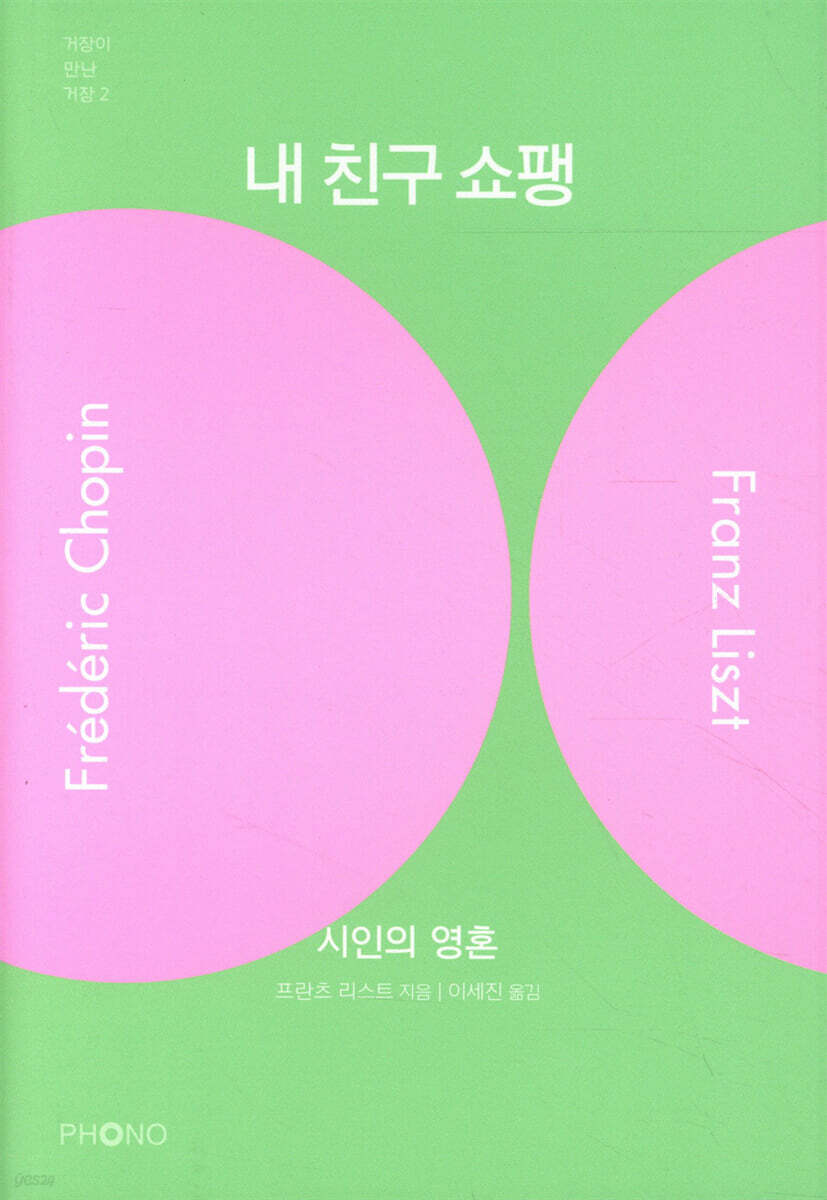
My friend Chopin
 |
Description
Book Introduction
The two people who created ‘Romantic piano music’, Liszt and Chopin.
List, who was both a friend and a competitor
The first biography of Chopin in history, written after his death with the sole purpose of passing on his greatness to future generations.
“The sun god has finally appeared!” _ Franz Liszt
“I am not a good fit for a concert.
If the audience feels threatened.
Their breath suffocates me, their curious gazes make me stiffen, and I can't say anything in front of those unfamiliar faces.
But you are different.
You are a concert person.
“Even when you can’t captivate your audience, you can still overwhelm them.” --- p84, Chopin to Liszt
The first biography of Chopin in history, written by Liszt, his friend and rival
Franz Liszt, the legendary Hungarian pianist and composer, was Chopin's close competitor and friend.
The two were once very close, but gradually grew apart due to differences in temperament.
As is well known, Liszt was a very curious, sometimes temperamental, and extroverted person who made a name for himself in social circles, whereas Chopin was a delicate, reserved, and reserved person who did not even enjoy being the center of attention.
However, Chopin was not sparing in his words when it came to matters of art, and Liszt, who respected and admired his music and the world of art, ended up leaving behind the first and most favorable study on Chopin, My Friend Chopin (original title: Chopin).
It is rare for a great composer to write and publish about a brilliant fellow composer, and given that this book was written in 1849, the year of Chopin's death, one can only imagine how much Liszt admired and missed Chopin as a musician and friend, regardless of their rivalry.
index
Chapter 1 Overall Character of the Work
Chapter 2 Polonaise
Chapter 3 Mazurka
Chapter 4: Virtuosity
Chapter 5: The Human Chopin
Chapter 6: Young Days
Chapter 7: Lelia
Chapter 8: Ten Thousand Years, the Final Moment
Chapter 9 Conclusion
Translator's Note
Frédéric Chopin Chronology
Search
Into the book
Despite the immense regret of all artists and all who knew him, we believe that the time has finally come for him to be properly recognized and to rise to the lofty heights that the future holds for him.
His absence is especially great for us.
--- p.10
The saying, “No prophet is welcome in his own hometown” has often proven true.
But shouldn't prophets—that is, people of the future, who foresee the future and foresee it through their works—be recognized as prophets while alive? It would be an overreach to argue otherwise.
It is useless for the younger generation of artists to protest against those who are left behind.
Because it is an unchanging custom of anti-progressives to beat up the living and the dead at the same time.
In music or any other art form, sometimes only time reveals the full beauty and value of a work.
--- p.10
The different forms of art are nothing but different spells.
These spells evoke emotions and passions, and in some ways they feel tangible and thrilling.
Genius is sometimes expressed by inventing new forms suited to emotions that had never before arisen within the magical sphere.
--- p.10
Musicians who do not confine themselves to the framework of convention need the help of time more than other musicians.
--- p.11
Future music historians will place this man in the highest esteem, distinguished by his rare melodic talent and his wonderfully blessed extension of harmonic organization.
--- p.12
Chopin had no ambitions for a loud orchestral sound and was content to transfer his thoughts entirely to the ivory keyboard.
I have achieved my goal of maintaining the power of the work without resorting to the effects of a choir or orchestra or the skills of a stage designer.
--- p.13
When analyzing Chopin's works, we cannot help but encounter a beauty of a different dimension, a completely new expression, and an original yet intelligent harmonic organization.
In Chopin's work, boldness is always justified.
Even the abundance, or rather the splendor, is clear.
His uniqueness never regresses to baroque strangeness.
It is meticulously polished with a chisel, but never goes overboard, and even with the abundance of ornamentation, the elegance of the main melody is not disturbed.
His most outstanding works are replete with groundbreaking combinations of musical styles.
Bold, dazzling, and captivating, these combinations disguise profundity with elegance, and sophistication with allure.
So, unless the audience makes a great effort, it is very difficult to avoid being swayed by this magic and to coolly judge the theoretical value of the work.
--- p.15
“I am not a good fit for a concert.
If the audience feels threatened.
Their breath suffocates me, their curious gazes make me stiffen, and I can't say anything in front of those unfamiliar faces.
But you are different.
You are a concert person.
Even when you can't captivate your audience, you can still overwhelm them." --- p.84
He lived as a pure and noble man, a good and compassionate man, and knew only one emotion.
The name of the noblest emotion on earth is patriotism.
He lived among us like a ghost, distinguished by all the poetry of Poland.
So let us pay our respects to his grave.
We must not offer him false flowers! We must not offer him light, easy garlands! Let us nobly exalt our feelings before his coffin! --- p.89
There was only one occasion when Chopin broke away from his thoughtful silence, his habitual neutrality.
He abandoned his usual cautious attitude only when fighting for art.
Art was the only subject on which he could express his views unequivocally, no matter the circumstances.
As far as art is concerned, he has been very consistent in exercising his influence and will.
This is tacit evidence that he himself knew that he had the authority to do so as a great artist.
--- p.130
Chopin, who was the greatest artist of his time but rarely gave concerts, chose a concert costume as the clothes he would wear to his grave.
--- p.136
He has seen many instances where a single poet or artist embodies the poetic sensibility of an entire people or an entire era.
I have seen a case where a single person, through his works, perfectly embodies the types of things people pursue and want to realize.
Chopin was just such a figure for his country and the times in which he was born.
He condensed the unique poetic sensibility that was widespread in Poland into his own imagination and expressed it with his own talent.
How many minstrels has Poland produced?
--- p.159
Mozart was a kind of ideal for him, an outstanding poet.
In Mozart's case, it was because he personally humbled himself and walked down the steps that distinguished between the noble and the vulgar.
Chopin liked the very thing that Mozart's father had scolded his son for when he saw a performance of Idomeneo.
“You’re wrong for not including any part for fools.” p167
His life seemed to be devoid of materiality, unrelated to public events, leaving traces only in the songs he left behind.
He died in a foreign land he never considered his own, longing for his homeland.
He was a poet of a troubled soul, a man of careful and complex thoughts, accustomed to suffering.
[…] We are destined to live after sending them away, but we wanted to at least show them the pain we feel.
I felt a duty to express my sorrow and respect for the grave of that great musician who lived among us.
--- p.219
Is a mere bouquet of flowers worthy of those who deserve immortal laurels? Leave aside fleeting sympathy and fleeting praise at the grave of one who deserves far more glory.
Chopin's works are destined to be passed down to distant lands and distant generations.
A work of art awakens such joy, such comfort, such beneficial emotions in the suffering, weary, yearning, enduring, and faithful soul.
Chopin's works are dedicated to such souls.
Wherever you live on Earth or in whatever era you live, people of noble character will find solidarity through his work.
--- p.226
Publisher's Review
Polish Chopin
This book is known to have been co-written with Duchess Caroline de Wittgenstein, who was Liszt's lover at the time.
The customs and national sentiment of this country, which was also Chopin's homeland, were quite familiar to the Duchess, whose parents were both Polish.
According to Emil Haraszti, an authority on Chopin and Liszt, Liszt came to understand Poland under the influence of this woman, and based on that understanding, he wanted to write a book about Chopin.
Liszt even went so far as to equate Chopin with Poland, saying, “How can one dare to separate the inspiration of the poet Chopin from the inspiration of his countrymen?”
Therefore, this book contains many references to Poland, including the Polish people, Polish literature, and Polish dance, as well as stories about Chopin.
In particular, Chapter 2, 'Polonaise', and Chapter 3, 'Mazurka', contain very detailed descriptions of these dances, which are Poland's national dances.
Reading about what these dances mean to the Polish people and the descriptions of the dance movements, gestures, and facial expressions of the dancers can provide a starting point for a deeper understanding of Chopin's polonaises and mazurkas.
Poland, the country where the virtuoso pianist Ignacy Jan Paderewski (1860-1941) was the first Prime Minister.
It is indeed worthy of being called Chopin's homeland.
Chopin, the Poet's Soul
Although there may have been friction due to temperamental differences, Liszt in this book shows his unstinting respect and admiration for Chopin, who was both a great artist and a good human being.
(“Future music historians will place in the highest esteem this man, who stood out for his rare melodic talent and his wonderfully blessed extension of harmonic organization.”_ p12 “He lived as a pure and noble man, a good and compassionate man […]”_ p89 “Do you know what a deep sense of pride close friends and artists feel when they recall the history of a man who was free from all inconsistencies or contradictions that deserved to be tolerated?”_ p118) There is also a sense of regret that Chopin did not receive the praise he deserved during his lifetime, which is permeated throughout.
Few recognized Chopin's abilities and genius, and Liszt questions whether even those who did fully understood him.
He observes Chopin closely and discovers within him the poet's soul, the brilliance of genius, and the unquenchable patriotism.
And then, with the foresight of an artist, he foresees that “Chopin’s works are destined to be passed down to distant countries and distant generations.”
When “My Friend Chopin” was first published in France in 1851, it was praised by the contemporary literary critic and writer Théophile Gautier, who said it was “remarkable for its style and its ingenious imagination.”
More than a century and a half have passed since then, but as the author hoped or predicted, we encounter Chopin's pure and extraordinary artistic world through archaic sentences imbued with the atmosphere of Romanticism at the time.
Above all, it is even more meaningful to meet him through the eyes of Liszt, the master who led the Romantic era with him, rather than anyone else.
'Masters Meet Masters' Series _ "My Friend Chopin _ The Poet's Soul" is the second volume in the 'Masters Meet Masters' series presented by music publisher Pono.
Although there are occasional ironic exceptions, genius is usually recognized as a genius. As the title suggests, a master who appeared in history like a 'lighthouse' meets another master and through him, we meet him directly in the writings of that master and learn how he understood the world and art.
GOODS SPECIFICS
- Date of issue: May 20, 2016
- Page count, weight, size: 240 pages | 128*188*20mm
- ISBN13: 9788993818819
- ISBN10: 8993818819
You may also like
카테고리
korean


korean


