

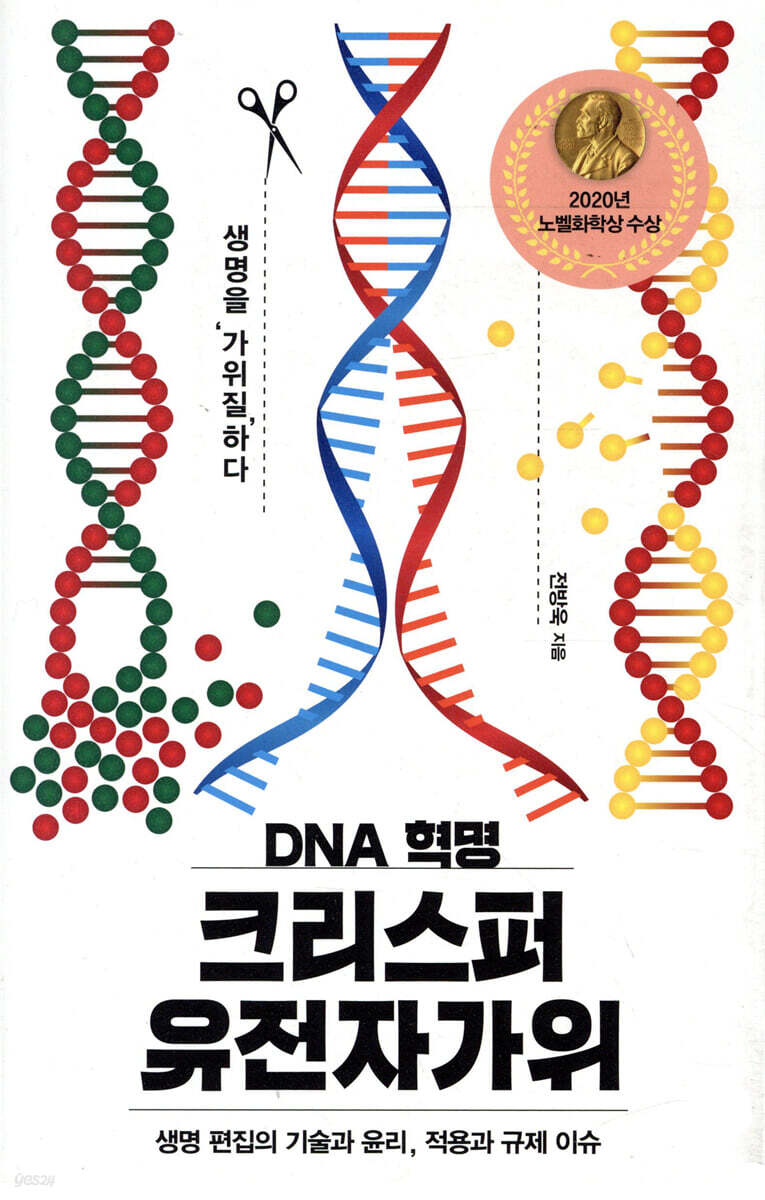
DNA Revolution CRISPR Gene Scissors
 |
Description
Book Introduction
CRISPR gene scissors, cutting life!
In 2015, the two major scientific journals, Nature and Science, called the 'CRISPR gene-editing technology' the most outstanding achievement of that year.
Also, in August 2016, National Geographic's cover featured the words "DNA Revolution."
The phrase itself that describes the CRISPR gene scissors was “DNA revolution.”
As of 2017, scientists in China and the United States have gone so far as to directly experiment with CRISPR gene editing on human embryos.
The CRISPR gene scissors have already begun to have a direct impact on humans.
Is the CRISPR gene-editing tool a boon for life sciences, or just a grand fantasy? This question is by no means easy.
So, discussions are ongoing in several countries, involving various technical and ethical issues.
There are scholars who have blind faith in this technology to the point of worrying about a second Hwang Woo-suk incident, while others view it critically.
This book, "DNA Revolution: CRISPR Gene Scissors," provides insight into the revolutionary technology, "CRISPR gene scissors," its research achievements to date, various cases, and potential applications, and provides scientific and social discussion points on "how science and human life can coexist."
A Choice for Life, or a Daring Imagination of Science and Technology?
As can be seen from the fact that the World Economic Forum (Davos Forum) in January 2016 presented the 'Fourth Industrial Revolution' as a topic, humanity is currently pouring its passion into the Internet of Things and advanced robotics based on digital technology on the one hand, and on the other hand, as an extension of biotechnology, dreaming of being reborn as a more perfect life form through gene editing.
Things that seem like they could appear in novels or movies are gradually becoming reality.
Among them, the third-generation gene scissors 'CRISPR' developed by Jennifer Doudna and Emmanuel Charpentier, who were considered strong candidates for the Nobel Prize in Chemistry, is a groundbreaking genetic engineering tool that has brought about expectations for the treatment and even prevention of incurable diseases such as AIDS and cancer.
'Gene scissors' refers to a broad class of enzymes that have the ability to cut DNA at specific sites in genes.
Simply put, it means that genes can be edited by cutting out the genome of an organism or inserting a desired gene using gene scissors technology.
CRISPR technology is not only widely used in basic biology research, but also has a wide range of applications, including somatic cell gene therapy through mutant gene editing, embryonic and gamete cell mutant gene editing to prevent genetic diseases in children, plant genome modification without introducing foreign genes, and the extinction of pests or invasive species and restoration of extinct animals.
However, on the other hand, such powerful technology could lead to side effects due to immature clinical application, enhancement of human genes rather than treatment, difficulty in regulating gene-edited plants, and disruption of the ecosystem through extinction or restoration.
Additionally, the recent and competitive genetic editing of human embryos may have implications for human evolution.
Therefore, the author of this book argues that it is important for citizens to participate in this technology, deliberate on it from an ethical perspective, and democratically control it through laws and systems.
This book covers the technology and ethics of CRISPR gene scissors, the cutting edge of science and technology that humanity has just reached, as well as the specific applications of gene scissors technology and the regulations that follow.
Before we blindly jump into the rosy blueprint of editing our genes to escape the nightmare of incurable and genetic diseases, and live younger and healthier lives, we need to consider the social and cultural implications of biotechnology.
Issues and Controversies Surrounding CRISPR Gene Scissors
This book, “DNA Revolution, CRISPR Gene Scissors,” introduces CRISPR gene scissors technology and illuminates the implications of this biotechnology from various perspectives.
The first half of this book, consisting of 10 chapters, meticulously describes scientifically related topics such as model organism development, somatic cell therapy, germline cell therapy, crop and livestock improvement, and gene drives.
As the author states in the preface, he had to rewrite it every time a new issue arose, and it covers even the most recent achievements, such as behavioral science research on ants, the production of germ-free pigs carrying endogenous retroviruses, the approval of CAR-T therapy, and efforts to clone mammoths.
Meanwhile, the latter part of the book, with expert advice from patent attorneys, lawyers, and securities experts, addresses the ethical, legal, and social implications of the technology, including patents, commercialization, and regulatory issues that are not specifically addressed in various domestic and international CRISPR-related books.
He also maintains a keen eye on the issue of the term 'editing or proofreading', which has not yet been resolved.
This book was written for the general public by an author who majored in life sciences and bioethics and has consistently published papers on CRISPR gene scissors. However, given the subject matter, it stands out with a level of expertise that goes beyond that of a general science book.
So, to help readers understand, I included a 'Quiz' and a 'Glossary' at the back of the book.
With powerful technology comes powerful danger, so I hope the author's message not to be uncritically enthusiastic about the achievements of the CRISPR gene-editing technology will reach a wider audience.
Furthermore, he urges that since scientists' self-regulation alone cannot solve the problem, we, as citizens, must actively step forward to solve the problem.
"When new forms of citizen participation are implemented that go beyond the self-regulation of scientists and experts, science and technology will become another arena for democracy to be realized."
In 2015, the two major scientific journals, Nature and Science, called the 'CRISPR gene-editing technology' the most outstanding achievement of that year.
Also, in August 2016, National Geographic's cover featured the words "DNA Revolution."
The phrase itself that describes the CRISPR gene scissors was “DNA revolution.”
As of 2017, scientists in China and the United States have gone so far as to directly experiment with CRISPR gene editing on human embryos.
The CRISPR gene scissors have already begun to have a direct impact on humans.
Is the CRISPR gene-editing tool a boon for life sciences, or just a grand fantasy? This question is by no means easy.
So, discussions are ongoing in several countries, involving various technical and ethical issues.
There are scholars who have blind faith in this technology to the point of worrying about a second Hwang Woo-suk incident, while others view it critically.
This book, "DNA Revolution: CRISPR Gene Scissors," provides insight into the revolutionary technology, "CRISPR gene scissors," its research achievements to date, various cases, and potential applications, and provides scientific and social discussion points on "how science and human life can coexist."
A Choice for Life, or a Daring Imagination of Science and Technology?
As can be seen from the fact that the World Economic Forum (Davos Forum) in January 2016 presented the 'Fourth Industrial Revolution' as a topic, humanity is currently pouring its passion into the Internet of Things and advanced robotics based on digital technology on the one hand, and on the other hand, as an extension of biotechnology, dreaming of being reborn as a more perfect life form through gene editing.
Things that seem like they could appear in novels or movies are gradually becoming reality.
Among them, the third-generation gene scissors 'CRISPR' developed by Jennifer Doudna and Emmanuel Charpentier, who were considered strong candidates for the Nobel Prize in Chemistry, is a groundbreaking genetic engineering tool that has brought about expectations for the treatment and even prevention of incurable diseases such as AIDS and cancer.
'Gene scissors' refers to a broad class of enzymes that have the ability to cut DNA at specific sites in genes.
Simply put, it means that genes can be edited by cutting out the genome of an organism or inserting a desired gene using gene scissors technology.
CRISPR technology is not only widely used in basic biology research, but also has a wide range of applications, including somatic cell gene therapy through mutant gene editing, embryonic and gamete cell mutant gene editing to prevent genetic diseases in children, plant genome modification without introducing foreign genes, and the extinction of pests or invasive species and restoration of extinct animals.
However, on the other hand, such powerful technology could lead to side effects due to immature clinical application, enhancement of human genes rather than treatment, difficulty in regulating gene-edited plants, and disruption of the ecosystem through extinction or restoration.
Additionally, the recent and competitive genetic editing of human embryos may have implications for human evolution.
Therefore, the author of this book argues that it is important for citizens to participate in this technology, deliberate on it from an ethical perspective, and democratically control it through laws and systems.
This book covers the technology and ethics of CRISPR gene scissors, the cutting edge of science and technology that humanity has just reached, as well as the specific applications of gene scissors technology and the regulations that follow.
Before we blindly jump into the rosy blueprint of editing our genes to escape the nightmare of incurable and genetic diseases, and live younger and healthier lives, we need to consider the social and cultural implications of biotechnology.
Issues and Controversies Surrounding CRISPR Gene Scissors
This book, “DNA Revolution, CRISPR Gene Scissors,” introduces CRISPR gene scissors technology and illuminates the implications of this biotechnology from various perspectives.
The first half of this book, consisting of 10 chapters, meticulously describes scientifically related topics such as model organism development, somatic cell therapy, germline cell therapy, crop and livestock improvement, and gene drives.
As the author states in the preface, he had to rewrite it every time a new issue arose, and it covers even the most recent achievements, such as behavioral science research on ants, the production of germ-free pigs carrying endogenous retroviruses, the approval of CAR-T therapy, and efforts to clone mammoths.
Meanwhile, the latter part of the book, with expert advice from patent attorneys, lawyers, and securities experts, addresses the ethical, legal, and social implications of the technology, including patents, commercialization, and regulatory issues that are not specifically addressed in various domestic and international CRISPR-related books.
He also maintains a keen eye on the issue of the term 'editing or proofreading', which has not yet been resolved.
This book was written for the general public by an author who majored in life sciences and bioethics and has consistently published papers on CRISPR gene scissors. However, given the subject matter, it stands out with a level of expertise that goes beyond that of a general science book.
So, to help readers understand, I included a 'Quiz' and a 'Glossary' at the back of the book.
With powerful technology comes powerful danger, so I hope the author's message not to be uncritically enthusiastic about the achievements of the CRISPR gene-editing technology will reach a wider audience.
Furthermore, he urges that since scientists' self-regulation alone cannot solve the problem, we, as citizens, must actively step forward to solve the problem.
"When new forms of citizen participation are implemented that go beyond the self-regulation of scientists and experts, science and technology will become another arena for democracy to be realized."
- You can preview some of the book's contents.
Preview
index
Author's Preface - Editing Science, Life
Chapter 1: The Advent of CRISPR Gene Scissors
DNA, the code of life
mutation
Early genetic scissors
Memories of the Attack
Crisper and Cheese
joint research
Repair of the cut area
Pros and Cons of Gene Scissors
The powerful CRISPR gene scissors
Chapter 2 Production of Laboratory Animals
Genetic Variation and Disease Models
Various animal models
animal welfare
Production of useful substances
organ transplant animals
Cultivation of replacement organs
ethical balance
Chapter 3 Somatic Cell Therapy
Miracle cure
Methods of treating diseases
Treatment of individual diseases
New drug development
technical issues
ethical issues
Chapter 4 Gene Editing in Human Embryos
precursor
First experiment
controversy
Second experiment
Research Rush
Third experiment
Korea-US joint experiment
Technical implications
Ethical implications
Case-by-case, multi-centric regulatory approach
Fifth experiment
Continued germline editing
Chapter 5: The Boundary Between Treatment and Augmentation
Somatic cell therapy, germ cell therapy, and augmentation
Technical issues in germ cell therapy
Ethical Issues in Germ Cell Therapy
What is disease
Ethical Issues in Germline Augmentation
Chapter 6 Crop and Livestock Improvement
The need for increased food production and existing breeding methods
Challenges of Plant Genome Modification
Plant genome modification methods
Plant editing
Crisper Pasta
Regulatory standards of each country
desirable regulation
Ambiguous criteria
Concerned eyes
Livestock improvement
Chapter 7 Extinction and Restoration
gene drive
Mosquitoes and Disease
Uses
The technological limitations of gene drives
The ethics of mosquito extinction
Research under regulation
Do mosquitoes have borders?
Restoration of the mammoth
Chapter 8 Patent Competition
Who owns the patent?
The impact of patent competition
Proxy licensing
Commercialization of gene editing technology
startup
Chapter 9: The Framing War
The importance of interpreting terms
Is it editing?
Is it correction?
The Myth of Precision
Exaggeration and Marketing
Chapter 10 From Scientist Self-Regulation to Citizen Regulation
Various regulatory methods
Regulatory situations in each country
The Vision of Asilomar
Is a Second Asilomar Conference Necessary?
International Summit on Human Gene Editing
Self-Regulation Plus
The need for citizen deliberation
Quiz / Glossary / References / Index
Chapter 1: The Advent of CRISPR Gene Scissors
DNA, the code of life
mutation
Early genetic scissors
Memories of the Attack
Crisper and Cheese
joint research
Repair of the cut area
Pros and Cons of Gene Scissors
The powerful CRISPR gene scissors
Chapter 2 Production of Laboratory Animals
Genetic Variation and Disease Models
Various animal models
animal welfare
Production of useful substances
organ transplant animals
Cultivation of replacement organs
ethical balance
Chapter 3 Somatic Cell Therapy
Miracle cure
Methods of treating diseases
Treatment of individual diseases
New drug development
technical issues
ethical issues
Chapter 4 Gene Editing in Human Embryos
precursor
First experiment
controversy
Second experiment
Research Rush
Third experiment
Korea-US joint experiment
Technical implications
Ethical implications
Case-by-case, multi-centric regulatory approach
Fifth experiment
Continued germline editing
Chapter 5: The Boundary Between Treatment and Augmentation
Somatic cell therapy, germ cell therapy, and augmentation
Technical issues in germ cell therapy
Ethical Issues in Germ Cell Therapy
What is disease
Ethical Issues in Germline Augmentation
Chapter 6 Crop and Livestock Improvement
The need for increased food production and existing breeding methods
Challenges of Plant Genome Modification
Plant genome modification methods
Plant editing
Crisper Pasta
Regulatory standards of each country
desirable regulation
Ambiguous criteria
Concerned eyes
Livestock improvement
Chapter 7 Extinction and Restoration
gene drive
Mosquitoes and Disease
Uses
The technological limitations of gene drives
The ethics of mosquito extinction
Research under regulation
Do mosquitoes have borders?
Restoration of the mammoth
Chapter 8 Patent Competition
Who owns the patent?
The impact of patent competition
Proxy licensing
Commercialization of gene editing technology
startup
Chapter 9: The Framing War
The importance of interpreting terms
Is it editing?
Is it correction?
The Myth of Precision
Exaggeration and Marketing
Chapter 10 From Scientist Self-Regulation to Citizen Regulation
Various regulatory methods
Regulatory situations in each country
The Vision of Asilomar
Is a Second Asilomar Conference Necessary?
International Summit on Human Gene Editing
Self-Regulation Plus
The need for citizen deliberation
Quiz / Glossary / References / Index
Into the book
Early geneticists considered methods for selecting individuals with mutant phenotypes or artificially creating mutant phenotypes to understand specific genetic phenomena.
Gregor Mendel used natural variations in pea seed color and height to study heredity.
Thomas Morgan was the first to discover and study the white-eyed fruit fly.
Hermann Joseph Muller induced mutations in fruit flies by exposing them to ultraviolet light.
Charlotte Auerbach discovered that mustard gas had a mutagenic effect.
For a long time, scientists have tried to identify the relevant genes from random mutations that manifest as phenotypes.
Sequencing the genome has allowed us to induce mutations in genes we already know about, and to analyze the effects of these mutations through the resulting phenotypes.
This could be said to be the beginning of gene editing technology.
_Page 18 of the text
If we design an enzyme that cuts the genome at a specific location, we can repair the cut in a chosen way.
For example, if we use molecular scissors to cut at or near a genetic mutation, we can correct the faulty sequence by using new DNA as a repair template that fits into that spot.
But designing molecular scissors has long been a challenge.
How can an enzyme specifically and efficiently cut a single region of a genome consisting of 3 billion letters? Bacteria have already solved this problem precisely in this way.
Bacteria use CRISPR gene scissors to target and cut the virus's DNA sequence.
_Page 31 of the text
We are now at the point where we can actually edit the genome in the laboratory using CRISPR gene-editing technology to target and cut human DNA.
CRISPR gene scissors can, for example, perform the 'find and replace' function of the 'Araemhan-geul' program.
If you have a misspelled word, you can enter it in the 'Find word' field and use the 'Replace word' field to correct the misspelling wherever that word appears in the document.
In exactly the same way, CRISPR genome-editing tools can detect and replace typos in genome documents.
Like the 'find-word' method, the letters of RNA simply need to be matched with letters of DNA throughout the sentence.
A student who has studied bioinformatics can easily design RNA to change the search word, and a student who has studied molecular biology can also do so.
_Page 32 of the text
A new gene-editing technology called CRISPR could also contribute to the revival of mammoths.
By introducing new genes into existing genomes, it may be possible to create animals with traits lost to extinction.
Using this idea, a team of researchers at Harvard University's Church Institute announced plans in February 2017 to create hybrid animals from the genetic material of elephants and mammoths.
Using the CRISPR gene-editing tool to combine DNA from two organisms and then implant them into artificial embryos, they pledged to create elephants with mammoth characteristics, including long, coarse hair, subcutaneous fat, and blood uniquely adapted to freezing temperatures, within 10 years.
_Page 210 of the text
In particular, the Harvard University Church research team used CRISPR gene scissors to remove specific genes so that human stem cells would grow in accordance with the cycle of chimeric embryos.
Ultimately, the embryos will be grown for several months to determine whether the organs are of human origin.
If these experiments are successful, the embryos are allowed to grow until birth (four months in the case of pigs).
We are not yet at the stage of producing chimeric piglets.
We also need to figure out how best to combine human stem cells and animal embryos to ensure chimeras can survive throughout pregnancy.
Even if we cannot create perfectly formed organs, the technologies we have discovered so far will help us better understand the onset, progression, and clinical outcomes of many complex and deadly diseases, including cancer.
If successful, this room could have a huge impact on organ transplant treatment.
Because it could provide a massive supply of replacement organs from farmed animals for tens of thousands of suffering people around the world.
_Page 47
CRISPR gene-editing technology can directly correct a patient's genetic mutations and change their regulatory patterns.
CRISPR gene editing tools can be particularly time-saving compared to other gene editing tools such as ZFNs and TALENs.
CRISPR gene editing can now alleviate genetic abnormalities in animal models, which could lead to in vivo therapies for blindness, blood disorders, and congenital heart disease.
CRISPR Therapeutics and Editas Medicine have completed proof-of-principle trials for therapeutic studies in some genetic diseases, such as Duchenne muscular dystrophy and sickle cell anemia, and are preparing to move into clinical trials.
As of late August 2017, the CAR-T-based cancer treatment Kymriah had received approval from the U.S. Food and Drug Administration and was poised to be launched on the market.
_Page 58 of the text
Thus, gene therapy raises particularly sensitive pricing issues.
Patients can enjoy life-changing, and therefore highly valuable, benefits, but at a significant cost.
To date, there has been little public discussion about the costs of somatic cell gene therapy.
However, the socio-economic dimensions of new treatments should not be overlooked, as they have ethical implications for fair access and resource distribution.
And the cost of somatic cell gene therapy becomes a real issue when assessing the likelihood of translating proof-of-concept technologies into clinical trials.
New technologies must be made available to everyone fairly.
Ethical concerns can be countered by the argument that while all technologies are initially unfair, they can become cheaper in the long run and have real benefits for society as a whole.
However, in the case of treatments using CRISPR gene-editing technology, this argument is not persuasive for two reasons.
First of all, we cannot expect a real price reduction in biologically derived treatments.
Because of the differences in production standards compared to simple chemicals, it is not possible to make generic drugs in this area.
_Page 91 of the text
To repair every cell in the body, human genes must be altered early in embryonic development, and these changes must be passed on to future generations.
If CRISPR gene editing is used on embryos to cure humans, wouldn't it also be used to improve humans? Wouldn't parents who want blue-eyed children order CRISPR gene editing to alter the OCA2 gene? And if they want healthy babies, wouldn't they be able to edit the MSTN gene? While there's no technical difference between using CRISPR to treat diseases and creating designer babies, the ethical differences are profound.
Beyond curing disease, CRISPR gene scissors pose difficult questions.
Who decides who is a better human being? What if only the rich can edit genes? Is it acceptable to let parents decide their children's genetic futures? What if technologies like birth control or in vitro fertilization made this possible? _Page 136
Gregor Mendel used natural variations in pea seed color and height to study heredity.
Thomas Morgan was the first to discover and study the white-eyed fruit fly.
Hermann Joseph Muller induced mutations in fruit flies by exposing them to ultraviolet light.
Charlotte Auerbach discovered that mustard gas had a mutagenic effect.
For a long time, scientists have tried to identify the relevant genes from random mutations that manifest as phenotypes.
Sequencing the genome has allowed us to induce mutations in genes we already know about, and to analyze the effects of these mutations through the resulting phenotypes.
This could be said to be the beginning of gene editing technology.
_Page 18 of the text
If we design an enzyme that cuts the genome at a specific location, we can repair the cut in a chosen way.
For example, if we use molecular scissors to cut at or near a genetic mutation, we can correct the faulty sequence by using new DNA as a repair template that fits into that spot.
But designing molecular scissors has long been a challenge.
How can an enzyme specifically and efficiently cut a single region of a genome consisting of 3 billion letters? Bacteria have already solved this problem precisely in this way.
Bacteria use CRISPR gene scissors to target and cut the virus's DNA sequence.
_Page 31 of the text
We are now at the point where we can actually edit the genome in the laboratory using CRISPR gene-editing technology to target and cut human DNA.
CRISPR gene scissors can, for example, perform the 'find and replace' function of the 'Araemhan-geul' program.
If you have a misspelled word, you can enter it in the 'Find word' field and use the 'Replace word' field to correct the misspelling wherever that word appears in the document.
In exactly the same way, CRISPR genome-editing tools can detect and replace typos in genome documents.
Like the 'find-word' method, the letters of RNA simply need to be matched with letters of DNA throughout the sentence.
A student who has studied bioinformatics can easily design RNA to change the search word, and a student who has studied molecular biology can also do so.
_Page 32 of the text
A new gene-editing technology called CRISPR could also contribute to the revival of mammoths.
By introducing new genes into existing genomes, it may be possible to create animals with traits lost to extinction.
Using this idea, a team of researchers at Harvard University's Church Institute announced plans in February 2017 to create hybrid animals from the genetic material of elephants and mammoths.
Using the CRISPR gene-editing tool to combine DNA from two organisms and then implant them into artificial embryos, they pledged to create elephants with mammoth characteristics, including long, coarse hair, subcutaneous fat, and blood uniquely adapted to freezing temperatures, within 10 years.
_Page 210 of the text
In particular, the Harvard University Church research team used CRISPR gene scissors to remove specific genes so that human stem cells would grow in accordance with the cycle of chimeric embryos.
Ultimately, the embryos will be grown for several months to determine whether the organs are of human origin.
If these experiments are successful, the embryos are allowed to grow until birth (four months in the case of pigs).
We are not yet at the stage of producing chimeric piglets.
We also need to figure out how best to combine human stem cells and animal embryos to ensure chimeras can survive throughout pregnancy.
Even if we cannot create perfectly formed organs, the technologies we have discovered so far will help us better understand the onset, progression, and clinical outcomes of many complex and deadly diseases, including cancer.
If successful, this room could have a huge impact on organ transplant treatment.
Because it could provide a massive supply of replacement organs from farmed animals for tens of thousands of suffering people around the world.
_Page 47
CRISPR gene-editing technology can directly correct a patient's genetic mutations and change their regulatory patterns.
CRISPR gene editing tools can be particularly time-saving compared to other gene editing tools such as ZFNs and TALENs.
CRISPR gene editing can now alleviate genetic abnormalities in animal models, which could lead to in vivo therapies for blindness, blood disorders, and congenital heart disease.
CRISPR Therapeutics and Editas Medicine have completed proof-of-principle trials for therapeutic studies in some genetic diseases, such as Duchenne muscular dystrophy and sickle cell anemia, and are preparing to move into clinical trials.
As of late August 2017, the CAR-T-based cancer treatment Kymriah had received approval from the U.S. Food and Drug Administration and was poised to be launched on the market.
_Page 58 of the text
Thus, gene therapy raises particularly sensitive pricing issues.
Patients can enjoy life-changing, and therefore highly valuable, benefits, but at a significant cost.
To date, there has been little public discussion about the costs of somatic cell gene therapy.
However, the socio-economic dimensions of new treatments should not be overlooked, as they have ethical implications for fair access and resource distribution.
And the cost of somatic cell gene therapy becomes a real issue when assessing the likelihood of translating proof-of-concept technologies into clinical trials.
New technologies must be made available to everyone fairly.
Ethical concerns can be countered by the argument that while all technologies are initially unfair, they can become cheaper in the long run and have real benefits for society as a whole.
However, in the case of treatments using CRISPR gene-editing technology, this argument is not persuasive for two reasons.
First of all, we cannot expect a real price reduction in biologically derived treatments.
Because of the differences in production standards compared to simple chemicals, it is not possible to make generic drugs in this area.
_Page 91 of the text
To repair every cell in the body, human genes must be altered early in embryonic development, and these changes must be passed on to future generations.
If CRISPR gene editing is used on embryos to cure humans, wouldn't it also be used to improve humans? Wouldn't parents who want blue-eyed children order CRISPR gene editing to alter the OCA2 gene? And if they want healthy babies, wouldn't they be able to edit the MSTN gene? While there's no technical difference between using CRISPR to treat diseases and creating designer babies, the ethical differences are profound.
Beyond curing disease, CRISPR gene scissors pose difficult questions.
Who decides who is a better human being? What if only the rich can edit genes? Is it acceptable to let parents decide their children's genetic futures? What if technologies like birth control or in vitro fertilization made this possible? _Page 136
--- From the text
GOODS SPECIFICS
- Date of publication: November 7, 2017
- Page count, weight, size: 332 pages | 435g | 135*210*30mm
- ISBN13: 9788993690491
- ISBN10: 8993690499
You may also like
카테고리
korean


korean

![GQ KOREA Mark (Monthly): December [2025]](http://librairie.coreenne.fr/cdn/shop/files/8ef265dbbfbf186523ed75ba7319009d.jpg?v=1765340328&width=3840)


