

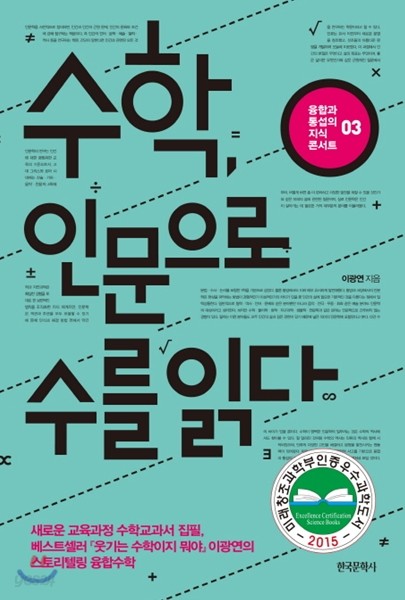
Reading numbers through mathematics and humanities
 |
Description
Book Introduction
"Mathematics, Reading Numbers with Humanities" examines the fundamental concepts of mathematics and the interesting elements inherent in the discipline of mathematics in connection with other fields of study. This book will serve as an excellent guide for students studying mathematics and adults who want to know about mathematics but have found it difficult to approach.
- You can preview some of the book's contents.
Preview
index
Entering
Chapter 1: Mathematics is Hidden in Every Field
Mathematics: A Window to a Rational View of the World | Math becomes easier when you understand order and the center | Mathematics proves right from wrong in real life | Mathematics survives only when it reduces volume | The origin of all things is 'number' | Mathematics repeats convergence and integration across all fields.
Chapter 2: Mathematics and Music, a Fantastic Harmony
Pythagoras, who discovered 'harmony' in music | Translating the principles of the universe into the language of music and mathematics: The Laws of Music | Creating beautiful music with mathematics: The Fibonacci sequence and the golden ratio | Representing the notes of the piano keyboard with the residue system: Scales and residue systems | Tonnets, which create fantastical harmonies: Residue systems and tonnets
Chapter 3: Understanding Mathematics Understands the Economy
Predicting stock prices using the wave principle: Fibonacci sequence | Is the Black-Scholes equation the flower of financial engineering?: Stochastic partial differential equations | Learning mathematics through the prisoner's dilemma: Game theory | Is income distributed equally?: Lorenz curve and Gini coefficient | How to calculate the area of an island?: Piecewise quadrature and definite integral | Mathematically analyzing Malthus's population theory: Natural logarithms and the logistic model
Chapter 4: Mathematical Ideas That Shine in Film
Newton's law of cooling in the life-or-death Snowpiercer: Exponential functions | How Wilford maintains the population of objects on the train: Statistical estimation | How the protagonist of the movie Blind reads Braille: Discrete mathematics | How a detective identifies a culprit: Inference and logic | The mathematical principles governing the complex dream space of Inception: Topology | Devices that add meaning to movies: Impossible shapes and shape paradoxes
Chapter 5: Building with Mathematics: Stronger and More Beautiful
The Urban Hive, a honeycomb structure imbued with mathematics: The Secret of Hexagons | Boutique Monaco, Embracing the Mysteries of Mathematics: Fractals | Traditional Hanok, Embracing Beauty and Science: Cycloids and Tessellations | What Mathematics of Goryeo Hidden in the GT Tower and the Royal Tombs of Goryeo?: The Golden Ratio and the Diamond Ratio | Seokguram Grotto Embraces Advanced Mathematical Concepts: Irrational Numbers
Chapter 6: Mathematical Thinking Sprouts in Eastern Classics
Mathematics in 『Mozi』, the flower of ancient logic: Mountain trees and the foundation of geometry | Mathematical definitions seen in 『Zhuangzi』 and the butterfly effect: Chaos | The truth of the universe and the birth of numbers in 『Thousand Character Classic』: Ancient numbers | 『The Art of War』 and Qin Shi Huang, using numbers in military strategy and governance: Weights and measures | Mathematical secrets in the 'Gyeolle' in 『Romance of the Three Kingdoms』: Cryptography
Chapter 7: Mathematical Stories Unraveled by Historical Figures
Kim Satgat, who expanded the concept of numbers through poetry: Units of numbers | Did Archimedes count all the grains of sand?: Expansion of numbers | What was the decisive secret to Admiral Yi Sun-sin's victory in naval battles?: Crane-wing formation and Manghaedo technique | Choi Seok-jeong's "Gusuryak", which laid the framework for entertainment mathematics: Magic square | Columbus and Eratosthenes, who measured the circumference of the Earth: Pi and projective geometry
Chapter 8: The Amazing World of Mathematics Illustrated in Famous Paintings
〈Spring〉 and 〈Birth of Venus〉, what is the secret of their beauty?: Golden ratio | 〈Holy Trinity〉, the first to apply perspective: Vanishing point and numerical sequence | Paintings that approach the truth through anamorphosis: Perspective and projective geometry | What mathematics did Dido use when she founded Carthage?: Isoperic problem | 〈Christ Crucified〉, utilizing dimensions: Four-dimensional solids | The world's largest painting, 〈Apollonian Gasket〉: Geometry | Mathematicians who appeared in 〈School of Athens〉: Meeting of ancient mathematicians
Notes | Search
Chapter 1: Mathematics is Hidden in Every Field
Mathematics: A Window to a Rational View of the World | Math becomes easier when you understand order and the center | Mathematics proves right from wrong in real life | Mathematics survives only when it reduces volume | The origin of all things is 'number' | Mathematics repeats convergence and integration across all fields.
Chapter 2: Mathematics and Music, a Fantastic Harmony
Pythagoras, who discovered 'harmony' in music | Translating the principles of the universe into the language of music and mathematics: The Laws of Music | Creating beautiful music with mathematics: The Fibonacci sequence and the golden ratio | Representing the notes of the piano keyboard with the residue system: Scales and residue systems | Tonnets, which create fantastical harmonies: Residue systems and tonnets
Chapter 3: Understanding Mathematics Understands the Economy
Predicting stock prices using the wave principle: Fibonacci sequence | Is the Black-Scholes equation the flower of financial engineering?: Stochastic partial differential equations | Learning mathematics through the prisoner's dilemma: Game theory | Is income distributed equally?: Lorenz curve and Gini coefficient | How to calculate the area of an island?: Piecewise quadrature and definite integral | Mathematically analyzing Malthus's population theory: Natural logarithms and the logistic model
Chapter 4: Mathematical Ideas That Shine in Film
Newton's law of cooling in the life-or-death Snowpiercer: Exponential functions | How Wilford maintains the population of objects on the train: Statistical estimation | How the protagonist of the movie Blind reads Braille: Discrete mathematics | How a detective identifies a culprit: Inference and logic | The mathematical principles governing the complex dream space of Inception: Topology | Devices that add meaning to movies: Impossible shapes and shape paradoxes
Chapter 5: Building with Mathematics: Stronger and More Beautiful
The Urban Hive, a honeycomb structure imbued with mathematics: The Secret of Hexagons | Boutique Monaco, Embracing the Mysteries of Mathematics: Fractals | Traditional Hanok, Embracing Beauty and Science: Cycloids and Tessellations | What Mathematics of Goryeo Hidden in the GT Tower and the Royal Tombs of Goryeo?: The Golden Ratio and the Diamond Ratio | Seokguram Grotto Embraces Advanced Mathematical Concepts: Irrational Numbers
Chapter 6: Mathematical Thinking Sprouts in Eastern Classics
Mathematics in 『Mozi』, the flower of ancient logic: Mountain trees and the foundation of geometry | Mathematical definitions seen in 『Zhuangzi』 and the butterfly effect: Chaos | The truth of the universe and the birth of numbers in 『Thousand Character Classic』: Ancient numbers | 『The Art of War』 and Qin Shi Huang, using numbers in military strategy and governance: Weights and measures | Mathematical secrets in the 'Gyeolle' in 『Romance of the Three Kingdoms』: Cryptography
Chapter 7: Mathematical Stories Unraveled by Historical Figures
Kim Satgat, who expanded the concept of numbers through poetry: Units of numbers | Did Archimedes count all the grains of sand?: Expansion of numbers | What was the decisive secret to Admiral Yi Sun-sin's victory in naval battles?: Crane-wing formation and Manghaedo technique | Choi Seok-jeong's "Gusuryak", which laid the framework for entertainment mathematics: Magic square | Columbus and Eratosthenes, who measured the circumference of the Earth: Pi and projective geometry
Chapter 8: The Amazing World of Mathematics Illustrated in Famous Paintings
〈Spring〉 and 〈Birth of Venus〉, what is the secret of their beauty?: Golden ratio | 〈Holy Trinity〉, the first to apply perspective: Vanishing point and numerical sequence | Paintings that approach the truth through anamorphosis: Perspective and projective geometry | What mathematics did Dido use when she founded Carthage?: Isoperic problem | 〈Christ Crucified〉, utilizing dimensions: Four-dimensional solids | The world's largest painting, 〈Apollonian Gasket〉: Geometry | Mathematicians who appeared in 〈School of Athens〉: Meeting of ancient mathematicians
Notes | Search
Into the book
“Fibonacci numbers and the golden ratio can also be found in music, a representative example being the piano keyboard.
Starting at C, there are five black keys grouped in pairs and threes between the seven white keys, and the eighth note makes up an octave, which when added together equals 13.
As you know, these are all Fibonacci numbers.”
---From "Chapter 2: Mathematics and Music, Achieving a Fantastic Harmony"
“It is difficult to count the number of beans in each bag stacked in the warehouse.
But a hop of beans can be counted in no time.
For example, one bag is 10 mal, 1 mal is 10 doe, and 1 doe is 10 hop, so if the number of beans in one hop is 500, then the number of beans in one bag can be estimated to be 500×10×10×10=500000 (beans).
“This method of predicting the whole by examining only a part of it rather than examining the whole is called ‘statistical thinking.’”
---From "Chapter 4 Mathematical Ideas That Shine in Film"
“When bees build a nest, they instinctively try to build a “house that is strong and can store a lot of honey with as few materials as possible.”
If you only have to make one room, a circular shape would be the most suitable.
A circle is the widest of all plane figures with the same perimeter, so it requires less material and can store a lot of honey.
However, if you connect several circles together, the gaps between the circles become wide and it is not sturdy.
“Because it is impossible to fill the plane perfectly.”
---From "Chapter 5: Building with Mathematics: More Durable and Beautiful"
“Most traditional houses in our country are wooden structures, so they are very vulnerable to moisture.
(…) Rainwater must drain quickly from the eaves and tiles because it will cause the wooden structure to rot if rainwater seeps in.
In other words, the time that rainwater or snow stays on the roof had to be reduced as much as possible to prevent water from seeping into the house or causing the roof to collapse.
“So, the roof of a Hanok, including the tiles and eaves, was made into a cycloid with the property of the shortest descent.”
---From "Chapter 5: Building with Mathematics: More Durable and Beautiful"
“However, this type of password can be deciphered relatively easily by taking advantage of the frequency of use of the alphabet in English.
In fact, in English, E is used 12.51%, T 9.25%, A 8.04%, O 7.60%, I 7.26%, N 7.09%, S 6.54%, R 6.12%, and H 5.49%.
Therefore, if the most frequently used alphabet in the ciphertext is replaced with E and the next most frequently used alphabet is replaced with T, the decryption task becomes much easier.
Also, the most frequently paired spelling in English is TH, followed by HE, AN, IN, and ER.”
---From "Chapter 6: Mathematical Thought Sprouting in Eastern Classics"
“(…) The Joseon fleet deployed in a fan shape around the enemy, and in order to “shoot arrows and bullets like the wind and thunder,” it was necessary to know the exact distance between the friendly ships and the enemy ships.
It is also necessary to consider the range of the various cannons fired by friendly forces. If the distance to the enemy ships is not known, shells fired by the Joseon fleet may hit friendly ships.
(…) and to measure distances in the middle of the ocean, mathematics had to be used.”
---From "Chapter 7: Mathematical Stories Unraveled by Historical Figures"
“Distortion art has developed over a long period of time.
Some anamorphic artists have even used the reflections of cylindrical, conical, and pyramidal mirrors to distort their paintings.
(…) When light shines on a flat mirror, the angle of incidence and the angle of reflection are equal.
However, in the case of a curved mirror, the angle of incidence and the angle of reflection change depending on the degree of curvature.
Therefore, the image of an object reflected in a curved mirror appears different from reality.
(…) On the other hand, if the mirror is cylindrical, conical, or pyramidal in shape, the object will appear more complexly distorted.”
Starting at C, there are five black keys grouped in pairs and threes between the seven white keys, and the eighth note makes up an octave, which when added together equals 13.
As you know, these are all Fibonacci numbers.”
---From "Chapter 2: Mathematics and Music, Achieving a Fantastic Harmony"
“It is difficult to count the number of beans in each bag stacked in the warehouse.
But a hop of beans can be counted in no time.
For example, one bag is 10 mal, 1 mal is 10 doe, and 1 doe is 10 hop, so if the number of beans in one hop is 500, then the number of beans in one bag can be estimated to be 500×10×10×10=500000 (beans).
“This method of predicting the whole by examining only a part of it rather than examining the whole is called ‘statistical thinking.’”
---From "Chapter 4 Mathematical Ideas That Shine in Film"
“When bees build a nest, they instinctively try to build a “house that is strong and can store a lot of honey with as few materials as possible.”
If you only have to make one room, a circular shape would be the most suitable.
A circle is the widest of all plane figures with the same perimeter, so it requires less material and can store a lot of honey.
However, if you connect several circles together, the gaps between the circles become wide and it is not sturdy.
“Because it is impossible to fill the plane perfectly.”
---From "Chapter 5: Building with Mathematics: More Durable and Beautiful"
“Most traditional houses in our country are wooden structures, so they are very vulnerable to moisture.
(…) Rainwater must drain quickly from the eaves and tiles because it will cause the wooden structure to rot if rainwater seeps in.
In other words, the time that rainwater or snow stays on the roof had to be reduced as much as possible to prevent water from seeping into the house or causing the roof to collapse.
“So, the roof of a Hanok, including the tiles and eaves, was made into a cycloid with the property of the shortest descent.”
---From "Chapter 5: Building with Mathematics: More Durable and Beautiful"
“However, this type of password can be deciphered relatively easily by taking advantage of the frequency of use of the alphabet in English.
In fact, in English, E is used 12.51%, T 9.25%, A 8.04%, O 7.60%, I 7.26%, N 7.09%, S 6.54%, R 6.12%, and H 5.49%.
Therefore, if the most frequently used alphabet in the ciphertext is replaced with E and the next most frequently used alphabet is replaced with T, the decryption task becomes much easier.
Also, the most frequently paired spelling in English is TH, followed by HE, AN, IN, and ER.”
---From "Chapter 6: Mathematical Thought Sprouting in Eastern Classics"
“(…) The Joseon fleet deployed in a fan shape around the enemy, and in order to “shoot arrows and bullets like the wind and thunder,” it was necessary to know the exact distance between the friendly ships and the enemy ships.
It is also necessary to consider the range of the various cannons fired by friendly forces. If the distance to the enemy ships is not known, shells fired by the Joseon fleet may hit friendly ships.
(…) and to measure distances in the middle of the ocean, mathematics had to be used.”
---From "Chapter 7: Mathematical Stories Unraveled by Historical Figures"
“Distortion art has developed over a long period of time.
Some anamorphic artists have even used the reflections of cylindrical, conical, and pyramidal mirrors to distort their paintings.
(…) When light shines on a flat mirror, the angle of incidence and the angle of reflection are equal.
However, in the case of a curved mirror, the angle of incidence and the angle of reflection change depending on the degree of curvature.
Therefore, the image of an object reflected in a curved mirror appears different from reality.
(…) On the other hand, if the mirror is cylindrical, conical, or pyramidal in shape, the object will appear more complexly distorted.”
---From "Chapter 8 The Amazing World of Mathematics Illustrated in Famous Paintings"
Publisher's Review
Storytelling and Convergence Mathematics by the Author of the 7th Revised Curriculum Mathematics Textbook
Everyone in modern life uses mathematics, whether knowingly or unknowingly.
In particular, mathematical cognition is the basis behind our logical thinking and actions.
These principles are applied everywhere in today's knowledge-information society.
It may be foolish to question how mathematics can be integrated and integrated with other fields.
Because mathematics continues to integrate and converge with all fields today.
However, most of the mathematics hidden in every field of daily life cannot be explained by what we learn in textbooks.
Additionally, many people have an aversion to mathematics as a subject due to its uniform, entrance exam-oriented learning method.
Even people who major in mathematics do not know how mathematics is used in various fields and in what ways.
"Mathematics, Understanding Numbers through Humanities" aims to explain interesting mathematical principles related to real life or integrated with other fields through storytelling methods that readers can easily understand, based on humanistic thinking.
This approach is consistent with the new curriculum and reflects the concerns of the author, who also wrote the mathematics textbook for the 7th revised curriculum.
Since the content is understandable to anyone who has studied middle school mathematics, it will be helpful to high school students who are studying mathematics intensively, college students who want to delve deeper into mathematical principles, and even adults who have unintentionally distanced themselves from mathematics.
This book also aims to present a correct learning method for the subject of mathematics.
If we compare mathematics to architecture, the table of contents of a mathematics book can be said to be the blueprint of a building.
Just as a building is completed in a predetermined order and shape according to a blueprint, mathematics is also studied according to a table of contents.
Just as you can see the shape of a building by looking at a blueprint, you can understand at a glance what you will study and in what order by looking at the table of contents provided in a math textbook.
Professor Lee Kwang-yeon, widely known as the "funny mathematician" and author of the best-selling book "What a Funny Math," has revealed the mathematical principles at work in our daily lives, music, economics, film, architecture, oriental classics, history, and famous paintings.
The book, which is approximately 400 pages long, contains a considerable amount of material, including photographs, drawings, tables, and graphs, to enhance the understanding of mathematics. It can be said to be the culmination of all the author's mathematical and humanistic research and activities to date.
Chapter 1: Mathematics is Hidden in Every Field
Why should we know mathematics? If we understand the reason and essence of mathematics through the relationship between algebra and geometry, the two pillars of mathematics, mathematical abstraction related to crossing the Königsberg Bridge and drawing with a single stroke, mathematical principles hidden in physics, and knot theory used in DNA and virus research, we will be able to dispel the misunderstanding about mathematics as a difficult subject and reduce fear and resistance.
Chapter 2: Mathematics and Music, a Fantastic Harmony
Why did Pythagoras try to understand mathematics through music? There are countless examples of Pythagoras using various mathematical tools to create more perfect works, such as the theory of musical scales discovered from the sound of a blacksmith's hammer while seeking harmony in music and approaching the origin of the universe, the beauty of music that shines even brighter with the Fibonacci sequence and the golden ratio, and the principle of the redundant series of the piano keyboard and the tonnets that create fantastic harmonies.
Chapter 3: Understanding Mathematics Understands the Economy
Economics, which refers to all human activities related to the production, exchange, distribution, and consumption of goods and services in a country, is particularly based on mathematics.
Develop an economic perspective by studying mathematical theories used in economics, such as accurately predicting stock prices, constructing efficient derivatives, surviving the prisoner's dilemma, the Gini coefficient as a measure of income distribution, and natural logarithms for analyzing population theory.
Chapter 4: Mathematical Ideas That Shine in Film
The reason why the arm was put out of the train for 7 minutes in “Snowpiercer” is because, regardless of the intention of the writer or director, the mathematical principles incorporated into the film, which is a comprehensive art form, such as Newton’s law of cooling and the method of maintaining population, discrete mathematics applied to reading Braille, the inference and estimation that detectives use to identify criminals, the topology that governs the space of dreams, and the devices that add fun to the film, maximize the theme of the work.
Chapter 5: Building with Mathematics: Stronger and More Beautiful
Why were buildings built with a hexagonal honeycomb structure? Buildings that hold the secrets of mysterious hexagons, architecture that utilizes fractal shapes, traditional Korean houses that implement cycloids and tessellations, and the golden ratio and diamond-shaped ratio hidden in Goryeo royal tombs and Seokguram Grotto are examples of cases where architects utilized mathematical principles in the design and construction of buildings to create more beautiful and sturdy buildings.
Chapter 6: Mathematical Thinking Sprouts in Eastern Classics
What are the mathematical principles hidden in Eastern classics? To properly understand mathematics, which has been built up from facts confirmed to be true since ancient times, we must examine the books read by people of old.
By understanding the logic contained in 『Mozi』, the butterfly effect and chaos theory of Zhuangzi, the ancient concept of numbers contained in the Thousand Character Classic, 『The Art of War』 which taught us how to win without fighting, and the secret of the code contained in the 'Gyeolle' of 『Romance of the Three Kingdoms』, we can understand the beginning of mathematics and approach today's cutting-edge mathematics.
Chapter 7: Mathematical Stories Unraveled by Historical Figures
Admiral Yi Sun-sin won a naval battle using mathematics. Kim Sat-gat, who expanded the concept of numbers with poetry; Archimedes, who counted grains of sand; the crane-wing formation and manghae-do technique that led Admiral Yi Sun-sin to victory; Choi Seok-jeong, who established the framework for entertainment mathematics called the magic square; and Columbus, who measured the circumference of the Earth. We will learn about the principles of mathematics utilized by historical figures across regions and fields, including the East and the West, literature, astronomy, and war.
Chapter 8: The Amazing World of Mathematics Illustrated in Famous Paintings
Mathematics and painting are historically closely related, to the point that it can be said that mathematics was the nutrient that nurtured the sprouts of Western art.
Additionally, the major forms of art, such as harmony, balance, unity, and symmetry, all require mathematics.
By understanding and appreciating the principles of famous paintings, which become more beautiful, mysterious, and closer to the truth by applying the golden ratio, perspective, anamorphosis, optical illusion, and three-dimensionality, you will not only develop a deeper artistic sensibility, but also understand mathematical principles more easily.
A delightful meeting of humanistic imagination and mathematical thinking!
The history of mathematics began alongside the history of mankind, and has been a driving force in solving various human problems and advancing civilization.
Pythagoras, an ancient philosopher and mathematician, said that to understand the origin of all things, one must study mathematics.
“Arithmetic, music, geometry, and astronomy are the foundations of wisdom, and they have the order 1, 2, 3, 4.” According to Pythagoras, arithmetic is the study of numbers themselves, music is the study of numbers in time, geometry is the study of numbers in space, and astronomy is the study of numbers in time and space.
This means that mathematical principles are present in all fields.
Today, the ability and attitude to solve various problems by utilizing mathematical principles are not only essential for understanding one's field of interest, but also for improving professional skills and acquiring rational decision-making methods.
However, if we overemphasize only the practical necessity, 'pure mathematics' cannot develop, and if pure mathematics does not develop, 'applied mathematics', which makes it easy to solve problems in real life, will also have difficulty developing.
That is why close interaction with other disciplines is of utmost importance.
Therefore, this book aims to suggest a future-oriented path for mathematics by exquisitely combining humanistic imagination and mathematical thinking.
With mathematics embedded in all of our lives, we have the opportunity to question and answer the fundamental meaning of life.
Everyone in modern life uses mathematics, whether knowingly or unknowingly.
In particular, mathematical cognition is the basis behind our logical thinking and actions.
These principles are applied everywhere in today's knowledge-information society.
It may be foolish to question how mathematics can be integrated and integrated with other fields.
Because mathematics continues to integrate and converge with all fields today.
However, most of the mathematics hidden in every field of daily life cannot be explained by what we learn in textbooks.
Additionally, many people have an aversion to mathematics as a subject due to its uniform, entrance exam-oriented learning method.
Even people who major in mathematics do not know how mathematics is used in various fields and in what ways.
"Mathematics, Understanding Numbers through Humanities" aims to explain interesting mathematical principles related to real life or integrated with other fields through storytelling methods that readers can easily understand, based on humanistic thinking.
This approach is consistent with the new curriculum and reflects the concerns of the author, who also wrote the mathematics textbook for the 7th revised curriculum.
Since the content is understandable to anyone who has studied middle school mathematics, it will be helpful to high school students who are studying mathematics intensively, college students who want to delve deeper into mathematical principles, and even adults who have unintentionally distanced themselves from mathematics.
This book also aims to present a correct learning method for the subject of mathematics.
If we compare mathematics to architecture, the table of contents of a mathematics book can be said to be the blueprint of a building.
Just as a building is completed in a predetermined order and shape according to a blueprint, mathematics is also studied according to a table of contents.
Just as you can see the shape of a building by looking at a blueprint, you can understand at a glance what you will study and in what order by looking at the table of contents provided in a math textbook.
Professor Lee Kwang-yeon, widely known as the "funny mathematician" and author of the best-selling book "What a Funny Math," has revealed the mathematical principles at work in our daily lives, music, economics, film, architecture, oriental classics, history, and famous paintings.
The book, which is approximately 400 pages long, contains a considerable amount of material, including photographs, drawings, tables, and graphs, to enhance the understanding of mathematics. It can be said to be the culmination of all the author's mathematical and humanistic research and activities to date.
Chapter 1: Mathematics is Hidden in Every Field
Why should we know mathematics? If we understand the reason and essence of mathematics through the relationship between algebra and geometry, the two pillars of mathematics, mathematical abstraction related to crossing the Königsberg Bridge and drawing with a single stroke, mathematical principles hidden in physics, and knot theory used in DNA and virus research, we will be able to dispel the misunderstanding about mathematics as a difficult subject and reduce fear and resistance.
Chapter 2: Mathematics and Music, a Fantastic Harmony
Why did Pythagoras try to understand mathematics through music? There are countless examples of Pythagoras using various mathematical tools to create more perfect works, such as the theory of musical scales discovered from the sound of a blacksmith's hammer while seeking harmony in music and approaching the origin of the universe, the beauty of music that shines even brighter with the Fibonacci sequence and the golden ratio, and the principle of the redundant series of the piano keyboard and the tonnets that create fantastic harmonies.
Chapter 3: Understanding Mathematics Understands the Economy
Economics, which refers to all human activities related to the production, exchange, distribution, and consumption of goods and services in a country, is particularly based on mathematics.
Develop an economic perspective by studying mathematical theories used in economics, such as accurately predicting stock prices, constructing efficient derivatives, surviving the prisoner's dilemma, the Gini coefficient as a measure of income distribution, and natural logarithms for analyzing population theory.
Chapter 4: Mathematical Ideas That Shine in Film
The reason why the arm was put out of the train for 7 minutes in “Snowpiercer” is because, regardless of the intention of the writer or director, the mathematical principles incorporated into the film, which is a comprehensive art form, such as Newton’s law of cooling and the method of maintaining population, discrete mathematics applied to reading Braille, the inference and estimation that detectives use to identify criminals, the topology that governs the space of dreams, and the devices that add fun to the film, maximize the theme of the work.
Chapter 5: Building with Mathematics: Stronger and More Beautiful
Why were buildings built with a hexagonal honeycomb structure? Buildings that hold the secrets of mysterious hexagons, architecture that utilizes fractal shapes, traditional Korean houses that implement cycloids and tessellations, and the golden ratio and diamond-shaped ratio hidden in Goryeo royal tombs and Seokguram Grotto are examples of cases where architects utilized mathematical principles in the design and construction of buildings to create more beautiful and sturdy buildings.
Chapter 6: Mathematical Thinking Sprouts in Eastern Classics
What are the mathematical principles hidden in Eastern classics? To properly understand mathematics, which has been built up from facts confirmed to be true since ancient times, we must examine the books read by people of old.
By understanding the logic contained in 『Mozi』, the butterfly effect and chaos theory of Zhuangzi, the ancient concept of numbers contained in the Thousand Character Classic, 『The Art of War』 which taught us how to win without fighting, and the secret of the code contained in the 'Gyeolle' of 『Romance of the Three Kingdoms』, we can understand the beginning of mathematics and approach today's cutting-edge mathematics.
Chapter 7: Mathematical Stories Unraveled by Historical Figures
Admiral Yi Sun-sin won a naval battle using mathematics. Kim Sat-gat, who expanded the concept of numbers with poetry; Archimedes, who counted grains of sand; the crane-wing formation and manghae-do technique that led Admiral Yi Sun-sin to victory; Choi Seok-jeong, who established the framework for entertainment mathematics called the magic square; and Columbus, who measured the circumference of the Earth. We will learn about the principles of mathematics utilized by historical figures across regions and fields, including the East and the West, literature, astronomy, and war.
Chapter 8: The Amazing World of Mathematics Illustrated in Famous Paintings
Mathematics and painting are historically closely related, to the point that it can be said that mathematics was the nutrient that nurtured the sprouts of Western art.
Additionally, the major forms of art, such as harmony, balance, unity, and symmetry, all require mathematics.
By understanding and appreciating the principles of famous paintings, which become more beautiful, mysterious, and closer to the truth by applying the golden ratio, perspective, anamorphosis, optical illusion, and three-dimensionality, you will not only develop a deeper artistic sensibility, but also understand mathematical principles more easily.
A delightful meeting of humanistic imagination and mathematical thinking!
The history of mathematics began alongside the history of mankind, and has been a driving force in solving various human problems and advancing civilization.
Pythagoras, an ancient philosopher and mathematician, said that to understand the origin of all things, one must study mathematics.
“Arithmetic, music, geometry, and astronomy are the foundations of wisdom, and they have the order 1, 2, 3, 4.” According to Pythagoras, arithmetic is the study of numbers themselves, music is the study of numbers in time, geometry is the study of numbers in space, and astronomy is the study of numbers in time and space.
This means that mathematical principles are present in all fields.
Today, the ability and attitude to solve various problems by utilizing mathematical principles are not only essential for understanding one's field of interest, but also for improving professional skills and acquiring rational decision-making methods.
However, if we overemphasize only the practical necessity, 'pure mathematics' cannot develop, and if pure mathematics does not develop, 'applied mathematics', which makes it easy to solve problems in real life, will also have difficulty developing.
That is why close interaction with other disciplines is of utmost importance.
Therefore, this book aims to suggest a future-oriented path for mathematics by exquisitely combining humanistic imagination and mathematical thinking.
With mathematics embedded in all of our lives, we have the opportunity to question and answer the fundamental meaning of life.
GOODS SPECIFICS
- Date of issue: August 5, 2014
- Page count, weight, size: 384 pages | 604g | 152*225*19mm
- ISBN13: 9788987527376
- ISBN10: 8987527379
You may also like
카테고리
korean


korean

![ELLE 엘르 스페셜 에디션 A형 : 12월 [2025]](http://librairie.coreenne.fr/cdn/shop/files/b8e27a3de6c9538896439686c6b0e8fb.jpg?v=1766436872&width=3840)


