

Horse bowl
 |
Description
Book Introduction
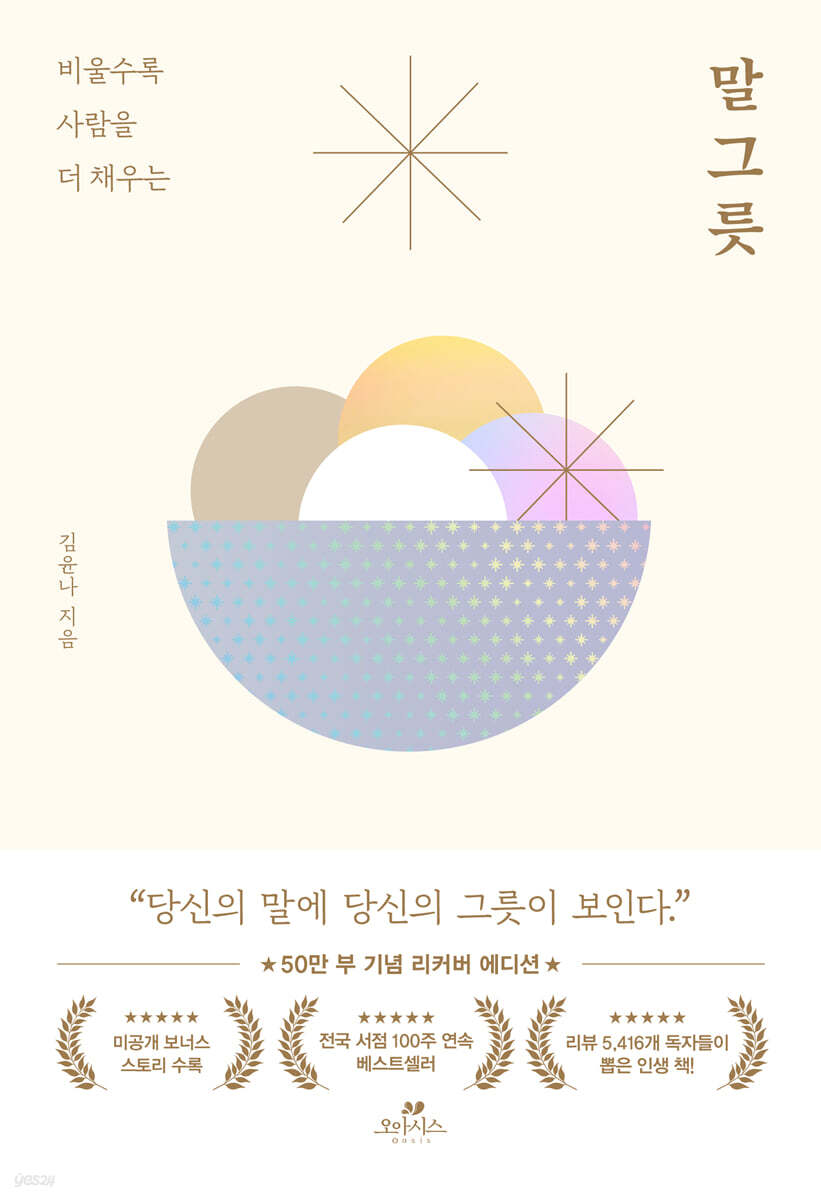
“Do not leave your bowl unattended.” A fundamental reflection on words gained through coaching numerous companies and individuals, including SK, LG, and Samsung. How to cultivate a vessel of speech, not a technique of speech, and then contain people within it A nationwide bestseller for 100 consecutive weeks, readers' pick for the book of a lifetime! "The Bowl of Words" has been reborn with a new cover to commemorate its 500,000th copy release. We've included the author's unpublished story of how he came to write the book, along with recommendations from readers who have already read it. People live with each vessel that holds their words. However, depending on the size and condition of the vessel, the level of the words and the depth of the relationship vary greatly. A person who has a generous vessel to hold words can hold many words. The bowl is deep, so the words contained in it do not easily leak out, and you can select the words you need from the wide bowl. People who are narrow-minded and shallow tend to talk too much and say a lot of unnecessary things. This is not a simple difference in speaking skills. It is because of the difference in the ‘speech vessels’ that are created while living. This book is not simply about teaching you how to speak well. This book encourages each person to think about the meaning of their own speaking vessel and tells them how to make their speaking vessel stronger and deeper. People who focus only on 'skills of speaking' use speech to attract attention, but 'people with a strong speaking ability' use speech that communicates. The author says that after coaching various people for over 10 years, he came to realize that 'speech is another form of breathing.' Because a single word reveals a person's emotions, the formula of the years he has lived, and his usual habits. That is why, rather than focusing on learning the finer points of speaking, we should focus on developing the 'speaking vessel' itself that contains the words. It teaches the skills of 'listening' to make your speaking bowl bigger and stronger, and the skills of 'speaking' to deepen your speaking bowl, with various examples. Ultimately, developing the ability to speak is about developing the ability to understand yourself and others. How is your speaking vessel? Is it large and sturdy, capable of containing a person? Or is it shallow and small, easily shaken by even a passing word? |
- You can preview some of the book's contents.
Preview
index
Recommendations from readers who have read it first!
Bonus Story To you who is hurt by words and who is hurt by words today
Prologue: The wounds caused by words are the most painful.
Part 1: People Who Get Lonely Because of Words
Your 'words' resemble you
Why you use 'that word'
The trap of sincerity
A person with a big mouth
If I could tell you what you want to hear
Nothing gets better on its own.
When your heart changes, your words change.
Speaking like myself
Part 2: Refining Your Inner Speech Vessel
About emotions
What Your Emotions Tell You | People Who Are Awkward with Emotions | Finding Your True Emotions | Analyzing Your Emotions | Emotions Are a Gift
About the formula
The formula in my head | You and I are both pretty good people | Even if I can't understand it at all | Discovering my formula
About habits
Unexpected Speaking Habits | Discovering Your Speaking Habits
Part 3: The Art of Listening to Develop Your Speaking Skills
To you who longs to speak
Talking too much doesn't mean you'll be heard | I only speak when I'm safe | I open my heart to those who understand me
To you who misunderstands listening
Misconception #1: Listening is just being patient | Misconception #2: Listening is just nodding and responding
For those of you who need listening skills
Rediscovering Listening | Listening for Facts | Listening for Feelings | Listening for Key Points | Practice
Part 4: The 'Speaking' Skill that Deepens Your Speaking Skills
Why don't we ask questions?
Questions Are Powerful | Why Questions Are Uncomfortable
Why should we ask questions?
Questions are the Key to the Heart | Increase Engagement and Responsibility | Be Mindful
How to ask questions
Questioning Skills | Open-ended Questions | Hypothetical Questions | Goal-Oriented Questions | Emotional Questions | Neutral Questions | Practice
Part 5 There is 'words' between people.
Emptying the words
Taking responsibility for your words
Connect with me
The Three Laws of Relationships
The way of wrestling, the way of waltz
Epilogue: Words Grow Following the Heart
Bonus Story To you who is hurt by words and who is hurt by words today
Prologue: The wounds caused by words are the most painful.
Part 1: People Who Get Lonely Because of Words
Your 'words' resemble you
Why you use 'that word'
The trap of sincerity
A person with a big mouth
If I could tell you what you want to hear
Nothing gets better on its own.
When your heart changes, your words change.
Speaking like myself
Part 2: Refining Your Inner Speech Vessel
About emotions
What Your Emotions Tell You | People Who Are Awkward with Emotions | Finding Your True Emotions | Analyzing Your Emotions | Emotions Are a Gift
About the formula
The formula in my head | You and I are both pretty good people | Even if I can't understand it at all | Discovering my formula
About habits
Unexpected Speaking Habits | Discovering Your Speaking Habits
Part 3: The Art of Listening to Develop Your Speaking Skills
To you who longs to speak
Talking too much doesn't mean you'll be heard | I only speak when I'm safe | I open my heart to those who understand me
To you who misunderstands listening
Misconception #1: Listening is just being patient | Misconception #2: Listening is just nodding and responding
For those of you who need listening skills
Rediscovering Listening | Listening for Facts | Listening for Feelings | Listening for Key Points | Practice
Part 4: The 'Speaking' Skill that Deepens Your Speaking Skills
Why don't we ask questions?
Questions Are Powerful | Why Questions Are Uncomfortable
Why should we ask questions?
Questions are the Key to the Heart | Increase Engagement and Responsibility | Be Mindful
How to ask questions
Questioning Skills | Open-ended Questions | Hypothetical Questions | Goal-Oriented Questions | Emotional Questions | Neutral Questions | Practice
Part 5 There is 'words' between people.
Emptying the words
Taking responsibility for your words
Connect with me
The Three Laws of Relationships
The way of wrestling, the way of waltz
Epilogue: Words Grow Following the Heart
Detailed image
.jpg)
Into the book
Each person has a vessel to hold their words.
However, depending on the size, the level of speech and the depth of the relationship change.
People who are known to be big talkers do not use their words to dazzle or exploit others or to stand out from the crowd.
Rather, we use words to communicate with others, overcome conflicts, and understand people.
We naturally accept the differences between you and me and find ways to continue conversations with people even in difficult communication situations.
--- p.17, from “Wounds given by words are the most painful”
A man fills his mouth with words.
People with a big heart have enough space to listen and accept what others have to say.
Because you don't have to be impatient or rude, you don't interrupt or interrupt the other person by saying, "That's not it," "I don't know," or "Listen to me."
Rather, you make the other person open their mouth more by saying things like, “I see,” “Tell me more,” or “What do you think?”
It lowers the other person's anxiety and opens their heart.
That's why people feel comfortable talking to people who have a big mouth.
--- p.39, from “A Man of Great Words”
What's interesting is that when you have a conversation about horses, you'll find yourself pouring out thoughts about that person's past, present, and future.
Situations that have been bothering you, such as hidden family history, problems at work that you couldn't reveal, conflicts and crises in relationships with friends or lovers, etc., naturally come out.
And as you spend time asking and answering questions like that, you come across the psychological roots that were driving a person's words.
--- p.52, from “When the mind changes, the words change”
If you don't learn about emotions from a young age because you're studying Korean, English, and math, you'll still be awkward with emotions as an adult.
To be overly stingy or overly generous.
If you pretend not to know the colors of emotions that arise in your own heart, you will end up living only showing the emotions that you deem beneficial to yourself.
In particular, you become accustomed to the emotion called ‘anger’.
When things are good, they don't express it, but when things are unfair, they react with glares and raised voices.
This is the so-called 'anger addiction'.
When you get angry, you think you have power and you only seek out harsh and strong words.
--- p.75, from “People who are awkward with emotions”
When having a conversation, there are often times when 'my words' and 'the other person's words' are too different, which causes conflict.
At first, I try to speak nicely, but soon my voice gets louder and my emotions get intense.
What is needed to wisely navigate this situation is an understanding of the formula in your head.
Because a person's special formula and emotions are tangled like a thread.
We cannot accept the differences between each formula and complain, “He’s driving me crazy.”
Finally, he drives the other person away with the words, “I just can’t understand you!”
The underlying premise is that one is right and the other person is wrong.
I wish I could tear down your thoughts and change them.
--- p.107, from “Formulas Created in the Head”
To have a generous vessel to hold the words of others, you must be free and not be bound by a single formula.
Express your opinions confidently, but understand that they can be interpreted quite differently depending on your perspective.
We must accept that what is a precious jewel to us may be a rock to someone else, or vice versa.
Only by knowing this can we reconcile differences, big and small, and integrate conflicts.
Differences clearly create conflict.
However, when we realize that the differences in the numerous formulas we encounter are ultimately not differences in 'humanity and superiority' but differences in 'experience and formula', our hearts become much more softened.
However, depending on the size, the level of speech and the depth of the relationship change.
People who are known to be big talkers do not use their words to dazzle or exploit others or to stand out from the crowd.
Rather, we use words to communicate with others, overcome conflicts, and understand people.
We naturally accept the differences between you and me and find ways to continue conversations with people even in difficult communication situations.
--- p.17, from “Wounds given by words are the most painful”
A man fills his mouth with words.
People with a big heart have enough space to listen and accept what others have to say.
Because you don't have to be impatient or rude, you don't interrupt or interrupt the other person by saying, "That's not it," "I don't know," or "Listen to me."
Rather, you make the other person open their mouth more by saying things like, “I see,” “Tell me more,” or “What do you think?”
It lowers the other person's anxiety and opens their heart.
That's why people feel comfortable talking to people who have a big mouth.
--- p.39, from “A Man of Great Words”
What's interesting is that when you have a conversation about horses, you'll find yourself pouring out thoughts about that person's past, present, and future.
Situations that have been bothering you, such as hidden family history, problems at work that you couldn't reveal, conflicts and crises in relationships with friends or lovers, etc., naturally come out.
And as you spend time asking and answering questions like that, you come across the psychological roots that were driving a person's words.
--- p.52, from “When the mind changes, the words change”
If you don't learn about emotions from a young age because you're studying Korean, English, and math, you'll still be awkward with emotions as an adult.
To be overly stingy or overly generous.
If you pretend not to know the colors of emotions that arise in your own heart, you will end up living only showing the emotions that you deem beneficial to yourself.
In particular, you become accustomed to the emotion called ‘anger’.
When things are good, they don't express it, but when things are unfair, they react with glares and raised voices.
This is the so-called 'anger addiction'.
When you get angry, you think you have power and you only seek out harsh and strong words.
--- p.75, from “People who are awkward with emotions”
When having a conversation, there are often times when 'my words' and 'the other person's words' are too different, which causes conflict.
At first, I try to speak nicely, but soon my voice gets louder and my emotions get intense.
What is needed to wisely navigate this situation is an understanding of the formula in your head.
Because a person's special formula and emotions are tangled like a thread.
We cannot accept the differences between each formula and complain, “He’s driving me crazy.”
Finally, he drives the other person away with the words, “I just can’t understand you!”
The underlying premise is that one is right and the other person is wrong.
I wish I could tear down your thoughts and change them.
--- p.107, from “Formulas Created in the Head”
To have a generous vessel to hold the words of others, you must be free and not be bound by a single formula.
Express your opinions confidently, but understand that they can be interpreted quite differently depending on your perspective.
We must accept that what is a precious jewel to us may be a rock to someone else, or vice versa.
Only by knowing this can we reconcile differences, big and small, and integrate conflicts.
Differences clearly create conflict.
However, when we realize that the differences in the numerous formulas we encounter are ultimately not differences in 'humanity and superiority' but differences in 'experience and formula', our hearts become much more softened.
--- p.123, from “You and I Are Pretty Good People”
Publisher's Review
Where your words are born and grow
How to Cultivate Your "Word Bowl" and Become the Master of Your Relationships and Life
People envy people who are good at talking, but the people they want to keep around are those whose words convey their heart.
We are drawn to people who don't say much but who are able to speak articulately and concisely, who know when to speak and when to be silent, and who convey a sense of class in every word they say.
This book is divided into five parts to help us make our speaking vessels bigger and stronger.
In Part 1, we will learn about the meaning of the speaking bowl, and in Part 2, we will learn about the personal emotions, formulas, and habits that we need to look into to develop the speaking bowl.
As you follow this process step by step, you will discover what was hindering your speech growth.
In parts 3 and 4, we introduce representative 'conversational techniques' used by people with great speaking skills.
The most direct way to express one's feelings is through speech, and unfortunately, if the art of speaking is not smooth, the path of the heart is likely to be blocked.
In this part, we will learn about the most basic and important 'conversation skills', 'listening' and 'questioning', and practice techniques to draw the other person into a conversation without saying much.
In the final five parts, we explore what it means to understand others, reflect on whether we are truly capable of shouldering the responsibility of our words, and explore what else we need to consider to overcome differences in relationships.
“Your words reveal your vessel.”
Break the 'word-trading' cycle and speak your own way
A single word contains a lot of information about the person who said it.
It is something like a 'unique fragrance that comes through words'.
That is why everyone should know how to use the words that best suit them and how to properly express their feelings and state of mind.
The more indifferent you are to it, the more often you will be misunderstood by others.
Sometimes I meet people who say things that are different from what they mean.
People who speak coldly because they are embarrassed, get irritated the more they apologize, and get angrier the more worried they are.
People who say they can't change it because it's a 'habit' without even knowing why they say it.
But if you look closely at the details, you will see that those words are often not necessarily 'your own words'.
It may be the way your parents spoke to you often as a child, or it may be the way a senior or superior who had a strong influence spoke to you.
Whose words are those you frequently use? Are you speaking in your own way, or are you simply being swayed by habit? Let's now reflect on the history of your words, your emotions, and your wounds.
Let's take a closer look at your 'speaking bowl' that you have left alone.
That's the first step in a long journey to find the words that best suit me.
How to Cultivate Your "Word Bowl" and Become the Master of Your Relationships and Life
People envy people who are good at talking, but the people they want to keep around are those whose words convey their heart.
We are drawn to people who don't say much but who are able to speak articulately and concisely, who know when to speak and when to be silent, and who convey a sense of class in every word they say.
This book is divided into five parts to help us make our speaking vessels bigger and stronger.
In Part 1, we will learn about the meaning of the speaking bowl, and in Part 2, we will learn about the personal emotions, formulas, and habits that we need to look into to develop the speaking bowl.
As you follow this process step by step, you will discover what was hindering your speech growth.
In parts 3 and 4, we introduce representative 'conversational techniques' used by people with great speaking skills.
The most direct way to express one's feelings is through speech, and unfortunately, if the art of speaking is not smooth, the path of the heart is likely to be blocked.
In this part, we will learn about the most basic and important 'conversation skills', 'listening' and 'questioning', and practice techniques to draw the other person into a conversation without saying much.
In the final five parts, we explore what it means to understand others, reflect on whether we are truly capable of shouldering the responsibility of our words, and explore what else we need to consider to overcome differences in relationships.
“Your words reveal your vessel.”
Break the 'word-trading' cycle and speak your own way
A single word contains a lot of information about the person who said it.
It is something like a 'unique fragrance that comes through words'.
That is why everyone should know how to use the words that best suit them and how to properly express their feelings and state of mind.
The more indifferent you are to it, the more often you will be misunderstood by others.
Sometimes I meet people who say things that are different from what they mean.
People who speak coldly because they are embarrassed, get irritated the more they apologize, and get angrier the more worried they are.
People who say they can't change it because it's a 'habit' without even knowing why they say it.
But if you look closely at the details, you will see that those words are often not necessarily 'your own words'.
It may be the way your parents spoke to you often as a child, or it may be the way a senior or superior who had a strong influence spoke to you.
Whose words are those you frequently use? Are you speaking in your own way, or are you simply being swayed by habit? Let's now reflect on the history of your words, your emotions, and your wounds.
Let's take a closer look at your 'speaking bowl' that you have left alone.
That's the first step in a long journey to find the words that best suit me.
GOODS SPECIFICS
- Date of publication: September 22, 2017
- Page count, weight, size: 320 pages | 470g | 140*205*20mm
- ISBN13: 9791185952987
- ISBN10: 1185952985
You may also like
카테고리
korean


korean

![GQ KOREA Mark (Monthly): December [2025]](http://librairie.coreenne.fr/cdn/shop/files/8ef265dbbfbf186523ed75ba7319009d.jpg?v=1765340328&width=3840)


