

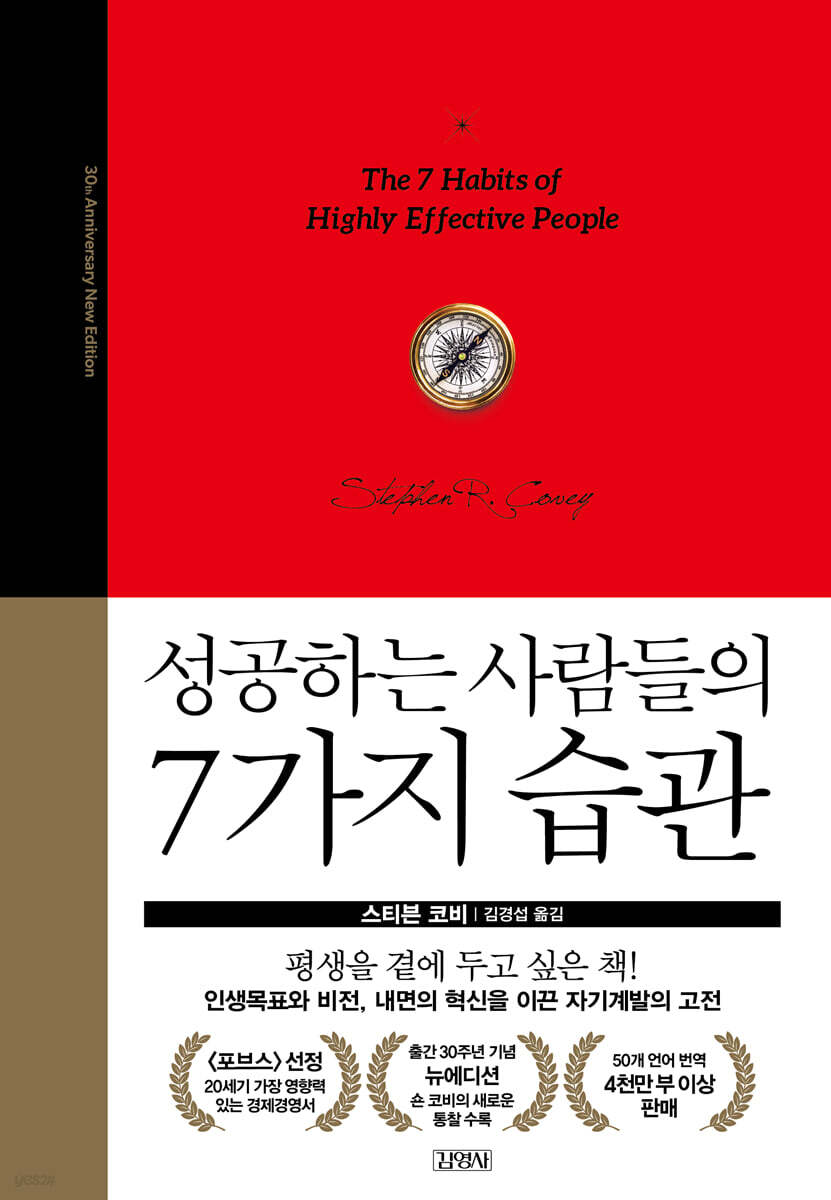
The 7 Habits of Highly Effective People: 30th Anniversary New Edition
 |
Description
Book Introduction
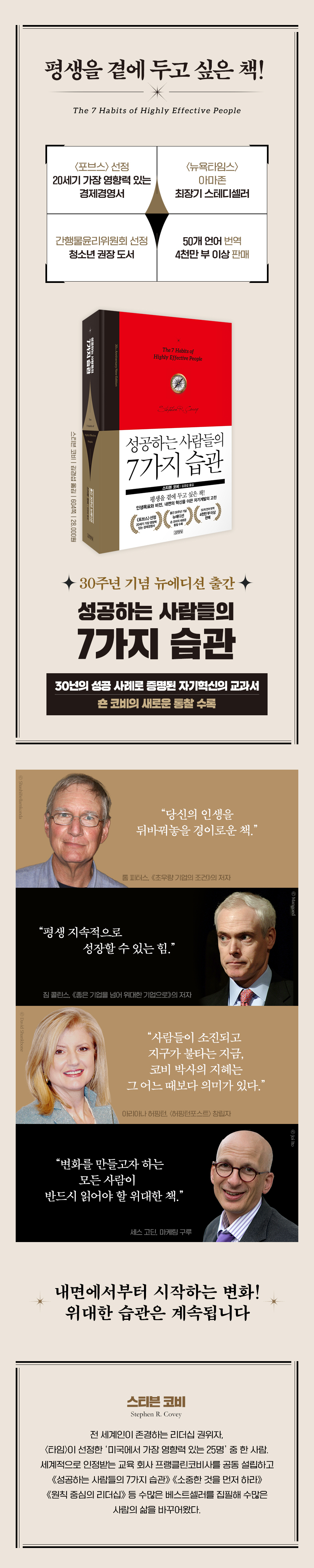
*Selected by Forbes as the most influential business book of the 20th century*
*Recommended books for youth selected by the Publication Ethics Committee*
*Translated into 50 languages, sold over 40 million copies*
A classic self-development guide to life goals, vision, and inner transformation.
30th Anniversary New Edition
A book you'll want to keep by your side for a lifetime! "The 7 Habits of Highly Effective People," a self-help book that has transformed the lives of 40 million readers worldwide, 4 million domestic readers, and over 10,000 companies and organizations worldwide.
The immortal self-help book that created a sensation by suggesting a principle-centered life and a paradigm shift that begins from within has been published in a new edition with a new cover and editing to celebrate its 30th anniversary.
Added commentary by Shawn Covey, who has studied the 7 Habits more than anyone else.
From daily habits to lifelong goals and attitudes, 'The 7 Habits' will reveal the unchanging coordinates of your life.
*Recommended books for youth selected by the Publication Ethics Committee*
*Translated into 50 languages, sold over 40 million copies*
A classic self-development guide to life goals, vision, and inner transformation.
30th Anniversary New Edition
A book you'll want to keep by your side for a lifetime! "The 7 Habits of Highly Effective People," a self-help book that has transformed the lives of 40 million readers worldwide, 4 million domestic readers, and over 10,000 companies and organizations worldwide.
The immortal self-help book that created a sensation by suggesting a principle-centered life and a paradigm shift that begins from within has been published in a new edition with a new cover and editing to celebrate its 30th anniversary.
Added commentary by Shawn Covey, who has studied the 7 Habits more than anyone else.
From daily habits to lifelong goals and attitudes, 'The 7 Habits' will reveal the unchanging coordinates of your life.
- You can preview some of the book's contents.
Preview
index
Celebrating the 30th anniversary of the publication of 'The 7 Habits'
Part 1: Paradigms and Principles
Start from within
An Overview of the 7 Habits
Part 2: Individual Victory
Habit 1: Take charge of your own life
Habit 2: Begin with the End in Mind
Habit 3: Put important things first
Part 3: The Triumph of Interpersonal Relationships
Paradigm of Interdependence
Habit 4: Think Win-Win
Habit 5: Understand first, then make others understand.
Habit 6: Create Synergy
Part 4: Self-renewal
Habit 7: Constantly Renew
Emphasizing again the change from within
My personal notes
Appendix: Quadrant 2 Office Schedule
Stephen Covey Interview
Acknowledgements
main
Search
To celebrate the publication of 'The 7 Habits'
Part 1: Paradigms and Principles
Start from within
An Overview of the 7 Habits
Part 2: Individual Victory
Habit 1: Take charge of your own life
Habit 2: Begin with the End in Mind
Habit 3: Put important things first
Part 3: The Triumph of Interpersonal Relationships
Paradigm of Interdependence
Habit 4: Think Win-Win
Habit 5: Understand first, then make others understand.
Habit 6: Create Synergy
Part 4: Self-renewal
Habit 7: Constantly Renew
Emphasizing again the change from within
My personal notes
Appendix: Quadrant 2 Office Schedule
Stephen Covey Interview
Acknowledgements
main
Search
To celebrate the publication of 'The 7 Habits'
Detailed image
Into the book
[Viktor] Frankl experienced misery beyond our imagination while imprisoned in a Jewish concentration camp in Nazi Germany.
…one day, while he was naked and alone in his small cell, he began to become aware of what he later called 'the last freedom man possesses.'
…he used the innate human ability of self-awareness to discover a fundamental principle of human nature: “Between stimulus and response, there is freedom of choice.”
---From "Habit 1_Take charge of your own life"
“Dr. Kobe, can we teach these habits to children too?”
“How young is he?” “About five years old.”
My father thought carefully, then smiled and said.
“I don’t see why it wouldn’t work.”
---From "Habit 2_Begin with the End in Mind"
Urgent matters are usually right in front of us.
These things put pressure on us and push us to act.
But most of these urgent matters aren't important! "Importance," on the other hand, is about results.
It's important to contribute to our mission, values, and high-priority goals.
---From "Habit 3_Put important things first"
If we are polite, kind, honest, and keep our promises to others, we are saving our feelings.
Then, even if we make a mistake, we can offset the mistake because our emotional balance, which is our level of trust, is high.
But if we are unkind, rude, cut off, overreact, dismissive, dogmatic, untrustworthy, threatening, or even show off to others, our emotional bank account will be empty or in the red.
---From "The Paradigm of Interdependence"
The language of logic is different from the language of emotions or feelings.
You can ask a lot of questions all day long and never find out what's wrong with your child.
This constant searching is one of the main reasons why many parents fail to reach their children.
I have taught this concept to thousands of people in numerous seminars.
Participants achieved dramatic improvements in communication skills by learning how to practice empathic listening.
---From “Habit 5_ Understand first, then make others understand”
The tool that does the work is yourself.
Therefore, we can effectively increase our productivity only when we recognize the importance of regularly sharpening our saw blades, that is, taking time to train our mind and body.
---From "Habit 7_ Constantly Renew"
Our problems and suffering are universal and ever-growing.
And the solution to that problem has been, and will continue to be, based on universal, eternal, and self-evident 'principles' common to all societies that have historically endured and prospered.
…one day, while he was naked and alone in his small cell, he began to become aware of what he later called 'the last freedom man possesses.'
…he used the innate human ability of self-awareness to discover a fundamental principle of human nature: “Between stimulus and response, there is freedom of choice.”
---From "Habit 1_Take charge of your own life"
“Dr. Kobe, can we teach these habits to children too?”
“How young is he?” “About five years old.”
My father thought carefully, then smiled and said.
“I don’t see why it wouldn’t work.”
---From "Habit 2_Begin with the End in Mind"
Urgent matters are usually right in front of us.
These things put pressure on us and push us to act.
But most of these urgent matters aren't important! "Importance," on the other hand, is about results.
It's important to contribute to our mission, values, and high-priority goals.
---From "Habit 3_Put important things first"
If we are polite, kind, honest, and keep our promises to others, we are saving our feelings.
Then, even if we make a mistake, we can offset the mistake because our emotional balance, which is our level of trust, is high.
But if we are unkind, rude, cut off, overreact, dismissive, dogmatic, untrustworthy, threatening, or even show off to others, our emotional bank account will be empty or in the red.
---From "The Paradigm of Interdependence"
The language of logic is different from the language of emotions or feelings.
You can ask a lot of questions all day long and never find out what's wrong with your child.
This constant searching is one of the main reasons why many parents fail to reach their children.
I have taught this concept to thousands of people in numerous seminars.
Participants achieved dramatic improvements in communication skills by learning how to practice empathic listening.
---From “Habit 5_ Understand first, then make others understand”
The tool that does the work is yourself.
Therefore, we can effectively increase our productivity only when we recognize the importance of regularly sharpening our saw blades, that is, taking time to train our mind and body.
---From "Habit 7_ Constantly Renew"
Our problems and suffering are universal and ever-growing.
And the solution to that problem has been, and will continue to be, based on universal, eternal, and self-evident 'principles' common to all societies that have historically endured and prospered.
---From "Stephen Covey Interview"
Publisher's Review
A book you want to keep by your side for the rest of your life.
A masterpiece of success that captivated people around the world
“A wonderful book that will change your life.” —Tom Peters
"The 7 Habits of Highly Effective People" created a sensation in the self-development market, where most of the books focused on technique-oriented life skills, by suggesting a paradigm shift that starts from within and a life centered on principles.
Even with the countless self-help books that have been published since then, it remains a timeless classic.
Celebrating its 30th anniversary, "The 7 Habits of Highly Effective People" has returned with a new edition.
Commentary by Shawn Covey, who has studied the 7 Habits more than anyone else, has been added, and the Stephen Covey interview has also been newly revised.
The 7 Habits of Highly Effective People, a textbook on success read by people all over the world.
It will also reveal to you the unchanging coordinates of life.
What are the '7 Habits'?
Stephen Covey believed that even as society becomes more complex and new problems constantly emerge, solutions are based on “universal, timeless, and self-evident principles.”
These are values that all societies have pursued in common.
Stephen Covey collected and selected the principles of success scattered throughout the East and the West, past and present, and created 'The 7 Habits of Highly Effective People'.
The 7 Habits of Success will help you reach your goals and solve problems faster and in a better way.
From personal triumphs (Habits 1, 2, and 3) to interpersonal triumphs (Habits 4, 5, and 6) and the recharge and improvement that surrounds them (Habit 7), these habits move us from dependence to independence and then interdependence.
7 habits, 30 years!
Great habits last
“Now that people are exhausted and the earth is burning,
“Dr. Covey’s wisdom is more relevant than ever.”
_Ariana Huffington
A book that collects the inspiration and wisdom of numerous thinkers.
There were many books about success before "The 7 Habits of Highly Effective People," but Stephen Covey's book was the first self-help book to integrate it into a single system.
This book is “a library of success literature from the East and the West, past and present” (Ken Blanchard) and “a standard operating system for personal effectiveness” (Jim Collins).
Covering everything from daily habits to attitudes toward life, it quickly became a must-read for CEOs and became a hit in schools, government, the military, and even families.
"The 7 Habits of Highly Effective People" can be considered the forerunner of today's self-help books, and it remains a firm favorite even amidst the proliferation of similar books.
A book that illuminates the importance of inner transformation and a principle-centered life.
What is the most precious thing in life? External worldly wisdom may solve your immediate problems, but its effects are short-lived.
But the principles are different.
Stephen Covey shows us a concrete way to achieve success by setting our own goals and overcoming hardships and crises through active self-development.
When times are good, you can easily achieve success with piecemeal prescriptions and life skills, but in difficult times, you need to lead yourself with firm principles.
Stephen Covey called this “principle-centered leadership.”
It's not the traditional concept of leadership, which involves leading others, but self-leadership. Now, with the economic situation more challenging than during the IMF financial crisis, "The 7 Habits of Highly Effective People" will cultivate leaders who, based on principles, can survive and thrive in times of crisis.
A textbook on self-innovation proven by 30 years of success stories
Steve Covey develops and utilizes the four innate abilities of human beings (self-awareness, conscience, imagination, and independent will) to transform themselves, and presents a method for individuals and businesses to fundamentally solve any problem based on principles and values.
The 7 Habits are based on universal and timeless principles, so they resonate with everyone, regardless of nationality, gender, age, or occupation.
This principle has helped a public school that was on the verge of closure due to under-enrollment become the best magnet school in the United States, and a factory that was flooded by record-breaking rains defied all expectations by reopening in just 15 days and regaining its market leadership.
It is so easy that even a five-year-old child can understand it, and its effectiveness has been proven in the top 500 companies in Pocheon.
“I believe my best work is yet to come.” Stephen Covey cited “living in crescendo” (a musical term meaning “stronger”) as his most important final message.
His life, to the very end, was filled with “wonderful next challenges, greater learning, more intense romances, and more meaningful loves.”
The reason he was able to live that kind of life was because the '7 Habits' were the foundation for it.
"The 7 Habits of Highly Effective People" has changed countless lives over the past 30 years.
And today, it will change your life too.
A masterpiece of success that captivated people around the world
“A wonderful book that will change your life.” —Tom Peters
"The 7 Habits of Highly Effective People" created a sensation in the self-development market, where most of the books focused on technique-oriented life skills, by suggesting a paradigm shift that starts from within and a life centered on principles.
Even with the countless self-help books that have been published since then, it remains a timeless classic.
Celebrating its 30th anniversary, "The 7 Habits of Highly Effective People" has returned with a new edition.
Commentary by Shawn Covey, who has studied the 7 Habits more than anyone else, has been added, and the Stephen Covey interview has also been newly revised.
The 7 Habits of Highly Effective People, a textbook on success read by people all over the world.
It will also reveal to you the unchanging coordinates of life.
What are the '7 Habits'?
Stephen Covey believed that even as society becomes more complex and new problems constantly emerge, solutions are based on “universal, timeless, and self-evident principles.”
These are values that all societies have pursued in common.
Stephen Covey collected and selected the principles of success scattered throughout the East and the West, past and present, and created 'The 7 Habits of Highly Effective People'.
The 7 Habits of Success will help you reach your goals and solve problems faster and in a better way.
From personal triumphs (Habits 1, 2, and 3) to interpersonal triumphs (Habits 4, 5, and 6) and the recharge and improvement that surrounds them (Habit 7), these habits move us from dependence to independence and then interdependence.
7 habits, 30 years!
Great habits last
“Now that people are exhausted and the earth is burning,
“Dr. Covey’s wisdom is more relevant than ever.”
_Ariana Huffington
A book that collects the inspiration and wisdom of numerous thinkers.
There were many books about success before "The 7 Habits of Highly Effective People," but Stephen Covey's book was the first self-help book to integrate it into a single system.
This book is “a library of success literature from the East and the West, past and present” (Ken Blanchard) and “a standard operating system for personal effectiveness” (Jim Collins).
Covering everything from daily habits to attitudes toward life, it quickly became a must-read for CEOs and became a hit in schools, government, the military, and even families.
"The 7 Habits of Highly Effective People" can be considered the forerunner of today's self-help books, and it remains a firm favorite even amidst the proliferation of similar books.
A book that illuminates the importance of inner transformation and a principle-centered life.
What is the most precious thing in life? External worldly wisdom may solve your immediate problems, but its effects are short-lived.
But the principles are different.
Stephen Covey shows us a concrete way to achieve success by setting our own goals and overcoming hardships and crises through active self-development.
When times are good, you can easily achieve success with piecemeal prescriptions and life skills, but in difficult times, you need to lead yourself with firm principles.
Stephen Covey called this “principle-centered leadership.”
It's not the traditional concept of leadership, which involves leading others, but self-leadership. Now, with the economic situation more challenging than during the IMF financial crisis, "The 7 Habits of Highly Effective People" will cultivate leaders who, based on principles, can survive and thrive in times of crisis.
A textbook on self-innovation proven by 30 years of success stories
Steve Covey develops and utilizes the four innate abilities of human beings (self-awareness, conscience, imagination, and independent will) to transform themselves, and presents a method for individuals and businesses to fundamentally solve any problem based on principles and values.
The 7 Habits are based on universal and timeless principles, so they resonate with everyone, regardless of nationality, gender, age, or occupation.
This principle has helped a public school that was on the verge of closure due to under-enrollment become the best magnet school in the United States, and a factory that was flooded by record-breaking rains defied all expectations by reopening in just 15 days and regaining its market leadership.
It is so easy that even a five-year-old child can understand it, and its effectiveness has been proven in the top 500 companies in Pocheon.
“I believe my best work is yet to come.” Stephen Covey cited “living in crescendo” (a musical term meaning “stronger”) as his most important final message.
His life, to the very end, was filled with “wonderful next challenges, greater learning, more intense romances, and more meaningful loves.”
The reason he was able to live that kind of life was because the '7 Habits' were the foundation for it.
"The 7 Habits of Highly Effective People" has changed countless lives over the past 30 years.
And today, it will change your life too.
GOODS SPECIFICS
- Date of issue: May 30, 2023
- Format: Hardcover book binding method guide
- Page count, weight, size: 604 pages | 980g | 152*225*34mm
- ISBN13: 9788934965954
- ISBN10: 8934965959
You may also like
카테고리
korean


korean

![GQ KOREA Mark (Monthly): December [2025]](http://librairie.coreenne.fr/cdn/shop/files/8ef265dbbfbf186523ed75ba7319009d.jpg?v=1765340328&width=3840)


