

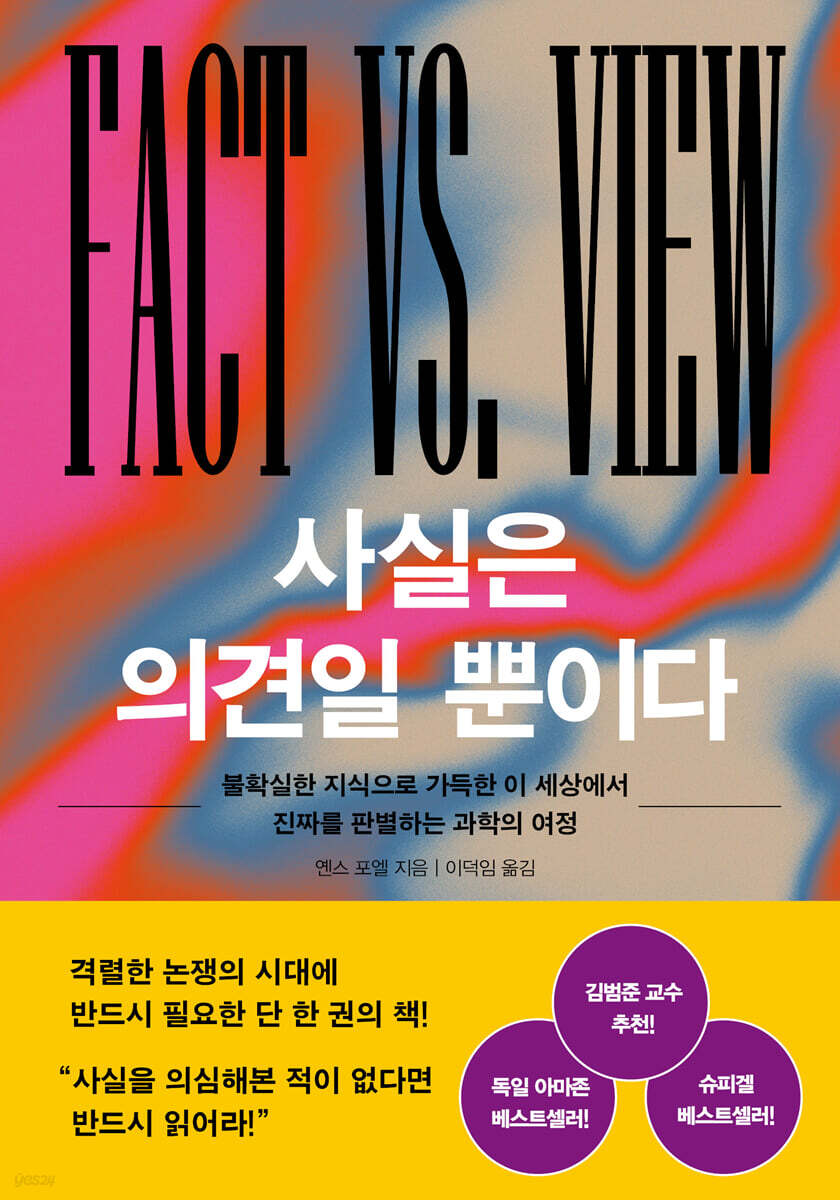
Facts are just opinions
 |
Description
Book Introduction
Beyond the ambiguous gray area between fact and opinion
On how to see the world in higher resolution
In the early stages of the coronavirus pandemic, the easiest and most obvious response humanity could take in the face of an unprecedented outbreak was to wear a mask to prevent the virus from spreading through the air.
This is an obvious countermeasure that is beyond doubt, according to existing modern medical research.
However, some people have argued that wearing masks is useless, citing reasons such as that wearing masks can actually cause lung disease.
What's interesting is that during the debate over mask-wearing, there were more opinions than facts, and those in favor of wearing masks were more likely to cite sources for their arguments than those against.
But one more surprising fact remains.
What's more, less than half of both groups cited reliable sources, such as independent research or government information.
In other words, the majority of content for and against mask-wearing at the time was 'just opinions.'
Even though one side of the argument may be closer to the truth, when we assert or accept something, we tend to rely on our own arbitrary beliefs rather than the facts themselves, or we decide whether to accept the facts based on our own political, social, and cultural positions.
In this book, German neuropsychologist Jens Poel suggests that we consider 16 issues that we must keep in mind when exploring the boundary between “scientific consensus” and “controversial opinion.”
When we seek to explore, evaluate, understand, and communicate facts to others, the world before us is bound to present obstacles and problems.
Such errors of perception and reasoning occur naturally even when we are not ideologically or emotionally blind and have no intention of lying to anyone, including ourselves.
These errors in perception and reasoning that we constantly fall into sometimes originate from our own minds, and sometimes from inherent flaws in the process of scientifically reaching a consensus on facts.
It also has to do with the fact that no one has ever explained specifically to the public how scientific research is actually conducted and communicated.
The book follows four broad areas sequentially, corresponding to the process of discovering scientific facts.
Observe ('Look'), test hypotheses ('Test Hypotheses'), interpret ('Interpret'), and communicate ('Talk to a Friend').
At every stage, humans confuse facts and opinions due to limitations in their observation and memory, excessive confidence in what they believe, and misinterpretation or bias of observed facts.
Jens Poel argues that only when we acknowledge and accept these limitations of our perception can we move on to discovering better facts and making better decisions.
Jens Poel also emphasizes the importance of flexible thinking, understanding that even surprising discoveries that we now consider "facts" were once just "opinions," and that existing facts can be stripped of their factual status at any time when a new hypothesis that refutes them is proven through a series of procedures.
At the end of the book, we've summarized some key points that can help you make better decisions, serving as a sort of guide, so you can review the main points of the text.
In this complex world where facts and opinions are intertwined, this is a must-read science textbook for anyone who wants to develop "high-resolution eyes" that can choose better opinions based on facts.
On how to see the world in higher resolution
In the early stages of the coronavirus pandemic, the easiest and most obvious response humanity could take in the face of an unprecedented outbreak was to wear a mask to prevent the virus from spreading through the air.
This is an obvious countermeasure that is beyond doubt, according to existing modern medical research.
However, some people have argued that wearing masks is useless, citing reasons such as that wearing masks can actually cause lung disease.
What's interesting is that during the debate over mask-wearing, there were more opinions than facts, and those in favor of wearing masks were more likely to cite sources for their arguments than those against.
But one more surprising fact remains.
What's more, less than half of both groups cited reliable sources, such as independent research or government information.
In other words, the majority of content for and against mask-wearing at the time was 'just opinions.'
Even though one side of the argument may be closer to the truth, when we assert or accept something, we tend to rely on our own arbitrary beliefs rather than the facts themselves, or we decide whether to accept the facts based on our own political, social, and cultural positions.
In this book, German neuropsychologist Jens Poel suggests that we consider 16 issues that we must keep in mind when exploring the boundary between “scientific consensus” and “controversial opinion.”
When we seek to explore, evaluate, understand, and communicate facts to others, the world before us is bound to present obstacles and problems.
Such errors of perception and reasoning occur naturally even when we are not ideologically or emotionally blind and have no intention of lying to anyone, including ourselves.
These errors in perception and reasoning that we constantly fall into sometimes originate from our own minds, and sometimes from inherent flaws in the process of scientifically reaching a consensus on facts.
It also has to do with the fact that no one has ever explained specifically to the public how scientific research is actually conducted and communicated.
The book follows four broad areas sequentially, corresponding to the process of discovering scientific facts.
Observe ('Look'), test hypotheses ('Test Hypotheses'), interpret ('Interpret'), and communicate ('Talk to a Friend').
At every stage, humans confuse facts and opinions due to limitations in their observation and memory, excessive confidence in what they believe, and misinterpretation or bias of observed facts.
Jens Poel argues that only when we acknowledge and accept these limitations of our perception can we move on to discovering better facts and making better decisions.
Jens Poel also emphasizes the importance of flexible thinking, understanding that even surprising discoveries that we now consider "facts" were once just "opinions," and that existing facts can be stripped of their factual status at any time when a new hypothesis that refutes them is proven through a series of procedures.
At the end of the book, we've summarized some key points that can help you make better decisions, serving as a sort of guide, so you can review the main points of the text.
In this complex world where facts and opinions are intertwined, this is a must-read science textbook for anyone who wants to develop "high-resolution eyes" that can choose better opinions based on facts.
- You can preview some of the book's contents.
Preview
index
Recommendation
Special Preface for Korean Readers
prolog
Part 1 Overview
We miss out on a lot
We are not good at observing or remembering.
We can only measure what we have
We don't doubt our own methods.
Testing the hypothesis
We like irrefutable assumptions.
We don't know everything for sure
Sometimes we observe things that cannot be explained.
We are overly fixated on certain assumptions.
Interpret
We don't measure what we think we measure
We don't know which explanation is correct.
We classify according to expectations
We cannot observe without expectation.
Talk to a friend
We don't understand each other
We don't know how to read research materials.
We are fooled by fake research
We consider all research equally trustworthy.
Guidelines for Better Judgment
Americas
Epilogue
References
Special Preface for Korean Readers
prolog
Part 1 Overview
We miss out on a lot
We are not good at observing or remembering.
We can only measure what we have
We don't doubt our own methods.
Testing the hypothesis
We like irrefutable assumptions.
We don't know everything for sure
Sometimes we observe things that cannot be explained.
We are overly fixated on certain assumptions.
Interpret
We don't measure what we think we measure
We don't know which explanation is correct.
We classify according to expectations
We cannot observe without expectation.
Talk to a friend
We don't understand each other
We don't know how to read research materials.
We are fooled by fake research
We consider all research equally trustworthy.
Guidelines for Better Judgment
Americas
Epilogue
References
Detailed image
Into the book
We humans have known for a very long time that these observations are fundamentally important.
But even after all this time, we are still clumsy at observing properly.
In other words, it is difficult to perceive the environment and world you belong to as they are.
One reason is that the ability to make scientifically valid observations is not innate but rather acquired through effort.
--- From "We Miss a Lot"
We sometimes become like drunks who only look for our apartment keys under streetlights, not because we lost them there, but because it's dark everywhere else.
--- From "We can only measure what we have"
Things like fingerprints, lie detectors, and DNA samples are seen as tools for uncovering facts when observation, perception, or memory are lacking.
In situations where it is difficult to distinguish between facts and opinions, they must play a role in making scientifically objective judgments, excluding unreliable subjectivity.
But now it's becoming clear that even these analyses can be completely wrong.
--- From "We do not doubt our own methods"
From a purely scientific point of view, an irrefutable hypothesis is not interesting at all.
On the other hand, a hypothesis that can be refuted can be a powerful tool that can move heaven and earth.
--- From "We Like Irrefutable Assumptions"
Scientific consensus on what statements can be considered factual is unclear and ambiguous.
Therefore, we must introduce a compromise that is as open as possible, yet as strict as necessary.
That is, any new and extraordinary statement, regardless of who made it, must be accepted and then subjected to rigorous testing to determine whether it is true or not.
--- From "We don't know which explanation is correct"
Fake news exists even in the scientific community.
There are fake papers, fake journals, and even full-blown fake scientific publishers.
Unfortunately, outside of academia, no one seems to be talking about this issue.
It can't be a serious problem.
For several years now, there has been a flood of papers published that appear to be serious science, but are either entirely made up or at least completely unverified.
To outsiders, it generally appears real, but the problem is that there is currently no practical way in academia to stop it.
But even after all this time, we are still clumsy at observing properly.
In other words, it is difficult to perceive the environment and world you belong to as they are.
One reason is that the ability to make scientifically valid observations is not innate but rather acquired through effort.
--- From "We Miss a Lot"
We sometimes become like drunks who only look for our apartment keys under streetlights, not because we lost them there, but because it's dark everywhere else.
--- From "We can only measure what we have"
Things like fingerprints, lie detectors, and DNA samples are seen as tools for uncovering facts when observation, perception, or memory are lacking.
In situations where it is difficult to distinguish between facts and opinions, they must play a role in making scientifically objective judgments, excluding unreliable subjectivity.
But now it's becoming clear that even these analyses can be completely wrong.
--- From "We do not doubt our own methods"
From a purely scientific point of view, an irrefutable hypothesis is not interesting at all.
On the other hand, a hypothesis that can be refuted can be a powerful tool that can move heaven and earth.
--- From "We Like Irrefutable Assumptions"
Scientific consensus on what statements can be considered factual is unclear and ambiguous.
Therefore, we must introduce a compromise that is as open as possible, yet as strict as necessary.
That is, any new and extraordinary statement, regardless of who made it, must be accepted and then subjected to rigorous testing to determine whether it is true or not.
--- From "We don't know which explanation is correct"
Fake news exists even in the scientific community.
There are fake papers, fake journals, and even full-blown fake scientific publishers.
Unfortunately, outside of academia, no one seems to be talking about this issue.
It can't be a serious problem.
For several years now, there has been a flood of papers published that appear to be serious science, but are either entirely made up or at least completely unverified.
To outsiders, it generally appears real, but the problem is that there is currently no practical way in academia to stop it.
--- From "We are fooled by fake research"
Publisher's Review
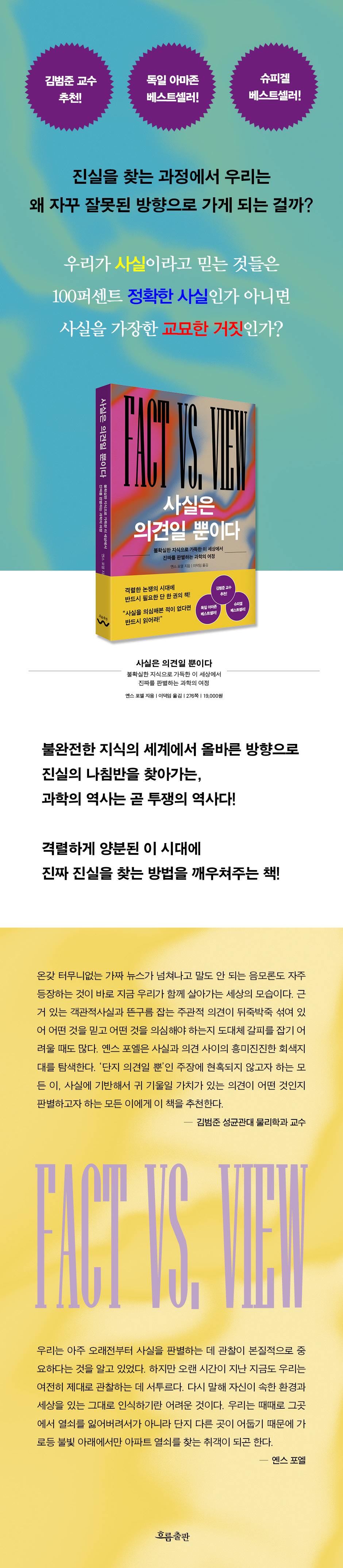
This book explores the fascinating gray area between fact and opinion.
Anyone who wants to avoid being fooled by claims that are 'just opinions',
An opinion worth listening to based on facts
I recommend this book to anyone who wants to determine what it is.
- Kim Beom-jun, Professor of Physics, Sungkyunkwan University
“It is not easy to distinguish between fact, opinion, and interpretation.”
Nevertheless, there are clearly ways to make better decisions.
Is drinking a certain amount of coffee every day good for your health? Are the pros and cons of getting a COVID-19 vaccine outweighed by the pros and cons? When watching videos and articles on various health and medical media, you sometimes find yourself confused about which claims are true.
This is because medical studies on the same topic often claim conflicting results.
What should we believe in times like these? Indeed, a group of researchers analyzed research on 50 common ingredients commonly used in cooking, including butter, cheese, salt, carrots, and onions, revealing that this confusion is inevitable.
Researchers combed through relevant scientific databases to determine whether each ingredient could cause or prevent cancer.
The conclusion was surprising.
Most of the foods we eat either cause cancer or prevent it.
For every clinical study that suggests a material is a carcinogen, other studies claim the opposite.
Of course, sometimes the evidence tilted in favor of one side or the other, but the overall result was often a situation where conflicting claims coexisted.
So, is there no standard by which we can judge what is closer to the truth and what we should rightly believe and accept?
In "Facts Are Just Opinions," Jens Poel, a German neuropsychologist and active science communicator connecting academia and the public, organizes the core problems that make it difficult to distinguish between facts and opinions into 16 types. He explains the errors in perception and reasoning that we are prone to making, as well as the problems inherent in the process of scientifically agreeing on facts.
We often think that it is easy to clearly distinguish between facts and opinions.
But in reality, it is not that simple.
For example, many people tend not to question scientific theories or scientific concepts as established facts.
But according to the authors, “if planets were simply planets, the decision to grant Pluto dwarf planet status would never have been put to a vote.”
Moreover, even in the world of tiny particles, the line between opinion and fact is not always as clear as we might think.
The existence of atoms was merely an opinion until it was accepted as fact through rigorous scientific research and discussion.
This is not something that only happens in the scientific field.
In most areas of life, we have difficulty clearly distinguishing between 'facts and opinions'.
Moreover, in today's world of advanced digital communication technology, there are many people who intentionally blur or manipulate the line between fact and opinion, spreading so-called "fake news" to pursue the interests of their own groups (for example, the case of US President Trump, who declared withdrawal from the Paris Agreement while claiming "climate crisis denial" despite clear scientific indicators, can be considered an example of this).
It is no exaggeration to say that we live in a world where it is increasingly important to clearly distinguish between facts and opinions.
The difference between fact and opinion is like the difference between “The temperature in this room is 23 degrees Celsius” and “It’s a good day to wear a T-shirt.”
Measuring temperature is a science, and personal opinions about what to wear are not science.
So far, it's clear.
So, we could say that we all have the right to our own opinions, but we do not have the right to facts.
But it's not that simple.
As we will continue to discuss in this book, the line between fact, opinion, and interpretation is not always easy to draw.
Because this is a core element of psychology, natural science, and our understanding of the world.
(From the Prologue)
“Until one opinion is established
“How many facts do you need?”
According to Poel, “It is right for facts to be the basis of opinions, but sometimes opinions determine how facts are treated.” Therefore, if it is not easy to completely separate the two in reality, the only desirable way to do so is to have an honest discussion about “why it is so difficult, and sometimes impossible, to distinguish scientific fact from opinion.”
Simply put, before blindly agreeing on generally accepted facts, we must first agree on how to approach 'as reliable as possible facts'.
The opinions and positions that are already inherent within us often act as obstacles to our observation and acceptance of facts.
However, a hypothesis (an 'opinion') established through some observation can become the starting point of scientific progress if it is properly proven by following certain procedures agreed upon by the academic community.
The book cites Albert Einstein's 'general theory of relativity' as a 'model example of a scientific hypothesis'.
Einstein's theory of general relativity, which he proposed in 1915, had as its core idea that 'where gravity is strong, time and space are warped (time flows slowly).' This was a revolutionary 'opinion' that revised the world of Newton's classical physics, which had been considered established until then.
The hypothesis proposed by Einstein was later proven 'through observation' of a total solar eclipse by British astrophysicist Eddington in 1919.
When the light of stars around the sun was observed and calculated during a total solar eclipse, the degree to which the light was refracted was found to be similar to the value calculated using the general theory of relativity.
According to the author, “Einstein was able to formulate clear hypotheses because, as he said, he stood on the shoulders of giants who had accumulated measurements and insights over centuries.”
In other words, the history of science is nothing less than a history of establishing an opinion (hypothesis) based on facts accumulated through numerous measurements and insights, and then establishing that hypothesis as a new fact by proving or refuting it through further observation and measurement.
The book explains, through easy and interesting examples, the errors that humans make in each step of establishing scientific facts, namely, 'observe-hypothesize-interpret-communicate', such as the limitations of observation and memory, excessive confidence in what one believes, and misinterpretation or bias of observed facts.
'Survival bias' and the 'marshmallow experiment' are representative examples of these errors.
A special case of the phenomenon that we can only measure what we already have is 'survivorship bias'.
During World War II, Royal Air Force aircraft mechanics examined the locations of bullet hits on returning bombers.
For example, the wing section was often hit but the fuselage was not.
As a result, they decided to reinforce the damaged area.
However, statistician Abraham Wald is said to have realized that there was a fatal flaw in this strategy.
If you decide which areas to strengthen based solely on the bombers who survived and returned, you will end up strengthening the wrong areas.
Rather, the area without bullet marks may be more important, and if it had been hit there, there is a high possibility that the aircraft would not have been able to return.
What actually determines a child's future success? The replication study (of the marshmallow experiment) took a somewhat reserved stance, noting that delaying reward isn't the only factor that plays a significant role in this matter.
Children of wealthy parents grow up in environments with ample resources, so they have less trouble waiting for the second marshmallow.
And these children tend to be more successful precisely because their parents are wealthy.
Conversely, some of the children in the study came from families that were poor or barely above poverty.
The children were often unsure whether they would receive a second marshmallow.
Because I've already had the experience of a drawer full of snacks today being empty tomorrow.
Therefore, it is possible that they easily decided not to believe the experimenter's promises.
In other words, their less satisfied later in life had nothing to do with marshmallows or self-control.
It's just that the opportunities given to them were less than those given to other children.
(The marshmallow experiment) was supposed to test children's will, but in the end it ended up being little more than an experiment to test the differences in parental income.
Here, parents' bank balances were a confounding factor—a variable that skewed the results in unexpected or unrecognized ways.
“What should we know,
“Where can I find reliable information?”
The final chapter of this book is where the author's expertise as a science communicator particularly shines.
In an age where fake news is rampant, it offers a concrete methodology for accessing "facts that are as reliable as possible."
Poel notes that even among credible sources, there are distinct levels of trustworthiness, and warns that we should not blindly trust information just because it appears in a scientific journal or paper.
That is, “even if they are not clearly fake, not all papers can be trusted equally.”
To help you discern what is closer to the truth and what is a more credible opinion, the author devotes considerable space to explaining in detail the structure of a scientific paper.
It also brings to mind the fact that even within the scientific community, which we thought was a field that pursued only hard facts, a significant number of fake papers and fake journals have been produced recently.
He notes that, especially in the era of generative AI like ChatGPT, these language programs are starting to be listed as co-authors on numerous scientific papers, raising questions about whether the scientific community is sufficiently prepared for the potential misuse of AI.
We cannot fully trust either our perceptions or our memories.
Even if we try to rely on experiments and scientific research, mistakes and errors are inevitable in the process of conducting them, and even if we try to minimize these errors, the results are often inaccurate.
Whether in the laboratory or during the data interpretation process, psychological filters are applied that can distort the results.
Moreover, our language is so ambiguous and subjective that even well-established facts can be distorted during the transmission process.
Even if we recognize that we are subjective, we cannot completely escape that subjectivity.
So, is finding the truth really meaningless because it's impossible? According to the author, absolutely not.
The important thing is to set high standards for the facts that support your opinions.
If we follow the process outlined in this book and take every step to heart, we will be approaching it in a scientific way.
It doesn't matter whether you're a white coat-wearing PhD or simply a thoughtful individual with a thirst for knowledge and insight.
If you do your best to see things as they really are, and are aware of all the pitfalls that can arise in the process, then that alone is the attitude of a good scientist.
When we engage in discussion, we must first set and adhere to the standard of doing our best based on our knowledge and beliefs.
Otherwise, facts are just opinions.
Anyone who wants to avoid being fooled by claims that are 'just opinions',
An opinion worth listening to based on facts
I recommend this book to anyone who wants to determine what it is.
- Kim Beom-jun, Professor of Physics, Sungkyunkwan University
“It is not easy to distinguish between fact, opinion, and interpretation.”
Nevertheless, there are clearly ways to make better decisions.
Is drinking a certain amount of coffee every day good for your health? Are the pros and cons of getting a COVID-19 vaccine outweighed by the pros and cons? When watching videos and articles on various health and medical media, you sometimes find yourself confused about which claims are true.
This is because medical studies on the same topic often claim conflicting results.
What should we believe in times like these? Indeed, a group of researchers analyzed research on 50 common ingredients commonly used in cooking, including butter, cheese, salt, carrots, and onions, revealing that this confusion is inevitable.
Researchers combed through relevant scientific databases to determine whether each ingredient could cause or prevent cancer.
The conclusion was surprising.
Most of the foods we eat either cause cancer or prevent it.
For every clinical study that suggests a material is a carcinogen, other studies claim the opposite.
Of course, sometimes the evidence tilted in favor of one side or the other, but the overall result was often a situation where conflicting claims coexisted.
So, is there no standard by which we can judge what is closer to the truth and what we should rightly believe and accept?
In "Facts Are Just Opinions," Jens Poel, a German neuropsychologist and active science communicator connecting academia and the public, organizes the core problems that make it difficult to distinguish between facts and opinions into 16 types. He explains the errors in perception and reasoning that we are prone to making, as well as the problems inherent in the process of scientifically agreeing on facts.
We often think that it is easy to clearly distinguish between facts and opinions.
But in reality, it is not that simple.
For example, many people tend not to question scientific theories or scientific concepts as established facts.
But according to the authors, “if planets were simply planets, the decision to grant Pluto dwarf planet status would never have been put to a vote.”
Moreover, even in the world of tiny particles, the line between opinion and fact is not always as clear as we might think.
The existence of atoms was merely an opinion until it was accepted as fact through rigorous scientific research and discussion.
This is not something that only happens in the scientific field.
In most areas of life, we have difficulty clearly distinguishing between 'facts and opinions'.
Moreover, in today's world of advanced digital communication technology, there are many people who intentionally blur or manipulate the line between fact and opinion, spreading so-called "fake news" to pursue the interests of their own groups (for example, the case of US President Trump, who declared withdrawal from the Paris Agreement while claiming "climate crisis denial" despite clear scientific indicators, can be considered an example of this).
It is no exaggeration to say that we live in a world where it is increasingly important to clearly distinguish between facts and opinions.
The difference between fact and opinion is like the difference between “The temperature in this room is 23 degrees Celsius” and “It’s a good day to wear a T-shirt.”
Measuring temperature is a science, and personal opinions about what to wear are not science.
So far, it's clear.
So, we could say that we all have the right to our own opinions, but we do not have the right to facts.
But it's not that simple.
As we will continue to discuss in this book, the line between fact, opinion, and interpretation is not always easy to draw.
Because this is a core element of psychology, natural science, and our understanding of the world.
(From the Prologue)
“Until one opinion is established
“How many facts do you need?”
According to Poel, “It is right for facts to be the basis of opinions, but sometimes opinions determine how facts are treated.” Therefore, if it is not easy to completely separate the two in reality, the only desirable way to do so is to have an honest discussion about “why it is so difficult, and sometimes impossible, to distinguish scientific fact from opinion.”
Simply put, before blindly agreeing on generally accepted facts, we must first agree on how to approach 'as reliable as possible facts'.
The opinions and positions that are already inherent within us often act as obstacles to our observation and acceptance of facts.
However, a hypothesis (an 'opinion') established through some observation can become the starting point of scientific progress if it is properly proven by following certain procedures agreed upon by the academic community.
The book cites Albert Einstein's 'general theory of relativity' as a 'model example of a scientific hypothesis'.
Einstein's theory of general relativity, which he proposed in 1915, had as its core idea that 'where gravity is strong, time and space are warped (time flows slowly).' This was a revolutionary 'opinion' that revised the world of Newton's classical physics, which had been considered established until then.
The hypothesis proposed by Einstein was later proven 'through observation' of a total solar eclipse by British astrophysicist Eddington in 1919.
When the light of stars around the sun was observed and calculated during a total solar eclipse, the degree to which the light was refracted was found to be similar to the value calculated using the general theory of relativity.
According to the author, “Einstein was able to formulate clear hypotheses because, as he said, he stood on the shoulders of giants who had accumulated measurements and insights over centuries.”
In other words, the history of science is nothing less than a history of establishing an opinion (hypothesis) based on facts accumulated through numerous measurements and insights, and then establishing that hypothesis as a new fact by proving or refuting it through further observation and measurement.
The book explains, through easy and interesting examples, the errors that humans make in each step of establishing scientific facts, namely, 'observe-hypothesize-interpret-communicate', such as the limitations of observation and memory, excessive confidence in what one believes, and misinterpretation or bias of observed facts.
'Survival bias' and the 'marshmallow experiment' are representative examples of these errors.
A special case of the phenomenon that we can only measure what we already have is 'survivorship bias'.
During World War II, Royal Air Force aircraft mechanics examined the locations of bullet hits on returning bombers.
For example, the wing section was often hit but the fuselage was not.
As a result, they decided to reinforce the damaged area.
However, statistician Abraham Wald is said to have realized that there was a fatal flaw in this strategy.
If you decide which areas to strengthen based solely on the bombers who survived and returned, you will end up strengthening the wrong areas.
Rather, the area without bullet marks may be more important, and if it had been hit there, there is a high possibility that the aircraft would not have been able to return.
What actually determines a child's future success? The replication study (of the marshmallow experiment) took a somewhat reserved stance, noting that delaying reward isn't the only factor that plays a significant role in this matter.
Children of wealthy parents grow up in environments with ample resources, so they have less trouble waiting for the second marshmallow.
And these children tend to be more successful precisely because their parents are wealthy.
Conversely, some of the children in the study came from families that were poor or barely above poverty.
The children were often unsure whether they would receive a second marshmallow.
Because I've already had the experience of a drawer full of snacks today being empty tomorrow.
Therefore, it is possible that they easily decided not to believe the experimenter's promises.
In other words, their less satisfied later in life had nothing to do with marshmallows or self-control.
It's just that the opportunities given to them were less than those given to other children.
(The marshmallow experiment) was supposed to test children's will, but in the end it ended up being little more than an experiment to test the differences in parental income.
Here, parents' bank balances were a confounding factor—a variable that skewed the results in unexpected or unrecognized ways.
“What should we know,
“Where can I find reliable information?”
The final chapter of this book is where the author's expertise as a science communicator particularly shines.
In an age where fake news is rampant, it offers a concrete methodology for accessing "facts that are as reliable as possible."
Poel notes that even among credible sources, there are distinct levels of trustworthiness, and warns that we should not blindly trust information just because it appears in a scientific journal or paper.
That is, “even if they are not clearly fake, not all papers can be trusted equally.”
To help you discern what is closer to the truth and what is a more credible opinion, the author devotes considerable space to explaining in detail the structure of a scientific paper.
It also brings to mind the fact that even within the scientific community, which we thought was a field that pursued only hard facts, a significant number of fake papers and fake journals have been produced recently.
He notes that, especially in the era of generative AI like ChatGPT, these language programs are starting to be listed as co-authors on numerous scientific papers, raising questions about whether the scientific community is sufficiently prepared for the potential misuse of AI.
We cannot fully trust either our perceptions or our memories.
Even if we try to rely on experiments and scientific research, mistakes and errors are inevitable in the process of conducting them, and even if we try to minimize these errors, the results are often inaccurate.
Whether in the laboratory or during the data interpretation process, psychological filters are applied that can distort the results.
Moreover, our language is so ambiguous and subjective that even well-established facts can be distorted during the transmission process.
Even if we recognize that we are subjective, we cannot completely escape that subjectivity.
So, is finding the truth really meaningless because it's impossible? According to the author, absolutely not.
The important thing is to set high standards for the facts that support your opinions.
If we follow the process outlined in this book and take every step to heart, we will be approaching it in a scientific way.
It doesn't matter whether you're a white coat-wearing PhD or simply a thoughtful individual with a thirst for knowledge and insight.
If you do your best to see things as they really are, and are aware of all the pitfalls that can arise in the process, then that alone is the attitude of a good scientist.
When we engage in discussion, we must first set and adhere to the standard of doing our best based on our knowledge and beliefs.
Otherwise, facts are just opinions.
GOODS SPECIFICS
- Date of issue: September 24, 2025
- Page count, weight, size: 276 pages | 362g | 140*200*17mm
- ISBN13: 9788965967538
- ISBN10: 8965967538
You may also like
카테고리
korean


korean

![ELLE 엘르 스페셜 에디션 A형 : 12월 [2025]](http://librairie.coreenne.fr/cdn/shop/files/b8e27a3de6c9538896439686c6b0e8fb.jpg?v=1766436872&width=3840)


