

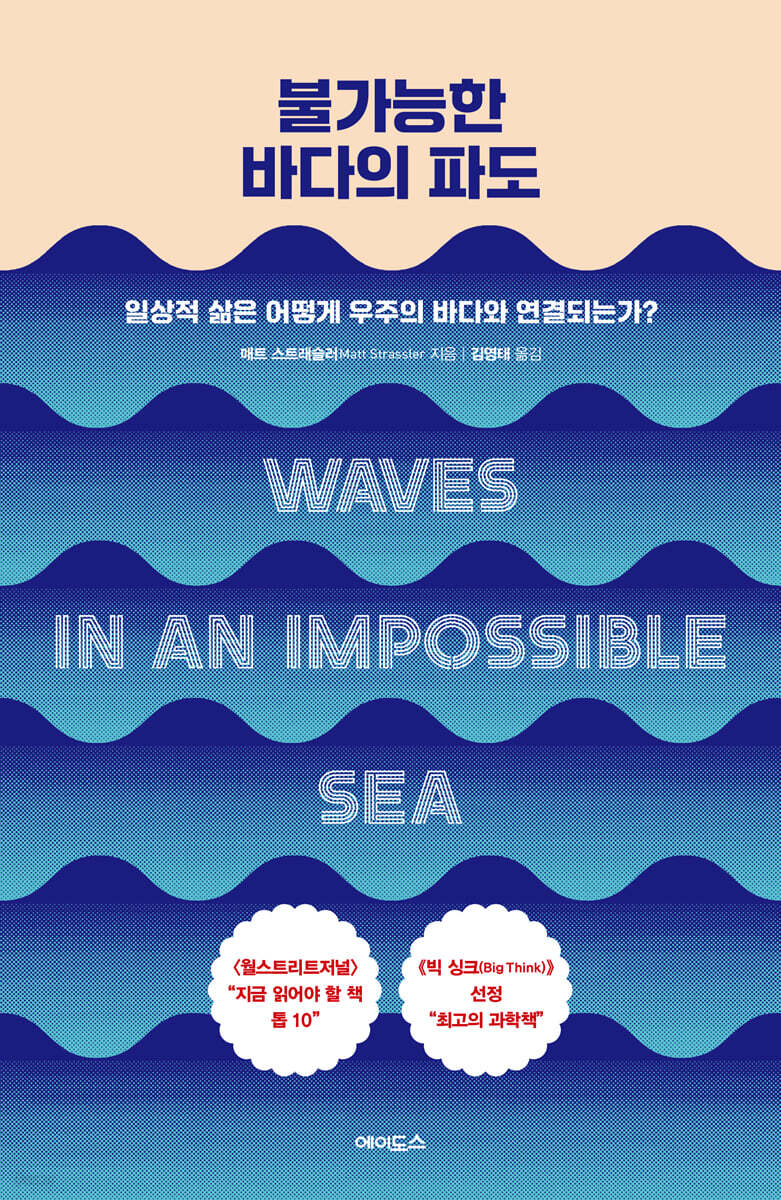
The Impossible Sea Waves
 |
Description
Book Introduction
How do our everyday lives connect with the cosmic ocean? How did atoms and cells, books and roses, cats and humans, water and light, planets and galaxies, and everything else in the universe come into being and function? What are the fundamental principles that drive all of this? The author, a physicist with over 30 years of experience in particle physics, string theory, and quantum field theory, and an accomplished science communicator, explains how human daily life connects with the order of the universe through core concepts of modern physics, including the theory of relativity and quantum physics.
By reconstructing basic concepts such as motion, energy, matter, mass, light, waves, resonance, medium, field, Higgs, Big Bang, and cosmos in a way that is accessible to the general public, it presents a new perspective on the world we live in.
From the extremely microscopic world of electrons and quarks to the principles of creation of our bodies, minds, sensory experiences, and everything in this world, as well as the workings of the universe, this conceptually clear explanation feels like watching an ecstatic cosmic odyssey.
By reconstructing basic concepts such as motion, energy, matter, mass, light, waves, resonance, medium, field, Higgs, Big Bang, and cosmos in a way that is accessible to the general public, it presents a new perspective on the world we live in.
From the extremely microscopic world of electrons and quarks to the principles of creation of our bodies, minds, sensory experiences, and everything in this world, as well as the workings of the universe, this conceptually clear explanation feels like watching an ecstatic cosmic odyssey.
index
1.
Overture 007
Part 1 Exercise
2.
Relativity: The Great Illusion 028
3.
Uniform Motion: Easier Than It Looks 050
Part 2 Mass
4.
Armor Against Space 073
5.
Einstein's Appearance: Rest Mass 100
6.
Worlds within Worlds: The Structure of Matter 124
7.
What is Mass (and What is Not Mass) 151
8.
Energy, Mass, and Their Meaning 165
9.
The Most Important Thing in Prison 179
Part 3 wave
10.
Resonance 195
11.
Understanding Waves 216
12.
What the Ears Cannot Hear and the Eyes Cannot See 232
Part 4 Chapter
13.
General Field 257
14.
Basic Chapter: First, Anxious Appearance 276
15.
Basic Chapter: Second, Humble Appearance 321
Part 5 Quantum
16.
Quantum and Particle 339
17.
Mass of wave particle 353
18.
Einstein's Haiku 379
Part 6 Higgs
19.
Chapter 387: A Chapter Unlike Any Other
20.
How the Higgs Field Works 394
21.
417 Unanswered Basic Questions
22, Deeper Conceptual Questions 434
23.
The Really Important Question 442
Part 7 Cosmos
24.
Protons and Neutrons 465
25.
Quantum Field Magic 478
26.
Coda: The Extraordinary in the Ordinary 489
Acknowledgments 498
Glossary 501
Americas 505
Search 528
Overture 007
Part 1 Exercise
2.
Relativity: The Great Illusion 028
3.
Uniform Motion: Easier Than It Looks 050
Part 2 Mass
4.
Armor Against Space 073
5.
Einstein's Appearance: Rest Mass 100
6.
Worlds within Worlds: The Structure of Matter 124
7.
What is Mass (and What is Not Mass) 151
8.
Energy, Mass, and Their Meaning 165
9.
The Most Important Thing in Prison 179
Part 3 wave
10.
Resonance 195
11.
Understanding Waves 216
12.
What the Ears Cannot Hear and the Eyes Cannot See 232
Part 4 Chapter
13.
General Field 257
14.
Basic Chapter: First, Anxious Appearance 276
15.
Basic Chapter: Second, Humble Appearance 321
Part 5 Quantum
16.
Quantum and Particle 339
17.
Mass of wave particle 353
18.
Einstein's Haiku 379
Part 6 Higgs
19.
Chapter 387: A Chapter Unlike Any Other
20.
How the Higgs Field Works 394
21.
417 Unanswered Basic Questions
22, Deeper Conceptual Questions 434
23.
The Really Important Question 442
Part 7 Cosmos
24.
Protons and Neutrons 465
25.
Quantum Field Magic 478
26.
Coda: The Extraordinary in the Ordinary 489
Acknowledgments 498
Glossary 501
Americas 505
Search 528
Detailed image

Into the book
A few words are enough to explain the principle of relativity - for example, that uniform motion is undetectable.
But it moves in a direction quite different from human psychology.
The principle of relativity overturns the assumptions about the world that we, as well as future physicists, have naturally developed since childhood.
It's almost as if everyday life itself is designed to keep the human mind out of touch with the basic laws of physics.
This is precisely why even the greatest mathematicians and philosophers of ancient Greece failed to discover the principle of relativity.
They proved that the Earth is round and measured its size without having to leave home, but they did not conclude that the Earth moves.
Some people have suggested that the Earth might rotate and move, but the most influential thinkers have assumed that if the Earth were moving, we would be able to detect it easily.
It took centuries to realize that movement need not necessarily be easily detected.
--- p.31
A ball is clearly a physical object, a substance with substance and weight, which can be held, thrown, caught, cut in half, weighed on a scale, and balanced on one's nose.
More generally, the ball exists on its own and can go anywhere, east, west, south, or north, depending on how we throw it.
However, waves on a rope, unlike this, are a phenomenon that appears and disappears for a moment, and are trapped in the medium.
We cannot hold, throw, catch, or cut the waves on the rope in half.
So while it's interesting that waves and spheres can produce similar effects, it's important not to overinterpret the implications.
Our intuition tells us that these two are ultimately fundamentally different.
After all, although waves contain 'vibrations of some material thing,' waves themselves are not material.
No… 'Could waves really be matter?' As we soon come face to face with the quantum nature of the world, we will rethink this question from a whole new perspective.
--- p.230~231
When we pluck a guitar string, the string vibrates and creates sound waves that travel across the room and reach our eardrums.
Only then does the listening process begin.
Sound waves vibrate the eardrum, causing waves in the fluid in the cochlea, which are detected by tiny hair-like structures called auditory cilia.
The electrical signals generated by the cilia are then transmitted along the auditory nerve to the brain, where they are processed to somehow create the conscious experience of musical tones.
During this process, our ears and brain never come into direct contact with the guitar.
It only interacts with sound waves that enter our ear canal.
So to speak, what we actually 'hear' are just sound waves.
Likewise, everything we 'see' is simply light reflected from the guitar and reaching our eyes.
We rely on moving waves of sound and light to obtain information, detecting these waves with our eyes and ears, and our brains making meaning from them.
However, rather than directly hearing or seeing the objects themselves that produce or reflect sound and light, the brain simply infers their existence.
Our knowledge of objects is entirely indirect.
All of our sense organs only receive information when it reaches our body.
I can't accept it before then.
The brain interprets the information received by the sense organs and, based on this, obtains a concept of the surrounding objects and draws a picture of the external world in our consciousness.
We think of these drawings as if they were real, but we either don't realize or forget that these drawings are partial reconstructions of the external world and not direct images.
Everything we know about our surroundings is indirect and incomplete.
--- p.233~234
It may not be surprising that quantum physics is important to our everyday lives.
Because great beings are originally made up of small things.
What's truly remarkable is the breadth of the role quantum physics plays.
From electrons to photons, all wave particles are quanta of fundamental fields.
Protons and neutrons exist because quark and gluon wave-particles are trapped by an unavoidable force that arises from the quantum uncertainty of the gluon field.
From these atoms are created and do not decay due to the limits of cosmic certainty.
The richness of atomic chemistry, on which all life depends, requires not only the existence of wave particles, but also the bizarre mathematics of identical fermions: 'one plus one equals zero.'
The mathematics of such unusual fermion quantum fields even guarantees the stability of macroscopic objects that act like solids or impermeable membranes.
Thanks to this, various structures, from planets and chairs to skin and blood vessel walls, can exist stably.
Even in this vast world, where we are surrounded by objects composed of an unimaginable number of wave particles, every activity we do in our daily lives—walking, driving, reading, eating, talking, sleeping—has never been free from the influence of quantum physics, not even for a moment.
But it moves in a direction quite different from human psychology.
The principle of relativity overturns the assumptions about the world that we, as well as future physicists, have naturally developed since childhood.
It's almost as if everyday life itself is designed to keep the human mind out of touch with the basic laws of physics.
This is precisely why even the greatest mathematicians and philosophers of ancient Greece failed to discover the principle of relativity.
They proved that the Earth is round and measured its size without having to leave home, but they did not conclude that the Earth moves.
Some people have suggested that the Earth might rotate and move, but the most influential thinkers have assumed that if the Earth were moving, we would be able to detect it easily.
It took centuries to realize that movement need not necessarily be easily detected.
--- p.31
A ball is clearly a physical object, a substance with substance and weight, which can be held, thrown, caught, cut in half, weighed on a scale, and balanced on one's nose.
More generally, the ball exists on its own and can go anywhere, east, west, south, or north, depending on how we throw it.
However, waves on a rope, unlike this, are a phenomenon that appears and disappears for a moment, and are trapped in the medium.
We cannot hold, throw, catch, or cut the waves on the rope in half.
So while it's interesting that waves and spheres can produce similar effects, it's important not to overinterpret the implications.
Our intuition tells us that these two are ultimately fundamentally different.
After all, although waves contain 'vibrations of some material thing,' waves themselves are not material.
No… 'Could waves really be matter?' As we soon come face to face with the quantum nature of the world, we will rethink this question from a whole new perspective.
--- p.230~231
When we pluck a guitar string, the string vibrates and creates sound waves that travel across the room and reach our eardrums.
Only then does the listening process begin.
Sound waves vibrate the eardrum, causing waves in the fluid in the cochlea, which are detected by tiny hair-like structures called auditory cilia.
The electrical signals generated by the cilia are then transmitted along the auditory nerve to the brain, where they are processed to somehow create the conscious experience of musical tones.
During this process, our ears and brain never come into direct contact with the guitar.
It only interacts with sound waves that enter our ear canal.
So to speak, what we actually 'hear' are just sound waves.
Likewise, everything we 'see' is simply light reflected from the guitar and reaching our eyes.
We rely on moving waves of sound and light to obtain information, detecting these waves with our eyes and ears, and our brains making meaning from them.
However, rather than directly hearing or seeing the objects themselves that produce or reflect sound and light, the brain simply infers their existence.
Our knowledge of objects is entirely indirect.
All of our sense organs only receive information when it reaches our body.
I can't accept it before then.
The brain interprets the information received by the sense organs and, based on this, obtains a concept of the surrounding objects and draws a picture of the external world in our consciousness.
We think of these drawings as if they were real, but we either don't realize or forget that these drawings are partial reconstructions of the external world and not direct images.
Everything we know about our surroundings is indirect and incomplete.
--- p.233~234
It may not be surprising that quantum physics is important to our everyday lives.
Because great beings are originally made up of small things.
What's truly remarkable is the breadth of the role quantum physics plays.
From electrons to photons, all wave particles are quanta of fundamental fields.
Protons and neutrons exist because quark and gluon wave-particles are trapped by an unavoidable force that arises from the quantum uncertainty of the gluon field.
From these atoms are created and do not decay due to the limits of cosmic certainty.
The richness of atomic chemistry, on which all life depends, requires not only the existence of wave particles, but also the bizarre mathematics of identical fermions: 'one plus one equals zero.'
The mathematics of such unusual fermion quantum fields even guarantees the stability of macroscopic objects that act like solids or impermeable membranes.
Thanks to this, various structures, from planets and chairs to skin and blood vessel walls, can exist stably.
Even in this vast world, where we are surrounded by objects composed of an unimaginable number of wave particles, every activity we do in our daily lives—walking, driving, reading, eating, talking, sleeping—has never been free from the influence of quantum physics, not even for a moment.
--- p.490~491
Publisher's Review
An ecstatic odyssey into the secrets of the universe as seen through the lens of modern physics.
“This is an ecstatic odyssey.” (Stefan Alexander) From electrons and quarks so tiny that they can never be seen by the human eye, to the immeasurably vast and gigantic universe, from things that disappear in an instant as soon as they are created to things that have existed for billions of years since the birth of the universe, from the empty space of nothing to the countless things that the human mind cannot fathom, it covers a wide range of topics.
It encompasses everything in our bodies, the ordinary objects we see around us, and the vast and vast universe of the night sky.
What are atoms and cells, books and roses, cats and humans, water and light, the movement of planets and galaxies, and everything in the universe made of, and how do they work? The author, a physicist and accomplished science communicator who has studied particle physics, string theory, and quantum field theory for over 30 years, meticulously explains, through the lens of modern physics, how everyday human life and the cosmic order are connected.
By reconstructing the key clues to understanding the principles of the material world, such as motion, energy, matter, mass, light, waves, resonance, medium, fields, and Higgs, to a level that is accessible to the general public, and leading us on a dramatic journey, we are able to look at the world we live in in a new way.
This book thus takes us to the heart of the problems physicists are grappling with at the forefront of modern physics.
Why do our intuition, common sense, and language operate in opposition to the principles of physics?
Even at this very moment, the Earth is spinning at 240 kilometers per second.
Muon particles are hurtling through the atmosphere towards the human head at incredible speeds, air molecules are blasting our faces, and the elementary particles that make up our bodies are constantly vibrating.
But we don't perceive this at all.
Why? Why, when the atoms that make up objects are mostly empty space, don't we pass through the chair we're sitting on and fall to the ground? How can solid, tangible objects like tables, trees, hands, and planets be created when the world's matter is made of moving, rippling, fluid, and fleeting waves? To understand how the universe works, as taught by modern physics, we must peel away the layers of intuitive knowledge, sensory illusions, common-sense logic, and linguistic confusion that humans have acquired while surviving on this planet.
On Earth, we must be able to imagine a world without friction, something even a three-year-old child can understand, and we must go beyond the common-sense logic that a moving object will eventually come to rest.
The fact that even the most brilliant thinkers of the past thousands of years failed to realize that the Earth could rotate continuously without external forces, and that it was only in the 20th century that the core principle of the principle of relativity, that “uniform motion is undetectable,” could be scientifically established, was due to the limitations of the intuition, common sense, and language that we have accumulated for survival during our evolution.
The book reframes and explains the most fundamental concepts of modern physics, such as motion, mass, light, energy, and waves, in an easy-to-understand manner, dusting off this intuitive knowledge and unlocking the secrets of the physical world.
We delve into how motion is possible without force, what a frictionless world would be like, and why the fundamental particles that make us up move slower than the speed of light, the cosmic limit.
The universe in which life exists is turbulent, chaotic, diverse, and full of innumerable complexities.
Our universe is not elegant.
How did our universe come to be what it is today? How did the fundamental particles that make up the universe form water, sugar, minerals, and protein molecules, and how did these molecules then come together to form DNA, cells, plants, animals, rocks, roses, and even thinking humans? The answer is that particles like electrons, protons, and neutrons possess rest mass and move slower than the cosmic speed limit.
This is how everything that exists in our universe came into being.
What if electrons and quarks had no rest mass? What would a universe be like where everything moved at the speed of light, the cosmic limit? "If all the materials in the world were forever moving at the cosmic limit, how could clouds of gas collapse to form stars, seeds germinate and bloom roses, and brains connect to form thoughts? How could sand castles be built if it refused to stay put but was instantly scattered like a tornado?" It is thanks to the fact that the fundamental particles that make up the world move slower than the cosmic limit that this universe and the life we possess exist.
What would the world be like if all the most fundamental components of matter moved at the speed of light? "This universe is much simpler than ours.
It looks the same everywhere.
Whether viewed through a high-performance microscope or a powerful telescope, the appearance is always the same.
It looks smooth, perfect, and flawless, like a machine-painted white wall.
This is the most elegant universe.
But life does not exist.” (p. 120) The universe we live in is intense, chaotic, diverse, and full of countless complexities.
The universe is never elegant.
We are not beings living in a house called the universe.
It's not like a fish swimming in the ocean of space.
We are waves in the ocean of this strange universe!
People often compare space to the ocean.
It fills the space and everything sways like waves.
But the universe is a sea of unknowns, of unimaginable depths, of incomprehensible depths, and perhaps of impossible depths.
The book takes readers on a journey to uncover the secrets of the Higgs field, which has existed since the birth of the universe and has given mass to everything, revealing that everything is connected, from electrons and quarks, which appear to be the most fundamental particles, to atoms, cells, the human body, plants and animals, and everything in the universe.
But the universe still holds something that cannot be explained logically, and fundamental questions remain unanswered.
Why does only light move at the cosmic speed limit? Do the fundamental particles that make up everything in the universe move slower than the cosmic speed limit? Why does light have such a nightmarish property that it can never catch up with no matter how hard we try? Why has the average value of the Higgs field not been zero, nor has it grown or decreased, but remained stable and constant for 13 billion years since the birth of the universe? (If the average value of the Higgs field were to grow or shrink, the universe would face a catastrophic catastrophe and disappear into nothingness.) This leads to many unsolved problems of modern physics, such as the mass hierarchy puzzle, the naturalness problem, and the limits of cosmic certainty.
The book, which leads us from the most basic concepts of physics into the unknown abyss of space, ends with a fable about a distant future where everything has been destroyed and humanity has survived.
Future humanity, which has ventured into the sea, the atmosphere, and space to uncover the secrets of life, will ultimately return to ourselves.
The secrets of the universe are not far away.
We are not beings who live within the universe as if we were living in a house, nor are we beings who swim like fish in the ocean of the universe.
We are waves in the ocean of the universe.
We are waves in an impossible sea.
“As far as I know, there is no other book that explains the nature of matter and energy in modern physics in a way that is easy for the general public to understand.
…a must-read for anyone seeking to understand how the Higgs field shapes the laws of nature.” —Science
“A remarkable book that offers a new perspective on things.” —The New York Times
“A book that is both accessible and insightful, offering a fascinating insight into the questions physicists are still grappling with as they try to unravel the mysteries of the universe.” —The Wall Street Journal
“A model for how scientists should write about matter, motion, and mass for the general public.” —Scientific American
“What is most impressive is the way it approaches fundamental concepts such as mass, energy, and light.
…a wonderful introduction to space”—Kirkus Reviews
“This is an ecstatic odyssey.” (Stefan Alexander) From electrons and quarks so tiny that they can never be seen by the human eye, to the immeasurably vast and gigantic universe, from things that disappear in an instant as soon as they are created to things that have existed for billions of years since the birth of the universe, from the empty space of nothing to the countless things that the human mind cannot fathom, it covers a wide range of topics.
It encompasses everything in our bodies, the ordinary objects we see around us, and the vast and vast universe of the night sky.
What are atoms and cells, books and roses, cats and humans, water and light, the movement of planets and galaxies, and everything in the universe made of, and how do they work? The author, a physicist and accomplished science communicator who has studied particle physics, string theory, and quantum field theory for over 30 years, meticulously explains, through the lens of modern physics, how everyday human life and the cosmic order are connected.
By reconstructing the key clues to understanding the principles of the material world, such as motion, energy, matter, mass, light, waves, resonance, medium, fields, and Higgs, to a level that is accessible to the general public, and leading us on a dramatic journey, we are able to look at the world we live in in a new way.
This book thus takes us to the heart of the problems physicists are grappling with at the forefront of modern physics.
Why do our intuition, common sense, and language operate in opposition to the principles of physics?
Even at this very moment, the Earth is spinning at 240 kilometers per second.
Muon particles are hurtling through the atmosphere towards the human head at incredible speeds, air molecules are blasting our faces, and the elementary particles that make up our bodies are constantly vibrating.
But we don't perceive this at all.
Why? Why, when the atoms that make up objects are mostly empty space, don't we pass through the chair we're sitting on and fall to the ground? How can solid, tangible objects like tables, trees, hands, and planets be created when the world's matter is made of moving, rippling, fluid, and fleeting waves? To understand how the universe works, as taught by modern physics, we must peel away the layers of intuitive knowledge, sensory illusions, common-sense logic, and linguistic confusion that humans have acquired while surviving on this planet.
On Earth, we must be able to imagine a world without friction, something even a three-year-old child can understand, and we must go beyond the common-sense logic that a moving object will eventually come to rest.
The fact that even the most brilliant thinkers of the past thousands of years failed to realize that the Earth could rotate continuously without external forces, and that it was only in the 20th century that the core principle of the principle of relativity, that “uniform motion is undetectable,” could be scientifically established, was due to the limitations of the intuition, common sense, and language that we have accumulated for survival during our evolution.
The book reframes and explains the most fundamental concepts of modern physics, such as motion, mass, light, energy, and waves, in an easy-to-understand manner, dusting off this intuitive knowledge and unlocking the secrets of the physical world.
We delve into how motion is possible without force, what a frictionless world would be like, and why the fundamental particles that make us up move slower than the speed of light, the cosmic limit.
The universe in which life exists is turbulent, chaotic, diverse, and full of innumerable complexities.
Our universe is not elegant.
How did our universe come to be what it is today? How did the fundamental particles that make up the universe form water, sugar, minerals, and protein molecules, and how did these molecules then come together to form DNA, cells, plants, animals, rocks, roses, and even thinking humans? The answer is that particles like electrons, protons, and neutrons possess rest mass and move slower than the cosmic speed limit.
This is how everything that exists in our universe came into being.
What if electrons and quarks had no rest mass? What would a universe be like where everything moved at the speed of light, the cosmic limit? "If all the materials in the world were forever moving at the cosmic limit, how could clouds of gas collapse to form stars, seeds germinate and bloom roses, and brains connect to form thoughts? How could sand castles be built if it refused to stay put but was instantly scattered like a tornado?" It is thanks to the fact that the fundamental particles that make up the world move slower than the cosmic limit that this universe and the life we possess exist.
What would the world be like if all the most fundamental components of matter moved at the speed of light? "This universe is much simpler than ours.
It looks the same everywhere.
Whether viewed through a high-performance microscope or a powerful telescope, the appearance is always the same.
It looks smooth, perfect, and flawless, like a machine-painted white wall.
This is the most elegant universe.
But life does not exist.” (p. 120) The universe we live in is intense, chaotic, diverse, and full of countless complexities.
The universe is never elegant.
We are not beings living in a house called the universe.
It's not like a fish swimming in the ocean of space.
We are waves in the ocean of this strange universe!
People often compare space to the ocean.
It fills the space and everything sways like waves.
But the universe is a sea of unknowns, of unimaginable depths, of incomprehensible depths, and perhaps of impossible depths.
The book takes readers on a journey to uncover the secrets of the Higgs field, which has existed since the birth of the universe and has given mass to everything, revealing that everything is connected, from electrons and quarks, which appear to be the most fundamental particles, to atoms, cells, the human body, plants and animals, and everything in the universe.
But the universe still holds something that cannot be explained logically, and fundamental questions remain unanswered.
Why does only light move at the cosmic speed limit? Do the fundamental particles that make up everything in the universe move slower than the cosmic speed limit? Why does light have such a nightmarish property that it can never catch up with no matter how hard we try? Why has the average value of the Higgs field not been zero, nor has it grown or decreased, but remained stable and constant for 13 billion years since the birth of the universe? (If the average value of the Higgs field were to grow or shrink, the universe would face a catastrophic catastrophe and disappear into nothingness.) This leads to many unsolved problems of modern physics, such as the mass hierarchy puzzle, the naturalness problem, and the limits of cosmic certainty.
The book, which leads us from the most basic concepts of physics into the unknown abyss of space, ends with a fable about a distant future where everything has been destroyed and humanity has survived.
Future humanity, which has ventured into the sea, the atmosphere, and space to uncover the secrets of life, will ultimately return to ourselves.
The secrets of the universe are not far away.
We are not beings who live within the universe as if we were living in a house, nor are we beings who swim like fish in the ocean of the universe.
We are waves in the ocean of the universe.
We are waves in an impossible sea.
“As far as I know, there is no other book that explains the nature of matter and energy in modern physics in a way that is easy for the general public to understand.
…a must-read for anyone seeking to understand how the Higgs field shapes the laws of nature.” —Science
“A remarkable book that offers a new perspective on things.” —The New York Times
“A book that is both accessible and insightful, offering a fascinating insight into the questions physicists are still grappling with as they try to unravel the mysteries of the universe.” —The Wall Street Journal
“A model for how scientists should write about matter, motion, and mass for the general public.” —Scientific American
“What is most impressive is the way it approaches fundamental concepts such as mass, energy, and light.
…a wonderful introduction to space”—Kirkus Reviews
GOODS SPECIFICS
- Date of issue: August 22, 2025
- Format: Hardcover book binding method guide
- Page count, weight, size: 540 pages | 842g | 150*225*38mm
- ISBN13: 9791185415802
- ISBN10: 1185415807
You may also like
카테고리
korean


korean

![ELLE 엘르 스페셜 에디션 A형 : 12월 [2025]](http://librairie.coreenne.fr/cdn/shop/files/b8e27a3de6c9538896439686c6b0e8fb.jpg?v=1766436872&width=3840)


