

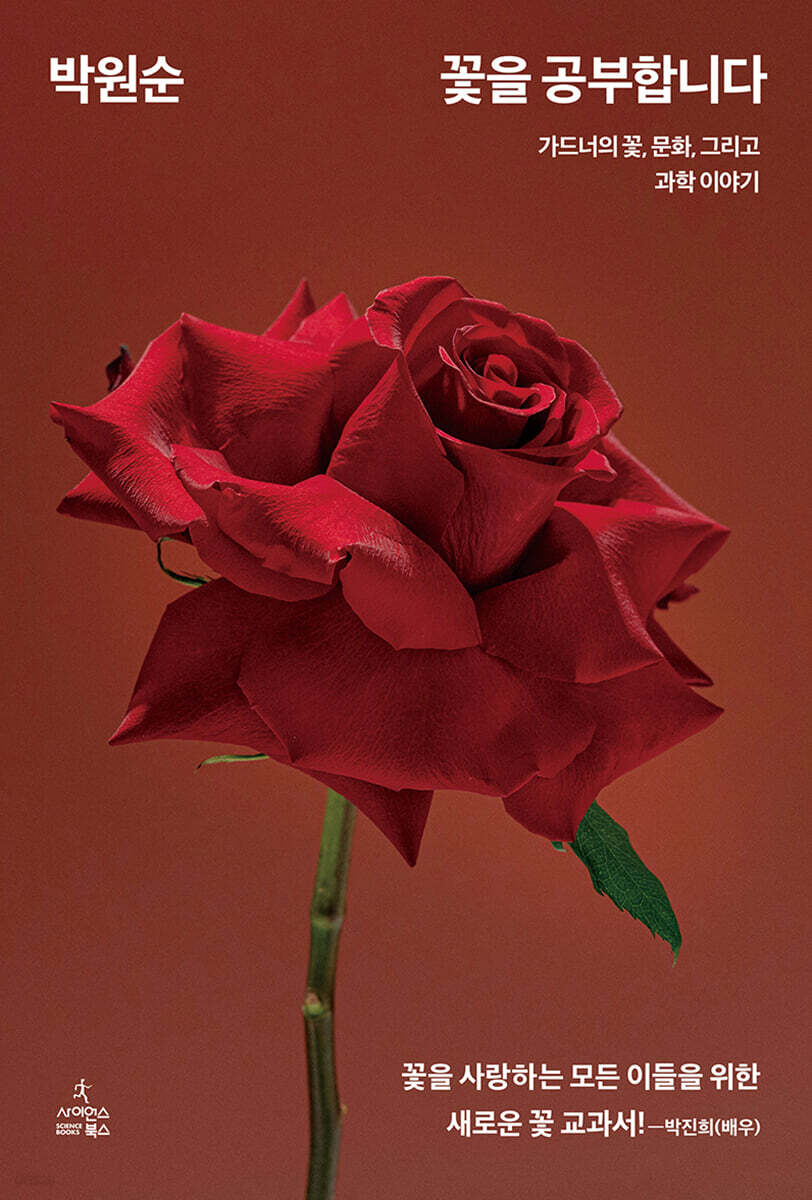
Studying flowers
 |
Description
Book Introduction
Human desire, art, love, and healing intertwined with 29 flowers.
The Cultural and Scientific History of Flowers as Told by a Gardener at the National Arboretum, Sejong
Park Won-soon's 『Studying Flowers: Gardner's Story of Flowers, Culture, and Science』, published by Science Books Co., Ltd., is the latest work by a gardener who has played a role in the 'flower lifestyle' movement that has become active since the late 2010s.
Won-soon Park, an author and gardener, currently serves as the director of the exhibition hall at the National Arboretum in Sejong, Korea, under the Korea Arboretum Garden Management Department.
Although he majored in horticulture and his first job was as an editorial planner at a publishing company, he never forgot his dream of pursuing his major and changed his life path. He worked and studied at places such as the Yeomiji Botanical Garden in Jeju and Longwood Gardens in the United States, and entered the path of a gardener, or professional gardener.
After receiving a master's degree in public horticulture from the University of Delaware's Longwood Graduate School, he returned to Korea and worked as a flower festival planning and plant exhibition director at Everland.
The first large-scale Kochia (Cockalea) Festival and Red Flower Festival planned by Everland, as well as the special exhibitions in the 10,000-square-meter four-season greenhouse of the National Arboretum of Sejong, were all created through his hands.
Moreover, to popularize horticulture, he has already written and translated more than 10 books on plants, flowers, and gardens since returning to Korea.
Park Won-soon has introduced various aspects of horticulture to our readers in various ways, from translated books for beginners like 『Plants』, which can be called an illustrated encyclopedia of botany, to 『Discovering American Gardens』, which introduces American gardens that he personally visited and reported on, and 『I am a Gardener』, which covers the process of growing into a professional gardener at Longwood Gardens. In his latest book, 『Studying Flowers: A Gardener's Story of Flowers, Culture, and Science』, he carefully selects 29 species of flowers, regardless of whether they are native or foreign, that Korean readers can plant when creating their own gardens, whether outdoors or indoors.
The Cultural and Scientific History of Flowers as Told by a Gardener at the National Arboretum, Sejong
Park Won-soon's 『Studying Flowers: Gardner's Story of Flowers, Culture, and Science』, published by Science Books Co., Ltd., is the latest work by a gardener who has played a role in the 'flower lifestyle' movement that has become active since the late 2010s.
Won-soon Park, an author and gardener, currently serves as the director of the exhibition hall at the National Arboretum in Sejong, Korea, under the Korea Arboretum Garden Management Department.
Although he majored in horticulture and his first job was as an editorial planner at a publishing company, he never forgot his dream of pursuing his major and changed his life path. He worked and studied at places such as the Yeomiji Botanical Garden in Jeju and Longwood Gardens in the United States, and entered the path of a gardener, or professional gardener.
After receiving a master's degree in public horticulture from the University of Delaware's Longwood Graduate School, he returned to Korea and worked as a flower festival planning and plant exhibition director at Everland.
The first large-scale Kochia (Cockalea) Festival and Red Flower Festival planned by Everland, as well as the special exhibitions in the 10,000-square-meter four-season greenhouse of the National Arboretum of Sejong, were all created through his hands.
Moreover, to popularize horticulture, he has already written and translated more than 10 books on plants, flowers, and gardens since returning to Korea.
Park Won-soon has introduced various aspects of horticulture to our readers in various ways, from translated books for beginners like 『Plants』, which can be called an illustrated encyclopedia of botany, to 『Discovering American Gardens』, which introduces American gardens that he personally visited and reported on, and 『I am a Gardener』, which covers the process of growing into a professional gardener at Longwood Gardens. In his latest book, 『Studying Flowers: A Gardener's Story of Flowers, Culture, and Science』, he carefully selects 29 species of flowers, regardless of whether they are native or foreign, that Korean readers can plant when creating their own gardens, whether outdoors or indoors.
- You can preview some of the book's contents.
Preview
index
Starting to study flowers 7
Part 1: Reading Desire in Flowers
Chapter 1: The Blue Lotus: The Flower of the Pharaoh Who Dreamed of Reincarnation 17
Chapter 2: Narcissus: A Symbol of Extreme Narcissism 27
Chapter 3: Iris, the Granter of Divine Sovereignty 37
Chapter 4: Orchid Collector and Hunter's Trophy 47
Chapter 5: The Tulip Mania: The Man Who Drives Speculative Fever 59
Chapter 6: A Feast of Dazzling New Varieties of Dahlias 69
Chapter 7: The Bouquet in the Hands of the Silverbell Princess 79
Part 2: Flowers Loved by Artists
Chapter 8: Acanthus Architectural Design Motifs 91
Chapter 9: The Sunflower Artist's Brilliant Hope 101
Chapter 10: The Beauty that Enchanted an Orphan Girl, Dongbaek 113
Chapter 11: Friends of the Hydrangea Immortals 125
Chapter 12: A Warm Comfort Blooming at the Entrance of a Country House, 137
Chapter 13: The Lily: A Symbol of Martyrs and Puritans 147
Chapter 14: Delphinium: Pure and Deep Natural Blue 157
Part 3: Asking Flowers About Love
Chapter 15: Carnation: Secret Messenger 169
Chapter 16: Roses, Sweet Messengers of Love 181
Chapter 17: Peony, a token of love 193
Chapter 18: Anemone's Unfulfilled, Poor Love 205
Chapter 19: Poinsettia, the Flower of Christmas Eve 215
Chapter 20: Violet: The Flower That Accompanied Napoleon's Death 225
Chapter 21: Rose of Sharon, the Ever-Blooming Flower 237
Part 4: The Power of Flowers to Soothe Humans
Chapter 22: Chrysanthemum: The Nobility of Overcoming Loneliness 249
Chapter 23: Salvia, the Herb of Immortality 261
Chapter 24: Primrose, the Beautiful Herb, the Key to Heaven 271
ㆍChapter 25ㆍ Cyclamen, a Winter-Hardening Flower 281
Chapter 26: The Lotus Seed Transcending Time and Space 291
ㆍChapter 27ㆍ Coneflower Soothes Sorrow and Comforts the Heart 299
Chapter 28: A Red Flower Blooming in the Poppy Ruins 309
Chapter 29: The Antidote to the Witch's Curse, Snowdrop 319
Acknowledgments 328
Glossary 329
Reference 335
Copyright 344
Search 345
Part 1: Reading Desire in Flowers
Chapter 1: The Blue Lotus: The Flower of the Pharaoh Who Dreamed of Reincarnation 17
Chapter 2: Narcissus: A Symbol of Extreme Narcissism 27
Chapter 3: Iris, the Granter of Divine Sovereignty 37
Chapter 4: Orchid Collector and Hunter's Trophy 47
Chapter 5: The Tulip Mania: The Man Who Drives Speculative Fever 59
Chapter 6: A Feast of Dazzling New Varieties of Dahlias 69
Chapter 7: The Bouquet in the Hands of the Silverbell Princess 79
Part 2: Flowers Loved by Artists
Chapter 8: Acanthus Architectural Design Motifs 91
Chapter 9: The Sunflower Artist's Brilliant Hope 101
Chapter 10: The Beauty that Enchanted an Orphan Girl, Dongbaek 113
Chapter 11: Friends of the Hydrangea Immortals 125
Chapter 12: A Warm Comfort Blooming at the Entrance of a Country House, 137
Chapter 13: The Lily: A Symbol of Martyrs and Puritans 147
Chapter 14: Delphinium: Pure and Deep Natural Blue 157
Part 3: Asking Flowers About Love
Chapter 15: Carnation: Secret Messenger 169
Chapter 16: Roses, Sweet Messengers of Love 181
Chapter 17: Peony, a token of love 193
Chapter 18: Anemone's Unfulfilled, Poor Love 205
Chapter 19: Poinsettia, the Flower of Christmas Eve 215
Chapter 20: Violet: The Flower That Accompanied Napoleon's Death 225
Chapter 21: Rose of Sharon, the Ever-Blooming Flower 237
Part 4: The Power of Flowers to Soothe Humans
Chapter 22: Chrysanthemum: The Nobility of Overcoming Loneliness 249
Chapter 23: Salvia, the Herb of Immortality 261
Chapter 24: Primrose, the Beautiful Herb, the Key to Heaven 271
ㆍChapter 25ㆍ Cyclamen, a Winter-Hardening Flower 281
Chapter 26: The Lotus Seed Transcending Time and Space 291
ㆍChapter 27ㆍ Coneflower Soothes Sorrow and Comforts the Heart 299
Chapter 28: A Red Flower Blooming in the Poppy Ruins 309
Chapter 29: The Antidote to the Witch's Curse, Snowdrop 319
Acknowledgments 328
Glossary 329
Reference 335
Copyright 344
Search 345
Detailed image

Publisher's Review
A new flower textbook for all flower lovers!
-Park Jin-hee (actress)
“A vivid experience, as if reading the autobiography of a living being!”
-Im Yeong-seok (Director of the National Arboretum)
A book that conveys to readers the ‘fun of feeling flowers.’
-Lee Hyo-beom (Professor of Horticultural Biotechnology, Seoul National University)
Human desire, art, love, and healing intertwined with 29 flowers.
The Cultural and Scientific History of Flowers as Told by a Gardener at the National Arboretum, Sejong
April and May are the flower seasons in Korea.
Starting with the Goyang International Flower Expo, in which over 200 domestic and international organizations participate, various flower events will be in full bloom, including the Seoul International Garden Expo, which begins on May 22nd at Boramae Park in Seoul, the Gokseong World Rose Festival, the Taean Spring Flower Garden Festival, and the Gapyeong Spring Flower Festa.
As national income and the standard of living increase, the budget for parks, green spaces, and garden landscaping by the state and local governments increases every year. Furthermore, during the pandemic, floriculture and landscaping were highlighted as a means of psychological healing and emotional stability in terms of psychological quarantine, leading to a significant increase in interest in flowers and gardens.
Park Won-soon's 『Studying Flowers: Gardner's Stories of Flowers, Culture, and Science』, published by Science Books Co., Ltd., is the latest work by a gardener who has played a role in the 'flower lifestyle' movement that has been active since the late 2010s.
Won-soon Park, an author and gardener, currently serves as the director of the exhibition hall at the National Arboretum in Sejong, Korea, under the Korea Arboretum Garden Management Department.
Although he majored in horticulture and his first job was as an editorial planner at a publishing company, he never forgot his dream of pursuing his major and changed his life path. He worked and studied at places such as the Yeomiji Botanical Garden in Jeju and Longwood Gardens in the United States, and entered the path of a gardener, or professional gardener.
After receiving a master's degree in public horticulture from the University of Delaware's Longwood Graduate School, he returned to Korea and worked as a flower festival planning and plant exhibition director at Everland.
The first large-scale Kochia (Cockalea) Festival and Red Flower Festival planned by Everland, as well as the special exhibitions in the 10,000-square-meter four-season greenhouse of the National Arboretum of Sejong, were all created through his hands.
Moreover, to popularize horticulture, he has already written and translated more than 10 books on plants, flowers, and gardens since returning to Korea.
Park Won-soon has introduced various aspects of horticulture to our readers in various ways, from translated books for beginners like 『Plants』, which can be called an illustrated encyclopedia of botany, to 『Discovering American Gardens』, which introduces American gardens that he personally visited and reported on, and 『I am a Gardener』, which covers the process of growing into a professional gardener at Longwood Gardens. In his latest book, 『Studying Flowers: A Gardener's Story of Flowers, Culture, and Science』, he carefully selects 29 species of flowers, regardless of whether they are native or foreign, that Korean readers can plant when creating their own gardens, whether outdoors or indoors.
At the same time, these flowers are also the most brilliant flowers in the history of human civilization.
The author not only introduces the morphological, ecological, and physiological stories of these flowers, but also the historical context of their significance in human culture and art, giving this book a three-dimensional feel of practicality and humanistic depth.
From ancient Egypt, through the Greco-Roman era, through the Middle Ages and Renaissance, through the Baroque and Victorian eras, and on to the modern era, we will examine the background, meaning, value, and symbolism of each flower as it emerged into human civilization. We will also examine the process by which new flowers emerged, spread across continents, and deeply penetrated people's culture and hearts.
This book is divided into four major parts and introduces 29 types of flowers.
Part 1, “Reading Desire in Flowers,” introduces flowers that represent human desires; Part 2, “Flowers Loved by Artists,” introduces flowers that have given people strong artistic inspiration; Part 3, “Asking Flowers About Love,” introduces flowers associated with heartbreaking love; and Part 4, “The Power of Flowers to Soothe Humans,” introduces flowers that have healed people’s bodies and minds.
And the back of the book contains a glossary of botany and horticulture terms and an index, which will be helpful to readers who are just beginning to study flowers.
Humanity owes a great debt to flowering plants, which have existed on Earth for 130 million years and boast a biodiversity of 400,000 species.
Not only did it serve as food and medicine, it also served as a vessel and mirror containing all of human desires and emotions.
How about taking a step closer to bringing flowers to life with this book, filled with the studies of a gardener who wanted to know more about such flowers?
The beauty of flowers resembles the image of a utopia and paradise that humans dream of, and has always reminded us of the providence of the universe and nature, and has helped us not to lose hope and courage in this difficult world.
This book is an autobiography of flowers for those who do not regard flowers as mere interior decorations or mere objects of interest, but at least call them by their names and listen to the stories each flower holds.
At least, the stories of flowers loved by humans follow the same trajectory as human civilization, so we can take the time to reflect on ourselves through their stories.
A panorama of human civilization blooming in your garden
Much has changed, but everyone today dreams of paradise in their own Querencia (Spanish for refuge, shelter, etc.).
Even if it's not a large, fancy garden surrounded by a wall, with a pond and shade from large trees, and colorful flowers blooming all year round, if I can bring plants into my living space and find peace and joy in them, wouldn't that be my own personal paradise?
- From Chapter 1, “Blue Lotus”
Can you imagine a garden without daffodils blooming in early spring? Every year at the end of March, I gaze upon the daffodils in full bloom along the walls of the former residence of Kim Jeong-hui, the scholar-official Chusa, and contemplate the countless stories contained within each flower.
I look forward to the day when the war ends and we can enjoy the spectacle of pure white Poeticus daffodils covering millions of square meters of Ukrainian daffodil valleys.
As long as the daffodil bulbs that have long been rooted in the earth's soil are not dug up, daffodils will continue to inspire poets and gardeners and brighten spring on Earth.
- From Chapter 2, “Daffodils”
In addition to its political and artistic symbolism, the fleur-de-lis also had religious significance.
The three stylized petals represented faith, wisdom, and chivalry, but also symbolized the Christian Trinity.
By using these symbols, the French monarchs attributed a divine right to rule.
- From Chapter 3, "Irises"
Some say that orchids, along with insects, are the last plants to survive on Earth.
This probably means that they have a good understanding of their surroundings, including other species, and have a good strategy for coexisting with them.
As Albert Einstein said, “If you look deeply into nature, you will understand everything better.” We need to look deeply into the strategies and wisdom of orchids that have lived wisely throughout their long evolutionary history.
- From Chapter 4, “Orchid”
The first person known to have introduced tulips to Europe is Ogier Ghiselin de Busbecq.
He was a royal ambassador sent to the Ottoman Sultan by order of Ferdinand I, Holy Roman Emperor, in 1554.
Viewsbek was so impressed by the tulips he had never seen before, which were in full bloom in the fields of Constantinople, that he asked his guide, who happened to be wearing a tulip in his hair, the name of the flower.
The guide thought he was asking about the turban he was wearing, so he answered "Tulbend", and Bysbeck gave that name to the flower, which has since become widely known as the tulip.
If the guide had answered correctly, it would have been called lale, not tulip.
In any case, the tulip bulbs that were introduced from Turkey to Western Europe by Antwerp merchants in 1562 did not receive much attention as ornamental plants, as they were often mistaken for onions from a practical standpoint. - Chapter 5, "Tulips"
When dahlias were first introduced to Spain, there were attempts to cultivate them as a new food crop for Europe, inspired by the Aztecs' edible use of the plant's tubers.
However, it failed to capture the taste of the public, including the French, and could not overcome the wall of potatoes, which were already widely available and familiar.
However, some recipes, such as dahlia soup or fritters, still remain in Spain.
- From Chapter 6, “Dahlia”
May Day is intertwined with the traditions of many European countries.
In France, there is a tradition of giving lilies of the valley as a gift.
Its origins date back to May 1, 1561, when King Charles IX of France received a lily of the valley as a good luck charm.
Charles IX, who was deeply moved by the fragrance of the flower, began giving lilies of the valley as gifts to the ladies of the court every year on the first day of May.
This tradition was revived in the early 20th century, and it became customary to give lilies of the valley to family and friends every year on May Day, wishing each other happiness.
And on this day, anyone can sell silver bell flowers without paying tax.
- From Chapter 7, “Silver Bells”
Acanthus was a perfect plant in many ways.
First of all, it was widely used as an antibiotic, anti-inflammatory, and pain reliever due to its excellent medicinal properties, and it also symbolized longevity, creativity, and elegance.
The acanthus's ability to withstand even the most adverse conditions meant that no matter what difficulties one encounters in life, they will eventually pass and happiness will return.
Its appearance was outstanding, and it possessed architectural beauty and balance, so it may not have been a coincidence but fate that an artist like Callimachus recognized it.
- From Chapter 8, "Acanthus"
The most famous artist to have painted sunflowers on canvas was probably Vincent van Gogh.
Van Gogh, who left the Netherlands for Arles in southern France, was full of hope for a new life and painted many sunflowers to hang in the studio where he would work with Paul Gauguin.
Sunflowers were Van Gogh's favorite flower from a very young age.
To him, sunflowers represented hope itself: the beauty of life overcoming death, an active will to live, and a bright and radiant self-affirmation.
Because of this, Van Gogh was nicknamed the Painter of the Sun, and sunflowers have a lasting status in art history that other flowers envy.
- From Chapter 9, “Sunflower”
Camellia is a mysterious flower that evokes various emotions just by thinking about its appearance.
It is neither simply gorgeous like a rose nor simply plain like an azalea.
Camellia flowers, which give off a feeling of “sad beauty” like the title of a song that has passed away, seem to most purely embody the emotions of Asia.
- From Chapter 10, "Camellia"
Hydrangeas grow well in partial shade and full sun, and prefer moist soil with good drainage and a good mix of compost and leaf mold.
If you want to enjoy hydrangea flowers as cut flowers, cut the flower stems at a 45-degree angle and immediately dip them in boiling water.
Then, the sap that prevents the flower stem from rising will melt and disappear.
After that, you can enjoy it by placing it in room temperature water.
It is recommended to change the water daily.
- From Chapter 11, “Hydrangea”
The flower language of the hollyhock is simplicity, comfort, fertility, and abundance, but the feelings that Koreans have toward the hollyhock are well captured in the poem “Hollyhock, You” published by poet Do Jong-hwan in 1986.
It is a deep longing for a loved one.
As if to express that feeling, the daisy does not bloom in its first year, but begins to bloom around June of the following year and continues to bloom throughout the summer.
The daisy is a flower that gives a richer and more generous reward than any other flower after such a long wait.
In someone's simple garden, where the shoots and roots that survive the cold winter and sprout every year are not tampered with, the hollyhock is a precious plant that decorates the summer most beautifully.
- From Chapter 12, “The Plate Flower”
With its majestic beauty, powerful fragrance, and aura that evokes awe, the lily is a special flower that has been valued for medicinal, edible, and ornamental purposes in many cultures since ancient times.
In Chinese characters, it is called Baekhap (百合), meaning a root made up of 100 pieces of scales, and in pure Korean, it is called Nari.
A Korean word meaning a flower or vegetable as beautiful as a butterfly
It originated from.
- From Chapter 13, “Lilies”
As we enter early summer, there is a plant that blooms blue flowers in a garden where the spring flower season is coming to an end, with tall, vertical stems.
Delphinium is a flower that decorates the finale of spring and welcomes the coming summer with a cool breeze.
Few plants can replace the delphinium, boasting an impressively vivid sapphire blue color.
Some varieties grow to nearly two meters, boasting a majestic appearance that is difficult to approach.
King Charles III of England, known as an enthusiastic gardener, chose delphiniums as his favorite flower at the Chelsea Flower Show several years ago, saying they were “dazzlingly beautiful, elegantly dressed, and impeccable.”
- From Chapter 14, "Delphinium"
In Victorian England, it was very popular to convey messages through secret flower language.
The meanings varied not only depending on the type of flower but also its color: pink carnations meant gratitude, white meant good luck, red meant love and passion, yellow meant disappointment and rejection, and purple meant fickleness.
For example, when expressing gratitude and love, pink or red carnations were given, white carnations were given to students about to graduate or take on a new challenge, and yellow carnations were given when carefully expressing refusal.
- From Chapter 15, "Carnation"
Perhaps the most timeless attribute of the rose, transcending time and place, is a line from Shakespeare's "Romeo and Juliet."
“What does a name matter? A rose will smell just as sweet by any name.” - Chapter 16, “Rose”
The record of peony being introduced to Korea is earlier than that of the tree peony.
According to Samguk Yusa, peonies appeared during the reign of King Jinpyeong of the Silla Dynasty.
When Queen Seondeok was a princess, she saw a painting of peonies sent from the Tang Dynasty without butterflies and assumed that the flowers had no fragrance. Later, when the actual flowers were brought in, they really had no fragrance, and everyone was amazed at Queen Seondeok's cleverness.
But, despite the story, butterflies actually really like peonies.
- From Chapter 17, “Peony”
There is one more reason why beautiful anemones, with their delicate petals swaying in the wind, are good for gardeners.
The fact is that deer avoid anemones.
In a garden where many plants are being eaten by deer and roe deer, even if only a few flowers can be saved, it is a small but precious joy for the gardener.
- From Chapter 18, “Anemone”
There are some things you should know about poinsettias.
In fact, the parts that look like petals, with their velvety, soft texture and striking, bright colors, are not flowers.
What many people think of as the showy flower is actually the bracts of the poinsettia, while the actual flowers are very small and bloom in the center.
This type of flower is called a peduncle and is commonly found in the Euphorbia family, to which poinsettias belong.
That is, it is a form in which several degenerate male flowers and one female flower are gathered together in the center surrounded by bracts, which are leaves of a modified form.
- From Chapter 19, "Poinsettia"
People really liked the scent of violets, which had an elusive charm that seemed to be within reach.
The Islamic prophet Muhammad also praised the violet as having the best fragrance among all flowers.
The Greeks made wine from the sweet and fragrant violets, and also used them in cooking and medicine.
Even the violet became the flower of Athens, and specialized farms for commercial cultivation of violets emerged.
- From Chapter 20, "Violet"
Rose of Sharon flowers usually bloom for only one day, but many new flower buds develop on the branches.
There, it continues to produce fresh flowers for about 100 days.
The name "infinite" also comes from this characteristic.
When the flower withers, the flower falls off with its corolla.
It was in the late 19th century and early to mid 20th century that the Rose of Sharon began to stand out as the national flower.
In 1892, the Rose of Sharon design appeared on the five-nyang silver coin.
On August 17, 1897, the Independent Newspaper reported on the 505th anniversary of the founding of Joseon, and also mentioned that the "Mugunghwa Song" was sung during the event.
The Rose of Sharon design was also engraved on the ceremonial uniforms of civil officials of the Korean Empire introduced in 1900.
- From Chapter 21, “Rose of Sharon”
Chrysanthemums have a particularly long history in Korea, China, and Japan.
China's influence is particularly significant.
Records of cultivation date back to about 3,000 years ago.
Initially, chrysanthemums had small yellow flowers and were primarily used as edible and medicinal herbs rather than ornamental plants.
The roots were boiled and used to treat headaches, the petals and young shoots were eaten in salads, and the leaves were steeped and drunk as tea.
In the Shennong Bencao Jing, the first Chinese herbal medicine book containing 365 kinds of medicinal herbs, it was said that chrysanthemum, which lightens the body and clears the mind and eyes, is the best elixir for extending life.
- From Chapter 22, “Chrysanthemum”
Salvia is a plant that has long been loved for its unique fragrance and beautiful flowers.
'Sarubia', which brings back memories of sucking sweet honey water as a child, is the Japanese name for salvia.
- From Chapter 23, "Salvia"
The flower language of primrose is 'youth' and contains the message of passionate love, 'I can't live without you.'
When spring comes, it would be nice to gain new vitality by looking at the primroses blooming elegantly by the pond in the garden, think about how grateful and lovable the precious person by my side is, and prepare a sincere confession.
- From Chapter 24, "Primrose"
Cyclamen is also a very useful plant for humans.
It boasts a history of over 2,000 years as a medicinal herb and over 400 years as an ornamental plant.
Around the 1st century AD, the Greek pharmacologist Dioscorides recorded several stories about the Greek cyclamen (Cyclamen graecum) in detail in his Pharmacognosy.
It includes stories about how walking on cyclamen flowers can cause a miscarriage if you have an unwanted pregnancy, as well as its medicinal properties for snake bites, poor eyesight, various skin diseases, and hair regrowth.
It was said that it could also be used as a laxative, and it was written that the juice squeezed from the root could be applied to the lower abdomen, bladder, and anal area.
- From Chapter 25, “Cyclamen”
The lotus flower has long been loved for its beauty and mystical aura thanks to the special abilities of each organ.
First, the round shield-shaped leaves, which are 40 to 80 centimeters in diameter, have excellent water-repellent properties.
The unique, fine protrusions covered in a waxy cuticle repel water droplets, preventing them from staying on the leaf surface and causing them to roll off.
Because the petioles grow very high above the water surface from the roots at the bottom of the pond, the lotus leaves sway even in the breeze, quickly shaking off rainwater and foreign substances that have accumulated in the center.
This excellent self-cleaning function, called the lotus effect, has led to research into the development of special nano-coatings and is actively being applied to clothing with self-cleaning functions and water-repellent paints.
- From Chapter 26, “Lotus”
The Chinese character for coneflower is 'Hwoncho' (萱草), and when pronounced in Korean, it became fixed as the name 'woncho', 'wonchori', and 'wonchuri'.
The word 'Hwondang' (萱堂), which is used to honor another person's mother, is also written with 'Hwon' for 'wonchuri' and 'Dang' for 'house'.
The coneflower was a flower that bloomed close to the women's difficult lives in the home, and was always emotionally connected to them and soothed their hearts.
- From Chapter 27, “The Cone”
Wide open fields of poppies often appear in movies.
The most striking scene can be seen in the 1939 film "The Wizard of Oz," based on the original story by American children's author Lyman Frank Baum.
This is a scene where the main characters, including Dorothy, pass through a field of red poppies, smell the scent of the numerous poppies, and fall asleep.
This is a passage that clearly shows the properties of poppy, which have been associated with sleep since ancient times.
- From Chapter 28, “Poppy”
The leaves of the snowdrop are small but strong and functional.
When it's cold, it lies flat on the ground, but when the temperature rises, it stands up again as if nothing had happened.
The tips of the leaves are sharp and strong enough to pierce through frozen ground, and the leaf tissue itself is designed to not freeze.
The delicate leaves of common plants suffer frost damage when temperatures drop below freezing, as ice crystals form inside their cells.
However, the leaves of the snowdrop contain antifreeze proteins inside their cells that prevent freezing, so ice crystals do not form and thus they are not affected by the freezing sea.
Indeed, it is a plant specialized for winter, as befitting a snow flower.
So, the snowdrop blooms very early, basking in the winter sunlight on the quiet forest floor, before the tall trees have yet to sprout leaves.
The sight of clusters of flowers whiter than snow fluttering in the wind between the snow fields here and there is a spectacular sight that can only be seen at this time of year.
- From Chapter 29, “Snowdrop”
-Park Jin-hee (actress)
“A vivid experience, as if reading the autobiography of a living being!”
-Im Yeong-seok (Director of the National Arboretum)
A book that conveys to readers the ‘fun of feeling flowers.’
-Lee Hyo-beom (Professor of Horticultural Biotechnology, Seoul National University)
Human desire, art, love, and healing intertwined with 29 flowers.
The Cultural and Scientific History of Flowers as Told by a Gardener at the National Arboretum, Sejong
April and May are the flower seasons in Korea.
Starting with the Goyang International Flower Expo, in which over 200 domestic and international organizations participate, various flower events will be in full bloom, including the Seoul International Garden Expo, which begins on May 22nd at Boramae Park in Seoul, the Gokseong World Rose Festival, the Taean Spring Flower Garden Festival, and the Gapyeong Spring Flower Festa.
As national income and the standard of living increase, the budget for parks, green spaces, and garden landscaping by the state and local governments increases every year. Furthermore, during the pandemic, floriculture and landscaping were highlighted as a means of psychological healing and emotional stability in terms of psychological quarantine, leading to a significant increase in interest in flowers and gardens.
Park Won-soon's 『Studying Flowers: Gardner's Stories of Flowers, Culture, and Science』, published by Science Books Co., Ltd., is the latest work by a gardener who has played a role in the 'flower lifestyle' movement that has been active since the late 2010s.
Won-soon Park, an author and gardener, currently serves as the director of the exhibition hall at the National Arboretum in Sejong, Korea, under the Korea Arboretum Garden Management Department.
Although he majored in horticulture and his first job was as an editorial planner at a publishing company, he never forgot his dream of pursuing his major and changed his life path. He worked and studied at places such as the Yeomiji Botanical Garden in Jeju and Longwood Gardens in the United States, and entered the path of a gardener, or professional gardener.
After receiving a master's degree in public horticulture from the University of Delaware's Longwood Graduate School, he returned to Korea and worked as a flower festival planning and plant exhibition director at Everland.
The first large-scale Kochia (Cockalea) Festival and Red Flower Festival planned by Everland, as well as the special exhibitions in the 10,000-square-meter four-season greenhouse of the National Arboretum of Sejong, were all created through his hands.
Moreover, to popularize horticulture, he has already written and translated more than 10 books on plants, flowers, and gardens since returning to Korea.
Park Won-soon has introduced various aspects of horticulture to our readers in various ways, from translated books for beginners like 『Plants』, which can be called an illustrated encyclopedia of botany, to 『Discovering American Gardens』, which introduces American gardens that he personally visited and reported on, and 『I am a Gardener』, which covers the process of growing into a professional gardener at Longwood Gardens. In his latest book, 『Studying Flowers: A Gardener's Story of Flowers, Culture, and Science』, he carefully selects 29 species of flowers, regardless of whether they are native or foreign, that Korean readers can plant when creating their own gardens, whether outdoors or indoors.
At the same time, these flowers are also the most brilliant flowers in the history of human civilization.
The author not only introduces the morphological, ecological, and physiological stories of these flowers, but also the historical context of their significance in human culture and art, giving this book a three-dimensional feel of practicality and humanistic depth.
From ancient Egypt, through the Greco-Roman era, through the Middle Ages and Renaissance, through the Baroque and Victorian eras, and on to the modern era, we will examine the background, meaning, value, and symbolism of each flower as it emerged into human civilization. We will also examine the process by which new flowers emerged, spread across continents, and deeply penetrated people's culture and hearts.
This book is divided into four major parts and introduces 29 types of flowers.
Part 1, “Reading Desire in Flowers,” introduces flowers that represent human desires; Part 2, “Flowers Loved by Artists,” introduces flowers that have given people strong artistic inspiration; Part 3, “Asking Flowers About Love,” introduces flowers associated with heartbreaking love; and Part 4, “The Power of Flowers to Soothe Humans,” introduces flowers that have healed people’s bodies and minds.
And the back of the book contains a glossary of botany and horticulture terms and an index, which will be helpful to readers who are just beginning to study flowers.
Humanity owes a great debt to flowering plants, which have existed on Earth for 130 million years and boast a biodiversity of 400,000 species.
Not only did it serve as food and medicine, it also served as a vessel and mirror containing all of human desires and emotions.
How about taking a step closer to bringing flowers to life with this book, filled with the studies of a gardener who wanted to know more about such flowers?
The beauty of flowers resembles the image of a utopia and paradise that humans dream of, and has always reminded us of the providence of the universe and nature, and has helped us not to lose hope and courage in this difficult world.
This book is an autobiography of flowers for those who do not regard flowers as mere interior decorations or mere objects of interest, but at least call them by their names and listen to the stories each flower holds.
At least, the stories of flowers loved by humans follow the same trajectory as human civilization, so we can take the time to reflect on ourselves through their stories.
A panorama of human civilization blooming in your garden
Much has changed, but everyone today dreams of paradise in their own Querencia (Spanish for refuge, shelter, etc.).
Even if it's not a large, fancy garden surrounded by a wall, with a pond and shade from large trees, and colorful flowers blooming all year round, if I can bring plants into my living space and find peace and joy in them, wouldn't that be my own personal paradise?
- From Chapter 1, “Blue Lotus”
Can you imagine a garden without daffodils blooming in early spring? Every year at the end of March, I gaze upon the daffodils in full bloom along the walls of the former residence of Kim Jeong-hui, the scholar-official Chusa, and contemplate the countless stories contained within each flower.
I look forward to the day when the war ends and we can enjoy the spectacle of pure white Poeticus daffodils covering millions of square meters of Ukrainian daffodil valleys.
As long as the daffodil bulbs that have long been rooted in the earth's soil are not dug up, daffodils will continue to inspire poets and gardeners and brighten spring on Earth.
- From Chapter 2, “Daffodils”
In addition to its political and artistic symbolism, the fleur-de-lis also had religious significance.
The three stylized petals represented faith, wisdom, and chivalry, but also symbolized the Christian Trinity.
By using these symbols, the French monarchs attributed a divine right to rule.
- From Chapter 3, "Irises"
Some say that orchids, along with insects, are the last plants to survive on Earth.
This probably means that they have a good understanding of their surroundings, including other species, and have a good strategy for coexisting with them.
As Albert Einstein said, “If you look deeply into nature, you will understand everything better.” We need to look deeply into the strategies and wisdom of orchids that have lived wisely throughout their long evolutionary history.
- From Chapter 4, “Orchid”
The first person known to have introduced tulips to Europe is Ogier Ghiselin de Busbecq.
He was a royal ambassador sent to the Ottoman Sultan by order of Ferdinand I, Holy Roman Emperor, in 1554.
Viewsbek was so impressed by the tulips he had never seen before, which were in full bloom in the fields of Constantinople, that he asked his guide, who happened to be wearing a tulip in his hair, the name of the flower.
The guide thought he was asking about the turban he was wearing, so he answered "Tulbend", and Bysbeck gave that name to the flower, which has since become widely known as the tulip.
If the guide had answered correctly, it would have been called lale, not tulip.
In any case, the tulip bulbs that were introduced from Turkey to Western Europe by Antwerp merchants in 1562 did not receive much attention as ornamental plants, as they were often mistaken for onions from a practical standpoint. - Chapter 5, "Tulips"
When dahlias were first introduced to Spain, there were attempts to cultivate them as a new food crop for Europe, inspired by the Aztecs' edible use of the plant's tubers.
However, it failed to capture the taste of the public, including the French, and could not overcome the wall of potatoes, which were already widely available and familiar.
However, some recipes, such as dahlia soup or fritters, still remain in Spain.
- From Chapter 6, “Dahlia”
May Day is intertwined with the traditions of many European countries.
In France, there is a tradition of giving lilies of the valley as a gift.
Its origins date back to May 1, 1561, when King Charles IX of France received a lily of the valley as a good luck charm.
Charles IX, who was deeply moved by the fragrance of the flower, began giving lilies of the valley as gifts to the ladies of the court every year on the first day of May.
This tradition was revived in the early 20th century, and it became customary to give lilies of the valley to family and friends every year on May Day, wishing each other happiness.
And on this day, anyone can sell silver bell flowers without paying tax.
- From Chapter 7, “Silver Bells”
Acanthus was a perfect plant in many ways.
First of all, it was widely used as an antibiotic, anti-inflammatory, and pain reliever due to its excellent medicinal properties, and it also symbolized longevity, creativity, and elegance.
The acanthus's ability to withstand even the most adverse conditions meant that no matter what difficulties one encounters in life, they will eventually pass and happiness will return.
Its appearance was outstanding, and it possessed architectural beauty and balance, so it may not have been a coincidence but fate that an artist like Callimachus recognized it.
- From Chapter 8, "Acanthus"
The most famous artist to have painted sunflowers on canvas was probably Vincent van Gogh.
Van Gogh, who left the Netherlands for Arles in southern France, was full of hope for a new life and painted many sunflowers to hang in the studio where he would work with Paul Gauguin.
Sunflowers were Van Gogh's favorite flower from a very young age.
To him, sunflowers represented hope itself: the beauty of life overcoming death, an active will to live, and a bright and radiant self-affirmation.
Because of this, Van Gogh was nicknamed the Painter of the Sun, and sunflowers have a lasting status in art history that other flowers envy.
- From Chapter 9, “Sunflower”
Camellia is a mysterious flower that evokes various emotions just by thinking about its appearance.
It is neither simply gorgeous like a rose nor simply plain like an azalea.
Camellia flowers, which give off a feeling of “sad beauty” like the title of a song that has passed away, seem to most purely embody the emotions of Asia.
- From Chapter 10, "Camellia"
Hydrangeas grow well in partial shade and full sun, and prefer moist soil with good drainage and a good mix of compost and leaf mold.
If you want to enjoy hydrangea flowers as cut flowers, cut the flower stems at a 45-degree angle and immediately dip them in boiling water.
Then, the sap that prevents the flower stem from rising will melt and disappear.
After that, you can enjoy it by placing it in room temperature water.
It is recommended to change the water daily.
- From Chapter 11, “Hydrangea”
The flower language of the hollyhock is simplicity, comfort, fertility, and abundance, but the feelings that Koreans have toward the hollyhock are well captured in the poem “Hollyhock, You” published by poet Do Jong-hwan in 1986.
It is a deep longing for a loved one.
As if to express that feeling, the daisy does not bloom in its first year, but begins to bloom around June of the following year and continues to bloom throughout the summer.
The daisy is a flower that gives a richer and more generous reward than any other flower after such a long wait.
In someone's simple garden, where the shoots and roots that survive the cold winter and sprout every year are not tampered with, the hollyhock is a precious plant that decorates the summer most beautifully.
- From Chapter 12, “The Plate Flower”
With its majestic beauty, powerful fragrance, and aura that evokes awe, the lily is a special flower that has been valued for medicinal, edible, and ornamental purposes in many cultures since ancient times.
In Chinese characters, it is called Baekhap (百合), meaning a root made up of 100 pieces of scales, and in pure Korean, it is called Nari.
A Korean word meaning a flower or vegetable as beautiful as a butterfly
It originated from.
- From Chapter 13, “Lilies”
As we enter early summer, there is a plant that blooms blue flowers in a garden where the spring flower season is coming to an end, with tall, vertical stems.
Delphinium is a flower that decorates the finale of spring and welcomes the coming summer with a cool breeze.
Few plants can replace the delphinium, boasting an impressively vivid sapphire blue color.
Some varieties grow to nearly two meters, boasting a majestic appearance that is difficult to approach.
King Charles III of England, known as an enthusiastic gardener, chose delphiniums as his favorite flower at the Chelsea Flower Show several years ago, saying they were “dazzlingly beautiful, elegantly dressed, and impeccable.”
- From Chapter 14, "Delphinium"
In Victorian England, it was very popular to convey messages through secret flower language.
The meanings varied not only depending on the type of flower but also its color: pink carnations meant gratitude, white meant good luck, red meant love and passion, yellow meant disappointment and rejection, and purple meant fickleness.
For example, when expressing gratitude and love, pink or red carnations were given, white carnations were given to students about to graduate or take on a new challenge, and yellow carnations were given when carefully expressing refusal.
- From Chapter 15, "Carnation"
Perhaps the most timeless attribute of the rose, transcending time and place, is a line from Shakespeare's "Romeo and Juliet."
“What does a name matter? A rose will smell just as sweet by any name.” - Chapter 16, “Rose”
The record of peony being introduced to Korea is earlier than that of the tree peony.
According to Samguk Yusa, peonies appeared during the reign of King Jinpyeong of the Silla Dynasty.
When Queen Seondeok was a princess, she saw a painting of peonies sent from the Tang Dynasty without butterflies and assumed that the flowers had no fragrance. Later, when the actual flowers were brought in, they really had no fragrance, and everyone was amazed at Queen Seondeok's cleverness.
But, despite the story, butterflies actually really like peonies.
- From Chapter 17, “Peony”
There is one more reason why beautiful anemones, with their delicate petals swaying in the wind, are good for gardeners.
The fact is that deer avoid anemones.
In a garden where many plants are being eaten by deer and roe deer, even if only a few flowers can be saved, it is a small but precious joy for the gardener.
- From Chapter 18, “Anemone”
There are some things you should know about poinsettias.
In fact, the parts that look like petals, with their velvety, soft texture and striking, bright colors, are not flowers.
What many people think of as the showy flower is actually the bracts of the poinsettia, while the actual flowers are very small and bloom in the center.
This type of flower is called a peduncle and is commonly found in the Euphorbia family, to which poinsettias belong.
That is, it is a form in which several degenerate male flowers and one female flower are gathered together in the center surrounded by bracts, which are leaves of a modified form.
- From Chapter 19, "Poinsettia"
People really liked the scent of violets, which had an elusive charm that seemed to be within reach.
The Islamic prophet Muhammad also praised the violet as having the best fragrance among all flowers.
The Greeks made wine from the sweet and fragrant violets, and also used them in cooking and medicine.
Even the violet became the flower of Athens, and specialized farms for commercial cultivation of violets emerged.
- From Chapter 20, "Violet"
Rose of Sharon flowers usually bloom for only one day, but many new flower buds develop on the branches.
There, it continues to produce fresh flowers for about 100 days.
The name "infinite" also comes from this characteristic.
When the flower withers, the flower falls off with its corolla.
It was in the late 19th century and early to mid 20th century that the Rose of Sharon began to stand out as the national flower.
In 1892, the Rose of Sharon design appeared on the five-nyang silver coin.
On August 17, 1897, the Independent Newspaper reported on the 505th anniversary of the founding of Joseon, and also mentioned that the "Mugunghwa Song" was sung during the event.
The Rose of Sharon design was also engraved on the ceremonial uniforms of civil officials of the Korean Empire introduced in 1900.
- From Chapter 21, “Rose of Sharon”
Chrysanthemums have a particularly long history in Korea, China, and Japan.
China's influence is particularly significant.
Records of cultivation date back to about 3,000 years ago.
Initially, chrysanthemums had small yellow flowers and were primarily used as edible and medicinal herbs rather than ornamental plants.
The roots were boiled and used to treat headaches, the petals and young shoots were eaten in salads, and the leaves were steeped and drunk as tea.
In the Shennong Bencao Jing, the first Chinese herbal medicine book containing 365 kinds of medicinal herbs, it was said that chrysanthemum, which lightens the body and clears the mind and eyes, is the best elixir for extending life.
- From Chapter 22, “Chrysanthemum”
Salvia is a plant that has long been loved for its unique fragrance and beautiful flowers.
'Sarubia', which brings back memories of sucking sweet honey water as a child, is the Japanese name for salvia.
- From Chapter 23, "Salvia"
The flower language of primrose is 'youth' and contains the message of passionate love, 'I can't live without you.'
When spring comes, it would be nice to gain new vitality by looking at the primroses blooming elegantly by the pond in the garden, think about how grateful and lovable the precious person by my side is, and prepare a sincere confession.
- From Chapter 24, "Primrose"
Cyclamen is also a very useful plant for humans.
It boasts a history of over 2,000 years as a medicinal herb and over 400 years as an ornamental plant.
Around the 1st century AD, the Greek pharmacologist Dioscorides recorded several stories about the Greek cyclamen (Cyclamen graecum) in detail in his Pharmacognosy.
It includes stories about how walking on cyclamen flowers can cause a miscarriage if you have an unwanted pregnancy, as well as its medicinal properties for snake bites, poor eyesight, various skin diseases, and hair regrowth.
It was said that it could also be used as a laxative, and it was written that the juice squeezed from the root could be applied to the lower abdomen, bladder, and anal area.
- From Chapter 25, “Cyclamen”
The lotus flower has long been loved for its beauty and mystical aura thanks to the special abilities of each organ.
First, the round shield-shaped leaves, which are 40 to 80 centimeters in diameter, have excellent water-repellent properties.
The unique, fine protrusions covered in a waxy cuticle repel water droplets, preventing them from staying on the leaf surface and causing them to roll off.
Because the petioles grow very high above the water surface from the roots at the bottom of the pond, the lotus leaves sway even in the breeze, quickly shaking off rainwater and foreign substances that have accumulated in the center.
This excellent self-cleaning function, called the lotus effect, has led to research into the development of special nano-coatings and is actively being applied to clothing with self-cleaning functions and water-repellent paints.
- From Chapter 26, “Lotus”
The Chinese character for coneflower is 'Hwoncho' (萱草), and when pronounced in Korean, it became fixed as the name 'woncho', 'wonchori', and 'wonchuri'.
The word 'Hwondang' (萱堂), which is used to honor another person's mother, is also written with 'Hwon' for 'wonchuri' and 'Dang' for 'house'.
The coneflower was a flower that bloomed close to the women's difficult lives in the home, and was always emotionally connected to them and soothed their hearts.
- From Chapter 27, “The Cone”
Wide open fields of poppies often appear in movies.
The most striking scene can be seen in the 1939 film "The Wizard of Oz," based on the original story by American children's author Lyman Frank Baum.
This is a scene where the main characters, including Dorothy, pass through a field of red poppies, smell the scent of the numerous poppies, and fall asleep.
This is a passage that clearly shows the properties of poppy, which have been associated with sleep since ancient times.
- From Chapter 28, “Poppy”
The leaves of the snowdrop are small but strong and functional.
When it's cold, it lies flat on the ground, but when the temperature rises, it stands up again as if nothing had happened.
The tips of the leaves are sharp and strong enough to pierce through frozen ground, and the leaf tissue itself is designed to not freeze.
The delicate leaves of common plants suffer frost damage when temperatures drop below freezing, as ice crystals form inside their cells.
However, the leaves of the snowdrop contain antifreeze proteins inside their cells that prevent freezing, so ice crystals do not form and thus they are not affected by the freezing sea.
Indeed, it is a plant specialized for winter, as befitting a snow flower.
So, the snowdrop blooms very early, basking in the winter sunlight on the quiet forest floor, before the tall trees have yet to sprout leaves.
The sight of clusters of flowers whiter than snow fluttering in the wind between the snow fields here and there is a spectacular sight that can only be seen at this time of year.
- From Chapter 29, “Snowdrop”
GOODS SPECIFICS
- Date of issue: April 30, 2025
- Format: Hardcover book binding method guide
- Page count, weight, size: 360 pages | 148*220*30mm
- ISBN13: 9791194087199
- ISBN10: 1194087191
You may also like
카테고리
korean


korean

![GQ KOREA Mark (Monthly): December [2025]](http://librairie.coreenne.fr/cdn/shop/files/8ef265dbbfbf186523ed75ba7319009d.jpg?v=1765340328&width=3840)


