

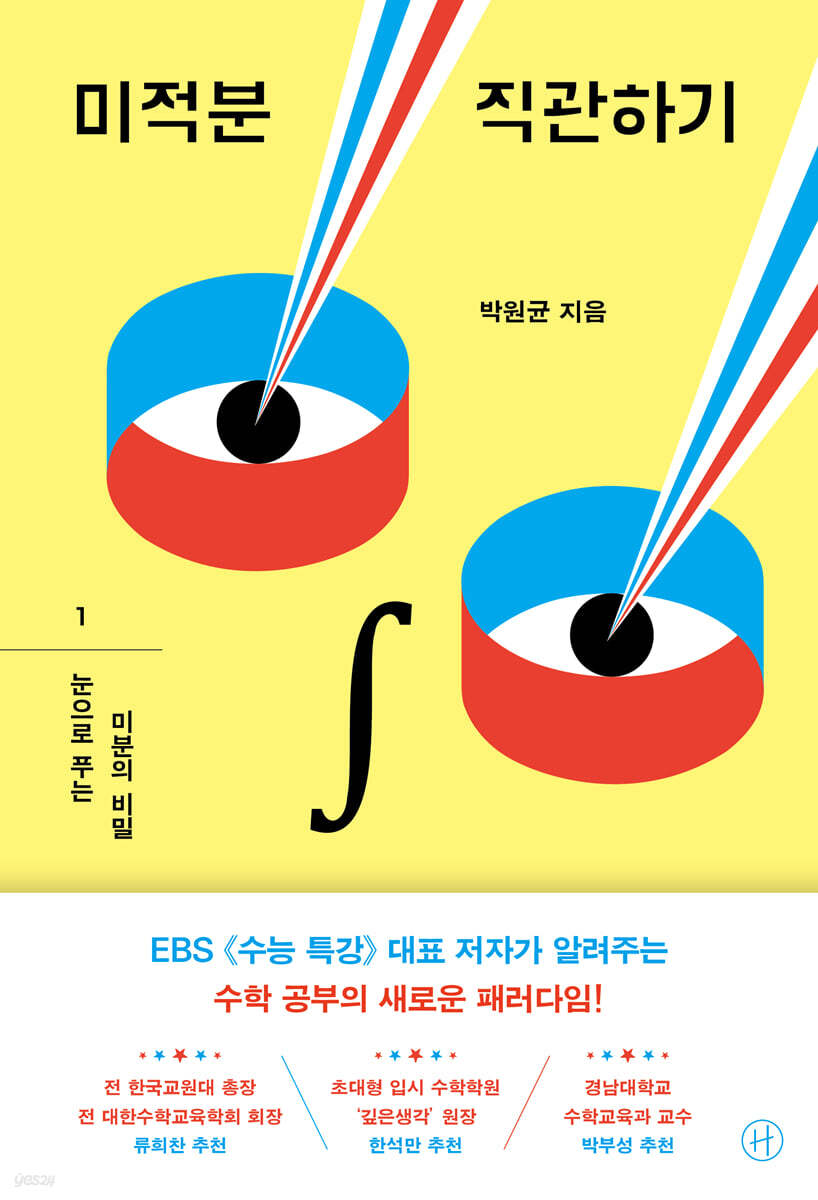
Intuitive Calculus 1
 |
Description
Book Introduction
A calculus strategy book that lets you solve problems intuitively, rather than memorizing symbols and formulas!
A new paradigm for studying math, presented by the leading author of EBS's "College Scholastic Ability Test Special Lecture"!
In a subject that was like a 'terrible nightmare' where you just had to solve problems mechanically,
The one book that transforms your imagination into a moment of "amazing inspiration" by imagining extreme situations.
★★★
Recommended by Ryu Hee-chan, former president of Korea National University of Education and former president of the Korean Society for Mathematics Education
Recommended by Professor Park Bu-seong of the Department of Mathematics Education at Gyeongnam National University
Recommended by Han Seok-man, director of "Deep Thought," a large-scale entrance exam prep academy.
★★★
"Intuitive Calculus" is a new concept in mathematics that not only allows you to intuitively grasp problems without algebraic calculations, but also provides the experience of "directly" "observing" the splendid stage of calculus, which has created a major stream of human history.
Park Won-gyun, the author of this book, is a math teacher who has taught students in high schools for nearly 30 years and is the longest-serving writer of the CSAT-related textbook 『EBS CSAT Special Lecture』. He also leads training for teachers every year on how to create CSAT-style problems.
This book explains calculus based on the intentions of the examiners by actually covering the evaluation institute problems and the college entrance exam problems.
By approaching a mathematical problem from its origins, readers not only discover a much easier way to solve it, but also experience the beauty hidden within.
Reading a book can also provide the thrilling experience of discovering yourself solving problems on your own.
The thought processes of mathematicians and the inspiration from the humanities that emerged with the advent of calculus in human civilization also accompany this colorful journey.
Calculus is not just a mathematical formula; it is a powerful thinking tool for understanding the world we live in.
Since Newton and Leibniz invented calculus, the concept has played an essential role in virtually every field, including science, engineering, economics, and computer science.
However, many people today view calculus as a simple exam subject or complex mathematical problem, and fail to experience its essential meaning and intuitive beauty.
Author Won-Kyun Park helps students, teachers, and general readers break down stereotypes and enjoy calculus from a new perspective.
『Intuitive Calculus』 covers differentiation in Volume 1 and integration in Volume 2.
The first step on that journey, "Intuitive Calculus 1: The Secret of Differentiation Solved with Your Eyes," begins with a story about differentiation.
Now, let's open the book and dive into the story of differentiation that will awaken my dormant intuition.
A new paradigm for studying math, presented by the leading author of EBS's "College Scholastic Ability Test Special Lecture"!
In a subject that was like a 'terrible nightmare' where you just had to solve problems mechanically,
The one book that transforms your imagination into a moment of "amazing inspiration" by imagining extreme situations.
★★★
Recommended by Ryu Hee-chan, former president of Korea National University of Education and former president of the Korean Society for Mathematics Education
Recommended by Professor Park Bu-seong of the Department of Mathematics Education at Gyeongnam National University
Recommended by Han Seok-man, director of "Deep Thought," a large-scale entrance exam prep academy.
★★★
"Intuitive Calculus" is a new concept in mathematics that not only allows you to intuitively grasp problems without algebraic calculations, but also provides the experience of "directly" "observing" the splendid stage of calculus, which has created a major stream of human history.
Park Won-gyun, the author of this book, is a math teacher who has taught students in high schools for nearly 30 years and is the longest-serving writer of the CSAT-related textbook 『EBS CSAT Special Lecture』. He also leads training for teachers every year on how to create CSAT-style problems.
This book explains calculus based on the intentions of the examiners by actually covering the evaluation institute problems and the college entrance exam problems.
By approaching a mathematical problem from its origins, readers not only discover a much easier way to solve it, but also experience the beauty hidden within.
Reading a book can also provide the thrilling experience of discovering yourself solving problems on your own.
The thought processes of mathematicians and the inspiration from the humanities that emerged with the advent of calculus in human civilization also accompany this colorful journey.
Calculus is not just a mathematical formula; it is a powerful thinking tool for understanding the world we live in.
Since Newton and Leibniz invented calculus, the concept has played an essential role in virtually every field, including science, engineering, economics, and computer science.
However, many people today view calculus as a simple exam subject or complex mathematical problem, and fail to experience its essential meaning and intuitive beauty.
Author Won-Kyun Park helps students, teachers, and general readers break down stereotypes and enjoy calculus from a new perspective.
『Intuitive Calculus』 covers differentiation in Volume 1 and integration in Volume 2.
The first step on that journey, "Intuitive Calculus 1: The Secret of Differentiation Solved with Your Eyes," begins with a story about differentiation.
Now, let's open the book and dive into the story of differentiation that will awaken my dormant intuition.
- You can preview some of the book's contents.
Preview
index
Praise from those who read this book first
Introduction: From Understanding Mathematics to Discovering Mathematics
Part 1: Gazing into the Endless World: The Extreme
1. Begin to embrace infinity
2 The worldview created by Infinite
3 Define infinity
4 Infinite vs Infinite
5 Make people believe the unbelievable
6 The Birth of Extremes
7 Complete the vertical line
8 Between continuation and discontinuity
9 Infinite imagination stretching into space
10 The Beginning of an Extreme Journey
11 Riding your intuition into the macro world
12 Riding the Intuition into the Micro World
13 Constant Port explodes in an endless battle
14 Experience extreme situations
15 Beyond the extreme of illusion
Part 2: Intuition of Change: Differentiation
1 New Era and Calculus
2 Uncovering the Secrets of Exercise
3 Differential calculus sprouts
4 Pioneers of Differentiation
5 Newton and Leibniz's Differentiation
6 Modern Differentiation
7 Tangent Intuition
8 The World Through a Mathematical Microscope
9 Riding the intuition into the world of tangents
10 Journey to Earth
11 Understanding Differentiability
12 The Role of Differentiation
Understanding the Differentiation of 13 Multiplications
14 Applications of Differentiation
15 Open your eyes to the world of light
16 The Mathematics of Light
17 The World of Intuition Unfolded by Differentiation
18 A World of Change
19 Mathematics of the Universe
20 The end is another beginning
supplement
Go deeper
References
Source of the illustration
Introduction: From Understanding Mathematics to Discovering Mathematics
Part 1: Gazing into the Endless World: The Extreme
1. Begin to embrace infinity
2 The worldview created by Infinite
3 Define infinity
4 Infinite vs Infinite
5 Make people believe the unbelievable
6 The Birth of Extremes
7 Complete the vertical line
8 Between continuation and discontinuity
9 Infinite imagination stretching into space
10 The Beginning of an Extreme Journey
11 Riding your intuition into the macro world
12 Riding the Intuition into the Micro World
13 Constant Port explodes in an endless battle
14 Experience extreme situations
15 Beyond the extreme of illusion
Part 2: Intuition of Change: Differentiation
1 New Era and Calculus
2 Uncovering the Secrets of Exercise
3 Differential calculus sprouts
4 Pioneers of Differentiation
5 Newton and Leibniz's Differentiation
6 Modern Differentiation
7 Tangent Intuition
8 The World Through a Mathematical Microscope
9 Riding the intuition into the world of tangents
10 Journey to Earth
11 Understanding Differentiability
12 The Role of Differentiation
Understanding the Differentiation of 13 Multiplications
14 Applications of Differentiation
15 Open your eyes to the world of light
16 The Mathematics of Light
17 The World of Intuition Unfolded by Differentiation
18 A World of Change
19 Mathematics of the Universe
20 The end is another beginning
supplement
Go deeper
References
Source of the illustration
Detailed image

Into the book
Students believe that mathematics is a discipline that was born perfect and will remain eternally pure.
When I was in high school, I also thought that Newton and Leibniz created calculus as it is written in textbooks today.
This was an inevitable misunderstanding, as the mathematical concepts in textbooks were reconstructed in a way that best suited students' learning, regardless of history.
The reason experts structured the curriculum this way is probably because they judged it to be the most accurate and efficient way to teach mathematics.
--- From "From Understanding Mathematics to Discovering Mathematics"
To make the fraction b/a infinite, you can either make the numerator b infinitely large or make the denominator a infinitely close to 0.
However, the first time that mankind was able to utilize infinity in life was not by infinitely increasing the numerator, but by infinitely reducing the denominator.
It can be said that humanity's endless challenge toward infinity began in the Stone Age, as the concept of infinity can be found in sharp knives, axes, and arrowheads.
--- From "Part 1, Chapter 1, "Begin to Embrace Infinity"
Even genius mathematicians could not have accepted 0.999… = 1 without any doubt from the beginning.
0.999… was a goblin-like being that even tormented Newton.
Mathematicians have clearly 'defined' 0.999... to remove even a single doubt that 0.999... = 1, so that this goblin can no longer run wild.
And the tools used in that process are ‘infinity’ and ‘limit (lim)’.
--- From "Part 1, Chapter 6, "The Birth of the Extreme"
Let's draw a picture while gradually increasing the value of t.
The following figure shows the values of t increasing by 1 from 1 to 10 in sequence.
However, in a situation where we need to solve the problem when 't→infinity', t=10 is still an extremely small number.
Shouldn't we at least draw the situation at t=100? However, drawing the situation at t=100 requires a much larger piece of paper than drawing the situation at t=10.
However, it would be much simpler and more economical to draw on a smaller scale without having to draw on a large piece of paper.
Haven't we already seen the vast Milky Way drawn on a single sheet of paper? It might be helpful to think of a scene in a movie where the camera zooms out from Earth's surface, zooms out into the far reaches of space, and then zooms out so far that Earth is no longer visible.
--- From "Part 1, Chapter 11, "Riding Intuition to the Macro World"
As 'theta' approaches 0, the sector becomes increasingly sharp like a needle, and the inscribed circle begins to resemble the eye of a needle and then disappears altogether.
If we just draw the picture like this, the inscribed circle, which is the core of this problem, will become infinitely small and eventually disappear from our sight.
However, if you open your imagination eyes wide and zoom in on the part where the inscribed circle is, the circle that you thought had disappeared will come back to life perfectly.
--- From "Part 1, Chapter 12, "Riding Intuition into the Microscopic World"
To learn mathematics properly, logic and intuition must be balanced, allowing one to develop both logical reasoning skills and intuitive insight.
Only then can we create new mathematics, and only then can we truly understand this world.
Most great mathematical and scientific discoveries are the result of a complementary blend of intuitive insight and rigorous argument.
Archimedes was able to intuitively figure out the principle of buoyancy in a bath and then confirm his theory through verification, and Newton was able to complete the law of universal gravitation using calculus after intuitively thinking of universal gravitation through a falling apple.
--- From Chapter 15 of Part 1, “Beyond the Extreme of Delusion”
In the 16th century, when the clouds of war were gathering in Joseon, Europe was desperate to explore the world and establish colonies, and to this end, various weapons, navigation, astronomy, and physics all made explosive progress in science and technology.
And the need for mathematics to theoretically support and guide this began to become urgent.
As a result, a golden age unfolded from the late 16th century to the 17th century, when new mathematical properties that had been buried like a treasure trove began to emerge here and there and flourish.
--- From "Part 2, Chapter 1, "The New Era and Calculus"
Newton believed that 'time' flows continuously, and that a 'curve' is the trajectory traced by a point moving along the flow of time.
Therefore, the curve was seen as a 'continuous' shape that could be cut into infinitely small pieces.
Here, Newton thought of time as a quantity that always flows at a constant speed, and he used this constant flow of time to find the slope of the tangent line through the following two ideas.
--- From “Part 2, Chapter 5, “Newton and Leibniz’s Differential Calculus”
The profound meaning and procedure contained in this symbol (lim) were on a different level from other symbols.
So, the absence of this symbol was like having an impassable river blocking the way.
It took nearly 200 years of mathematician effort to cross that river and perfect the concept of limits.
--- From “Part 2, Chapter 6, “Modern Differential Calculus”
This problem was not originally posed as a problem in the differentiation unit, but as a limit problem of a function using the law of cosines, but I think it was born from the idea of intuitive differentiation.
The author must have wanted to make students realize through this problem why differentiation is a 'mathematical microscope'.
--- From “Part 2, Chapter 9, “Riding Intuition to the World of Tangential Lines”
Even Newton and Leibniz could not have imagined that such a peculiar curve could exist.
If Newton and Leibniz had known about the existence of such functions, the progress of calculus might have been even slower, as they would have had to check for the existence of strange functions with each step they took.
--- From "Part 2, Chapter 11, "Intuition of Differentiability"
When you see someone differentiating something, it may seem like they're just finding the slope of a tangent line, but in fact, they might be finding the velocity, the current, or the marginal cost.
Perhaps even when we are finding the slope of a tangent line, we are practicing solving problems in all fields.
--- From “Part 2, Chapter 14, “Applications of Differentiation”
Fermat's proof that light moves according to the laws of calculus was a great achievement that confirmed once again that the universe operates mathematically, following Kepler's laws, and it became the first case of discovering the secrets of nature using calculus.
Furthermore, it was a signal to mathematicians and scientists that differentiation could potentially unlock more secrets of the universe.
--- From "Part 2, Chapter 16, "Mathematics of Light"
When a skier skis down a mountainside, if he leans to the right, his skis will trace a path that turns right, and if he leans to the left, his skis will trace a path that turns left.
And if this player wants to change direction, he has to straighten his body in an instant.
These moments of straightening the body to change direction become turning points in the athlete's path.
When I was in high school, I also thought that Newton and Leibniz created calculus as it is written in textbooks today.
This was an inevitable misunderstanding, as the mathematical concepts in textbooks were reconstructed in a way that best suited students' learning, regardless of history.
The reason experts structured the curriculum this way is probably because they judged it to be the most accurate and efficient way to teach mathematics.
--- From "From Understanding Mathematics to Discovering Mathematics"
To make the fraction b/a infinite, you can either make the numerator b infinitely large or make the denominator a infinitely close to 0.
However, the first time that mankind was able to utilize infinity in life was not by infinitely increasing the numerator, but by infinitely reducing the denominator.
It can be said that humanity's endless challenge toward infinity began in the Stone Age, as the concept of infinity can be found in sharp knives, axes, and arrowheads.
--- From "Part 1, Chapter 1, "Begin to Embrace Infinity"
Even genius mathematicians could not have accepted 0.999… = 1 without any doubt from the beginning.
0.999… was a goblin-like being that even tormented Newton.
Mathematicians have clearly 'defined' 0.999... to remove even a single doubt that 0.999... = 1, so that this goblin can no longer run wild.
And the tools used in that process are ‘infinity’ and ‘limit (lim)’.
--- From "Part 1, Chapter 6, "The Birth of the Extreme"
Let's draw a picture while gradually increasing the value of t.
The following figure shows the values of t increasing by 1 from 1 to 10 in sequence.
However, in a situation where we need to solve the problem when 't→infinity', t=10 is still an extremely small number.
Shouldn't we at least draw the situation at t=100? However, drawing the situation at t=100 requires a much larger piece of paper than drawing the situation at t=10.
However, it would be much simpler and more economical to draw on a smaller scale without having to draw on a large piece of paper.
Haven't we already seen the vast Milky Way drawn on a single sheet of paper? It might be helpful to think of a scene in a movie where the camera zooms out from Earth's surface, zooms out into the far reaches of space, and then zooms out so far that Earth is no longer visible.
--- From "Part 1, Chapter 11, "Riding Intuition to the Macro World"
As 'theta' approaches 0, the sector becomes increasingly sharp like a needle, and the inscribed circle begins to resemble the eye of a needle and then disappears altogether.
If we just draw the picture like this, the inscribed circle, which is the core of this problem, will become infinitely small and eventually disappear from our sight.
However, if you open your imagination eyes wide and zoom in on the part where the inscribed circle is, the circle that you thought had disappeared will come back to life perfectly.
--- From "Part 1, Chapter 12, "Riding Intuition into the Microscopic World"
To learn mathematics properly, logic and intuition must be balanced, allowing one to develop both logical reasoning skills and intuitive insight.
Only then can we create new mathematics, and only then can we truly understand this world.
Most great mathematical and scientific discoveries are the result of a complementary blend of intuitive insight and rigorous argument.
Archimedes was able to intuitively figure out the principle of buoyancy in a bath and then confirm his theory through verification, and Newton was able to complete the law of universal gravitation using calculus after intuitively thinking of universal gravitation through a falling apple.
--- From Chapter 15 of Part 1, “Beyond the Extreme of Delusion”
In the 16th century, when the clouds of war were gathering in Joseon, Europe was desperate to explore the world and establish colonies, and to this end, various weapons, navigation, astronomy, and physics all made explosive progress in science and technology.
And the need for mathematics to theoretically support and guide this began to become urgent.
As a result, a golden age unfolded from the late 16th century to the 17th century, when new mathematical properties that had been buried like a treasure trove began to emerge here and there and flourish.
--- From "Part 2, Chapter 1, "The New Era and Calculus"
Newton believed that 'time' flows continuously, and that a 'curve' is the trajectory traced by a point moving along the flow of time.
Therefore, the curve was seen as a 'continuous' shape that could be cut into infinitely small pieces.
Here, Newton thought of time as a quantity that always flows at a constant speed, and he used this constant flow of time to find the slope of the tangent line through the following two ideas.
--- From “Part 2, Chapter 5, “Newton and Leibniz’s Differential Calculus”
The profound meaning and procedure contained in this symbol (lim) were on a different level from other symbols.
So, the absence of this symbol was like having an impassable river blocking the way.
It took nearly 200 years of mathematician effort to cross that river and perfect the concept of limits.
--- From “Part 2, Chapter 6, “Modern Differential Calculus”
This problem was not originally posed as a problem in the differentiation unit, but as a limit problem of a function using the law of cosines, but I think it was born from the idea of intuitive differentiation.
The author must have wanted to make students realize through this problem why differentiation is a 'mathematical microscope'.
--- From “Part 2, Chapter 9, “Riding Intuition to the World of Tangential Lines”
Even Newton and Leibniz could not have imagined that such a peculiar curve could exist.
If Newton and Leibniz had known about the existence of such functions, the progress of calculus might have been even slower, as they would have had to check for the existence of strange functions with each step they took.
--- From "Part 2, Chapter 11, "Intuition of Differentiability"
When you see someone differentiating something, it may seem like they're just finding the slope of a tangent line, but in fact, they might be finding the velocity, the current, or the marginal cost.
Perhaps even when we are finding the slope of a tangent line, we are practicing solving problems in all fields.
--- From “Part 2, Chapter 14, “Applications of Differentiation”
Fermat's proof that light moves according to the laws of calculus was a great achievement that confirmed once again that the universe operates mathematically, following Kepler's laws, and it became the first case of discovering the secrets of nature using calculus.
Furthermore, it was a signal to mathematicians and scientists that differentiation could potentially unlock more secrets of the universe.
--- From "Part 2, Chapter 16, "Mathematics of Light"
When a skier skis down a mountainside, if he leans to the right, his skis will trace a path that turns right, and if he leans to the left, his skis will trace a path that turns left.
And if this player wants to change direction, he has to straighten his body in an instant.
These moments of straightening the body to change direction become turning points in the athlete's path.
--- From “Part 2, Chapter 18, “The World of Change”
Publisher's Review
1.
Tired of calculations, meet the true essence of mathematics!
- The extreme of dreaming of a world that cannot be experienced
- Stimulate your intuition and imagination to rediscover the infinite mysteries and limitations.
- Exploring the universe and the quantum world with mathematical intuition beyond calculation.
Differentiation is an attempt to understand the essence of subtle changes that are beyond the reach of human perception.
Through extremes, we define the 'moment' we cannot directly experience, and through this, we embark on a journey to capture the changes in the world.
The core of differentiation, a tool for analyzing moments of change, lies in the concept of limits.
Because we can define the slope and tangent of a curve through limits and capture changes.
The entire process of mathematics began with the effort to explain the world that humanity faces and to unfold a new world.
Writing down complex formulas and calculations and rubbing your aching hands was not the beginning of mathematics.
Proper learning of mathematics is a balanced combination of logic and intuition.
Reasoning with insight is the driving force behind creating new mathematics and the key to understanding the world.
The author takes us into the real world of space and quantum mechanics, with the real mathematics of intuition beyond calculation.
Part 1, “Intuitively Seeing the Endless World: The Limit,” explores the boundary between infinity and limitation.
Through various examples such as Zeno's paradox and the recurring decimal 0.999, it allows readers to intuitively experience the subtle boundaries between nature and the universe, as revealed in convergence and divergence, and extreme situations.
Infinity is a concept that is difficult for humans to understand intuitively.
We imagine an infinitely vast universe, an endless array of numbers, and infinitely small particles, but it is not easy to clearly define them.
This book explores various thought experiments that intuitively approach infinity and explores how we perceive infinity.
Infinity is not simply 'no end'.
In mathematics, infinity is rigorously defined and dealt with.
Cantor proposed a method for comparing infinite magnitudes, and modern mathematics has developed tools to distinguish between finite and infinite.
Infinity, without boundaries, is not actually all the same size.
Through the concepts of countable and uncountable infinities, the hierarchy of infinities in mathematics, and the process of using limits to prove that 0.999… = 1, we can understand how the concept of limits works ‘with our eyes, not our hands.’
Humans have imagined endless space and time and have explored the concept of infinity philosophically.
Is the universe infinite or finite?
How can the infinity of the universe and mathematical infinity be connected?
In Part 1, we conduct thought experiments using extremes and attempt to understand the cosmic scale through them.
Furthermore, we explore quantum mechanics, a topic more talked about than any other science today, and the microscopic world smaller than atoms through the methodology of intuition, and examine the role of limits within it.
2.
'Intuitively' observing the process of concept creation
- For a moment, I felt like Archimedes, Newton, and Leibniz!
- Newton and Leibniz's fierce and fortuitous race toward differential calculus
- Discover the mathematical narrative behind compressed concepts.
Part 2, “Intuitively Observing Change: Differentiation,” makes readers feel “for a moment as if I had become Archimedes, Newton, and Leibniz” (Han Do-yoon, high school student).
In each class, the author creates and applies various scenarios so that students can “experience creating mathematics themselves, however clumsily.” This allows readers to follow the development of the innovative discoveries of Newton and Leibniz to modern applications, step by step, and enjoy the experience of becoming a mathematician themselves and revealing the meaning of differentiation.
Mathematicians have been developing basic concepts of differentiation from ancient times to the 16th century.
Then, starting in the 17th century, several mathematicians independently discovered the basic principles of differential calculus.
The history of the development of early differential calculus includes numerous pioneers who contributed to the birth of calculus.
The story continues with the conceptual origins of calculus, including Fermat's maximum and minimum problems, Descartes' analytical geometry, and infinitesimals.
Here, we will discuss in detail Newton and Leibniz, who are known as the founders of calculus.
The two mathematicians independently discovered calculus and established its system in their own way.
By comparing Newton's approach as a tool for analyzing motion and Leibniz's approach as a method for studying the change of functions, we can examine the foundations of modern differential calculus and continue to understand the modern concept of differentiation.
As the author says, many people "believe that mathematics is a discipline that was born perfect and will remain supreme and pure forever." But let's think about the 200 years it took to perfect the concept of limits.
Mathematics is also the result of humankind's repeated trial and error, and even at this very moment, it is being formed through the direct conversations and indirect experiences of countless mathematicians.
3.
Differentiation, the language of the ever-changing modern society
- Differentiation in everyday life with clear intuition
- From the theory of relativity to the evolution of stars, the laws of the universe explained through differentiation.
- With the most beautiful perspective to interpret the world
Differentiation is used in various fields such as astronomy, engineering, economics, and biology.
A key concept for applying this to real life is 'tangent'.
Calculating the cost of producing something most efficiently or applying current to an electronic device we use every day involves finding the tangent.
When someone is differentiating something, he may be calculating marginal cost or measuring current.
Differentiation is always involved in solving humanity's problems.
Finding a tangent line at a point on a curve is a basic application of differentiation.
Here the author explores an intuitive way to understand the concept of tangent.
In particular, we explore the process of understanding the change of a curve by utilizing the concept of limit presented in Part 1, and synthesize this to embark on a journey to the limit toward the tangent line.
The process of finding the tangent to a curve is ultimately a process of using limits.
It explains step-by-step how to define a tangent at a point, emphasizing the relationship between limits and differentiation.
When you look at the Earth from space, it looks like a small dot.
Likewise, differentiation allows us to understand the complex world as a single, consistent principle.
Space and light are inseparable.
In mathematical models that reveal the fundamental laws of the universe, light simultaneously explains wave-particle duality and is a crucial driving force that precisely interprets energy flow using calculus and physical formulas.
In optics, which studies light, differentiation plays a particularly important role, and its concepts are used in the process of analyzing reflection and refraction of light.
The path of light follows Fermat's principle, which is connected to the concept of differentiation, and differentiation can be used to analyze how light finds the shortest path.
Many laws, such as the movement of celestial bodies, the theory of relativity, and the structure of black holes, are explained through differentiation.
The book also concludes with the phenomenon of a supernova, which occurs when a star explodes at the end of its evolutionary process.
Ultimately, this book guides us through the process of acquiring a new perspective on the world, rather than simply accumulating knowledge, to understand why we should learn calculus.
We invite you to the world of differentiation, the most beautiful language that interprets our lives and the universe.
Tired of calculations, meet the true essence of mathematics!
- The extreme of dreaming of a world that cannot be experienced
- Stimulate your intuition and imagination to rediscover the infinite mysteries and limitations.
- Exploring the universe and the quantum world with mathematical intuition beyond calculation.
Differentiation is an attempt to understand the essence of subtle changes that are beyond the reach of human perception.
Through extremes, we define the 'moment' we cannot directly experience, and through this, we embark on a journey to capture the changes in the world.
The core of differentiation, a tool for analyzing moments of change, lies in the concept of limits.
Because we can define the slope and tangent of a curve through limits and capture changes.
The entire process of mathematics began with the effort to explain the world that humanity faces and to unfold a new world.
Writing down complex formulas and calculations and rubbing your aching hands was not the beginning of mathematics.
Proper learning of mathematics is a balanced combination of logic and intuition.
Reasoning with insight is the driving force behind creating new mathematics and the key to understanding the world.
The author takes us into the real world of space and quantum mechanics, with the real mathematics of intuition beyond calculation.
Part 1, “Intuitively Seeing the Endless World: The Limit,” explores the boundary between infinity and limitation.
Through various examples such as Zeno's paradox and the recurring decimal 0.999, it allows readers to intuitively experience the subtle boundaries between nature and the universe, as revealed in convergence and divergence, and extreme situations.
Infinity is a concept that is difficult for humans to understand intuitively.
We imagine an infinitely vast universe, an endless array of numbers, and infinitely small particles, but it is not easy to clearly define them.
This book explores various thought experiments that intuitively approach infinity and explores how we perceive infinity.
Infinity is not simply 'no end'.
In mathematics, infinity is rigorously defined and dealt with.
Cantor proposed a method for comparing infinite magnitudes, and modern mathematics has developed tools to distinguish between finite and infinite.
Infinity, without boundaries, is not actually all the same size.
Through the concepts of countable and uncountable infinities, the hierarchy of infinities in mathematics, and the process of using limits to prove that 0.999… = 1, we can understand how the concept of limits works ‘with our eyes, not our hands.’
Humans have imagined endless space and time and have explored the concept of infinity philosophically.
Is the universe infinite or finite?
How can the infinity of the universe and mathematical infinity be connected?
In Part 1, we conduct thought experiments using extremes and attempt to understand the cosmic scale through them.
Furthermore, we explore quantum mechanics, a topic more talked about than any other science today, and the microscopic world smaller than atoms through the methodology of intuition, and examine the role of limits within it.
2.
'Intuitively' observing the process of concept creation
- For a moment, I felt like Archimedes, Newton, and Leibniz!
- Newton and Leibniz's fierce and fortuitous race toward differential calculus
- Discover the mathematical narrative behind compressed concepts.
Part 2, “Intuitively Observing Change: Differentiation,” makes readers feel “for a moment as if I had become Archimedes, Newton, and Leibniz” (Han Do-yoon, high school student).
In each class, the author creates and applies various scenarios so that students can “experience creating mathematics themselves, however clumsily.” This allows readers to follow the development of the innovative discoveries of Newton and Leibniz to modern applications, step by step, and enjoy the experience of becoming a mathematician themselves and revealing the meaning of differentiation.
Mathematicians have been developing basic concepts of differentiation from ancient times to the 16th century.
Then, starting in the 17th century, several mathematicians independently discovered the basic principles of differential calculus.
The history of the development of early differential calculus includes numerous pioneers who contributed to the birth of calculus.
The story continues with the conceptual origins of calculus, including Fermat's maximum and minimum problems, Descartes' analytical geometry, and infinitesimals.
Here, we will discuss in detail Newton and Leibniz, who are known as the founders of calculus.
The two mathematicians independently discovered calculus and established its system in their own way.
By comparing Newton's approach as a tool for analyzing motion and Leibniz's approach as a method for studying the change of functions, we can examine the foundations of modern differential calculus and continue to understand the modern concept of differentiation.
As the author says, many people "believe that mathematics is a discipline that was born perfect and will remain supreme and pure forever." But let's think about the 200 years it took to perfect the concept of limits.
Mathematics is also the result of humankind's repeated trial and error, and even at this very moment, it is being formed through the direct conversations and indirect experiences of countless mathematicians.
3.
Differentiation, the language of the ever-changing modern society
- Differentiation in everyday life with clear intuition
- From the theory of relativity to the evolution of stars, the laws of the universe explained through differentiation.
- With the most beautiful perspective to interpret the world
Differentiation is used in various fields such as astronomy, engineering, economics, and biology.
A key concept for applying this to real life is 'tangent'.
Calculating the cost of producing something most efficiently or applying current to an electronic device we use every day involves finding the tangent.
When someone is differentiating something, he may be calculating marginal cost or measuring current.
Differentiation is always involved in solving humanity's problems.
Finding a tangent line at a point on a curve is a basic application of differentiation.
Here the author explores an intuitive way to understand the concept of tangent.
In particular, we explore the process of understanding the change of a curve by utilizing the concept of limit presented in Part 1, and synthesize this to embark on a journey to the limit toward the tangent line.
The process of finding the tangent to a curve is ultimately a process of using limits.
It explains step-by-step how to define a tangent at a point, emphasizing the relationship between limits and differentiation.
When you look at the Earth from space, it looks like a small dot.
Likewise, differentiation allows us to understand the complex world as a single, consistent principle.
Space and light are inseparable.
In mathematical models that reveal the fundamental laws of the universe, light simultaneously explains wave-particle duality and is a crucial driving force that precisely interprets energy flow using calculus and physical formulas.
In optics, which studies light, differentiation plays a particularly important role, and its concepts are used in the process of analyzing reflection and refraction of light.
The path of light follows Fermat's principle, which is connected to the concept of differentiation, and differentiation can be used to analyze how light finds the shortest path.
Many laws, such as the movement of celestial bodies, the theory of relativity, and the structure of black holes, are explained through differentiation.
The book also concludes with the phenomenon of a supernova, which occurs when a star explodes at the end of its evolutionary process.
Ultimately, this book guides us through the process of acquiring a new perspective on the world, rather than simply accumulating knowledge, to understand why we should learn calculus.
We invite you to the world of differentiation, the most beautiful language that interprets our lives and the universe.
GOODS SPECIFICS
- Date of issue: March 3, 2025
- Page count, weight, size: 320 pages | 562g | 150*220*20mm
- ISBN13: 9791170873044
- ISBN10: 1170873049
You may also like
카테고리
korean


korean

![ELLE 엘르 스페셜 에디션 A형 : 12월 [2025]](http://librairie.coreenne.fr/cdn/shop/files/b8e27a3de6c9538896439686c6b0e8fb.jpg?v=1766436872&width=3840)


