

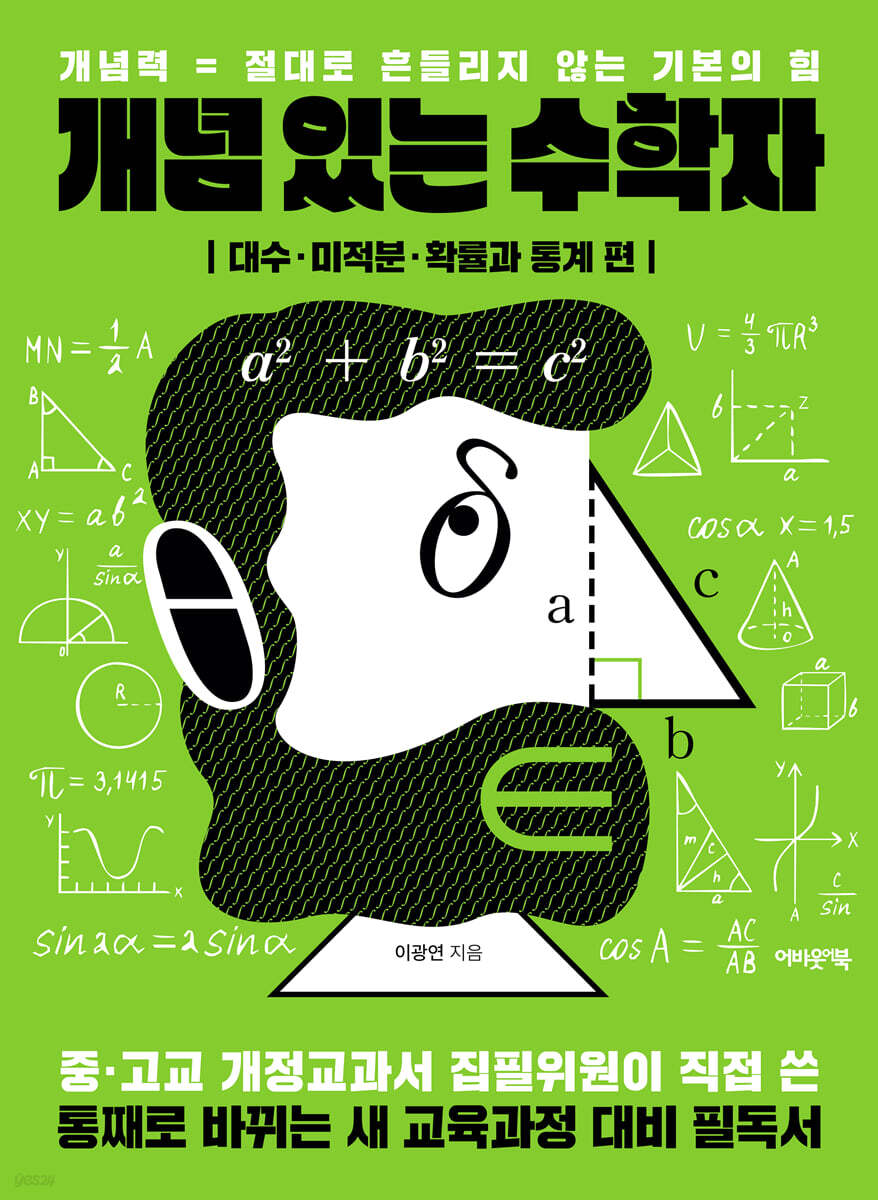
The Conceptual Mathematician: Algebra, Calculus, Probability and Statistics
 |
Description
Book Introduction
Starting from the 2028 college entrance exam, ‘Algebra’, ‘Calculus’, and ‘Probability and Statistics’ will be common subjects.
Perfectly organized into 49 concepts!
A must-read for the new curriculum, written by a member of the middle and high school textbook revision committee.
Prepare for the drastically changing scope and subjects of the 2028 College Scholastic Ability Test!
Based on experience in preparing major exams, we provide guidance on exam trends and study strategies.
As mathematics becomes established as a core subject that determines college entrance exams, students and parents' fear of mathematics is growing.
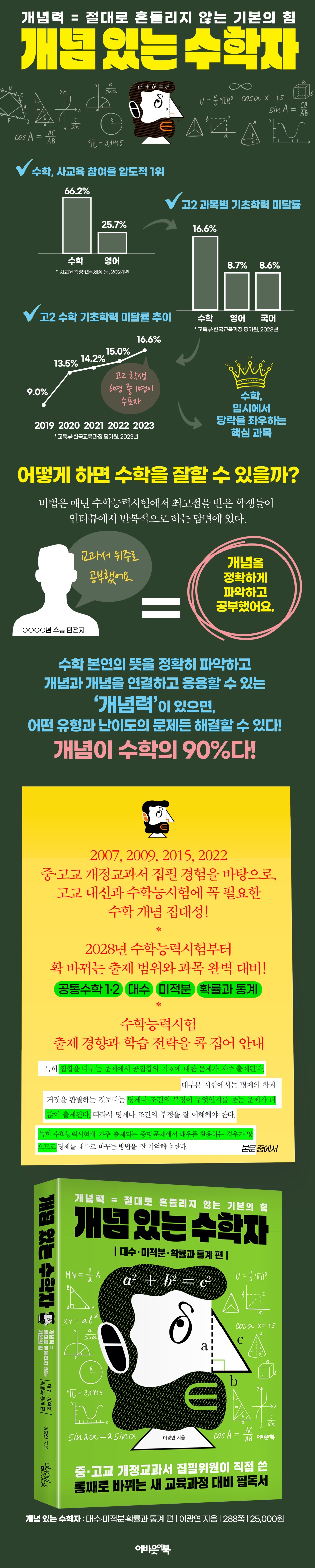
How can I excel in math? Every year, students who score highest on the College Scholastic Ability Test (CSAT) consistently answer in interviews: "I focused on studying from the textbook."
The true meaning of this phrase, which we often overlook as being too cliche, is “I studied it after understanding the concept clearly.”
The author, who has been participating in textbook writing committees for many years and has been researching and contemplating methods for studying mathematics, also shares the same thoughts.
“Concepts are 90% of math.”
If you have the 'conceptual power' to accurately understand the original meaning of mathematics and to connect and apply concepts, you can solve problems of any type and difficulty.
However, many students are in a hurry to solve problems by simply following the types of math problems.
As a result, even if the concept remains the same and only the packaging of the problem is slightly changed, it is perceived as a new problem and collapses helplessly.
If you have a firm grasp of the concept, you will never be shaken.
In mathematics, concepts are more important than types.
The subject that will undergo the biggest change with the 11th revision of the curriculum, which will be applied to first-year high school students starting in 2025, is mathematics.
Starting with the 2028 College Scholastic Ability Test, elective subjects in mathematics will be abolished and advanced mathematics will be excluded.
Previously, the elective subjects 'Probability and Statistics', 'Calculus 2', and 'Geometry' were removed from the advanced mathematics subjects 'Calculus 2' and 'Geometry', and problems were presented from three subjects: 'Algebra', 'Calculus 1', and 'Probability and Statistics'.
Accordingly, changes in preparation strategies for the College Scholastic Ability Test became inevitable.
Since the new math ability test excludes advanced mathematics, preparation should focus on developing the ability to accurately understand and utilize basic concepts.
This book perfectly organizes 'Algebra', 'Calculus', and 'Probability and Statistics', which will be common subjects starting with the 2028 College Scholastic Ability Test, into 49 concepts.
Mathematical concepts are delved into from the root, the most basic of terms.
The formula explains how, why, and where it comes from, and where and how it is used.
Additionally, by revising the curriculum and restoring explanations that were omitted but are essential for understanding higher-level concepts, we fill in the conceptual gaps in textbooks.
Mathematics is a hierarchical discipline where you have to know one thing to understand the next, so if you lose even one concept, you cannot move forward.
Although this book covers high school mathematics, it goes back to middle school and elementary school levels, covering concepts from the very bottom, such as the 'root formula', 'discriminant', 'division', and 'trigonometric ratios'.
Additionally, the latter part of the concept explanation provides guidance on the trend of questions and learning strategies, thereby suggesting a direction for studying mathematics.
Perfectly organized into 49 concepts!
A must-read for the new curriculum, written by a member of the middle and high school textbook revision committee.
Prepare for the drastically changing scope and subjects of the 2028 College Scholastic Ability Test!
Based on experience in preparing major exams, we provide guidance on exam trends and study strategies.
As mathematics becomes established as a core subject that determines college entrance exams, students and parents' fear of mathematics is growing.
How can I excel in math? Every year, students who score highest on the College Scholastic Ability Test (CSAT) consistently answer in interviews: "I focused on studying from the textbook."
The true meaning of this phrase, which we often overlook as being too cliche, is “I studied it after understanding the concept clearly.”
The author, who has been participating in textbook writing committees for many years and has been researching and contemplating methods for studying mathematics, also shares the same thoughts.
“Concepts are 90% of math.”
If you have the 'conceptual power' to accurately understand the original meaning of mathematics and to connect and apply concepts, you can solve problems of any type and difficulty.
However, many students are in a hurry to solve problems by simply following the types of math problems.
As a result, even if the concept remains the same and only the packaging of the problem is slightly changed, it is perceived as a new problem and collapses helplessly.
If you have a firm grasp of the concept, you will never be shaken.
In mathematics, concepts are more important than types.
The subject that will undergo the biggest change with the 11th revision of the curriculum, which will be applied to first-year high school students starting in 2025, is mathematics.
Starting with the 2028 College Scholastic Ability Test, elective subjects in mathematics will be abolished and advanced mathematics will be excluded.
Previously, the elective subjects 'Probability and Statistics', 'Calculus 2', and 'Geometry' were removed from the advanced mathematics subjects 'Calculus 2' and 'Geometry', and problems were presented from three subjects: 'Algebra', 'Calculus 1', and 'Probability and Statistics'.
Accordingly, changes in preparation strategies for the College Scholastic Ability Test became inevitable.
Since the new math ability test excludes advanced mathematics, preparation should focus on developing the ability to accurately understand and utilize basic concepts.
This book perfectly organizes 'Algebra', 'Calculus', and 'Probability and Statistics', which will be common subjects starting with the 2028 College Scholastic Ability Test, into 49 concepts.
Mathematical concepts are delved into from the root, the most basic of terms.
The formula explains how, why, and where it comes from, and where and how it is used.
Additionally, by revising the curriculum and restoring explanations that were omitted but are essential for understanding higher-level concepts, we fill in the conceptual gaps in textbooks.
Mathematics is a hierarchical discipline where you have to know one thing to understand the next, so if you lose even one concept, you cannot move forward.
Although this book covers high school mathematics, it goes back to middle school and elementary school levels, covering concepts from the very bottom, such as the 'root formula', 'discriminant', 'division', and 'trigonometric ratios'.
Additionally, the latter part of the concept explanation provides guidance on the trend of questions and learning strategies, thereby suggesting a direction for studying mathematics.
- You can preview some of the book's contents.
Preview
index
Preface - When Math Gets You Struggling, Go Back to the Concepts!
Exponential and logarithmic functions
52.
square root
: A number whose square gives a
53.
log
: A symbol that revolutionized the difficult calculation process
54.
exponential function
: A function in which a variable is included in the exponent of a power
55.
Logarithmic function
: The logarithmic function is the inverse function of the exponential function.
Trigonometric functions
56.
General angle
: Each angle is defined to be distinguished by considering the amount of rotation together.
57.
Hodo method
: Expressing the size of an angle in terms of length
58.
Trigonometric ratios
: Ratio of side lengths in a right triangle
59.
Trigonometric functions
: Converting angles from trigonometry learned in middle school into general angles
60.
Graphs of trigonometric functions
: If you graph the locations of the London Eye's gondolas,
61.
Law of Signs
: The relationship between the lengths of the three sides of a triangle and the sizes of the three interior angles
62.
Law of cosines
: Trigonometry needed to dig an undersea tunnel
sequence
63.
arithmetic sequence
: A sequence created by adding a constant number (common difference) to the preceding term
64.
geometric sequence
: What would it taste like if you drew it in geometric progression?
65.
Agreement symbol
: Σ, the first letter of 'Sum'
66.
sum of several sequences
: Prove with a picture, without a formula
67.
mathematical induction
: A tool for understanding mathematical arguments.
Limits and continuity of functions
68.
limit of a function
: When the function value approaches a constant value infinitely
69.
infinity
: A state of infinite growth
70.
Right and left limits
: The value of x gets infinitely closer to a
71.
continuity of functions
: A function that can predict changes
72.
Properties of continuous functions
: Useful maximum/minimum theorems and intermediate value theorems in differentiation
differential
73.
Average rate of change and derivative
: Cut it into small pieces and look at the changes.
74.
derivative
: A new function obtained by differentiating a function
75.
Equation of tangent line
: The equations needed to place Nuri into orbit
76.
Mean value theorem
: Differentiation required for section control of automobiles
77.
Increasing and decreasing functions
: Finding sea level without drawing a graph
78.
Maxima and minima
: When the function value is largest and smallest in a certain interval
79.
Drawing a graph of a function
: How to roughly draw the graph of a function
integral
80.
indefinite integral
: The inverse operation process of differentiation
81.
Disjunctive quadrature and definite integral
: How do you find the area of a terrain with an indented coastline?
82.
Indefinite and definite integrals
: Finding the extent of a crude oil spill
Case 2
83.
Various permutations
: Number of cases of going from point A to point B by the shortest distance
84.
Duplicate combination
: The math that powers a snack shop kiosk
85.
binomial theorem
: The number of cases when there are only two choices.
probability
86.
probability
: A number that represents the likelihood of an event occurring
87.
The addition theorem of probability and the probability of complementary events
: The probability of having a friend with the same birthday in the same class
88.
Conditional probability and the multiplication theorem of probability
: Find the probability of being a lung cancer patient, a smoker, and a male
89.
Independence and dependence of events
: The probability that events may or may not affect each other
statistics
90.
Random variables and probability distributions, discrete probability distributions
: The probability that an event will or will not occur
91.
Probability distribution of continuous random variables
: Probability of moving continuously
92.
Expected value and standard deviation of discrete random variables
: Between two people with the same average, who is more stable?
93.
binomial distribution
: Probability distribution when independent trials with constant probability are repeated
94.
normal distribution
: The most frequently encountered probability distribution in real life
95.
Population and sample
: The basis of reliable statistical research
96.
Representative value, sample mean, and population mean
: How many people have the same number of hairs on their heads?
97.
Population mean and sample mean
: Relationship between population and sample
98.
Estimation of the population mean
: Inferring the population from data obtained from a sample
99.
Population ratio and sample ratio
: The math needed to speed up the end of infectious diseases
100.
Estimation of the population ratio
: Counting the number of deer living in the forest without capturing them all.
References
Exponential and logarithmic functions
52.
square root
: A number whose square gives a
53.
log
: A symbol that revolutionized the difficult calculation process
54.
exponential function
: A function in which a variable is included in the exponent of a power
55.
Logarithmic function
: The logarithmic function is the inverse function of the exponential function.
Trigonometric functions
56.
General angle
: Each angle is defined to be distinguished by considering the amount of rotation together.
57.
Hodo method
: Expressing the size of an angle in terms of length
58.
Trigonometric ratios
: Ratio of side lengths in a right triangle
59.
Trigonometric functions
: Converting angles from trigonometry learned in middle school into general angles
60.
Graphs of trigonometric functions
: If you graph the locations of the London Eye's gondolas,
61.
Law of Signs
: The relationship between the lengths of the three sides of a triangle and the sizes of the three interior angles
62.
Law of cosines
: Trigonometry needed to dig an undersea tunnel
sequence
63.
arithmetic sequence
: A sequence created by adding a constant number (common difference) to the preceding term
64.
geometric sequence
: What would it taste like if you drew it in geometric progression?
65.
Agreement symbol
: Σ, the first letter of 'Sum'
66.
sum of several sequences
: Prove with a picture, without a formula
67.
mathematical induction
: A tool for understanding mathematical arguments.
Limits and continuity of functions
68.
limit of a function
: When the function value approaches a constant value infinitely
69.
infinity
: A state of infinite growth
70.
Right and left limits
: The value of x gets infinitely closer to a
71.
continuity of functions
: A function that can predict changes
72.
Properties of continuous functions
: Useful maximum/minimum theorems and intermediate value theorems in differentiation
differential
73.
Average rate of change and derivative
: Cut it into small pieces and look at the changes.
74.
derivative
: A new function obtained by differentiating a function
75.
Equation of tangent line
: The equations needed to place Nuri into orbit
76.
Mean value theorem
: Differentiation required for section control of automobiles
77.
Increasing and decreasing functions
: Finding sea level without drawing a graph
78.
Maxima and minima
: When the function value is largest and smallest in a certain interval
79.
Drawing a graph of a function
: How to roughly draw the graph of a function
integral
80.
indefinite integral
: The inverse operation process of differentiation
81.
Disjunctive quadrature and definite integral
: How do you find the area of a terrain with an indented coastline?
82.
Indefinite and definite integrals
: Finding the extent of a crude oil spill
Case 2
83.
Various permutations
: Number of cases of going from point A to point B by the shortest distance
84.
Duplicate combination
: The math that powers a snack shop kiosk
85.
binomial theorem
: The number of cases when there are only two choices.
probability
86.
probability
: A number that represents the likelihood of an event occurring
87.
The addition theorem of probability and the probability of complementary events
: The probability of having a friend with the same birthday in the same class
88.
Conditional probability and the multiplication theorem of probability
: Find the probability of being a lung cancer patient, a smoker, and a male
89.
Independence and dependence of events
: The probability that events may or may not affect each other
statistics
90.
Random variables and probability distributions, discrete probability distributions
: The probability that an event will or will not occur
91.
Probability distribution of continuous random variables
: Probability of moving continuously
92.
Expected value and standard deviation of discrete random variables
: Between two people with the same average, who is more stable?
93.
binomial distribution
: Probability distribution when independent trials with constant probability are repeated
94.
normal distribution
: The most frequently encountered probability distribution in real life
95.
Population and sample
: The basis of reliable statistical research
96.
Representative value, sample mean, and population mean
: How many people have the same number of hairs on their heads?
97.
Population mean and sample mean
: Relationship between population and sample
98.
Estimation of the population mean
: Inferring the population from data obtained from a sample
99.
Population ratio and sample ratio
: The math needed to speed up the end of infectious diseases
100.
Estimation of the population ratio
: Counting the number of deer living in the forest without capturing them all.
References
Detailed image
Publisher's Review
Concepts are a window that penetrates any type of problem precisely!
Concepts are 90% of math.
In our country, the students who suffer the most from math bullying are those who have to solve math ability test problems.
If you are on the verge of taking the college entrance exam, whether you are good at math or not, you will be suffering from math.
It is an undeniable fact that students who solve even one more math problem, especially one that is extremely difficult, go to better universities.
In addition, the phenomenon of science students with high math standard scores invading humanities under the integrated humanities and science college entrance exam is becoming increasingly severe.
As mathematics becomes established as a core subject that determines college entrance exams, students and parents' fear of mathematics is growing.
How can you excel in math? Find hints in the study methods of students who overcame their fear of math.
Every year, students who score highest on the College Scholastic Ability Test always answer in interviews, “I studied mainly from the textbook.”
The essence of studying mathematics is contained in this obvious answer that has been repeated for decades since the days of college entrance exams.
The true meaning of this statement is, “I studied with a clear understanding of the concept.”
The author of the revised middle and high school mathematics textbooks for the 2007, 2009, 2015, and 2022 curriculums shares the same view.
“Concepts are 90% of math.”
If you have the 'conceptual power' to accurately understand the original meaning of mathematics and to connect and apply concepts, you can solve problems of any type and difficulty.
However, many students are in a hurry to solve problems by simply following the types of math problems.
As a result, even if the concept remains the same and only the packaging of the problem is slightly changed, it is perceived as a new problem and collapses helplessly.
If you have a firm grasp of the concept, you will never be shaken.
The only thing that can 'kill' extremely difficult questions is 'conceptual power'.
It will become a common subject starting from the 2028 college entrance exam.
'Algebra', 'Calculus', and 'Probability and Statistics' perfectly organized into 49 concepts!
The subject that will undergo the biggest change with the 11th curriculum revision is mathematics.
The biggest change is that mathematics in the College Scholastic Ability Test will change from a common + elective subject system to a common subject system.
Until 2027, students will solve Math 1 and 2 as common subjects and then choose one subject from among 'Calculus 2', 'Probability and Statistics', and 'Geometry'.
However, starting with the 2028 College Scholastic Ability Test, 'Calculus 2' and 'Geometry' will be omitted, and questions will be asked from three subjects: 'Algebra', 'Calculus 1', and 'Probability and Statistics'.
In other words, advanced mathematics is excluded and the scope of the questions is reduced.
Starting in 2025, first-year high school students will study using revised textbooks that reflect these changes.
This book perfectly organizes 'Algebra', 'Calculus', and 'Probability and Statistics', which will be common subjects starting with the 2028 College Scholastic Ability Test, into 49 concepts.
There are many books on the market that claim to be textbooks on mathematics concepts, but most of them are either translated books that are out of sync with our curriculum or are based on textbooks that were revised before the revision.
This book, written by the author of the latest revised textbook, quickly and thoroughly dissects the revised textbook, compiling the mathematical concepts essential for high school grades and the College Scholastic Ability Test.
"Most exams ask more questions about the negation of a proposition or condition than about determining the truth or falsity of a proposition." These trends in exam questions and learning strategies, found at the end of the concept explanations, are invaluable information that only the author, who served on a major exam committee, could provide.
Mathematical terms are easily explained with their etymology and origin.
We go back to elementary school and solidify the concept from the ground up!
The proportion of questions measuring thinking ability in math tests is increasing, and 'literacy' is considered an essential ability to do well in math, along with 'conceptual ability'.
This book begins by providing various real-life examples of how each concept is applied, such as MBTI, the eruption of Mount Baekdu, the speed of a freely falling object, quantum mechanics, penalty shootouts, skid marks, and the brightness of stars, to explain why each concept is necessary.
These conceptually engaging texts not only help us realize how deeply mathematics permeates our lives, but are also excellent reading materials that foster literacy skills in their own right.
There is an episode related to mathematical terms in the drama Reply 1988.
Deokseon, who has decided to study math late in life, runs into a wall of terminology before even solving the problem.
“Sangsu? Who is that? There’s nothing there.
“Why do you use such difficult terms?” This book delves into the roots of mathematical concepts, including their etymology and origin, to make them easier to understand.
We do not force you to memorize the formula unconditionally.
Because memorized formulas are of no help in solving problems.
This book explains in detail how, why, and where the formula comes from, and where and how it is used.
Additionally, by revising the curriculum and restoring explanations that were omitted but are essential for understanding higher-level concepts, we fill in the conceptual gaps in textbooks.
Mathematics is a hierarchical discipline where you have to know one thing to know the next.
So, if there is a conceptual deficit in even one part, we cannot move forward.
Although this book covers high school mathematics, it goes back to middle school and elementary school levels and covers concepts from the very bottom, such as the 'root formula', 'discriminant', 'division', and 'trigonometric ratios'.
Concepts are 90% of math.
In our country, the students who suffer the most from math bullying are those who have to solve math ability test problems.
If you are on the verge of taking the college entrance exam, whether you are good at math or not, you will be suffering from math.
It is an undeniable fact that students who solve even one more math problem, especially one that is extremely difficult, go to better universities.
In addition, the phenomenon of science students with high math standard scores invading humanities under the integrated humanities and science college entrance exam is becoming increasingly severe.
As mathematics becomes established as a core subject that determines college entrance exams, students and parents' fear of mathematics is growing.
How can you excel in math? Find hints in the study methods of students who overcame their fear of math.
Every year, students who score highest on the College Scholastic Ability Test always answer in interviews, “I studied mainly from the textbook.”
The essence of studying mathematics is contained in this obvious answer that has been repeated for decades since the days of college entrance exams.
The true meaning of this statement is, “I studied with a clear understanding of the concept.”
The author of the revised middle and high school mathematics textbooks for the 2007, 2009, 2015, and 2022 curriculums shares the same view.
“Concepts are 90% of math.”
If you have the 'conceptual power' to accurately understand the original meaning of mathematics and to connect and apply concepts, you can solve problems of any type and difficulty.
However, many students are in a hurry to solve problems by simply following the types of math problems.
As a result, even if the concept remains the same and only the packaging of the problem is slightly changed, it is perceived as a new problem and collapses helplessly.
If you have a firm grasp of the concept, you will never be shaken.
The only thing that can 'kill' extremely difficult questions is 'conceptual power'.
It will become a common subject starting from the 2028 college entrance exam.
'Algebra', 'Calculus', and 'Probability and Statistics' perfectly organized into 49 concepts!
The subject that will undergo the biggest change with the 11th curriculum revision is mathematics.
The biggest change is that mathematics in the College Scholastic Ability Test will change from a common + elective subject system to a common subject system.
Until 2027, students will solve Math 1 and 2 as common subjects and then choose one subject from among 'Calculus 2', 'Probability and Statistics', and 'Geometry'.
However, starting with the 2028 College Scholastic Ability Test, 'Calculus 2' and 'Geometry' will be omitted, and questions will be asked from three subjects: 'Algebra', 'Calculus 1', and 'Probability and Statistics'.
In other words, advanced mathematics is excluded and the scope of the questions is reduced.
Starting in 2025, first-year high school students will study using revised textbooks that reflect these changes.
This book perfectly organizes 'Algebra', 'Calculus', and 'Probability and Statistics', which will be common subjects starting with the 2028 College Scholastic Ability Test, into 49 concepts.
There are many books on the market that claim to be textbooks on mathematics concepts, but most of them are either translated books that are out of sync with our curriculum or are based on textbooks that were revised before the revision.
This book, written by the author of the latest revised textbook, quickly and thoroughly dissects the revised textbook, compiling the mathematical concepts essential for high school grades and the College Scholastic Ability Test.
"Most exams ask more questions about the negation of a proposition or condition than about determining the truth or falsity of a proposition." These trends in exam questions and learning strategies, found at the end of the concept explanations, are invaluable information that only the author, who served on a major exam committee, could provide.
Mathematical terms are easily explained with their etymology and origin.
We go back to elementary school and solidify the concept from the ground up!
The proportion of questions measuring thinking ability in math tests is increasing, and 'literacy' is considered an essential ability to do well in math, along with 'conceptual ability'.
This book begins by providing various real-life examples of how each concept is applied, such as MBTI, the eruption of Mount Baekdu, the speed of a freely falling object, quantum mechanics, penalty shootouts, skid marks, and the brightness of stars, to explain why each concept is necessary.
These conceptually engaging texts not only help us realize how deeply mathematics permeates our lives, but are also excellent reading materials that foster literacy skills in their own right.
There is an episode related to mathematical terms in the drama Reply 1988.
Deokseon, who has decided to study math late in life, runs into a wall of terminology before even solving the problem.
“Sangsu? Who is that? There’s nothing there.
“Why do you use such difficult terms?” This book delves into the roots of mathematical concepts, including their etymology and origin, to make them easier to understand.
We do not force you to memorize the formula unconditionally.
Because memorized formulas are of no help in solving problems.
This book explains in detail how, why, and where the formula comes from, and where and how it is used.
Additionally, by revising the curriculum and restoring explanations that were omitted but are essential for understanding higher-level concepts, we fill in the conceptual gaps in textbooks.
Mathematics is a hierarchical discipline where you have to know one thing to know the next.
So, if there is a conceptual deficit in even one part, we cannot move forward.
Although this book covers high school mathematics, it goes back to middle school and elementary school levels and covers concepts from the very bottom, such as the 'root formula', 'discriminant', 'division', and 'trigonometric ratios'.
GOODS SPECIFICS
- Date of issue: December 26, 2024
- Page count, weight, size: 288 pages | 516g | 172*295*17mm
- ISBN13: 9791192229508
- ISBN10: 1192229509
You may also like
카테고리
korean


korean

![ELLE 엘르 스페셜 에디션 A형 : 12월 [2025]](http://librairie.coreenne.fr/cdn/shop/files/b8e27a3de6c9538896439686c6b0e8fb.jpg?v=1766436872&width=3840)


