

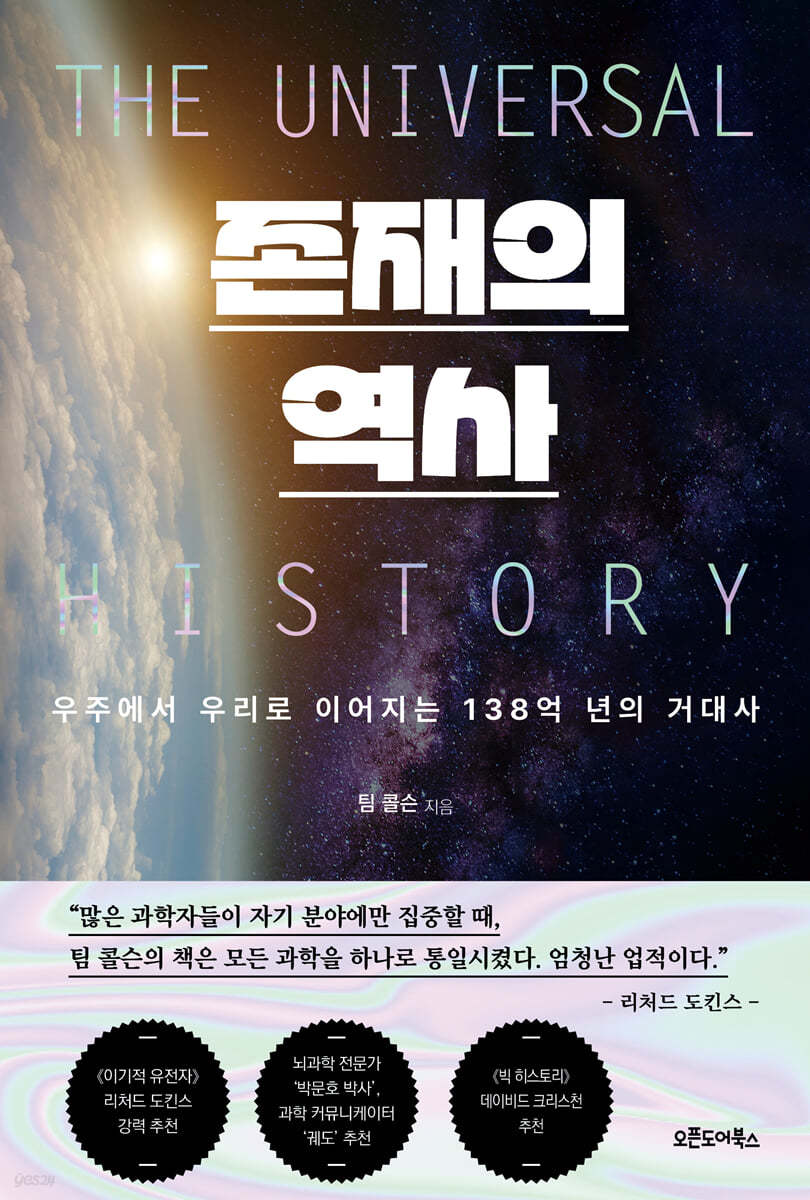
History of existence
 |
Description
Book Introduction
A 13.8 billion-year epic in a single volume
From the macrocosm to the birth of the microcosm of human history
Beyond the history of everything that has ever existed
An intellectual journey exploring the meaning and purpose of existence
Highly recommended by Richard Dawkins, author of "The Selfish Gene."
Recommended by neuroscience expert Dr. Park Moon-ho
Science Communicator Orbit Recommendations
Highly recommended by David Christian, author of "Big History."
Everyone has probably questioned their own existence at some point.
Scientists have conducted numerous studies to answer the question of what made it possible for us to be alive and conscious.
In this book, 『The History of Being』, all the facts discovered by the scientific community are explained.
The author further explores whether our existence was inevitable 13.8 billion years ago, or whether we were born with unimaginable luck.
"The History of Being" is aimed at readers who are interested in science, but not major in it.
This book begins with a fascinating and accessible narrative, exploring how scientists explore phenomena.
And it takes the reader on a long journey from the birth of the universe to the creation of the human genome.
The journey in this book covers a wide range of topics, from the birth and evolution of life, the emergence of consciousness, and the emergence of humanity across all fields of science, including physics, astronomy, chemistry, and earth science, to the question of how individuality is shaped by genes, environment, and chance.
Dating back 13.8 billion years, a point-sized burst of intense cosmic energy transformed into electrons and quarks, forming protons and neutrons.
And about 9 billion years later, the giant impact contributed to the creation of life when the Moon was formed from debris from Earth, and it is said that if Jupiter had not wandered through the solar system and ingested debris before settling into its current orbit, Earth would not have been in a habitable orbit.
In this way, 『The History of Being』 explains that the universe expanded infinitely from a point containing intense energy, and that at one point, the Earth and our existence were born.
From the macrocosm to the birth of the microcosm of human history
Beyond the history of everything that has ever existed
An intellectual journey exploring the meaning and purpose of existence
Highly recommended by Richard Dawkins, author of "The Selfish Gene."
Recommended by neuroscience expert Dr. Park Moon-ho
Science Communicator Orbit Recommendations
Highly recommended by David Christian, author of "Big History."
Everyone has probably questioned their own existence at some point.
Scientists have conducted numerous studies to answer the question of what made it possible for us to be alive and conscious.
In this book, 『The History of Being』, all the facts discovered by the scientific community are explained.
The author further explores whether our existence was inevitable 13.8 billion years ago, or whether we were born with unimaginable luck.
"The History of Being" is aimed at readers who are interested in science, but not major in it.
This book begins with a fascinating and accessible narrative, exploring how scientists explore phenomena.
And it takes the reader on a long journey from the birth of the universe to the creation of the human genome.
The journey in this book covers a wide range of topics, from the birth and evolution of life, the emergence of consciousness, and the emergence of humanity across all fields of science, including physics, astronomy, chemistry, and earth science, to the question of how individuality is shaped by genes, environment, and chance.
Dating back 13.8 billion years, a point-sized burst of intense cosmic energy transformed into electrons and quarks, forming protons and neutrons.
And about 9 billion years later, the giant impact contributed to the creation of life when the Moon was formed from debris from Earth, and it is said that if Jupiter had not wandered through the solar system and ingested debris before settling into its current orbit, Earth would not have been in a habitable orbit.
In this way, 『The History of Being』 explains that the universe expanded infinitely from a point containing intense energy, and that at one point, the Earth and our existence were born.
- You can preview some of the book's contents.
Preview
index
Introduction│Determinism, Probability, and the Universe
Chapter 1│The Premise of Great History
ㆍScience and non-science
ㆍThe beginning of scientific research
ㆍEvidence makes science
ㆍEvolution of technology and knowledge
ㆍUnderstanding scientific patterns
Chapter 2: Such a Small World
ㆍThe beginning of everything
The world of particles and matter
The Reality of Gravity
ㆍHistory of the Universe
Chapter 3 | Chemical Attraction
ㆍAntimatter and chemical reactions
ㆍDiscovery of elements and molecules
ㆍSuspicious movement of atoms
The Two Faces of Chemical Reactions
From elements to life
Chapter 4: Hometowns Wandering in the Unknown
ㆍOur space neighbors and us
ㆍGalaxy and Solar System
ㆍGreen land
ㆍCradle of life
Chapter 5: The Birth of Life
ㆍThe Secret of DNA
ㆍThe mystery of cells
ㆍAutocatalytic reaction
Chapter 6: Between Extinction and Prosperity
ㆍThe first life forms and evolution
ㆍHidden helper of evolution
ㆍEmergence of a new species
ㆍGolden age of life
Chapter 7│The Feeling of Existing as 'I'
ㆍIs consciousness exclusive to humans?
ㆍThe world seen by the brain
ㆍDecision-making and happiness
ㆍEvolution of the brain and consciousness
Chapter 8: The Rise of the Technological Apes
ㆍEvolution into a social being
Steps toward civilization
ㆍThe first city and technological innovation
ㆍThe status of modern humanity
Chapter 9│Our Trajectory
ㆍOur current appearance
ㆍPersonality expression traits
ㆍScientific narrative
Chapter 10│In Search of the Reason for Existence
ㆍSpeculation and doubt
ㆍTime led by chance
ㆍThe reason we exist
Acknowledgements
reference book
Chapter 1│The Premise of Great History
ㆍScience and non-science
ㆍThe beginning of scientific research
ㆍEvidence makes science
ㆍEvolution of technology and knowledge
ㆍUnderstanding scientific patterns
Chapter 2: Such a Small World
ㆍThe beginning of everything
The world of particles and matter
The Reality of Gravity
ㆍHistory of the Universe
Chapter 3 | Chemical Attraction
ㆍAntimatter and chemical reactions
ㆍDiscovery of elements and molecules
ㆍSuspicious movement of atoms
The Two Faces of Chemical Reactions
From elements to life
Chapter 4: Hometowns Wandering in the Unknown
ㆍOur space neighbors and us
ㆍGalaxy and Solar System
ㆍGreen land
ㆍCradle of life
Chapter 5: The Birth of Life
ㆍThe Secret of DNA
ㆍThe mystery of cells
ㆍAutocatalytic reaction
Chapter 6: Between Extinction and Prosperity
ㆍThe first life forms and evolution
ㆍHidden helper of evolution
ㆍEmergence of a new species
ㆍGolden age of life
Chapter 7│The Feeling of Existing as 'I'
ㆍIs consciousness exclusive to humans?
ㆍThe world seen by the brain
ㆍDecision-making and happiness
ㆍEvolution of the brain and consciousness
Chapter 8: The Rise of the Technological Apes
ㆍEvolution into a social being
Steps toward civilization
ㆍThe first city and technological innovation
ㆍThe status of modern humanity
Chapter 9│Our Trajectory
ㆍOur current appearance
ㆍPersonality expression traits
ㆍScientific narrative
Chapter 10│In Search of the Reason for Existence
ㆍSpeculation and doubt
ㆍTime led by chance
ㆍThe reason we exist
Acknowledgements
reference book
Detailed image

Into the book
This book aims to tell both stories:
It is the story of the birth of the universe and our existence, and the events that had to happen for this to happen.
This whole story is an epic spanning 13.77 billion years.
This story is in progress.
And the plot is also changed by the geniuses who continue to unravel the secrets of who I can be and who you can be.
--- p.18
The modern world can be defined by "technological advancements that transcend limitations." GPS, solar panels, nuclear power, increased crop yields, and modern medicine were all made possible by the insights scientists painstakingly gained.
--- p.25
Science is a wonderful tool for understanding how we exist in the world, and its application to reality has dramatically changed the world over the past few decades.
--- p.35
The scientific research method begins with observation and questioning.
The object of observation can be any natural or artificial object.
--- p.45
We all form hypotheses to explain some aspect of the world around us.
This hypothesis can be applied to questions as trivial as "Why did that person ignore me on the street this morning?" or as profound as "What is the meaning of life?"
--- p.55
The attitude of presenting different hypotheses is important.
Because the core of science is the activity of proposing hypotheses and verifying whether observed patterns actually appear.
--- p.68
Until the mid-20th century, most scientists assumed that the universe was a fixed, unchanging size, and would continue to exist as it always has.
However, with the development of telescopes, it has become increasingly clear that the size of the universe is not constant but rather expanding.
Conversely, this means that the universe had a beginning, and at that point it was very small.
--- p.97
The universe is vast beyond imagination.
Therefore, the light that reaches Earth will have traveled through space for millions or billions of years.
That is, when we look at the night sky, we are not seeing an object as it is now, but as it was when the radiation left the object.
--- p.129
If physics contains the universal principle of transforming energy into atoms, chemistry contains the universal principle of transforming elements into living things.
Living things are picky about which elements they use.
Iron accounts for slightly less than one-third of the mass of the elements that make up the Earth, but accounts for less than 0.01% of the human body.
--- p.175
The universe is truly beautiful, but sometimes it leaves us feeling overwhelmed.
The universe is so vast that the chances of us ever leaving our own front yard and exploring the far reaches of space are very slim.
--- p.187
It is said that science progresses by holding funerals one by one.
This is a metaphor for the difficulty many scientists have in abandoning their existing beliefs even when faced with strong evidence.
--- p.205
The human lifespan is so short that it allows us to glimpse only a small part of geological time.
Perhaps that is why, except for the occasional earthquake and volcanic eruption, the Earth appears more stable and peaceful than the chaotic human society.
But it is meaningless to discuss geological stability from a human perspective.
The Earth is dynamic and ever-changing, but compared to the 70-year human lifespan, the rate of change is very slow.
--- p.206∼207
All living creatures try to make copies of themselves through asexual or sexual reproduction.
Offspring born through asexual reproduction are genetically identical to their parents, but offspring born through sexual reproduction share half of their DNA from each parent.
Biological and evolutionary success is measured by the number of descendants who carry your DNA.
--- p.245
Evolution applies not only to chemicals that are autocatalytic, but also to living organisms, including viruses.
Although most scientists do not consider viruses to be living organisms, viruses can invade living cells and replicate themselves.
--- p.278∼279
As life has remained single-celled for billions of years, mutations and natural selection have continually increased the number of useful genes.
Beginning with bacteria, the evolution of ingenious ways to share DNA has led to a variety of lifestyles for some single-celled species.
In other words, when the environment in which a cell is placed changes, different genes are activated.
--- p.332
Happiness is truly a strange thing.
We make many choices to maximize our happiness, but sometimes it's just out of reach.
If there's one downside to our being conscious, it's that we 'consciously' try to be happy.
Sometimes, however, we focus on the wrong goals.
Living a life that others envy and accumulating a lot of money doesn't guarantee happiness, but that's how everyone ends up living.
Consciousness may not be as wonderful as we think.
--- p.394
Every now and then, a species emerges that changes the Earth through evolution.
There may be several, though.
Humans also belong to that species.
But humans are neither the first nor the last species to change the Earth.
--- p.403
Carnivores tend to have lower population densities than herbivorous animals.
Even during this time, Neanderthals would have occasionally come into contact with other groups and exchanged goods, food, and innovative ideas.
The creation of art, jewelry, and music demonstrates their ability to express objects or events that do not exist in reality through words and pictures.
To borrow a psychological term, symbolic thinking was possible.
Neanderthals weren't stupid.
--- p.431∼432
The illusion of stability can crumble in an instant.
When the supply chain is unable to support a large population, individuals face the challenge of survival.
And the systems that are crucial to maintaining existence begin to disintegrate.
The fall of ancient civilizations was so rapid that it often resulted in a great loss of life.
Along with numerous ancient civilizations, older civilizations have also collapsed to the point where not even a trace can be found today.
--- p.453
Narratives are a crucial part of what makes us human and help us navigate an uncertain world.
Science has developed ways to verify many aspects of the stories we tell.
And in scientific research methods, the verification method is done by giving credibility to the connection between a specific event and a cause.
In other words, if you understand the principles that connect causes and events well, your reliability can increase.
--- p.496∼497
Although intelligent life has appeared in our universe over the years, it took a tremendous amount of luck to get us there.
But the time we are allotted is not long, so I hope we can live enjoying being conscious beings.
70 years is but a fleeting moment compared to the 13.77 billion years the universe has existed.
It is the story of the birth of the universe and our existence, and the events that had to happen for this to happen.
This whole story is an epic spanning 13.77 billion years.
This story is in progress.
And the plot is also changed by the geniuses who continue to unravel the secrets of who I can be and who you can be.
--- p.18
The modern world can be defined by "technological advancements that transcend limitations." GPS, solar panels, nuclear power, increased crop yields, and modern medicine were all made possible by the insights scientists painstakingly gained.
--- p.25
Science is a wonderful tool for understanding how we exist in the world, and its application to reality has dramatically changed the world over the past few decades.
--- p.35
The scientific research method begins with observation and questioning.
The object of observation can be any natural or artificial object.
--- p.45
We all form hypotheses to explain some aspect of the world around us.
This hypothesis can be applied to questions as trivial as "Why did that person ignore me on the street this morning?" or as profound as "What is the meaning of life?"
--- p.55
The attitude of presenting different hypotheses is important.
Because the core of science is the activity of proposing hypotheses and verifying whether observed patterns actually appear.
--- p.68
Until the mid-20th century, most scientists assumed that the universe was a fixed, unchanging size, and would continue to exist as it always has.
However, with the development of telescopes, it has become increasingly clear that the size of the universe is not constant but rather expanding.
Conversely, this means that the universe had a beginning, and at that point it was very small.
--- p.97
The universe is vast beyond imagination.
Therefore, the light that reaches Earth will have traveled through space for millions or billions of years.
That is, when we look at the night sky, we are not seeing an object as it is now, but as it was when the radiation left the object.
--- p.129
If physics contains the universal principle of transforming energy into atoms, chemistry contains the universal principle of transforming elements into living things.
Living things are picky about which elements they use.
Iron accounts for slightly less than one-third of the mass of the elements that make up the Earth, but accounts for less than 0.01% of the human body.
--- p.175
The universe is truly beautiful, but sometimes it leaves us feeling overwhelmed.
The universe is so vast that the chances of us ever leaving our own front yard and exploring the far reaches of space are very slim.
--- p.187
It is said that science progresses by holding funerals one by one.
This is a metaphor for the difficulty many scientists have in abandoning their existing beliefs even when faced with strong evidence.
--- p.205
The human lifespan is so short that it allows us to glimpse only a small part of geological time.
Perhaps that is why, except for the occasional earthquake and volcanic eruption, the Earth appears more stable and peaceful than the chaotic human society.
But it is meaningless to discuss geological stability from a human perspective.
The Earth is dynamic and ever-changing, but compared to the 70-year human lifespan, the rate of change is very slow.
--- p.206∼207
All living creatures try to make copies of themselves through asexual or sexual reproduction.
Offspring born through asexual reproduction are genetically identical to their parents, but offspring born through sexual reproduction share half of their DNA from each parent.
Biological and evolutionary success is measured by the number of descendants who carry your DNA.
--- p.245
Evolution applies not only to chemicals that are autocatalytic, but also to living organisms, including viruses.
Although most scientists do not consider viruses to be living organisms, viruses can invade living cells and replicate themselves.
--- p.278∼279
As life has remained single-celled for billions of years, mutations and natural selection have continually increased the number of useful genes.
Beginning with bacteria, the evolution of ingenious ways to share DNA has led to a variety of lifestyles for some single-celled species.
In other words, when the environment in which a cell is placed changes, different genes are activated.
--- p.332
Happiness is truly a strange thing.
We make many choices to maximize our happiness, but sometimes it's just out of reach.
If there's one downside to our being conscious, it's that we 'consciously' try to be happy.
Sometimes, however, we focus on the wrong goals.
Living a life that others envy and accumulating a lot of money doesn't guarantee happiness, but that's how everyone ends up living.
Consciousness may not be as wonderful as we think.
--- p.394
Every now and then, a species emerges that changes the Earth through evolution.
There may be several, though.
Humans also belong to that species.
But humans are neither the first nor the last species to change the Earth.
--- p.403
Carnivores tend to have lower population densities than herbivorous animals.
Even during this time, Neanderthals would have occasionally come into contact with other groups and exchanged goods, food, and innovative ideas.
The creation of art, jewelry, and music demonstrates their ability to express objects or events that do not exist in reality through words and pictures.
To borrow a psychological term, symbolic thinking was possible.
Neanderthals weren't stupid.
--- p.431∼432
The illusion of stability can crumble in an instant.
When the supply chain is unable to support a large population, individuals face the challenge of survival.
And the systems that are crucial to maintaining existence begin to disintegrate.
The fall of ancient civilizations was so rapid that it often resulted in a great loss of life.
Along with numerous ancient civilizations, older civilizations have also collapsed to the point where not even a trace can be found today.
--- p.453
Narratives are a crucial part of what makes us human and help us navigate an uncertain world.
Science has developed ways to verify many aspects of the stories we tell.
And in scientific research methods, the verification method is done by giving credibility to the connection between a specific event and a cause.
In other words, if you understand the principles that connect causes and events well, your reliability can increase.
--- p.496∼497
Although intelligent life has appeared in our universe over the years, it took a tremendous amount of luck to get us there.
But the time we are allotted is not long, so I hope we can live enjoying being conscious beings.
70 years is but a fleeting moment compared to the 13.77 billion years the universe has existed.
--- p.559
Publisher's Review
From the birth of the universe to the emergence of modern humans,
The truth of the world that has continued for 13.8 billion years
A Scientific Reflection on All Beings in Extinction and Prosperity
The macro and micro worlds outside of us,
The beauty of our consciousness and inner world
The horizon of grand history unraveled through logic and reason
Determinism, Probability, and the Beginning and Meaning of Existence
Looking back on a person's life, one usually begins to contemplate one's own existence during the process of growing up.
Even as we each get busy trying to live our lives, such worries do not easily go away.
Ultimately, isn't the search for the beginning and meaning of existence a task that begins with recognizing 'myself' and the world, and continues from the moment when thinking begins to develop until the end of life?
In this context, Professor Tim Colson, author of "A Brief History of Being," also wrote this book after experiencing a near-death experience in his youth and seeking the reason and meaning of existence through various research experiences and analysis of numerous materials.
Through this, the author explains the reason and meaning of all beings in the universe, including himself, within the expanded perspective of science and 13.8 billion years of time.
So, what exactly is the reason for our existence? Were we destined to exist, or were we simply born into this world by sheer luck? In this way, the two words "inevitability" and "chance" have expanded into the themes of "determinism" and "probability," leading to countless debates surrounding the birth of the universe.
In this way, the author searches for answers by looking at all processes encompassing the Big Bang, the expansion of space, the emergence of particles and matter, the creation of stars and planets, the birth of life, and the evolution of mankind from various fields and perspectives of natural science.
Was the reality we have had until now all planned out under a meticulous plan, or was it just one possibility that was realized through a near-infinite impossibility?
In this way, the author expands the scope of history in this book from humans to humanity and the universe.
Through this perspective, it generously reveals the history of another universe, including the birth of the universe triggered by the Big Bang and the civilization created through the emergence and evolution of humanity.
This book does not simply list the history of science and the flow of scientific knowledge by field.
In contrast, it stimulates readers' interest by uncovering the secrets of the world based on various hypotheses, theories, and research cases.
Taking its first step into the ranks of great historians, led by Carl Sagan and David Christian, "A Brief History of Existence" presents the wonders of the universe and all things that began 13.8 billion years ago.
From the birth of the universe to the advancement of civilization, a vast history that began with a single point.
Although technological advancements have gradually broadened our understanding of the universe, we are still far from being able to fully understand the ever-expanding universe.
In other words, even though there are about 1 trillion galaxies in the observable universe, this is only a small fraction of the universe.
To calculate distances in the vast universe, mankind introduced units called 'light-year' and 'astronomical unit'.
But from a cosmic perspective, these units are ultimately just short distances.
Even the speed of light, which is said to be the fastest speed beyond human perception, is extremely slow in the vast universe.
This is especially true given that the Andromeda Galaxy, our nearest neighbor, is about 2.5 million light-years away, and the speed of light cannot keep up with the expansion of the universe.
But even this vast universe began from an extremely small point.
In general, the current universe and all things were born when an extremely small space called a 'singularity' with high density continuously expanded through the 'Big Bang'.
The evolution and development of living things are also connected to the birth of the universe in that all life began from a single unicellular organism.
Following the dictates of evolution, which aims to adapt to environmental changes and thrive, the first living organisms differentiated into numerous species of multicellular organisms through continuous division.
Humans are also a product of evolution, developing into a unique species distinct from other species.
As a result, humanity has developed a more systematic society through the development of linguistic ability, structural thinking, and technology, and has now become a being that reigns over the ecosystem and changes the appearance of the Earth's environment.
As humanity has developed on Earth, it has become curious about the world beyond the sky.
So far, simulations based on the giant impact theory have shown that the moon was created, and cosmic background radiation has made it clear that the Big Bang triggered the birth of the universe.
In this way, the scientific achievements brought about by humanity's intellectual curiosity about the world beyond Earth are gradually expanding.
However, the history of human progress and the transformation of each individual into a different form may seem eternal from our perspective, but compared to the history of the universe, it is only a speck of time.
In this way, the 13.8 billion years of time shown in 『The History of Existence』 reminds us of where we came from, where we are now, and the causes and aspects of our current form, thereby making us think about the meaning of existence in the universe.
The world inside and outside of us, created through repeated evolution from nature to humanity.
The birth of the universe and the emergence of the first life forms on Earth are amazing, but the evolution of humans from primitive to modern humans is also surprising.
A representative example is the history of development, from simple organizations to complex systems and large societies, following the lineage of humans from Australopithecus to Neanderthals and Homo sapiens, and from stone tools to the creation of smart devices and artificial intelligence.
This is in line with the evolution of consciousness, moving beyond the simple instinctive command of species survival and prosperity to the level of spontaneous and high-dimensional thinking and communication.
As a result, humanity succeeds in making the abstract world of consciousness a reality after evolving into that world.
In addition to the macroscopic and microscopic worlds that surround us, there is reality, but even in the world of consciousness, whose specific form we cannot know, there exists its own wonder and beauty.
Evolution is not 'progress'.
In other words, evolution is the result of the accumulation of multiple processes of adjusting various factors, including physical characteristics and lifestyle, in response to environmental changes.
Any living thing, as it develops and evolves over generations to adapt to a changing environment, also undergoes degeneration.
Nevertheless, humanity has developed through continuous evolution and has come to create another small universe called 'civilization'.
Modern humans, in the name of the will of the Absolute, have discovered the principles of numerous natural phenomena that terrified ancient people, and have taken advantage of them to reign over the world with the epithet of "the lord of all creation."
Now we are looking beyond Earth and uncovering the truth about the world, but at 13.8 billion years, human history is far too short.
Therefore, while much remains unknown and we can only rely on questions and speculation, the author predicts that science, which has advanced alongside humanity, will one day provide us with answers.
As such, 『The History of Being』 explains the enormous events that had to occur before the universe outside of us, as well as the universe within us, which is the life of a single person in the human group, could be created.
During this time, atoms that could not be seen with the naked eye came together to form the entity called matter, and the movements of various satellites and planets orbiting the sun, including the moon and Jupiter, created the Earth we know today.
Now, space is not only our home, but also a clue to understanding the truth of the world.
In this grand flow of history, each and every thing is given its own role and value.
We too were born into this world with the possibility of our own existence and meaning.
This book aims to understand existence through a scientific analysis, but ultimately, it will lead us to think beyond the scientific fact of "existence."
The truth of the world that has continued for 13.8 billion years
A Scientific Reflection on All Beings in Extinction and Prosperity
The macro and micro worlds outside of us,
The beauty of our consciousness and inner world
The horizon of grand history unraveled through logic and reason
Determinism, Probability, and the Beginning and Meaning of Existence
Looking back on a person's life, one usually begins to contemplate one's own existence during the process of growing up.
Even as we each get busy trying to live our lives, such worries do not easily go away.
Ultimately, isn't the search for the beginning and meaning of existence a task that begins with recognizing 'myself' and the world, and continues from the moment when thinking begins to develop until the end of life?
In this context, Professor Tim Colson, author of "A Brief History of Being," also wrote this book after experiencing a near-death experience in his youth and seeking the reason and meaning of existence through various research experiences and analysis of numerous materials.
Through this, the author explains the reason and meaning of all beings in the universe, including himself, within the expanded perspective of science and 13.8 billion years of time.
So, what exactly is the reason for our existence? Were we destined to exist, or were we simply born into this world by sheer luck? In this way, the two words "inevitability" and "chance" have expanded into the themes of "determinism" and "probability," leading to countless debates surrounding the birth of the universe.
In this way, the author searches for answers by looking at all processes encompassing the Big Bang, the expansion of space, the emergence of particles and matter, the creation of stars and planets, the birth of life, and the evolution of mankind from various fields and perspectives of natural science.
Was the reality we have had until now all planned out under a meticulous plan, or was it just one possibility that was realized through a near-infinite impossibility?
In this way, the author expands the scope of history in this book from humans to humanity and the universe.
Through this perspective, it generously reveals the history of another universe, including the birth of the universe triggered by the Big Bang and the civilization created through the emergence and evolution of humanity.
This book does not simply list the history of science and the flow of scientific knowledge by field.
In contrast, it stimulates readers' interest by uncovering the secrets of the world based on various hypotheses, theories, and research cases.
Taking its first step into the ranks of great historians, led by Carl Sagan and David Christian, "A Brief History of Existence" presents the wonders of the universe and all things that began 13.8 billion years ago.
From the birth of the universe to the advancement of civilization, a vast history that began with a single point.
Although technological advancements have gradually broadened our understanding of the universe, we are still far from being able to fully understand the ever-expanding universe.
In other words, even though there are about 1 trillion galaxies in the observable universe, this is only a small fraction of the universe.
To calculate distances in the vast universe, mankind introduced units called 'light-year' and 'astronomical unit'.
But from a cosmic perspective, these units are ultimately just short distances.
Even the speed of light, which is said to be the fastest speed beyond human perception, is extremely slow in the vast universe.
This is especially true given that the Andromeda Galaxy, our nearest neighbor, is about 2.5 million light-years away, and the speed of light cannot keep up with the expansion of the universe.
But even this vast universe began from an extremely small point.
In general, the current universe and all things were born when an extremely small space called a 'singularity' with high density continuously expanded through the 'Big Bang'.
The evolution and development of living things are also connected to the birth of the universe in that all life began from a single unicellular organism.
Following the dictates of evolution, which aims to adapt to environmental changes and thrive, the first living organisms differentiated into numerous species of multicellular organisms through continuous division.
Humans are also a product of evolution, developing into a unique species distinct from other species.
As a result, humanity has developed a more systematic society through the development of linguistic ability, structural thinking, and technology, and has now become a being that reigns over the ecosystem and changes the appearance of the Earth's environment.
As humanity has developed on Earth, it has become curious about the world beyond the sky.
So far, simulations based on the giant impact theory have shown that the moon was created, and cosmic background radiation has made it clear that the Big Bang triggered the birth of the universe.
In this way, the scientific achievements brought about by humanity's intellectual curiosity about the world beyond Earth are gradually expanding.
However, the history of human progress and the transformation of each individual into a different form may seem eternal from our perspective, but compared to the history of the universe, it is only a speck of time.
In this way, the 13.8 billion years of time shown in 『The History of Existence』 reminds us of where we came from, where we are now, and the causes and aspects of our current form, thereby making us think about the meaning of existence in the universe.
The world inside and outside of us, created through repeated evolution from nature to humanity.
The birth of the universe and the emergence of the first life forms on Earth are amazing, but the evolution of humans from primitive to modern humans is also surprising.
A representative example is the history of development, from simple organizations to complex systems and large societies, following the lineage of humans from Australopithecus to Neanderthals and Homo sapiens, and from stone tools to the creation of smart devices and artificial intelligence.
This is in line with the evolution of consciousness, moving beyond the simple instinctive command of species survival and prosperity to the level of spontaneous and high-dimensional thinking and communication.
As a result, humanity succeeds in making the abstract world of consciousness a reality after evolving into that world.
In addition to the macroscopic and microscopic worlds that surround us, there is reality, but even in the world of consciousness, whose specific form we cannot know, there exists its own wonder and beauty.
Evolution is not 'progress'.
In other words, evolution is the result of the accumulation of multiple processes of adjusting various factors, including physical characteristics and lifestyle, in response to environmental changes.
Any living thing, as it develops and evolves over generations to adapt to a changing environment, also undergoes degeneration.
Nevertheless, humanity has developed through continuous evolution and has come to create another small universe called 'civilization'.
Modern humans, in the name of the will of the Absolute, have discovered the principles of numerous natural phenomena that terrified ancient people, and have taken advantage of them to reign over the world with the epithet of "the lord of all creation."
Now we are looking beyond Earth and uncovering the truth about the world, but at 13.8 billion years, human history is far too short.
Therefore, while much remains unknown and we can only rely on questions and speculation, the author predicts that science, which has advanced alongside humanity, will one day provide us with answers.
As such, 『The History of Being』 explains the enormous events that had to occur before the universe outside of us, as well as the universe within us, which is the life of a single person in the human group, could be created.
During this time, atoms that could not be seen with the naked eye came together to form the entity called matter, and the movements of various satellites and planets orbiting the sun, including the moon and Jupiter, created the Earth we know today.
Now, space is not only our home, but also a clue to understanding the truth of the world.
In this grand flow of history, each and every thing is given its own role and value.
We too were born into this world with the possibility of our own existence and meaning.
This book aims to understand existence through a scientific analysis, but ultimately, it will lead us to think beyond the scientific fact of "existence."
GOODS SPECIFICS
- Date of issue: December 13, 2024
- Page count, weight, size: 575 pages | 748g | 152*225*35mm
- ISBN13: 9791194276555
- ISBN10: 1194276555
You may also like
카테고리
korean


korean

![ELLE 엘르 스페셜 에디션 A형 : 12월 [2025]](http://librairie.coreenne.fr/cdn/shop/files/b8e27a3de6c9538896439686c6b0e8fb.jpg?v=1766436872&width=3840)


