

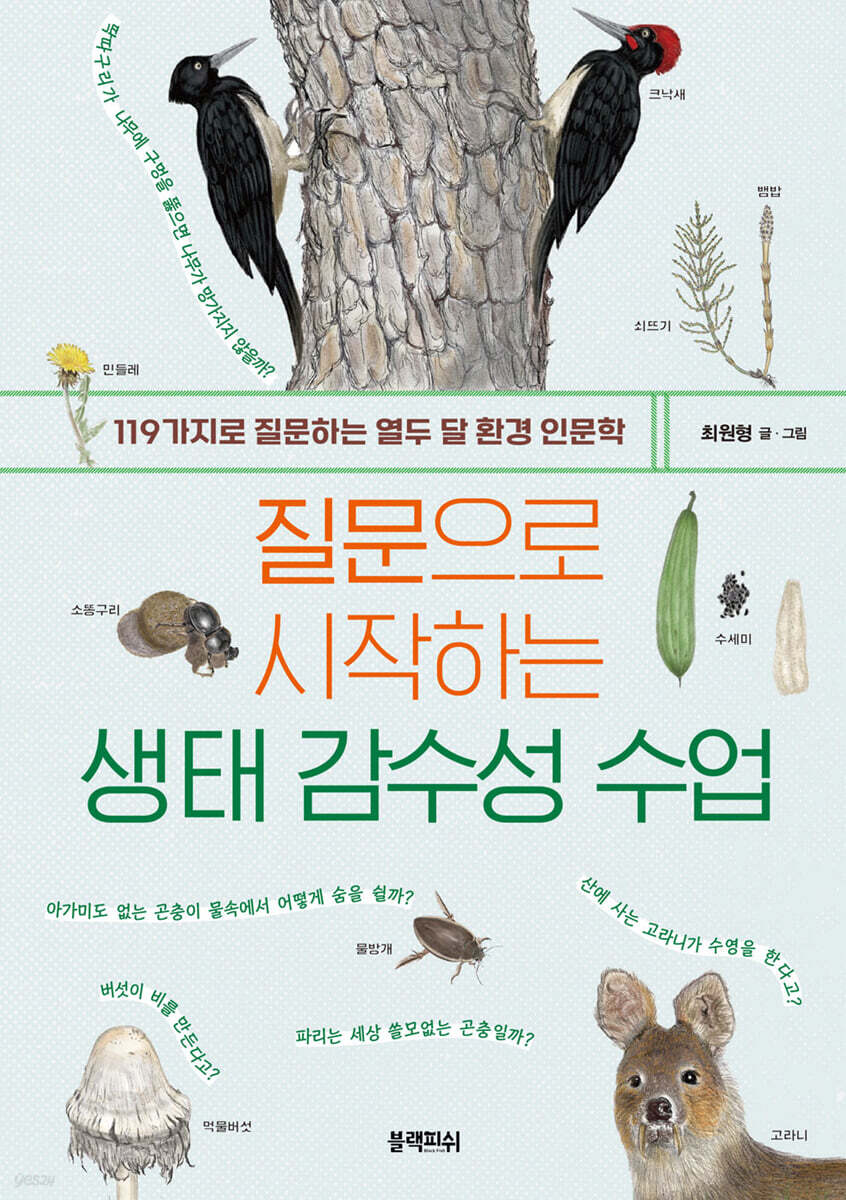
Ecological sensitivity class that starts with questions
 |
Description
Book Introduction
“The more questions we ask, the deeper our world becomes!”
Expanding the world by asking and answering questions
Nature Explorer Choi Won-hyung's Twelve-Month Ecological Sensitivity Class
We've heard countless times that "the Earth is sick," but what if it feels like someone else's story, not yours? That's because you lack ecological sensitivity! Why not naturally cultivate ecological sensitivity and become a climate citizen who cares about the environment, along with this book, which brims with curious questions year-round?
Author Wonhyung Choi, an ecology and environment expert who has published numerous excellent environmental books, including “Learning the Earth Environment through Calendars,” suggests “asking questions” as a solution to increasing ecological sensitivity.
There is no way to understand and become closer to someone as deeply as asking and answering questions.
Accordingly, the author poses a unique question every month in line with climate change, and sets out to find answers with questions that follow one after another.
If you've ever wondered in a snowy January, "The water is clear, but why is the glacier white?" If you've ever wondered in April, "The squirming of caterpillars is so disgusting, should I just put up with it?" If you've ever wondered in a sweltering July, "Why on earth are cicadas so noisy?" If you've ever wondered in a cool October, "Where did all those fallen leaves go?" If so, open this book!
One of the strengths of this book is that it begins with imaginative questions, builds scientific knowledge surrounding ecological principles, and enhances logical thinking skills through questioning and answering.
In addition, the practice of active and subjective questioning, which involves asking one question after another, will provide a pleasure of 'knowledge' that is on a different level from the passive reading activities you have been doing so far.
Expanding the world by asking and answering questions
Nature Explorer Choi Won-hyung's Twelve-Month Ecological Sensitivity Class
We've heard countless times that "the Earth is sick," but what if it feels like someone else's story, not yours? That's because you lack ecological sensitivity! Why not naturally cultivate ecological sensitivity and become a climate citizen who cares about the environment, along with this book, which brims with curious questions year-round?
Author Wonhyung Choi, an ecology and environment expert who has published numerous excellent environmental books, including “Learning the Earth Environment through Calendars,” suggests “asking questions” as a solution to increasing ecological sensitivity.
There is no way to understand and become closer to someone as deeply as asking and answering questions.
Accordingly, the author poses a unique question every month in line with climate change, and sets out to find answers with questions that follow one after another.
If you've ever wondered in a snowy January, "The water is clear, but why is the glacier white?" If you've ever wondered in April, "The squirming of caterpillars is so disgusting, should I just put up with it?" If you've ever wondered in a sweltering July, "Why on earth are cicadas so noisy?" If you've ever wondered in a cool October, "Where did all those fallen leaves go?" If so, open this book!
One of the strengths of this book is that it begins with imaginative questions, builds scientific knowledge surrounding ecological principles, and enhances logical thinking skills through questioning and answering.
In addition, the practice of active and subjective questioning, which involves asking one question after another, will provide a pleasure of 'knowledge' that is on a different level from the passive reading activities you have been doing so far.
- You can preview some of the book's contents.
Preview
index
Opening remarks
january
Feathers and Animal Hibernation
Wouldn't birds wearing only feathers be cold in winter?
snow and glaciers
Water is clear, so why is snow white?
february
Winter buds and wintering of trees
It was an empty branch, so how can it sprout leaves and bloom flowers in the spring?
Wintering of rosettes and grasses
Can even the weakest grass survive the winter?
March
Woodpecker and Birdhouse
If a woodpecker drills a hole in a tree, won't the tree be damaged?
Snake food, cowpeas, and fossil plants
How can plants that lived hundreds of millions of years ago still exist today?
Seeds and seeds
Why do seeds that fall to the ground in the fall only sprout in the spring?
april
Definition of dandelion and weed
Are all nameless weeds weeds? What defines a weed?
Caterpillar and Centinela extinction
Should I just endure the squirming of the caterpillars?
Frogs and amphibians
Why is frog skin slippery?
May
Bees and Polynators
Do all bees sting?
Biodiversity of rice and rice paddies
Why did we come to eat rice as a staple food?
Otters and River Ecology
How did the otter become a natural monument?
June
Ladybug, live pesticide
The red color stands out so much on the green grass, but wouldn't the ladybug be afraid of its natural enemies?
Thornberry, Invasive Species, Invasive Species, and Species Restoration
When new species are introduced to our country, it is good because it increases the number of species, so why do we get rid of alien species?
Korean deer and roadkill
A mountain deer swims?
July
Mosses, the first terrestrial plants
There are plants that can survive even in space?
Cicadas, from underground to above ground
Why do cicadas come up to the ground every 3, 5, 7, 13, and 17 years?
sesame and vines
Each vine has a different way of climbing?
August
Flying and aquatic insects
Beetles live in water too?
Dung beetles and beach sand dunes
There are deserts in our country too?
Mushrooms and Decomposers in the Ecosystem
Mushrooms are molds?
September
Locusts and dragonflies, the ultimate hunters
Do locusts eat males even while mating?
Lichen, the Earth's Clothing
You're saying that blotchy stuff isn't moss?
Wasps: Their Role in Preventing the Spread of Disease and Pests
Should we protect wasps even though they eat all the bees and threaten human life?
october
Spiders and Amazing Life Skills
In the expression 'a spider is falling', is the spider an actual spider?
Oak, the abundance that embraces countless lives
What did the gold medalists receive as prizes at the 1936 Berlin Olympics?
Fallen Leaves, the Right to Return to Nature
As temperatures rise, the autumn leaves become less vibrant?
November
Diptera insects: Beyond disgust, toward coexistence
Are flies the most useless insects in the world?
City animals, wild animals that live in cities
The city's hated bird, the pigeon, has been awarded a medal?
december
Soil and soil organisms, healthy soil makes humanity healthy
Why is the forest floor always at a constant height when leaves pile up every year?
Great white stork, migratory birds
Where on earth do migratory birds come from?
References
january
Feathers and Animal Hibernation
Wouldn't birds wearing only feathers be cold in winter?
snow and glaciers
Water is clear, so why is snow white?
february
Winter buds and wintering of trees
It was an empty branch, so how can it sprout leaves and bloom flowers in the spring?
Wintering of rosettes and grasses
Can even the weakest grass survive the winter?
March
Woodpecker and Birdhouse
If a woodpecker drills a hole in a tree, won't the tree be damaged?
Snake food, cowpeas, and fossil plants
How can plants that lived hundreds of millions of years ago still exist today?
Seeds and seeds
Why do seeds that fall to the ground in the fall only sprout in the spring?
april
Definition of dandelion and weed
Are all nameless weeds weeds? What defines a weed?
Caterpillar and Centinela extinction
Should I just endure the squirming of the caterpillars?
Frogs and amphibians
Why is frog skin slippery?
May
Bees and Polynators
Do all bees sting?
Biodiversity of rice and rice paddies
Why did we come to eat rice as a staple food?
Otters and River Ecology
How did the otter become a natural monument?
June
Ladybug, live pesticide
The red color stands out so much on the green grass, but wouldn't the ladybug be afraid of its natural enemies?
Thornberry, Invasive Species, Invasive Species, and Species Restoration
When new species are introduced to our country, it is good because it increases the number of species, so why do we get rid of alien species?
Korean deer and roadkill
A mountain deer swims?
July
Mosses, the first terrestrial plants
There are plants that can survive even in space?
Cicadas, from underground to above ground
Why do cicadas come up to the ground every 3, 5, 7, 13, and 17 years?
sesame and vines
Each vine has a different way of climbing?
August
Flying and aquatic insects
Beetles live in water too?
Dung beetles and beach sand dunes
There are deserts in our country too?
Mushrooms and Decomposers in the Ecosystem
Mushrooms are molds?
September
Locusts and dragonflies, the ultimate hunters
Do locusts eat males even while mating?
Lichen, the Earth's Clothing
You're saying that blotchy stuff isn't moss?
Wasps: Their Role in Preventing the Spread of Disease and Pests
Should we protect wasps even though they eat all the bees and threaten human life?
october
Spiders and Amazing Life Skills
In the expression 'a spider is falling', is the spider an actual spider?
Oak, the abundance that embraces countless lives
What did the gold medalists receive as prizes at the 1936 Berlin Olympics?
Fallen Leaves, the Right to Return to Nature
As temperatures rise, the autumn leaves become less vibrant?
November
Diptera insects: Beyond disgust, toward coexistence
Are flies the most useless insects in the world?
City animals, wild animals that live in cities
The city's hated bird, the pigeon, has been awarded a medal?
december
Soil and soil organisms, healthy soil makes humanity healthy
Why is the forest floor always at a constant height when leaves pile up every year?
Great white stork, migratory birds
Where on earth do migratory birds come from?
References
Detailed image

Into the book
Woodpeckers not only tap on trees with their beaks, but also peck at them.
One day, I suddenly wondered why woodpeckers knock and peck at trees in so many different ways.
Every year, when I hear news about wasps around Chuseok, I wonder if wasps are scary insects that need to be exterminated, if flies are just useless, annoying, and dirty creatures, and how city pigeons have become such nuisances.
In the process of finding answers to the questions that arose, countless misunderstandings were transformed into understanding, and a path of empathy was created.
(syncopation)
Questions are navigation that guides us to a new world and a shortcut to a harmonious world.
I hope that the silly question I asked will serve as a stepping stone that leads you to deeper questions.
I also hope that the questions will continue to unfold, leading to a chapter that explores ways to live in harmony with all life on Earth.
--- From "Opening Remarks_ An Age That Requires Questions"
The ladybug's forewings are a bright, vivid red.
Some ladybugs have yellow wings, but most are red.
Red is a striking color that contrasts well with green.
Why did ladybugs, whose natural habitat is grassy areas, evolve such vibrant colors? Obviously, being so conspicuous would make them easy targets for detection.
Most animals use camouflage to hide their bodies, such as spiders that resemble bird droppings, caterpillars that stretch their bodies to resemble tree branches, and frogs that change their color from green when they come to the grass to earth-colored when on the ground. Why do ladybugs do that?
Ladybugs protect themselves by being colored to stand out.
The ladybug, dressed in brightly colored clothes, will flap its six legs and fall to the ground when someone tries to catch it.
It's a pseudo-death act where you pretend to be dead.
Some of you may have already seen this behavior from ladybugs.
If you touch it to check if it's really dead, it releases a yellow liquid with a foul smell.
This yellow liquid not only smells bad, but it also tastes bitter, so any animal that has tasted a ladybug once will likely never look at it again.
Birds, which mainly eat insects, are probably the biggest natural enemies of ladybugs.
Long ago, birds ate ladybugs and, after experiencing a bitter taste, became wary of brightly colored and conspicuous insects.
The reason ladybugs have such striking forewings is camouflage. It seems that each living creature has a very diverse way of living.
--- “Red stands out so much on the green grass, wouldn’t the ladybug be afraid of its natural enemies?”_ From “June Ladybug, Living Pesticide”
Just as plants spread their seeds in a variety of ways to reproduce, fungi also spread their spores in a variety of ways.
Some mushrooms need to be stepped on by people or animals to spread their spores.
Some mushrooms use the wind to burst their spores.
The speed at which the spores are released accelerates 10,000 times faster than the speed at which the space shuttle was launched, reaching a maximum speed of 100 km/h in an instant.
Mold spores have even been found in clouds.
They also affect the weather by becoming the seeds of raindrops and the nuclei of ice crystals that form snow, sleet, and hail.
The mushrooms we see are tools for spreading spores, and the hyphae that we cannot see are the real protagonists.
Mycelia are networks of many interconnected cells that spread out in all directions, branching, merging, and intertwining to form a delicate, seemingly disordered mycelium.
--- From “Mushrooms Make Rain?”_ August Mushrooms and Decomposers of the Ecosystem
The order Diptera includes not only flies but also mosquitoes, gnats, midges, beetles, and spiders.
It is true that flies suck human blood and transmit diseases such as typhus, yellow fever, dengue fever, and dysentery.
However, the larvae of the flower fly species eat aphids, the adult flower fly species help crops to bear fruit, and parasitic flies parasitize other insects and play a role in pest control.
If the Diptera order disappeared from Earth, what would happen to all that excrement? The fly, the swarming swarm, not only breaks down the excrement but also prevents the spread of disease.
By decomposing the excrement and reducing its amount, the number of pathogen-carrying insects, such as the fly order, will decrease.
An important job that flies do is to act as decomposers in the ecosystem.
Fabre, famous for his insect books, said of the order Diptera, “People think of flies as ‘nasty and dirty insects,’ but that is not true.”
It was said that Paris is the one who diligently makes this world clean enough for us to live in.
There are countless species of flies that break down excrement.
If there were no flies, wouldn't the world be overflowing with accumulated excrement that couldn't be decomposed?
One day, I suddenly wondered why woodpeckers knock and peck at trees in so many different ways.
Every year, when I hear news about wasps around Chuseok, I wonder if wasps are scary insects that need to be exterminated, if flies are just useless, annoying, and dirty creatures, and how city pigeons have become such nuisances.
In the process of finding answers to the questions that arose, countless misunderstandings were transformed into understanding, and a path of empathy was created.
(syncopation)
Questions are navigation that guides us to a new world and a shortcut to a harmonious world.
I hope that the silly question I asked will serve as a stepping stone that leads you to deeper questions.
I also hope that the questions will continue to unfold, leading to a chapter that explores ways to live in harmony with all life on Earth.
--- From "Opening Remarks_ An Age That Requires Questions"
The ladybug's forewings are a bright, vivid red.
Some ladybugs have yellow wings, but most are red.
Red is a striking color that contrasts well with green.
Why did ladybugs, whose natural habitat is grassy areas, evolve such vibrant colors? Obviously, being so conspicuous would make them easy targets for detection.
Most animals use camouflage to hide their bodies, such as spiders that resemble bird droppings, caterpillars that stretch their bodies to resemble tree branches, and frogs that change their color from green when they come to the grass to earth-colored when on the ground. Why do ladybugs do that?
Ladybugs protect themselves by being colored to stand out.
The ladybug, dressed in brightly colored clothes, will flap its six legs and fall to the ground when someone tries to catch it.
It's a pseudo-death act where you pretend to be dead.
Some of you may have already seen this behavior from ladybugs.
If you touch it to check if it's really dead, it releases a yellow liquid with a foul smell.
This yellow liquid not only smells bad, but it also tastes bitter, so any animal that has tasted a ladybug once will likely never look at it again.
Birds, which mainly eat insects, are probably the biggest natural enemies of ladybugs.
Long ago, birds ate ladybugs and, after experiencing a bitter taste, became wary of brightly colored and conspicuous insects.
The reason ladybugs have such striking forewings is camouflage. It seems that each living creature has a very diverse way of living.
--- “Red stands out so much on the green grass, wouldn’t the ladybug be afraid of its natural enemies?”_ From “June Ladybug, Living Pesticide”
Just as plants spread their seeds in a variety of ways to reproduce, fungi also spread their spores in a variety of ways.
Some mushrooms need to be stepped on by people or animals to spread their spores.
Some mushrooms use the wind to burst their spores.
The speed at which the spores are released accelerates 10,000 times faster than the speed at which the space shuttle was launched, reaching a maximum speed of 100 km/h in an instant.
Mold spores have even been found in clouds.
They also affect the weather by becoming the seeds of raindrops and the nuclei of ice crystals that form snow, sleet, and hail.
The mushrooms we see are tools for spreading spores, and the hyphae that we cannot see are the real protagonists.
Mycelia are networks of many interconnected cells that spread out in all directions, branching, merging, and intertwining to form a delicate, seemingly disordered mycelium.
--- From “Mushrooms Make Rain?”_ August Mushrooms and Decomposers of the Ecosystem
The order Diptera includes not only flies but also mosquitoes, gnats, midges, beetles, and spiders.
It is true that flies suck human blood and transmit diseases such as typhus, yellow fever, dengue fever, and dysentery.
However, the larvae of the flower fly species eat aphids, the adult flower fly species help crops to bear fruit, and parasitic flies parasitize other insects and play a role in pest control.
If the Diptera order disappeared from Earth, what would happen to all that excrement? The fly, the swarming swarm, not only breaks down the excrement but also prevents the spread of disease.
By decomposing the excrement and reducing its amount, the number of pathogen-carrying insects, such as the fly order, will decrease.
An important job that flies do is to act as decomposers in the ecosystem.
Fabre, famous for his insect books, said of the order Diptera, “People think of flies as ‘nasty and dirty insects,’ but that is not true.”
It was said that Paris is the one who diligently makes this world clean enough for us to live in.
There are countless species of flies that break down excrement.
If there were no flies, wouldn't the world be overflowing with accumulated excrement that couldn't be decomposed?
--- From “If flies disappear, will we live in a clean world?”_ November Diptera Insects, Beyond Hatred to Coexistence
Publisher's Review
“Are flies useless to the world?”
“Should I just endure the disgusting sight of the larva wriggling around?”
The more questions we ask, the deeper our world becomes!
Twelve Months of Environmental Humanities: 119 Questions
Is there any tool that expands our thinking as much as questions? The process of asking questions and finding answers goes beyond broadening one's world; sometimes, it even changes the world.
Just as we can only realize the benefits of flies as decomposers by asking the question, “Are flies useless to the world?” (p. 301), questions are the starting point for finding answers to problems and a passageway that connects me to other worlds.
《Ecological Sensitivity Class Starting with Questions》 is a new work by Wonhyung Choi, an ecology, environment, and energy expert and author of the youth bestseller 《Learning the Earth Environment Class with a Calendar》. It starts with 119 questions that match the seasonal changes of the twelve months of the year and tells a variety of stories surrounding the environment.
If you've ever wondered in snowy January, "Water is clear, but why is the glacier white?", in the height of spring in April, "Should I put up with the squirming of caterpillars, when they're so gross?", or in the sweltering July, "Why on earth are cicadas so noisy?", open this book.
Starting with questions that stimulate curiosity, you can build scientific knowledge surrounding the principles of the ecosystem and improve your logical thinking skills through questioning and answering.
In addition, the practice of active and subjective questioning, which involves asking one question after another, will provide a pleasure of 'knowledge' that is on a different level from the passive reading activities you have been doing so far.
The Earth is facing environmental destruction and climate crisis,
Is 'ecological sensitivity' the solution?
In an age where environmental pollution and climate issues dominate the news, we've heard countless times that "the Earth is sick." But what if it feels like someone else's story, not yours? That's because we lack ecological sensitivity! How can we become wise adults who care about the climate crisis and the planet's ecology?
In this book, the author suggests 'questioning' as a solution to fostering ecological sensitivity.
There is no way to understand and become closer to someone as deeply as asking and answering questions.
Are wasps just scary insects to be exterminated? Are flies just a nuisance and a dirty thing? How did city pigeons become such nuisances?
“In the process of finding answers to the questions that arose, countless misunderstandings were transformed into understanding, and a path of empathy was created,” the author says.
Empathizing with the feelings of frogs being forcibly relocated from their habitats, trying to prevent roadkill from roaming the roads, and understanding the plight of wild animals flocking to cities are all no different from empathizing with others.
This also means acknowledging that I am part of the ecosystem.
The story of Australia, where dung overflowed because there were no dung beetles, the story of ants breeding aphids for sweet water, and the story of bears and goats increasing the germination rate of seeds with their dung, also make us realize that countless lives are closely connected.
If we can feel with our hearts, not just our heads, that all life on Earth forms a single ecosystem, isn't this the beginning of ecological sensitivity?
And this new mindset may be the only fundamental solution to the climate crisis.
As I learned about the mysteries of nature, science became fun!
A fun life of exploration for aspiring scientists
"If a woodpecker drills a hole in a tree, won't the tree be damaged?" "How do gill-less insects breathe underwater?" "What's the secret to ladybugs being able to crawl on glass without slipping?" This book asks and answers questions and reveals surprisingly fascinating stories about biology! "Ecological Sensitivity Classes Starting with Questions" is a friendly science book for aspiring scientists and everyone who enjoys exploration and inquiry.
The book is full of colorful stories of life that cross over cities, fields, forests, and the sea.
From aquatic insects like water beetles, to woodpeckers that make their nests by digging holes in places where rainwater doesn't seep in, to fossil plants like snakeheads and horsetails that have lived for hundreds of millions of years, to dragonflies that display their exceptional hunting skills with their hexagonal eyes that each function as a lens and their muscular wings, to ladybugs and frogs that can easily cling to walls, windows, and even grass stems thanks to their suckers, to mosses that are terrestrial plants that can survive even in space, to earthworms and microorganisms that decompose organic matter in the soil, and even dung beetles that graze on coastal sand dunes - let's embark on a journey into the mysterious stories of countless living things that have always been around us but that we have never properly looked into.
As you observe and explore, as if playing a game, and uncover the secrets of evolution held by each living creature, science, once considered difficult and boring, will become incredibly fun.
“Should I just endure the disgusting sight of the larva wriggling around?”
The more questions we ask, the deeper our world becomes!
Twelve Months of Environmental Humanities: 119 Questions
Is there any tool that expands our thinking as much as questions? The process of asking questions and finding answers goes beyond broadening one's world; sometimes, it even changes the world.
Just as we can only realize the benefits of flies as decomposers by asking the question, “Are flies useless to the world?” (p. 301), questions are the starting point for finding answers to problems and a passageway that connects me to other worlds.
《Ecological Sensitivity Class Starting with Questions》 is a new work by Wonhyung Choi, an ecology, environment, and energy expert and author of the youth bestseller 《Learning the Earth Environment Class with a Calendar》. It starts with 119 questions that match the seasonal changes of the twelve months of the year and tells a variety of stories surrounding the environment.
If you've ever wondered in snowy January, "Water is clear, but why is the glacier white?", in the height of spring in April, "Should I put up with the squirming of caterpillars, when they're so gross?", or in the sweltering July, "Why on earth are cicadas so noisy?", open this book.
Starting with questions that stimulate curiosity, you can build scientific knowledge surrounding the principles of the ecosystem and improve your logical thinking skills through questioning and answering.
In addition, the practice of active and subjective questioning, which involves asking one question after another, will provide a pleasure of 'knowledge' that is on a different level from the passive reading activities you have been doing so far.
The Earth is facing environmental destruction and climate crisis,
Is 'ecological sensitivity' the solution?
In an age where environmental pollution and climate issues dominate the news, we've heard countless times that "the Earth is sick." But what if it feels like someone else's story, not yours? That's because we lack ecological sensitivity! How can we become wise adults who care about the climate crisis and the planet's ecology?
In this book, the author suggests 'questioning' as a solution to fostering ecological sensitivity.
There is no way to understand and become closer to someone as deeply as asking and answering questions.
Are wasps just scary insects to be exterminated? Are flies just a nuisance and a dirty thing? How did city pigeons become such nuisances?
“In the process of finding answers to the questions that arose, countless misunderstandings were transformed into understanding, and a path of empathy was created,” the author says.
Empathizing with the feelings of frogs being forcibly relocated from their habitats, trying to prevent roadkill from roaming the roads, and understanding the plight of wild animals flocking to cities are all no different from empathizing with others.
This also means acknowledging that I am part of the ecosystem.
The story of Australia, where dung overflowed because there were no dung beetles, the story of ants breeding aphids for sweet water, and the story of bears and goats increasing the germination rate of seeds with their dung, also make us realize that countless lives are closely connected.
If we can feel with our hearts, not just our heads, that all life on Earth forms a single ecosystem, isn't this the beginning of ecological sensitivity?
And this new mindset may be the only fundamental solution to the climate crisis.
As I learned about the mysteries of nature, science became fun!
A fun life of exploration for aspiring scientists
"If a woodpecker drills a hole in a tree, won't the tree be damaged?" "How do gill-less insects breathe underwater?" "What's the secret to ladybugs being able to crawl on glass without slipping?" This book asks and answers questions and reveals surprisingly fascinating stories about biology! "Ecological Sensitivity Classes Starting with Questions" is a friendly science book for aspiring scientists and everyone who enjoys exploration and inquiry.
The book is full of colorful stories of life that cross over cities, fields, forests, and the sea.
From aquatic insects like water beetles, to woodpeckers that make their nests by digging holes in places where rainwater doesn't seep in, to fossil plants like snakeheads and horsetails that have lived for hundreds of millions of years, to dragonflies that display their exceptional hunting skills with their hexagonal eyes that each function as a lens and their muscular wings, to ladybugs and frogs that can easily cling to walls, windows, and even grass stems thanks to their suckers, to mosses that are terrestrial plants that can survive even in space, to earthworms and microorganisms that decompose organic matter in the soil, and even dung beetles that graze on coastal sand dunes - let's embark on a journey into the mysterious stories of countless living things that have always been around us but that we have never properly looked into.
As you observe and explore, as if playing a game, and uncover the secrets of evolution held by each living creature, science, once considered difficult and boring, will become incredibly fun.
GOODS SPECIFICS
- Date of issue: July 26, 2024
- Page count, weight, size: 340 pages | 542g | 148*210*21mm
- ISBN13: 9788968334740
- ISBN10: 8968334749
You may also like
카테고리
korean


korean

![GQ KOREA Mark (Monthly): December [2025]](http://librairie.coreenne.fr/cdn/shop/files/8ef265dbbfbf186523ed75ba7319009d.jpg?v=1765340328&width=3840)


