

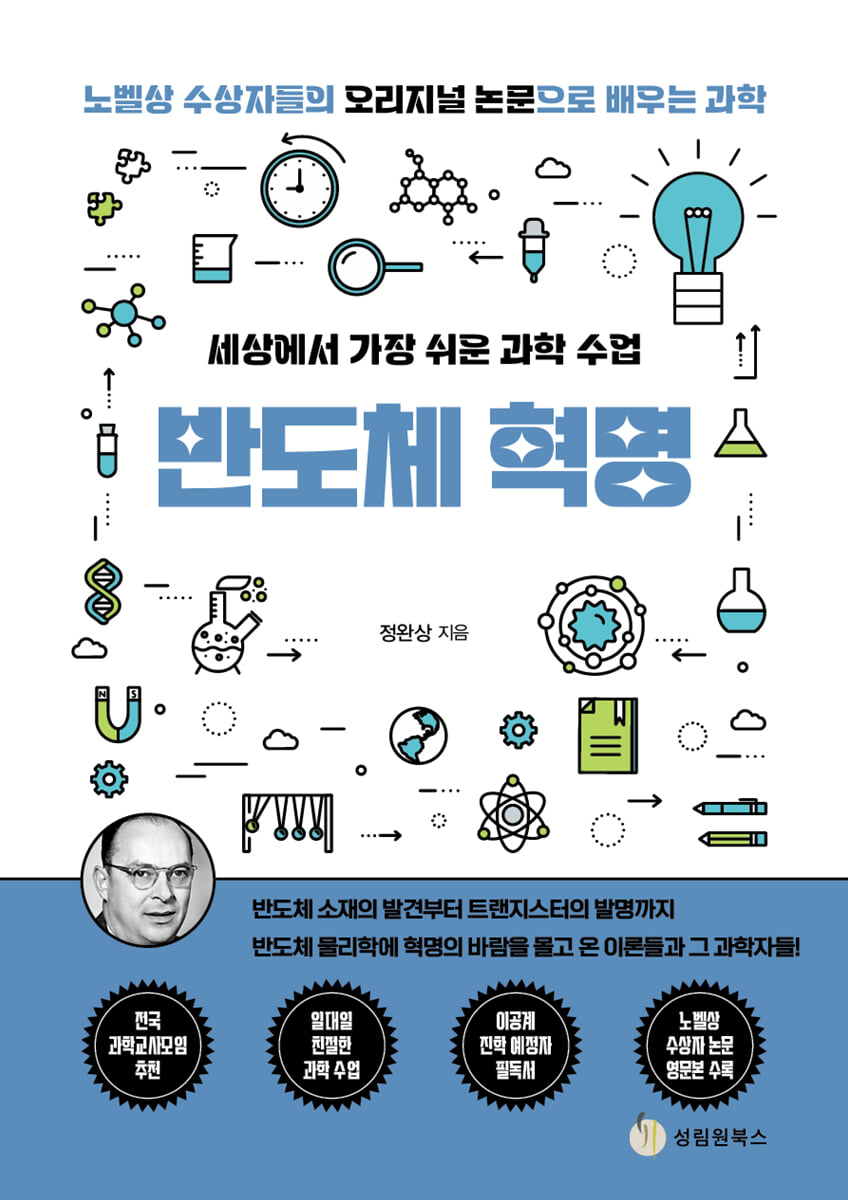
The World's Easiest Science Lesson: The Semiconductor Revolution
 |
Description
Book Introduction
From the discovery of semiconductor materials to the invention of the transistor
The theories and scientists who revolutionized semiconductor physics!
From solid-state physics research to the invention of the transistor!
How has semiconductor physics evolved?
We explore the various stories and history of solid-state and semiconductor physics, leading up to the Nobel Prize jointly awarded to Bardeen, Brattain, and Shockley for the invention of the transistor.
It details the theories and research achievements of scientists that revolutionized semiconductor physics, from the ideas of ancient scientists about solids and energy band theory, to the Fermi-Dirac statistical theory, to the invention of vacuum tubes and transistors before the advent of semiconductor transistors.
Semiconductor physics, which is presented in the form of a conversation between Professor Jeong, who represents the author, and a physics student who poses questions to Professor Jeong from the reader's perspective, is friendly and exciting, like a one-on-one class, and is woven with tightly-knit stories that leave no room for boredom.
This book, the tenth in the series “Learning Science through Original Papers by Nobel Prize Winners,” features many scientists.
Their birth story, their historical background, the trigger for their interest in science, the frustrations and hardships they encountered during their research, and the outstanding research results they ultimately achieved and their significance are captivating enough to draw in even those unfamiliar with science.
The process of looking at the lives of scientists includes their actual appearances and related photos to help readers understand.
Following the main text, it includes the original texts of Einstein's specific heat of solids, Bose and Fermi's papers, and Bardeen and Brattain's papers on the invention of the transistor, along with a list of Nobel Prize winners in Physics and Chemistry, leading to a world of deeper exploration.
The theories and scientists who revolutionized semiconductor physics!
From solid-state physics research to the invention of the transistor!
How has semiconductor physics evolved?
We explore the various stories and history of solid-state and semiconductor physics, leading up to the Nobel Prize jointly awarded to Bardeen, Brattain, and Shockley for the invention of the transistor.
It details the theories and research achievements of scientists that revolutionized semiconductor physics, from the ideas of ancient scientists about solids and energy band theory, to the Fermi-Dirac statistical theory, to the invention of vacuum tubes and transistors before the advent of semiconductor transistors.
Semiconductor physics, which is presented in the form of a conversation between Professor Jeong, who represents the author, and a physics student who poses questions to Professor Jeong from the reader's perspective, is friendly and exciting, like a one-on-one class, and is woven with tightly-knit stories that leave no room for boredom.
This book, the tenth in the series “Learning Science through Original Papers by Nobel Prize Winners,” features many scientists.
Their birth story, their historical background, the trigger for their interest in science, the frustrations and hardships they encountered during their research, and the outstanding research results they ultimately achieved and their significance are captivating enough to draw in even those unfamiliar with science.
The process of looking at the lives of scientists includes their actual appearances and related photos to help readers understand.
Following the main text, it includes the original texts of Einstein's specific heat of solids, Bose and Fermi's papers, and Bardeen and Brattain's papers on the invention of the transistor, along with a list of Nobel Prize winners in Physics and Chemistry, leading to a world of deeper exploration.
- You can preview some of the book's contents.
Preview
index
Recommendation
I hope you can understand the original papers of these genius scientists.
Who are the three musketeers who invented the transistor? A surprise interview with Nobel Prize-winning physics professor Dr. Kilby.
First Encounter: The Discovery of Semiconductor Materials
Various solids - solids called metals, minerals, and ceramics
Materials that make up semiconductors: silicon, germanium, and silicon dioxide
An interesting material, zirconia - a natural diamond imitation
The Discovery of Liquid Crystals - From Lineage to De Zen
Dulong-Petit Law _ Joint Research on Specific Heat of Solids
Ianstein's formula for the specific heat of solids _ The glory of the Nobel Prize goes to Debye
Discovery of Silicon and Germanium - Neither Conductor nor Insulator
Second Encounter: Energy Band
The birth of quantum mechanics _ the properties of particles and waves at the same time
Connecting Solid-State Physics and Quantum Mechanics _ Four Scientists
Energy bands and band gaps - allowed and forbidden regions
Effective mass of electrons and holes _ What happens when an electric field is applied to a semiconductor?
Third Encounter: Fermi-Dirac Statistics
Quantum Statistical Mechanics: The Intersection of Quantum Mechanics and Statistical Physics
Bose-Einstein Statistics _ Letter to Einstein
Fermi Dirac Statistics - How to maximize the total number of cases?
Fourth Meeting: Semiconductor Theory
The quantum density of states of a free electron is proportional to the square root of its energy.
Fermi Dirac distribution function - Correlation between temperature and Fermi probability density function
Basic Relationships of Semiconductors _ What is the effective state density function?
Intrinsic and extrinsic semiconductors _ n-type semiconductors, p-type semiconductors
Fifth Encounter: The Age of Vacuum Tubes
Invention of the vacuum tube diode - converting alternating current to direct current
Fleming's Valve and Marconi's Wireless Telegraph - Crossing the Atlantic
Russell All, who invented the semiconductor diode _ pn junction
Sixth Encounter: The Invention of the Transistor
People Who Ushered in the Transistor Era - Kelly, Bardeen, Shockley, and Brattain
The invention of the point-contact transistor: amplifying input signals by a factor of 100.
Metal-Oxide Semiconductor Field-Effect Transistors_ Dr. Atala and Dr. Kang Dae-won
The Invention of the Integrated Circuit _ Kilby and Noyce
In addition to the meeting
Planck's Theory of Radiation and The Theory of Specific Heat
_ English version of Einstein's paper
Planck's Law and The Light Quantum Hypothesis
_ English version of Bose's thesis (1924)
On Quantizing an Ideal Monatomic Gas
_ English version of Fermi's paper
The Transistor, A Semi-Conductor Triode
_ English version of the Bardeen-Brattain paper
Semiconductor Research Leading to the Point Contact Transistor
_ English version of Bardeen's Nobel Prize acceptance speech
Concluding our meeting with a great paper
Papers referenced for this book
Greek letters used in formulas
Introducing the Nobel Prize winners in Physics
Introducing the Nobel Prize winners in Chemistry
I hope you can understand the original papers of these genius scientists.
Who are the three musketeers who invented the transistor? A surprise interview with Nobel Prize-winning physics professor Dr. Kilby.
First Encounter: The Discovery of Semiconductor Materials
Various solids - solids called metals, minerals, and ceramics
Materials that make up semiconductors: silicon, germanium, and silicon dioxide
An interesting material, zirconia - a natural diamond imitation
The Discovery of Liquid Crystals - From Lineage to De Zen
Dulong-Petit Law _ Joint Research on Specific Heat of Solids
Ianstein's formula for the specific heat of solids _ The glory of the Nobel Prize goes to Debye
Discovery of Silicon and Germanium - Neither Conductor nor Insulator
Second Encounter: Energy Band
The birth of quantum mechanics _ the properties of particles and waves at the same time
Connecting Solid-State Physics and Quantum Mechanics _ Four Scientists
Energy bands and band gaps - allowed and forbidden regions
Effective mass of electrons and holes _ What happens when an electric field is applied to a semiconductor?
Third Encounter: Fermi-Dirac Statistics
Quantum Statistical Mechanics: The Intersection of Quantum Mechanics and Statistical Physics
Bose-Einstein Statistics _ Letter to Einstein
Fermi Dirac Statistics - How to maximize the total number of cases?
Fourth Meeting: Semiconductor Theory
The quantum density of states of a free electron is proportional to the square root of its energy.
Fermi Dirac distribution function - Correlation between temperature and Fermi probability density function
Basic Relationships of Semiconductors _ What is the effective state density function?
Intrinsic and extrinsic semiconductors _ n-type semiconductors, p-type semiconductors
Fifth Encounter: The Age of Vacuum Tubes
Invention of the vacuum tube diode - converting alternating current to direct current
Fleming's Valve and Marconi's Wireless Telegraph - Crossing the Atlantic
Russell All, who invented the semiconductor diode _ pn junction
Sixth Encounter: The Invention of the Transistor
People Who Ushered in the Transistor Era - Kelly, Bardeen, Shockley, and Brattain
The invention of the point-contact transistor: amplifying input signals by a factor of 100.
Metal-Oxide Semiconductor Field-Effect Transistors_ Dr. Atala and Dr. Kang Dae-won
The Invention of the Integrated Circuit _ Kilby and Noyce
In addition to the meeting
Planck's Theory of Radiation and The Theory of Specific Heat
_ English version of Einstein's paper
Planck's Law and The Light Quantum Hypothesis
_ English version of Bose's thesis (1924)
On Quantizing an Ideal Monatomic Gas
_ English version of Fermi's paper
The Transistor, A Semi-Conductor Triode
_ English version of the Bardeen-Brattain paper
Semiconductor Research Leading to the Point Contact Transistor
_ English version of Bardeen's Nobel Prize acceptance speech
Concluding our meeting with a great paper
Papers referenced for this book
Greek letters used in formulas
Introducing the Nobel Prize winners in Physics
Introducing the Nobel Prize winners in Chemistry
Detailed image

Into the book
Silicon is a representative semiconductor material.
A semiconductor is a material that is intermediate between a conductor that conducts electricity and an insulator that does not conduct electricity.
That's why the area in San Francisco where semiconductor companies are concentrated is called 'Silicon Valley'.
Silicon crystals are used to make wafers, one of the materials for semiconductors.
A wafer is a thinly baked bread or cookie with jam or cookie spread between them.
--- p.31
Devai, who immigrated to the United States, was clearly an opportunist.
Devi remained loyal to the political system that held power, whether it was Nazi Germany or the United States.
However, the device always provided an escape route.
In Nazi Germany he maintained Dutch citizenship, and in the United States he secretly contacted the Nazi German Foreign Ministry.
--- p.53
During the Manhattan Project, important decisions were made after the most careful consideration and discussion with those who were thought to be able to offer the soundest advice.
Oppenheimer, von Neumann, Penny, Parsons, and Ramsey participated in this operation.
--- p.75
Dear Professor Einstein, I am sending you the paper I wrote for your reading and comment.
I'd like to know what you think about it.
I don't know enough German to translate this paper.
If you think the paper is worthy of publication, we would be grateful if you could consider publishing it in Zeitschrift fur Physik.
--- p.101
In the summer of 1895, Marconi extended the range of radio reception to 3.2 km at his father's estate in Bologna.
Marconi, who found that people in Italy were not interested in his work, went to London with his mother in early 1896, at the age of 21, to seek support for his work.
--- p.167
In 1944, Shockley created a training program for B-29 bomber pilots to use the new radar bombsight.
In late 1944, he toured bases around the world for three months to evaluate the results.
In July 1945, the government asked Shockley to prepare a report on the possible casualties from an invasion of the Japanese home islands, and Shockley estimated the number of Japanese deaths at between 400,000 and 800,000.
--- p.188
Around 1935, Kelly, head of the vacuum tube research department at Bell Laboratories, was looking for ways to meet the growing demand for telephones in the United States.
There was a problem that when the voice signal of the telephone was transmitted through the cable, the signal gradually became weaker and became difficult to hear.
Kelly thought of a way to amplify the voice signal and used vacuum tubes to do so.
But the American continent was enormous, and installing vacuum tube amplifiers on such long cables required an enormous number of vacuum tubes.
--- p.190
Due to the floating gate developed by Dr. Kang Dae-won, Agfa, a world-renowned German film company, went bankrupt in 2005, 38 years later, after 140 years of founding.
This was because the development of NAND flash using floating gate technology and the emergence of digital cameras equipped with it reduced the demand for film.
NAND flash is one of the most profitable products in our country's semiconductor industry.
This is used as a storage device for various electronic products such as MP3 players because once stored, the data does not disappear even if the power is turned off.
--- p.209
In mid-1958, Kilby, a new employee at Texas Instruments (TI), couldn't take a summer vacation.
He spent the summer studying circuit design problems, eventually concluding that mass-manufacturing circuit components from a single semiconductor material could provide a solution.
That is, he invented the integrated circuit.
On September 12th of that year, he reported his findings to company management.
--- p.215~216
The relaxed culture Noyce brought to Intel was a continuation of his style at Fairchild Semiconductor.
He treated his employees like family and rewarded and encouraged teamwork.
Noyce's management style can be described as 'rolling up your sleeves'.
He eschewed fancy company cars, reserved parking spaces, private jets, offices, and furniture in favor of a less structured and more relaxed work environment where everyone contributed and no one received lavish perks.
A semiconductor is a material that is intermediate between a conductor that conducts electricity and an insulator that does not conduct electricity.
That's why the area in San Francisco where semiconductor companies are concentrated is called 'Silicon Valley'.
Silicon crystals are used to make wafers, one of the materials for semiconductors.
A wafer is a thinly baked bread or cookie with jam or cookie spread between them.
--- p.31
Devai, who immigrated to the United States, was clearly an opportunist.
Devi remained loyal to the political system that held power, whether it was Nazi Germany or the United States.
However, the device always provided an escape route.
In Nazi Germany he maintained Dutch citizenship, and in the United States he secretly contacted the Nazi German Foreign Ministry.
--- p.53
During the Manhattan Project, important decisions were made after the most careful consideration and discussion with those who were thought to be able to offer the soundest advice.
Oppenheimer, von Neumann, Penny, Parsons, and Ramsey participated in this operation.
--- p.75
Dear Professor Einstein, I am sending you the paper I wrote for your reading and comment.
I'd like to know what you think about it.
I don't know enough German to translate this paper.
If you think the paper is worthy of publication, we would be grateful if you could consider publishing it in Zeitschrift fur Physik.
--- p.101
In the summer of 1895, Marconi extended the range of radio reception to 3.2 km at his father's estate in Bologna.
Marconi, who found that people in Italy were not interested in his work, went to London with his mother in early 1896, at the age of 21, to seek support for his work.
--- p.167
In 1944, Shockley created a training program for B-29 bomber pilots to use the new radar bombsight.
In late 1944, he toured bases around the world for three months to evaluate the results.
In July 1945, the government asked Shockley to prepare a report on the possible casualties from an invasion of the Japanese home islands, and Shockley estimated the number of Japanese deaths at between 400,000 and 800,000.
--- p.188
Around 1935, Kelly, head of the vacuum tube research department at Bell Laboratories, was looking for ways to meet the growing demand for telephones in the United States.
There was a problem that when the voice signal of the telephone was transmitted through the cable, the signal gradually became weaker and became difficult to hear.
Kelly thought of a way to amplify the voice signal and used vacuum tubes to do so.
But the American continent was enormous, and installing vacuum tube amplifiers on such long cables required an enormous number of vacuum tubes.
--- p.190
Due to the floating gate developed by Dr. Kang Dae-won, Agfa, a world-renowned German film company, went bankrupt in 2005, 38 years later, after 140 years of founding.
This was because the development of NAND flash using floating gate technology and the emergence of digital cameras equipped with it reduced the demand for film.
NAND flash is one of the most profitable products in our country's semiconductor industry.
This is used as a storage device for various electronic products such as MP3 players because once stored, the data does not disappear even if the power is turned off.
--- p.209
In mid-1958, Kilby, a new employee at Texas Instruments (TI), couldn't take a summer vacation.
He spent the summer studying circuit design problems, eventually concluding that mass-manufacturing circuit components from a single semiconductor material could provide a solution.
That is, he invented the integrated circuit.
On September 12th of that year, he reported his findings to company management.
--- p.215~216
The relaxed culture Noyce brought to Intel was a continuation of his style at Fairchild Semiconductor.
He treated his employees like family and rewarded and encouraged teamwork.
Noyce's management style can be described as 'rolling up your sleeves'.
He eschewed fancy company cars, reserved parking spaces, private jets, offices, and furniture in favor of a less structured and more relaxed work environment where everyone contributed and no one received lavish perks.
--- p.220~221
Publisher's Review
★ Recommended by the National Science Teachers Association ★ Friendly, one-on-one science classes
★ A must-read for those planning to pursue a science or engineering degree ★ Includes English versions of Nobel Prize-winning papers
The discovery of the transistor!
It was a revolution in human history!
This book contains theories about semiconductors, a core technology of the Fourth Industrial Revolution and a very familiar technology to us living in the computer age, as well as stories of scientists who have contributed to semiconductor research.
Transistors are essential components in all electronic devices today, and they are semiconductor devices that amplify and switch electrical signals.
This book examines the history of the invention of the transistor, which revolutionized electronics and opened up the possibilities of computers, the Internet, and wireless communication.
Readers first encounter an interesting story about semiconductor materials.
Through the story of the scientists who worked tirelessly for 50 years to isolate silicon, the representative material of semiconductors, we can truly feel how much passion of many people has brought semiconductors to us.
What follows is a vivid story of the heroes who brought about the development of semiconductors and the theory of semiconductor physics from ancient Greece to the founding of Intel, through energy bands, Fermi-Dirac statistics, semiconductor theory, the vacuum tube era, and the invention of the transistor, captivating readers.
Above all, the unique strength and virtue of this book is that it provides access to the original texts of famous papers in the history of science, such as Einstein's specific heat of solids, Bose and Fermi's paper on new statistics, Bardeen and Brattain's paper on the invention of the point-contact transistor, and Bardeen's Nobel Prize acceptance speech.
With unwavering will and passion, semiconductors were invented.
The story of scientists who put all their effort into continuous research!
De Jenes, a physicist who won the Nobel Prize for his research on liquid crystals; Debye, who won the Nobel Prize in Chemistry for revising Einstein's research on the specific heat of solids; Mendeleev, who predicted the element that would fill the gap between silicon and tin while creating the periodic table; Bloch, who won the Nobel Prize for his research on nuclear magnetic resonance, the basic principle of MRI; Kronig, who first came up with the idea of spin but was unable to publish it due to Pauli's criticism and had the idea stolen; Penny, who worked on the Manhattan Project to create the atomic bomb; Wilson, who explained the principles of conductors, semiconductors, and insulators in terms of electron energy bands; Bose, who wrote a paper explaining Planck's quantum radiation law with his own idea but whose publication was rejected, are scientists who provided a solid foundation for the invention of semiconductors.
Thanks to their research, Kelly, Shockley, Bardeen, and Brattain were finally able to bring an end to the vacuum tube era and usher in the transistor era.
Along with this, you can also hear the story of Dr. Kang Dae-won of South Korea, who invented the MOSFET transistor, which led to the blossoming of the electronics industry, and Atala.
If we knew how many creative ideas and experiments scientists go through to discover new things before each theory is born, science would no longer be a subject to be memorized.
The author hopes that more people will take an interest in scientific research and, with an indomitable will, dive into it, leading to the production of a Nobel Prize winner in science from Korea. He hopes that this book will resonate with many readers.
For the future of South Korea, a semiconductor powerhouse
The essentials of semiconductor physics you must read!
Semiconductor competition is fierce around the world.
Korea is a semiconductor powerhouse, but we must all work together to make K-semiconductors take a bigger leap forward.
Above all, the cultivation of scientific talent is required.
Although the author states that this book is aimed at people with high school-level mathematical skills, it has a wide readership, from elementary school students interested in science to middle and high school students, the general public, and even science experts.
If, through this book, you develop an interest in semiconductor physics and grow into a pillar of the semiconductor industry, wouldn't the future of South Korea as a scientific powerhouse be bright?
This book was planned as a series.
I believe that through the process of completing each book, readers will become more interested in science and more motivated to pursue it, and the level of science in Korea will rise accordingly.
Science and technology are very important areas that determine a country's future competitiveness.
This book offers readers the pleasure of reading a science book and the joy of learning new scientific knowledge at the same time.
In particular, the original papers by great scientists included in the back of the book are undoubtedly valuable resources that will instill interest and a sense of challenge in scientists.
Until the day when Korea stands tall as a scientific powerhouse, the series "Learning Science through Original Papers by Nobel Prize Winners" will serve as a solid foundation for everyone, including aspiring scientists.
★ A must-read for those planning to pursue a science or engineering degree ★ Includes English versions of Nobel Prize-winning papers
The discovery of the transistor!
It was a revolution in human history!
This book contains theories about semiconductors, a core technology of the Fourth Industrial Revolution and a very familiar technology to us living in the computer age, as well as stories of scientists who have contributed to semiconductor research.
Transistors are essential components in all electronic devices today, and they are semiconductor devices that amplify and switch electrical signals.
This book examines the history of the invention of the transistor, which revolutionized electronics and opened up the possibilities of computers, the Internet, and wireless communication.
Readers first encounter an interesting story about semiconductor materials.
Through the story of the scientists who worked tirelessly for 50 years to isolate silicon, the representative material of semiconductors, we can truly feel how much passion of many people has brought semiconductors to us.
What follows is a vivid story of the heroes who brought about the development of semiconductors and the theory of semiconductor physics from ancient Greece to the founding of Intel, through energy bands, Fermi-Dirac statistics, semiconductor theory, the vacuum tube era, and the invention of the transistor, captivating readers.
Above all, the unique strength and virtue of this book is that it provides access to the original texts of famous papers in the history of science, such as Einstein's specific heat of solids, Bose and Fermi's paper on new statistics, Bardeen and Brattain's paper on the invention of the point-contact transistor, and Bardeen's Nobel Prize acceptance speech.
With unwavering will and passion, semiconductors were invented.
The story of scientists who put all their effort into continuous research!
De Jenes, a physicist who won the Nobel Prize for his research on liquid crystals; Debye, who won the Nobel Prize in Chemistry for revising Einstein's research on the specific heat of solids; Mendeleev, who predicted the element that would fill the gap between silicon and tin while creating the periodic table; Bloch, who won the Nobel Prize for his research on nuclear magnetic resonance, the basic principle of MRI; Kronig, who first came up with the idea of spin but was unable to publish it due to Pauli's criticism and had the idea stolen; Penny, who worked on the Manhattan Project to create the atomic bomb; Wilson, who explained the principles of conductors, semiconductors, and insulators in terms of electron energy bands; Bose, who wrote a paper explaining Planck's quantum radiation law with his own idea but whose publication was rejected, are scientists who provided a solid foundation for the invention of semiconductors.
Thanks to their research, Kelly, Shockley, Bardeen, and Brattain were finally able to bring an end to the vacuum tube era and usher in the transistor era.
Along with this, you can also hear the story of Dr. Kang Dae-won of South Korea, who invented the MOSFET transistor, which led to the blossoming of the electronics industry, and Atala.
If we knew how many creative ideas and experiments scientists go through to discover new things before each theory is born, science would no longer be a subject to be memorized.
The author hopes that more people will take an interest in scientific research and, with an indomitable will, dive into it, leading to the production of a Nobel Prize winner in science from Korea. He hopes that this book will resonate with many readers.
For the future of South Korea, a semiconductor powerhouse
The essentials of semiconductor physics you must read!
Semiconductor competition is fierce around the world.
Korea is a semiconductor powerhouse, but we must all work together to make K-semiconductors take a bigger leap forward.
Above all, the cultivation of scientific talent is required.
Although the author states that this book is aimed at people with high school-level mathematical skills, it has a wide readership, from elementary school students interested in science to middle and high school students, the general public, and even science experts.
If, through this book, you develop an interest in semiconductor physics and grow into a pillar of the semiconductor industry, wouldn't the future of South Korea as a scientific powerhouse be bright?
This book was planned as a series.
I believe that through the process of completing each book, readers will become more interested in science and more motivated to pursue it, and the level of science in Korea will rise accordingly.
Science and technology are very important areas that determine a country's future competitiveness.
This book offers readers the pleasure of reading a science book and the joy of learning new scientific knowledge at the same time.
In particular, the original papers by great scientists included in the back of the book are undoubtedly valuable resources that will instill interest and a sense of challenge in scientists.
Until the day when Korea stands tall as a scientific powerhouse, the series "Learning Science through Original Papers by Nobel Prize Winners" will serve as a solid foundation for everyone, including aspiring scientists.
GOODS SPECIFICS
- Date of issue: August 1, 2024
- Page count, weight, size: 306 pages | 152*210*30mm
- ISBN13: 9791193357316
- ISBN10: 1193357314
You may also like
카테고리
korean


korean

![ELLE 엘르 스페셜 에디션 A형 : 12월 [2025]](http://librairie.coreenne.fr/cdn/shop/files/b8e27a3de6c9538896439686c6b0e8fb.jpg?v=1766436872&width=3840)


