

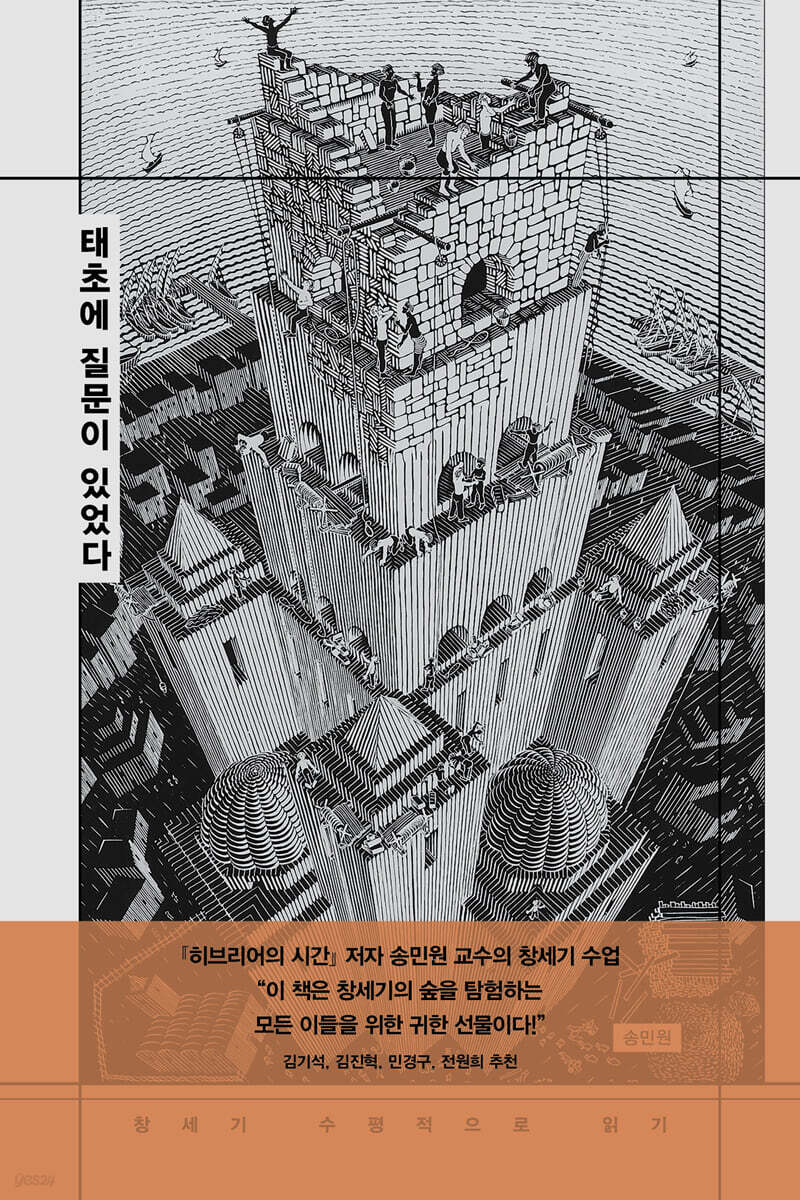
In the beginning there was a question
 |
Description
Book Introduction
Genesis class by Professor Song Min-won, author of "Time in Hebrew"
“This book is a precious gift for all who explore the forest of Genesis!”
Recommended by Kim Ki-seok, Kim Jin-hyeok, Min Kyung-gu, and Jeon Won-hee
This book takes a fresh look at Genesis from a 'vertical reading' to a 'horizontal reading.'
It follows the intertwined and conflicting stories between humans and between humans and creation, and delicately captures God's heart and will revealed within them.
Through this new reading, the narratives of Adam and Eve, Cain and Abel, Noah's flood, the Tower of Babel, and the patriarchs become not just events of the past, but mirrors that reflect ourselves today.
“This book is a precious gift for all who explore the forest of Genesis!”
Recommended by Kim Ki-seok, Kim Jin-hyeok, Min Kyung-gu, and Jeon Won-hee
This book takes a fresh look at Genesis from a 'vertical reading' to a 'horizontal reading.'
It follows the intertwined and conflicting stories between humans and between humans and creation, and delicately captures God's heart and will revealed within them.
Through this new reading, the narratives of Adam and Eve, Cain and Abel, Noah's flood, the Tower of Babel, and the patriarchs become not just events of the past, but mirrors that reflect ourselves today.
- You can preview some of the book's contents.
Preview
index
Introduction: The World of the Bible and Two Perspectives
Chapter 1: Why Were Humans Created? · Genesis 1-3
Chapter 2: Two Perspectives on Sin · Genesis 3-5
Chapter 3: Why the Flood Happened (Genesis 6-9)
Chapter 4: Why Did the Tower of Babel Fall? Genesis 10-11
Chapter 5: Why Were Sodom and Gomorrah Destroyed? · Genesis 18-19
Chapter 6: What is Holiness? · Expanding Horizontal Reading
Going Out: What's New in Jesus' New Commandment
Acknowledgements
main
Chapter 1: Why Were Humans Created? · Genesis 1-3
Chapter 2: Two Perspectives on Sin · Genesis 3-5
Chapter 3: Why the Flood Happened (Genesis 6-9)
Chapter 4: Why Did the Tower of Babel Fall? Genesis 10-11
Chapter 5: Why Were Sodom and Gomorrah Destroyed? · Genesis 18-19
Chapter 6: What is Holiness? · Expanding Horizontal Reading
Going Out: What's New in Jesus' New Commandment
Acknowledgements
main
Into the book
The act of reading is a comprehensive art.
Simply opening a book and reading it does not mean that the words will automatically enter your eyes and brain and be understood.
If the text is absorbed mechanically, each reader will understand the content in the same way.
But in reality, everyone understands it differently.
Why is that? Because reading is a "conversation."
Conversation is an act that goes through quite complex stages.
It is an intellectual, social, and relational act.
Just as the outcome changes if even one variable among the many intertwined factors changes, the same book tells a different story depending on the reader's conditions and circumstances.
--- p.10 From “Introduction”
How should we read the Bible? This question isn't simply a question of hermeneutical methodology. It also asks where we should look when confronted with God's Word, and what our attitude and perspective should be.
This book calls the mainstream method of interpreting the Bible so far “vertical reading,” and the newly proposed method of interpreting the Bible “horizontal reading.”
The terms vertical and horizontal are not strictly academic terms, nor are they concepts established in existing theological discourse.
This is a figurative language chosen to more intuitively visualize the direction of interpretation that this book seeks to show to its readers.
--- p.14 From “Introduction”
'Vertical reading' or 'vertical biblical interpretation' focuses on the relationship between God and humanity.
It is called 'vertical' because it focuses on the relationship between God in heaven and humans on earth.
An important theological topic from this perspective is whether or not people have 'kept' God's command from above.
The human desire and pride to ascend to heaven and attack God to become a god are defined as 'sin.'
Here, ‘humility’ and ‘obedience’ are the virtues required of humans.
It's a familiar topic we all know well.
This is also the mainstream way the Bible has been read for the past two thousand years.
On the other hand, 'horizontal reading' focuses more on human-to-human relationships.
It further focuses on the relationship between humans and the created world.
Rather than simply whether humans obeyed God's commands, God is interested in how we live on this earth, what kind of relationships He asks us to have with one another, and what responsibilities and roles we are given in our relationships with other creatures.
--- From p.16-17 "Introduction"
In this book, we will question the biblical text and our traditional interpretations from beginning to end.
This question will likely lead to many other questions and concerns.
There is something more important in the process than determining what is correct and what is the correct interpretation.
It's about learning how to ask good questions.
I hope that through vertical and horizontal reading, the biblical text will become more three-dimensional.
If readers gain a perspective and framework for reading and understanding the Bible through their own eyes, rather than relying on others' model answers, this book will have already fulfilled its purpose.
Simply opening a book and reading it does not mean that the words will automatically enter your eyes and brain and be understood.
If the text is absorbed mechanically, each reader will understand the content in the same way.
But in reality, everyone understands it differently.
Why is that? Because reading is a "conversation."
Conversation is an act that goes through quite complex stages.
It is an intellectual, social, and relational act.
Just as the outcome changes if even one variable among the many intertwined factors changes, the same book tells a different story depending on the reader's conditions and circumstances.
--- p.10 From “Introduction”
How should we read the Bible? This question isn't simply a question of hermeneutical methodology. It also asks where we should look when confronted with God's Word, and what our attitude and perspective should be.
This book calls the mainstream method of interpreting the Bible so far “vertical reading,” and the newly proposed method of interpreting the Bible “horizontal reading.”
The terms vertical and horizontal are not strictly academic terms, nor are they concepts established in existing theological discourse.
This is a figurative language chosen to more intuitively visualize the direction of interpretation that this book seeks to show to its readers.
--- p.14 From “Introduction”
'Vertical reading' or 'vertical biblical interpretation' focuses on the relationship between God and humanity.
It is called 'vertical' because it focuses on the relationship between God in heaven and humans on earth.
An important theological topic from this perspective is whether or not people have 'kept' God's command from above.
The human desire and pride to ascend to heaven and attack God to become a god are defined as 'sin.'
Here, ‘humility’ and ‘obedience’ are the virtues required of humans.
It's a familiar topic we all know well.
This is also the mainstream way the Bible has been read for the past two thousand years.
On the other hand, 'horizontal reading' focuses more on human-to-human relationships.
It further focuses on the relationship between humans and the created world.
Rather than simply whether humans obeyed God's commands, God is interested in how we live on this earth, what kind of relationships He asks us to have with one another, and what responsibilities and roles we are given in our relationships with other creatures.
--- From p.16-17 "Introduction"
In this book, we will question the biblical text and our traditional interpretations from beginning to end.
This question will likely lead to many other questions and concerns.
There is something more important in the process than determining what is correct and what is the correct interpretation.
It's about learning how to ask good questions.
I hope that through vertical and horizontal reading, the biblical text will become more three-dimensional.
If readers gain a perspective and framework for reading and understanding the Bible through their own eyes, rather than relying on others' model answers, this book will have already fulfilled its purpose.
--- From "Introduction" on p.19-20
Publisher's Review
For a long time, we have read the Bible only in a vertical relationship, flowing 'from top to bottom.'
The Bible has been interpreted within the framework of command and obedience, sin and punishment between God and man.
This is certainly a desirable perspective on faith, but the Bible reveals a world much broader and deeper than that.
This book takes a fresh look at Genesis from a 'vertical reading' to a 'horizontal reading.'
It follows the intertwined and conflicting stories between humans and between humans and creation, and delicately captures God's heart and will revealed within them.
Through this new reading, the narratives of Adam and Eve, Cain and Abel, Noah's Flood, the Tower of Babel, and the patriarchs become not just events of the past, but mirrors that reflect ourselves today.
“The Bible is not a book that gives answers, but a book that asks questions.” This is the key sentence that runs through the entire book.
This book constantly questions the reading of the Bible that we are familiar with.
For decades, I have been exploring Hebrew and ancient Near Eastern literature, tracing the deep roots of Genesis within the language and context of its original texts.
On that journey, I discovered moments when the familiar stories of Genesis took on a completely new face, and I believe readers of this book will have that same remarkable experience.
The stories ask:
Who are you? Where do you stand? Where are you going? This book is an attempt to confront these very questions, inviting the reader to join them.
I hope this book will serve as a solid guide for all who seek to reread the Bible and live again.
characteristic
- Genesis class by Professor Song Min-won, author of "Time in Hebrew"
- Go beyond the familiar reading of Genesis and approach Genesis in a new and deeper way.
Reading the Bible by asking yourself good questions and responding with your life rather than trying to find the right answer.
Target audience
- Christians who want to read Genesis in a new language
- Pastors, seminarians, and teachers preparing sermons on Genesis or contemplating a biblical worldview
- Readers who want to read the Bible from a literary and humanistic perspective
The Bible has been interpreted within the framework of command and obedience, sin and punishment between God and man.
This is certainly a desirable perspective on faith, but the Bible reveals a world much broader and deeper than that.
This book takes a fresh look at Genesis from a 'vertical reading' to a 'horizontal reading.'
It follows the intertwined and conflicting stories between humans and between humans and creation, and delicately captures God's heart and will revealed within them.
Through this new reading, the narratives of Adam and Eve, Cain and Abel, Noah's Flood, the Tower of Babel, and the patriarchs become not just events of the past, but mirrors that reflect ourselves today.
“The Bible is not a book that gives answers, but a book that asks questions.” This is the key sentence that runs through the entire book.
This book constantly questions the reading of the Bible that we are familiar with.
For decades, I have been exploring Hebrew and ancient Near Eastern literature, tracing the deep roots of Genesis within the language and context of its original texts.
On that journey, I discovered moments when the familiar stories of Genesis took on a completely new face, and I believe readers of this book will have that same remarkable experience.
The stories ask:
Who are you? Where do you stand? Where are you going? This book is an attempt to confront these very questions, inviting the reader to join them.
I hope this book will serve as a solid guide for all who seek to reread the Bible and live again.
characteristic
- Genesis class by Professor Song Min-won, author of "Time in Hebrew"
- Go beyond the familiar reading of Genesis and approach Genesis in a new and deeper way.
Reading the Bible by asking yourself good questions and responding with your life rather than trying to find the right answer.
Target audience
- Christians who want to read Genesis in a new language
- Pastors, seminarians, and teachers preparing sermons on Genesis or contemplating a biblical worldview
- Readers who want to read the Bible from a literary and humanistic perspective
GOODS SPECIFICS
- Date of issue: October 22, 2025
- Page count, weight, size: 224 pages | 306g | 140*210*14mm
- ISBN13: 9791170833079
- ISBN10: 1170833071
You may also like
카테고리
korean


korean

![GQ KOREA Mark (Monthly): December [2025]](http://librairie.coreenne.fr/cdn/shop/files/8ef265dbbfbf186523ed75ba7319009d.jpg?v=1765340328&width=3840)


