

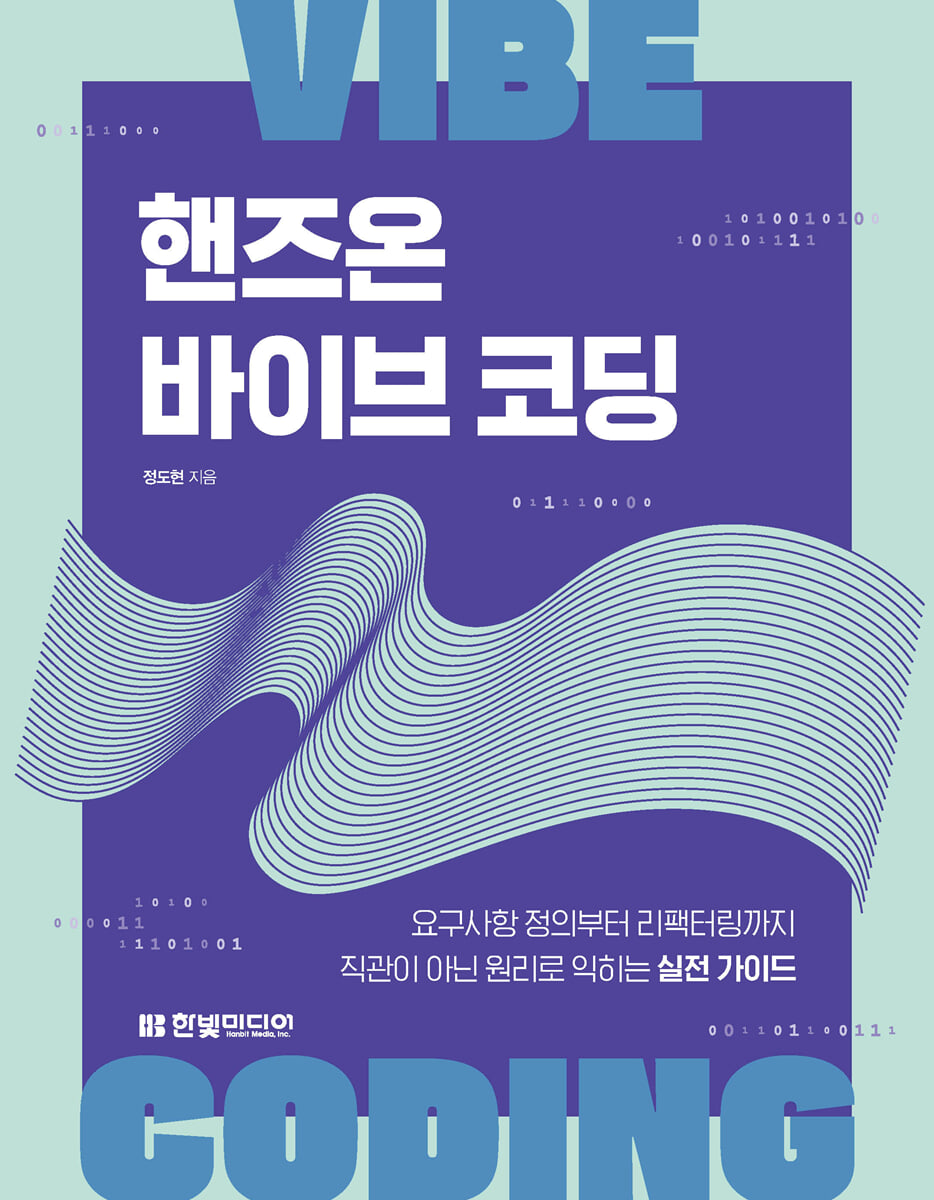
Hands-on Vibe Coding
 |
Description
Book Introduction
The essence of coding doesn't change, only the method has revolutionized.
AI is fundamentally changing the way we program.
Developers must now become “vibe coders” who collaborate with AI to solve problems, rather than writing all the code themselves.
This book goes beyond the intuitive and improvisational vibe coding and presents a systematic way to carry out projects with LLM-based AI.
Vibe Coding's five-stage maturity model allows you to assess your own level and identify growth opportunities. You can also acquire practical, on-the-job expertise, such as prompt engineering, automated verification, and Test Driven Development (TDD). The moment you embrace AI as a fellow developer, not just a tool, a new paradigm in development will open.
What do you mainly cover?
● Focus on the 'essence' beyond the tool: Covers the principles of LLM and the essence of prompt engineering along with how to use major AI coding tools such as ChatGPT, Cursor IDE, and Cloud Code, fostering a thinking system that can be adapted to any AI tool.
● For practical use only: Presents development techniques that can be applied directly to practical work, such as prompt engineering, TDD, and automation.
● Hands-on project: Integrated training covering everything from requirements definition to design, testing, and deployment.
● AI Code Review: Code Review Culture and Code Quality Management Methods to Reduce Errors
Who is this book for?
● Developers who want to systematically utilize AI tools such as ChatGPT, Cursor IDE, and Cloud Code, rather than just copy/paste.
● Senior developers and tech leads who want to effectively introduce generative AI into team projects
● All programmers who want to acquire 'design' and 'problem-solving' capabilities beyond coding automation in the AI era
- You can preview some of the book's contents.
Preview
index
CHAPTER 1: INTRODUCING VIBE CODING
_1.1 What is Vibe Coding?
_1.2 Vibe Coding Maturity
_1.3 Vibe Coding Strategy
_1.4 Limitations of Vibe Coding and Overcoming Strategies
CHAPTER 2: Principles of Vibe Coding
_2.1 Deep Learning and LLM
_2.2 Which language model to choose?
_2.3.
Prompt design and context optimization for programming tasks
_2.4 OpenAI vs. Antropic Approach
_2.5 In conclusion
CHAPTER 3 Tools for Vibe Coding
_3.1 Vibe Coding IDE Comparison
_3.2 Other useful tools
_3.3 Techniques I like to use in Vibe coding
_3.4 In conclusion
CHAPTER 4: Vibe Coding Optimization Technology Stack
_4.1 Operating System and Environment
_4.2 Editor and IDE
_4.3 Language and Runtime
_4.4 Test and Build Tools
_4.5 Agent Communication and Control Tools
_4.6 Log and Feedback System
_4.7 In conclusion
CHAPTER 5: YOUR FIRST VIBE CODING PROJECT
_5.1 Project Preparation
_5.2 First Vibe Coding
_5.3 Project Implementation
_5.4 In conclusion
CHAPTER 6: Prompt Engineering for Vibe Coding
_6.1 Coding based on Claude and AI agents
_6.2 Windsurf and Cursor Rule Management
_6.3 Differences in Rule Management between Windsurf and Cursor
CHAPTER 7 Pattern Language
7.1 What is a pattern language?
7.2 Development Documentation Patterns: PRD, Design Document, README, Issues
7.3 Software Design Principles and Patterns
7.4 Test Development Patterns: TDD and BDD
7.5 Operational and Infrastructure Patterns
7.6 In conclusion
CHAPTER 8 MCP: The Universal Adapter for AI Coding Assistants
_8.1 What is MCP?
_8.2 Vibe Coding and MCP
_8.3 CLI vs MCP
_8.4 Useful MCP Server Cases and Recommendations
_8.5 In conclusion
CHAPTER 9: Practical Project ①: AI-Based Cloud Architecture Designed with Vibe Coding
_9.1 Problem Statement: The Fargate Auto-Scaling Dilemma
_9.2 Information Gathering: Asking and Answering AI (ChatGPT DeepResearch)
_9.3 Architectural Design: Bringing Ideas to Life
_9.4 Implementation: Writing Code with AI
_9.5 Verification: Checking Results with AI
_9.6 In conclusion
CHAPTER 10 Practical Project ②: Full-Stack Web App Development
_10.1 Project Overview: AI-Generated RealWorld Web Apps
_10.2 Step 1: Draft the Product Requirements Document
_10.3 Step 2: Refine and Finalize the PRD
_10.4 Detailed Planning: Creating plan.md and Step-by-Step Issues
_10.5 Creating GitHub Issues and Managing Tasks
_10.6 Starting implementation work using cloud code
_10.7 Choosing a Technology Stack: Armin Ronacher's Recommendations and Practices
_10.8 Empirical Results of Automated Full-Stack Development
_10.9 In conclusion
CHAPTER 11 Review Strategies in the Vibe Coding Era
_11.1 The Importance of Reviews in Vibe Coding
_11.2 Why Reviews Are So Easy to Format
_11.3 A Psychology-Based Approach to Practical Review: Behavioral Economics
_11.4 AI's Assistive Role: Leveraging AI for Human-Centered Review
_11.5 Review application points and quality improvement measures throughout the development process
_11.6 In the era of Vibe Coding, developers' review skills are their competitive edge.
Detailed image

Publisher's Review
Understanding Vibe Coding with Principles, Not Intuition
[Basic Principles → Tools/Environment → Core Technologies → Practical Projects → Development Culture]
'Vibe coding' was once a term used to describe the moment when you were lucky enough to create a piece of code that worked.
But now, that "vibe" takes on a deeper meaning. With AI writing code for us, skill is no longer determined by the speed of our fingers, but by the developer's ability to think and design acumen to guide the AI in the right direction.
Developers should not be people who type code, but rather producers who define problems and design solution processes together with AI.
Amidst these changes, this book presents a new way of thinking for developers working with AI.
Starting with the question, "What should developers design when AI replaces coding?", it covers the essential principles of AI development that remain unchanged even in an era of constantly changing tools.
Rather than simply explaining how to use specific tools like ChatGPT, Cloud Code, and Cursor IDE, it fosters a mindset that allows you to understand their principles and utilize AI as a design partner in any environment.
I hope this book will help you navigate the flow with AI and build your own 'vibe'.
● [Chapter 1~4] Principles and Environment of Vibe Coding: Definition of 'Vibe Coding', basic principles of LLM and prompt optimization, and basic AI coding including setting up a development environment.
● [Chapter 5~8] Core skills of Vibe Coding: Get a feel for it through your first project and learn core skills such as prompt engineering, pattern language, and MCP (AI coding assistant adapter).
● [Chapter 9-10] AI Collaboration Practical Project: Practice designing an AWS cloud architecture and developing a full-stack web app from A to Z with AI.
● [Chapter 11] Development Culture in the AI Era: Strategies for Effectively Reviewing AI-Written Code and Presenting New Competitive Advantages for Developers
GOODS SPECIFICS
- Date of issue: October 31, 2025
- Page count, weight, size: 220 pages | 526g | 183*235*11mm
- ISBN13: 9791169214483
- ISBN10: 1169214487
You may also like
카테고리
korean


korean


