

Second Holy War
 |
Description
Book Introduction
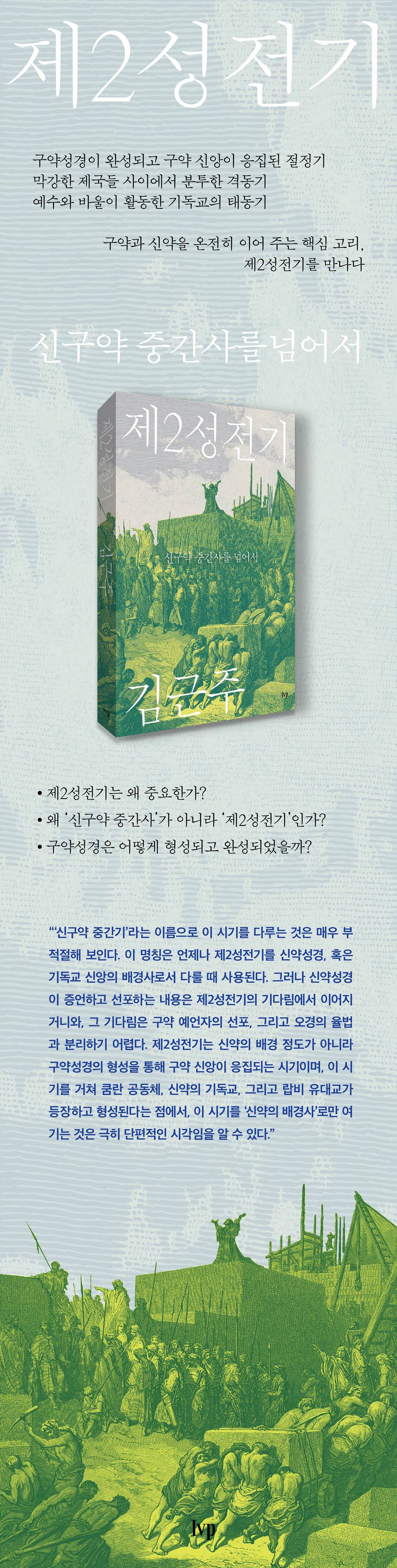
The key link that completely connects the Old and New Testaments,
Meet the Second Temple
The Second Temple period refers to the period from the rebuilding of the Temple in 516 BC to its destruction by the Romans in 70 AD.
This period, often referred to by the vague term "intertestamental period," has been dismissed as a background to the New Testament or a story outside the Bible.
However, the Second Temple period was a culmination of the completion of the Old Testament and the cohesion of Old Testament faith, and a turbulent period of struggle to preserve the essence of faith among powerful empires.
Old Testament scholar Kim Geun-ju has covered this vast period through meticulous and diligent research.
In a world where the Old and New Testaments seem disconnected, the Second Temple period holds the key to correcting distorted perspectives and bridging the gap.
Meet the Second Temple
The Second Temple period refers to the period from the rebuilding of the Temple in 516 BC to its destruction by the Romans in 70 AD.
This period, often referred to by the vague term "intertestamental period," has been dismissed as a background to the New Testament or a story outside the Bible.
However, the Second Temple period was a culmination of the completion of the Old Testament and the cohesion of Old Testament faith, and a turbulent period of struggle to preserve the essence of faith among powerful empires.
Old Testament scholar Kim Geun-ju has covered this vast period through meticulous and diligent research.
In a world where the Old and New Testaments seem disconnected, the Second Temple period holds the key to correcting distorted perspectives and bridging the gap.
- You can preview some of the book's contents.
Preview
index
preface
abbreviation
Timeline
introduction
Chapter 1: The Captivity: The Formation of the Old Testament
Chapter 2 The Persian Period: The Formation of the Old Testament 2
Chapter 3: The Hellenistic Era: The Encounter between Old Testament Faith and Hellenism
Chapter 4: Antiochus IV and the Radical Hellenistic Reform: Legalism and the Formation of Apocalypse
Chapter 5: The Hasmonean Dynasty: The Formation of Judaism
Chapter 6 Hellenism and Judaism: Beyond Torah Absolutism
Chapter 7: Apocrypha: Content and Significance
References
abbreviation
Timeline
introduction
Chapter 1: The Captivity: The Formation of the Old Testament
Chapter 2 The Persian Period: The Formation of the Old Testament 2
Chapter 3: The Hellenistic Era: The Encounter between Old Testament Faith and Hellenism
Chapter 4: Antiochus IV and the Radical Hellenistic Reform: Legalism and the Formation of Apocalypse
Chapter 5: The Hasmonean Dynasty: The Formation of Judaism
Chapter 6 Hellenism and Judaism: Beyond Torah Absolutism
Chapter 7: Apocrypha: Content and Significance
References
Detailed image
Into the book
Expressions like “intertestamental period” make us think that the Old and New Testaments are completely separate.
In the early first century AD, when Jesus lived and ministered, not a single line of the New Testament existed.
It wasn't even there in the mid-first century AD when Paul experienced his conversion and traveled throughout the Mediterranean world.
Although Paul wrote several letters, it cannot be said that these letters achieved the status of 'Scripture' comparable to the Old Testament in their time.
So, was the early to mid-first century AD the Old Testament era or the New Testament era? Given the countless citations, interpretations, and applications of Old Testament texts in the Gospels, wouldn't it be more plausible to say that Jesus Christ lived based on the Old Testament?
--- From the "Preface"
A much clearer and more substantial expression than the vague expression of 'intertestamental period', which has no beginning or end, is 'the Second Temple period'.
With the fall of Jerusalem, Solomon's Temple was destroyed, and a second temple, the Second Temple, was built by returnees from captivity (516 BC).
And this temple was destroyed by the Romans in 70 AD and has not been rebuilt since.
The kingdom of David, a symbol of God's choice, grace, and promise, the destroyed Temple in Jerusalem, and the experience of God's people being taken into captivity had a profound impact on the faith and life of ancient Israel.
Even if a country prospered in ancient times, when it falls, its religious system also disappears or is absorbed into the religion of a powerful country.
Surprisingly, ancient Israel did not abandon their faith in Yahweh with the destruction, but rather understood and interpreted the destruction as an event that occurred according to Yahweh's will.
And in this way, they began to critically reflect on the past and collect, organize, and compile the religious traditions that had been passed down to them.
Therefore, the early period of the Second Temple period was the period when the Old Testament, which contained the religious traditions of ancient Israel, was finally formed, edited, and completed.
Although the nation disappeared, the Old Testament, a compilation of ancient religious traditions, was formed.
--- From the "Preface"
It seems very inappropriate to treat this period under the name of the 'intertestamental period'.
This term is always used when discussing the Second Temple period as a background to the New Testament or the Christian faith.
However, the content that the New Testament testifies to and proclaims continues from the waiting of the Second Temple, and that waiting is difficult to separate from the proclamations of the Old Testament prophets and the laws of the Pentateuch.
The Second Temple period is not merely the background of the New Testament, but rather the period in which Old Testament faith was consolidated through the formation of the Old Testament. It is also during this period that the Qumran community, New Testament Christianity, and Rabbinic Judaism emerged and formed. Therefore, it is clear that viewing this period solely as the "background history of the New Testament" is an extremely simplistic perspective.
--- From the "Introduction"
This conflict in the Old Testament cannot be adequately described as a 'contradiction.'
This is because the essence of a particular concept or system is revealed through the coexistence of seemingly opposing and conflicting views.
The Second Temple period was a time when this diversity or pluralism was accepted and preserved.
--- From "Chapter 2 Persian Period: The Formation of the Old Testament 2"
While Rabbinic Judaism, through the Pharisees, focused on a literal understanding of the law, early Christianity, through Jesus and Paul, could be said to have firmly adhered to the Old Testament law but advanced to become a world religion through symbolic reinterpretation.
This path is not entirely new; it is one that was already taken by countless Jews living in the diaspora and in the Jewish homeland during the Second Temple period.
--- From "Chapter 4 Antiochus IV and the Radical Hellenization Reform: Legalism and the Formation of Apocalypse"
It is noteworthy that marriage, the Sabbath and other festivals, the temple and its purification regulations were the topics of debate and the cause of division among the Pharisees, Sadducees, and Essenes.
The debate is always limited to 'what external signs to observe'.
Instead of a just life, the seasons have become the subject of debate.
And ‘being with strangers’ is part of the essence of a ‘just life.’
In this respect, Christianity and Judaism, which have engaged in theological debates since then, are not much different from the situation during the Second Temple.
It has become too distant from everyday life, and has made everyday life too religious, so it has become distant from actual everyday life.
--- From "Chapter 5: The Hasmonean Dynasty: The Formation of Judaism"
The Apocrypha, regardless of whether it is canonical or not, has long been read as books that benefit the faith.
Today, Christians spend time reading devotional books and derive spiritual benefit from them.
From this perspective, the Apocrypha may still be the most valuable devotional books today.
--- From "Chapter 7 Apocrypha: Content and Significance"
The Second Temple period was truly a time when communities constantly formed books, books transformed communities, and books were formed as a result of those changes, a time when books, communities, and reality were intertwined.
In this respect, the books that expressed the faith of ancient Israel were not 'closed books' but rather 'open books'.
Since the Reformation, the canon has become an unchangeable fixed concept, and attempts to change it today are entirely futile, but at least Second Temple Judaism was an open system in which reality, books, and interpretive communities influenced each other.
In the early first century AD, when Jesus lived and ministered, not a single line of the New Testament existed.
It wasn't even there in the mid-first century AD when Paul experienced his conversion and traveled throughout the Mediterranean world.
Although Paul wrote several letters, it cannot be said that these letters achieved the status of 'Scripture' comparable to the Old Testament in their time.
So, was the early to mid-first century AD the Old Testament era or the New Testament era? Given the countless citations, interpretations, and applications of Old Testament texts in the Gospels, wouldn't it be more plausible to say that Jesus Christ lived based on the Old Testament?
--- From the "Preface"
A much clearer and more substantial expression than the vague expression of 'intertestamental period', which has no beginning or end, is 'the Second Temple period'.
With the fall of Jerusalem, Solomon's Temple was destroyed, and a second temple, the Second Temple, was built by returnees from captivity (516 BC).
And this temple was destroyed by the Romans in 70 AD and has not been rebuilt since.
The kingdom of David, a symbol of God's choice, grace, and promise, the destroyed Temple in Jerusalem, and the experience of God's people being taken into captivity had a profound impact on the faith and life of ancient Israel.
Even if a country prospered in ancient times, when it falls, its religious system also disappears or is absorbed into the religion of a powerful country.
Surprisingly, ancient Israel did not abandon their faith in Yahweh with the destruction, but rather understood and interpreted the destruction as an event that occurred according to Yahweh's will.
And in this way, they began to critically reflect on the past and collect, organize, and compile the religious traditions that had been passed down to them.
Therefore, the early period of the Second Temple period was the period when the Old Testament, which contained the religious traditions of ancient Israel, was finally formed, edited, and completed.
Although the nation disappeared, the Old Testament, a compilation of ancient religious traditions, was formed.
--- From the "Preface"
It seems very inappropriate to treat this period under the name of the 'intertestamental period'.
This term is always used when discussing the Second Temple period as a background to the New Testament or the Christian faith.
However, the content that the New Testament testifies to and proclaims continues from the waiting of the Second Temple, and that waiting is difficult to separate from the proclamations of the Old Testament prophets and the laws of the Pentateuch.
The Second Temple period is not merely the background of the New Testament, but rather the period in which Old Testament faith was consolidated through the formation of the Old Testament. It is also during this period that the Qumran community, New Testament Christianity, and Rabbinic Judaism emerged and formed. Therefore, it is clear that viewing this period solely as the "background history of the New Testament" is an extremely simplistic perspective.
--- From the "Introduction"
This conflict in the Old Testament cannot be adequately described as a 'contradiction.'
This is because the essence of a particular concept or system is revealed through the coexistence of seemingly opposing and conflicting views.
The Second Temple period was a time when this diversity or pluralism was accepted and preserved.
--- From "Chapter 2 Persian Period: The Formation of the Old Testament 2"
While Rabbinic Judaism, through the Pharisees, focused on a literal understanding of the law, early Christianity, through Jesus and Paul, could be said to have firmly adhered to the Old Testament law but advanced to become a world religion through symbolic reinterpretation.
This path is not entirely new; it is one that was already taken by countless Jews living in the diaspora and in the Jewish homeland during the Second Temple period.
--- From "Chapter 4 Antiochus IV and the Radical Hellenization Reform: Legalism and the Formation of Apocalypse"
It is noteworthy that marriage, the Sabbath and other festivals, the temple and its purification regulations were the topics of debate and the cause of division among the Pharisees, Sadducees, and Essenes.
The debate is always limited to 'what external signs to observe'.
Instead of a just life, the seasons have become the subject of debate.
And ‘being with strangers’ is part of the essence of a ‘just life.’
In this respect, Christianity and Judaism, which have engaged in theological debates since then, are not much different from the situation during the Second Temple.
It has become too distant from everyday life, and has made everyday life too religious, so it has become distant from actual everyday life.
--- From "Chapter 5: The Hasmonean Dynasty: The Formation of Judaism"
The Apocrypha, regardless of whether it is canonical or not, has long been read as books that benefit the faith.
Today, Christians spend time reading devotional books and derive spiritual benefit from them.
From this perspective, the Apocrypha may still be the most valuable devotional books today.
--- From "Chapter 7 Apocrypha: Content and Significance"
The Second Temple period was truly a time when communities constantly formed books, books transformed communities, and books were formed as a result of those changes, a time when books, communities, and reality were intertwined.
In this respect, the books that expressed the faith of ancient Israel were not 'closed books' but rather 'open books'.
Since the Reformation, the canon has become an unchangeable fixed concept, and attempts to change it today are entirely futile, but at least Second Temple Judaism was an open system in which reality, books, and interpretive communities influenced each other.
--- From "Chapter 7 Apocrypha: Content and Significance"
Publisher's Review
Why the Second Temple?
The Second Temple period refers to the period from 516 BC, when the Babylonian exiles rebuilt the temple, to AD 70, when it was destroyed by the Romans.
This period is often vaguely referred to as the 'intertestamental period' and has been dismissed as merely a background to the New Testament or a story outside the Bible.
However, this term is inappropriate, and it is also incorrect to consider this period merely as the background to the New Testament.
The author discusses the problems with the terms 'intertestamental period' or 'intertestamental history' as follows.
“It seems very inappropriate to treat this period under the name of ‘intertestamental period.’
This term is always used when discussing the Second Temple period as a background to the New Testament or the Christian faith.
However, the content that the New Testament testifies to and proclaims continues from the waiting of the Second Temple, and that waiting is difficult to separate from the proclamations of the Old Testament prophets and the laws of the Pentateuch.
The Second Temple period is not just the background of the New Testament, but the period in which Old Testament faith was consolidated through the formation of the Old Testament. It is also the period in which the Qumran community, New Testament Christianity, and Rabbinic Judaism emerged and were formed. Therefore, it is an extremely short-sighted view to regard this period only as the ‘background history of the New Testament. ’ _From the introduction
In this way, the Second Temple period was the culmination of the completion of the Old Testament and the cohesion of Old Testament faith, and it was also a turbulent period in which powerful empires struggled to preserve the essence of faith.
The Old Testament is completed and Old Testament faith is consolidated.
This book begins with the captivity.
“Because the destruction of the First Temple was the direct cause of the construction of the Second Temple, research on the ‘Second Temple Period’ demands that it give priority to the period after the destruction of the First Temple.”
The captivity and Persian periods in particular were important periods in which the Old Testament was formed, edited, and completed.
The author, an Old Testament scholar, faithfully covers the context in which each book of the Bible, including Lamentations, Ezekiel, Haggai-Zechariah, and Ezra-Nehemiah, was formed and what message it emphasizes.
Through this, we learn that the Old Testament is a literature of great dynamism and diversity.
The Old Testament is a product of intense thought in the midst of the times.
“The Old Testament is not a book that fell from the sky all at once, but a book that was formed throughout the history of ancient Israel.
Their reflections and interpretations of their circumstances led them to collect and form their religious traditions, and the documents thus formed enabled them to interpret and live in a new era.
“It can be said that the Old Testament scriptures and their reality were formed through interaction.” _From the introduction
Age of Empires, Changing Faiths
The period of captivity and the Second Temple was a time when the Babylonian, Persian, Greek, and Roman empires were each at the height of their power.
Under its influence, Israel found it difficult to maintain its previous faith, and in the process, various changes occurred in the form of faith, which cannot be viewed simply as corruption or compromise.
Rather, it was a trace of a struggle to preserve faith among empires.
“Faith is linked to the changing times.
The changing times bring to the fore certain aspects of faith, and these highlighted faiths form new communities and exist within history.
History and faith communities interact.
When this is not done properly, the faith and the community of faith perish.” _Chapter 3, Hellenistic Period
A particularly important feature is the shift from a collective faith centered on the temple to an individual faith centered on external signs such as food laws, circumcision, and observance of the holidays.
During the destruction of the First Temple, the exile, the spread of Hellenism, and the persecution of Antiochus IV, the significance of the physical temple diminished, and instead, symbolic temples and external signs became important.
This aspect is also closely connected to the context of the New Testament.
The author emphasizes that the New Testament must be read in connection with the Old Testament and the Second Temple period.
“The New Testament can be said to be a flower that bloomed entirely from the anticipation of the Second Temple period.
Since this expectation of the Second Temple is based on the expectations testified and proclaimed in the Old Testament, we can see that the proclamation of the New Testament is the result of the long tradition of faith, laws, and promises that have continued from the Old Testament.
Therefore, the New Testament must be understood based on the Old Testament, and in relation to the Second Temple period, when the Old Testament faith was finally established.” _From the Introduction
The Second Temple is the link that completely connects the Old and New Testaments.
Therefore, the study of the Second Temple period is also “a task that seeks to clarify the reality of the gospel, which is divided into the Old and New Testaments, as if gold were its own.”
The Second Temple period refers to the period from 516 BC, when the Babylonian exiles rebuilt the temple, to AD 70, when it was destroyed by the Romans.
This period is often vaguely referred to as the 'intertestamental period' and has been dismissed as merely a background to the New Testament or a story outside the Bible.
However, this term is inappropriate, and it is also incorrect to consider this period merely as the background to the New Testament.
The author discusses the problems with the terms 'intertestamental period' or 'intertestamental history' as follows.
“It seems very inappropriate to treat this period under the name of ‘intertestamental period.’
This term is always used when discussing the Second Temple period as a background to the New Testament or the Christian faith.
However, the content that the New Testament testifies to and proclaims continues from the waiting of the Second Temple, and that waiting is difficult to separate from the proclamations of the Old Testament prophets and the laws of the Pentateuch.
The Second Temple period is not just the background of the New Testament, but the period in which Old Testament faith was consolidated through the formation of the Old Testament. It is also the period in which the Qumran community, New Testament Christianity, and Rabbinic Judaism emerged and were formed. Therefore, it is an extremely short-sighted view to regard this period only as the ‘background history of the New Testament. ’ _From the introduction
In this way, the Second Temple period was the culmination of the completion of the Old Testament and the cohesion of Old Testament faith, and it was also a turbulent period in which powerful empires struggled to preserve the essence of faith.
The Old Testament is completed and Old Testament faith is consolidated.
This book begins with the captivity.
“Because the destruction of the First Temple was the direct cause of the construction of the Second Temple, research on the ‘Second Temple Period’ demands that it give priority to the period after the destruction of the First Temple.”
The captivity and Persian periods in particular were important periods in which the Old Testament was formed, edited, and completed.
The author, an Old Testament scholar, faithfully covers the context in which each book of the Bible, including Lamentations, Ezekiel, Haggai-Zechariah, and Ezra-Nehemiah, was formed and what message it emphasizes.
Through this, we learn that the Old Testament is a literature of great dynamism and diversity.
The Old Testament is a product of intense thought in the midst of the times.
“The Old Testament is not a book that fell from the sky all at once, but a book that was formed throughout the history of ancient Israel.
Their reflections and interpretations of their circumstances led them to collect and form their religious traditions, and the documents thus formed enabled them to interpret and live in a new era.
“It can be said that the Old Testament scriptures and their reality were formed through interaction.” _From the introduction
Age of Empires, Changing Faiths
The period of captivity and the Second Temple was a time when the Babylonian, Persian, Greek, and Roman empires were each at the height of their power.
Under its influence, Israel found it difficult to maintain its previous faith, and in the process, various changes occurred in the form of faith, which cannot be viewed simply as corruption or compromise.
Rather, it was a trace of a struggle to preserve faith among empires.
“Faith is linked to the changing times.
The changing times bring to the fore certain aspects of faith, and these highlighted faiths form new communities and exist within history.
History and faith communities interact.
When this is not done properly, the faith and the community of faith perish.” _Chapter 3, Hellenistic Period
A particularly important feature is the shift from a collective faith centered on the temple to an individual faith centered on external signs such as food laws, circumcision, and observance of the holidays.
During the destruction of the First Temple, the exile, the spread of Hellenism, and the persecution of Antiochus IV, the significance of the physical temple diminished, and instead, symbolic temples and external signs became important.
This aspect is also closely connected to the context of the New Testament.
The author emphasizes that the New Testament must be read in connection with the Old Testament and the Second Temple period.
“The New Testament can be said to be a flower that bloomed entirely from the anticipation of the Second Temple period.
Since this expectation of the Second Temple is based on the expectations testified and proclaimed in the Old Testament, we can see that the proclamation of the New Testament is the result of the long tradition of faith, laws, and promises that have continued from the Old Testament.
Therefore, the New Testament must be understood based on the Old Testament, and in relation to the Second Temple period, when the Old Testament faith was finally established.” _From the Introduction
The Second Temple is the link that completely connects the Old and New Testaments.
Therefore, the study of the Second Temple period is also “a task that seeks to clarify the reality of the gospel, which is divided into the Old and New Testaments, as if gold were its own.”
GOODS SPECIFICS
- Date of issue: September 29, 2025
- Page count, weight, size: 378 pages | 470g | 155*224*18mm
- ISBN13: 9788932823720
- ISBN10: 8932823723
You may also like
카테고리
korean


korean

![GQ KOREA Mark (Monthly): December [2025]](http://librairie.coreenne.fr/cdn/shop/files/8ef265dbbfbf186523ed75ba7319009d.jpg?v=1765340328&width=3840)


