

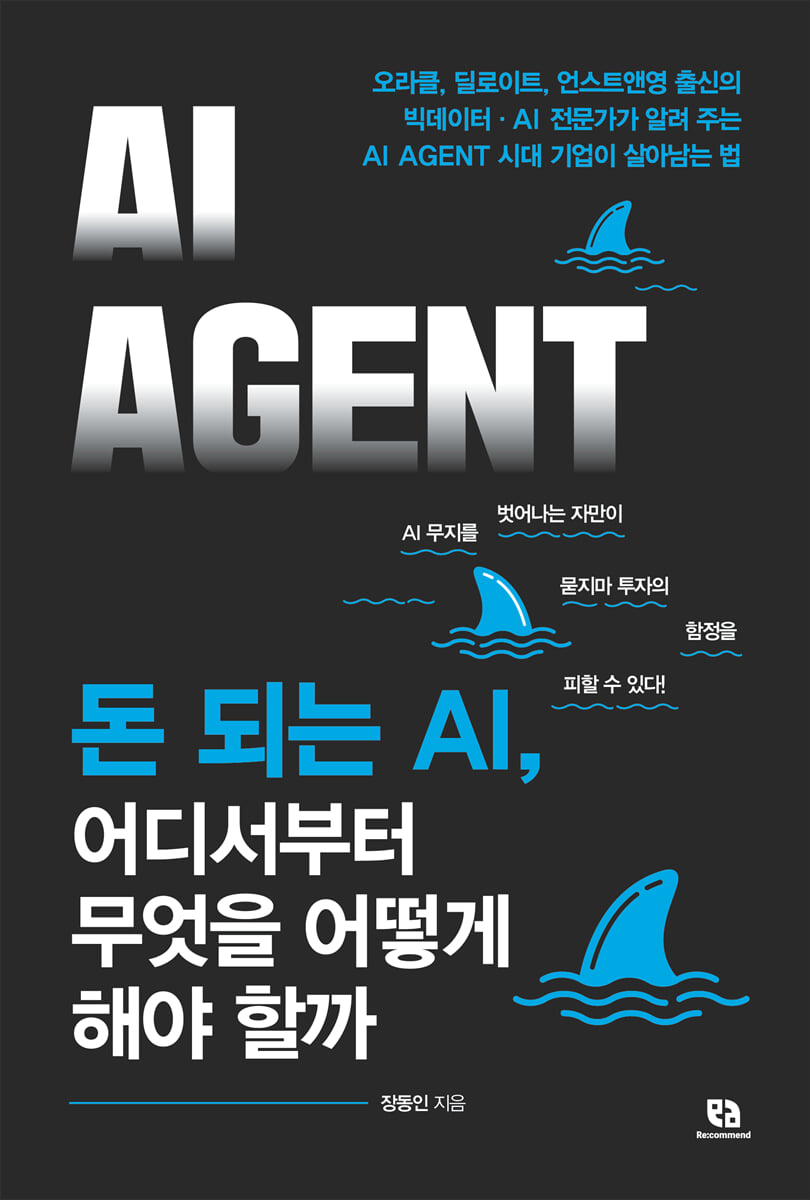
Profitable AI: Where to Start, What to Do, and How to Do It
 |
Description
Book Introduction
★ From Nvidia's Jensen Huang's secret to success to ChatGPT, DeepSearch, RAG, and AI Agent
★ Practical strategies for businesses to survive and grow in the rapidly evolving AI paradigm!
AI is no longer an option; it has become an essential strategy for business survival.
As we move beyond ChatGPT and enter the threshold of AGI (Artificial Intelligence), only companies that understand and embrace AI as a force that can fundamentally transform their business, rather than simply a tool, will survive.
The author, a leading AI and big data expert in Korea who has provided technology consulting to global corporations and public institutions for decades, weaves together the latest technological trends and real-world examples from his own experience to present a comprehensive plan for how both managers and practitioners can effectively utilize AI.
This book emphasizes that we should no longer rely on the illusion of AI.
Instead, it comprehensively covers the leadership of NVIDIA's Jensen Huang, cutting-edge technologies like ChatGPT and DeepSearch, and how to leverage next-generation AI like RAG and MCP. It emphasizes that to create truly profitable AI, even CEOs must have a solid understanding of AI. Discover this practical AI management book, a must-read for decision-makers like CEOs and executives, as well as all businesspeople preparing for the future.
- You can preview some of the book's contents.
Preview
index
prolog
Chapter 01 Why Companies Fail to Adopt AI
The idea that not using AI will save us from immediate ruin is ultimately a failure.
__Major Causes of AI Adoption Failure
__[Problem Solving] First, figure out why your employees aren't using AI!
Isolated AI organizations lead to failure.
__9-Step Work Process for AI Implementation
__Step-by-step roles in the 9-step AI implementation process
Insights from the 9-Step Process for AI Implementation
__The Problem with Isolated AI Organizations
__[Problem Solution] Only an open AI organization and company-wide collaboration are the way forward!
AI projects fail because people have different ideas about AI.
__Why AI Projects Are Going to the Mountains
__[Problem Solution] Executives need to study AI more than practitioners!
Leaving everything to externally hired AI experts is a recipe for failure.
__The Pitfalls of Hiring External Experts
The Strategic Value of Internal Talent Development
__[Problem Solution] Hire a small number of external experts, focusing on internal personnel!
Failure Checklist and Solutions
__Lack of strategy and timing
__Issues of organizational culture and perception
__Misunderstandings about technology and its introduction
__[Business Insights for CEOs] Remember the Six Sigma Movement?
Chapter 02: Introducing and Using Profitable AI
How to Define Problems for Profitable AI
Defining the Problem, Not Solving It: A 4-Step Filtering Guide
Step 1: Have you defined the problem narrowly and sharply?
Step 2: Is this a data-related issue?
Step 3: Is this a type that can be solved by AI?
Step 4: So, is it profitable? (Calculating ROI)
Five Principles for Choosing a Profitable AI Field
__Rule 1: Focus on a narrow, sharp area, not a grand one.
__Principle 2: Start with business objectives, not data.
__Rule 3: Leverage proven successes rather than completely new ones.
__Principle 4: Think of AI like Excel, not a specialized technology.
__Principle 5: Target areas that replace or reinforce existing systems.
How to Launch a Profitable AI Project
__Recruiting AI experts
__AI project outsourcing
Hybrid Model: Hiring Experts + Focusing on AI Projects
__In-house implementation after internal staff training
A 4-Step Roadmap to Profitable AI Work: Focusing on HR
Step 1: Reduce repetitive tasks with task automation.
Step 2: Predicting and Looking to the Future
Step 3: Review the results of various "what ifs" using simulations.
Step 4: Find the best solution by optimizing your work
__[Case 1] Finding Ideas for Optimization: Salesforce.com
__[Case 2] Finding Ideas for Optimization: Palantir
The ABCD Methodology for Profitable AI Implementation
__What is the ABCD methodology?
Why is the ABCD methodology necessary?
Step 1: Analysis and Opportunity Spotting
Step 2: Problem Definition and Design (Blueprint)
Step 3: Create
Step 4: Performance Evaluation and Development
Chapter 03 Business Insights Through Understanding AI
Three Things to Know Before Understanding AI
A minimal history of AI
__The root cause of AI winter
__[Business Insights for CEOs] Why We Trusted AI Experts' Excessive Promises and Paid Huge Research Funds
Learning and Inference in Artificial Intelligence
__Learning: The arduous process of finding the optimal formula
__Inference: The process of calculating an answer using a formula
__[Business Insights for CEOs] Learning and Inference
How Computers Understand Human Language
__The Story of the Vector Revolution
__Embedding process
__[Business Insights for CEOs] What Assets Can Be Vectorized in Your Company?
A revolutionary model that ushered in the LLM era: Transformer
__RNN
__LSTM
__The appearance of Transformers
__Transformer's architecture
__Why did OpenAI create GPT using only a decoder?
How to Make AI Smarter: The First Law of Scaling
__Transformer differentiation: decoder series, encoder series, decoder-encoder series
The Birth of the __LLM Scaling Law
__The Beginning of Prompt Engineering
__[Business Insights for CEOs] Bigger Models, More Data, More GPUs: The Money Wars
After creating GPT-3
__smart reasoning skills
__GPT-3's answer without common sense
How to Make AI Smarter: The Second Law of Scaling
OpenAI's Concerns After GPT-3
__[Business Insights for CEOs] Conversational AI Service Businesses: A Series of Failures
Preparing for the Birth of ChatGPT: The World's First Conversational AI Service
__ChatGPT is finally released
__Second Scaling Law: RLHF
__[Business Insights for CEOs] AI that Holds All the World's Knowledge vs. AI that Provides the Answers Users Want
How to Make AI Smarter: The Third Law of Scaling
__Test-time calculation
__The Beginning of Deep Thinking, the Emergence of O1
__The Three-Stage Paradigm of Modern AI: Learning, Reasoning, and Thinking
The emergence of deep chic
__Three Key Questions About DeepSeak
__Deep Seek's second shock
The ripple effects of DeepSec's full disclosure
__ Deep Seek's influence
__The implications of Jensen Huang's announcement of the test time scaling law
__Why does Yann LeCun say that AGI cannot be achieved with the current LLM?
__[Business Insights for CEOs] What the Law of Test Time Scaling Means for Korean AI Chip Ventures
Chapter 04 Systems Thinking in the AI Era
System 1 Thinking: Fast Intuition
__Characteristics of System 1 thinking
System 2 Thinking: Careful Logic and Analysis
__Characteristics of System 2 thinking
The Influence of Daniel Kahneman's Thoughts and Theories
System 1 thinking is AI's reasoning model, and System 2 thinking is AI's thinking model.
__Mapping System 1, System 2 Thinking with AI Models
The Limitations of System 2 Thinking and the Potential of AI Thinking Models
What Happens When AI Replaces System 2 Thinking in the Corporate Environment
__[Problem Solution: Corporate Perspective] Employees should become masters of AI tools, not slaves to them.
__[Problem Solution: CEO Perspective] The CEO must lead the entire organization's thinking.
__[Business Insights for CEOs] What are High-Value-Added Jobs in the AI Era?
Chapter 05: How Companies Use AI, RAG
Why Companies Should Leverage RAG
__RAG
__RAG's Advantages
The company's RAG process
__Data Preparation Process: Building AI's Knowledge Warehouse (Vector DB)
__Question Answering Pipeline: Generating Answers Intelligently
Comparing Open Source and Closed Source LLMs at RAG
__How to Use Open Source LLM
__Comparative Analysis of Open-Source LLM vs. Closed-Source LLM-Based RAG Implementations
Things to consider in RAG
__Careful selection and management of embedding models
__Complexity of document processing
__Advanced technology to improve search accuracy
__Building an intelligent RAG
What are Ragas?
__Ragas' Key Evaluation Indicators
__Verification Process
__Result analysis and improvement
Key applications of RAG
__Industry-specific utilization plans
__RAG's business-specific utilization plans
Chapter 06 AI Agent
What is an AI agent?
__Differences between general programs and AI agents
__The structure of an AI agent
__Advantages and Limitations of AI Agents
How to implement an AI agent
__Major development tools for implementing AI agents
__Why is choosing development tools important in your business?
Agent Package
__LangChain: A Standard Framework for AI Agent Development
__Langgraph: Flow Engineering for Complex AI Agents
__Open Deep Research
__OpenAI Agents SDK
__CrewAI: A World of Collaborative Agents
Vibe Coding
__Cursor: A representative Vibe coding tool based on Visual Studio Code
__Claude Code: Antropic's coding expert AI
Gemini CLI: A Google AI-Powered Command-Line Assistant
No-code tools
Microsoft Copilot Studio: Optimized for building AI chatbots and agents.
Google Agent Builder: A Data-Retrieval-Based AI Agent Development Platform
AWS Bedrock Agent Core: A Comprehensive AI Agent Platform Consisting of Seven Modules
__n8n: A no-code workflow automation tool that connects over 1,000 apps.
__Defi: An all-in-one no-code platform for LLM-based application development.
__Asiworks: A no-code AI agent platform specialized for Korean corporate practices.
Integrating AI agents with existing systems
__Simple information retrieval: Areas where AI alone can do it
__Optimization: An area impossible without system integration
__Why Integration is Key to Optimization
__Innovative benefits from AI agent integration
AI Agents vs. Agentic AI
Comparing the Concepts of AI Agents and Agentic AI
__Agentic AI Case Study
__Agentic AI's orchestration capabilities
__Comparison of Skyworks and Genspark
__OpenAI's ChatGPT agent
Problems with AI agents
__Major problems with AI agents
__Solution to AI Agent Problems
MCP: The App Store in the AI Agent Era
__How AI agents linked to MCP servers work
__MCP Server and smithery.ai
__MCP's architecture
__MCP's Core Values
__Disadvantages of MCP
__MCP Server Recommendation
How to Use AI Agents
__Industry-specific applications of AI agents
__AI Agent Utilization Plans for Each Task
Chapter 07 Various Ways to Introduce AI in Businesses
Current status of network separation in domestic companies
__Detailed analysis of network separation obligation targets
How Network Separation Constrains Enterprises' Use of AI
Data Security and Architecture Choices
__Data Security: How to Protect Your Data
__Data Privacy: The Rules for Handling Data (What & Why)
__Strategic Compromise and the Need for Hybrids
Various architectures for AI adoption
__Type A: Closed Source LLM
__A-1 Type: Using OpenAI's Assistant API
__Type B: Use of open source LLM
__B-1 Type: Open Source LLM + Cloud Access
__Type C: A type + B type hybrid
__D Type: OpenAI's Enterprise ChatGPT
__D-1 Type: OpenAI's Team with GPTs
Epilogue
Detailed image

Into the book
For Korean companies to lead global trends, they must take unprecedented paths.
Korean companies have always worked hard.
Going forward, it's essential for all employees to work hard, and CEOs must possess extraordinary insight and technological foresight to navigate the AI era.
This book is written for CEOs who want that kind of leadership.
--- p.10
What I've realized from consulting with many companies is that, ultimately, a company's AI level cannot be higher than that of its CEO.
Why is this? Because there are no guidelines or manuals for how AI should be applied in businesses. The concept of AI itself is so abstract that everyone's level of understanding varies greatly, making CEOs unable to expect anything beyond their own capabilities.
So no matter how hard you try, you will only get to that level.
--- p.13
There are numerous reasons why AI projects fail, but the most fundamental one lies in the vast gap between management and operational staff in their perception and expectations of AI.
It's like several blind men trying to imagine the whole elephant, each touching a different part of it.
This gap can cause projects to drift and ultimately lead to failure.
--- p.45
Executives need to move beyond AGI-level fantasies and clearly understand the current possibilities and limitations of AI, while practitioners need to be honest from the outset about the practical implementation of AI technology.
This way, management will not have unnecessary expectations.
--- p.47
A leader's true commitment must be demonstrated through the adoption of human-centered AI. AI projects succeed when employees who know the business best drive change in their respective fields.
To achieve this, collaboration that breaks down barriers between departments is essential, and channels must be established for the voices of collective intelligence emerging from a horizontal culture to be freely proposed and quickly reflected in management.
--- p.367
Publisher's Review
★ Only those who overcome AI ignorance can avoid the trap of blind investment!
★ A comprehensive navigation system for introducing real ‘profitable AI’, not just a show-off project!
After ChatGPT, the world is entering the era of AGI (Artificial Intelligence).
However, many companies are not achieving remarkable results despite adopting AI.
It is not uncommon for systems to be introduced but fail to connect with the field or to fail at the implementation stage due to lack of understanding from management.
The author finds the cause in the 'perspective that sees AI only as technology.'
The level of AI in a company can never exceed the level of understanding of the CEO, and 90% of AI projects fail from the very first problem definition stage.
This book goes beyond simply introducing AI technology; it answers the fundamental question: "How can we connect AI to corporate strategy?"
More important than simply introducing AI is how to strategically utilize it.
This is an era where only well-prepared companies can create new opportunities with AI, while unprepared companies will soon disappear from the market.
This book will serve as an accurate compass for AI adoption for companies and CEOs at this critical juncture.
▶ 4 Steps to Defining Problems for "Monetary AI"
- Step 1: Have you defined the problem narrowly and sharply?
- Step 2: Is the problem data-related?
- Step 3: Is this a type that can be solved by AI?
- Step 4: So does it make money?
The ABCD Methodology for Implementing "Monetary AI"
- Step 1: Analysis and Opportunity Spotting
- Step 2: Problem Definition and Design (Blueprint)
- Step 3: Create
- Step 4: Performance Evaluation and Development (Develop)
▶ Introduction to key development tools for implementing AI agents
- Agent packages: LangChain, LangGraph, OpenAI Agents SDK, CrewAI
- Vibe Coding: Cursor, Cloud Code, Gemini CLI
No-code: Microsoft Copilot Studio, Google Agent Builder, AWS Bedrock Agent Core, n8n, DeFi, Asiworks
▶ Various architectures for AI adoption
- Type A: Closed Source LLM
- Type A-1: Use of OpenAI's Assistant API
- Type B: Use of open source LLM
- Type B-1: Open Source LLM + Cloud Usage
- Type C: A type + B type hybrid
- Type D: OpenAI's enterprise ChatGPT
- Type D-1: OpenAI's Team with GPTs
▶ Readers who need this book
- CEOs and executives who want to apply AI to corporate management
- Planners and corporate consultants who develop various AI adoption strategies
- Practitioners who want to achieve work innovation through AI technology and connect it to real-world businesses.
- Businesses seeking to secure future competitiveness through AI innovation
- Anyone considering business direction in the AGI era
GOODS SPECIFICS
- Date of issue: September 30, 2025
- Page count, weight, size: 368 pages | 538g | 152*225*18mm
- ISBN13: 9791194084181
You may also like
카테고리
korean


korean


