

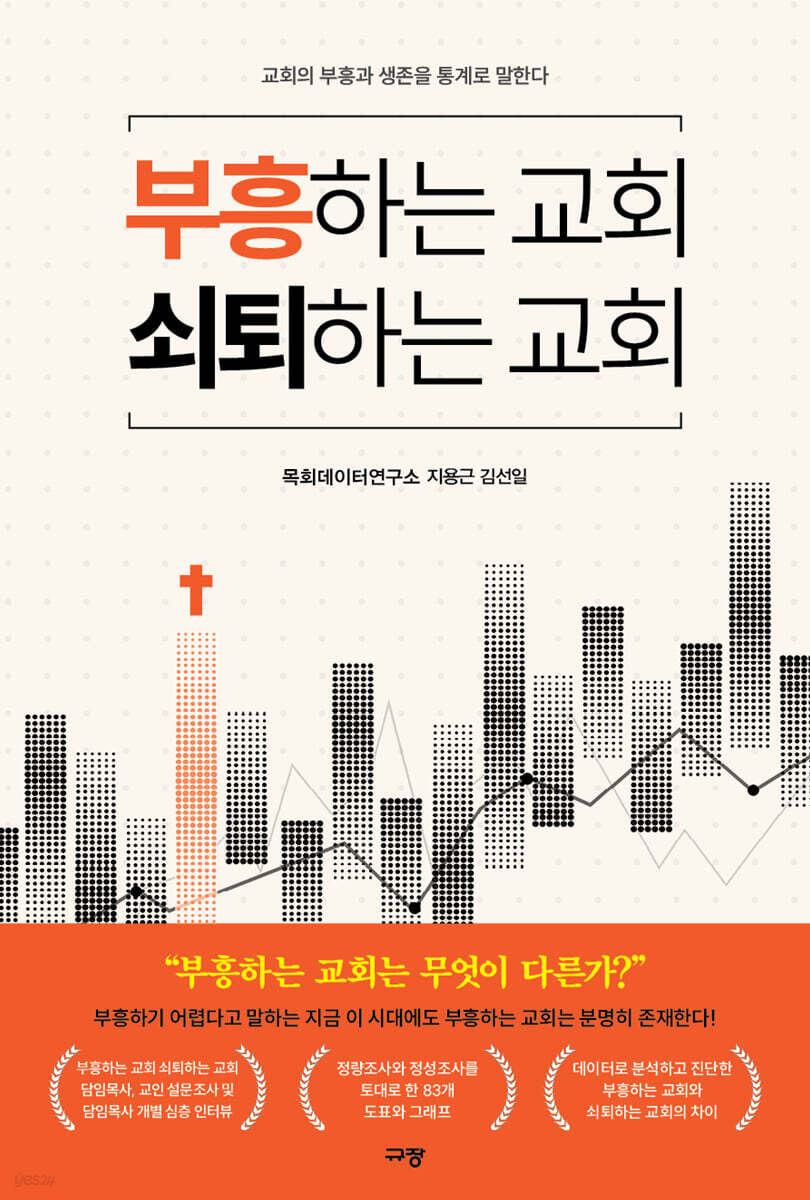
The Revival Church, the Declining Church
 |
Description
Book Introduction
Now is the time for transformation rather than recovery.
It is too early to give up on church revival!
“Where is the Korean church headed now?” This is a contemporary question facing those concerned about the future of the Korean church.
The church, once the spiritual center of Korean society and the foundation of the community, has recently been struggling to restore worship services, especially since the COVID-19 pandemic. Pastoral care is facing more serious challenges than ever before, with issues such as a sharp decline in the next generation, a decline in church membership, the departure of the 30-40 age group, shrinking finances, a decline in devotees, and accumulated fatigue.
However, as pastors struggle with the difficulties caused by COVID-19, a sense of helplessness and isolation is evident everywhere in the ministry field. Many pastors are frustrated and unsure of what to do next. By presenting solutions based on the current diagnosis, I wanted to give them hope that “our church can also survive.”
Now is the time when 'transition' is required rather than 'recovery'.
This is not a time to simply return to the pre-COVID state, but a time to explore new ministries, cultures, leadership, and ways to communicate the gospel.
The church must be re-established as a new vessel that is faithful to its essence while also being flexible enough to embody the language of the times.
Revival is still possible.
It is not simply a matter of numerical increase, but a process in which the gospel is fully proclaimed, disciples are nurtured, communities are brought to life, and the next generation grows up with a vision of the kingdom of God.
It starts with the change-oriented attitude of pastors and church leaders.
I hope this book will serve as a practical guide to starting that journey.
It is too early to give up on church revival!
“Where is the Korean church headed now?” This is a contemporary question facing those concerned about the future of the Korean church.
The church, once the spiritual center of Korean society and the foundation of the community, has recently been struggling to restore worship services, especially since the COVID-19 pandemic. Pastoral care is facing more serious challenges than ever before, with issues such as a sharp decline in the next generation, a decline in church membership, the departure of the 30-40 age group, shrinking finances, a decline in devotees, and accumulated fatigue.
However, as pastors struggle with the difficulties caused by COVID-19, a sense of helplessness and isolation is evident everywhere in the ministry field. Many pastors are frustrated and unsure of what to do next. By presenting solutions based on the current diagnosis, I wanted to give them hope that “our church can also survive.”
Now is the time when 'transition' is required rather than 'recovery'.
This is not a time to simply return to the pre-COVID state, but a time to explore new ministries, cultures, leadership, and ways to communicate the gospel.
The church must be re-established as a new vessel that is faithful to its essence while also being flexible enough to embody the language of the times.
Revival is still possible.
It is not simply a matter of numerical increase, but a process in which the gospel is fully proclaimed, disciples are nurtured, communities are brought to life, and the next generation grows up with a vision of the kingdom of God.
It starts with the change-oriented attitude of pastors and church leaders.
I hope this book will serve as a practical guide to starting that journey.
- You can preview some of the book's contents.
Preview
index
introduction
Opening remarks
?
Part 1: A Revival Church Has a Culture of Ministry Participation
01 Increase in the number of volunteers
02 Expansion of ministry programs
03 High ministry participation
04 Activation of Lay Ministry
Part 2: The Revival Church is Future-Oriented
05 Increase in the number of 3040 generation
06 The next generation's revival
07 Activation of parent education
Part 3: The Revival Church Is Committed to the Great Commission
08 Increase in the number of baptisms
09 Practice and Culture of Evangelism
10 Systematizing New Family Education
11 Finances Beyond the Church Walls
Part 4: A Revival Church is a Community of Togetherness
12 Activating small group ministry
13. The acceptability of change among church members
14 The will of the believers to reform
Part 5: Why Are Declining Churches Dying?
15. Shifting responsibility
16 Conflict and confrontation within the church
17 The spiritual stagnation of pastors
18 Weakening of prayer and spirituality
19. Disconnection from communication and fellowship
20 Decreasing service
21 Absence of vision
22 The Lost Waist Generation
Closing remarks
supplement
Comparing the Revival of Churches in Korea and the United States
Correlation Analysis Table Between Key Variables in Revival vs. Declining Churches
Summary of quantitative survey results
Summary of qualitative research results
Church Diagnostic Test Sheet
Americas
Opening remarks
?
Part 1: A Revival Church Has a Culture of Ministry Participation
01 Increase in the number of volunteers
02 Expansion of ministry programs
03 High ministry participation
04 Activation of Lay Ministry
Part 2: The Revival Church is Future-Oriented
05 Increase in the number of 3040 generation
06 The next generation's revival
07 Activation of parent education
Part 3: The Revival Church Is Committed to the Great Commission
08 Increase in the number of baptisms
09 Practice and Culture of Evangelism
10 Systematizing New Family Education
11 Finances Beyond the Church Walls
Part 4: A Revival Church is a Community of Togetherness
12 Activating small group ministry
13. The acceptability of change among church members
14 The will of the believers to reform
Part 5: Why Are Declining Churches Dying?
15. Shifting responsibility
16 Conflict and confrontation within the church
17 The spiritual stagnation of pastors
18 Weakening of prayer and spirituality
19. Disconnection from communication and fellowship
20 Decreasing service
21 Absence of vision
22 The Lost Waist Generation
Closing remarks
supplement
Comparing the Revival of Churches in Korea and the United States
Correlation Analysis Table Between Key Variables in Revival vs. Declining Churches
Summary of quantitative survey results
Summary of qualitative research results
Church Diagnostic Test Sheet
Americas
Detailed image
Into the book
The vitality of a church is not simply measured by the number of members, but rather by complex indicators such as age distribution, ministry participation, and the number of baptisms and conversions.
According to our research, thriving and declining churches show marked differences across nearly every key indicator.
--- p.16
Recently, the Korean church has recognized the decline of the 30-40 age group, also known as the "Waist Generation," and the weakening of faith as a serious issue.
Ironically, this study shows that the increase in the number of believers in their 30s and 40s is the main driving force behind growth in revivalist churches.
The revival of the 3040 generation will lead to the revival of the next generation, which will brighten the future of the church.
--- p.69
Regional factors have some influence.
In the reviving churches in Seoul and other large cities, the growth rate of the next generation was 48.7% and 46.9%, respectively, while in the reviving churches in towns and villages, it was significantly lower at 28.6%.
This shows that large cities have advantageous conditions in terms of next-generation infrastructure and social resources.
However, at the same time, in the response of church members in revival, there was no significant difference in the response of the next generation increase, with 44.3% in large cities and 39.5% in rural areas.
These results suggest that region is not an absolute barrier, and demonstrate that there are examples of overcoming regional constraints and achieving next-generation revival.
--- p.82
Among the next-generation ministry evaluation items comparing thriving and declining churches, parent education activation recorded the lowest positive response rate across all church types.
This means that all churches place parent education at the bottom of their ministry priorities.
What's even more serious is that, despite the fact that parent education is closely related to church revival—increased church membership, growth of the next generation, revitalization of small groups, and the establishment of the 30-40 age group—it is the most neglected aspect of practice and strategy.
--- p.93
The growth and vitality of a reviving church does not come from mere expansion in size or outward appearance, but from faithfully carrying out its essential mission of evangelism and missionary work.
Saints who are dedicated to evangelism and missions are workers who actively participate in the church's mission, and their very existence is evidence of the church's vitality and dynamism.
--- p.115
Churches that hold regular small group meetings at least once a week are more likely to experience revival.
In thriving churches, 70.3% met at least once a week, compared to only 52.1% in declining churches.
In addition, the lower the level of faith of believers, the lower the rate of participation in small groups, which means that small groups are a necessary device for new believers to settle in and mature in their faith.
Furthermore, the more ministry programs a church has, the more actively small groups are operated, confirming that a virtuous cycle is operating between small groups and programs.
--- p.141
On the other hand, in declining churches, the will to reform was significantly lower.
In the case of declining churches, only 31.3% of pastors and 26.0% of church members responded that they had the will to reform.
The higher the proportion of elderly church members, the greater the resistance to reform, and the younger the pastor, the more skeptical the church members were about their will to reform.
This suggests that differences in perception between age groups and the difficulties of generational change are intertwined.
--- p.154
Ultimately, the beginning of true revival depends on whether the church can undertake its own spiritual self-diagnosis.
For a declining church to move toward recovery, it needs the courage to make internal diagnoses and strategic shifts, rather than complaining about the environment.
The insight that a church that blames others does not change, while a church that reflects and moves changes, is still valid in today's Korean church.
--- p.170
For a declining church to experience true revival, it must return to prayer and spirituality.
This is not simply a strengthening of personal religious life, but a way to restore the identity and mission of the church.
There is no revival without prayer.
Without prayer, there are no small groups, no 30-40 generation, and no next generation.
A church that has lost its spiritual strength will eventually become nothing more than a shell organization, losing its meaning in the world.
Now is the time for the church to stand again as a praying community.
--- p.188
Another characteristic of a declining church is a fear and passivity toward change.
Even if you want to try something new, there are many cases where you can't even try due to internal conflicts or disagreements among church members.
In particular, changes in core ministries such as worship can easily lead to tensions caused by generational gaps, which can ultimately lead to abandonment of change and the departure of the younger generation.
--- p.203
In small or rural churches, talking about ministry to the 30-40 age group, raising the next generation, and family faith education can sound like unrealistic tasks.
But as this study shows, there are clear paths to action, regardless of scale.
Rather, small churches have the advantage of being able to look into each member more deeply and provide personalized care due to their smaller size.
Even if there aren't many people in their 30s and 40s, if you appoint one or two of them as central coworkers and entrust them with small groups and service ministries, the entire church will be energized.
Just by sharing a meal with them and sharing their faith and mission, a deep bond is formed.
According to our research, thriving and declining churches show marked differences across nearly every key indicator.
--- p.16
Recently, the Korean church has recognized the decline of the 30-40 age group, also known as the "Waist Generation," and the weakening of faith as a serious issue.
Ironically, this study shows that the increase in the number of believers in their 30s and 40s is the main driving force behind growth in revivalist churches.
The revival of the 3040 generation will lead to the revival of the next generation, which will brighten the future of the church.
--- p.69
Regional factors have some influence.
In the reviving churches in Seoul and other large cities, the growth rate of the next generation was 48.7% and 46.9%, respectively, while in the reviving churches in towns and villages, it was significantly lower at 28.6%.
This shows that large cities have advantageous conditions in terms of next-generation infrastructure and social resources.
However, at the same time, in the response of church members in revival, there was no significant difference in the response of the next generation increase, with 44.3% in large cities and 39.5% in rural areas.
These results suggest that region is not an absolute barrier, and demonstrate that there are examples of overcoming regional constraints and achieving next-generation revival.
--- p.82
Among the next-generation ministry evaluation items comparing thriving and declining churches, parent education activation recorded the lowest positive response rate across all church types.
This means that all churches place parent education at the bottom of their ministry priorities.
What's even more serious is that, despite the fact that parent education is closely related to church revival—increased church membership, growth of the next generation, revitalization of small groups, and the establishment of the 30-40 age group—it is the most neglected aspect of practice and strategy.
--- p.93
The growth and vitality of a reviving church does not come from mere expansion in size or outward appearance, but from faithfully carrying out its essential mission of evangelism and missionary work.
Saints who are dedicated to evangelism and missions are workers who actively participate in the church's mission, and their very existence is evidence of the church's vitality and dynamism.
--- p.115
Churches that hold regular small group meetings at least once a week are more likely to experience revival.
In thriving churches, 70.3% met at least once a week, compared to only 52.1% in declining churches.
In addition, the lower the level of faith of believers, the lower the rate of participation in small groups, which means that small groups are a necessary device for new believers to settle in and mature in their faith.
Furthermore, the more ministry programs a church has, the more actively small groups are operated, confirming that a virtuous cycle is operating between small groups and programs.
--- p.141
On the other hand, in declining churches, the will to reform was significantly lower.
In the case of declining churches, only 31.3% of pastors and 26.0% of church members responded that they had the will to reform.
The higher the proportion of elderly church members, the greater the resistance to reform, and the younger the pastor, the more skeptical the church members were about their will to reform.
This suggests that differences in perception between age groups and the difficulties of generational change are intertwined.
--- p.154
Ultimately, the beginning of true revival depends on whether the church can undertake its own spiritual self-diagnosis.
For a declining church to move toward recovery, it needs the courage to make internal diagnoses and strategic shifts, rather than complaining about the environment.
The insight that a church that blames others does not change, while a church that reflects and moves changes, is still valid in today's Korean church.
--- p.170
For a declining church to experience true revival, it must return to prayer and spirituality.
This is not simply a strengthening of personal religious life, but a way to restore the identity and mission of the church.
There is no revival without prayer.
Without prayer, there are no small groups, no 30-40 generation, and no next generation.
A church that has lost its spiritual strength will eventually become nothing more than a shell organization, losing its meaning in the world.
Now is the time for the church to stand again as a praying community.
--- p.188
Another characteristic of a declining church is a fear and passivity toward change.
Even if you want to try something new, there are many cases where you can't even try due to internal conflicts or disagreements among church members.
In particular, changes in core ministries such as worship can easily lead to tensions caused by generational gaps, which can ultimately lead to abandonment of change and the departure of the younger generation.
--- p.203
In small or rural churches, talking about ministry to the 30-40 age group, raising the next generation, and family faith education can sound like unrealistic tasks.
But as this study shows, there are clear paths to action, regardless of scale.
Rather, small churches have the advantage of being able to look into each member more deeply and provide personalized care due to their smaller size.
Even if there aren't many people in their 30s and 40s, if you appoint one or two of them as central coworkers and entrust them with small groups and service ministries, the entire church will be energized.
Just by sharing a meal with them and sharing their faith and mission, a deep bond is formed.
--- p.219
Publisher's Review
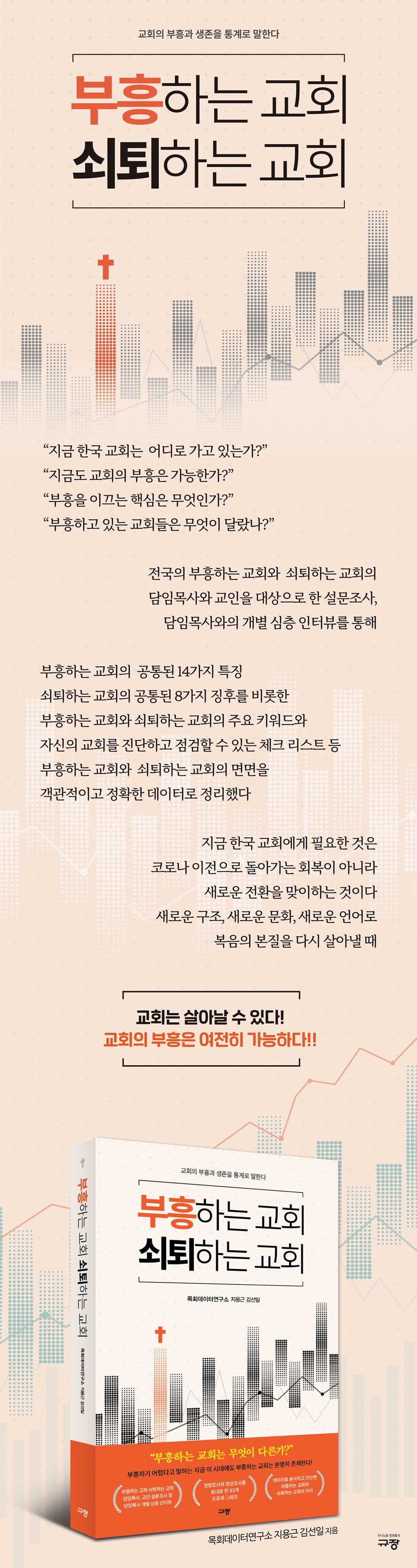
"Reviving Churches, Declining Churches," which began with the contemporary question, "Where is the Korean Church Headed?" accurately diagnoses the current state of the Korean Church and statistically identifies the gap between reviving and declining churches.
Even in times when revival is truly difficult, there are still churches that are thriving.
Accordingly, we investigated and analyzed 14 common characteristics of reviving churches and 8 signs of declining churches, as well as the correlation between their structure and culture, by investigating and analyzing both flourishing and declining churches, pastors, and believers.
Rather than expecting a return to pre-COVID levels, a new transition is needed.
In such cases, the analysis and cases presented in this book can provide insight.
Revival is still possible today when not only pastors but also church leaders actively seek change and challenge.
The only thing that can be salt and light in this world is the church.
I highly recommend this book to all Christians, especially pastors, church leaders, and leaders, who dream of revival and are building the church as the body of Christ.
Even in times when revival is truly difficult, there are still churches that are thriving.
Accordingly, we investigated and analyzed 14 common characteristics of reviving churches and 8 signs of declining churches, as well as the correlation between their structure and culture, by investigating and analyzing both flourishing and declining churches, pastors, and believers.
Rather than expecting a return to pre-COVID levels, a new transition is needed.
In such cases, the analysis and cases presented in this book can provide insight.
Revival is still possible today when not only pastors but also church leaders actively seek change and challenge.
The only thing that can be salt and light in this world is the church.
I highly recommend this book to all Christians, especially pastors, church leaders, and leaders, who dream of revival and are building the church as the body of Christ.
GOODS SPECIFICS
- Date of issue: August 7, 2025
- Page count, weight, size: 240 pages | 152*225*20mm
- ISBN13: 9791165046446
- ISBN10: 116504644X
You may also like
카테고리
korean


korean

![GQ KOREA Mark (Monthly): December [2025]](http://librairie.coreenne.fr/cdn/shop/files/8ef265dbbfbf186523ed75ba7319009d.jpg?v=1765340328&width=3840)


