

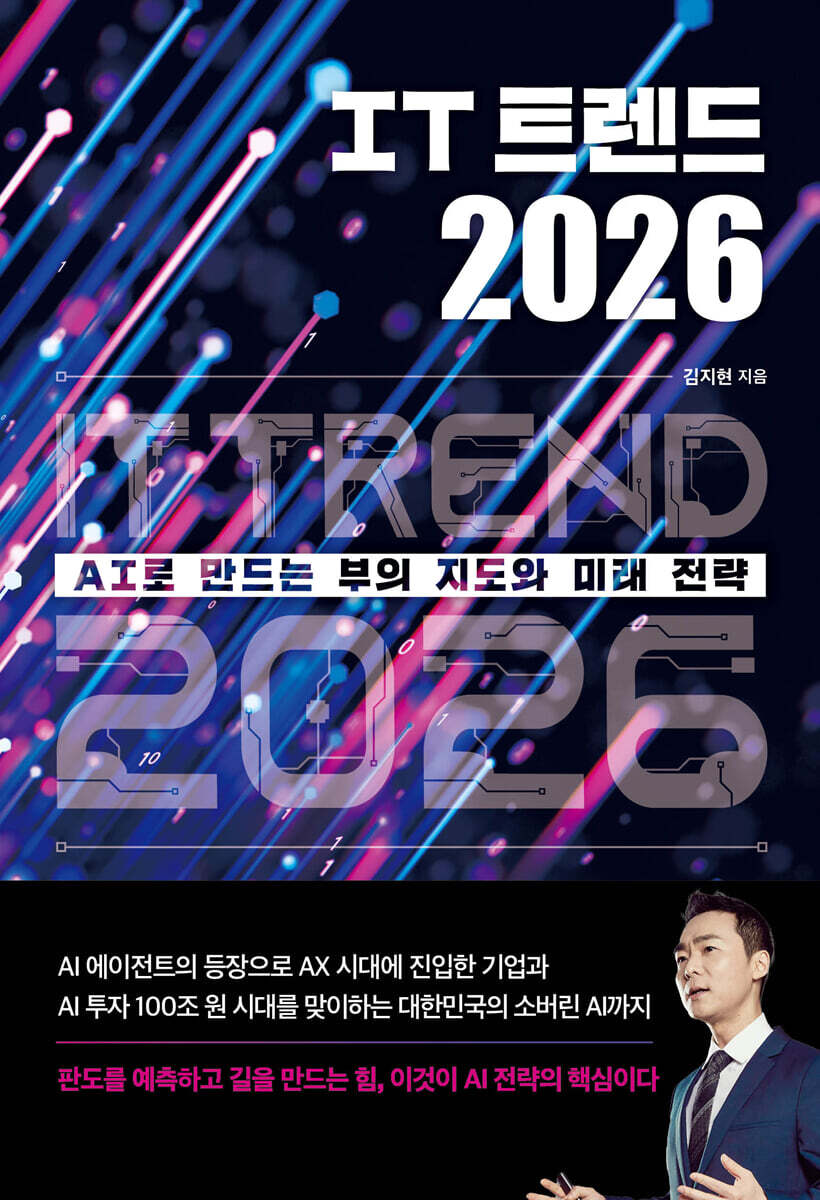
IT Trends 2026
 |
Description
Book Introduction
“Recognizing and understanding technological change is
“A starting point for insight into new market innovations and industry prospects.”
2026 Korea and AX Future Survival Strategy Designed with AI,
A new era of AI-driven hegemony is coming.
The time of technology runs much faster and more powerfully than the time of humans.
The past year has made the past decade pale in comparison, and the changes of the past month have compressed the past year into a single whole.
Just a year ago, AI was predicted to permeate our lives through standardization and upward standardization. But by 2025, we face a completely different reality. AI core technologies have made tremendous strides, and AI services and products based on them are proliferating.
Technology is no longer an option.
It overwhelms society, economy, culture, business, politics, and diplomacy, and business models change 180 degrees every year based on this.
The IT keywords that will dominate 2026 can be simply summarized into two.
This marks the dawn of the AI agent era and the revival of the metaverse. AI is no longer a tool, but a new interface that acts on behalf of humans.
It is embedded in all our devices, software, apps and services, becoming our hands and feet.
The metaverse is finally waking up from its long slumber. The combination of mixed reality (MR) devices and AI agents will usher in another massive leap forward.
We stand at the threshold of a third revolution driven by AI agents and the metaverse.
And in 2026, South Korea must take the lead in driving this change.
In 2026, South Korea will embark on a full-scale acceleration strategy toward technological competition, AI self-reliance, and industrial ecosystem innovation. As we enter an era of 100 trillion won in AI investment, we anticipate a commitment to sovereign AI, along with strategic investment and talent development. Let's prepare for 2026 with "IT Trends 2026," which explores the trends and strategies of IT technology and South Korea's future.
- You can preview some of the book's contents.
Preview
index
prolog
PART 1.
10 IT Keywords for 2026
10 Keywords for 2026 Readable Through AI
1.
AI Agents: A Leap From Thinking AI to Acting AI
2.
Innovator AI solves problems even humans can't.
3.
The Evolution of Application Services: Beyond AI Core Technologies, into Business Opportunities
4.
Completing AI with 'Imitation Learning and Associative Learning'
5.
AI Optimization Strategy: A New Strategy That Overwhelms Search Engine Optimization
6.
"AX Full-Fledged" Transforms Corporate Business and Work Culture
7.
AI-Dedicated Devices Connect PCs and Smartphones
8.
Another revolution in intelligent spaces: 'Metaverse and AI'
9.
"Human Digital Twins" Evolve into Digital Humans
10.
The 'AI Research Revolution' Will Bring an Era Where Anyone Can Write a PhD-Like Paper
PART 2. The Dawn of the AI Agent Era
The Agent Economy at a Turning Point
AI Agents Evolve into Full Form
The Third Browser War in the AI Era
The birth of the AI-AI alliance: the superintelligence alliance.
Let's give AI a leg up: MCP and A2A
The Agent Economy: Threatening the Platform Throne
A new business map designed by Agent Economy
Considerations for Agent Building and Development
Types and roles of agents
Agent Development: A Puzzle of Technology and Strategy
Why Companies Choose Agents
Agent Performance Optimization Methods
Pitfalls and Considerations of Agent Introduction
Agent operation technology and ecosystem conditions
PART 3. The Evolution of AI Devices and Metaverse Platforms
A device by AI, for AI, and of AI
The world in my hands, transformed by AI devices
The spectacular failure of first-generation AI devices
The potential of next-generation AI devices
Metaverse and AI in Everyday Life
Orion of Meta, will he become the savior of the metaverse?
Metaverse content created by generative AI
The metaverse ecosystem is now user-centric.
A metaverse economy driven by AI agents
AI agents with wallets, the protagonists of the future economy.
PART 4. AI Sovereignty and Innovation: Challenges for Governments and Corporations Ahead of 2026
At the Threshold of the AGI Era, AI Accelerates
In an era where AI writes code, development takes place without developers.
A World Working with AI: Asking About New Roles for Humans
Physical AI is infiltrating reality, requiring realistic control. Is AI a tool or a power?
The government's AI policy for national competitiveness, "Sovereign AI."
In the AI era, Korea must take the lead again.
China's vertical integration strategy showcases its AI prowess.
Why is Chinese capital targeting Korean platforms?
HBM Alone Isn't Enough: Korea's AI Investment Landscape
The AI Sovereignty War: Seize the Golden Time in 2026
The Hidden Variable in AI Competitiveness: The Global Energy War
Korean AI Voucher: Digital Welfare for the People
Platforms in the AI Era: Impossible Without Investment?
Corporate Attitudes and Strategies for AI Innovation
AX is the answer to a company's survival strategy.
The Future of Organizations: AI Colleagues
The Evolution of High-Performance Memory: The Power That Powers AI
Self-driving cars and robots will lead the semiconductor industry's second revival.
Individual and Organizational Response Strategies in the Age of AI Transformation
3 Principles for Making AI Your Ally
A New Standard for Children Growing Up with AI
The Role of Leaders in the AI Era and AX Strategy
Appendix. AI Trends 2026: Q&A
① How should we understand complex AI technologies and terminology?
② Can AI replace the human brain?
③ Will AI take over the future of internet search?
④ From Google Glass to Apple Vision Pro, will the path to popularizing the metaverse open?
⑤ In the era of manufacturing AX, what is the secret behind AI driving factory innovation?
⑥ Will cryptocurrencies be revived through stablecoins and DeFi combined with existing finance?
⑦ With the introduction of AI agents, what kind of work will people do?
⑧ In the AGI era, will humanity be able to control it?
⑨ Could the AI Agent Economy Become a New Center of Wealth?
⑩ Are quantum computers enemies or partners of AI and blockchain?
Explore AI Insights for 2026
Detailed image

Into the book
Ultimately, LLM is language, RLM is reasoning, LAM is execution, and agents are based on behavior. Based on these technologies, agentic AI achieves autonomy, and physical AI realizes existence and relationships. Only by completing all these steps can AGI truly become a "living AI" like humans. The final puzzle piece in AGI's new journey is physical AI.
--- p.24
2026 will be the year when AI breaks free from its role as a human assistant and leaps forward to become a true "innovator."
Until now, AI has been limited to responding and executing based on given information, such as generating text or creating images.
But now, AI is moving towards defining and solving complex problems that even humans find difficult to solve, and even creating new knowledge.
This leap goes beyond simply advancing technology; it marks a turning point where the roles of humans and AI are fundamentally reconfigured.
--- p.25~26
In the future, imitative learning and associative learning will be applied more widely across various industries and social fields.
In industries like manufacturing, healthcare, and finance, as well as education and service industries, AI will collaborate more closely with humans, supporting sophisticated decision-making and automating routine tasks.
This learning method is expected to ultimately contribute greatly to improving the quality of human life and building a safer and more efficient society.
--- p.42
What makes AI devices different from existing PCs and smartphones is that AI is not just a built-in feature, but rather the 'purpose of use itself.'
Just as smartphones have expanded beyond phones to include cameras, wallets, maps, gaming consoles, and payment methods, AI devices encompass personal memory, schedule management, work productivity, content creation, and even emotional companionship.
In this way, AI devices are redefining the core of the user experience.
--- p.56
The evolution of AI has gone beyond summarizing information or organizing data.
This is now leading to the emergence of new research models that generate and structure expert knowledge.
By 2026, AI will reach a turning point, moving beyond being a tool for summarizing research papers to becoming a "researcher" who directly discovers knowledge, reconstructs theories, and even proposes research methodologies.
--- p.66
Just as Apple pioneered the mobile platform ecosystem in earnest with the launch of the App Store in 2007, the emergence of MCP and A2A is seen as a signal that will lead to explosive growth in the AI agent ecosystem.
In particular, A2A will help agents interact, exchange data, and collaborate more efficiently, allowing agents to communicate with other AIs and perform a wider range of tasks more seamlessly.
--- p.77
The most important part of an agent is its ability to go beyond simply understanding commands to 'understand goals', 'plan', and 'execute' them.
The first technological element needed to realize this is a high-performance LLM and a planning algorithm based on it.
Because simple responsive LLM alone cannot execute, a reasoning-centric model that can understand complex intent and structure it in a goal-oriented manner is needed.
For this reason, prompt-based reasoning frameworks such as React, ToT (tree of thought), and CoT (chain-of-thought) have recently been in the spotlight.
Agents must plan multi-step actions rather than simply performing a single action.
Therefore, it is essential to design a separate planner on top of the LLM.
--- p.111~112
Agents are no longer evaluated based on the performance of a single model.
It should be viewed as a single system that combines various technical elements such as planning, tool integration, state memory, security management, and data integration.
To simplify this complexity, agent development frameworks are emerging.
But essentially, the designer's planning ability and understanding of the overall system are key.
--- p.121
The reason why the combination of metaverse and AI agents is important is because it provides a ‘transformation’ of experience.
Users no longer have to worry about “What should I do?”
Because if you tell AI what you need, it will understand and do it automatically.
In other words, all actions within the metaverse are converted from imperative to ‘conversational’.
The metaverse will evolve toward providing users with more convenient and natural ways to achieve desired outcomes, rather than becoming a more technologically sophisticated concept.
This naturalness serves as a decisive factor in breaking down the 'complex interface' and 'barrier to entry', which were the biggest weaknesses of the existing metaverse.
--- p.165
The metaverse, combined with generative AI, blurs the lines between stage and audience.
Users will be able to configure their own space as actors, directors, consumers, and creators, and produce content themselves with the help of AI.
The greatest value that generative AI brings to the metaverse is that it transforms the metaverse from simply a "space for utilizing what exists" to a "space where anything can be created."
--- p.173
The Lee Jae-myung administration announced a plan to invest a total of 100 trillion won in the AI industry over the next five years since taking office.
Of this, 50 trillion won will be directly executed through government finances, and the remaining 50 trillion won will be used to encourage investment from private companies.
Key investment areas include expanding AI data centers, developing domestic LLMs, fostering AI talent, and providing AI vouchers to all citizens.
In particular, the voucher business is a key policy for popularizing AI services.
It is designed so that anyone can experience and utilize AI functions such as chatbots, translators, recommendation systems, and learning assistants in their daily lives through monthly subscriptions by receiving a certain amount of AI service usage fees from the government.
This is considered a highly symbolic measure in that it provides equal opportunities for all citizens to acquire "digital capabilities," rather than limiting the benefits of AI to specific companies or classes.
--- p.204~205
We are now at a crossroads, wondering whether we can move beyond utilizing AI technology and become a nation with AI sovereignty.
An industrial structure that focuses solely on supplying memory semiconductors and infrastructure cannot take the lead in the AI ecosystem.
We must secure independent competitiveness in the global order through the AI models we create, the AI chips we design, and the data and platforms we operate.
That is ‘Sovereign AI’.
--- p.218
Korea's renewable energy ratio is less than 10%.
In this state, no matter how excellent AI technology or services are, they will not meet global environmental standards such as carbon neutrality, and as a result, they may face export barriers.
Furthermore, for the continued development of the AI industry, it is urgent to reorganize the energy strategy.
Increasing energy self-sufficiency and expanding eco-friendly power supply are not optional but essential.
--- p.223
The key to Korea's AI competitiveness is developing AI that can be used on the global stage.
This isn't a problem that can be solved solely with an LLM. Comprehensive support is needed across a wide range of technical fields, including AI utilization areas, infrastructure, data processing, and applications.
Furthermore, increased investment and deregulation in data centers are essential, and this must be accompanied by integrated support for policies and demand stimulation that enable domestic companies, starting with the public sector, to actively utilize them.
--- p.238
Memory semiconductors are becoming a key element in maximizing system semiconductor performance.
The role of memory semiconductors will continue to expand in various industries, including AI, edge computing, autonomous driving, and mixed reality (MR), driving continued demand for high-performance, low-power technology innovation.
--- p.255~256
We need to reflect on whether we are not fully understanding AI, or whether we are, despite our understanding, failing to fully utilize its potential, remaining in a state of inaction. Leaders must self-reflect and strive to embrace AI services, encourage employees to use them, expand their adoption across the organization, and even develop proprietary AI solutions. A leader who successfully spearheads an AI strategy is one who constantly questions their current position and prepares for the next step.
--- p.287
The era of AI search is opening up a new competitive arena centered on better service experiences that automatically perform tasks that users actually need, by finding and organizing information on their behalf.
In the process, user convenience will increase, existing platform powerhouses will be threatened, and a new competitive landscape will unfold.
--- p.298
Publisher's Review
Human AI persona,
The world of AI agents unfolds.
A new platform era opened by AI agents
South Korea's Sovereign AI Strategy
In the IT industry in 2026, "working AI" will become a reality in our lives.
AI, which used to respond and generate text, has now evolved into a digital agent that understands goals, develops plans, and connects systems and data to complete tasks on its own.
The massive evolution from LLM to RLM to LAM over the past three years is driving AX (AI Transformation) in the form of 'AI agents', partners working alongside humans.
"IT Trends 2026" aims to clarify which technologies should be automated and what capabilities individuals and companies should develop amidst this wave of change.
At the same time, it suggests how South Korea should adopt an AI strategy amidst the competition for AI hegemony between the United States and China.
The United States and China are pursuing large-scale, large-scale strategies, including the SOTA model and data centers.
Accordingly, countries around the world are emphasizing their commitment to 'sovereign AI' to improve their own data and infrastructure.
Korea, too, is at a point where it must simultaneously cultivate AI data centers, domestic LLMs, and industry-specific agent service ecosystems based on its strengths in semiconductors and networks.
Accordingly, companies must also develop AX strategies in line with national policies, while simultaneously maintaining a sense of responsibility for AI ethics, stability, and data sovereignty issues.
《IT Trends 2026》 simultaneously covers technology, industry, and national strategies, making it an essential strategy book for business leaders and practitioners preparing for 2026.
In 2026, when thinking AI and acting AI meet and innovative AI takes over, I hope this book provides actionable insights.
Top 10 IT Trend Keywords for 2026
AI technology proves it's not just a fad.
Yesterday's footsteps
An era of innovation that transcends 10 years
AI technology that overwhelms time,
Now is the time for us to prepare
▶ 'AI Agent': A Leap From Thinking AI to Acting AI
2026 will be the year when AI takes its first steps as a human companion.
Following the LLM and LMM technologies that surprised the world, RLM proved that AI can perform high-level activities in the human world.
Now, thanks to Antropic's MCP and Google's A2A, protocols that connect and collaborate with AI tools, we will evolve from "generating AI" to "acting AI."
▶ 'Innovator AI' solves problems that even humans couldn't solve.
Behavioral AI will leap forward to solve complex problems that humans have found difficult or create new knowledge.
Current AI is at the level of an 'agent,' but when the era of agentic AI arrives, it will evolve from an agent to an 'innovator.'
Therefore, humans must welcome AI companions with responsibility and control mechanisms.
▶ 'Evolution of application services' goes beyond AI core technology and becomes a business opportunity.
Since the full-scale introduction of smartphones in 2010, it took several years for apps we use today, such as KakaoTalk, Coupang, and Baedal Minjok, to become established.
Change, like this, takes physical time. In the AI industry, it took about three years for AI tools like Dali's service after ChatGPT, Microsoft's Copilot, and Google's Workspace to become established.
As AI services become fully operational starting in 2026, a variety of AI application services will emerge, completing a human-centered platform.
▶ Completing AI with 'Imitation Learning and Associative Learning'
'Imitation learning', where AI learns by observing and imitating human behavior, and 'federated learning', where multiple distributed devices learn collaboratively without directly sharing their respective data, will bring AI closer to perfection.
It is expected to support sophisticated human decision-making in manufacturing, healthcare, finance, autonomous vehicles, education, and service industries, and automate routine, repetitive tasks, contributing to building a safe and efficient society.
▶ 'AI Optimization Strategy': A New Strategy That Overwhelms Search Engine Optimization
SEO (search engine optimization) has been an important website marketing strategy for over 20 years.
But in the ChatGPT world, content that is read more and cited more frequently by AI will become the true marketing performance.
The shift from traditional SEO to AIO (AI optimization) will be a new turning point in our mindset.
▶ 'AX in full swing' transforms corporate business and work culture.
2026 will be the year when AI becomes a true 'member of the organization'.
In addition to traditional CX (Customer Experience) and EX (Employee Experience), AX (AI Transformation) must be implemented. A new organizational design is required, including infrastructure and system access rights, to ensure AI agents operate seamlessly within the organization.
Companies must reimagine their work methods and cultures, focusing on how to design organizations that work with AI.
▶ 'AI-dedicated devices' connect PCs and smartphones.
AI devices should not be focused solely on AI.
It should be a concept that encompasses personal memory, schedule management, work productivity, content creation, and even the role of emotional companion.
Therefore, if AI truly becomes an integral part of each person's life, it will likely become the first window through which humans interact. AI device technology will soon become the first physical means of achieving AGI.
▶ Another Innovation in Intelligent Spaces: 'Metaverse and AI'
The metaverse is evolving from a virtual space using VR devices into an intelligent, hybrid world where AI interacts with people in real time and provides services.
The combination of metaverse and AI is rapidly spreading in the B2B sector, where it is being applied to digital twin simulations to support process optimization and autonomous factory design.
In this way, the metaverse is evolving into a truly mixed intelligence space in the AI era, with the metaverse providing 'place' and AI giving 'meaning' to activities.
▶ 'Human Digital Twin' Evolves into Digital Humans
Digital twin technology, which created digital twins of physical objects or spaces, is now evolving into a digital self that replicates human behavior, psychology, experiences, and even emotions.
In the healthcare industry, it could simulate a patient's rehabilitation path, or in business, it could replicate a worker's persona or create a customer service representative.
In this way, we are entering an era where technology is developed through self-expansion in the AI era.
The 'AI Research Revolution' is ushering in an era where anyone can write a PhD-like paper.
2026 is the year when the power of knowledge production changes.
'Agent swarm', where multiple AI agents collaborate to solve problems, enables the creation of researcher AI.
This will also bring about significant changes to the existing academic structure and research ecosystem.
Implementing numerous informal tasks as LLM and RAG will transform them into prompt-based, exploratory, and combinatorial intellectual activities.
GOODS SPECIFICS
- Date of issue: October 3, 2025
- Page count, weight, size: 336 pages | 528g | 145*212*20mm
- ISBN13: 9791192742557
- ISBN10: 1192742559
You may also like
카테고리
korean


korean


