

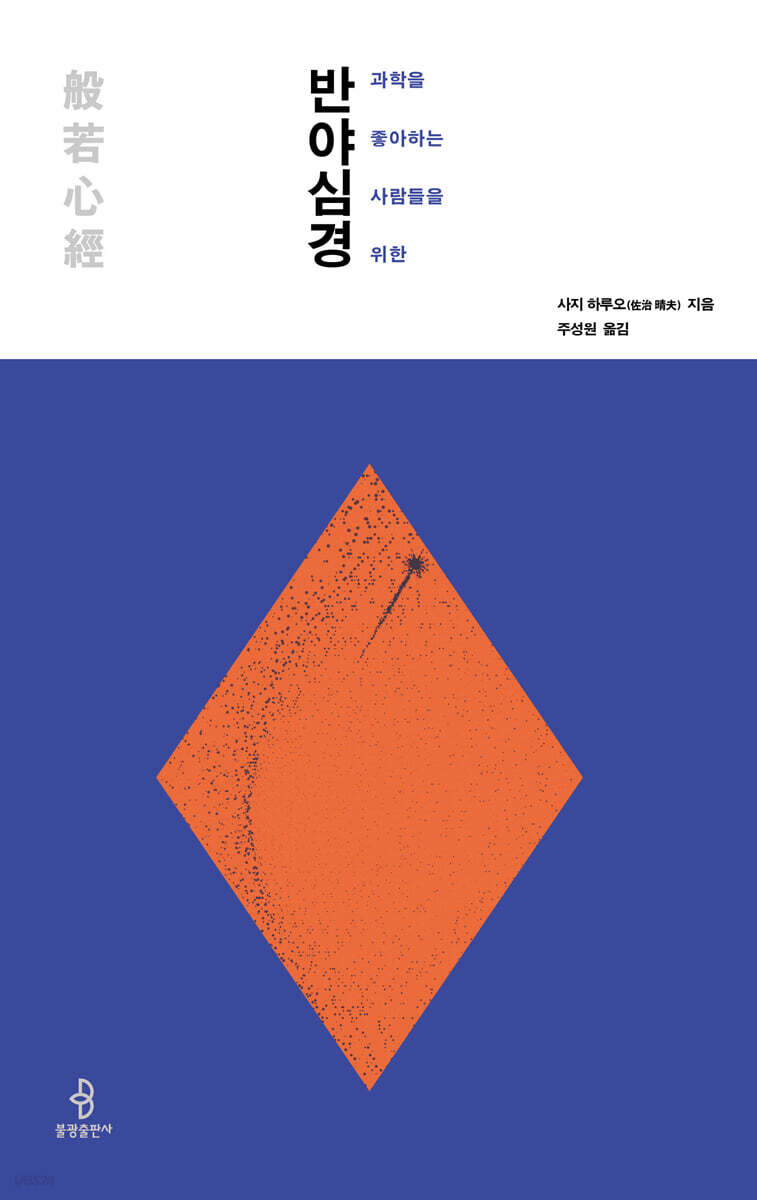
The Heart Sutra for Science Lovers
 |
Description
Book Introduction
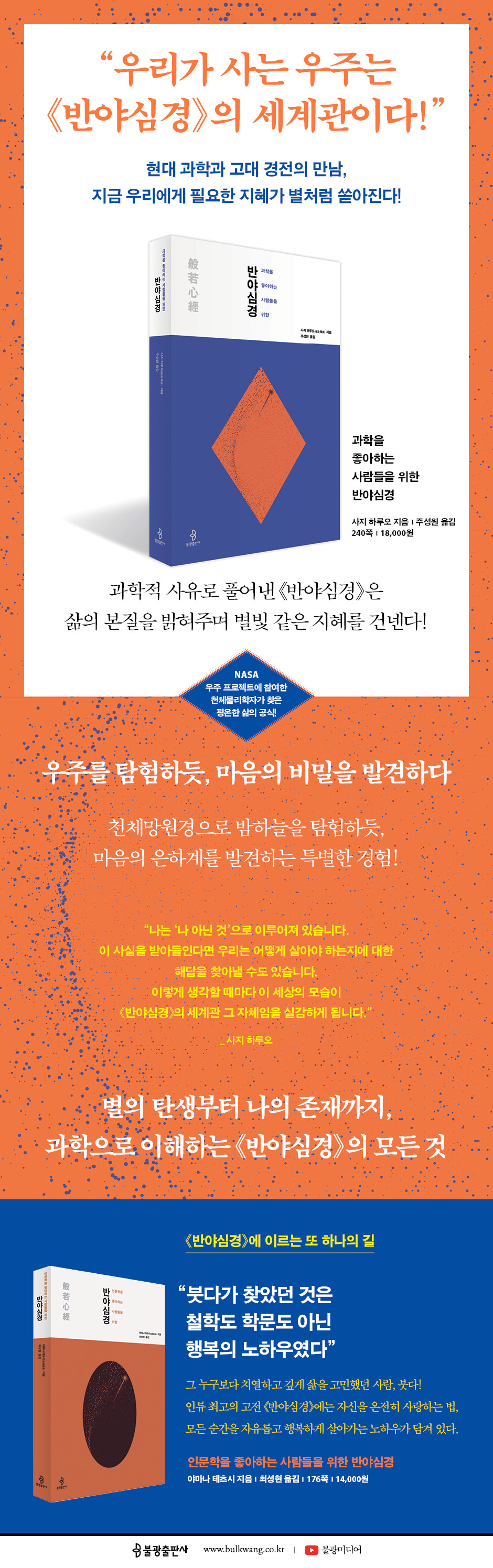
“The universe we live in is the worldview of the Heart Sutra!”
The meeting of modern science and ancient scriptures
The wisdom we need now is pouring down like stars!
Participated in NASA's Voyager project
The formula for a happy life discovered by an astrophysicist!
We reread the idea of 'emptiness', which is the core of the representative Buddhist scripture, the Heart Sutra, through the language of modern physics.
The author, who has studied the universe for many years, explains the profound teachings of the Heart Sutra in an easy-to-understand way using 'visible science' such as the birth of stars, the transformation of cells, and light.
Above all, the scientific rediscovery of the Heart Sutra is interesting.
If you follow the sentences that read smoothly, it is a series of surprising experiences.
For example, we experience a special moment when the scientific knowledge that water (H₂O) is not water itself but is made up of hydrogen (H₂) and oxygen (O) expands into the wisdom of life that 'I' am also made up of 'what is not me'.
Another appeal of this book is that the author's extensive experience and knowledge are expressed in easy-to-understand language.
The author, an educator who has given lectures at over 500 universities and elementary and middle schools for decades, is also a veteran physicist who participated in NASA's Voyager project.
The author, who has a deep artistic background and served as a visiting professor at Osaka University of Music, naturally unfolds the broad worldview of the Heart Sutra into our daily lives through a broad perspective encompassing modern science, literature, and music.
As you follow the comfortable sentences of an essay and search for traces of emptiness, you will soon find yourself discovering wisdom like starlight that brightens life.
The meeting of modern science and ancient scriptures
The wisdom we need now is pouring down like stars!
Participated in NASA's Voyager project
The formula for a happy life discovered by an astrophysicist!
We reread the idea of 'emptiness', which is the core of the representative Buddhist scripture, the Heart Sutra, through the language of modern physics.
The author, who has studied the universe for many years, explains the profound teachings of the Heart Sutra in an easy-to-understand way using 'visible science' such as the birth of stars, the transformation of cells, and light.
Above all, the scientific rediscovery of the Heart Sutra is interesting.
If you follow the sentences that read smoothly, it is a series of surprising experiences.
For example, we experience a special moment when the scientific knowledge that water (H₂O) is not water itself but is made up of hydrogen (H₂) and oxygen (O) expands into the wisdom of life that 'I' am also made up of 'what is not me'.
Another appeal of this book is that the author's extensive experience and knowledge are expressed in easy-to-understand language.
The author, an educator who has given lectures at over 500 universities and elementary and middle schools for decades, is also a veteran physicist who participated in NASA's Voyager project.
The author, who has a deep artistic background and served as a visiting professor at Osaka University of Music, naturally unfolds the broad worldview of the Heart Sutra into our daily lives through a broad perspective encompassing modern science, literature, and music.
As you follow the comfortable sentences of an essay and search for traces of emptiness, you will soon find yourself discovering wisdom like starlight that brightens life.
- You can preview some of the book's contents.
Preview
index
Chapter 1: Where am I?
'Me' as seen from space
The riddle called 'I'
Questions about existence
Buddhist worldview
Nothing goes as planned
The concept of 'emptiness'
Chapter 2: The World of the Heart Sutra
The establishment of the Heart Sutra
Sutras that permeate like a song
Freedom and Unfreedom
Reading the Heart Sutra
260-character prayer
Chapter 3: The Heart Sutra from a Modern Cosmological Perspective
Why does night exist?
Born from light
The creation of matter and 'vibration'
Neither concrete nor abstract
In a conversation between Tagore (T) and Einstein (E)
The universe born from the wind
In the fairness of the universe
The essence of beauty
At the border between reality and perception
Reality in 'Welcome'
The essence of the Heart Sutra
Chapter 4: Life and Cosmic Time
Cosmic Calendar
The grand experience called life
Number sense of 1, 2, and 3
The brain woke up to sound
The origins of religion
The beginning of humanity
The individuality of men and women
Love, trust, and wait
one's own face
Does the right age exist?
The mystery of time
'Now' to 'From now on'
Chapter 5: Life's Destination
planetarium
A life of stargazing
Why do people travel?
Hidden √2 in Japanese Culture
human-to-human relationships
Freedom to change the future
The mysterious duality of language
Things that wouldn't exist if there were no moon
365 days and 108 afflictions
The birth of Jesus
There is no such thing as first-person death
Guide to Peace
In conclusion
supplement
The Chinese version of the Heart Sutra
Korean version of the Heart Sutra
English version of the Heart Sutra
Sanskrit version of the Heart Sutra
'Me' as seen from space
The riddle called 'I'
Questions about existence
Buddhist worldview
Nothing goes as planned
The concept of 'emptiness'
Chapter 2: The World of the Heart Sutra
The establishment of the Heart Sutra
Sutras that permeate like a song
Freedom and Unfreedom
Reading the Heart Sutra
260-character prayer
Chapter 3: The Heart Sutra from a Modern Cosmological Perspective
Why does night exist?
Born from light
The creation of matter and 'vibration'
Neither concrete nor abstract
In a conversation between Tagore (T) and Einstein (E)
The universe born from the wind
In the fairness of the universe
The essence of beauty
At the border between reality and perception
Reality in 'Welcome'
The essence of the Heart Sutra
Chapter 4: Life and Cosmic Time
Cosmic Calendar
The grand experience called life
Number sense of 1, 2, and 3
The brain woke up to sound
The origins of religion
The beginning of humanity
The individuality of men and women
Love, trust, and wait
one's own face
Does the right age exist?
The mystery of time
'Now' to 'From now on'
Chapter 5: Life's Destination
planetarium
A life of stargazing
Why do people travel?
Hidden √2 in Japanese Culture
human-to-human relationships
Freedom to change the future
The mysterious duality of language
Things that wouldn't exist if there were no moon
365 days and 108 afflictions
The birth of Jesus
There is no such thing as first-person death
Guide to Peace
In conclusion
supplement
The Chinese version of the Heart Sutra
Korean version of the Heart Sutra
English version of the Heart Sutra
Sanskrit version of the Heart Sutra
Detailed image
Into the book
Stars synthesize countless elements, including life-forming substances, as they emit light. When their energy is depleted, they lose their balance and explode in a supernova, scattering debris throughout space.
Those fragments came together to create the solar system, the Earth, and all beings, including us.
Everything that exists in this universe is fundamentally the same, and there can be no independent existence.
We are simply interdependent beings who influence each other.
--- p.7
The human body is made of star fragments, or more specifically, trillions of cells.
That is, you are not made of yourself, but of something other than yourself.
That is the nature of your body.
Therefore, it is not ‘I = body’.
--- p.17
A person cannot establish himself by his own strength alone.
Because only when there is something that is not me can the existence of me be established.
This is not emotional logic.
It is a cold scientific view that the universe is composed entirely of the interdependence of matter.
--- p.18
Perhaps the true beginning of the universe came from a single, very small primordial substance.
If so, then we can think of everything that exists in this world as being connected to its source, and that the current universe is a form in which matter that branched off from the source has transformed into various forms.
--- p.22
“If you clap both hands, it makes a sound, but what sound does it make with one hand?”
What this means is that we should abandon the distinction between sound and silence, or between two hands and one hand.
For example, it could be interpreted to mean visually capturing a scene of clapping with one hand and listening for sounds that are not heard in that scene.
--- p.56
The past has already passed and does not exist, and the future has not yet arrived and does not exist.
If there is, it will only be for this moment.
But there is no room for a time called 'moment'.
Because in an instant, it becomes the past and ceases to exist.
Perhaps this 'end of the moment', which approaches me without end, is what is eternal.
That's why it's important to live this moment 100% 'accepting it as it is'.
Wouldn't that be the state of correct enlightenment?
--- p.84
The Heart Sutra does not mention why this happens, but only tells us to memorize it.
However, it is your choice whether to memorize or not, and there is no compulsion.
This is also a tolerant aspect of Buddhism, unlike other religions.
--- p.96
In a world where Hubble's law holds, we cannot specify where the center of expansion is, nor can we specify where the end of the universe is.
It is not a problem to think that the point where the expansion is being observed is itself the center of the expansion and at the same time the end of the world.
In other words, it can be said to be in line with the Buddhist concept of 'all things are without self' in the sense that there is no fixed central self and everything exists only in relationship with one another.
--- p.105
E I believe that there is an objectivity that transcends human beings.
The Pythagorean theorem is a truth that exists independently of human existence.
T Science has proven that the moon is also a phenomenon made up of countless atoms.
But it is up to human decision whether to see the mystery of light and darkness in that celestial body or to see countless atoms.
If human consciousness does not feel that it is the moon, then it is not the moon.
--- p.115~116
It's an important element in life that half things are predictable and half things are unpredictable.
If you couldn't predict tomorrow at all, you wouldn't be able to live in fear, but if you knew everything that would happen tomorrow, you wouldn't be able to live in fear either.
Even if you don't have money today, you can still be strong if tomorrow is payday, but if you know in advance that a major accident will happen at a certain time and minute tomorrow, you can't help but live in fear.
Because of this uncertainty, everything can exist, and life can exist.
The fact that half of it is predictable and half is unpredictable is an important property of nature that we have developed to survive.
--- p.128
Looking back on the evolution of life, it is a miracle that you exist here now.
The process from the moment of conception in the mother's womb to birth is like experiencing the process of cosmic evolution once again.
A helpless human being born like that is raised with the help of his parents and many others.
We humans cannot survive without the help of other beings.
But if you think about it, among mammals, we humans are the only ones who can give purely without any reward.
Amazingly, evolution has given us that ability.
Perhaps here lies the answer to how we should live.
--- p.149
Now let's explain how physics views time.
If you throw a ball vertically, it will initially rise quickly, then pause briefly at the highest point before falling.
At first it falls slowly, but gradually its speed increases, and when it reaches the ground it reaches the same speed as when it was thrown upwards.
If you film this process with a video camera and play it back in reverse, the rise and fall are exactly the same and cannot be distinguished from the video played in chronological order.
In other words, in physics, especially in the field of dynamics, which studies motion and forces, there is no absolute distinction between past and future time.
--- p.174
We say we 'see' or 'look at' stars, but when we look at stars, our brain functions differently than when we look at flowers or landscapes.
When you look at a flower, you capture the whole thing visually, whereas looking at a star means that your pupils are precisely aligned with the light that started from that star in the distant past.
You could say that this is a direct contact between you, the vast universe and its products.
Those fragments came together to create the solar system, the Earth, and all beings, including us.
Everything that exists in this universe is fundamentally the same, and there can be no independent existence.
We are simply interdependent beings who influence each other.
--- p.7
The human body is made of star fragments, or more specifically, trillions of cells.
That is, you are not made of yourself, but of something other than yourself.
That is the nature of your body.
Therefore, it is not ‘I = body’.
--- p.17
A person cannot establish himself by his own strength alone.
Because only when there is something that is not me can the existence of me be established.
This is not emotional logic.
It is a cold scientific view that the universe is composed entirely of the interdependence of matter.
--- p.18
Perhaps the true beginning of the universe came from a single, very small primordial substance.
If so, then we can think of everything that exists in this world as being connected to its source, and that the current universe is a form in which matter that branched off from the source has transformed into various forms.
--- p.22
“If you clap both hands, it makes a sound, but what sound does it make with one hand?”
What this means is that we should abandon the distinction between sound and silence, or between two hands and one hand.
For example, it could be interpreted to mean visually capturing a scene of clapping with one hand and listening for sounds that are not heard in that scene.
--- p.56
The past has already passed and does not exist, and the future has not yet arrived and does not exist.
If there is, it will only be for this moment.
But there is no room for a time called 'moment'.
Because in an instant, it becomes the past and ceases to exist.
Perhaps this 'end of the moment', which approaches me without end, is what is eternal.
That's why it's important to live this moment 100% 'accepting it as it is'.
Wouldn't that be the state of correct enlightenment?
--- p.84
The Heart Sutra does not mention why this happens, but only tells us to memorize it.
However, it is your choice whether to memorize or not, and there is no compulsion.
This is also a tolerant aspect of Buddhism, unlike other religions.
--- p.96
In a world where Hubble's law holds, we cannot specify where the center of expansion is, nor can we specify where the end of the universe is.
It is not a problem to think that the point where the expansion is being observed is itself the center of the expansion and at the same time the end of the world.
In other words, it can be said to be in line with the Buddhist concept of 'all things are without self' in the sense that there is no fixed central self and everything exists only in relationship with one another.
--- p.105
E I believe that there is an objectivity that transcends human beings.
The Pythagorean theorem is a truth that exists independently of human existence.
T Science has proven that the moon is also a phenomenon made up of countless atoms.
But it is up to human decision whether to see the mystery of light and darkness in that celestial body or to see countless atoms.
If human consciousness does not feel that it is the moon, then it is not the moon.
--- p.115~116
It's an important element in life that half things are predictable and half things are unpredictable.
If you couldn't predict tomorrow at all, you wouldn't be able to live in fear, but if you knew everything that would happen tomorrow, you wouldn't be able to live in fear either.
Even if you don't have money today, you can still be strong if tomorrow is payday, but if you know in advance that a major accident will happen at a certain time and minute tomorrow, you can't help but live in fear.
Because of this uncertainty, everything can exist, and life can exist.
The fact that half of it is predictable and half is unpredictable is an important property of nature that we have developed to survive.
--- p.128
Looking back on the evolution of life, it is a miracle that you exist here now.
The process from the moment of conception in the mother's womb to birth is like experiencing the process of cosmic evolution once again.
A helpless human being born like that is raised with the help of his parents and many others.
We humans cannot survive without the help of other beings.
But if you think about it, among mammals, we humans are the only ones who can give purely without any reward.
Amazingly, evolution has given us that ability.
Perhaps here lies the answer to how we should live.
--- p.149
Now let's explain how physics views time.
If you throw a ball vertically, it will initially rise quickly, then pause briefly at the highest point before falling.
At first it falls slowly, but gradually its speed increases, and when it reaches the ground it reaches the same speed as when it was thrown upwards.
If you film this process with a video camera and play it back in reverse, the rise and fall are exactly the same and cannot be distinguished from the video played in chronological order.
In other words, in physics, especially in the field of dynamics, which studies motion and forces, there is no absolute distinction between past and future time.
--- p.174
We say we 'see' or 'look at' stars, but when we look at stars, our brain functions differently than when we look at flowers or landscapes.
When you look at a flower, you capture the whole thing visually, whereas looking at a star means that your pupils are precisely aligned with the light that started from that star in the distant past.
You could say that this is a direct contact between you, the vast universe and its products.
--- p.187
Publisher's Review
Modern science meets ancient scriptures
The Heart Sutra, reinterpreted by an astrophysicist
Science that sees the universe, Buddhism that opens the mind
Modern physicists say that the universe is not a rigid entity, but a constantly changing web of relationships.
As stars are born and die, and atoms and particles collide and change, the world is renewed every moment.
Surprisingly, this idea is consistent with the idea of 'emptiness' that Buddha realized 2,600 years ago.
Just as scientists like Einstein and Carlo Rovelli had already noted the intersection of Buddhism and science, Haruo Saji, a Japanese astrophysicist who worked at NASA, also realized after extensive research that the Heart Sutra was not simply a religious text, but a worldview that explains the universe.
The Heart Sutra is the most widely read sutra in Buddhism, but it is only 260 characters long.
But it contains the immense wisdom that all beings depend on and are connected to one another.
It is not easy to understand the depth in short sentences.
Many people know the phrase “color is emptiness, emptiness is color,” but they find it difficult to explain.
This book explains difficult passages using scientific examples.
Through the process of star birth, the life phenomenon of cells constantly being replaced, and the property of light existing as both particles and waves, readers confirm the truth of the Heart Sutra through visible science.
For example, just as we come to know that water (H₂O) is not water itself but is made up of hydrogen and oxygen, we also come to realize that the existence of 'me' is made up of numerous relationships and conditions.
“What am I made of?”
This book constantly poses questions to the reader.
“My body is changing every day, so why am I still ‘me’?”
“If everything depends on each other to exist, then what is the true ‘self’?”
Buddhism tells us through the law of dependent origination that 'I' do not exist alone, but are connected to everything around me.
Air, water, food, family and friends, society and nature.
The being called 'I' is actually a collection of 'things that are not me'.
Modern physics tells the same story.
Everything in the universe does not exist alone, but rather influences and changes with each other.
Saji Haruo shows that scientific questions and Buddhist answers can be connected.
Science explains how matter changes, but it cannot give a fundamental answer as to why it happens.
Buddhism fills that void.
The Buddha logically explored the human mind and way of being, explaining how to understand the world and escape suffering.
The book tells the reader, “The way to know the universe is the way to know yourself.”
Therefore, 『The Heart Sutra for Science Lovers』 is not simply a textbook, but a guidebook that helps you understand yourself and the world at the same time.
In a rapidly changing world and facing an uncertain future, this book will provide readers with peace of mind and the wisdom to live together with others.
Wisdom like starlight, here and now
Saji Haruo is not just a scientist in a lab.
He taught countless students from his university lectures and visited over 500 elementary and middle schools to share stories of the universe with children. He also carried Bach's music on board NASA's Voyager spacecraft, and served as a visiting professor at Osaka University of Music.
His career, which spans not only science but also music and art, is revealed throughout the book.
So this book is not difficult.
It reads smoothly like a warm essay, and the short poems and metaphors interspersed between the explanations help to understand the content.
It is written in language that is easy enough for even a middle school student to understand, but it leaves a deep resonance that lingers in the heart after reading it.
Even those unfamiliar with philosophical concepts or Buddhist terminology can naturally recall the Heart Sutra through everyday images such as starlight in the night sky or sunlight shining through a window.
If 『Heart Sutra for People Who Love the Humanities』 rereads the sutra in the language of the humanities, this 『Heart Sutra for People Who Love Science』 shows the wisdom of prajna in the language of science.
It is accessible not only to 'science-savvy readers' familiar with science, but also to all readers who find the scriptures difficult.
Above all, this book gives you the strength to endure life right now.
It helps us guard our hearts in uncertain times and let go of anxiety and obsession.
The message of the Heart Sutra, “When we accept things as they are and let go of attachments, suffering disappears on its own,” is still valid for us living today.
When life feels bleak and full of suffering, "The Heart Sutra for Science Lovers" will be a starlight of wisdom that illuminates the reader's side.
The Heart Sutra, reinterpreted by an astrophysicist
Science that sees the universe, Buddhism that opens the mind
Modern physicists say that the universe is not a rigid entity, but a constantly changing web of relationships.
As stars are born and die, and atoms and particles collide and change, the world is renewed every moment.
Surprisingly, this idea is consistent with the idea of 'emptiness' that Buddha realized 2,600 years ago.
Just as scientists like Einstein and Carlo Rovelli had already noted the intersection of Buddhism and science, Haruo Saji, a Japanese astrophysicist who worked at NASA, also realized after extensive research that the Heart Sutra was not simply a religious text, but a worldview that explains the universe.
The Heart Sutra is the most widely read sutra in Buddhism, but it is only 260 characters long.
But it contains the immense wisdom that all beings depend on and are connected to one another.
It is not easy to understand the depth in short sentences.
Many people know the phrase “color is emptiness, emptiness is color,” but they find it difficult to explain.
This book explains difficult passages using scientific examples.
Through the process of star birth, the life phenomenon of cells constantly being replaced, and the property of light existing as both particles and waves, readers confirm the truth of the Heart Sutra through visible science.
For example, just as we come to know that water (H₂O) is not water itself but is made up of hydrogen and oxygen, we also come to realize that the existence of 'me' is made up of numerous relationships and conditions.
“What am I made of?”
This book constantly poses questions to the reader.
“My body is changing every day, so why am I still ‘me’?”
“If everything depends on each other to exist, then what is the true ‘self’?”
Buddhism tells us through the law of dependent origination that 'I' do not exist alone, but are connected to everything around me.
Air, water, food, family and friends, society and nature.
The being called 'I' is actually a collection of 'things that are not me'.
Modern physics tells the same story.
Everything in the universe does not exist alone, but rather influences and changes with each other.
Saji Haruo shows that scientific questions and Buddhist answers can be connected.
Science explains how matter changes, but it cannot give a fundamental answer as to why it happens.
Buddhism fills that void.
The Buddha logically explored the human mind and way of being, explaining how to understand the world and escape suffering.
The book tells the reader, “The way to know the universe is the way to know yourself.”
Therefore, 『The Heart Sutra for Science Lovers』 is not simply a textbook, but a guidebook that helps you understand yourself and the world at the same time.
In a rapidly changing world and facing an uncertain future, this book will provide readers with peace of mind and the wisdom to live together with others.
Wisdom like starlight, here and now
Saji Haruo is not just a scientist in a lab.
He taught countless students from his university lectures and visited over 500 elementary and middle schools to share stories of the universe with children. He also carried Bach's music on board NASA's Voyager spacecraft, and served as a visiting professor at Osaka University of Music.
His career, which spans not only science but also music and art, is revealed throughout the book.
So this book is not difficult.
It reads smoothly like a warm essay, and the short poems and metaphors interspersed between the explanations help to understand the content.
It is written in language that is easy enough for even a middle school student to understand, but it leaves a deep resonance that lingers in the heart after reading it.
Even those unfamiliar with philosophical concepts or Buddhist terminology can naturally recall the Heart Sutra through everyday images such as starlight in the night sky or sunlight shining through a window.
If 『Heart Sutra for People Who Love the Humanities』 rereads the sutra in the language of the humanities, this 『Heart Sutra for People Who Love Science』 shows the wisdom of prajna in the language of science.
It is accessible not only to 'science-savvy readers' familiar with science, but also to all readers who find the scriptures difficult.
Above all, this book gives you the strength to endure life right now.
It helps us guard our hearts in uncertain times and let go of anxiety and obsession.
The message of the Heart Sutra, “When we accept things as they are and let go of attachments, suffering disappears on its own,” is still valid for us living today.
When life feels bleak and full of suffering, "The Heart Sutra for Science Lovers" will be a starlight of wisdom that illuminates the reader's side.
GOODS SPECIFICS
- Date of issue: August 25, 2025
- Page count, weight, size: 240 pages | 308g | 121*190*20mm
- ISBN13: 9791172611972
- ISBN10: 1172611971
You may also like
카테고리
korean


korean

![GQ KOREA Mark (Monthly): December [2025]](http://librairie.coreenne.fr/cdn/shop/files/8ef265dbbfbf186523ed75ba7319009d.jpg?v=1765340328&width=3840)


